アミノ酸は蛋白の部品であるだけではない。神経伝達物質・ホルモン・色素・血管作動物質——体内の情報伝達を担う分子の多くが、特定のアミノ酸から数段階で作られる。
ここを押さえておくと、薬理学の大半が「経路のどこを止めるか」の話に見えてくる。そして欠乏症・代謝異常症の症状も、作れなくなった物質から逆算できる。
- チロシンから — カテコラミン・甲状腺ホルモン・メラニン
- トリプトファンとヒスチジン — セロトニン・ナイアシン・ヒスタミン
- アルギニンとグリシン — 一酸化窒素・クレアチン・ヘム
- グルタミン酸と GABA — 興奮と抑制が、1つの脱炭酸でつながっている
- ヒスタミンと、それを壊す酵素 — 食中毒と薬が交差する場所
チロシンから — カテコラミン・甲状腺ホルモン・メラニン
チロシンは3系統の出発点である。
1. カテコラミン
チロシン →(チロシン水酸化酵素、律速)→ ドパ →(ドパ脱炭酸酵素)→ ドパミン →(ドパミンβ水酸化酵素)→ ノルアドレナリン →(フェニルエタノールアミンN-メチル基転移酵素)→ アドレナリン
2. 甲状腺ホルモン
サイログロブリン上のチロシン残基にヨウ素が結合し、2つが縮合してT₄・T₃になる
3. メラニン
チロシン →(チロシナーゼ)→ ドパキノン → メラニン
- フェニルエタノールアミンN-メチル基転移酵素は副腎髄質にしかない(コルチゾールが誘導する)。だからアドレナリンを作れるのは副腎髄質だけ
- チロシナーゼの欠損が眼皮膚白皮症I型
- 分解はモノアミン酸化酵素とカテコールO-メチル基転移酵素。代謝産物がバニリルマンデル酸・メタネフリン
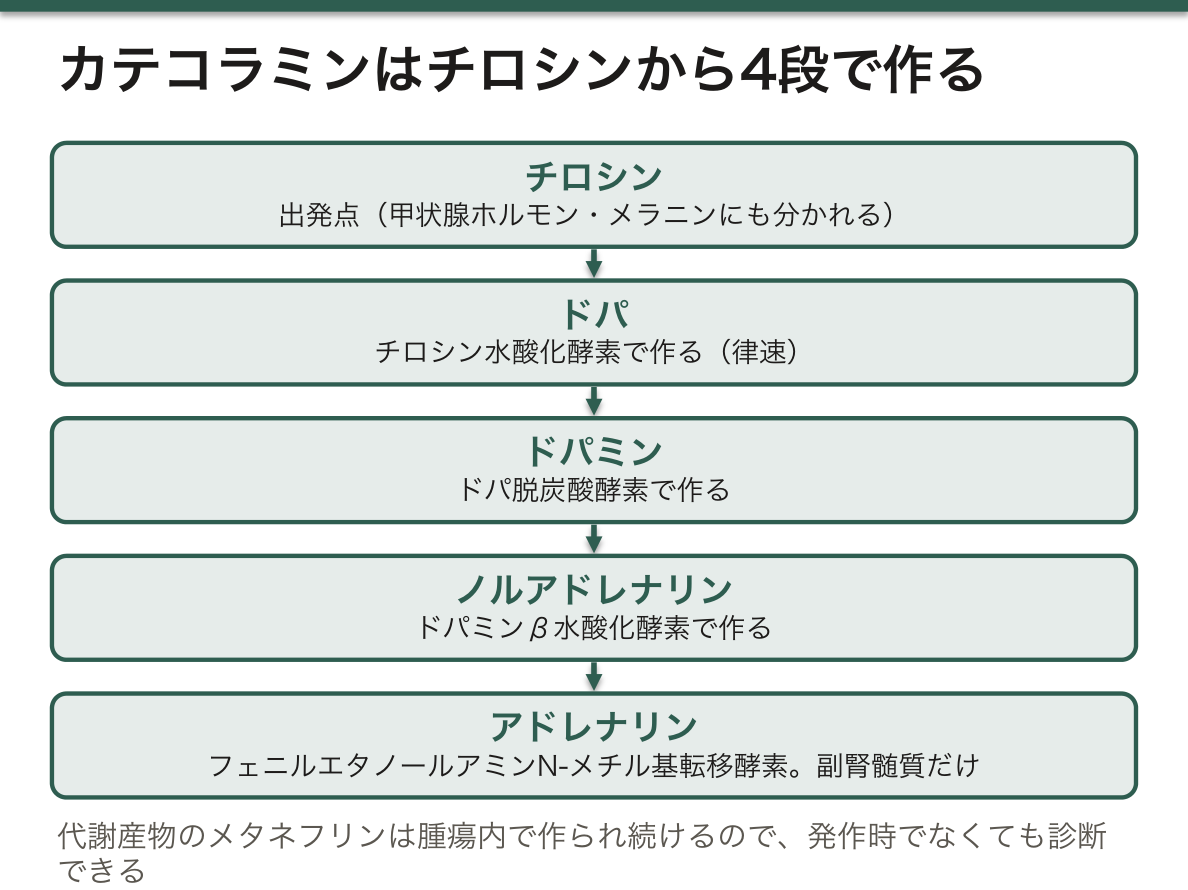
副腎髄質にしかない酵素がある、という事実が診断に直結する。褐色細胞腫が副腎内にあればアドレナリンも分泌するが、副腎外(傍神経節腫)ではノルアドレナリンが主体になる。コルチゾールが門脈様の血流で髄質へ高濃度に届くことが、この酵素の発現条件だからである。
診断にはメタネフリンを測るのが原則で、理由はカテコラミン自体は分泌が発作性で、採血した瞬間に出ているとは限らないのに対し、メタネフリンは腫瘍内で持続的に産生され続けるためである。「発作時に採れなくても診断できる」——ここが要点になる。
薬の作用点も同じ図の上に置ける。
- レボドパ——ドパミンは血液脳関門を通れないが、前駆体のドパは通れる。末梢での脱炭酸を防ぐためカルビドパを併用する
- αメチルドパ——偽の伝達物質を作らせる。妊娠高血圧で今も使われる
- メチロシン——チロシン水酸化酵素を阻害。褐色細胞腫の術前に用いる
- モノアミン酸化酵素阻害薬+チラミン——チーズや赤ワインのチラミンが分解されず高血圧クリーゼ
アルカプトン尿症はチロシン分解側の異常で、ホモゲンチジン酸酸化酵素の欠損により尿が放置すると黒くなる。成人期に軟骨の黒色沈着(組織黒変症)と関節症を起こす——小児期は無症状に近いため、成人の変形性関節症として現れる。
English version
Core
Tyrosine is the starting point of three lines.
1. Catecholamines
Tyrosine → (tyrosine hydroxylase, rate-limiting) → DOPA → (DOPA decarboxylase) → dopamine → (dopamine β-hydroxylase) → noradrenaline → (phenylethanolamine N-methyltransferase) → adrenaline
2. Thyroid hormone
Iodine is attached to tyrosine residues on thyroglobulin and two condense to give T₄ and T₃.
3. Melanin
Tyrosine → (tyrosinase) → dopaquinone → melanin
- Phenylethanolamine N-methyltransferase is present only in the adrenal medulla (induced by cortisol). So only the adrenal medulla can make adrenaline.
- Tyrosinase deficiency is oculocutaneous albinism type I.
- Degradation is by monoamine oxidase and catechol-O-methyltransferase; the metabolites are vanillylmandelic acid and metanephrines.
Going further
The fact that one enzyme exists only in the adrenal medulla bears directly on diagnosis. A phaeochromocytoma within the adrenal secretes adrenaline as well; an extra-adrenal paraganglioma secretes chiefly noradrenaline — because the high concentration of cortisol reaching the medulla by a portal-like circulation is the condition for expressing that enzyme.
The rule is to measure the metanephrines, because catecholamine secretion is paroxysmal and may not be occurring at the moment of venepuncture, whereas metanephrines are produced continuously within the tumour. Here is the point — it can be diagnosed even if the sample cannot be taken during an attack.
The drugs sit on the same diagram.
- Levodopa — dopamine cannot cross the blood–brain barrier but its precursor DOPA can. Carbidopa is added to prevent peripheral decarboxylation.
- α-methyldopa — has a false transmitter made. Still used in hypertension of pregnancy.
- Metyrosine — inhibits tyrosine hydroxylase. Used before surgery for phaeochromocytoma.
- MAO inhibitor + tyramine — the tyramine of cheese and red wine is not degraded and a hypertensive crisis follows.
Alkaptonuria is a defect on the degradative side, homogentisate oxidase deficiency, in which the urine blackens on standing. In adult life it causes black deposition in cartilage (ochronosis) and an arthropathy — being nearly asymptomatic in childhood, it presents as osteoarthritis in the adult.
トリプトファンとヒスチジン — セロトニン・ナイアシン・ヒスタミン
トリプトファンの2つの行き先。
- セロトニン経路:トリプトファン →(トリプトファン水酸化酵素)→ 5ヒドロキシトリプトファン → セロトニン → メラトニン(松果体)。代謝産物は5ヒドロキシインドール酢酸
- キヌレニン経路:ナイアシン(ニコチンアミド)へ。トリプトファン60 mgからナイアシン1 mg。この変換にビタミンB6が要る
ヒスチジン →(ヒスチジン脱炭酸酵素、ビタミンB6依存)→ ヒスタミン
- カルチノイド症候群——腫瘍がトリプトファンをセロトニンへ大量に消費し、ナイアシン欠乏(ペラグラ)を併発しうる
- Hartnup病——中性アミノ酸の輸送体異常。トリプトファンが吸収されずペラグラ様症状
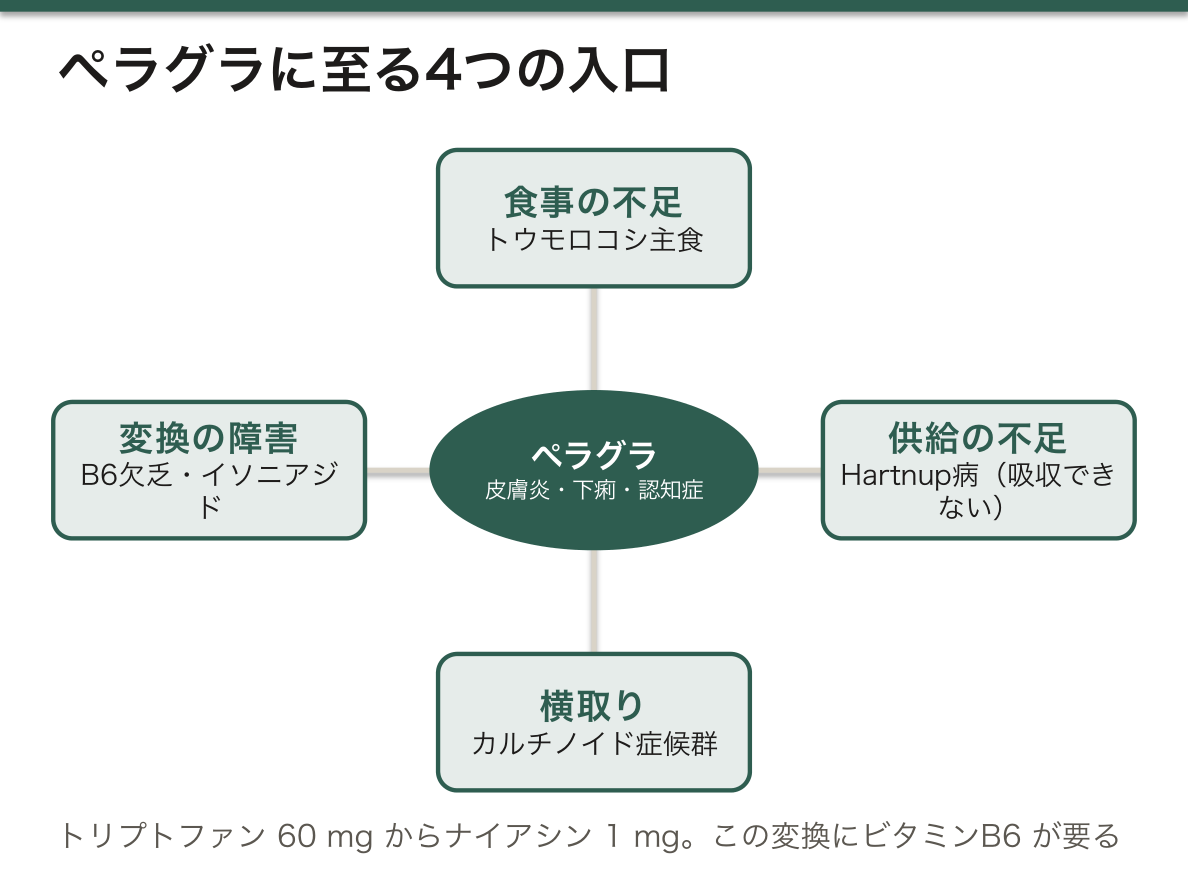
ペラグラの3徴(皮膚炎・下痢・認知症)が「トリプトファンの病気」として現れうる——この構図を掴んでおくと、栄養素の欠乏を食事だけで考えなくなる。
- 食事のナイアシン不足——トウモロコシ主食(結合型で吸収されない)
- トリプトファンの供給不足——Hartnup病
- トリプトファンの横取り——カルチノイド症候群
- 変換の障害——ビタミンB6欠乏。イソニアジドはビタミンB6を消費するので、結核治療中にペラグラ様症状と末梢神経障害が出うる
イソニアジドにピリドキシンを併用する理由が、ここで生化学として理解できる。単なる慣習ではなく、キヌレニン経路と神経伝達物質合成の両方を守っている。
カルチノイド症候群の症状も経路から出る。皮膚紅潮・下痢・喘鳴・右心系の弁膜症——セロトニンなどの血管作動物質による。右心系だけが侵されるのは、肺でモノアミン酸化酵素により分解されるため左心系へは届かないからである。肺転移があると左心系も侵される——例外もまた機序どおりになる。
ヒスタミンの分解はジアミン酸化酵素とヒスタミンN-メチル基転移酵素が担う。サバなどの青魚が細菌でヒスチジンからヒスタミンを作るとヒスタミン食中毒になり、加熱しても分解されない。抗ヒスタミン薬が効き、アレルギーではない——問診で区別できる。
English version
Core
Tryptophan has two destinations.
- The serotonin route: tryptophan → (tryptophan hydroxylase) → 5-hydroxytryptophan → serotonin → melatonin (pineal). The metabolite is 5-HIAA.
- The kynurenine route: to niacin (nicotinamide). 60 mg of tryptophan gives 1 mg of niacin, and the conversion requires vitamin B6.
Histidine → (histidine decarboxylase, B6-dependent) → histamine.
- Carcinoid syndrome — the tumour consumes tryptophan for serotonin in quantity and niacin deficiency (pellagra) may accompany it.
- Hartnup disease — a defect of the neutral amino acid transporter; tryptophan is not absorbed and pellagra-like symptoms follow.
Going further
That the triad of pellagra (dermatitis, diarrhoea, dementia) can present as a disease of tryptophan — grasp this pattern and you stop thinking of nutrient deficiency in terms of diet alone.
- Too little niacin in the diet — a maize staple (bound and unabsorbable).
- Too little tryptophan supplied — Hartnup disease.
- Tryptophan diverted — carcinoid syndrome.
- The conversion blocked — vitamin B6 deficiency. Isoniazid consumes B6, so pellagra-like symptoms and peripheral neuropathy can appear during treatment for tuberculosis.
The reason pyridoxine is given with isoniazid can be understood here as biochemistry. It is not mere custom: it protects both the kynurenine pathway and the synthesis of neurotransmitters.
The symptoms of carcinoid syndrome come out of the pathway too. Flushing, diarrhoea, wheeze and right-sided valve disease — from serotonin and other vasoactive substances. Only the right heart is affected because monoamine oxidase in the lung degrades them before they reach the left. With pulmonary metastases the left heart is affected too — the exception also follows the mechanism.
Histamine is degraded by diamine oxidase and histamine N-methyltransferase. When bacteria make histamine from histidine in oily fish, histamine (scombroid) poisoning results, and heating does not destroy it. Antihistamines work and it is not an allergy — the history distinguishes them.
アルギニンとグリシン — 一酸化窒素・クレアチン・ヘム
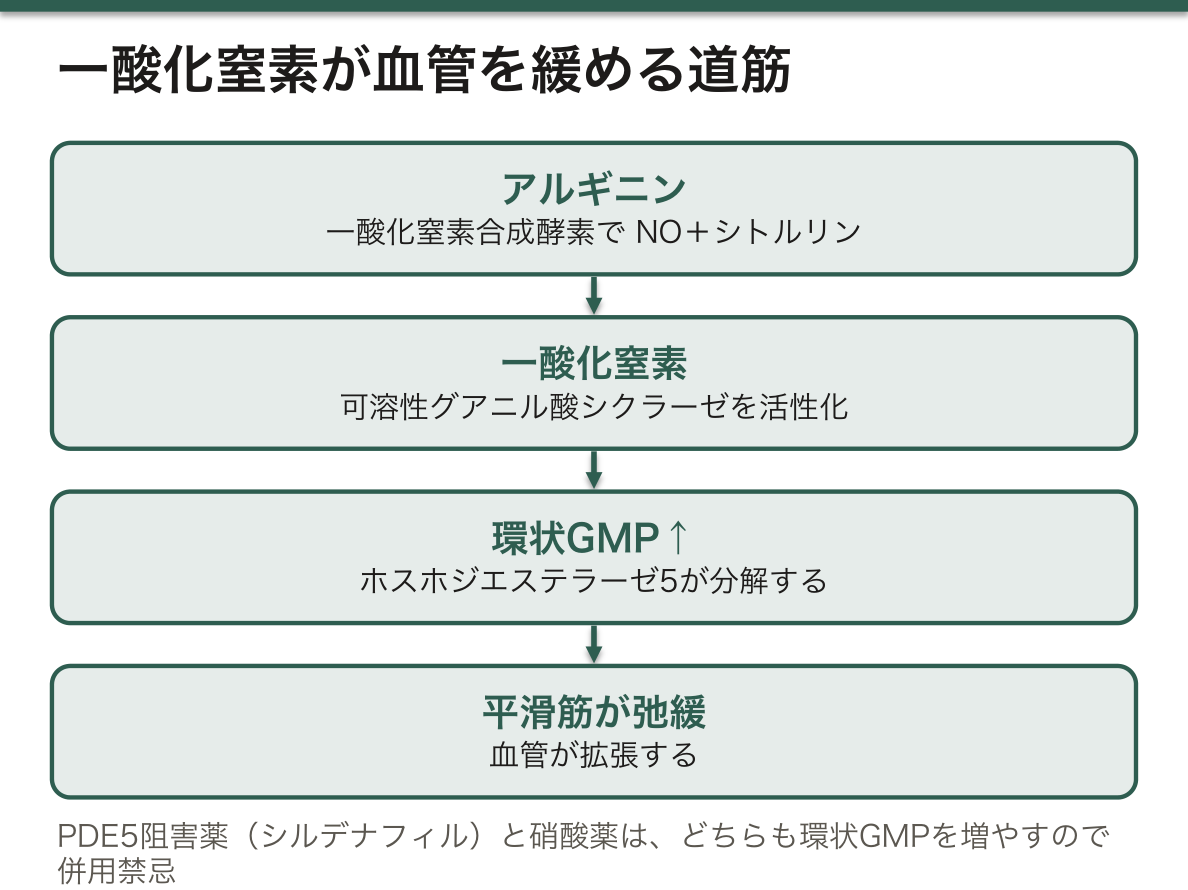
アルギニン →(一酸化窒素合成酵素)→ 一酸化窒素+シトルリン
- 一酸化窒素は可溶性グアニル酸シクラーゼを活性化し、環状GMPを増やして血管平滑筋を弛緩させる
- ホスホジエステラーゼ5阻害薬(シルデナフィル)は環状GMPの分解を止める
- 硝酸薬は一酸化窒素を外から供給する。だから両者の併用は禁忌
グリシン+アルギニン → グアニジノ酢酸 →(メチル化)→ クレアチン → クレアチンリン酸
- クレアチンは非酵素的に一定割合が壊れてクレアチニンになる。だから産生量が筋肉量に比例し、腎機能の指標として使える
グリシン+スクシニルCoA → δアミノレブリン酸 → ヘム(ビタミンと補酵素の章)
クレアチニンが腎機能の指標になる条件を、生化学から確認しておく。
- 産生が一定——筋肉量に比例する。だから高齢者・るいそう・四肢麻痺では低く出て、腎機能を過大評価する
- 糸球体で濾過され、再吸収されない——ただし約10〜20%は尿細管から分泌されるので、クレアチニンクリアランスは糸球体濾過量をやや過大に見積もる
- 分泌を阻害する薬がある——シメチジン・トリメトプリム。腎機能は変わっていないのに血清クレアチニンだけ上がる
シスタチンCが代替になるのは、全有核細胞が一定速度で産生し、筋肉量に依存しないためである。ただしステロイドと甲状腺機能で変動する。
一酸化窒素の合成酵素には3種類ある。神経型と内皮型は常時少量を作り(カルシウム依存性)、誘導型はサイトカインで誘導され大量に作る(カルシウム非依存性)。敗血症性ショックの血管拡張は誘導型による大量の一酸化窒素が主因である——だから昇圧薬が効きにくい。
アルギニンは尿素回路の一部でもある。尿素回路異常症では、しばしばアルギニンが必須アミノ酸になる(作れなくなるため)——だから治療にアルギニンを補充する。1つのアミノ酸が複数の系にまたがることの実例である。
English version
Core
Arginine → (nitric oxide synthase) → nitric oxide + citrulline
- Nitric oxide activates soluble guanylate cyclase, raises cGMP and relaxes vascular smooth muscle.
- Phosphodiesterase 5 inhibitors (sildenafil) stop the breakdown of cGMP.
- Nitrates supply nitric oxide from outside — hence the combination is contraindicated.
Glycine + arginine → guanidinoacetate → (methylation) → creatine → creatine phosphate
- A fixed proportion of creatine breaks down non-enzymatically to creatinine. So the amount produced is proportional to muscle mass and can serve as an index of renal function.
Glycine + succinyl-CoA → δ-aminolaevulinic acid → haem
Going further
Confirm from the biochemistry the conditions under which creatinine serves as an index of renal function.
- Production is constant — proportional to muscle mass. So in the elderly, the wasted and the tetraplegic it reads low and overestimates renal function.
- Filtered at the glomerulus and not reabsorbed — but 10–20 per cent is secreted by the tubule, so creatinine clearance somewhat overestimates the GFR.
- Some drugs inhibit that secretion — cimetidine, trimethoprim. The serum creatinine alone rises with no change in renal function.
Cystatin C serves as an alternative because every nucleated cell produces it at a constant rate and it does not depend on muscle mass. But it varies with steroids and with thyroid function.
There are three nitric oxide synthases. The neuronal and endothelial forms make small amounts continuously (calcium-dependent); the inducible form is induced by cytokines and makes large amounts (calcium-independent). The vasodilatation of septic shock is chiefly due to that large amount of nitric oxide from the inducible form — hence vasopressors work poorly.
Arginine is also part of the urea cycle. In the urea cycle disorders it often becomes an essential amino acid (since it can no longer be made) — hence arginine is supplemented in treatment. An instance of one amino acid spanning several systems.
グルタミン酸と GABA — 興奮と抑制が、1つの脱炭酸でつながっている
中枢神経の主要な興奮性伝達物質がグルタミン酸、主要な抑制性伝達物質が GABA になる。
GABA は、グルタミン酸脱炭酸酵素(GAD)が二酸化炭素を1つ外して作る——補酵素はビタミンB6(ピリドキサールリン酸)。
| 受容体 | 型 | 動くイオン | 効く薬 |
|---|---|---|---|
| GABA-A | イオンチャネル型 | Cl⁻ 流入 → 過分極 | ベンゾジアゼピン・バルビツール酸・エタノール・全身麻酔薬 |
| GABA-B | Gタンパク質共役型 | K⁺ 流出・Ca²⁺ 抑制 | バクロフェン |
| NMDA(グルタミン酸) | イオンチャネル型 | Ca²⁺ 流入 | ケタミン・メマンチン |
グルタミン酸はグルタミンとして星状膠細胞から供給される(グルタミン・グルタミン酸回路)。
「1つの脱炭酸で、興奮性が抑制性に変わる」ことが、ビタミンB6 の重要さを作っている。B6 が欠乏すると GABA が作れず、けいれんが起こる(水溶性ビタミンの章)——「イソニアジド中毒のけいれんに、ピリドキシンが解毒薬になる理由がここにある」。
ビタミンB6 依存性てんかんは、新生児の難治性けいれんで必ず考える(抗てんかん薬の章)——「抗けいれん薬が効かず、ピリドキシンの静注で止まる」。
GABA-A がイオンチャネル型であることは、薬の作用の速さを決めている(シグナル伝達の章)——「第二伝令を挟まないので、秒で効く」。
同じ受容体に多くの薬が結合することが、相加的な危険を生む(中枢神経作用薬の章)——「ベンゾジアゼピンと飲酒とオピオイドの併用で、呼吸が止まる」。
グルタミン酸の過剰は、興奮毒性として細胞を殺す(細胞傷害の章)——「虚血で放出されたグルタミン酸が NMDA 受容体を開き、カルシウムが流入する」。
English version
Core
The principal excitatory transmitter of the central nervous system is glutamate and the principal inhibitory transmitter GABA. GABA is made by glutamate decarboxylase (GAD) removing one carbon dioxide — with vitamin B6 (pyridoxal phosphate) as coenzyme.
| Receptor | Type | Ion | Drugs |
|---|---|---|---|
| GABA-A | Ion channel | Cl⁻ in → hyperpolarisation | Benzodiazepines, barbiturates, ethanol, general anaesthetics |
| GABA-B | G protein-coupled | K⁺ out, Ca²⁺ suppressed | Baclofen |
| NMDA (glutamate) | Ion channel | Ca²⁺ in | Ketamine, memantine |
Glutamate is supplied as glutamine from astrocytes (the glutamine–glutamate cycle).
Going further
That one decarboxylation turns an excitatory transmitter into an inhibitory one is what makes vitamin B6 so important. Without B6, GABA cannot be made and seizures occur — here is why pyridoxine is the antidote to the seizures of isoniazid poisoning.
Pyridoxine-dependent epilepsy must always be considered in intractable neonatal seizures — anticonvulsants do not work and intravenous pyridoxine stops it.
That GABA-A is an ion channel decides the speed of the drugs — with no second messenger interposed, they act in seconds.
That many drugs bind the same receptor creates an additive danger — combine a benzodiazepine with alcohol and an opioid and breathing stops.
An excess of glutamate kills cells as excitotoxicity — glutamate released in ischaemia opens the NMDA receptor and calcium floods in.
ヒスタミンと、それを壊す酵素 — 食中毒と薬が交差する場所
ヒスチジンから、ヒスチジン脱炭酸酵素(ビタミンB6 が要る)で作られる。
貯えられている場所——肥満細胞・好塩基球の顆粒・胃の ECL 細胞・視床下部の神経。
| 受容体 | 働き | 薬 |
|---|---|---|
| H1 | 血管透過性↑・気管支収縮・掻痒・血管拡張 | 抗ヒスタミン薬 |
| H2 | 胃酸分泌 | H2 遮断薬 |
| H3 | 中枢での放出の抑制 | — |
| H4 | 免疫細胞の遊走 | — |
壊す酵素は2つ——ジアミンオキシダーゼ(腸管・腎で、体外から来たヒスタミンを処理)と、ヒスタミン-N-メチル基転移酵素(細胞内で、自分が作ったものを処理)。
「外から来るヒスタミンを、腸の酵素が処理している」ことが、ヒスタミン食中毒を説明する。不適切に保存された赤身魚で、細菌がヒスチジンをヒスタミンに変える(食の安全の章)——「加熱しても壊れないので、鮮度の管理でしか防げない」。
症状はアレルギーそっくりになるが、免疫が関わっていない(アレルギーの章)——「同じ魚を食べた全員に出る、という点が鑑別になる。抗ヒスタミン薬が効く」。
ジアミンオキシダーゼを阻害する薬があると、症状が強く出る(相互作用の章)——「イソニアジドが、この酵素も阻害する」。
H1 遮断薬の眠気は、中枢のヒスタミンが覚醒に関わることの裏返しになる(睡眠の章)——「第1世代は血液脳関門を通るので眠くなる。第2世代は通りにくい」。
肥満細胞症やアナフィラキシーでは、血漿トリプターゼを測る(アナフィラキシーの章)——「ヒスタミンは半減期が短いので、後から採っても残らない」。
English version
Core
Made from histidine by histidine decarboxylase (requiring vitamin B6). Stored in the granules of mast cells and basophils, in the gastric ECL cells and in hypothalamic neurones.
| Receptor | Action | Drugs |
|---|---|---|
| H1 | Increased permeability, bronchoconstriction, itch, vasodilatation | Antihistamines |
| H2 | Gastric acid secretion | H2 blockers |
| H3 | Suppression of release centrally | — |
| H4 | Chemotaxis of immune cells | — |
Two enzymes degrade it — diamine oxidase (in gut and kidney, dealing with histamine from outside) and histamine-N-methyltransferase (within the cell, dealing with what it made itself).
Going further
That an intestinal enzyme deals with histamine coming from outside explains scombroid poisoning. In improperly stored dark-fleshed fish, bacteria convert histidine to histamine — it is not destroyed by cooking, so it can only be prevented by control of freshness.
The symptoms look exactly like allergy but no immunity is involved — that it affects everyone who ate the same fish is the differential. Antihistamines work.
A drug that inhibits diamine oxidase makes the symptoms worse — isoniazid also inhibits this enzyme.
The drowsiness of H1 blockers is the converse of central histamine being involved in arousal — the first generation crosses the blood–brain barrier and causes sleepiness; the second crosses poorly.
In mastocytosis and anaphylaxis, measure the plasma tryptase — histamine has a short half-life and is not there if the sample is taken later.
まとめ
| チロシンから — カテコラミン・甲状腺ホルモン・メラニン | チロシンは3系統の出発点である。1. カテコラミンチロシン →(チロシン水酸化酵素、律速)→ ドパ →(ドパ脱炭酸酵素)→ ドパミン →(ドパミンβ水酸化酵素)→ ノルアドレナリン… |
|---|---|
| トリプトファンとヒスチジン — セロトニン・ナイアシン・ヒスタミン | トリプトファンの2つの行き先。セロトニン経路:トリプトファン →(トリプトファン水酸化酵素)→ 5ヒドロキシトリプトファン → セロトニン → メラトニン(松果体)。 |
| アルギニンとグリシン — 一酸化窒素・クレアチン・ヘム | アルギニン →(一酸化窒素合成酵素)→ 一酸化窒素+シトルリン一酸化窒素は可溶性グアニル酸シクラーゼを活性化し、環状GMPを増やして血管平滑筋を弛緩させるホスホジエステラーゼ5阻害… |
| グルタミン酸と GABA — 興奮と抑制が、1つの脱炭酸でつながっている | 中枢神経の主要な興奮性伝達物質がグルタミン酸、主要な抑制性伝達物質が GABA になる。 |
| ヒスタミンと、それを壊す酵素 — 食中毒と薬が交差する場所 | ヒスチジンから、ヒスチジン脱炭酸酵素(ビタミンB6 が要る)で作られる。 |
このノートは医学生が授業の内容を自分の言葉でまとめたもので、診療の判断に使うものではありません。誤りに気づいたらお知らせください。