代謝で起きる反応は、突き詰めると数種類しかない。解糖の10段階も、TCA 回路の8段階も、この章の4つの型の組み合わせである。
経路を丸暗記する前にここを押さえると、矢印の1本ごとに「何が起きているか」を言えるようになる。試験で「この酵素は何を触媒するか」と問われたとき、名前ではなく反応の型から答えられる。
この章の芯は「酵素の名前は反応の型を言っているだけ」だということである。デヒドロゲナーゼは水素を取り、キナーゼはリン酸を付け、ムターゼは位置を変え、リアーゼは水を使わずに切る。名前が読めれば、機能は暗記しなくてよい。
- 酸化と還元 — 生体では「水素の受け渡し」
- 縮合と加水分解 — 生体高分子を作る/壊す
- 置換と脱離 — 基を入れ替える/二重結合を作る
- 求核剤と求電子剤 — SN2・SN1 と付加反応
酸化と還元 — 生体では「水素の受け渡し」
定義は3通りあるが、生化学では「水素の授受」で考えるのがいちばん実用的である。
| 酸化 | 還元 | |
|---|---|---|
| 電子 | 失う | 得る |
| 水素 | 失う | 得る |
| 酸素 | 得る | 失う |
| 酸化数 | 増える | 減る |
炭素の酸化段階は、見た目で判断できる:–CH₃(アルカン)→ –CH₂OH(アルコール)→ –CHO(アルデヒド)→ –COOH(カルボン酸)→ CO₂。右へ行くほど酸化されており、エネルギーは減っている。
受け渡しの相手が補酵素:NAD⁺/NADH(異化・エネルギーを取り出す)、NADP⁺/NADPH(同化・還元的合成)、FAD/FADH₂(2水素を同時に)。
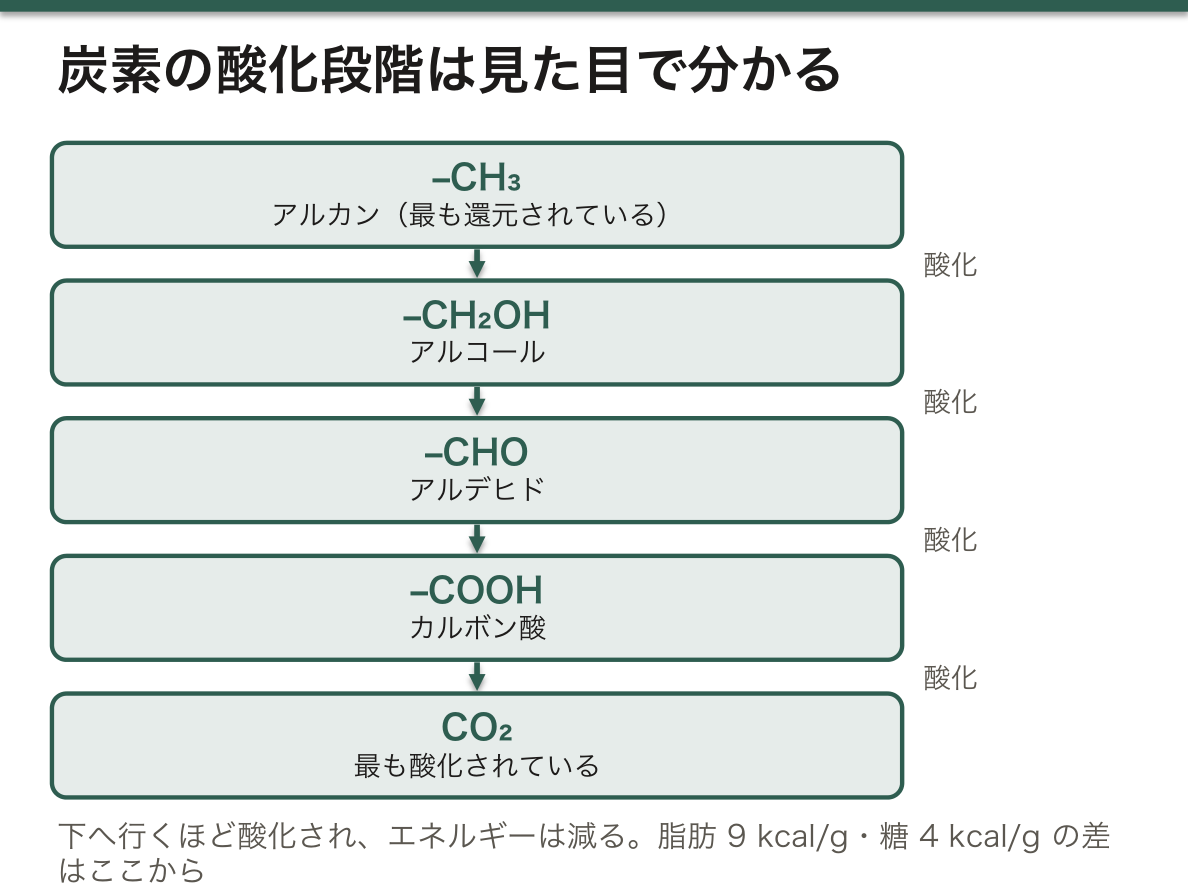
「脂肪が糖よりエネルギーが多い」のは酸化段階で説明できる。脂肪酸は –CH₂– の連なりで最も還元された状態にあり、糖は炭素ごとに –OH を持ちすでに部分的に酸化されている。還元されているほど、燃やしたときに取り出せる電子が多い——だから 1g あたり 9 kcal と 4 kcal の差が出る。
NADH と NADPH の使い分けには理由がある。構造の違いは 2′位のリン酸1個だけだが、細胞はこの目印で2つのプールを別に保つ。NAD⁺/NADH 比は高く(酸化型が多い=異化を進めやすい)、NADP⁺/NADPH 比は低い(還元型が多い=合成と抗酸化に使える)。同じ化学をする2つの分子を分けて持つこと自体が、代謝の方向を制御する仕組みになっている。
酸化還元の考え方は、そのまま酵素の実験と電子伝達系に続く。コハク酸脱水素酵素の実験でメチレンブルーを使うのは、人工的な水素受容体として FAD の代わりをさせるため——還元されると青が消えるので、反応の進行が目で見える。電子伝達系と ROS の話も、電子が1個ずつ漏れるとスーパーオキシドになるという同じ枠組みで読める。
English version
Core
There are three definitions, but in biochemistry the most practical is to think in terms of the transfer of hydrogen.
| Oxidation | Reduction | |
|---|---|---|
| Electrons | Lost | Gained |
| Hydrogen | Lost | Gained |
| Oxygen | Gained | Lost |
| Oxidation number | Rises | Falls |
The oxidation state of carbon can be judged by eye: –CH₃ (alkane) → –CH₂OH (alcohol) → –CHO (aldehyde) → –COOH (carboxylic acid) → CO₂. The further right, the more oxidised and the less energy remains.
The partners in the transfer are the coenzymes: NAD⁺/NADH (catabolism, extracting energy), NADP⁺/NADPH (anabolism, reductive synthesis), FAD/FADH₂ (two hydrogens at once).
Going further
That fat holds more energy than sugar is explained by oxidation state. A fatty acid is a run of –CH₂– groups and is in the most reduced state; a sugar carries an –OH on every carbon and is already partly oxidised. The more reduced, the more electrons can be extracted on burning — hence the difference between 9 and 4 kcal per gram.
There is a reason for keeping NADH and NADPH separate. The structural difference is a single phosphate at the 2′ position, but the cell uses that tag to keep two separate pools. The NAD⁺/NADH ratio is high (mostly oxidised, ready to drive catabolism); the NADP⁺/NADPH ratio is low (mostly reduced, available for synthesis and antioxidant defence). Holding two molecules that do the same chemistry apart is itself a means of controlling the direction of metabolism.
The idea of oxidation and reduction carries straight on into enzyme experiments and the electron transport chain. Methylene blue is used in the succinate dehydrogenase experiment as an artificial hydrogen acceptor standing in for FAD — reduced, its blue colour disappears, so the progress of the reaction can be seen. The electron transport chain and ROS reads within the same framework: electrons leaking one at a time become superoxide.
縮合と加水分解 — 生体高分子を作る/壊す
縮合(脱水縮合):2つの分子が結合し、水1分子が出る。生体高分子はすべてこれで作られる。
| 結合 | 単位 | 作られる高分子 |
|---|---|---|
| ペプチド結合(アミド) | アミノ酸 | 蛋白質 |
| グリコシド結合 | 単糖 | 多糖 |
| エステル結合 | 脂肪酸+グリセロール | 中性脂肪 |
| ホスホジエステル結合 | ヌクレオチド | 核酸 |
加水分解:その逆で、水を加えて切る。消化酵素はすべて加水分解酵素(ペプチダーゼ・アミラーゼ・リパーゼ・ヌクレアーゼ)。
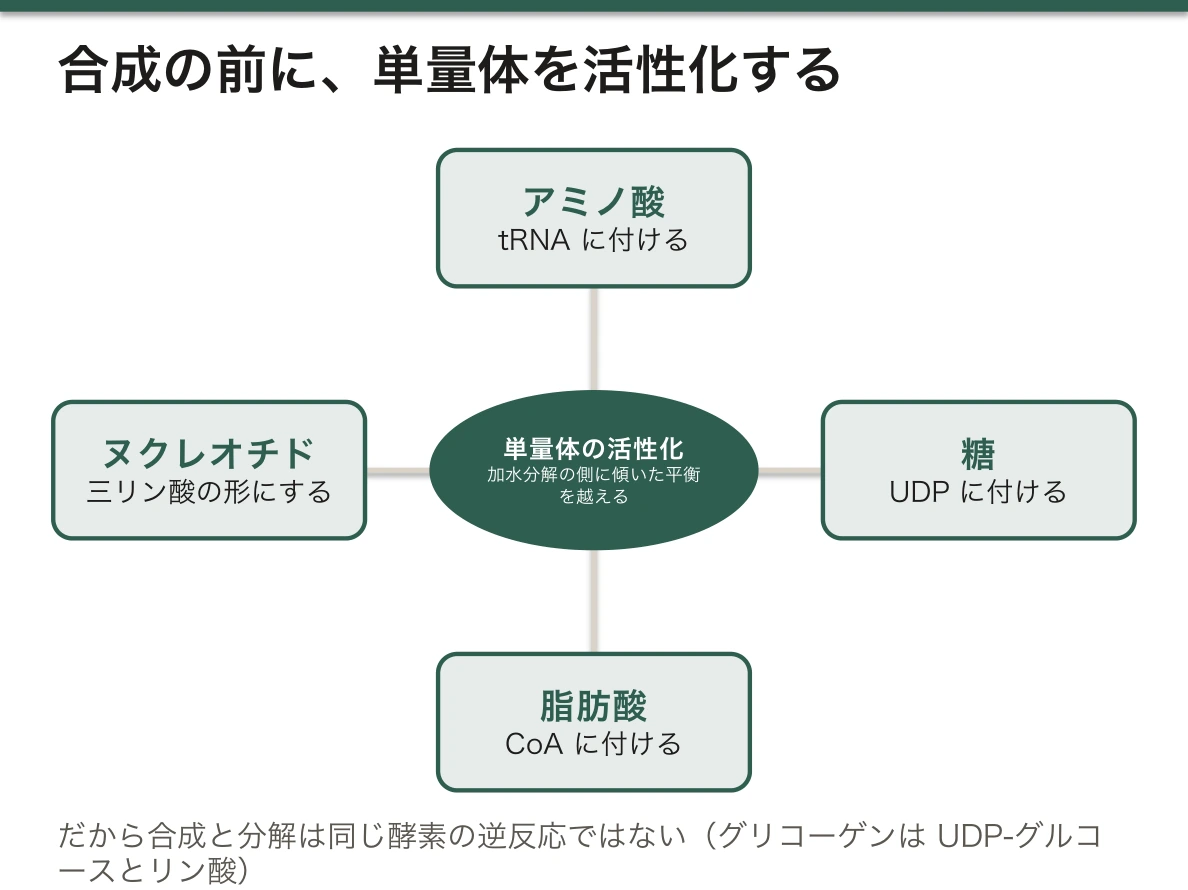
水の中で「水が出る反応」を進めるには工夫が要る。体内は水だらけなので、平衡は圧倒的に加水分解の側に傾いている。だから生合成では単量体をあらかじめ活性化しておく——アミノ酸は tRNA に、糖は UDP に、脂肪酸は CoA に、ヌクレオチドは三リン酸として。「活性化された中間体」がどれも高エネルギー結合を持つのは、この熱力学的な壁を越えるためである。
だから合成と分解は同じ酵素の逆反応ではない。グリコーゲンは合成に UDP-グルコース、分解にリン酸を使う(グリコーゲンホスホリラーゼは加水分解ではなくホスホロリシス)。脂肪酸の合成と β 酸化も、酵素も補酵素も細胞内の場所も別である。「往復に別の道を用意する」ことで、それぞれを独立に調節できる。
消化液中のグリコシダーゼの実験が、まさにこの反応である。デンプンのグリコシド結合を加水分解して還元糖が生じるのを Fehling で検出する——結合の型・切る酵素・生成物の性質が1つの実験に収まっている。
English version
Core
Condensation (dehydration synthesis): two molecules join and one molecule of water is released. Every biological macromolecule is made this way.
| Bond | Monomer | Macromolecule |
|---|---|---|
| Peptide (amide) | Amino acid | Protein |
| Glycosidic | Monosaccharide | Polysaccharide |
| Ester | Fatty acid + glycerol | Triacylglycerol |
| Phosphodiester | Nucleotide | Nucleic acid |
Hydrolysis: the reverse, adding water to cut. Every digestive enzyme is a hydrolase (peptidases, amylase, lipase, nucleases).
Going further
Driving a reaction that releases water, in water, requires a device. The body is full of water, so the equilibrium lies overwhelmingly towards hydrolysis. So in biosynthesis the monomer is activated in advance — amino acids on tRNA, sugars on UDP, fatty acids on CoA, nucleotides as triphosphates. That every "activated intermediate" carries a high-energy bond is in order to cross this thermodynamic barrier.
So synthesis and degradation are not the same enzyme run backwards. Glycogen synthesis uses UDP-glucose and its breakdown uses phosphate (glycogen phosphorylase performs phosphorolysis, not hydrolysis). Fatty acid synthesis and β-oxidation differ in enzymes, coenzymes and location within the cell. Providing separate roads for the outward and return journeys allows each to be regulated independently.
The experiment on glycosidases in the digestive juices is precisely this reaction — the glycosidic bonds of starch are hydrolysed and the reducing sugar produced is detected with Fehling’s. The type of bond, the enzyme that cuts it and the property of the product are contained in one experiment.
置換と脱離 — 基を入れ替える/二重結合を作る
置換 substitution:分子の一部の基が別の基に置き換わる。求核置換が生体では中心で、電子に富む基(求核剤:–OH, –NH₂, –SH)が電子の乏しい炭素を攻撃する。
- リン酸化(キナーゼ)— ATP のリン酸を基質の –OH へ
- メチル化(メチルトランスフェラーゼ)— SAM からメチル基を
- アセチル化 — アセチル CoA からアセチル基を
- アミノ基転移(トランスアミナーゼ)— アミノ基とケト基を交換
脱離 elimination:隣り合う2つの原子団が外れて二重結合ができる。脱水(水が外れる)が代表。
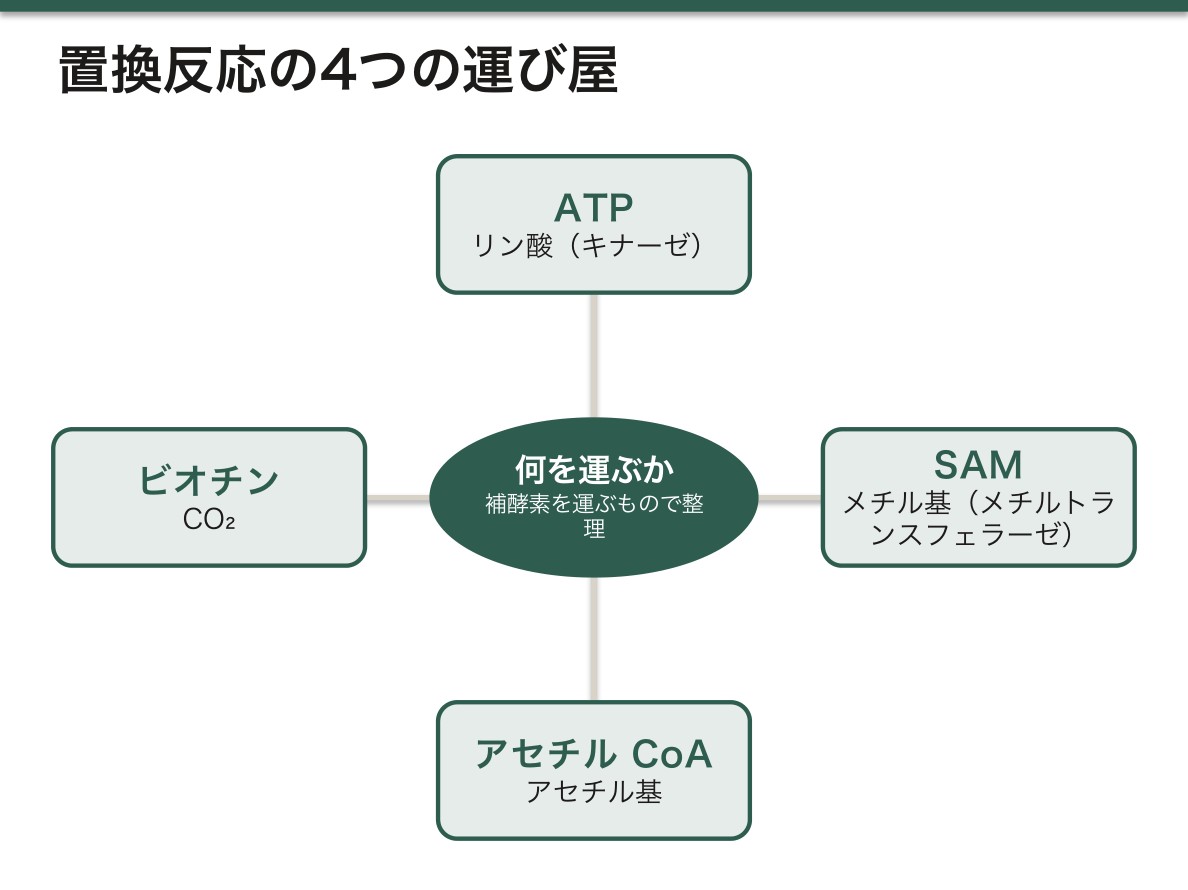
置換反応は「基を運ぶ運び屋」を必ず伴う。覚えるべきは4つ:ATP がリン酸を、SAM がメチル基を、アセチル CoA がアセチル基を、ビオチンが CO₂ を運ぶ。「何を運ぶか」で補酵素を整理すると、経路が違っても同じ知識が使える。
アミノ基転移は置換の典型で、臨床検査に直結する。AST(GOT)と ALT(GPT)はどちらもアミノ基を α-ケトグルタル酸へ渡す酵素で、補酵素はピリドキサールリン酸(ビタミンB6)。ALT が肝細胞の細胞質に多く、AST が肝以外(心筋・骨格筋)と肝細胞のミトコンドリアにも多いという分布の差が、AST/ALT 比で病態を読む根拠になっている。
脱離は TCA 回路とβ酸化に繰り返し出てくる。フマラーゼ(フマル酸 + H₂O → リンゴ酸)は脱離の逆=付加、アコニターゼ(クエン酸 → シス-アコニット酸 → イソクエン酸)は脱水と水和の組み合わせ。これらの酵素が「リアーゼ」「ヒドラターゼ」と呼ばれるのは、反応の型をそのまま名前にしているだけである。
酵素の命名6分類を反応の型と対応づけておく:1 酸化還元酵素・2 転移酵素・3 加水分解酵素・4 脱離酵素(リアーゼ)・5 異性化酵素・6 合成酵素(リガーゼ)。この章で扱った4つの型が、そのまま 1・2・3・4 に当たる。
English version
Core
Substitution: one group of a molecule is replaced by another. Nucleophilic substitution is the central case in the body, an electron-rich group (a nucleophile: –OH, –NH₂, –SH) attacking an electron-poor carbon.
- Phosphorylation (kinase) — a phosphate from ATP onto an –OH of the substrate.
- Methylation (methyltransferase) — a methyl group from SAM.
- Acetylation — an acetyl group from acetyl-CoA.
- Transamination (transaminase) — exchange of an amino group for a keto group.
Elimination: two adjacent groups leave and a double bond forms. Dehydration is the classic case.
Going further
A substitution always involves a carrier of the group. Four to remember: ATP carries phosphate, SAM the methyl group, acetyl-CoA the acetyl group, biotin CO₂. Organise the coenzymes by what they carry and the same knowledge serves in different pathways.
Transamination is the typical substitution and bears directly on laboratory tests. AST (GOT) and ALT (GPT) both hand an amino group to α-ketoglutarate, with pyridoxal phosphate (vitamin B6) as coenzyme. That ALT is abundant in the hepatocyte cytosol while AST is abundant outside the liver (heart, skeletal muscle) and in hepatic mitochondria — that difference in distribution is the basis for reading the AST/ALT ratio.
Elimination recurs in the TCA cycle and β-oxidation. Fumarase (fumarate + H₂O → malate) is the reverse of elimination — an addition; aconitase (citrate → cis-aconitate → isocitrate) is a dehydration followed by a hydration. That these enzymes are called lyases and hydratases is simply the type of reaction used as a name.
Match the six classes of enzyme nomenclature to the types of reaction: 1 oxidoreductases, 2 transferases, 3 hydrolases, 4 lyases, 5 isomerases, 6 ligases. The four types dealt with in this chapter are 1, 2, 3 and 4.
求核剤と求電子剤 — SN2・SN1 と付加反応
有機反応のほとんどは、電子の豊富な場所が、電子の足りない場所を攻撃することで起きる。
| 求核剤(nucleophile) | 求電子剤(electrophile) | |
|---|---|---|
| 性質 | 電子対を与える。負電荷や非共有電子対を持つ | 電子対を受け取る。正電荷や部分的な正電荷(δ⁺)を持つ |
| 生体での例 | –OH・–SH・–NH₂ の O・S・N、カルボキシラート、イミダゾール(His) | カルボニル炭素(C=O の C)、リン酸の P、メチル基の付いた硫黄(SAM)のメチル炭素、H⁺ |
求核置換には2つの型がある。SN2は1段階で、求核剤が脱離基の反対側から攻撃し、脱離基が出ていくのと同時に結合ができる。速さは基質と求核剤の両方の濃度に比例し、不斉炭素なら立体配置が反転する。SN1は2段階で、まず脱離基が外れて平面のカルボカチオンができ、そこを求核剤が攻撃する。速さは基質の濃度だけで決まり、両側から攻撃されるので立体はほぼラセミ化する。
付加反応は、二重結合に原子団が付いて単結合になる反応で、脱離の逆である。フマラーゼがフマル酸に水を付けて L-リンゴ酸にするのが代表で、ほかに β 酸化のエノイル CoA ヒドラターゼがある。
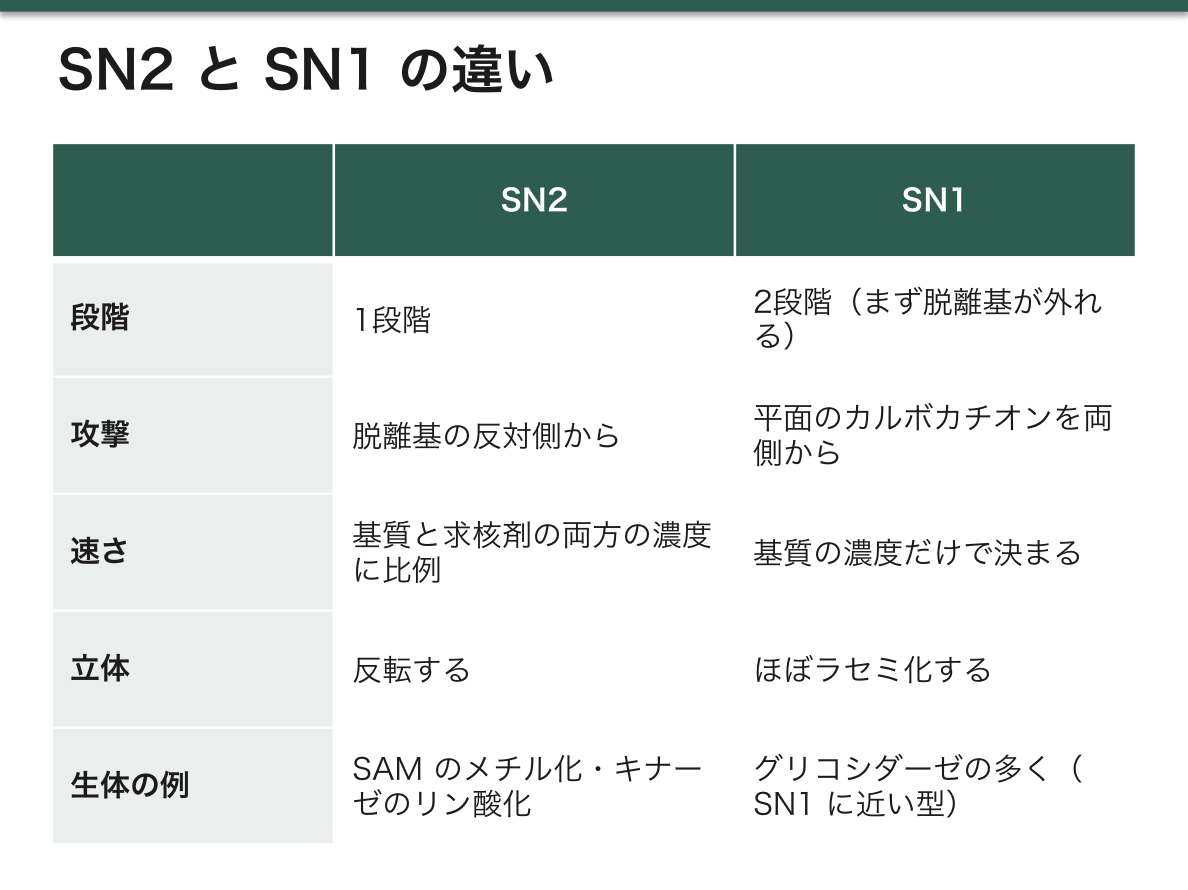
生体の置換反応は、ほとんどが SN2 型か、それに近い。SAM によるメチル化では、受け手の N・O・S が SAM の硫黄に付いたメチル基を背面から攻撃し、S-アデノシルホモシステインが脱離基として外れる。キナーゼのリン酸化も、基質の –OH が ATP の γ-リン酸の P を攻撃する置換である。酵素は求核剤と求電子剤をちょうどよい向きで向かい合わせることで、溶液中では遅い反応を速めている。
一方、グリコシダーゼの多くは、グリコシド結合が外れるときに正電荷を帯びた環(オキソカルベニウムイオン)に近い状態を通る。これは SN1 に近い型で、アミラーゼの2つの酸性残基のうち一方が H⁺ を与え、もう一方が正電荷の中間状態を支えている。
抗がん薬のアルキル化薬(シクロホスファミド・ナイトロジェンマスタード)は強い求電子剤で、DNA のグアニンの N7(求核剤)を攻撃して共有結合を作り、DNA の鎖をつなぎとめて複製を止める。アセトアミノフェンの中毒で問題になる代謝物 NAPQI も求電子剤で、グルタチオンの –SH(求核剤)に捕まえられて無毒化される。グルタチオンが尽きると、肝細胞の蛋白の –SH を攻撃して細胞を壊す。
English version
Core
Most organic reactions happen when an electron-rich site attacks an electron-poor site.
| Nucleophile | Electrophile | |
|---|---|---|
| Nature | Gives an electron pair; negative charge or lone pairs | Takes an electron pair; positive or partial positive (δ⁺) charge |
| Biological examples | O, S, N of –OH, –SH, –NH₂; carboxylates; imidazole (His) | Carbonyl carbon (C of C=O), P of phosphate, methyl carbon on the sulphur of SAM, H⁺ |
Nucleophilic substitution has two types. SN2 is one step: the nucleophile attacks from the side opposite the leaving group, and the new bond forms as the leaving group departs. The rate depends on both substrate and nucleophile, and a chiral centre is inverted. SN1 is two steps: the leaving group goes first, giving a flat carbocation, which the nucleophile then attacks. The rate depends only on the substrate, and attack from both sides gives near-racemisation.
Addition puts atoms across a double bond, making a single bond — the reverse of elimination. Fumarase adding water to fumarate to make L-malate is the classic case; enoyl-CoA hydratase in β-oxidation is another.
Going further
Most biological substitutions are SN2 or close to it. In SAM methylation an acceptor N, O or S attacks the methyl on SAM’s sulphur from behind, and S-adenosylhomocysteine leaves. Kinase phosphorylation is also substitution: the substrate –OH attacks the P of ATP’s γ-phosphate. Enzymes hold nucleophile and electrophile in exactly the right orientation, speeding reactions that are slow in solution.
Many glycosidases, by contrast, pass through a positively charged ring state (oxocarbenium ion) as the glycosidic bond breaks — closer to SN1. In amylase one acidic residue gives H⁺ and the other stabilises the positive intermediate.
In the clinic
Alkylating anticancer drugs (cyclophosphamide, nitrogen mustards) are strong electrophiles. They attack the N7 of guanine in DNA (a nucleophile), forming covalent cross-links that stop replication. NAPQI, the toxic metabolite in paracetamol poisoning, is also an electrophile; it is captured by the –SH of glutathione (a nucleophile). When glutathione runs out, it attacks –SH groups of liver proteins and kills the cells.
まとめ
| 酸化と還元 — 生体では「水素の受け渡し」 | 定義は3通りあるが、生化学では「水素の授受」で考えるのがいちばん実用的である。 |
|---|---|
| 縮合と加水分解 — 生体高分子を作る/壊す | 縮合(脱水縮合):2つの分子が結合し、水1分子が出る。 |
| 置換と脱離 — 基を入れ替える/二重結合を作る | 置換 substitution:分子の一部の基が別の基に置き換わる。 |
| 求核剤と求電子剤 — SN2・SN1 と付加反応 | 有機反応のほとんどは、電子の豊富な場所が、電子の足りない場所を攻撃することで起きる。 |
このノートは医学生が授業の内容を自分の言葉でまとめたもので、診療の判断に使うものではありません。誤りに気づいたらお知らせください。