全身の細胞は同じゲノムを持つのに、神経細胞と肝細胞はまったく違う。差を作っているのはどの遺伝子を読むかであり、その指定を担うのがエピジェネティックな修飾である。
特徴は可逆であることと細胞分裂を越えて受け継がれることの両立である。だから環境の影響が細胞の記憶として残り、同時に薬で戻せる可能性がある。
- DNAメチル化とヒストン修飾 — 2つの書き込み方
- RNAの世界 — 蛋白にならないRNAが、量を決める
- ゲノム刷り込み — 父由来か母由来かで、働き方が違う遺伝子
- X染色体の不活化 — 女性の細胞は、2種類が混ざっている
- 胎児期の環境が、数十年後の病気を決める
- 加齢とともに、血液は少数の細胞のクローンに置き換わっていく
DNAメチル化とヒストン修飾 — 2つの書き込み方
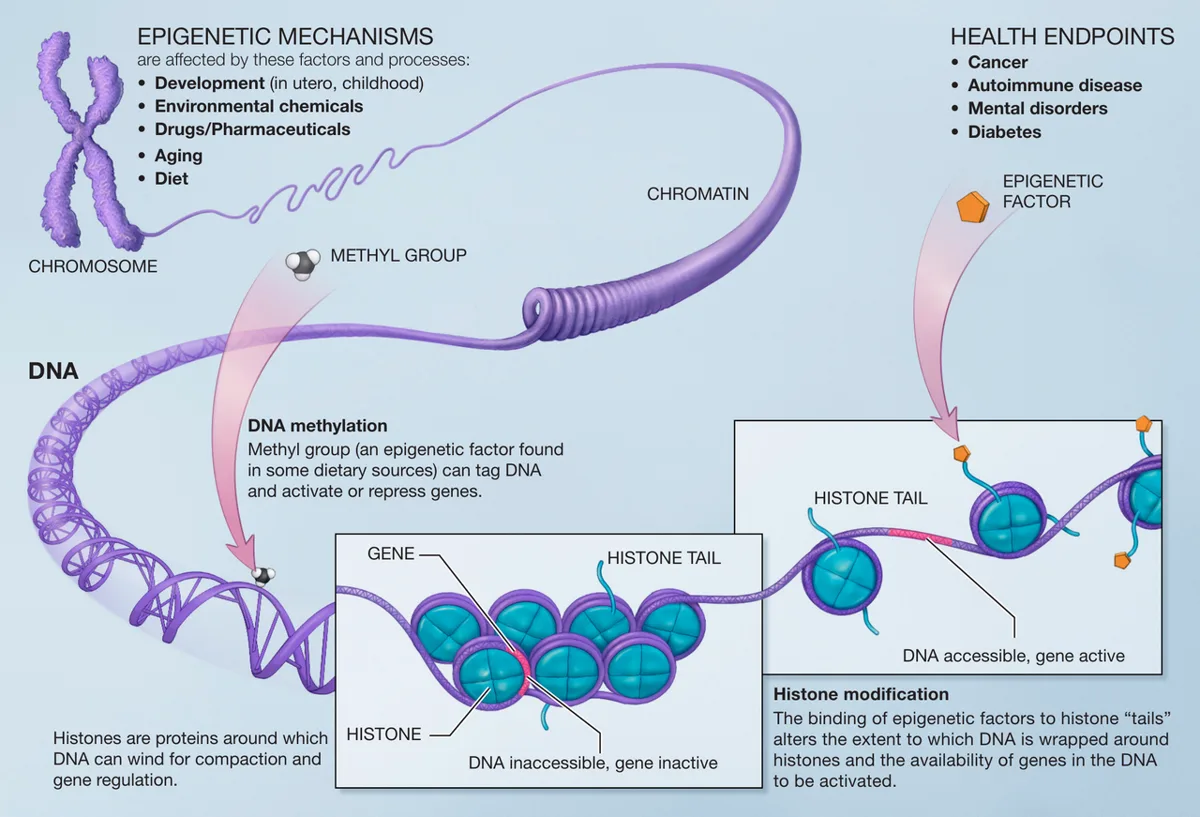
DNAメチル化
- CpG部位のシトシンにメチル基が付く
- プロモーター領域のCpGアイランドがメチル化されると、転写が抑制される
- 供与体はS-アデノシルメチオニン(含硫アミノ酸の章)
ヒストン修飾
| 修飾 | 酵素 | 効果 |
|---|---|---|
| アセチル化 | ヒストンアセチル基転移酵素 | 正電荷が中和され、DNAとの結合が緩む → 転写が進む |
| 脱アセチル化 | ヒストン脱アセチル化酵素 | 転写が抑制される |
| メチル化 | — | 場所により促進にも抑制にもなる |
ゲノム刷り込みは、エピジェネティクスが臨床で最も分かりやすく現れる現象である。父由来か母由来かで、発現する側が決まっている遺伝子がある。
| Prader-Willi症候群 | Angelman症候群 | |
|---|---|---|
| 欠けるもの | 父由来の15q11-13 | 母由来の15q11-13 |
| 症状 | 新生児期の筋緊張低下 → 過食と肥満・低身長・性腺機能低下 | 重い知的障害・けいれん・失調性歩行・突発的な笑い |
同じ場所が欠けているのに、まったく違う病気になる——父母どちらの染色体が残っているかで、そこにある遺伝子が読まれるかどうかが違うからである。片親性ダイソミー(両方の染色体を片方の親から受け継ぐ)でも同じことが起きるので、欠失が見つからなくてもメチル化試験で診断できる。
癌ではメチル化の異常が2方向に起きる。
- 癌抑制遺伝子のプロモーターが局所的に過剰メチル化される → 変異が無いのに機能を失う
- ゲノム全体では低メチル化 → 染色体が不安定になる
MGMTのメチル化は治療選択に直結する。MGMTはアルキル化剤による損傷を直す酵素で、そのプロモーターがメチル化されて発現が落ちている膠芽腫では、テモゾロミドがよく効く。「修復できないことが弱点になる」——DNA修復の章と同じ論理である。
ヒストン脱アセチル化酵素阻害薬(ボリノスタットなど)とDNAメチル化阻害薬(アザシチジン)は、骨髄異形成症候群や皮膚T細胞リンパ腫で実用化されている。「変異を治す」のではなく「読み方を戻す」薬である。
English version
Core
DNA methylation
- A methyl group is added to the cytosine of a CpG site.
- When the CpG island of a promoter is methylated, transcription is suppressed.
- The donor is S-adenosylmethionine (the chapter on the sulphur-containing amino acids).
Histone modification
| Modification | Enzyme | Effect |
|---|---|---|
| Acetylation | Histone acetyltransferase | The positive charge is neutralised, binding to DNA loosens → transcription proceeds |
| Deacetylation | Histone deacetylase | Transcription is suppressed |
| Methylation | — | Promotes or suppresses according to the site |
Going further
Genomic imprinting is the phenomenon in which epigenetics appears most plainly in the clinic. There are genes for which which copy is expressed is set by whether it came from the father or the mother.
| Prader–Willi syndrome | Angelman syndrome | |
|---|---|---|
| What is missing | The paternal 15q11-13 | The maternal 15q11-13 |
| Features | Hypotonia in the newborn period → hyperphagia and obesity, short stature, hypogonadism | Severe intellectual disability, seizures, ataxic gait, paroxysms of laughter |
The same region deleted gives entirely different diseases — because which parent’s chromosome remains decides whether the genes there are read. The same happens with uniparental disomy (inheriting both chromosomes from one parent), so the diagnosis can be made by a methylation test even when no deletion is found.
In cancer, abnormal methylation occurs in two directions.
- The promoter of a tumour suppressor gene is locally hypermethylated → the function is lost without a mutation.
- The genome as a whole is hypomethylated → the chromosomes become unstable.
Methylation of MGMT bears directly on the choice of treatment. MGMT is the enzyme repairing damage from alkylating agents, and in a glioblastoma whose promoter is methylated and expression reduced, temozolomide works well. "Not being able to repair becomes the weakness" — the same logic as the chapter on DNA repair.
Histone deacetylase inhibitors (vorinostat and others) and DNA methylation inhibitors (azacitidine) are in practical use in myelodysplastic syndrome and cutaneous T-cell lymphoma. Drugs that do not "cure the mutation" but "restore the reading".
RNAの世界 — 蛋白にならないRNAが、量を決める
ヒトゲノムのうち蛋白をコードするのは約2%で、残りの多くはRNAとして転写されるが翻訳されない。
| 種類 | 働き |
|---|---|
| マイクロRNA | 約22塩基。標的mRNAに結合して翻訳を抑える・分解する。1つが多数の遺伝子を制御 |
| 低分子干渉RNA | 配列特異的にmRNAを分解(RNA干渉) |
| 長鎖非コードRNA | クロマチン構造の制御(X染色体不活化のXIST) |
核酸医薬——RNAそのものを薬にする。
- アンチセンスオリゴヌクレオチド——スプライシングを変える(ヌシネルセン、脊髄性筋萎縮症)
- 低分子干渉RNA製剤——インクリシラン(PCSK9を標的、年2回投与)
- mRNAワクチン——抗原の設計図を届け、細胞に作らせる
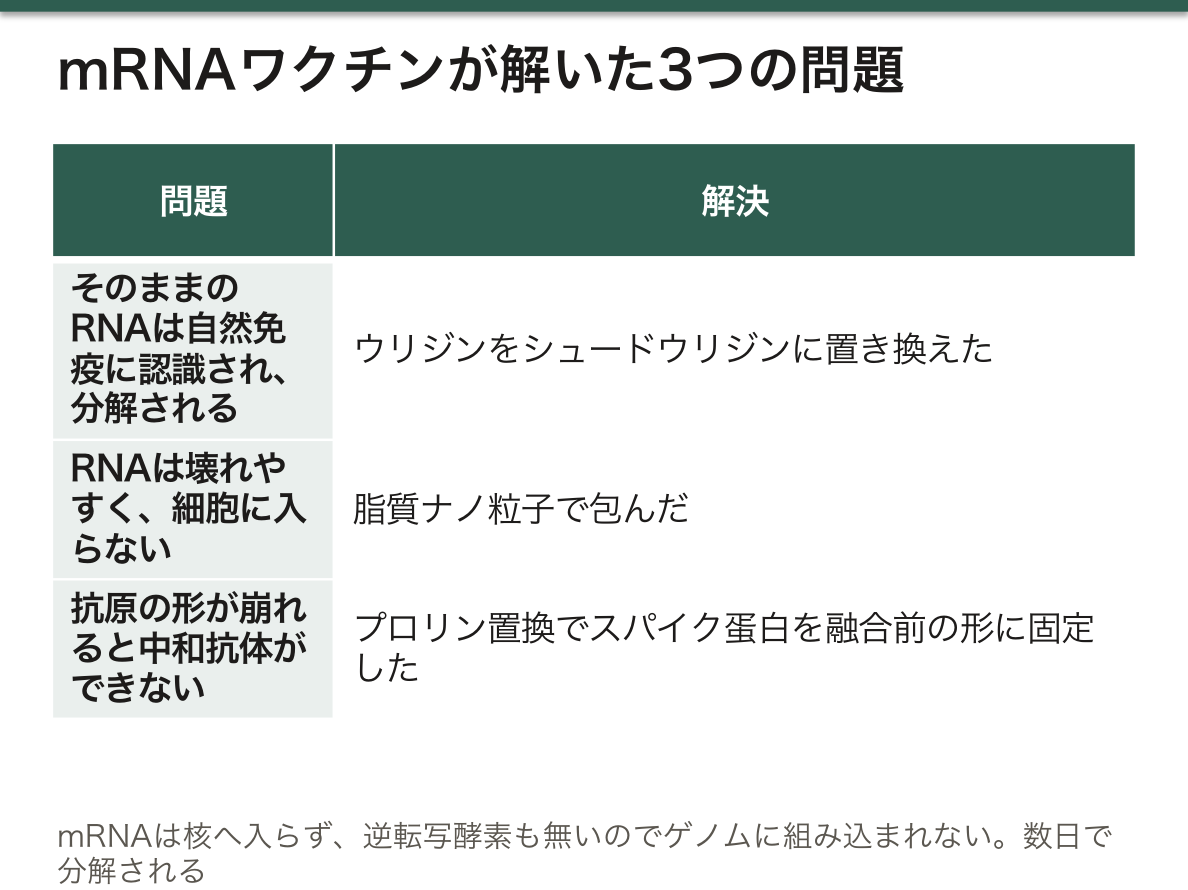
mRNAワクチンが成立するために解かれた3つの問題を押さえておくと、この技術の意味が分かる。
- そのままのRNAは自然免疫に強く認識され、炎症を起こして分解される → ウリジンをシュードウリジンに置き換えることで回避した(この発見がノーベル賞の対象になった)
- RNAは壊れやすく、細胞に入らない → 脂質ナノ粒子で包んだ
- 抗原の形が崩れると中和抗体ができない → プロリン置換でスパイク蛋白を融合前の形に固定した
「設計図を送る」ことの利点は明確である。配列が分かれば数日で設計でき、製造工程は抗原が変わっても同じ。細胞内で作られるのでMHCクラスIにも載り、細胞性免疫も立つ。
mRNAは核へ入らず、逆転写酵素も無いのでゲノムに組み込まれない——この点は、実際に患者から繰り返し受ける質問への答えとして、生化学の言葉で説明できるようにしておく。数日で分解される。
マイクロRNAは診断にも使われつつある。血中や体液中で安定に存在するため、癌の早期発見のバイオマーカーとしての研究が進んでいる。1つのマイクロRNAが数百の遺伝子を制御するので、その発現の型が組織の状態を反映する。
XISTによるX染色体不活化は、女性のヘテロ接合体が発症しうる理由(尿素回路の章)の分子的な基盤である。どちらのX染色体が不活化されるかは細胞ごとにほぼ無作為なので、偏りがあれば症状が出る。
English version
Core
About 2 per cent of the human genome codes for protein, and much of the rest is transcribed as RNA and not translated.
| Kind | Function |
|---|---|
| MicroRNA | About 22 bases. Binds a target mRNA and suppresses its translation or degrades it. One regulates many genes |
| Small interfering RNA | Degrades mRNA sequence-specifically (RNA interference) |
| Long non-coding RNA | Control of chromatin structure (XIST in X inactivation) |
Nucleic acid medicines — making the RNA itself the drug.
- Antisense oligonucleotide — alters splicing (nusinersen, spinal muscular atrophy).
- siRNA preparations — inclisiran (targeting PCSK9, given twice a year).
- mRNA vaccine — delivering the blueprint of the antigen and letting the cell make it.
Going further
Grasp the three problems that had to be solved for the mRNA vaccine to work and the meaning of the technology becomes clear.
- RNA as it is is strongly recognised by innate immunity, causing inflammation and being degraded → evaded by replacing uridine with pseudouridine (a discovery that was the subject of a Nobel Prize).
- RNA is fragile and does not enter cells → wrapped in a lipid nanoparticle.
- If the antigen’s shape collapses, no neutralising antibody is made → proline substitutions fixed the spike protein in its pre-fusion shape.
The advantage of "sending the blueprint" is clear. Once the sequence is known it can be designed in days, and the manufacturing process is the same even when the antigen changes. Being made within the cell it is also loaded on MHC class I, so cellular immunity is raised too.
mRNA does not enter the nucleus and, there being no reverse transcriptase, is not incorporated into the genome — be able to explain this in the words of biochemistry, as the answer to a question patients ask repeatedly. It is degraded within days.
MicroRNAs are coming into use in diagnosis too. Being stably present in blood and body fluids, they are being studied as biomarkers for the early detection of cancer. One microRNA regulates hundreds of genes, so the pattern of expression reflects the state of the tissue.
X inactivation by XIST is the molecular basis of why a heterozygous female may be affected (the chapter on the urea cycle). Which X is inactivated is almost random from cell to cell, so a skew gives symptoms.
ゲノム刷り込み — 父由来か母由来かで、働き方が違う遺伝子
一部の遺伝子は、どちらの親から来たかによって発現するかどうかが決まる。メチル化によって片方が黙らされている。
15q11-q13 が代表例になる。
| Prader-Willi 症候群 | Angelman 症候群 | |
|---|---|---|
| 失われるのは | 父由来の 15q11-q13 | 母由来の 15q11-q13(UBE3A) |
| 原因 | 欠失(約70%)・母性片親性ダイソミー | 欠失・父性片親性ダイソミー・UBE3A 変異 |
| 症状 | 乳児期の筋緊張低下と哺乳不良 → 幼児期以降の過食と肥満・低身長・性腺機能低下 | 重度の発達遅滞・言語の欠如・失調性歩行・てんかん・不釣り合いな笑い |
Beckwith-Wiedemann 症候群(11p15)も刷り込みの異常になる——過成長・巨舌・臍帯ヘルニア・小児腫瘍の危険。
「同じ場所の欠失で、まったく違う病気になる」という点が、刷り込みを学ぶ理由になる。メンデル遺伝では説明できない(単一遺伝子病の章)——「配列だけを見ても、どちらの症候群かは分からない」。
だからメチル化解析が診断の第一選択になる(分子生物学の技術の章)——「欠失・片親性ダイソミー・刷り込み中心の異常を、まとめて拾える」。
片親性ダイソミーという概念は、再発率の説明に必要になる(遺伝カウンセリングの章)——「原因によって、次の子での再発の確率が大きく変わる」。
刷り込みは、生殖補助医療との関連も議論されている(不妊治療の章)——「配偶子形成の時期にメチル化が書き換えられるため」。
Prader-Willi 症候群の経過が2相性であることは、診断の遅れの原因になる(染色体と代謝の異常の章)——「乳児期は『飲まない子』、幼児期以降は『食べすぎる子』として現れる」。
English version
Core
For some genes, whether they are expressed is decided by which parent they came from. One copy is silenced by methylation.
15q11-q13 is the representative example.
| Prader–Willi syndrome | Angelman syndrome | |
|---|---|---|
| What is lost | The paternal 15q11-q13 | The maternal 15q11-q13 (UBE3A) |
| Causes | Deletion (about 70 per cent), maternal uniparental disomy | Deletion, paternal uniparental disomy, UBE3A mutation |
| Features | Hypotonia and poor feeding in infancy → hyperphagia and obesity from the toddler years, short stature, hypogonadism | Severe developmental delay, absent speech, ataxic gait, epilepsy, inappropriate laughter |
Beckwith–Wiedemann syndrome (11p15) is also a disorder of imprinting — overgrowth, macroglossia, omphalocele, a risk of childhood tumours.
Going further
- The reason to learn imprinting is the point that a deletion of the same region gives entirely different diseases. Mendelian inheritance cannot explain it (the chapter on monogenic disease) — looking at the sequence alone does not say which syndrome it is.
- Hence methylation analysis is the first-line test (the chapter on the techniques of molecular biology) — it picks up deletion, uniparental disomy and imprinting-centre defects together.
- The concept of uniparental disomy is needed to explain the recurrence risk (the chapter on genetic counselling) — the probability of recurrence in a next child differs greatly with the cause.
- Imprinting is also discussed in relation to assisted reproduction (the chapter on fertility treatment) — because methylation is rewritten at the time of gametogenesis.
- That the course of Prader–Willi syndrome is biphasic is a cause of delayed diagnosis (the chapter on chromosomal and metabolic disorders) — it appears in infancy as "a baby who will not feed" and later as "a child who eats too much".
X染色体の不活化 — 女性の細胞は、2種類が混ざっている
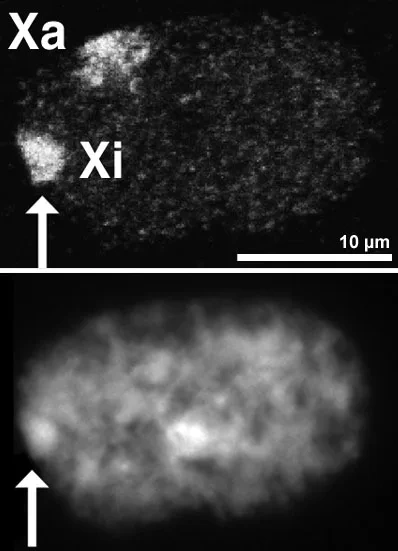
女性では、胚の初期に各細胞で X染色体の片方がランダムに不活化される(Lyon 仮説)。
- 不活化された X は凝縮し、Barr 小体として見える
- XIST という長鎖非コード RNA が、自分の乗っている X を覆って黙らせる
- 一度決まると、その細胞の子孫は同じ側を不活化し続ける(クローン性)
- 約 15% の遺伝子は不活化を逃れる
結果として、女性の体は2種類の細胞のモザイクになる。
Barr 小体の数 = X の数 − 1——Turner 症候群(45,X)では 0、Klinefelter 症候群(47,XXY)では 1。
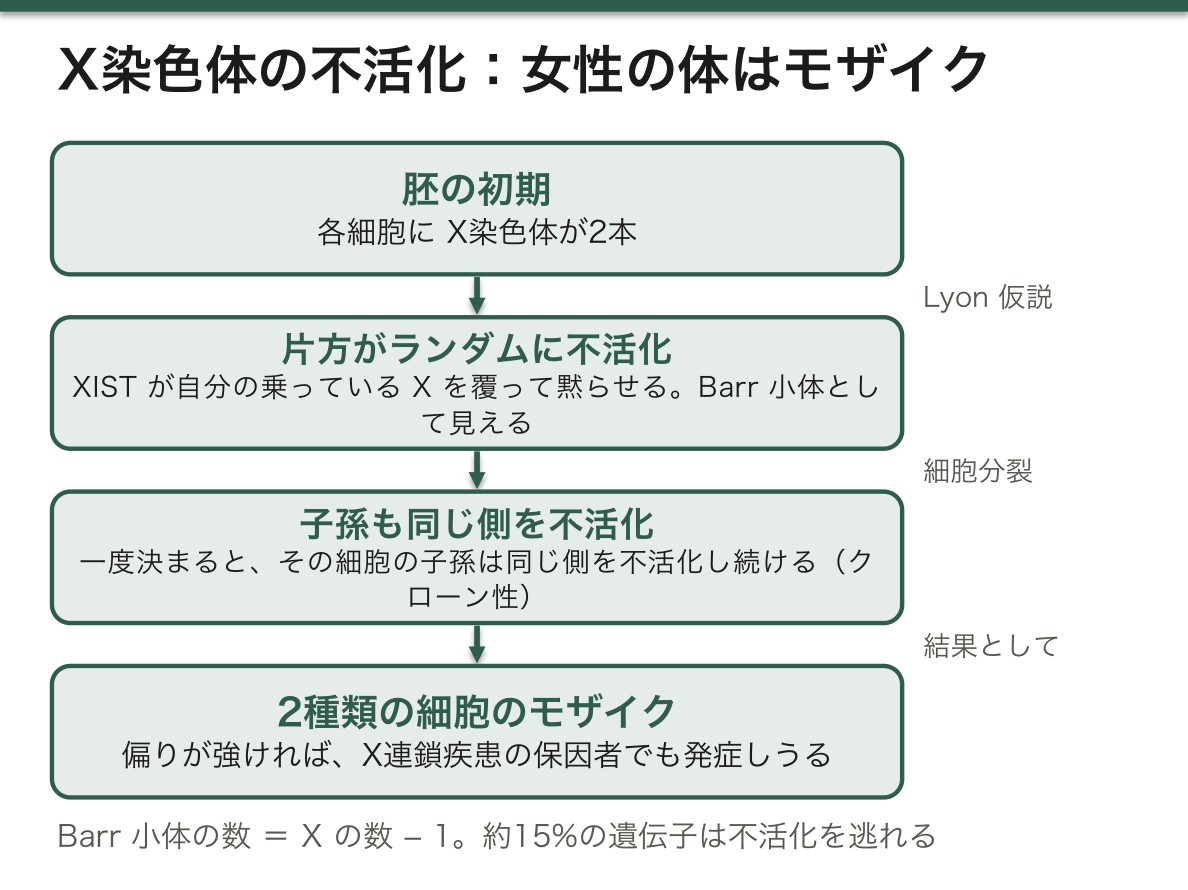
「モザイクである」という一点が、X連鎖疾患の女性保因者の多様さを説明する。偏りが強ければ、保因者でも発症しうる(歪んだ不活化)(Fabry 病の項)——「保因者=無症状、と決めつけない」。
Duchenne 型筋ジストロフィーの保因者でも、CK の上昇や心筋症が見られることがある(筋疾患の章)——「家族歴を聞いた女性に、心機能の評価を勧める根拠になる」。
不活化を逃れる遺伝子があることが、Turner 症候群の症状を作っている(成長の異常の章)——「X が1本でよいなら、45,X で症状が出ないはずになる」。
三毛猫の毛色は、この現象の最も分かりやすい例になる——「毛色の遺伝子が X 上にあるので、モザイクが模様として見える」。
XIST は、蛋白にならない RNA が働く代表例になる(この章の RNA の世界の項)——「遺伝情報の担い手という枠を超えた RNA の役割が、ここで見える」。
English version
Core
In a female, one X chromosome is randomly inactivated in each cell early in the embryo (the Lyon hypothesis).
- The inactivated X condenses and is visible as the Barr body.
- A long non-coding RNA called XIST coats the X it sits on and silences it.
- Once decided, the descendants of that cell go on inactivating the same side (clonality).
- About 15 per cent of genes escape inactivation.
As a result the female body is a mosaic of two kinds of cell.
The number of Barr bodies = the number of X minus one — 0 in Turner syndrome (45,X), 1 in Klinefelter syndrome (47,XXY).
Going further
- The single point of being a mosaic explains the variety among female carriers of X-linked disease. With a strong skew, a carrier may be affected (skewed inactivation) (the section on Fabry disease) — do not assume carrier = asymptomatic.
- A carrier of Duchenne muscular dystrophy may show a raised CK or a cardiomyopathy (the chapter on muscle disease) — the ground for recommending assessment of cardiac function in a woman who gives that family history.
- That some genes escape inactivation is what creates the features of Turner syndrome (the chapter on disorders of growth) — if one X were enough, 45,X should give no symptoms.
- The coat of a tortoiseshell cat is the plainest example of the phenomenon — the coat colour gene being on the X, the mosaic is visible as a pattern.
- XIST is a leading example of an RNA that works without becoming a protein (the section on the world of RNA in this chapter) — here the role of RNA beyond being a carrier of genetic information becomes visible.
胎児期の環境が、数十年後の病気を決める
成人の生活習慣病の一部は、胎児期から乳児期の栄養環境によって素地が作られているという考え方がある(DOHaD、疾病の発生起源説)。
根拠になった観察がいくつかある。
- 低出生体重と成人の疾患——出生体重が小さいほど、後年の2 型糖尿病・高血圧・虚血性心疾患が多い(Barker の観察)
- オランダの飢餓の冬(1944〜45)——妊娠初期に飢餓に曝された児で、成人後の肥満・脂質異常・統合失調症が増えた。妊娠後期に曝された児では耐糖能異常が増えた——時期によって出る影響が違う
- その群では、特定の遺伝子のメチル化が 60 年後も変化していた
配列は変わらないのに、読み方の設定が長く残る——エピジェネティクスが、この現象の有力な担い手と考えられている。
説明として提案されているのが「倹約表現型」である。胎児が栄養の乏しい環境を「予測」して、脂肪を溜めやすい・インスリン抵抗性の高い体に調整して生まれてくる。予測が当たっていれば有利だが、生まれた先が飽食の環境だと不利になる——ずれが病気を作るという枠組みである。
日本にとって、これは他人事ではない。日本は先進国のなかで低出生体重児の割合が高い(約 9〜10%)。背景に、やせ願望による妊娠前からの低体重と、妊娠中の体重増加を過度に制限してきた指導があると指摘されてきた。この反省から、妊婦の体重増加の目安は上方に改定されている。
⚠️ ただし、この分野の扱いには注意が要る。
- 観察研究が中心で、交絡(親の社会経済状況・遺伝)を完全には除けていない
- 母親の責任を問う語り方になりやすい。「妊娠中の食事が子の病気を決めた」という単純化は、科学的にも倫理的にも支持されない
- 言えるのは「妊娠前からの栄養と体重が、公衆衛生上の介入点になりうる」という水準である
妊婦健診で体重増加を指導するとき、増やしすぎないことだけを目標にしない。増えなさすぎることにも害がある。
English version
Core
There is a view that part of the lifestyle-related disease of adults has its ground laid by the nutritional environment of fetal and infant life (DOHaD, the developmental origins of health and disease).
Several observations formed the basis.
- Low birth weight and adult disease — the smaller the birth weight, the more type 2 diabetes, hypertension and ischaemic heart disease in later years (Barker’s observation).
- The Dutch Hunger Winter (1944–45) — children exposed to famine in early pregnancy had more obesity, dyslipidaemia and schizophrenia as adults. Those exposed in late pregnancy had more impaired glucose tolerance — the effect differing with the timing.
- In that group, the methylation of particular genes was still altered 60 years later.
The sequence does not change and the setting of how it is read persists — epigenetics is regarded as the likely carrier of this phenomenon.
Going further
The explanation proposed is the "thrifty phenotype". The fetus "predicts" an environment poor in nutrition and is born adjusted to a body that stores fat readily and is insulin-resistant. If the prediction is right it is an advantage; if it is born into a world of plenty it is a disadvantage — the framework that the mismatch creates the disease.
For Japan this is not someone else’s problem. Japan has a high proportion of low-birth-weight infants among developed countries (about 9–10 per cent). It has been pointed out that behind this lie low body weight from before pregnancy driven by the wish to be thin and guidance that excessively restricted weight gain in pregnancy. On that reflection, the recommended weight gain in pregnancy has been revised upwards.
⚠️ This field must be handled with care.
- It rests chiefly on observational studies and confounding (the parents’ socioeconomic position, genetics) cannot be fully removed.
- It readily becomes a way of speaking that assigns blame to the mother. The simplification "the mother’s diet in pregnancy decided the child’s disease" is supported neither scientifically nor ethically.
What can be said is at the level of "nutrition and weight from before pregnancy can be a point of intervention in public health".
In the clinic
When advising on weight gain at an antenatal visit, do not make not gaining too much the only goal. Gaining too little is harmful too.
加齢とともに、血液は少数の細胞のクローンに置き換わっていく
造血幹細胞は分裂のたびに変異を溜める。そのうち増殖にわずかに有利な変異を得た 1 個が、年月をかけて血液の中で割合を増やしていく。これをクローン性造血という。
- 頻度は年齢に強く依存する——40 代では数 %、70 歳以上では 10〜20% 以上に見つかる
- 血球数は正常で、症状も無い。健診では分からない
- 変異する遺伝子は決まっている——DNMT3A・TET2・ASXL1 が上位を占める。いずれもDNA メチル化とヒストン修飾を制御する遺伝子である
加齢に伴う「正常」の中に、既にクローンの拡大が起きている——白血病は突然始まるのではなく、その延長線上にある。
2 つの臨床的な含意があり、どちらも予想外だった。
| 血液の癌になる | 年 0.5〜1% の割合で骨髄系腫瘍へ進む | 危険は上がるが、大半は一生発症しない |
| 心血管疾患が増える | 危険が 1.5〜2 倍になる | 変異をもつ単球・マクロファージが炎症性サイトカインを多く出すためと考えられている |
「血液の変異が、動脈硬化の危険因子になる」という繋がりは、従来の枠組みには無かった。炎症が動脈硬化を進めるという理解(IL-1β 抗体が心血管イベントを減らした試験)と整合しており、抗炎症治療が効く集団を選べるのではないかと議論されている。
⚠️ 検査として測ることには、まだ問題がある。
- 見つけても、確立した介入が無い——治療法も、監視の間隔も定まっていない
- 本人に不安だけを与えうる——保険や就労への影響も考慮が要る
- 他の目的の検査で偶然見つかることがある(がん遺伝子パネル・非侵襲的出生前検査)。二次的所見としての扱いを、事前に決めておく
関連する概念として、MGUS(意義不明の単クローン性ガンマグロブリン血症)がある。前段階のクローンが、症状なく長く存在するという点で同じ型の話であり、「癌になる前の状態」を見つけられる時代の課題を共有している。
がん遺伝子パネル検査を出すときは、何が偶然見つかりうるかを事前に説明する。血液由来の変異が混じることは日常的に起きる。
English version
Core
Haematopoietic stem cells accumulate mutations with every division. Among them, one that has acquired a mutation giving a slight advantage in proliferation increases its share of the blood over the years. This is clonal haematopoiesis.
- The frequency depends strongly on age — a few per cent in the forties, 10–20 per cent or more over 70.
- The blood counts are normal and there are no symptoms. A health check does not show it.
- The genes mutated are a fixed set — DNMT3A, TET2 and ASXL1 lead the list. All are genes controlling DNA methylation and histone modification.
Within the "normal" of ageing, clonal expansion is already occurring — leukaemia does not begin suddenly but lies on the extension of this.
Going further
There are two clinical implications, both unexpected.
| It becomes a blood cancer | Progresses to a myeloid neoplasm at 0.5–1 per cent a year | The risk rises but most never develop one in a lifetime |
| Cardiovascular disease increases | The risk becomes 1.5- to 2-fold | Thought to be because monocytes and macrophages carrying the mutation release more inflammatory cytokines |
The connection "a mutation in the blood becoming a risk factor for atherosclerosis" did not exist in the older framework. It is consistent with the understanding that inflammation drives atherosclerosis (the trial in which an IL-1β antibody reduced cardiovascular events), and it is argued that a population in whom anti-inflammatory treatment works might be selected.
⚠️ There are still problems with measuring it as a test.
- Finding it, there is no established intervention — neither the treatment nor the interval of surveillance is settled.
- It may give the person nothing but anxiety — effects on insurance and employment must be considered too.
- It may be found incidentally in a test done for another purpose (a cancer gene panel, non-invasive prenatal testing). Decide in advance how to handle it as a secondary finding.
A related concept is MGUS (monoclonal gammopathy of undetermined significance). In that a precursor clone is present for a long time without symptoms, it is the same form of story, and shares the problems of an age in which "the state before cancer" can be found.
In the clinic
When sending a cancer gene panel, explain in advance what may be found incidentally. Mutations of blood origin mixing in happens routinely.
まとめ
| DNAメチル化とヒストン修飾 — 2つの書き込み方 | DNAメチル化CpG部位のシトシンにメチル基が付くプロモーター領域のCpGアイランドがメチル化されると、転写が抑制される供与体はS-アデノシルメチオニン(含硫アミノ酸の章)ヒストン… |
|---|---|
| RNAの世界 — 蛋白にならないRNAが、量を決める | ヒトゲノムのうち蛋白をコードするのは約2%で、残りの多くはRNAとして転写されるが翻訳されない。 |
| ゲノム刷り込み — 父由来か母由来かで、働き方が違う遺伝子 | 一部の遺伝子は、どちらの親から来たかによって発現するかどうかが決まる。 |
| X染色体の不活化 — 女性の細胞は、2種類が混ざっている | 女性では、胚の初期に各細胞で X染色体の片方がランダムに不活化される(Lyon 仮説)。 |
| 胎児期の環境が、数十年後の病気を決める | 成人の生活習慣病の一部は、胎児期から乳児期の栄養環境によって素地が作られているという考え方がある(DOHaD、疾病の発生起源説)。 |
| 加齢とともに、血液は少数の細胞のクローンに置き換わっていく | 造血幹細胞は分裂のたびに変異を溜める。そのうち増殖にわずかに有利な変異を得た 1 個が、年月をかけて血液の中で割合を増やしていく。 |
このノートは医学生が授業の内容を自分の言葉でまとめたもので、診療の判断に使うものではありません。誤りに気づいたらお知らせください。