DNAは1つの細胞で1日に数万か所傷つく。にもかかわらず遺伝情報が保たれるのは、傷の種類ごとに専用の修復系があるからである。
臨床的に重要なのは、どの修復系が壊れているかで、生じる癌の種類と、効く薬が決まる点である。修復の欠陥は弱点でもあり、そこを突くのが現代の抗癌薬の一つの型になっている。
- 5つの修復系 — 傷の種類に対応している
- 変異の種類と、それが起こすこと
- 相同組換え修復と合成致死 — 直せない癌を、別の修復ごと止める
- 紫外線とヌクレオチド除去修復 — 日光が作る、たった1種類の傷
- 酸化された G が、変異を作る — 塩基除去修復と MUTYH
- 変異には署名がある — どの原因が傷つけたかが、パターンに残る
5つの修復系 — 傷の種類に対応している
| 修復系 | 直す傷 | 壊れると |
|---|---|---|
| ヌクレオチド除去修復 | 紫外線によるピリミジン二量体 | 色素性乾皮症 |
| ミスマッチ修復 | 複製時の塩基の入れ違い | Lynch症候群・マイクロサテライト不安定性 |
| 塩基除去修復 | 酸化・脱アミノによる1塩基の損傷 | MUTYH関連ポリポーシス |
| 相同組換え修復 | 二本鎖切断(正確) | BRCA1/2・Fanconi貧血 |
| 非相同末端結合 | 二本鎖切断(誤りが入りやすい) | 免疫不全(V(D)J組換えにも使う) |
- 毛細血管拡張性運動失調症(ATM)——二本鎖切断の検知そのものが壊れる。放射線に極めて弱い
修復の欠陥が、そのまま治療標的になる——これが近年の抗癌薬の重要な発想である。
合成致死:2つの遺伝子が両方壊れたときだけ細胞が死ぬという関係のこと。
- BRCA変異の腫瘍は相同組換え修復ができない
- PARPは一本鎖切断の修復を担う。PARP阻害薬を与えると一本鎖切断が残り、複製時に二本鎖切断へ変わる
- 正常細胞は相同組換えで直せるが、BRCA変異の腫瘍は直せずに死ぬ
正常細胞と腫瘍細胞の違いを、毒性の差ではなく「修復能の差」で作っている点が新しい。だから従来の抗癌薬より副作用が軽い。
ミスマッチ修復の欠損も、別の形で治療に繋がる。修復できないと変異が大量に蓄積し、腫瘍が異常な蛋白(ネオ抗原)を多数作る。免疫系から見えやすくなるので、免疫チェックポイント阻害薬がよく効く。臓器を問わず「マイクロサテライト不安定性が高い固形癌」に適応がある——臓器ではなく分子の性質で薬を決めるという考え方の最初の実例になった。
色素性乾皮症は、修復系の意義を最も直接に示す。日光曝露部に多発する皮膚癌が若年から生じ、厳格な遮光がそのまま治療になる。一部の型では神経変性も伴う——酸化的損傷の修復にも同じ系が関わるためと考えられている。
English version
Core
| Repair system | Damage repaired | When it breaks |
|---|---|---|
| Nucleotide excision repair | Pyrimidine dimers from ultraviolet light | Xeroderma pigmentosum |
| Mismatch repair | Mispaired bases at replication | Lynch syndrome, microsatellite instability |
| Base excision repair | Single-base damage from oxidation and deamination | MUTYH-associated polyposis |
| Homologous recombination repair | Double-strand breaks (accurately) | BRCA1/2, Fanconi anaemia |
| Non-homologous end joining | Double-strand breaks (error-prone) | Immunodeficiency (it is also used in V(D)J recombination) |
Ataxia telangiectasia (ATM) — the detection of double-strand breaks itself is broken. Extremely sensitive to radiation.
Going further
A defect in repair becoming, directly, a target of treatment — this is an important idea in the recent antitumour drugs.
Synthetic lethality: the relation in which the cell dies only when both of two genes are broken.
- A BRCA-mutant tumour cannot do homologous recombination repair.
- PARP repairs single-strand breaks. Give a PARP inhibitor and single-strand breaks remain and become double-strand breaks at replication.
- The normal cell repairs them by homologous recombination; the BRCA-mutant tumour cannot and dies.
What is new is that the difference between normal and tumour cells is created not from a difference in toxicity but from a difference in repair capacity. Hence the adverse effects are milder than with the older antitumour drugs.
A defect of mismatch repair leads to treatment in another way. Unable to repair, a great many mutations accumulate and the tumour makes many abnormal proteins (neoantigens). Being more visible to the immune system, immune checkpoint inhibitors work well. The indication is for "solid tumours with high microsatellite instability" regardless of the organ — the first instance of the idea of choosing a drug by a molecular property rather than by the organ.
Xeroderma pigmentosum shows the significance of a repair system most directly. Multiple skin cancers on sun-exposed areas arise from a young age, and strict protection from light is itself the treatment. Some forms are accompanied by neurodegeneration — thought to be because the same system is involved in repairing oxidative damage.
変異の種類と、それが起こすこと
| 種類 | 内容 | 結果 |
|---|---|---|
| 同義置換 | 塩基は変わるがアミノ酸は同じ | 通常は無影響(スプライシングに影響することはある) |
| ミスセンス | アミノ酸が変わる | 機能が変わる(鎌状赤血球症) |
| ナンセンス | 終止コドンになる | 短い蛋白。多くは分解される |
| フレームシフト | 3の倍数でない挿入・欠失 | 以降がすべて別のアミノ酸。重症になりやすい |
| スプライス部位 | イントロンの境界 | エクソンの脱落 |
| 3塩基反復伸長 | 反復配列が伸びる | 表現促進(Huntington病・筋強直性ジストロフィー・脆弱X症候群) |
Duchenne型とBecker型筋ジストロフィーの違いが、変異の型だけで決まる——最も明快な例である。
- Duchenne型——フレームシフトを起こす欠失。ジストロフィンが作られない。歩行不能が10歳前後
- Becker型——読み枠が保たれる欠失。短いが機能する蛋白ができる。経過が軽い
同じ遺伝子の、同じ「欠失」でも、3の倍数かどうかで予後がまったく違う。だから遺伝子検査では欠失の長さより読み枠を見る。
この理解が治療を生んだ。エクソンスキッピング療法は、わざと1つエクソンを飛ばして読み枠を戻し、Duchenne型をBecker型に近づけるという発想である。核酸医薬として実用化されている。
3塩基反復伸長病では、世代を追うごとに発症が早く重くなる(表現促進)。反復配列は複製の際に滑りやすく、伸びやすいためである。Huntington病では父親由来、筋強直性ジストロフィーでは母親由来で伸びやすい——親のどちらから受け継いだかで重症度が変わる。家系図を読むときに要る知識である。
ナンセンス変異は、ナンセンス変異依存mRNA分解機構により、mRNAの段階で壊されることが多い。だから「短い蛋白ができる」というより「何もできない」。この機構を回避して読み飛ばさせる薬も開発されている。
English version
Core
| Kind | Content | Result |
|---|---|---|
| Synonymous | The base changes and the amino acid does not | Usually no effect (it can affect splicing) |
| Missense | The amino acid changes | The function changes (sickle cell disease) |
| Nonsense | It becomes a stop codon | A short protein. Mostly degraded |
| Frameshift | An insertion or deletion not a multiple of three | Everything after it is a different amino acid. Readily severe |
| Splice site | The boundary of an intron | Loss of an exon |
| Trinucleotide repeat expansion | The repeat lengthens | Anticipation (Huntington’s disease, myotonic dystrophy, fragile X syndrome) |
Going further
That the difference between Duchenne and Becker muscular dystrophy is settled by the type of mutation alone is the plainest example.
- Duchenne — a deletion causing a frameshift. No dystrophin is made. Loss of walking around ten years of age.
- Becker — a deletion preserving the reading frame. A short but functional protein is made. The course is milder.
With the same "deletion" in the same gene, the prognosis differs entirely according to whether it is a multiple of three. So in genetic testing one looks at the reading frame rather than the length of the deletion.
This understanding gave rise to a treatment. Exon-skipping therapy is the idea of deliberately skipping one exon to restore the reading frame and bring Duchenne closer to Becker. It is in practical use as a nucleic acid medicine.
In the trinucleotide repeat diseases, onset comes earlier and more severely with each generation (anticipation). Repeat sequences slip readily during replication and lengthen. In Huntington’s disease they lengthen more when inherited from the father, in myotonic dystrophy from the mother — the severity changing with which parent it came from. Knowledge needed when reading a pedigree.
Nonsense mutations are mostly destroyed at the mRNA stage by nonsense-mediated mRNA decay. So rather than "a short protein is made", nothing is made at all. Drugs that evade this mechanism and make the ribosome read through are also under development.
相同組換え修復と合成致死 — 直せない癌を、別の修復ごと止める
DNA の二重鎖切断には、2つの直し方がある。
| 相同組換え修復 | 非相同末端結合 | |
|---|---|---|
| 鋳型 | 姉妹染色分体を使う | 使わない |
| 正確さ | 正確 | 不正確(塩基を失う) |
| 時期 | S 期・G2 期 | いつでも |
| 主役 | BRCA1/BRCA2・RAD51 | Ku70/80・DNA-PK |
BRCA1/2 の変異は、遺伝性乳癌卵巣癌症候群(常染色体顕性)を起こす——乳癌・卵巣癌・前立腺癌・膵癌。
PARP は一本鎖切断を直す酵素。PARP を止めると一本鎖切断が二重鎖切断に変わる。
相同組換えが壊れた細胞で PARP も止めると、直す道が両方無くなって死ぬ(合成致死)。
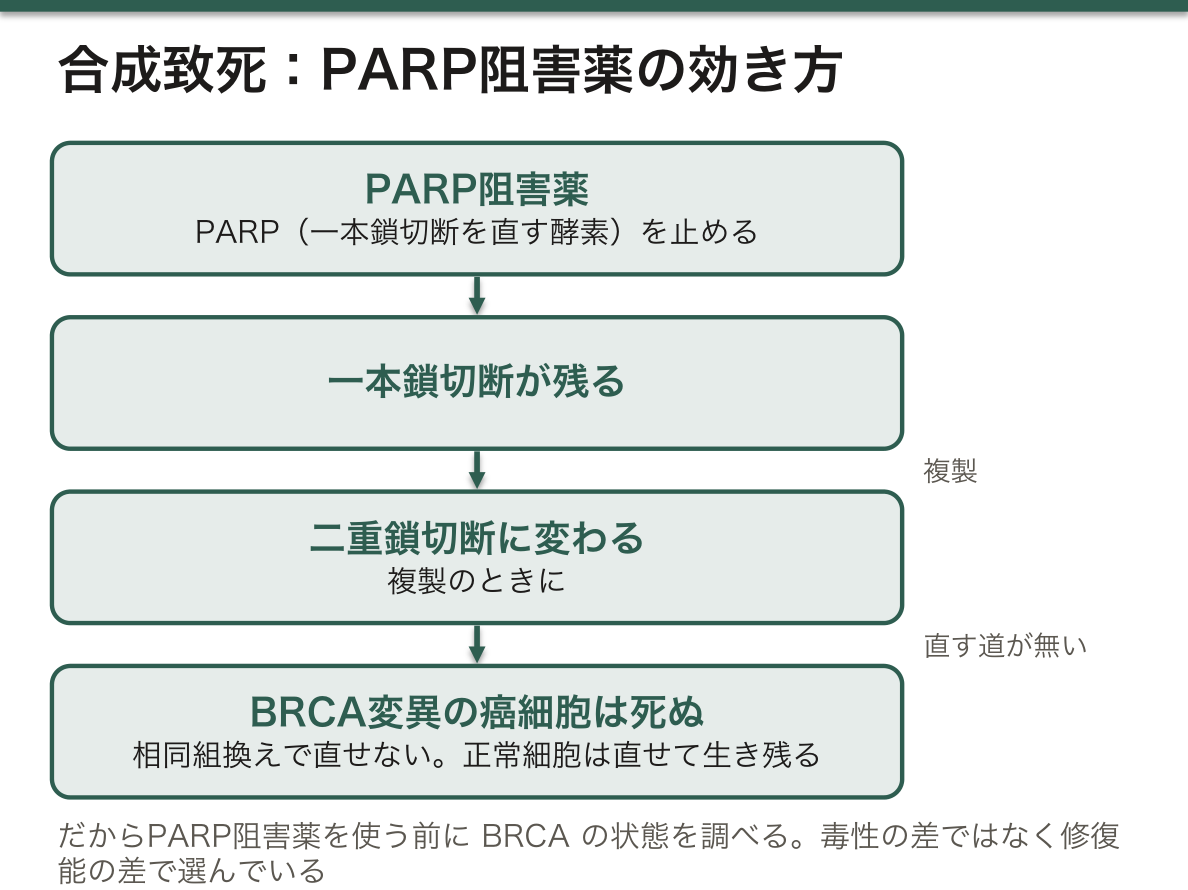
合成致死は「片方だけでは死なないが、両方だと死ぬ」という組み合わせの治療になる。正常細胞は相同組換えが使えるので生き残り、癌細胞だけが死ぬ(発癌の分子機構の章)——「毒性の差を、細胞の側の欠陥から作り出している」。
だから PARP 阻害薬を使う前に、BRCA の状態を調べる(分子標的薬の章)——「薬を選ぶために、遺伝子を測るという順序になる」。
生殖細胞系列の変異が見つかると、話が本人だけで終わらない。血縁者にも 1/2 の確率で伝わるので、遺伝カウンセリングが要る(遺伝性腫瘍の章)——「治療の検査が、家族の情報を生んでしまう」。
Lynch 症候群は、別の修復系(ミスマッチ修復)の異常になる。マイクロサテライト不安定性が高くなり、免疫チェックポイント阻害薬が効きやすい(腫瘍免疫の章)——「変異が多い腫瘍ほど、免疫から見つけられやすい」。
修復系の欠陥が、そのまま治療の弱点になるという構図が共通している——「壊れている場所が、狙える場所になる」。
English version
Core
A double-strand break in DNA has two ways of being repaired.
| Homologous recombination repair | Non-homologous end joining | |
|---|---|---|
| Template | Uses the sister chromatid | Uses none |
| Accuracy | Accurate | Inaccurate (bases are lost) |
| Phase | S and G2 | Any time |
| Principals | BRCA1/BRCA2, RAD51 | Ku70/80, DNA-PK |
Mutations of BRCA1/2 cause hereditary breast and ovarian cancer syndrome (autosomal dominant) — breast, ovarian, prostate and pancreatic cancer.
PARP is the enzyme repairing single-strand breaks. Stop PARP and single-strand breaks become double-strand breaks.
Stop PARP as well in a cell whose homologous recombination is broken, and both routes of repair are gone and it dies (synthetic lethality).
Going further
- Synthetic lethality is a treatment built on the combination "either alone does not kill; both together do". The normal cell survives because it can use homologous recombination, and only the cancer cell dies (the chapter on the molecular mechanisms of carcinogenesis) — the difference in toxicity created out of a defect on the side of the cell.
- Hence the BRCA status is tested before a PARP inhibitor is used (the chapter on molecularly targeted drugs) — measuring a gene in order to choose a drug, in that order.
- When a germline mutation is found, the matter does not end with the patient. It passes to blood relatives with a probability of one half, so genetic counselling is needed (the chapter on hereditary tumours) — a test for treatment generating information about the family.
- Lynch syndrome is an abnormality of another repair system (mismatch repair). Microsatellite instability becomes high and immune checkpoint inhibitors work readily (the chapter on tumour immunity) — the more mutations a tumour has, the more readily immunity finds it.
- The common structure is that a defect in repair becomes, directly, a weakness for treatment — the broken place being the place that can be aimed at.
紫外線とヌクレオチド除去修復 — 日光が作る、たった1種類の傷
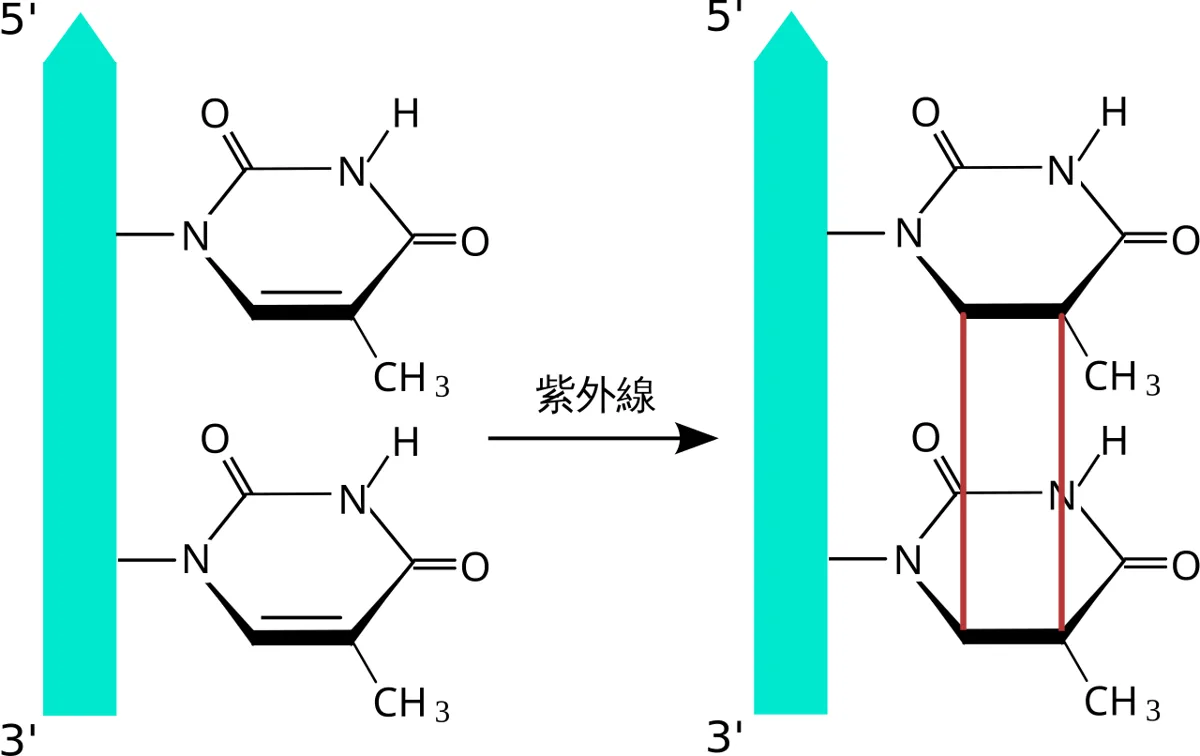
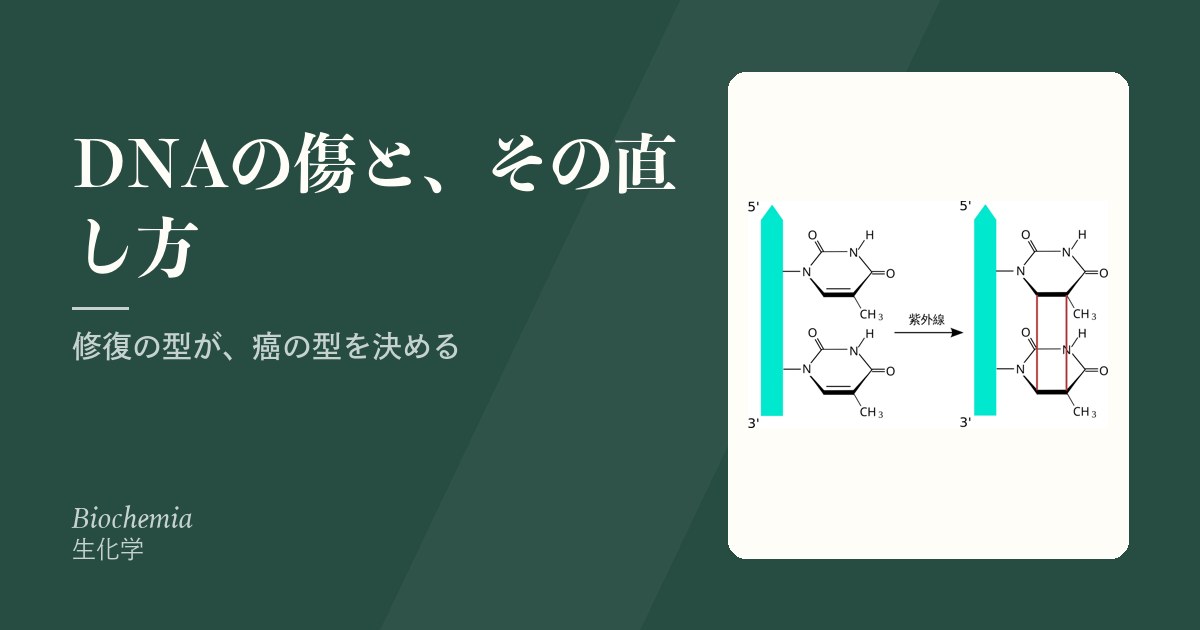
紫外線は、隣り合うピリミジン(主にチミン)を共有結合させる——ピリミジン二量体。らせんが歪み、複製と転写が止まる。
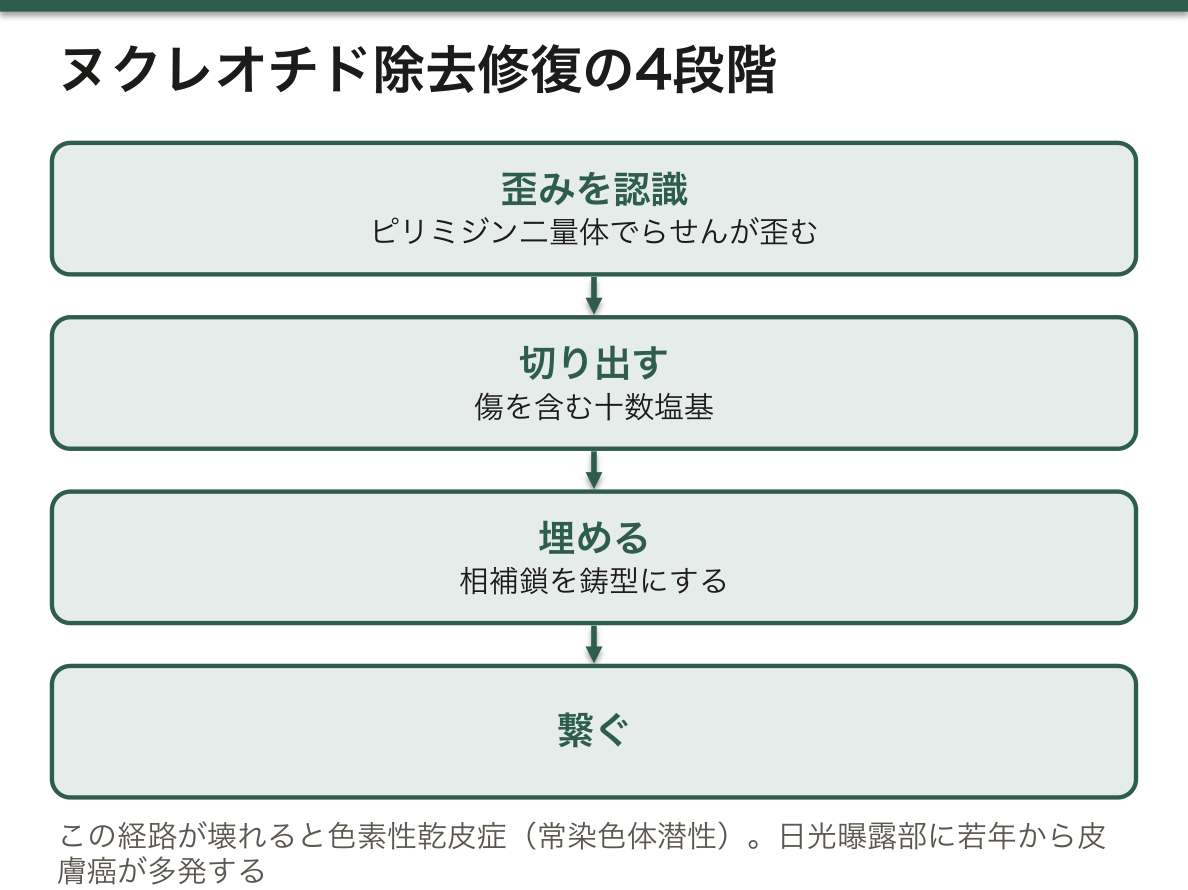
これを直すのがヌクレオチド除去修復——歪みを認識 → 傷を含む十数塩基を切り出す → 相補鎖を鋳型に埋める → 繋ぐ。
色素性乾皮症(常染色体潜性)は、この経路の異常になる。
- 乳幼児期からの高度の日光過敏・雀卵斑様の色素斑
- 皮膚癌が若年で多発する(基底細胞癌・扁平上皮癌・悪性黒色腫)
- 一部の型では神経症状を伴う
紫外線の波長——UVB(280〜315 nm)が二量体を作り、日焼けと発癌の主役。UVA は真皮まで届き、光老化に関わる。
修復系ごとに、対応する傷と病気が一対一で決まっている。
| 修復系 | 傷 | 壊れると |
|---|---|---|
| ヌクレオチド除去 | 紫外線によるかさばる傷 | 色素性乾皮症 |
| ミスマッチ | 複製の誤り | Lynch 症候群 |
| 相同組換え | 二重鎖切断 | 遺伝性乳癌卵巣癌症候群・Fanconi 貧血 |
| 塩基除去 | 酸化・脱アミノ | MUTYH 関連ポリポーシス |
(この章の5つの修復系の項)——「どの傷を直せないかが、どこに癌ができるかを決めている」。
色素性乾皮症の管理は、原因を断つことに尽きる。徹底的な遮光と、皮膚の定期的な観察(皮膚腫瘍の章)——「治す薬が無い病気で、曝露を減らすことが唯一の治療になる」。
日焼け止めの SPF は UVB、PA は UVA に対する指標になる(物理と化学が起こす皮膚障害の章)——「2つの波長に、別々の指標が要る理由が、傷の作られ方の違いにある」。
English version
Core
Ultraviolet light covalently joins adjacent pyrimidines (chiefly thymine) — a pyrimidine dimer. The helix is distorted and replication and transcription stop.
Nucleotide excision repair corrects it — recognise the distortion → excise a dozen or so bases including the damage → fill in using the complementary strand as template → ligate.
Xeroderma pigmentosum (autosomal recessive) is an abnormality of this pathway.
- Severe photosensitivity from infancy, freckle-like pigmentation.
- Multiple skin cancers at a young age (basal cell carcinoma, squamous carcinoma, melanoma).
- Some forms are accompanied by neurological signs.
The wavelengths — UVB (280–315 nm) makes the dimers and is the principal agent of sunburn and carcinogenesis. UVA reaches the dermis and is involved in photoageing.
Going further
For each repair system the damage and the disease correspond one to one.
| Repair system | Damage | When it breaks |
|---|---|---|
| Nucleotide excision | Bulky damage from ultraviolet light | Xeroderma pigmentosum |
| Mismatch | Errors of replication | Lynch syndrome |
| Homologous recombination | Double-strand breaks | Hereditary breast and ovarian cancer syndrome, Fanconi anaemia |
| Base excision | Oxidation, deamination | MUTYH-associated polyposis |
(the section on the five repair systems in this chapter) — which damage cannot be repaired deciding where the cancer forms.
- The management of xeroderma pigmentosum amounts to cutting off the cause. Thorough protection from light and regular inspection of the skin (the chapter on skin tumours) — in a disease with no curative drug, reducing exposure is the only treatment.
- The SPF of a sunscreen is an index against UVB and PA against UVA (the chapter on skin damage from physics and chemistry) — the reason two wavelengths need separate indices lies in the difference in how the damage is made.
酸化された G が、変異を作る — 塩基除去修復と MUTYH
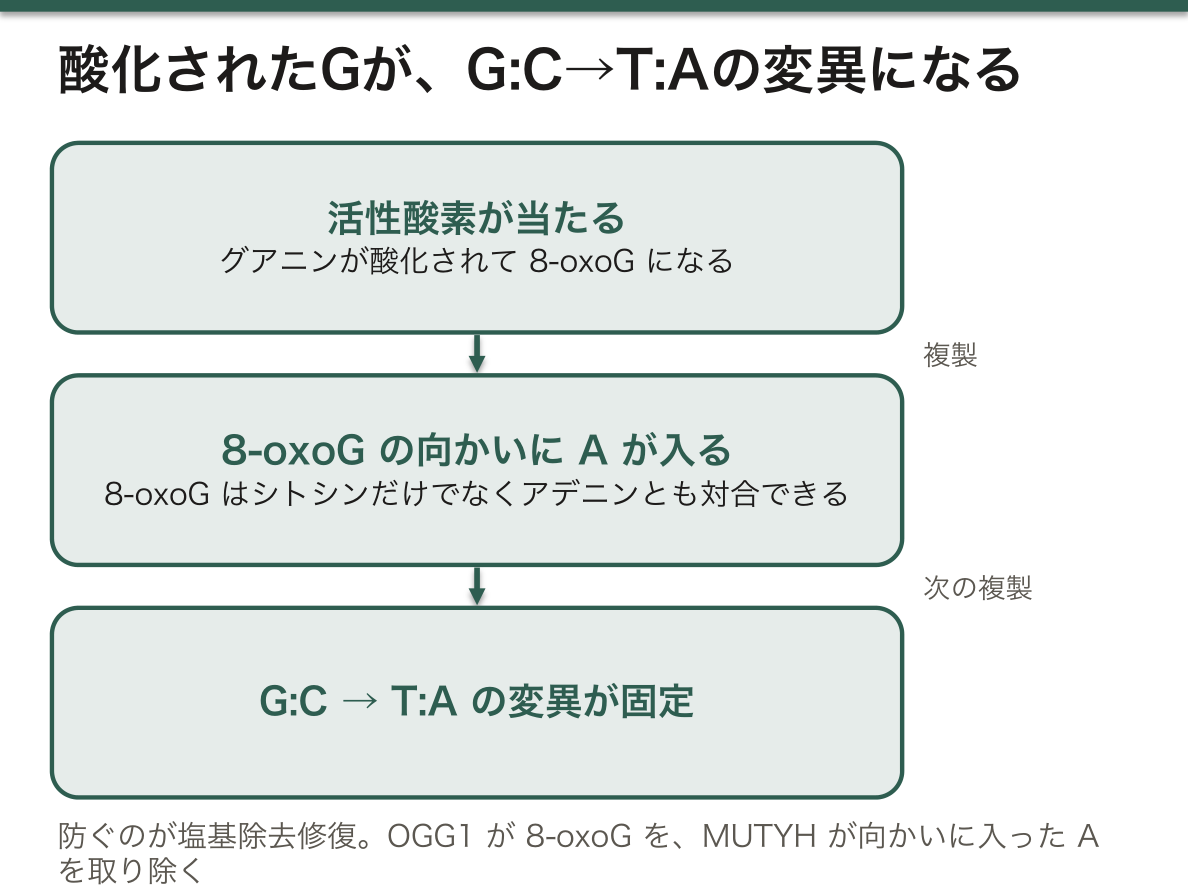
活性酸素が DNA に当たると、グアニンが酸化されて 8-oxoG になる。1 細胞あたり 1 日に数百〜数千個できるとされ、最も頻度の高い酸化的 DNA 損傷である。
やっかいなのは、8-oxoG がシトシンだけでなくアデニンとも対合できることである。
- 複製で 8-oxoG の向かいに A が入る
- 次の複製で G:C → T:A の変異が固定される
これを防ぐのが塩基除去修復で、傷んだ塩基だけを切り出して入れ替える(他の修復系は、鎖ごと/範囲ごと直す)。OGG1 が 8-oxoG を、MUTYH が「8-oxoG の向かいに入ってしまった A」を取り除く。
MUTYH が両アレルとも壊れると、大腸のポリポーシスになる。
| 家族性大腸腺腫症(FAP) | MUTYH 関連ポリポーシス | |
| 遺伝形式 | 常染色体顕性(APC) | 常染色体潜性 |
| 家族歴 | 親から縦に伝わる | 親は無症状。同胞に集まる(横に並ぶ) |
| ポリープ数 | 数百〜数千 | 数十〜数百(比較的少ない) |
| 発症年齢 | 10 代から | やや遅い(40〜50 代) |
「家族歴が無いポリポーシス」を見たときに思い出すのが、この疾患の位置づけである。潜性なので孤発例に見える。APC の変異が見つからないポリポーシスでは MUTYH を調べる。
修復系ごとに、対応する疾患が決まっているという枠組みで整理すると忘れにくい。
- 塩基除去修復(酸化・脱アミノ)→ MUTYH 関連ポリポーシス
- ヌクレオチド除去修復(紫外線)→ 色素性乾皮症
- ミスマッチ修復(複製の誤り)→ Lynch 症候群
- 相同組換え修復(二本鎖切断)→ 遺伝性乳癌卵巣癌症候群
若年の大腸癌や多発ポリープでは、親だけでなく同胞まで家族歴を聞く。潜性疾患は世代を縦に辿っても見つからない。
English version
Core
When reactive oxygen strikes DNA, guanine is oxidised to 8-oxoG. Several hundred to several thousand are made per cell per day, the commonest oxidative DNA damage.
What makes it troublesome is that 8-oxoG can pair with adenine as well as with cytosine.
- At replication an A is put opposite the 8-oxoG.
- At the next replication the mutation G:C → T:A is fixed.
What prevents this is base excision repair, which cuts out and replaces the damaged base alone (the other systems repair by strand or by stretch). OGG1 removes 8-oxoG and MUTYH removes "the A that has been put opposite an 8-oxoG".
Going further
When both alleles of MUTYH are broken, it gives a polyposis of the colon.
| Familial adenomatous polyposis (FAP) | MUTYH-associated polyposis | |
|---|---|---|
| Inheritance | Autosomal dominant (APC) | Autosomal recessive |
| Family history | Passes vertically from a parent | The parents are unaffected. It gathers in the siblings (horizontally) |
| Number of polyps | Hundreds to thousands | Tens to hundreds (relatively few) |
| Age at onset | From the teens | Somewhat later (40s–50s) |
The place of this disease is that it is what to recall on seeing a polyposis without a family history. Being recessive, it looks sporadic. In a polyposis with no APC mutation, test MUTYH.
Arranged in the framework that each repair system has its corresponding disease, it is not readily forgotten.
- Base excision repair (oxidation, deamination) → MUTYH-associated polyposis
- Nucleotide excision repair (ultraviolet light) → xeroderma pigmentosum
- Mismatch repair (errors of replication) → Lynch syndrome
- Homologous recombination repair (double-strand breaks) → hereditary breast and ovarian cancer syndrome
In the clinic
In colorectal cancer or multiple polyps in a young person, take the family history of the siblings as well as the parents. A recessive disease is not found by tracing generations vertically.
変異には署名がある — どの原因が傷つけたかが、パターンに残る
変異は無作為に起きるのではない。原因ごとに、変わりやすい塩基と前後の並びが決まっている。腫瘍の全ゲノムを読むと、この偏りが変異シグネチャーとして読み取れる。
| 紫外線 | 隣り合うピリミジンで C→T | 皮膚の悪性黒色腫・扁平上皮癌 |
| 喫煙 | G→T(ベンゾピレンの付加体) | 肺癌 |
| アフラトキシン | G→T(p53 の 249 番) | 肝細胞癌 |
| ミスマッチ修復の欠損 | 反復配列の伸縮 | マイクロサテライト不安定性。免疫チェックポイント阻害薬が効きやすい |
| APOBEC | 特定の並びで C→T/C→G | 本来ウイルス防御の酵素が、自分のゲノムを傷つけている |
| 加齢 | CpG の C→T | どの腫瘍にも一定量ある。時計のように蓄積する |
加齢のシグネチャーには、はっきりした化学的な理由がある。
シトシンは自然に脱アミノしてウラシルになるが、ウラシルは DNA には無い塩基なので、修復系がすぐ気づいて直せる。ところがメチル化されたシトシン(5-メチルシトシン)が脱アミノすると、チミンになる——チミンは正規の塩基なので、どちらが元か分からない。
だから CpG 配列は変異のホットスポットになる。ヒトゲノムで CpG が予想より少ないのも、進化の時間をかけて削られてきたからだと説明される。p53 の変異もこの部位に集中する。
「傷は外から来るものだけではない」ことも押さえる。自然な加水分解による脱プリン(1 細胞 1 日に約 1 万か所)、脱アミノ、代謝で生じる活性酸素——何もしていなくても DNA は壊れ続けている。修復は、環境に対してではなく化学そのものに対して働いている。
臨床への応用が始まっている。相同組換え修復の欠損に特徴的なシグネチャーがあれば、BRCA 変異が見つからなくてもPARP 阻害薬が効く可能性があると判断する、という使い方が検討されている。
「原因不明の癌」でも、ゲノムの傷のパターンが原因を示唆することがある。治療選択に直結する情報として使われ始めている。
English version
Core
Mutations do not arise at random. For each cause, the bases that change readily and the sequence around them are fixed. Read the whole genome of a tumour and this bias can be read as a mutational signature.
| Ultraviolet light | C→T at adjacent pyrimidines | Cutaneous melanoma, squamous carcinoma |
| Smoking | G→T (benzopyrene adducts) | Lung cancer |
| Aflatoxin | G→T (codon 249 of p53) | Hepatocellular carcinoma |
| Defective mismatch repair | Expansion and contraction of repeats | Microsatellite instability. Immune checkpoint inhibitors work readily |
| APOBEC | C→T / C→G in particular contexts | An enzyme meant for defence against viruses damaging one’s own genome |
| Ageing | C→T at CpG | Present in a certain amount in every tumour. It accumulates like a clock |
Going further
The signature of ageing has a clear chemical reason.
Cytosine deaminates spontaneously to uracil, but uracil is not a base of DNA, so the repair systems notice at once and correct it. When methylated cytosine (5-methylcytosine) deaminates, however, it becomes thymine — and thymine is a legitimate base, so which was the original cannot be told.
Hence CpG sequences are hotspots of mutation. That CpG is scarcer in the human genome than expected is explained as having been worn away over evolutionary time. Mutations of p53 concentrate at these sites too.
Hold also that damage does not only come from outside. Spontaneous hydrolytic depurination (about 10,000 sites per cell per day), deamination, reactive oxygen from metabolism — DNA goes on breaking even when nothing is being done. Repair works not against the environment but against chemistry itself.
Clinical application has begun. The use is being considered of judging that, where a signature characteristic of defective homologous recombination repair is present, a PARP inhibitor may work even without a BRCA mutation being found.
In the clinic
Even in a "cancer of unknown cause", the pattern of damage in the genome may indicate the cause. It is beginning to be used as information bearing directly on the choice of treatment.
まとめ
| 5つの修復系 — 傷の種類に対応している | 修復系直す傷壊れるとヌクレオチド除去修復紫外線によるピリミジン二量体色素性乾皮症ミスマッチ修復複製時の塩基の入れ違いLynch症候群・マイクロサテライト不安定性塩基除去修復酸化・脱… |
|---|---|
| 変異の種類と、それが起こすこと | 種類内容結果同義置換塩基は変わるがアミノ酸は同じ通常は無影響(スプライシングに影響することはある)ミスセンスアミノ酸が変わる機能が変わる(鎌状赤血球症)ナンセンス終止コドンになる短… |
| 相同組換え修復と合成致死 — 直せない癌を、別の修復ごと止める | DNA の二重鎖切断には、2つの直し方がある。 |
| 紫外線とヌクレオチド除去修復 — 日光が作る、たった1種類の傷 | 紫外線は、隣り合うピリミジン(主にチミン)を共有結合させる——ピリミジン二量体。 |
| 酸化された G が、変異を作る — 塩基除去修復と MUTYH | 活性酸素が DNA に当たると、グアニンが酸化されて 8-oxoG になる。 |
| 変異には署名がある — どの原因が傷つけたかが、パターンに残る | 変異は無作為に起きるのではない。原因ごとに、変わりやすい塩基と前後の並びが決まっている。 |
このノートは医学生が授業の内容を自分の言葉でまとめたもので、診療の判断に使うものではありません。誤りに気づいたらお知らせください。