医療は成功するほど需要が増える。だから資源は常に足りない。足りないものをどう分けるかが分配的正義の問題であり、国の予算(マクロ)から病院の中の配分(メゾ)、目の前のどの患者に治療を回すか(ミクロ)まで、あらゆる層で現れる。
この章では、正義の種類から始め、配分のレベル、くじ引きから社会的有用性までの8つの配分原則とその問題、原則を組み合わせた QALY と完全な人生システム、背景にある正義の理論、そして集団と個人がぶつかる公衆衛生倫理を見る。
覚えておく一文:「生物医学の事実は予後を決めるが、その事実にどう応じるかは価値判断である」。数字で決まる配分は存在しない。
- 正義の種類 — 「不公平だ」と感じる仕組み
- 分配的正義とマクロ・メゾ・ミクロの配分
- 配分の原則 — 4つの類と8つの原則
- QALY と EQ-5D — 生存の「量」と「質」を掛け合わせる
- 完全な人生システム — 人生全体を見て配分する
- 正義の理論 — 無知のヴェール・正常な機会・潜在能力
- 公衆衛生倫理 — 集団の利益と個人の自由
正義の種類 — 「不公平だ」と感じる仕組みIustitia
正義は単純でもあり複雑でもある。子どもは早くから「ずるい」と言うし、ヒト以外の動物にも公平への感受性が見られる。2匹のオマキザルに同じ作業をさせ、一方にはキュウリ、他方にはより好物のブドウを与えると、キュウリを渡されたサルはそれを投げ返して受け取りを拒む、という有名な実験がある。
正義にはいくつかの種類がある。
| 種類 | 扱うもの | 医療での例 |
|---|---|---|
| 分配的正義 | 社会の利益と負担を公正に分ける | 臓器・ICU病床・医療費の配分 |
| 応報的正義 | 不正に対して釣り合った罰を与える | 医療過誤・研究不正への処分 |
| 修復的正義 | 害を受けた人と害を与えた人の関係・損害を修復する | 医療事故後の謝罪・説明・補償 |
| 手続き的正義 | 決め方そのものが公正である | 配分基準を公開し、異議を申し立てられる |
生命倫理で中心になるのは分配的正義である。
公正の基本はアリストテレスの「等しいものは等しく、等しくないものは等しくなく扱え」である。平等に扱うとは、全員に同じものを与えることではない。関係のある違いに比例して扱うことであり、これを平等(equal)に対して衡平(equitable)な扱いと呼ぶ。
では何が「関係のある違い」か。年齢、病気の重さ、治療で得られる利益の大きさは関係しうる。一方、性別・民族・宗教・社会階層は、少なくとも一見したところ関係しない。支払い能力も、治療から利益を受ける能力とは無関係なので、医療の配分基準としては不公正だと考えられる。分配のどの原則も、この「関係のある違い」を何に置くかの違いだと見ると、以下の項目が整理しやすい。
手続き的正義は、配分の答えが割れる場面ほど重要になる。どの原則を採るかで全員が合意できなくても、基準が事前に公開され、一貫して適用され、理由が説明され、見直しの道があるなら、結果を受け入れやすくなる。日本の臓器移植の待機者選定が、公開された基準に従って行われているのはこの考え方による。
English version
Core
Justice is both simple and complex. Children say ‘that’s not fair!’ very early, and animals other than humans show a sense of fairness too. In a famous experiment, two capuchin monkeys did the same task; one got cucumber, the other got grapes, which they prefer. The monkey given cucumber threw it back and refused it.
There are several types of justice.
| Type | What it deals with | Medical example |
|---|---|---|
| Distributive | Fair sharing of society’s benefits and burdens | Allocating organs, ICU beds, health budgets |
| Retributive | Punishment in proportion to wrongdoing | Sanctions for malpractice or research fraud |
| Restorative | Repairing the relationship and the damage between those harmed and those who harmed | Apology, explanation and compensation after a medical accident |
| Procedural | The way of deciding is itself fair | Publishing allocation rules and allowing appeals |
In bioethics the central type is distributive justice.
Going further
The basis of fairness is Aristotle’s ‘treat equals equally and unequals unequally‘. Treating people equally does not mean giving everyone the same thing. It means treating them in proportion to their relevant differences — equitable rather than equal treatment.
What counts as a relevant difference? Age, severity of illness and size of expected benefit may be relevant. Sex, ethnicity, religion and social class are, at least at first sight, not. Ability to pay is unrelated to ability to benefit, so it is an unfair basis for allocating care. Each allocation principle below can be seen as a different answer to what the relevant difference is.
In the clinic
Procedural justice matters most when people disagree about the answer. Even if not everyone accepts the same principle, outcomes are easier to accept when rules are published in advance, applied consistently, explained, and open to review. This is why the selection of transplant recipients in Japan follows published criteria.
分配的正義とマクロ・メゾ・ミクロの配分Iustitia distributiva
分配的正義が問題になるには2つの前提条件がある。資源が限られていること、そしてその資源をめぐって競合があることである。いくらでもあるものや、誰も欲しがらないものには配分の問題は生じない。医療では、成功するほど需要が増えるので(長生きするほど慢性疾患が増え、高額な技術への期待が高まる)、需要は常に供給を上回る。
| レベル | 何を決めるか | 例 |
|---|---|---|
| マクロ | 国の資源のうち医療にどれだけ回すか(教育・防衛などとの間)。医療の中で分野間の優先順位 | GDPの何%を医療費に。予防か急性期医療か |
| メゾ | 医療の資源を、サービスや患者集団の間でどう分けるか | 急性期病院か長期療養か。認知症ケアか高額な癌治療か |
| ミクロ | 足りない治療を、目の前のどの個人に回すか(配給) | 1つの肝臓を3人の誰に移植するか |
大づかみに言えば、マクロは「優先順位」、ミクロは「人」を選ぶ。マクロの決定は個人を名指ししないが、間接的に多くの人の生死を左右する。
メゾのレベルの問題をよく表すのが崖の村のたとえである。夜に崖から落ちる人が多い村が、崖下に救急隊とヘリを置く資金を集めた。ところが一人が、崖の上に柵を作り、街灯を増やせばよいと言った。医療の予算は、劇的な救命医療(崖の下)に偏りやすく、予防(崖の上の柵)は後回しにされがちだ。救命の予算を削ると「人が死ぬ」と訴えられて政治的に動かせない。だが本来避けられた病気や苦しみを抱える人が出るのだから、救命ばかりを優先するのは不公正でもある。
もう一つが英国の医師チューダー・ハートの逆ケアの法則(1971年)である。良い医療が受けられる度合いは、その地域の必要と逆比例する。医療者は恵まれた地域で働きたがり、困窮した地域の人は医療を信頼できず受診を避ける。住む場所という道徳的に関係のない違いで、同じ必要が不平等に満たされている。
日本でも、医師の地域偏在・診療科偏在はマクロ・メゾの配分問題である。米国は医療費がGDP比で最も高い国の一つでありながら、乳児死亡率や平均寿命では多くの国に劣る。健康を決めるのは医療費の額だけでなく、それが公正かつ効率的に配分されているか、そして貧困・住居・教育などの健康の社会的決定要因である。
English version
Core
Distributive justice needs two preconditions: resources are limited, and people compete for them. There is no allocation problem for things that are unlimited or that no one wants. In medicine, success raises demand (longer lives bring more chronic disease and higher expectations of costly technology), so demand always exceeds supply.
| Level | What is decided | Example |
|---|---|---|
| Macro | How much of national resources goes to health (versus education, defence); priorities between areas within health | What % of GDP for health; prevention or acute care |
| Meso | How health resources are shared among services or patient groups | Acute hospitals or long-term care; dementia care or costly cancer drugs |
| Micro | Which individual gets a scarce treatment (rationing) | Which of three patients gets one liver |
Roughly, macro chooses priorities; micro chooses people. Macro decisions name no one, but indirectly decide many lives.
Going further
The village on the cliff illustrates the meso level. Villagers kept falling off a cliff at night, so the village raised money for an ambulance and a helicopter at the bottom. Then someone suggested a fence and better lighting at the top. Health budgets tend to favour dramatic rescue medicine (the bottom of the cliff) and neglect prevention (the fence). Cutting rescue budgets is politically impossible because ‘people will die’. Yet putting all priority on rescue is also unfair, because others suffer illness that could have been prevented.
Another is Tudor Hart’s inverse care law (1971): the availability of good medical care varies inversely with the need of the population served. Clinicians prefer to work in better-off areas, and people in deprived areas often distrust services and avoid them. The same need is met unequally because of a morally irrelevant difference: where people live.
In the clinic
In Japan, the uneven distribution of doctors between regions and specialties is a macro- and meso-level problem. The US spends one of the highest shares of GDP on health, yet ranks behind many countries in infant mortality and life expectancy. Health depends not only on how much is spent but on whether it is spent fairly and efficiently, and on social determinants of health such as poverty, housing and education.
配分の原則 — 4つの類と8つの原則
足りない資源を誰に配るか。価値判断を含まない基準は存在しない。予後や必要な量は生物医学の事実で決まるが、その事実にどう応じるかは倫理的な判断である。原則は大きく4つの類に分けられる(ペルサドらの整理)。
| 類 | 原則 | 主な問題 |
|---|---|---|
| 全員を等しく扱う | くじ引き | 必要や予後の違いを無視する |
| 先着順 | 情報やコネ、地理的に近い人が有利になる | |
| 最も不利な人を優先 | 最も重症な人から | 助かる見込みの低い人に資源が回り、全体の救命数が減ることがある |
| 最も若い人から | 乳児を最優先すべきかで議論が分かれる | |
| 全体の利益を最大化 | 最も多くの命を救う | 一人ひとりの違いを数で塗りつぶす |
| 予後(得られる生存年数) | 高齢者・障害者に不利になる | |
| 社会的有用性 | 道具的価値(社会に役立つ人を) | 人の価値を役割で測る危険 |
| 互恵性(過去に貢献した人を) | 何を貢献と数えるか、恣意的になりやすい |
どの原則にも問題がある。その問題には2種類あり、原則が不十分(それだけでは決まらない)なのか、欠陥がある(それ自体が不正義を生む)なのかを区別することが大切である。
この区別がなぜ大事か。不十分な原則は、他の原則と組み合わせれば使える。たとえばくじ引きは、予後の同じ候補者の間で最後に決める手段としては公正である。先着順は単独では不公正でも、待機時間をいくつかの基準の一つとして使うことはできる。一方、欠陥のある原則は、組み合わせても不正義を持ち込む。たとえば「社会に役立つ人」を職業や収入で測れば、差別そのものになる。
例外的に、道具的価値は限られた場面で使われる。感染症の流行時に、他の人を救える医療従事者にワクチンを優先するのは、彼ら個人の価値が高いからではなく、その人を通じて多くの人が救われるからである。互恵性も、臓器提供の登録者を優先する仕組みや、過去に研究に参加した人への配慮として議論される。どの原則も単独では足りない——だから次の項目のような原則の組み合わせ(配分システム)が必要になる。
3人の候補者に1つの肝臓がある場面を考えるとよい。若いが病状は安定している人、最も重症で予後の悪い人、子どもを育てている人。誰を選ぶかは、どの原則を重く見るかでそれぞれ変わる。実際の移植ネットワークは、適合性・医学的緊急度・待機期間など複数の基準に点数をつけて組み合わせ、一つの原則に頼らないようにしている。
English version
Core
Who should get a scarce resource? There are no criteria free of value judgements. Biomedical facts determine prognosis or the dose needed, but responding to those facts requires ethical judgement. The principles fall into four groups (Persad and colleagues).
| Group | Principle | Main problem |
|---|---|---|
| Treat everyone equally | Lottery | Ignores differences in need and prognosis |
| First come, first served | Favours people with information, connections or closeness | |
| Favour the worst-off | Sickest first | Resources go to those least likely to survive; total lives saved may fall |
| Youngest first | Disagreement over whether infants should come first | |
| Maximise total benefits | Save the most lives | Individual differences are lost in numbers |
| Prognosis (life-years gained) | Disadvantages older and disabled people | |
| Social usefulness | Instrumental value (those useful to society) | Risk of valuing people by their role |
| Reciprocity (those who contributed) | What counts as contribution easily becomes arbitrary |
Every principle has problems. It is important to tell whether a principle is insufficient (cannot decide alone) or flawed (creates injustice by itself).
Going further
Why does this matter? An insufficient principle can be used together with others. A lottery is fair as a final tie-breaker among candidates with the same prognosis. First come, first served is unfair alone, but waiting time can be one criterion among several. A flawed principle brings injustice even in combination: measuring ‘usefulness’ by job or income is simply discrimination.
Instrumental value is used in limited situations. In an epidemic, giving vaccines first to health workers is not because they are worth more, but because many others are saved through them. Reciprocity is discussed for giving priority to registered organ donors or to people who took part in research. No principle is enough alone — so we need combinations of principles (allocation systems), as in the next items.
In the clinic
Imagine one liver and three candidates: a young person whose condition is stable, the sickest person with a poor prognosis, and a parent raising children. The choice changes depending on which principle weighs most. Real transplant networks score several criteria — compatibility, medical urgency, waiting time — and combine them, so that no single principle decides.
QALY と EQ-5D — 生存の「量」と「質」を掛け合わせる
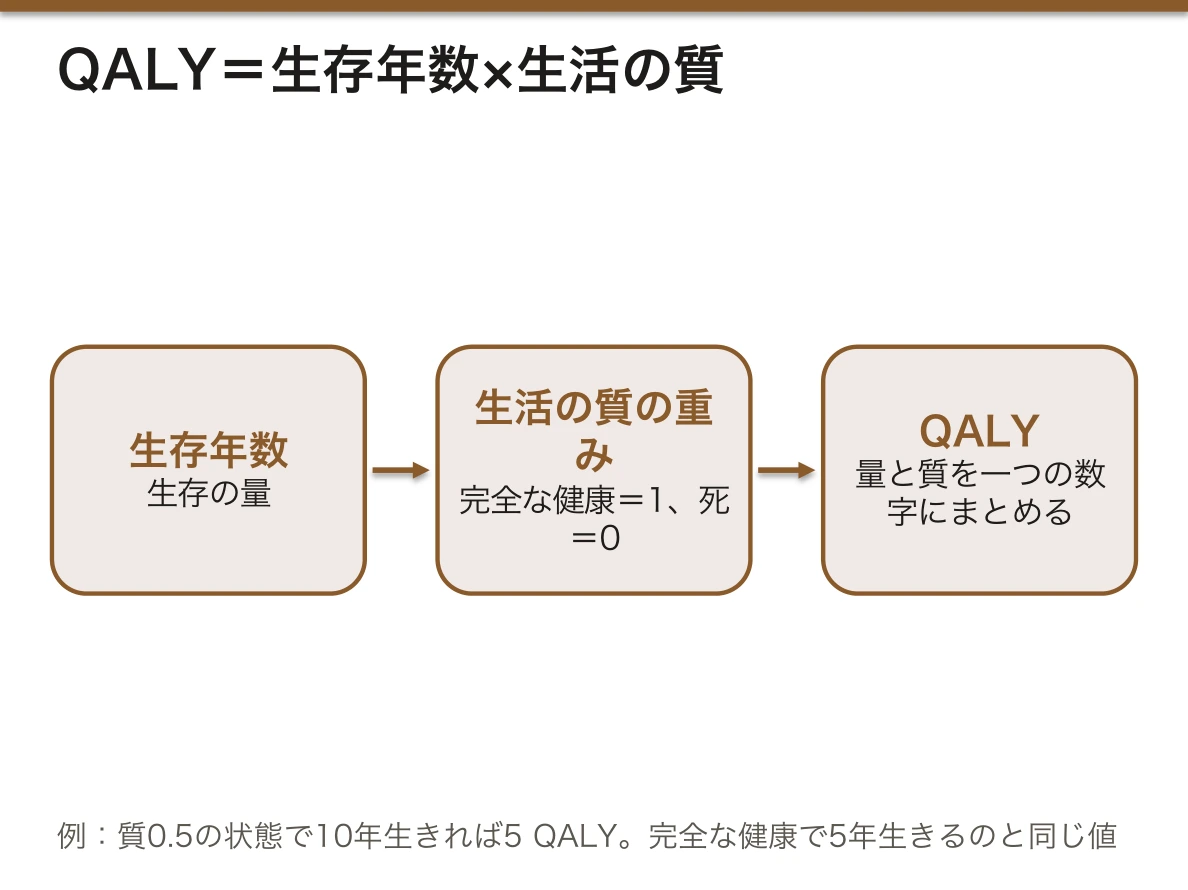
QALY(質調整生存年)は、配分の原則を組み合わせた代表的な仕組みで、2つの要素からなる。生存年数(量)と、その年の生活の質(質)である。質は「完全な健康=1、死=0」の尺度で表し、生存年数×質の重みで計算する。たとえば質0.5の状態で10年生きれば5 QALY、完全な健康で5年生きるのと同じ値になる。
QALY には最大化の要請が組み込まれている。限られた予算で、得られる QALY の合計が最大になるように資源を配る、という考え方である。量と質を一つの数字にまとめるので、まったく違う病気の治療どうしを比べられる。
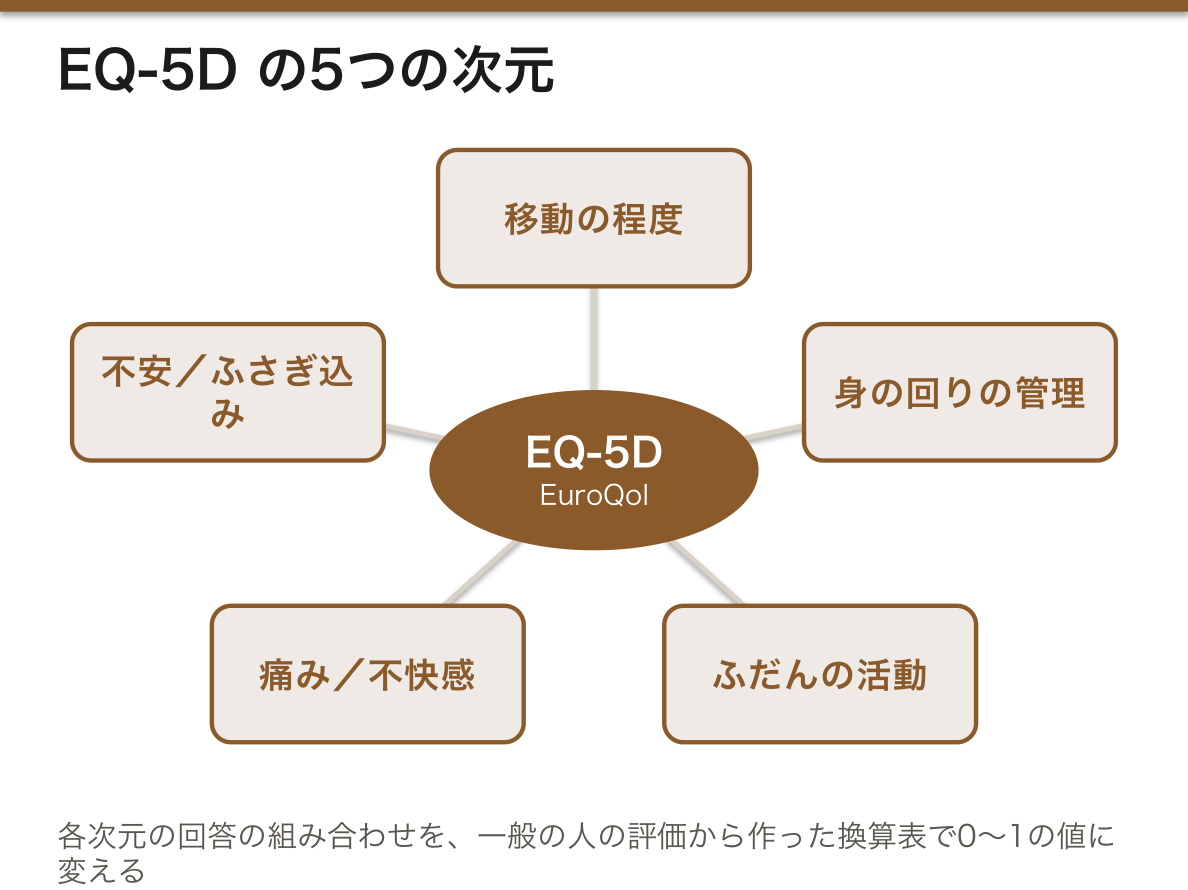
質の重みを決める代表的な道具が EQ-5D である。EQ は EuroQol(開発した国際グループ)、5D は5つの次元——移動の程度・身の回りの管理・ふだんの活動・痛み/不快感・不安/ふさぎ込み——を指す。各次元の回答の組み合わせを、一般の人の評価から作った換算表で0〜1の値に変える。
QALY への批判は2つに集約される。1つは生活の質の主観性である。同じ障害でも、本人の感じ方と、健康な一般人が想像する重さは違う。障害とともに暮らす人は自分の生活の質を、外から見積もられるより高く評価することが多い。一般の人の評価で重みを決めれば、障害のある人の命の価値を低く数えることになりかねない。
もう1つは関係のある道徳的考慮を無視することである。QALY は「合計」だけを見るので、誰にその QALY が配られるかを問わない。重症の人を少し良くすることと、軽症の人を大きく良くすることを、同じ物差しで並べてしまう。また、余命が短い高齢者は治療で得られる QALY が小さくなりやすく、年齢による差別だと批判される。救命できるかどうかの瀬戸際にいる人への配慮(救済の規則)も、QALY の計算には入らない。
日本でも2019年度から費用対効果評価の制度が始まり、一部の高額な新薬・医療機器について、1 QALY を得るのにかかる費用(増分費用効果比)を評価して価格を調整している。英国の NICE も QALY をもとに公的医療での採用を判断している。医療経済の数字の背後には、ここで見た価値判断がある。
English version
Core
The QALY (quality-adjusted life-year) is a leading system that combines principles. It has two elements: years of life (quantity) and the quality of those years. Quality is scored from 1 (full health) to 0 (death), and QALYs = years × quality weight. Ten years at quality 0.5 gives 5 QALYs — the same as five years in full health.
QALYs include a maximising requirement: allocate a limited budget to gain the largest total of QALYs. Because quantity and quality become one number, treatments for completely different diseases can be compared.
A common tool for quality weights is EQ-5D. EQ stands for EuroQol (the international group that made it); 5D means five dimensions — mobility, self-care, usual activities, pain/discomfort and anxiety/depression. The combination of answers is converted to a value between 0 and 1 using a table based on the public’s valuations.
Going further
Criticisms come down to two. The first is the subjectivity of quality of life. People living with a disability often rate their quality of life higher than healthy people imagine. If public valuations set the weights, the lives of disabled people may be counted as worth less.
The second is that QALYs ignore relevant moral considerations. They look only at the total, not at who gets the QALYs. Making a very sick person a little better and a mildly ill person much better are placed on the same scale. Older people with short life expectancy tend to gain fewer QALYs, so the method is accused of age discrimination. Concern for people on the edge of death (the ‘rule of rescue’) is not in the calculation either.
In the clinic
Since 2019 Japan has had a cost-effectiveness evaluation system. For some expensive new drugs and devices, the cost per QALY gained (the incremental cost-effectiveness ratio) is assessed and prices are adjusted. In the UK, NICE uses QALYs to decide what the public system will fund. Behind the numbers of health economics lie the value judgements discussed here.
完全な人生システム — 人生全体を見て配分する
完全な人生システム(complete lives system)は、QALY とは別の配分システムで、ある時点の利益ではなく人生全体を見る。すべての人に、子ども時代から老年まで、人生の各段階を生きる機会が公正に与えられるべきだ、という考え方である。次の5つの原則を組み合わせる。
| 原則 | システムの中での役割 |
|---|---|
| 若年優先 | まだ人生の段階を生きていない人を優先する(中心となる原則) |
| 予後 | 治療で得られる生存年数を考える |
| 最多救命 | より多くの命を救える配分を選ぶ |
| くじ引き | 条件の同じ人の間で公正に決める |
| 道具的価値 | 流行時のワクチン接種者など、他者を救うのに必要な人に限って考慮する |
先着順・最重症優先・互恵性のように欠陥を抱えやすい原則は、意図的に外されている。
若年優先が中心になる理由は、「公正な機会」論にある。20歳で死ぬ人は人生の多くの段階を奪われるが、80歳で死ぬ人はすでにそれを生きてきた。どちらの死も悲劇だが、奪われるものの量が違う。人は誰でも若いときと年老いたときを経験するので、生涯を通して見れば、若い人を優先する仕組みは全員を等しく扱っているとも言える。年齢による差別とは違う、という主張である。
ただしこのシステムは、若年優先を単純に「年齢が低いほど優先」とはしない。乳児よりも、人生の計画や人間関係にすでに多くを注いできた思春期から若年成人を厚く扱う形に修正している。これに対しては、乳児の命を軽く見るものだという強い批判がある。また、どの原則にどれだけの重みを置くかは、システムの外からの価値判断に委ねられる。QALY も完全な人生システムも、「数字で決まる」のではなく、どんな価値を組み込んだかを公開して議論するための道具である。
感染症の大流行で人工呼吸器や ICU 病床が足りなくなったとき、各国でトリアージの基準づくりが急がれ、年齢をどう扱うかが大きな論点になった。日本でも学会などがこの問題を議論した。こうした場面で、どの原則を採り、それをどう公開し、誰が決めるのかは、医療者が当事者として向き合う問題である。
English version
Core
The complete lives system is an allocation system different from QALYs. It looks at the whole life, not the benefit at one moment: everyone should have a fair chance to live through all the stages of life, from childhood to old age. It combines five principles.
| Principle | Role in the system |
|---|---|
| Youngest first | Priority to those who have not yet lived through life’s stages (the core principle) |
| Prognosis | Considers the life-years the treatment will give |
| Save the most lives | Chooses allocations that save more lives |
| Lottery | Decides fairly among people in the same position |
| Instrumental value | Considered only for people needed to save others, such as vaccinators in an epidemic |
Principles that tend to be flawed — first come first served, sickest first, reciprocity — are left out on purpose.
Going further
Youngest first is central because of the ‘fair innings’ idea. A person who dies at 20 loses many stages of life; a person who dies at 80 has already lived them. Both deaths are tragic, but the loss differs. Everyone is young once and old later, so over a lifetime a system that favours the young treats everyone equally — this, the argument says, is not age discrimination.
But the system does not simply say ‘the younger, the higher’. It is adjusted to give most weight to adolescents and young adults, who have already invested much in life plans and relationships, rather than to infants. This draws strong criticism for undervaluing infants’ lives. Also, how much weight each principle gets is a value judgement from outside the system. Neither QALYs nor the complete lives system ‘decide by numbers’; both are tools for making the built-in values public and open to debate.
In the clinic
When epidemics left too few ventilators and ICU beds, countries rushed to write triage criteria, and how to treat age became a major issue. Professional societies in Japan debated it too. Which principles to adopt, how to make them public, and who decides are questions clinicians face directly.
正義の理論 — 無知のヴェール・正常な機会・潜在能力
配分の原則を支える大きな理論が3つある。
| 理論 | 中心となる考え | 医療への含意 |
|---|---|---|
| ロールズの正義論 | 自分の能力や地位を知らない「無知のヴェール」の下で、人々が合意するであろう社会のルールが公正である | 基本的自由の平等(第一原理)と、不平等は最も不利な人の利益になる限りで許される(格差原理) |
| ダニエルズの正常な機会の範囲 | 病気と障害は、人がその社会で通常追求できる人生計画の幅を狭める | その幅を回復させる医療は、機会の公正な平等の一部として保障されるべきである |
| 潜在能力アプローチ(セン、ヌスバウム) | 人が実際に「何ができ、何になれるか」が大切 | 健康である能力を損なう物理的・社会的環境を変える社会的義務がある |
3つの理論は、功利主義(多数の利益)とも、単純な「全員に同じだけ」とも違う答えを示す。ロールズの無知のヴェールは思考実験である。自分が健康か病気か、裕福か貧しいかを知らなければ、人は最悪の立場に落ちても耐えられる社会を選ぶだろう。ここから、最も不利な人の境遇を最大限よくするマキシミン原理が導かれる。ロールズ自身は健康を論じなかったが、ダニエルズがそれを機会の平等の中に組み込んだ。
潜在能力アプローチは、正義の問題を「医療を受ける権利」から「健康である権利」へ広げる。健康を決める4つの要因(生物学的な素因・個人の行動・物理的環境・社会的条件)のうち、変えられるのは主に環境と社会的条件であり、そこを放置して避けられたはずの早死にや障害が生じることが不正義だ、とする。世界保健機関の委員会が「社会的不正義が大規模に人を死なせている」と述べたのは、この視点である。ただし、どの能力をどこまで保障するかは抽象的で、個々の配分(誰に腎臓を渡すか)には直接答えない。
5歳未満で死亡する確率は、最も貧しい国と最も豊かな国の間で数十倍の差がある。その差の多くは、医療技術ではなく、安全な水・衛生・栄養・教育の差から来る。臨床医が目の前の患者を診ることと、その患者を病気にした条件を考えることは、正義という一本の線でつながっている。
English version
Core
Three major theories support the principles of allocation.
| Theory | Core idea | Implication for health care |
|---|---|---|
| Rawls’s theory of justice | Fair rules are those people would agree to behind a ‘veil of ignorance’, not knowing their own abilities or position | Equal basic liberties (first principle); inequalities allowed only if they benefit the least advantaged (difference principle) |
| Daniels’s normal opportunity range | Illness and disability narrow the range of life plans a person could normally pursue in their society | Care that restores that range should be guaranteed as part of fair equality of opportunity |
| Capability approach (Sen, Nussbaum) | What matters is what people can actually do and be | Society must change the physical and social environments that damage the capability to be healthy |
Going further
These theories give answers different from utilitarianism (benefit to the majority) and from ‘the same for everyone’. Rawls’s veil of ignorance is a thought experiment: if you did not know whether you would be healthy or sick, rich or poor, you would choose a society you could bear even in the worst position. This leads to the maximin principle: make the position of the worst-off as good as possible. Rawls did not discuss health himself; Daniels placed it within equality of opportunity.
The capability approach widens justice from ‘a right to health care’ to ‘a right to health’. Of the four causes of health (biological endowment, individual behaviour, physical environment, social conditions), the ones we can change are mainly the environment and social conditions; leaving them alone so that avoidable early deaths and disabilities occur is injustice. A WHO commission said that ‘social injustice is killing people on a grand scale’ from this viewpoint. But the approach is abstract about which capabilities to guarantee and how far, and does not directly answer who gets the kidney.
In the clinic
The chance of dying before age five differs many times over between the poorest and richest countries. Much of the gap comes not from medical technology but from safe water, sanitation, nutrition and education. Treating the patient in front of us and thinking about the conditions that made them ill are linked by one line: justice.
公衆衛生倫理 — 集団の利益と個人の自由
公衆衛生倫理は、集団全体の病気を予防し健康を増進する政策の倫理を扱い、公共の利益のために個人の自由を制限してよいかを問う。19世紀のロンドンでコレラが流行したとき、医師ジョン・スノウは患者がある井戸ポンプの周辺に集中していることを突き止め、ポンプの柄を外させて流行を止めた。病気の分布の科学的な調査(疫学)と、断固とした社会的な行動の組み合わせ——これが公衆衛生倫理の原型である。
| 手段 | 倫理的な論点 |
|---|---|
| スクリーニング | 偽陽性・偽陰性の問題。治療法のある病気(新生児のフェニルケトン尿症)は義務化されうるが、多くは任意にすべき |
| 予防接種 | 集団免疫を守るため義務化するか。自分は接種せず他人の免疫に頼る「ただ乗り」 |
| 感染症対策 | 検疫・隔離・医師の届出義務(守秘義務の例外)は、どの程度の危険でどこまで許されるか |
| 健康増進 | シートベルトの義務化から、たばこの警告画像、健康的な食品を目の高さに置くナッジまで |
公衆衛生は、個人の自律だけを唯一の規範にできないことを示す。他人に害が及ぶ危険があれば、強制的な措置が必要になることがある。問題は2つの度合いである。どれほどの害の危険があれば制限を発動してよいか、そしてどこまでの制限が正当化されるか。鍵になるのが比例性で、流行への恐怖から、得られる利益に釣り合わない不公正な制限を個人に課してはならない。可能ならより制限の少ない手段を選ぶこともその一部である。
ナッジは、選択肢を取り除かず経済的な誘因も変えずに、行動を予測可能な方向へそっと押す小さな介入である。強制ではないが、理性的な判断を経ずに行動を変えさせる点で、操作ではないかという批判もある。一方、健康に害のある商品は巧みな広告で売られているのだから、健康のために同じ技法を使って何が悪い、という反論もある。
日本の予防接種は、かつての罰則つきの義務接種から、1994年の法改正で努力義務(接種を受けるよう努めなければならない)へと変わった。強制ではなく説明と勧奨で接種率を保つという選択である。感染症法による入院勧告や医師の届出も、個人の自由やプライバシーを公共の利益と比べて制限する仕組みであり、その際も比例性と人権への配慮が求められる。
English version
Core
Public health ethics deals with the ethics of policies that prevent disease and promote health in whole populations, and asks whether individual freedom may be limited for the public good. During a cholera outbreak in nineteenth-century London, the physician John Snow found that cases clustered around one water pump, and stopped the outbreak by having the pump handle removed. Scientific study of disease patterns (epidemiology) combined with decisive social action — this is the model of public health ethics.
| Measure | Ethical issue |
|---|---|
| Screening | False positives and negatives. Screening for treatable disease (phenylketonuria in newborns) may be compulsory; most should be optional |
| Vaccination | Should it be compulsory to protect herd immunity? ‘Free riders’ refuse vaccination but rely on others’ immunity |
| Infection control | Quarantine, isolation and compulsory notification by doctors (an exception to confidentiality): how much risk justifies how much restriction? |
| Health promotion | From compulsory seat belts to graphic warnings on cigarettes and nudges like placing healthy food at eye level |
Going further
Public health shows that individual autonomy cannot be the only norm. If others may be harmed, compulsory measures may be needed. The questions are of degree: how high must the risk be to trigger restrictions, and how much restriction is justified? The key is proportionality: fear of an epidemic must not lead to unfair restrictions out of proportion to the benefit. Choosing the least restrictive means available is part of this.
A nudge is a small intervention that steers behaviour in a predictable direction without removing options or changing economic incentives. It is not coercion, but because it changes behaviour without going through rational choice, some call it manipulation. Others reply that harmful products are sold with clever advertising, so why not use the same techniques for health?
In the clinic
Japanese vaccination changed from compulsory vaccination with penalties to an ‘effort obligation’ (people should try to be vaccinated) with the 1994 revision of the law — keeping coverage through explanation and encouragement rather than force. Hospital admission recommendations and doctors’ notification duties under the Infectious Diseases Act also limit freedom and privacy for the public good, and must respect proportionality and human rights.
まとめ
| 正義の種類 — 「不公平だ」と感じる仕組み | 正義は単純でもあり複雑でもある。子どもは早くから「ずるい」と言うし、ヒト以外の動物にも公平への感受性が見られる。 |
|---|---|
| 分配的正義とマクロ・メゾ・ミクロの配分 | 分配的正義が問題になるには2つの前提条件がある。 |
| 配分の原則 — 4つの類と8つの原則 | 足りない資源を誰に配るか。価値判断を含まない基準は存在しない。 |
| QALY と EQ-5D — 生存の「量」と「質」を掛け合わせる | QALY(質調整生存年)は、配分の原則を組み合わせた代表的な仕組みで、2つの要素からなる。 |
| 完全な人生システム — 人生全体を見て配分する | 完全な人生システム(complete lives system)は、QALY とは別の配分システムで、ある時点の利益ではなく人生全体を見る。 |
| 正義の理論 — 無知のヴェール・正常な機会・潜在能力 | 配分の原則を支える大きな理論が3つある。 |
| 公衆衛生倫理 — 集団の利益と個人の自由 | 公衆衛生倫理は、集団全体の病気を予防し健康を増進する政策の倫理を扱い、公共の利益のために個人の自由を制限してよいかを問う。 |
このノートは医学生が授業の内容を自分の言葉でまとめたもので、診療の判断に使うものではありません。誤りに気づいたらお知らせください。