病院の医学が医師と患者の関係の上に立つなら、地域の医学(公衆衛生)は国家と個人の関係の上に立つ。目的は病気を治すことより、防ぐことである。公衆衛生は医学の中で最も目立たず、同時に最も目立つ分野でもある。入院しても誰も気づかないが、水道が汚染されればニュースになる。
Bynum の区分では、この型が今の形になったのは19世紀の工業化した都市である。その前史として、ペストと検疫、天然痘の予防接種がある。そして、瘴気か接触伝染かという論争の中から、チャドウィックの衛生改革とスノウの疫学が生まれ、調査・監視・統計という今の公衆衛生の道具がそろった。
国試の公衆衛生(疫学・感染症法・予防接種・保健行政)は、この章の人物たちが19世紀に作った道具の現代版である。
- ペストと検疫 — 「40日」と国家の介入
- 人痘接種から種痘へ — ジェンナーと天然痘の根絶
- 瘴気説と接触伝染説 — 「迷ったら両方やる」
- チャドウィックと衛生改革 — 貧困・病気・下水
- ジョン・スノウ — コレラは水で広がる(疫学の誕生)
- 調査・監視・届出 — 数で病気を追う仕組みと「腸チフスのメアリー」
- 統計学と有意性 — ゴルトン、ピアソン、そして優生学の影
- ウィルヒョウと社会医学 — 「医学は社会科学である」
ペストと検疫 — 「40日」と国家の介入
14世紀半ばの黒死病(ペスト, pestis)は、中央アジアからシルクロードを通って4年以上かけてヨーロッパ・中東・北アフリカに広がり、ヨーロッパの人口の4分の1から半分を奪った。史上初のパンデミック(大陸をまたぐ流行)とも言われる。その後もペストは3世紀にわたって繰り返し流行し、西ヨーロッパから姿を消したのは17世紀後半である(1665年のロンドンの大流行が最後の大きなもの)。
原因として、神の怒り、人の罪、ユダヤ人や「魔女」などの周縁の集団、悪い空気、星の配置までが挙げられた。それでも繰り返す流行は、共同体として病気を防ぐ仕組みを生んだ。患者の隔離、強制入院、国境の管理、人と物の移動の制限、流行地から来た船の検疫である。
英語の quarantine は、イタリア語の quaranta giorni(40日)に由来する。流行地から来た船と乗員を一定期間港の外に留め、発病しないことを確かめてから上陸させた。なぜ留め置くことが効いたのか。病原体を知らなくても、「病気には潜伏期がある」ことは経験から知られていたからである。期間を過ぎても発病しなければ、安全とみなせる。理論なしに潜伏期という性質だけを利用した対策だった。
ペストは国家と医学が危機の中で結びつくことを示した。オーストリア=ハンガリー帝国の南東の国境に設けられた防疫線(cordon sanitaire)が、中東からのペストの侵入をある程度防いだという研究もある。ペスト菌(Yersinia pestis)は、19世紀末の最後のパンデミックの際、1894年に香港でイェルサンと北里柴三郎がそれぞれ報告した。
臨床では:日本の検疫法は空港・港での検疫を定め、ペストは感染症法の1類感染症である。新型コロナウイルス感染症の流行では、入国者の待機期間を潜伏期から決めた。「潜伏期の分だけ留め置く」という14世紀の論理が、そのまま使われたのである。
English version
Core
The Black Death (plague, pestis) of the mid-14th century travelled from Central Asia along the Silk Road for more than four years, reaching Europe, the Middle East and North Africa, and killed between a quarter and a half of Europe’s people. It is often called the first pandemic in history. Plague came back again and again for three centuries and left Western Europe only in the late 17th century (the Great Plague of London in 1665 was the last big one).
People blamed God’s anger, human sin, marginal groups such as Jews and “witches”, bad air and even the stars. Yet the repeated outbreaks created ways to prevent disease as a community: isolating the sick, forced hospitalisation, border control, limits on moving people and goods, and the quarantine of ships from infected places.
Going further
The word quarantine comes from the Italian quaranta giorni, “forty days”. Ships and crews from infected places were kept outside the port for a set time, and were allowed to land only if nobody fell ill. Why did waiting work? Even without knowing the germ, people knew from experience that diseases have an incubation period. If no one fell ill after that period, the ship could be seen as safe. It was a measure that used only the fact of incubation, without any theory.
Plague showed how the state and medicine join in a crisis. Some research suggests that the cordon sanitaire along the south-eastern border of the Austro-Hungarian Empire helped keep plague from the Middle East out. The plague bacterium, Yersinia pestis, was reported in Hong Kong in 1894, during the last pandemic, by Yersin and by Kitasato Shibasaburō, separately.
In the clinic
Japan’s Quarantine Act sets rules for quarantine at airports and ports, and plague is a Category I disease under the Infectious Diseases Control Law. During COVID-19, waiting periods for people entering Japan were set by the incubation period. The 14th-century logic — hold people for the length of the incubation period — was used just as it was.
人痘接種から種痘へ — ジェンナーと天然痘の根絶
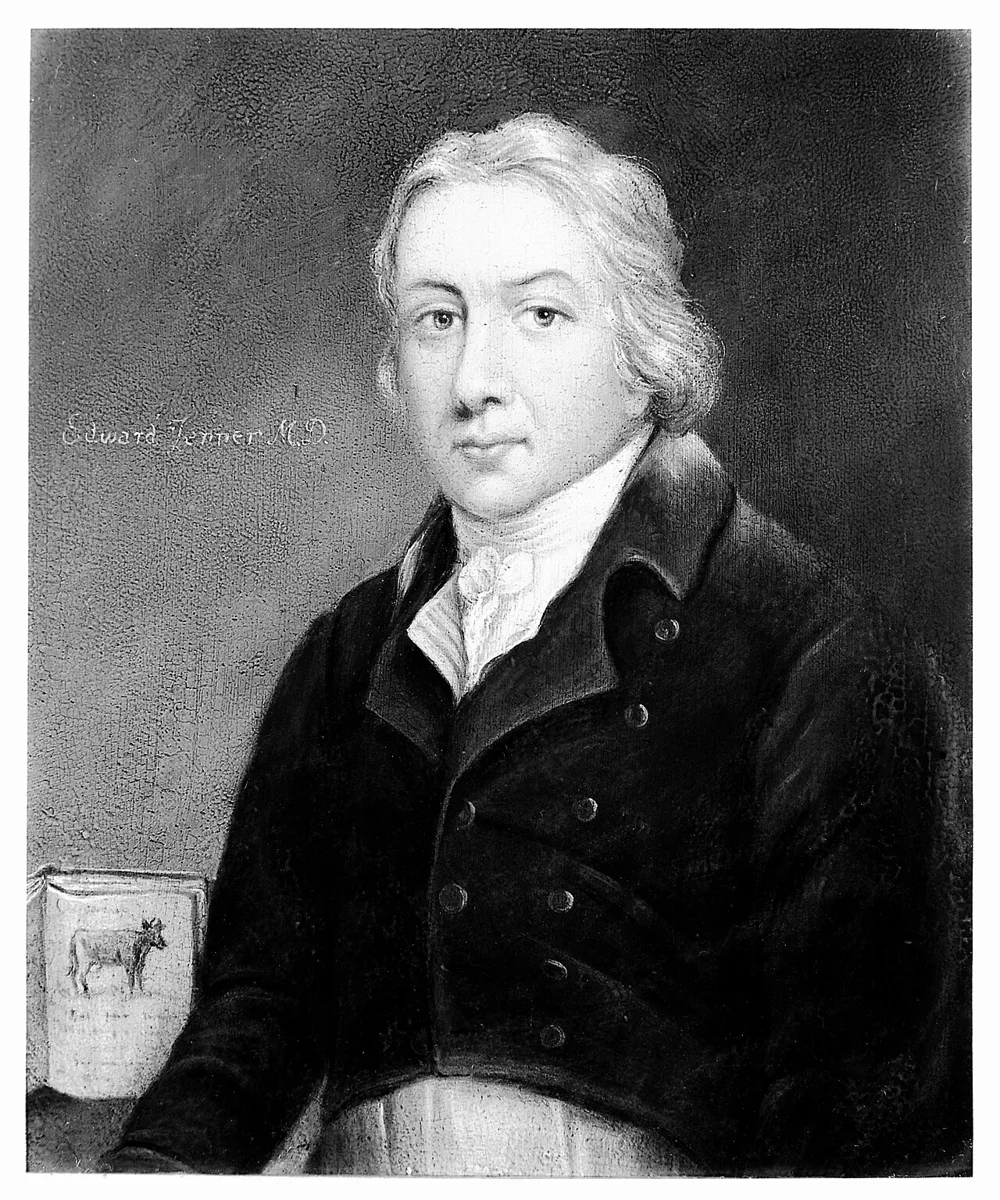
天然痘(variola)はかつてほぼ誰もがかかる病気で、死亡率も高かった。一方で、一度かかれば一生かからないことも知られていた。そこで、軽い患者の膿疱の材料をまだかかっていない人に植えて、わざと軽くかからせる人痘接種(inoculation, variolation)が東方で行われていた。中国では粉末を鼻から吸わせ、トルコでは皮膚の傷から入れた。イスタンブールに駐在した英国大使の妻メアリー・ワートリー・モンタギューが自分の子に受けさせ、18世紀前半にイギリスに広めた。国王が自分の子に接種させたことで普及し、ニュートンの弟子ジュリンは統計で死亡の危険が下がることを示した。
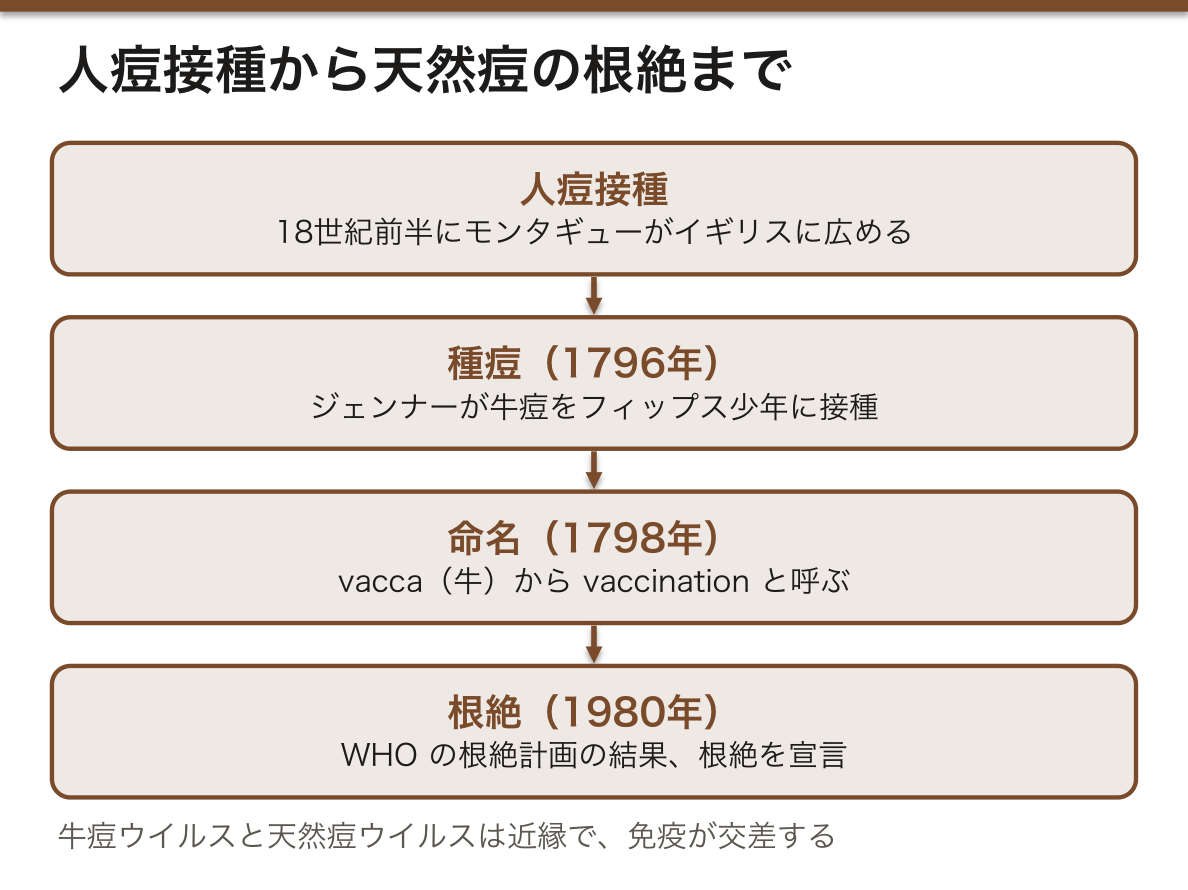
ただし人痘接種には、接種された人が死ぬことがあり、接種された人が周囲への感染源になるという欠点があった。イギリスの田舎医者エドワード・ジェンナー(1749–1823)は、牛の病気である牛痘にかかった乳しぼりの女性は天然痘にかからない、という土地の言い伝えに注目した。1796年、乳しぼりのサラ・ネルムズの牛痘の病変から材料を取り、少年ジェームズ・フィップスの腕に接種した。6週間後に天然痘の材料を接種しても、少年は発病しなかった。王立協会は論文の掲載を断ったため、彼は1798年に自費で小冊子を出し、この方法を、ラテン語の vacca(牛)からvaccinationと呼んだ。
牛痘が効いたのはなぜか。今の言葉でいえば、牛痘ウイルスと天然痘ウイルスは近縁で、免疫が交差するからである。ジェンナーは仕組みを知らずに、弱い近縁の病原体で強い病原体への免疫を作るという原理を使った。人痘・種痘はどちらも、医師が採用する前は民間の知恵から生まれたものだった。後にパスツールはジェンナーをたたえて、vaccine という言葉をあらゆるワクチンに広げた。そしてWHOの根絶計画の結果、1980年に天然痘の根絶が宣言された。人類が根絶した最初の、そして今のところヒトでは唯一の感染症である。
臨床では:日本では1849年に緒方洪庵らが大坂に除痘館を開いて種痘を広め、江戸では1858年にお玉ヶ池種痘所ができた。後者は東京大学医学部の源流とされる。天然痘は根絶された今も感染症法の1類感染症で、生物テロへの備えとしてワクチンが備蓄されている。
English version
Core
Smallpox (variola) was once a disease almost everyone caught, and many died. But people also knew that if you had it once, you never had it again. So in the East, people used inoculation (variolation): putting material from the pustule of a mild case into someone who had not had the disease, to give a mild illness on purpose. In China the powder was breathed in through the nose; in Turkey it was put into a scratch in the skin. Lady Mary Wortley Montagu, wife of the British ambassador in Constantinople, had her children inoculated and spread the practice in Britain in the early 18th century. It became common after the king had his own children inoculated, and Jurin, a follower of Newton, showed with statistics that it lowered the risk of death.
Going further
But inoculation had problems: some inoculated people died, and they could infect others around them. The country doctor Edward Jenner (1749–1823) paid attention to a local belief: milkmaids who had caught cowpox, a disease of cattle, did not get smallpox. In 1796 he took material from a cowpox sore on the milkmaid Sarah Nelmes and put it into the arm of a boy, James Phipps. Six weeks later he inoculated the boy with smallpox material, and the boy did not fall ill. The Royal Society refused his paper, so in 1798 he published a small book at his own cost and called the method vaccination, from the Latin vacca, “cow”.
Why did cowpox work? In today’s words, cowpox and smallpox viruses are related, so immunity crosses over. Without knowing the mechanism, Jenner used the principle of making immunity to a strong pathogen with a weak relative. Both inoculation and vaccination came from folk knowledge before doctors took them up. Later Pasteur, honouring Jenner, extended the word vaccine to all vaccines. After a WHO eradication programme, smallpox was declared eradicated in 1980 — the first infectious disease eradicated, and so far the only human one.
In the clinic
In Japan, Ogata Kōan and others opened the Jotokan in Osaka in 1849 to spread vaccination, and in Edo the Otamagaike vaccination centre opened in 1858 — seen as the origin of the University of Tokyo’s medical faculty. Even now that it is eradicated, smallpox is still a Category I disease under the Infectious Diseases Control Law, and vaccine is stored in case of bioterrorism.
瘴気説と接触伝染説 — 「迷ったら両方やる」
19世紀前半、インドからコレラ(cholera)の流行が西へ迫ると、ヨーロッパ各国は調査団を送り、対策を議論した。コレラは西洋にとって新しい病気で、症状が激しく死亡率も高かった。しかも広がり方が謎だった。当時、流行病の説明には対立する2つの考えがあった。
| 瘴気説(ミアズマ説) | 接触伝染説 | |
|---|---|---|
| 何が病気を運ぶか | 腐った有機物から出る悪い空気 | 病人から人へ移る何か |
| うまく説明できたこと | 同じ土地の多くの人が一斉に倒れること、「健康な土地」と「不健康な土地」があること | 看病する人が同じ病気になること |
| 導かれる対策 | 排水・清掃・下水などの衛生改善 | 隔離と検疫 |
どちらにも説明できない例があったため、「条件次第でどちらにもなる」という中間の説(条件つき接触伝染説)も生まれた。悪い空気で町に入った病気が、ある人の体内で接触伝染するようになる、という具合である。ただし、何でも説明できる理論は、ほとんど何も説明しない。実際の対策でも、ペストのときから隔離・検疫と、空気を清める火やにおい袋が併用されてきた。「迷ったら両方やる」のである。
この論争は科学だけで決まったのではない。世界最大の海運国だったイギリスは、検疫が貿易に与える損失が大きく、1851年から開かれた国際衛生会議で英領インドとともに一貫して日常的な検疫に反対した。どの理論を支持するかが、経済的な利害で左右されたのである。のちに細菌説が新しい枠組みを与えるが、それでも「同じ病原体にさらされても、発病する人としない人がいるのはなぜか」という謎は残った。
臨床では:今の感染経路の分類(接触・飛沫・空気・経口)は、この論争の答えを病原体ごとに整理したものと言える。新型コロナの流行でも「飛沫か空気(エアロゾル)か」の議論が対策を左右し、検疫と経済の衝突も繰り返された。19世紀の論争の構図は今も生きている。
English version
Core
In the early 19th century, as cholera spread west from India, European countries sent observers and argued about what to do. Cholera was a new disease for the West, with violent symptoms and a high death rate. And the way it spread was a mystery. At the time, two opposing ideas explained epidemic disease.
| Miasma theory | Contagion theory | |
|---|---|---|
| What carries disease | Bad air from rotting organic matter | Something passed from sick person to person |
| What it explained well | Many people in one place falling ill at once; “healthy” and “unhealthy” places | Nurses catching the disease of the patient |
| Measures it led to | Sanitary improvement: drainage, cleaning, sewers | Isolation and quarantine |
Going further
Both had cases they could not explain, so a middle view appeared — “either, depending on conditions” (contingent contagionism). A disease might enter a town through bad air and then become contagious inside some people. But a theory that explains everything explains almost nothing. In practice, since the days of plague, isolation and quarantine had been used together with fires and scented bags to clean the air. “When in doubt, do both.”
The argument was not decided by science alone. Britain, the largest shipping nation, lost much trade through quarantine, and at the International Sanitary Conferences held from 1851, Britain and British India always opposed routine quarantine. Which theory people supported depended on economic interests. Germ theory later gave a new framework, but one puzzle remained: why do some people exposed to the same germ fall ill and others do not?
In the clinic
Today’s routes of infection — contact, droplet, airborne and oral — can be seen as the answer to this argument, sorted pathogen by pathogen. During COVID-19, the debate “droplet or airborne (aerosol)?” shaped the measures, and the clash between quarantine and the economy happened again. The pattern of the 19th-century argument is still alive.
チャドウィックと衛生改革 — 貧困・病気・下水
イギリスは最初の工業国で、都市は急速に膨らみ、貧困と過密が広がった。エドウィン・チャドウィック(1800–1890)は医師ではなく法律家で、功利主義の哲学者ベンサムの秘書だった人である。「最大多数の最大幸福」と効率を重んじる彼は、まず救貧法(貧しい人を地方税で救う古い法律)の改革にかかわり、その仕事の中で貧困と病気の関係に向き合った。
救貧の申請の多くは、一家の稼ぎ手が病気で働けなくなったことから生じていた。病気が家族を貧しくするなら、病気を防げば救貧の負担が減る。熱心な瘴気説の支持者だった彼は、コレラ・チフス・猩紅熱などを「不潔病」と呼び、腐った有機物の悪臭が原因だと考えた。答えは単純である。不潔が病気を生み、清潔が病気を防ぐ。
1842年の『イギリス労働者の衛生状態に関する報告』で、彼は1837年に始まった出生・死亡の登録制度を使い、都市と農村、富者と貧者で死亡率と平均余命がどれほど違うかを数字で示した。そして、各家庭に圧力のかかった水を送り、汚水を漏れない陶管で運び去る上水と下水の一体のシステムを提案した。下水を肥料にして農家に売れば、作物も増える、という計算までついていた。
1848年、コレラが戻ってきた年に公衆衛生法ができ、中央に保健局が置かれ、地域が保健医務官(Medical Officer of Health)を置けるようになった。最初は「希望すれば置ける」という任意の法律だったが、医務官たちが予防の大切さを訴え、やがて義務になった。任意の制度から始めて、あとで義務にするという進め方は、自由主義の社会での公衆衛生の典型になった。病原体については誤っていたが、清潔な水と下水という対策は正しかった。
臨床では:上下水道の整備は、ワクチンや抗菌薬より前に、先進国の感染症死亡を大きく減らした要因の一つとされる。日本の保健所と保健所長(医師)は、保健医務官の役割を引き継ぐ存在である。また、健康格差を死亡統計で示すという方法は、今の社会疫学にそのままつながっている。
English version
Core
Britain was the first industrial nation. Its cities grew fast, and poverty and overcrowding spread. Edwin Chadwick (1800–1890) was not a doctor but a lawyer, once secretary to the utilitarian philosopher Bentham. Valuing efficiency and “the greatest happiness of the greatest number”, he first worked on reforming the Poor Law (the old law that helped the poor from local taxes), and through that work he faced the link between poverty and disease.
Many requests for poor relief came about because the family’s wage-earner was too sick to work. If disease makes families poor, preventing disease lowers the cost of relief. A firm believer in miasma, he called cholera, typhus, scarlet fever and others “filth diseases” and blamed the smell of rotting matter. The answer was simple: filth causes disease, and cleanliness prevents it.
Going further
His 1842 report on the sanitary state of Britain’s working people (Report on the Sanitary Condition of the Labouring Population) used the registration of births and deaths (begun in 1837) and showed in numbers how much death rates and life expectancy differed between town and country, and between rich and poor. He proposed one system of water supply and sewerage: water under pressure to every house, and sewage carried away in glazed pipes that did not leak. He even calculated that sewage could be sold to farmers as fertiliser.
In 1848, when cholera returned, a Public Health Act set up a central Board of Health and allowed local areas to appoint a Medical Officer of Health. At first the law was permissive — areas could appoint one if they wished — but the medical officers argued for prevention, and later it became compulsory. Start with a voluntary system, then make it compulsory — this became the typical path of public health in liberal societies. He was wrong about the cause, but clean water and sewers were the right measures.
In the clinic
Water supply and sewerage are thought to be among the main reasons why deaths from infection fell in rich countries, even before vaccines and antibiotics. Japan’s public health centres (hokenjo) and their directors, who are doctors, carry on the role of the Medical Officer of Health. And showing health inequality with death statistics leads directly to today’s social epidemiology.
ジョン・スノウ — コレラは水で広がる(疫学の誕生)
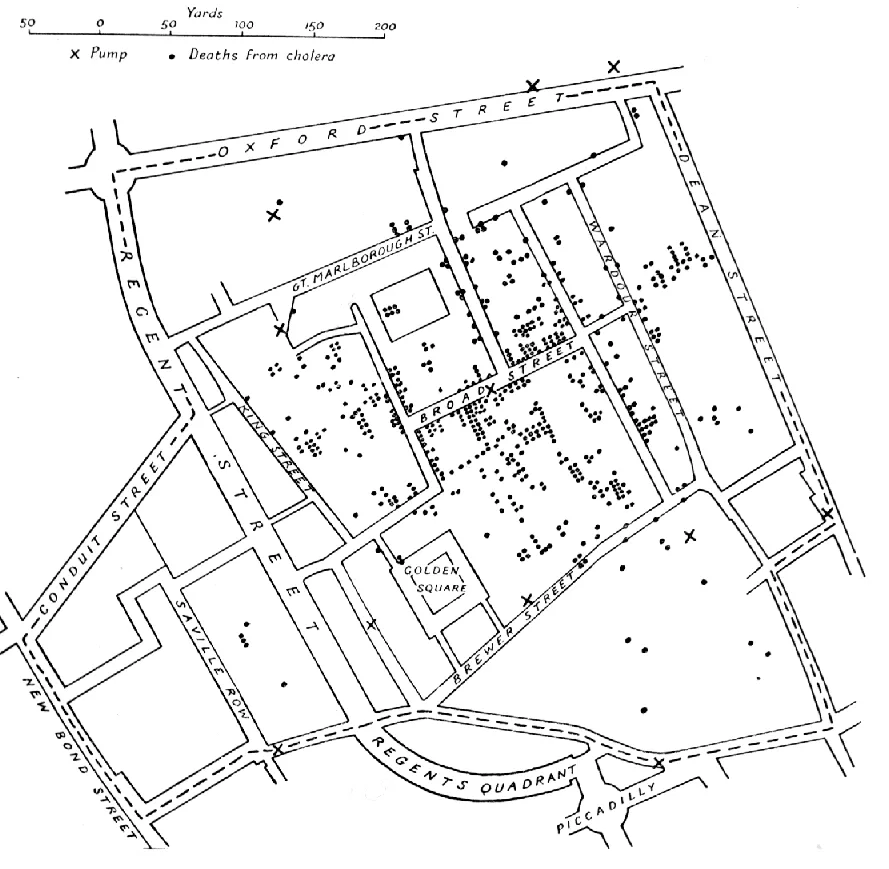
ロンドンの開業医で麻酔医でもあったジョン・スノウ(1813–1858)は、コレラは空気ではなく、便で汚れた水で広がることを示した。1848年の流行で根拠を集め、1854年の流行で2つの「地域での実験」によって決定的にした。
1つ目が有名なブロード・ストリートのポンプである。ソーホー地区の多くの家は水道をもたず、この井戸ポンプの水を使っていた。スノウは一軒一軒、患者の家を訪ねて地図に記し、遠くの患者もこのポンプの水を飲んでいたことを突き止めた。井戸のそばには汚水だめがあった。ポンプの柄を外させた話は有名だが、そのとき流行はすでに下火で、象徴的な意味のほうが大きかった。
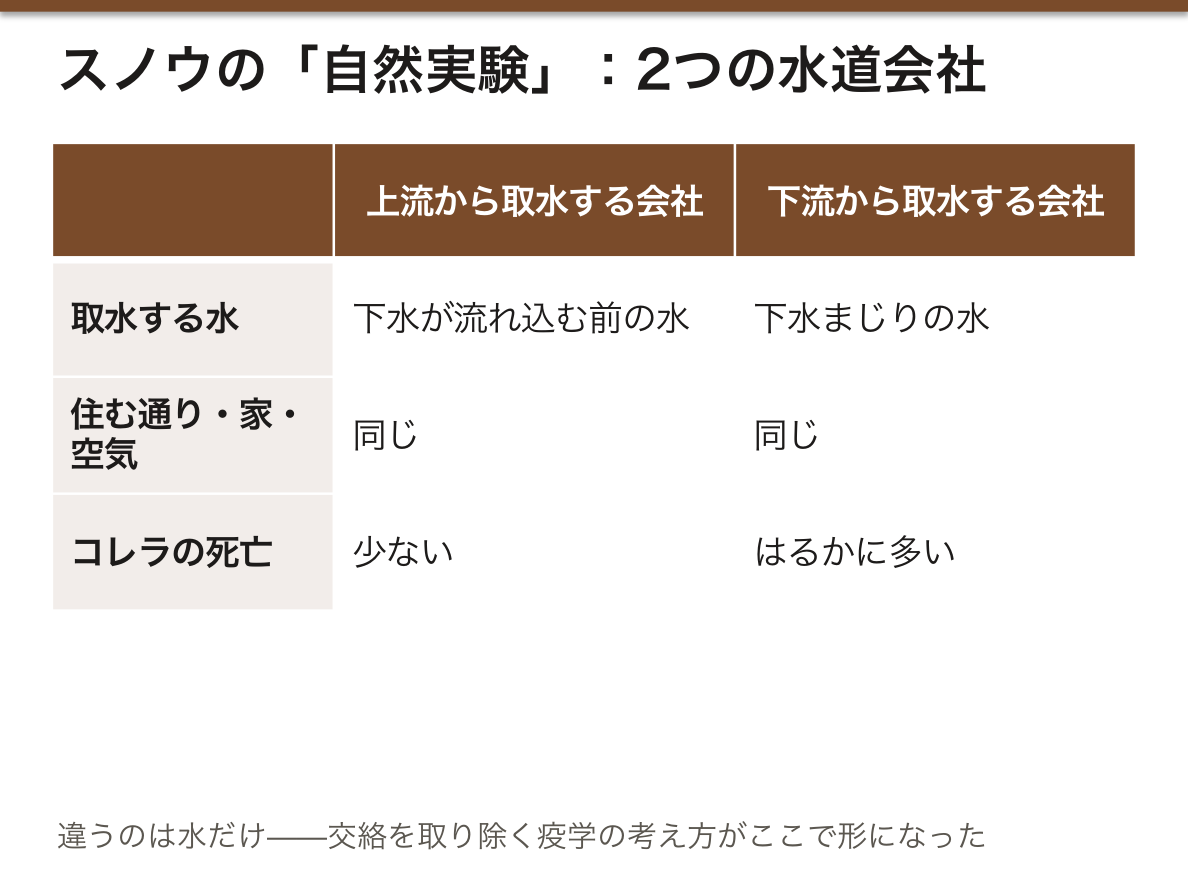
2つ目の調査のほうが、方法としてはより重要である。テムズ川の水を売る2つの水道会社のうち、一方は下水が流れ込む前の上流から取水し、もう一方は下水まじりの下流から取水していた。同じ通りに住み、同じような家で、同じ空気を吸っている人たちが、契約している会社だけ違うという状況があった。比べると、下流の会社の水を使う家でコレラの死亡がはるかに多かった。なぜこれが強い証拠になるのか。空気・住居・暮らしぶりという他の条件がそろっていて、違うのは水だけだからである。今でいう自然実験であり、交絡を取り除く疫学の考え方がここで形になった。
それでも同時代の多くの人は納得しなかった。1854年にはイタリアのパチーニが顕微鏡でコレラ菌を記述していたが注目されず、1883〜84年にコッホが菌を確認したあとも議論は続いた。古い考え方はなかなか死なないのである。
臨床では:曝露群と非曝露群で発症を比べ、相対危険を求めるという疫学の基本は、スノウの水道会社の比較そのものである。日本の例では、海軍軍医高木兼寛は1884年、脚気が多発した前回の遠洋航海と同じ航路で、食事だけを変えた練習艦を航海させ、脚気をほとんど出さなかった。原因(ビタミンB1欠乏)は知らなかったが、比べる方法が正しければ、仕組みを知る前に対策が当たる。
English version
Core
John Snow (1813–1858), a London general practitioner who was also an anaesthetist, showed that cholera spreads not through air but through water dirtied by faeces. He gathered evidence in the 1848 epidemic and settled the case with two “community experiments” in 1854.
The first is the famous Broad Street pump. Many houses in Soho had no piped water and used this street pump. Snow visited the homes of cases one by one and marked them on a map, and found that patients living farther away had also drunk water from the pump. A cesspit lay next to the well. The story of removing the pump handle is famous, but the outbreak was already fading — its meaning was more symbolic.
Going further
The second study is more important as a method. Two water companies sold Thames water. One took it from upstream, before the sewers entered the river; the other took it from downstream, sewage and all. People living in the same streets, in similar houses, breathing the same air, differed only in which company supplied them. Cholera deaths were far higher in houses supplied by the downstream company. Why is this strong evidence? Because air, housing and way of life were the same, and only the water differed. It was what we now call a natural experiment, and the epidemiological idea of removing confounding took shape here.
Even so, many people at the time were not convinced. In 1854 the Italian Pacini had described the cholera organism under the microscope, but nobody paid attention, and the debate went on even after Koch confirmed the bacterium in 1883–84. Old ways of thinking die hard.
In the clinic
Comparing disease in exposed and unexposed groups to get the relative risk — the basic method of epidemiology — is exactly Snow’s comparison of water companies. A Japanese example: in 1884 the navy surgeon Takaki Kanehiro sent a training ship on the same route as an earlier voyage that had suffered badly from beriberi, changing only the food — and there was almost no beriberi. He did not know the cause (vitamin B1 deficiency), but if the method of comparison is right, the measure can work before the mechanism is known.
調査・監視・届出 — 数で病気を追う仕組みと「腸チフスのメアリー」
公衆衛生の証拠は必ず数である。19世紀の公衆衛生は、工場の損益計算や国勢調査と同じ「数で考える」精神の上に育った。その道具は3つにまとめられる。調査(survey)、監視(surveillance)、有意性(significance)である(有意性は次の項目)。
調査は、新しい関係を見つけるための一回ごとの大規模な聞き取りである。救貧法委員会が全国の教区に質問票を送ったのが先駆けとされ、貧困・児童労働・工場・食品の混ぜ物・水道・住宅などが次々に調べられた。チャドウィックの後継者ジョン・サイモン(1816–1904)はヨーロッパ中の種痘の効果を調べ、イギリスに公費・無料・全員対象・罰則つきの義務的な種痘制度を整えた。
監視は、決まった問題を継続して追う仕組みである。その最も強い形が届出が必要な病気(notifiable disease)で、1880年代から細菌学の進歩とともに国の制度になった。天然痘・猩紅熱・腸チフス、のちに結核・梅毒について、公共への危険が個人のプライバシーより重いとされ、すべての医師に届出の義務が課された。医師は治療者であると同時に、監視の担い手にもなったのである。
その倫理的な難しさを示すのが「腸チフスのメアリー」ことメアリー・マローンである。ニューヨークの裕福な家々で料理人として働いた彼女は、自分はまったく健康なのに腸チフス菌を出し続ける保菌者だった。複数の家族に感染を広げたが、本人には悪いことをした自覚がなかった。教育の機会が少ない移民の女性だった彼女は、罪を犯していないのに長く隔離された。公共の安全と個人の自由をどう釣り合わせるかという問いは、ここで最も鋭い形をとる。
臨床では:日本の感染症法は病気を1〜5類などに分け、全数届出と定点届出を定めている。結核・梅毒・麻疹などを診断したら、医師は保健所に届け出る義務がある。感染症法の前文が、ハンセン病などの患者への差別と偏見の歴史を反省すると述べているのは、メアリーの事例と同じ問いへの一つの答えである。
English version
Core
Evidence in public health is always numbers. 19th-century public health grew from the same number-minded spirit as factory accounts and the national census. Its tools can be grouped into three: surveys, surveillance and significance (significance is in the next item).
A survey is a one-time, large inquiry to find new relationships. The Poor Law Commission, which sent questionnaires to parishes across the country, is seen as a pioneer; then poverty, child labour, factories, food adulteration, water supply and housing were studied one after another. Chadwick’s successor John Simon (1816–1904) studied the effect of vaccination across Europe and gave Britain a public, free, universal and compulsory vaccination system, with penalties.
Going further
Surveillance is a system that keeps following a known problem. Its strongest form is the notifiable disease, which became a national system from the 1880s, along with the progress of bacteriology. For smallpox, scarlet fever, typhoid and later tuberculosis and syphilis, the risk to the public was judged more important than privacy, and every doctor had to report cases. The doctor became both a healer and an agent of surveillance.
The ethical difficulty is shown by “Typhoid Mary”, Mary Mallon. She worked as a cook for rich families in New York. She was completely healthy but was a carrier who kept shedding typhoid bacteria. She infected several families, but did not feel she had done wrong. An immigrant woman with little education, she was isolated for a long time without committing any crime. How to balance public safety and personal freedom takes its sharpest form here.
In the clinic
Japan’s Infectious Diseases Control Law sorts diseases into Categories I–V and others, and sets rules for reporting every case or reporting from sentinel sites. When a doctor diagnoses tuberculosis, syphilis, measles and others, he must report to the public health centre. The law’s preamble expresses regret for the history of discrimination and prejudice against patients with leprosy and other diseases — one answer to the same question that Mary’s case raises.
統計学と有意性 — ゴルトン、ピアソン、そして優生学の影
19世紀前半の統計は、多くの観察を集めて表にすることが中心だった。死亡登録が広まると、各国が毎年死因の表を出し、国際的に比べるために病名をそろえる必要が生まれた。「熱」「黄疸」のような症状名は病名から外され、疾病分類学(nosologia)が死亡診断書の土台として重要になった。
19世紀後半、統計に「有意性」を持ち込んだのが、ダーウィンのいとこフランシス・ゴルトン(1822–1911)である。遺伝に関心をもった彼は、親や祖先がその人の性質にどれだけ寄与するかを数学で調べ、身長・寿命・筋力などを大量に測った。回帰や相関の考え方はここから生まれた。弟子のカール・ピアソン(1857–1936)は統計学を実験科学と臨床医学の中心に据え、その流れの中で20世紀に臨床試験の統計的な評価が確立した。
ゴルトンは公衆衛生に遺伝という要素を持ち込んだ。それまでの公衆衛生は過密や不潔といった環境ばかりを見ていたが、以後は「生まれ(nature)」と「育ち(nurture)」の両方を考えるようになった。しかしゴルトンは優生学の父でもある。彼は、貧しい人が多く子を産み中流の人が少なく産むことを心配し、「望ましい」人を増やす社会を構想した。同じ統計の道具が、人の価値に序列をつける政策を支えたことは、医学史の最も暗い側面の一つである。
なお、有意性の p 値は「仮説が正しい確率」ではない。帰無仮説が正しいとしたときに、観察された以上に極端な結果が偶然に出る確率である。p が小さいことは「差がない」という仮定と結果が合わないことを示すだけで、差の大きさや臨床的な重要さは別に考える必要がある。
臨床では:日本でも優生保護法(1948–1996年)のもとで、障害のある人などに本人の同意のない不妊手術が行われた。2024年、最高裁はこの規定を憲法違反と判断した。p 値・信頼区間・相関と因果の区別は論文を読む基本であり、統計を正しく使うことと、統計で人を序列化しないことは、どちらも医師の責任である。
English version
Core
In the early 19th century, statistics mostly meant collecting many observations and putting them in tables. When death registration spread, countries published yearly tables of causes of death, and disease names had to be standardised so that countries could be compared. Symptom names such as “fever” and “jaundice” were dropped as diseases, and nosology became important as the base of the death certificate.
In the late 19th century, Darwin’s cousin Francis Galton (1822–1911) brought “significance” into statistics. Interested in heredity, he used mathematics to study how much parents and ancestors contribute to a person’s traits, and measured height, length of life, muscle strength and more in large numbers. The ideas of regression and correlation came from this. His follower Karl Pearson (1857–1936) put statistics at the centre of experimental science and clinical medicine, and from this line the statistical evaluation of clinical trials was established in the 20th century.
Going further
Galton brought heredity into public health. Until then public health had looked only at the environment, such as overcrowding and dirt; afterwards what we inherit had to be weighed together with how we live. But Galton was also the father of eugenics. He worried that poor people had many children and middle-class people few, and imagined a society that would increase “desirable” people. That the same statistical tools supported policies ranking the value of human beings is one of the darkest sides of medical history.
Note that a p value is not “the probability that the hypothesis is true”. It is the probability of getting a result at least as extreme as the one observed, by chance, if the null hypothesis is true. A small p only shows that the result does not fit the assumption of “no difference”; the size of the difference and its clinical importance must be judged separately.
In the clinic
In Japan, too, under the Eugenic Protection Law (1948–1996), people with disabilities and others were sterilised without their consent. In 2024 the Supreme Court ruled these provisions unconstitutional. P values, confidence intervals and the difference between correlation and causation are basic to reading papers. Using statistics correctly, and never using statistics to rank people, are both a doctor’s responsibility.
ウィルヒョウと社会医学 — 「医学は社会科学である」
細胞病理学で知られるルドルフ・ウィルヒョウ(1821–1902)は、若いころ急進的な改革派の医師でもあった。1848年、ベルリンの革命に加わった彼を遠ざけるため、プロイセン政府は彼を上シレジア(今のポーランド南部)の発疹チフスの流行の調査に送った。
彼の報告は政府の望むものではなかった。流行の原因を貧困・教育の欠如・政治的な不平等に求め、流行を抑える方法は民主主義・教育・経済的な公正だと書いたのである。彼は「医学は社会科学であり、政治とは大規模な医学にほかならない」という趣旨の言葉を残した。
なぜ医師が政治を語るのか。ウィルヒョウの答えは明快である。医師は仕事の中で、病気の経済的・社会的な原因にいちばん近く触れる。だから医師は貧しい人の自然な代弁者であるべきだ。彼は生涯、ドイツ議会やベルリン市の公衆衛生の委員として衛生改革に取り組み、体を国家に、細胞を市民にたとえた。
この考えは20世紀に別の形で裏づけられた。イギリスの社会医学者マキューンは、西洋の死亡率の低下の多くは栄養と生活水準の向上によるもので、医療そのものの寄与は(ごく最近までは)小さかったと論じた。例えば結核の死亡率は、有効な抗結核薬が登場するずっと前から下がり続けていた。この主張には反論も多いが、病院や薬だけが健康を決めるのではないという視点を医学に突きつけた。
臨床では:今の健康の社会的決定要因(SDOH)——所得・教育・住居・雇用・社会的孤立が健康を左右する——という考え方は、ウィルヒョウの上シレジア報告の直系である。外来で治療が続かない患者の背景に、経済的な困窮や孤立があることは少なくない。病気の「原因の原因」を見ることは、今の臨床医にも求められている。
English version
Core
Rudolf Virchow (1821–1902), famous for cellular pathology, was also a radical reforming doctor when young. In 1848, after he joined the revolution in Berlin, the Prussian government sent him away to investigate typhus in Upper Silesia, a region that today lies in southern Poland.
His report was not what the government wanted. He blamed the epidemic on poverty, lack of education and political inequality, and wrote that the way to control it was democracy, education and economic justice. He is known for the idea that “medicine is a social science, and politics is nothing but medicine on a large scale”.
Going further
Why should a doctor talk about politics? Virchow’s answer was clear: in their work, doctors come closest to the economic and social causes of disease, so they should be the natural advocates of the poor. All his life he worked on sanitary reform, in the German parliament and on Berlin’s public health council, and he compared the body to a state and cells to its citizens.
In the 20th century this idea found support in another form. The British professor of social medicine McKeown argued that most of the fall in Western death rates came from better nutrition and living standards, and that medicine itself added little (until quite recently). For example, deaths from tuberculosis kept falling long before effective anti-TB drugs appeared. His claim has many critics, but it confronted medicine with the view that hospitals and drugs are not the only things that decide health.
In the clinic
Today’s idea of the social determinants of health (SDOH) — that income, education, housing, work and social isolation shape health — comes directly from Virchow’s Upper Silesia report. Behind patients who cannot continue treatment, there is often money trouble or isolation. Looking at the “causes of the causes” of illness is still asked of clinicians today.
まとめ
| ペストと検疫 — 「40日」と国家の介入 | 14世紀半ばの黒死病(ペスト, pestis)は、中央アジアからシルクロードを通って4年以上かけてヨーロッパ・中東・北アフリカに広がり、ヨーロッパの人口の4分の1から半分を奪った。 |
|---|---|
| 人痘接種から種痘へ — ジェンナーと天然痘の根絶 | 天然痘(variola)はかつてほぼ誰もがかかる病気で、死亡率も高かった。 |
| 瘴気説と接触伝染説 — 「迷ったら両方やる」 | 19世紀前半、インドからコレラ(cholera)の流行が西へ迫ると、ヨーロッパ各国は調査団を送り、対策を議論した。 |
| チャドウィックと衛生改革 — 貧困・病気・下水 | イギリスは最初の工業国で、都市は急速に膨らみ、貧困と過密が広がった。 |
| ジョン・スノウ — コレラは水で広がる(疫学の誕生) | ロンドンの開業医で麻酔医でもあったジョン・スノウ(1813–1858)は、コレラは空気ではなく、便で汚れた水で広がることを示した。 |
| 調査・監視・届出 — 数で病気を追う仕組みと「腸チフスのメアリー」 | 公衆衛生の証拠は必ず数である。19世紀の公衆衛生は、工場の損益計算や国勢調査と同じ「数で考える」精神の上に育った。 |
| 統計学と有意性 — ゴルトン、ピアソン、そして優生学の影 | 19世紀前半の統計は、多くの観察を集めて表にすることが中心だった。 |
| ウィルヒョウと社会医学 — 「医学は社会科学である」 | 細胞病理学で知られるルドルフ・ウィルヒョウ(1821–1902)は、若いころ急進的な改革派の医師でもあった。 |
このノートは医学生が授業の内容を自分の言葉でまとめたもので、診療の判断に使うものではありません。誤りに気づいたらお知らせください。