医学の歴史を「偉人の発見の年表」として覚えると、すぐに忘れるうえに、今の医療と結びつかない。この科目では、医師が何を相手にし、どこで働き、何を目指したかによって医学を5つの型に分けて読む。枕元の医学・書庫の医学・病院の医学・地域の医学・実験室の医学である。
この章とそれに続く5章は、W. Bynum『The History of Medicine: A Very Short Introduction』(2008)の5つの区分に沿って組み立てた。ただし説明と例は自分で選び直し、日本の医学生が今の医療のどこにつながるかで読めるようにしてある。
5つの型は時代順に現れたが、古い型が消えたわけではない。外来で問診をするとき、論文を検索するとき、病棟で回診するとき、保健所が感染症の届出を受けるとき、研究室でマウスを扱うとき——どれも別々の型の子孫である。
- 医学の5つの型 — 何を見て、どこで、何のために
- 型は積み重なる — 今の医療制度の5つの柱
- 歴史の読み方 — 過去を「今への階段」にも「悪の見本」にもしない
- 西洋医学の伝統という枠 — この科目が扱う範囲
医学の5つの型 — 何を見て、どこで、何のために
医学の歴史は、医師の見る対象・働く場所・目標の組み合わせで5つの型に分けられる。
| 型 | 見る対象 | 学ぶ場 | 目標 | 象徴となる人 |
|---|---|---|---|---|
| 枕元 | 患者その人の全体 | 師について学ぶ徒弟制 | 治療 | ヒポクラテス |
| 書庫 | 古典の本文 | 大学・翻訳と注釈 | 知の保存と回復 | アフリカのコンスタンティヌス |
| 病院 | 患者と、その臓器の病変 | 病院 | 診断 | ラエンネック |
| 地域 | 集団と統計 | 地域社会 | 予防 | ジョン・サイモン |
| 実験室 | 動物モデル | 実験室 | 仕組みの理解 | クロード・ベルナール |
この表で大事なのは、型ごとに「病気」の単位が違うことである。枕元の医師にとって病気は「この人に起きた出来事」だった。病院の医師は、それを臓器の病変として見た。地域の医師は集団の中の数として、実験室の研究者は動物で再現できる仕組みとして見た。同じ肺結核でも、咳と痩せていく様子を見るのか、聴診と剖検で結節を探すのか、死亡統計を取るのか、菌を培養するのかで、見えるものがまったく違う。
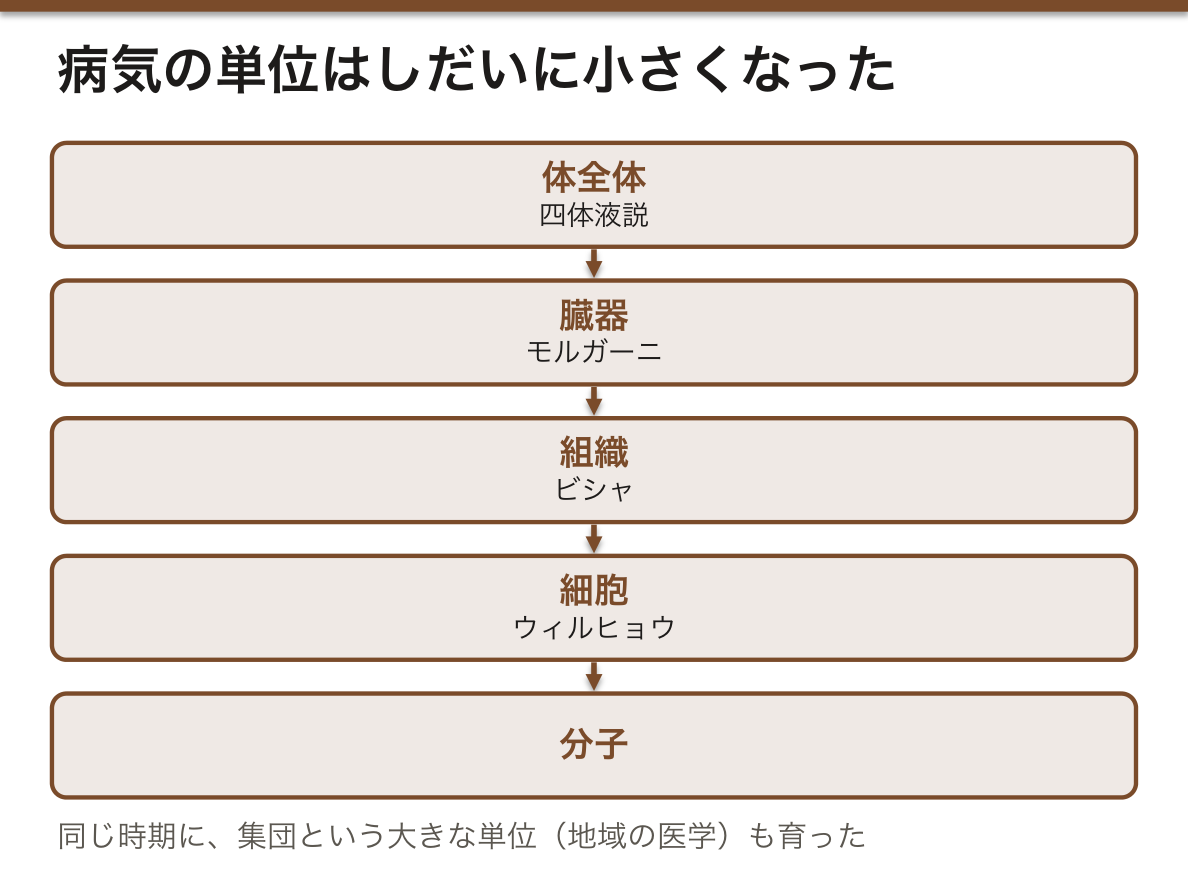
医学が進むほど、この単位は体全体→臓器→組織→細胞→分子と小さくなってきた。一方で集団という大きな単位も同じ時期に育った。「小さくなる流れ」と「大きくなる流れ」が同時に進んだのが近代医学だ、と覚えておくと全体がつかみやすい。
臨床では:今の診療でも5つの型は同時に使われている。外来の問診と診察は枕元の医学、文献検索やガイドラインは書庫の医学、入院・画像・病理は病院の医学、健診・予防接種・感染症の届出は地域の医学、血液検査や新薬の開発は実験室の医学の子孫である。一人の患者を診るとき、自分がいまどの型で考えているかを意識すると、見落としに気づきやすい。
English version
Core
The history of medicine can be divided into five kinds by combining what doctors studied, where they worked, and what they aimed at.
| Kind | Object | Place of learning | Goal | Symbolic figure |
|---|---|---|---|---|
| Bedside | The whole patient | Apprenticeship | Therapy | Hippocrates |
| Library | Classical texts | University; translation and commentary | Preserving and recovering knowledge | Constantine the African |
| Hospital | The patient and the lesion in an organ | Hospital | Diagnosis | Laennec |
| Community | Populations and statistics | Community | Prevention | John Simon |
| Laboratory | Animal models | Laboratory | Understanding mechanisms | Claude Bernard |
Going further
The key point is that the unit of “disease” is different in each kind. For the bedside doctor, a disease was something that happened to this person. The hospital doctor saw it as a lesion in an organ. The community doctor saw it as a number in a population, and the lab scientist as a mechanism that can be reproduced in an animal. With the same tuberculosis, you see very different things if you watch the cough and the weight loss, listen to the chest and look for tubercles at autopsy, count deaths, or grow the bacterium.
As medicine advanced, the unit became smaller: whole body → organ → tissue → cell → molecule. At the same time, the large unit — the population — also grew in importance. Modern medicine is these two movements, smaller and larger, happening together.
In the clinic
In clinical practice, all five kinds are used at once. History-taking and examination in clinic are bedside medicine; literature searches and guidelines are library medicine; admission, imaging and pathology are hospital medicine; health checks, vaccination and reporting of infections are community medicine; blood tests and drug development come from laboratory medicine. When you see a patient, notice which kind you are thinking in — it helps you catch what you have missed.
型は積み重なる — 今の医療制度の5つの柱
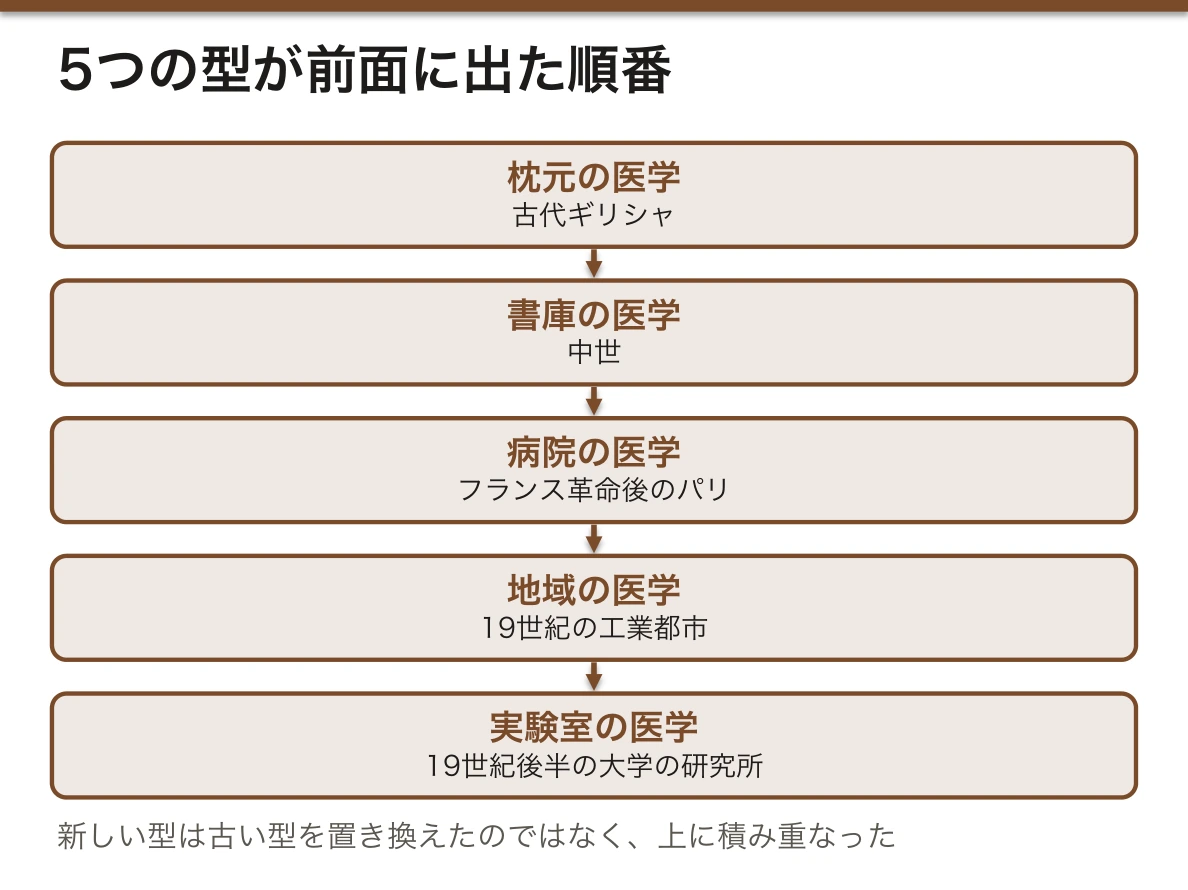
5つの型は古代ギリシャ→中世→フランス革命後のパリ→19世紀の工業都市→19世紀後半の大学の研究所という順で前面に出てきた。しかし新しい型が古い型を置き換えたのではなく、上に積み重なった。
その証拠に、今の国の保健医療予算はほぼこの5つに分けられる。プライマリ・ケア(枕元)、病院医療(病院)、公衆衛生(地域)、生命医学研究(実験室)、医学情報の生産と提供(書庫)である。
なぜこれが大事か。予算には限りがあり、5つの柱は互いに取り合う関係にあるからだ。研究に多く配れば病院の人手や予防に回る分が減り、逆もまた同じである。どの柱を厚くするかは、医学の問題であると同時に政治の問題でもある。
また、型の境目は古代からはっきりしていたわけではない。古代ギリシャ・ローマにも、集団の病気を防ぐ工夫、兵士や奴隷を収容する施設、医学書を集めた場所、新しい知識を求める探究があった。今の形の病院・公衆衛生・実験医学が出そろったのは19世紀であり、20世紀以降は5つが絡み合って一つの医療になっている。
臨床では:日本の医療も同じ柱で動いている。かかりつけ医の外来、急性期病院、保健所と予防接種、大学や研究機関の基礎研究、診療ガイドラインや医学データベース。国試の公衆衛生で学ぶ医療制度・保健行政は、この「地域」と「病院」の柱の設計図だと思って読むと、暗記事項が整理しやすい。
English version
Core
The five kinds came to the front in this order: ancient Greece → the Middle Ages → Paris after the French Revolution → the industrial cities of the 19th century → university institutes of the late 19th century. But a new kind did not replace an old one. Each was added on top.
You can see this in today’s health budgets, which fall almost entirely into five parts: primary care (bedside), hospital services (hospital), public health (community), biomedical research (laboratory), and the production and supply of medical information (library).
Going further
Why does this matter? Budgets are limited, so the five parts compete with each other. More money for research can mean less for hospital staff or prevention, and the other way round. Choosing which part to make stronger is a medical question and also a political one.
The borders between the kinds were not sharp even in ancient times. Greece and Rome already had ways to prevent disease in communities, buildings for sick soldiers and slaves, collections of medical books, and new research. But the modern forms of the hospital, public health and experimental medicine all appeared in the 19th century. Since the 20th century, the five have been woven into one system of care.
In the clinic
In practice, Japanese healthcare runs on the same pillars: the family doctor’s clinic, acute hospitals, public health centres and vaccination, basic research in universities and institutes, and clinical guidelines and medical databases. When you study the health system and public health administration for the national exam, read them as the design drawings of the “community” and “hospital” pillars. The facts become easier to organise.
歴史の読み方 — 過去を「今への階段」にも「悪の見本」にもしない
医学史を読むときに避けたい見方が2つある。一つはホイッグ史観(Whig history)——歴史をすべて現在に向かう進歩の階段として見ることである。もう一つは、今の道徳の物差しで過去の人を裁くことである。
どちらも、その時代の人がなぜそう考え、なぜそう治療したのかを見えなくする。過去の患者も、手に入る医療を求め、「よい医者」に診てほしいと願っていた。その点は今と変わらない。変わったのは「よい医者」の中身である。
例えば瀉血(血を抜く治療)は、今から見れば有害な迷信に見える。しかし四体液説の世界では、熱っぽく赤い顔は「血が多すぎる」しるしであり、血を抜くのは筋の通った治療だった。患者自身が瀉血を求めることも多かった。前提となる理論の中では合理的だったと見ることで、初めて「なぜその理論が長く信じられ、何がそれを崩したのか」を問えるようになる。
この見方は、今の自分たちにも返ってくる。今の標準治療も、未来の医師から見れば「あの時代はなぜあんなことを」と言われる部分を必ず含んでいる。医学史を学ぶ意味の一つは、自分の常識が時代の産物であることを知ることにある。
臨床では:診療ガイドラインが改訂されるたびに、昨日までの「正しい治療」が変わる。かつて安静が基本だった病気で早期離床が勧められるようになった例や、広く使われた薬が大規模試験で有害とわかった例は少なくない。「なぜ以前はそうしていたのか」を理解している医師ほど、新しい根拠を正しく受け止められる。
English version
Core
There are two ways of reading medical history that we should avoid. One is Whig history — seeing the whole past as a staircase of progress that leads to the present. The other is judging people in the past by today’s moral standards.
Both hide why people at that time thought and treated as they did. Patients in the past also looked for the care that was available, and wanted a good doctor. That has not changed. What has changed is what a “good doctor” means.
Going further
Bloodletting, for example, looks like a harmful superstition today. But in the world of the four humours, a hot red face was a sign of “too much blood”, so removing blood was a logical treatment. Patients often asked for it. If we see that it was rational inside its own theory, we can ask the real questions: why was the theory believed for so long, and what finally broke it?
This view also applies to us. Today’s standard treatment surely contains things that future doctors will look back on and ask, “Why did they do that?” One reason to study medical history is to learn that our own common sense is a product of our time.
In the clinic
In practice, every revision of a clinical guideline changes yesterday’s “correct treatment”. There are many examples: bed rest was once basic for some diseases, and now early mobilisation is advised; some widely used drugs were shown to be harmful in large trials. Doctors who understand why things used to be done are better at accepting new evidence correctly.
西洋医学の伝統という枠 — この科目が扱う範囲
この科目が追うのは、古代ギリシャに始まる西洋医学の伝統である。これは、ヒポクラテスとガレノスの著作が中世のイスラーム世界とヨーロッパで受け継がれ、ルネサンス以降に解剖学・病院医学・公衆衛生・実験医学へと変わっていった流れを指す。
世界には中国医学・アーユルヴェーダ・ユナニ医学など、別の体系をもつ医学がある。西洋医学の伝統を中心にするのは、今の世界の医療で最も大きな力をもち、医師養成の土台になっているからであって、ほかの体系に価値がないからではない。
この伝統を一本の流れとして読めるのはなぜか。どの時代の医師も、自分より前の権威(特にヒポクラテス)を引き合いに出しながら、自分の新しさを主張したからである。ガレノスはヒポクラテスを完成させる者を名乗り、17世紀のシデナムは「イギリスのヒポクラテス」と呼ばれ、19世紀のパリの医師たちは自分たちの方法をヒポクラテスの観察の拡大版と考えた。過去との対話そのものが、この伝統の背骨になっている。
日本の医学もこの流れに途中から合流した。江戸時代の蘭学、とくに杉田玄白らがオランダ語の解剖書を訳した『解体新書』(1774年)は、ヨーロッパの「書庫の医学」と「解剖学の発見」が日本に届いた瞬間である。明治以降はドイツ医学が手本になり、実験室の医学が大学に根づいた。
臨床では:日本では漢方薬が保険診療で処方でき、西洋医学の病名で診断して漢方で治療する、という併用が日常的に行われている。体系の違う医学がどう共存しているかを考えるうえでも、西洋医学がどの前提の上に立っているかを知っておく価値がある。
English version
Core
This subject follows the Western medical tradition that began in ancient Greece. The writings of Hippocrates and Galen were handed down in the medieval Islamic world and in Europe, and after the Renaissance they turned into anatomy, hospital medicine, public health and experimental medicine.
The world has other medical systems, such as Chinese medicine, Ayurveda and Unani medicine. We focus on the Western tradition because it has the greatest power in world healthcare today and is the base of medical training, not because other systems have no value.
Going further
Why can this tradition be read as one stream? Because doctors in every age referred to earlier authorities — above all Hippocrates — while claiming that they themselves were new. Galen said he was completing Hippocrates. Sydenham in the 17th century was called “the English Hippocrates”. The Paris doctors of the 19th century saw their method as Hippocratic observation on a larger scale. This conversation with the past is the backbone of the tradition.
Japanese medicine joined this stream part of the way along. In the Edo period, Dutch learning (rangaku) arrived; Sugita Genpaku and others translated a Dutch anatomy book as Kaitai Shinsho (1774). That was the moment when Europe’s library medicine and its new anatomy reached Japan. After the Meiji era, German medicine became the model, and laboratory medicine took root in Japanese universities.
In the clinic
In Japan, Kampo (traditional herbal) medicines can be prescribed under national health insurance, and it is common to diagnose with Western disease names and treat with Kampo. To think about how medical systems with different foundations live side by side, it is worth knowing what assumptions Western medicine stands on.
まとめ
| 医学の5つの型 — 何を見て、どこで、何のために | 医学の歴史は、医師の見る対象・働く場所・目標の組み合わせで5つの型に分けられる。 |
|---|---|
| 型は積み重なる — 今の医療制度の5つの柱 | 5つの型は古代ギリシャ→中世→フランス革命後のパリ→19世紀の工業都市→19世紀後半の大学の研究所という順で前面に出てきた。 |
| 歴史の読み方 — 過去を「今への階段」にも「悪の見本」にもしない | 医学史を読むときに避けたい見方が2つある。 |
| 西洋医学の伝統という枠 — この科目が扱う範囲 | この科目が追うのは、古代ギリシャに始まる西洋医学の伝統である。 |
このノートは医学生が授業の内容を自分の言葉でまとめたもので、診療の判断に使うものではありません。誤りに気づいたらお知らせください。