病院そのものは中世からあったが、医学史で「病院の医学」というときは、1789年と1848年の2つの革命にはさまれたパリで花開いた医学を指す。この半世紀、パリは世界中から医学生が集まる「医学のメッカ」になった。
Bynum の区分でいえば、ここで医学の目標が治療から診断へ移る。パリの病院医学は3本の柱に立っていた。①身体診察(視診・触診・打診・聴診)、②臨床所見と剖検所見の突き合わせ(臨床病理相関)、③多数の症例を数えること。どれも今の医学教育と病院の仕組みにそのまま残っている。
後半では、病院が医学教育の中心になった経緯(回診・研修医制度)、別の道を歩んだ精神科の施設、そして病院の衛生と看護を変えたナイチンゲールを扱う。
- パリ学派の誕生 — 革命が内科と外科を一つにした
- 身体診察の4つ — 視診・触診・打診・聴診
- ラエンネックと聴診器 — 結核をひとつの病気にまとめる
- 臨床病理相関 — モルガーニとビシャ
- ルイの「数量的方法」— 瀉血を数で確かめる
- 病院が医学教育の中心に — 回診・研修医制度・ジョンズ・ホプキンズ
- 精神医学と病院 — ピネルの「道徳療法」から大規模収容へ
- ナイチンゲール — 看護と病院の衛生を変え、統計で訴えた人
パリ学派の誕生 — 革命が内科と外科を一つにした
フランス革命は、医師・外科医・病院・古いアカデミーや医学部といった旧体制の制度を一度すべて廃止した。「特権がなくなれば病気もなくなる」という楽観もあったが、長くは続かなかった。戦争をする共和国の軍隊には、内科も外科もできる医師が大量に必要だったからである。
1794年、化学者で医師のフルクロワが中心となって、パリ・モンペリエ・ストラスブールに医学校が再開された。新しい教育の方針は3つあった。①最初の日から実践的に(「少し読み、多く見て、多く行え」)、②教育の場を病院に置く、③内科と外科を両方教える。
③が決定的だった。内科医は伝統的に体全体——体液や精気——で病気を考えてきた。一方、外科医はいつも局所を相手にしてきた。膿瘍、骨折、ある場所の異常である。両者を一つの教育にまとめた結果、内科医が外科医のように考えるようになり、体の「固い部分」が医学の主役になった。
そのとき中心に置かれた概念が病変(lesion)である。病変とは病気によって生じた形の変化で、肉眼か顕微鏡で見ることができる。「目に見えない体液のつり合い」から「目に見える臓器の変化」へ——病気の居場所が液体から臓器へ移ったことが、病院医学の本質である。なぜパリでそれができたのか。革命後の病院には貧しい患者が大量に集まり、医師は彼らを生前に診察し、死後に解剖できたからである。
臨床では:病理診断が「確定診断」とされ、病変の場所と性質で病名をつける今の診断学は、この転換の上にある。日本の医学部で内科と外科を区別せず全員が両方を学び、卒後の臨床研修でも内科・外科を回るのも、パリが始めた「内科と外科の統合教育」の延長と見ることができる。
English version
Core
The French Revolution swept away every institution of the old regime at once, including the medical ones: the professions, the hospitals, the academies and the faculties. There was hope that disease would disappear with privilege, but it did not last. The armies of a republic at war needed many doctors who could do both medicine and surgery.
In 1794, led by the chemist and physician Fourcroy, medical schools reopened in Paris, Montpellier and Strasbourg. The new teaching had three rules: (1) be practical from the first day (“read little, see much, do much”); (2) base teaching in the hospital; (3) teach both medicine and surgery.
Going further
Rule (3) was decisive. Physicians had always thought about disease in terms of the whole body — humours and spirits. Surgeons had always dealt with the local: abscesses, fractures, a problem in one place. When the two were joined in one education, physicians began to think like surgeons, and the solid parts of the body became the centre of medicine.
The key idea was the lesion — a change in form caused by disease that can be seen, with the naked eye or a microscope. From an invisible balance of fluids to a visible change in an organ — the home of disease moved from fluids to organs. That is the heart of hospital medicine. Why could it happen in Paris? Because after the Revolution, huge numbers of poor patients filled the hospitals, and doctors could examine them in life and dissect them after death.
In the clinic
Today’s diagnosis, in which pathology gives the “definitive diagnosis” and disease is named by the place and nature of the lesion, rests on this shift. In Japanese medical schools, every student learns both medicine and surgery, and postgraduate training rotates through both. This can be seen as a continuation of the joint teaching of medicine and surgery that Paris began.
身体診察の4つ — 視診・触診・打診・聴診Inventum novum
パリの病院では、医師は患者の話(症状)だけに頼らず、医師が自分で確かめられる徴候を探すようになった。痛みやだるさは本人にしかわからない私的なものだが、筋萎縮や膿瘍は他人にも見える公的なものである。この「客観的な徴候」を集める方法が、視診・触診・打診・聴診の4段階の身体診察である。どれも古代から散発的には使われていたが、パリの医師たちがまとめて、毎回、系統的に行うものにした。
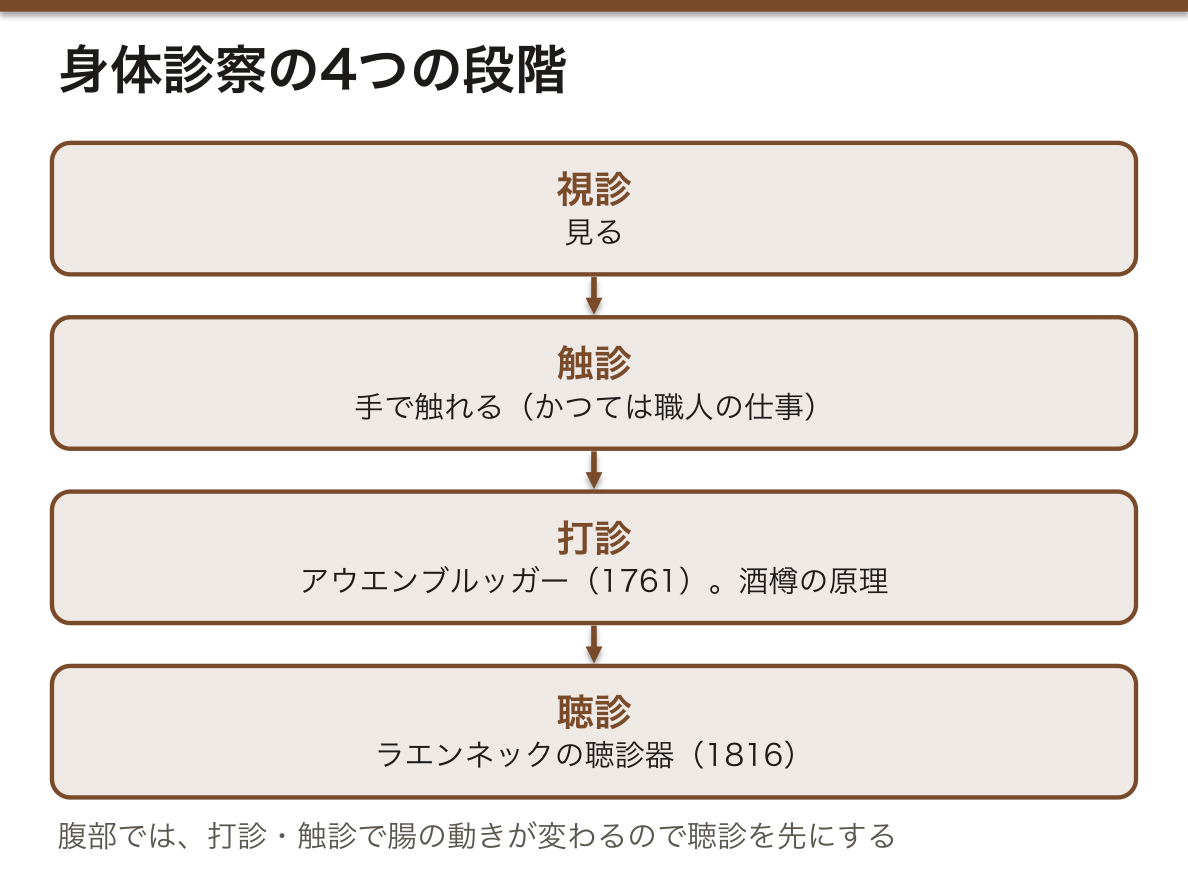
4つのうち打診には面白い来歴がある。ウィーンの医師アウエンブルッガーは1761年、小冊子『新発見』(Inventum novum)で胸をたたく診察法を発表した。宿屋の息子だった彼は、酒樽をたたいて残量を確かめる方法——液面の高さで音が変わる——を人の胸に応用したと伝えられる。ところがこの本は40年以上ほとんど無視された。18世紀の医師は、体の固い部分を診断に使うことに関心がなかったからである。
それを掘り起こしたのが、ナポレオンの侍医でパリの教授コルヴィザールである。心臓病に関心があった彼は、心拡大や心膜液貯留の診断に打診が役立つと見抜き、1808年にフランス語に訳して詳しい注を加えた。古典は生まれるのではなく、作られる——ある知識が受け入れられるかどうかは、それを必要とする考え方が育っているかで決まる、という好例である。
また、触診は手を使う「職人の仕事」として、紳士である内科医が長く避けてきた手技だった。内科と外科の統合によって、手で診ることが内科に戻ってきたのである。
臨床では:OSCE で学ぶ視診→触診→打診→聴診の順番(腹部では打診・触診で腸の動きが変わるので聴診を先にする)はこの伝統そのものである。打診で心濁音界や肝濁音界を確かめる、胸水で濁音になる、といった所見は、アウエンブルッガーの酒樽の原理で説明できる。
English version
Core
In the Paris hospitals, doctors stopped relying only on what the patient said (symptoms) and looked for signs that they could check themselves. Pain and tiredness are private — only the patient knows them. Muscle wasting or an abscess is public — others can see it. The method of collecting these objective signs was the four-step physical examination: inspection, palpation, percussion and auscultation. All four had been used now and then since ancient times, but the Paris doctors made them a complete, routine, systematic part of every examination.
Going further
Percussion has an interesting history. In 1761 the Viennese doctor Auenbrugger described tapping the chest in a small book, Inventum novum (“New invention”). The son of an innkeeper, he is said to have used the way you tap a barrel to find how much wine is left — the sound changes at the fluid level. But the book was almost ignored for more than 40 years, because 18th-century doctors were not interested in using the solid parts of the body for diagnosis.
It was rediscovered by Corvisart, Napoleon’s doctor and a Paris professor. Interested in heart disease, he saw that percussion helped diagnose an enlarged heart or fluid around it, and in 1808 he translated the book into French with long notes. Classics are made, not born — whether knowledge is accepted depends on whether the way of thinking that needs it has grown.
Palpation, too, was “manual work” that gentlemen physicians had long avoided. With the union of medicine and surgery, examining with the hands came back into medicine.
In the clinic
The order inspection → palpation → percussion → auscultation that you learn for the OSCE (for the abdomen, auscultation comes first because touching changes bowel activity) is this tradition. Finding the borders of the heart or liver by percussion, or dullness over a pleural effusion, can be explained by Auenbrugger’s barrel.
ラエンネックと聴診器 — 結核をひとつの病気にまとめる
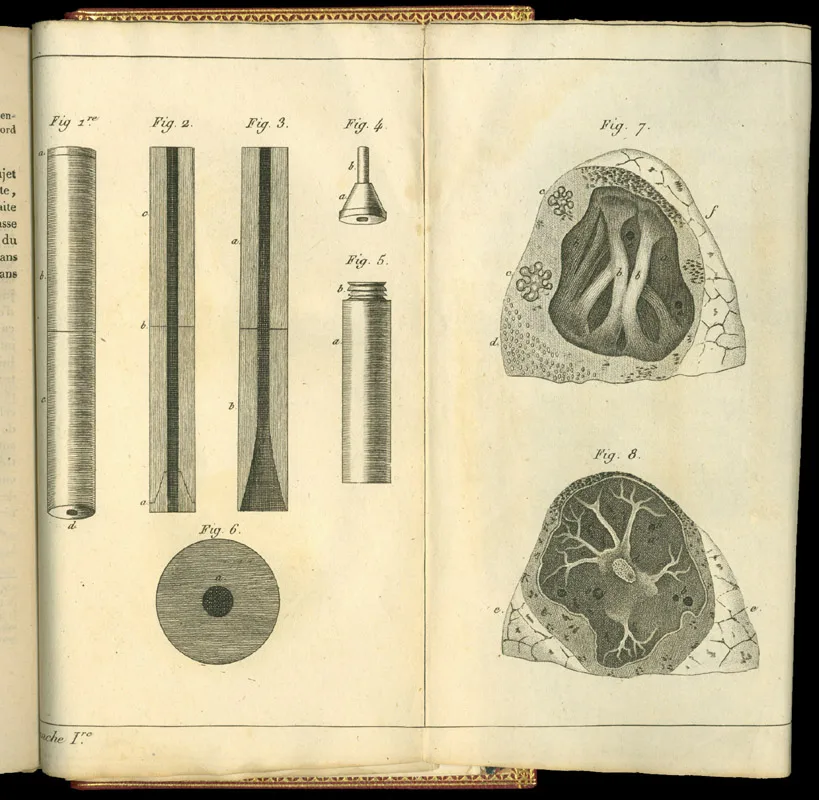
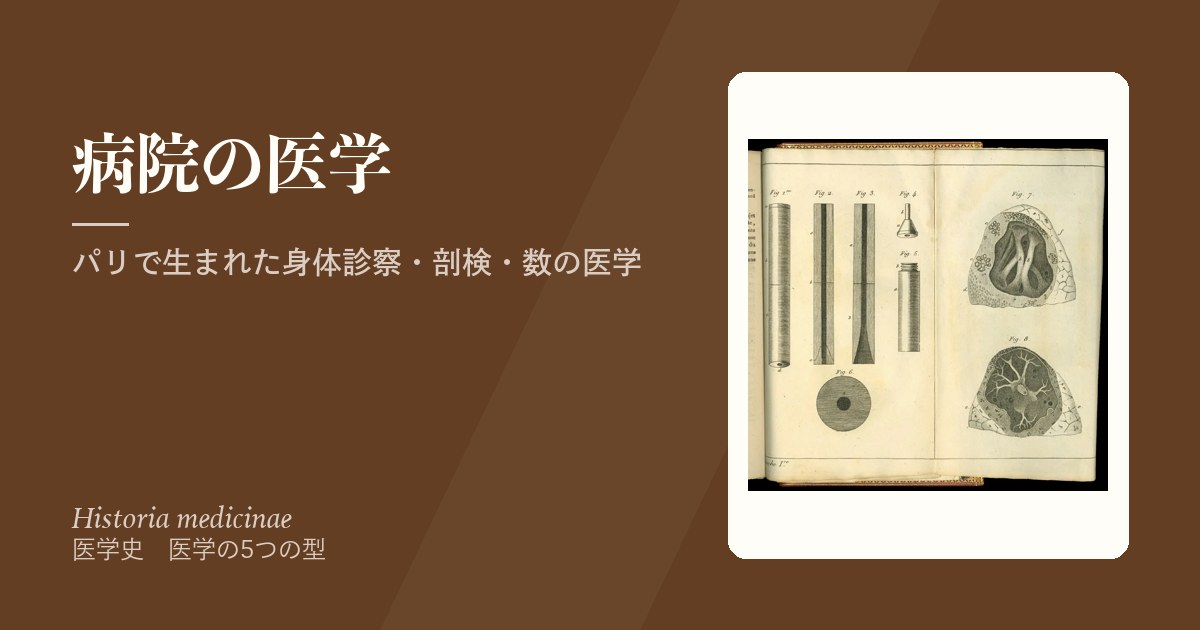
4つ目の、そして最も新しい手段が間接聴診である。耳を直接胸に当てる直接聴診は以前からあったが、1816年、パリのネッケル病院でR. T. H. ラエンネック(1781–1826)は、太った若い女性の胸に耳を当てるのをためらい、ノートを固く丸めて筒にして当てた。すると直接より音がはっきり聞こえた。彼はすぐに木の筒の道具を作り、stethoscope(聴診器)と名づけた。
1816年から1819年の3年間は、医学史でも屈指の創造的な期間である。1819年の著書で、彼は今も使われる呼吸音の用語の多くを作り、聴こえる音の型で心臓と肺の多くの病気を診断できると論じた。
ラエンネックの仕事が強力だったのは、聴診だけで終わらなかったからである。彼は亡くなった患者を病棟から剖検室まで追いかけ、生前に聴いた音と死後の病変を突き合わせた。特に力を注いだのが、当時最大の死因だった肺結核(phthisis=「消耗」)である。
彼は、小さな結節(tubercle)があれば、体のどこにあっても同じ一つの病気だと主張した。こうして、首のリンパ節の瘰癧(scrofula)、結核性髄膜炎、腸の結核など、別々の病名がひとつにまとめられた。臓器ごとに病気を分けるパリ学派の流儀からすれば直感に反する飛躍だったが、1882年にコッホが結核菌を見つけたことで正しさが証明された。一方で原因については「強い情念」を疑うなど見当違いだった。病変は見事に記述できても、病変ができる過程と原因は剖検からはわからない——臨床病理相関の強みと限界がよく表れている。彼自身も結核で亡くなった。
臨床では:今の聴診器は改良されたが、原理と用語(断続性ラ音・連続性ラ音などの分類の起点)はラエンネックにさかのぼる。結核が肺だけでなくリンパ節・髄膜・腸・骨(脊椎カリエス)にも起きる「全身の感染症」であることは、今も診断で見落としやすい点である。日本は今も結核が届出の必要な重要な感染症である。
English version
Core
The fourth and newest tool was mediate auscultation. Putting the ear directly on the chest was already known. But in 1816, at the Necker Hospital in Paris, R. T. H. Laennec (1781–1826) did not want to put his ear on the chest of a plump young woman. He rolled a notebook into a tight tube and listened through it — and heard more clearly than with his ear. He soon made a wooden tube and named it the stethoscope.
His three years from 1816 to 1819 were among the most creative in medical history. In his 1819 book he created much of the vocabulary of breath sounds that we still use, and argued that many heart and lung diseases could be diagnosed by their sound patterns.
Going further
Laennec’s work was powerful because it did not stop at listening. He followed dead patients from the ward to the autopsy room and matched the sounds heard in life with the lesions found after death. He worked hardest on pulmonary tuberculosis (phthisis, “wasting”), the leading cause of death in his time.
He argued that wherever the small nodule, the tubercle, was found, it was one and the same disease. This joined separate diagnoses — scrofula of the neck glands, tuberculous meningitis, tuberculosis of the intestine — into one. In the Paris habit of dividing diseases by organ, this was a leap against intuition, but Koch proved it right when he found the tubercle bacillus in 1882. On the cause, however, Laennec was wrong; he suspected “strong passions”. Autopsy could describe the lesion beautifully, but it could not show how the lesion formed or what caused it — the strength and limit of clinico-pathological correlation. He himself died of tuberculosis.
In the clinic
Stethoscopes have improved, but the principle and the terms (the starting point for classifying crackles and wheezes) go back to Laennec. Tuberculosis is a whole-body infection that can affect lymph nodes, meninges, intestine and bone (spinal tuberculosis), not just the lung — still a point easily missed in diagnosis. In Japan it remains an important notifiable infection.
臨床病理相関 — モルガーニとビシャDe sedibus et causis morborum
1761年は、アウエンブルッガーの打診の本と同じ年に、もう一冊の重要な本が出た年でもある。パドヴァのモルガーニ(1682–1771)の『病気の座と原因について』(De sedibus et causis morborum)である。約700例の病歴と剖検を、頭から足へという順に並べ、病気のときに臓器に起きる変化を記述した。この本の価値は個々の発見より、病歴と剖検を結びつける方法にあった。
パリの医師たちはこの方法を大規模に、日常的に行った。病院に住み込むような彼らは、モルガーニが一生かけて集めた数の剖検を数年で集められた。
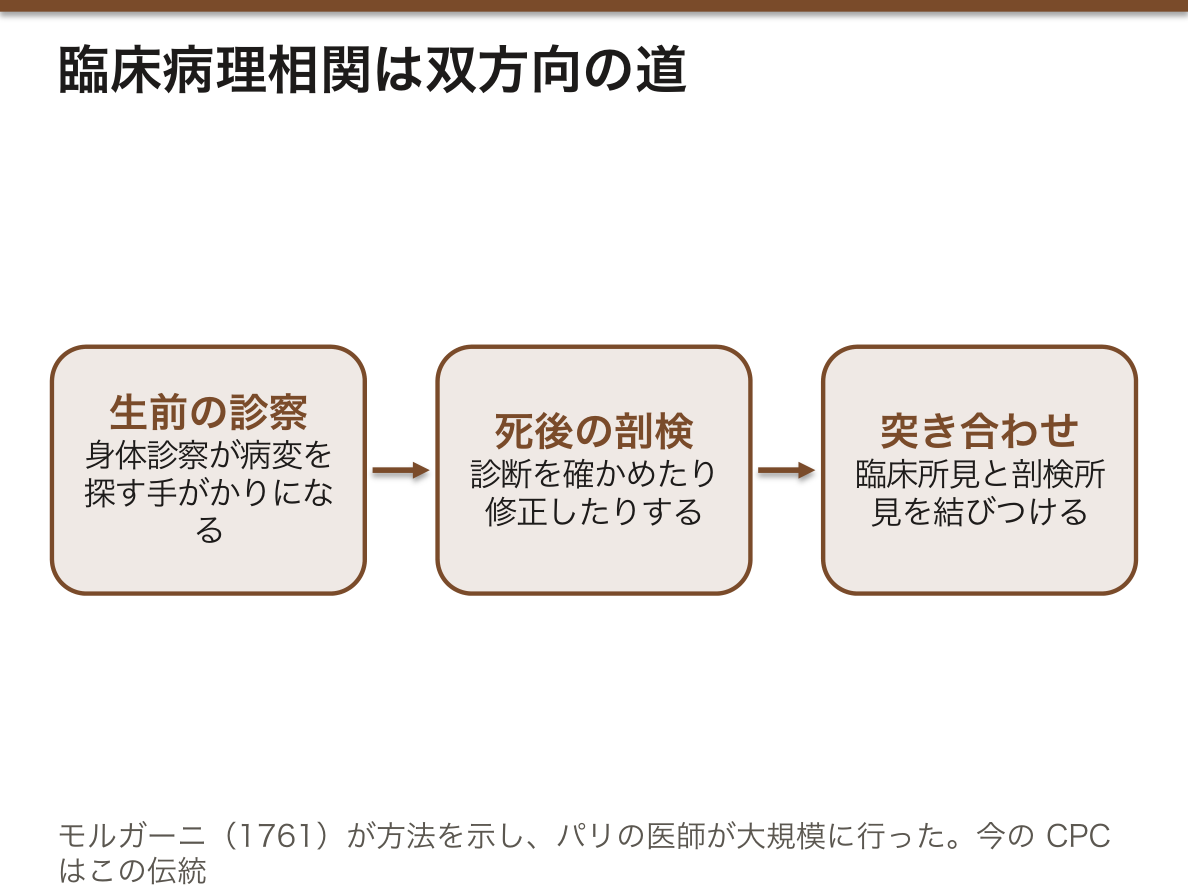
臨床病理相関は双方向の道である。身体診察が病変を探す手がかりになり、剖検がその診断を確かめたり修正したりする。医師は自分の患者の病理医でもあり、生前も死後も患者を診た。哲学者フランシス・ベーコンは病変を「病気の足跡」と呼んだが、剖検はその足跡を読む作業だった。
この流れの中でビシャ(1771–1802)は一歩先へ進んだ。彼は、同じ種類の組織は、体のどこにあっても病気に同じように反応することに気づいた。心臓・脳・胸部・腹部を覆う漿膜は、場所が違っても似た炎症を起こす。彼は肉眼と簡単なルーペで21種類の組織を区別し、「組織学の父」と呼ばれる。31歳で亡くなった。
ここで病気の単位の変化を整理しておく。四体液説は体全体、モルガーニは臓器、ビシャは組織を単位にした。次の世紀、顕微鏡によってその単位は細胞まで小さくなる(実験室の医学の章)。
臨床では:病院で今も行われるCPC(臨床病理検討会)は、生前の経過と剖検所見を突き合わせる、まさにこの伝統である。日本の臨床研修でも CPC レポートの作成が求められる。また、病理学の総論で「炎症」「変性」を臓器ではなく組織の反応として学ぶのは、ビシャの発想の延長である。
English version
Core
In 1761 — the same year as Auenbrugger’s book on percussion — another important book appeared: De sedibus et causis morborum (“On the seats and causes of diseases”) by Morgagni (1682–1771) of Padua. It set out about 700 case histories with autopsies, from head to foot, and described the changes in organs during disease. Its value lay less in single discoveries than in the method of linking case history and autopsy.
The Paris doctors used this method on a large scale and every day. Almost living in the hospitals, they could collect in a few years as many autopsies as Morgagni gathered in his whole life.
Going further
Clinico-pathological correlation is a two-way street. Physical examination gives clues to the lesion, and autopsy confirms or corrects the diagnosis. The doctor was his own patients’ pathologist and cared for them in life and in death. The philosopher Francis Bacon called lesions “the footsteps of disease”; autopsy was the work of reading those footsteps.
Bichat (1771–1802) went one step further. He noticed that the same kind of tissue reacts to disease in the same way wherever it is in the body. The serous membranes around the heart, brain, chest and abdomen show similar inflammation in different places. With his eyes and a simple lens he distinguished 21 kinds of tissue, and is called “the father of histology”. He died at 31.
Let us sort out the unit of disease: humoral theory used the whole body, Morgagni the organ, Bichat the tissue. In the next century the microscope made the unit smaller still — the cell (see the chapter on laboratory medicine).
In the clinic
The CPC (clinico-pathological conference) held in hospitals today, which matches the clinical course with autopsy findings, is exactly this tradition. Japanese postgraduate training also requires a CPC report. And in general pathology we study “inflammation” and “degeneration” as reactions of tissues rather than organs — a continuation of Bichat’s idea.
ルイの「数量的方法」— 瀉血を数で確かめる
パリ学派の3本目の柱は数えることである。その最も体系的な実践者がピエール・ルイ(1787–1872)で、彼はこれをméthode numérique(数量的方法)と呼んだ。ルイは開業をやめてシャリテ病院に通い、6年間に2000例を超える剖検を行い、臨床と病理の記録を細かく残した。
その成果の一つが、腸チフス(febris typhoidea)の病理学的な定義である(1829年)。腸チフスと発疹チフス(typhus)は名前も症状も似ていて、古い文献では区別が難しい。ルイは回腸のパイエル板の腫れを腸チフスに特徴的な所見とし、イギリスやアメリカの医師たちとともに2つの病気を分けた。
もう一つの成果が、1835年の瀉血の効果の研究である。彼は肺炎の患者を、瀉血を早く行った群と遅く行った群、少量と多量に分け、結果を比べた。今の基準ではプロトコルとして不十分で、そもそも「瀉血をしない群」がない。それでも、似た患者を群に分けて治療の結果を比べるという発想は、臨床試験の原型である。
この研究には論争の背景があった。ライバルのブルセは、すべての病気は胃の炎症から始まると唱え、ヒルを使った瀉血を盛んに勧めた治療の熱狂者だった。一方ルイは、当時の薬で病気の進行を止められることは少ないと静かに見ていた。「手持ちの治療はあまり効かない」とわかったこと自体が発見である。それは数え、比べたからこそ得られた。ブルセの理論はすぐに廃れたが、ルイの方法は今の医学に欠かせないものになった。
臨床では:根拠に基づく医療(EBM)とランダム化比較試験は、ルイの数量的方法の直系の子孫である。「効くと信じられている治療を、数で確かめたら効かなかった」という例は今もある。対照群を正しく置くこと(ルイの研究に欠けていたもの)の重要さは、この歴史から学べる。
English version
Core
The third pillar of the Paris school was counting. Its most systematic user was Pierre Louis (1787–1872), who called it the méthode numérique (numerical method). Louis gave up private practice, attached himself to the Charité hospital, performed more than 2,000 autopsies in six years and kept detailed clinical and pathological records.
One result was a pathological definition of typhoid fever (febris typhoidea) in 1829. Typhoid and typhus have similar names and symptoms and are hard to tell apart in old writings. Louis took swelling of the Peyer’s patches in the ileum as the typical finding of typhoid, and with doctors in Britain and America he separated the two diseases.
Going further
Another result was his study of bloodletting (1835). He divided patients with pneumonia into groups — bled early or late, a little or a lot — and compared the results. By today’s standards the protocol was weak, and there was no “no bloodletting” group. Still, the idea of putting comparable patients into groups and setting their outcomes side by side is the prototype of the clinical trial.
The study had a background of argument. His rival Broussais taught that all disease starts with inflammation of the stomach, and he was an enthusiast for bloodletting with leeches. Louis quietly believed that the drugs of his time could rarely stop the course of disease. Finding that the available treatments did not work very well was itself a discovery — and it came only from counting and comparing. Broussais’s theory soon faded; Louis’s method became essential to modern medicine.
In the clinic
Evidence-based medicine (EBM) and the randomised controlled trial are direct descendants of Louis’s numerical method. There are still cases where a treatment believed to work turns out not to work when it is counted. The importance of a proper control group — what Louis’s study lacked — is a lesson from this history.
病院が医学教育の中心に — 回診・研修医制度・ジョンズ・ホプキンズ
パリで学んだ数千人の学生は、イギリス・ドイツ・オーストリア・イタリア・アメリカ・オランダへ帰り、医学校や病院を作った。19世紀前半には病院をもたない医学校は二流とされ、1820年代末にロンドン大学(今の UCL)が医学校を始めたとき、まず病院を作った。
アメリカでは長く、病院も実験室もなく数か月の授業料で学位を出す私立校が栄えたが、19世紀末にジョンズ・ホプキンズ大学がこれを変えた。病院(1889年開院)と医学校(1893年開校)で、ドイツの研究と、フランスの臨床実習を組み合わせたのである。初代の内科教授ウィリアム・オスラー(1849–1919)は、科学的でありながら人間味のある臨床医・教育者として今も敬愛される。
パリから教育病院に残ったものは2つある。毎日の病棟回診——指導医の後ろに研修医・学生・看護師が続き、ベッドサイドで一人ずつ患者を診て議論する——と、グランドラウンド——若手が症例を発表し、上級医が大勢の前で分析し、最後に病理医が剖検所見を明かして、患者の生と死を一つの物語にまとめる会——である。
なぜ病院が教育の中心になったのか。病院には多くの患者が集まり、同じ病気を何例も診て、比べ、剖検で確かめられたからである。パリの3本柱(診察・臨床病理相関・数)は、どれも患者が集まる場所でしか成り立たない。その後、大病院の中に小児科・循環器・神経・産科・整形外科・耳鼻科などの専門科が、それぞれの長・病床・回診をもって分かれていった。
臨床では:ホプキンズで整えられた住み込みの研修医(resident)制度は、世界の卒後研修の手本になった。日本でも2004年度から卒後2年間の臨床研修が必修になり、回診・症例発表・CPC を通じて学ぶ形は、この150年の流れの上にある。
English version
Core
Thousands of students who trained in Paris returned home to Britain, Germany, Austria, Italy, the United States and the Netherlands, where they set up new schools and hospitals. Soon a school that had no hospital of its own was seen as second-class. When the University of London (now UCL) started its medical school in the late 1820s, the first step was to build a hospital.
In the United States, private schools without hospitals or laboratories, giving degrees for a few months’ fees, did well for a long time. Johns Hopkins University changed this at the end of the century. Its hospital (opened 1889) and medical school (opened 1893) combined German research with French clinical training. Its first professor of medicine, William Osler (1849–1919), is still admired as a scientific but humane clinician and teacher.
Going further
Two things from Paris stayed in teaching hospitals. The daily ward round — a senior doctor followed by junior doctors, students and a nurse, seeing and discussing each patient at the bedside — and grand rounds, where a junior presents a case, a senior analyses it in front of a large audience, and finally a pathologist reveals the autopsy findings, joining the patient’s life and death into one story.
Why did the hospital become the centre of teaching? Because many patients gathered there, and doctors could see many cases of the same disease, compare them, and check them at autopsy. All three Paris pillars — examination, clinico-pathological correlation and numbers — work only where patients are gathered. Later, large hospitals divided into specialties — paediatrics, cardiology, neurology, obstetrics, orthopaedics, ENT and others — each with its own chief, beds and rounds.
In the clinic
The residency system, with junior doctors living in the hospital, was shaped at Hopkins and became the model for postgraduate training worldwide. In Japan, two years of postgraduate clinical training became compulsory from 2004. Learning through ward rounds, case presentations and CPCs stands on this 150-year history.
精神医学と病院 — ピネルの「道徳療法」から大規模収容へ
一般病院の発展から長く取り残されたのが精神医学である。重い精神疾患の人は、一般病院ではなく別の施設に入れられた。近世の「マッドハウス」は多くが営利の小さな施設で、医師でない者が経営することも多かった。ロンドンのベスレム病院の略称「ベドラム」は、英語で「大混乱」を意味する言葉になった。
転機は革命期のパリである。フィリップ・ピネル(1745–1826)は、男性のビセートル、女性のサルペトリエールという大収容施設の医師となり、患者を少しずつ鎖から解き、確固とした人間らしさで接する「道徳療法」を進めた。同じころイギリスではクエーカー教徒のテューク家がヨーク・リトリートを、イタリアではキアルージが同様の実践を行った。
道徳療法は精神疾患の人を世間の目に触れさせ、精神医学という専門分野を生んだ。19世紀半ばには各国に精神医学会ができ、アサイラム(精神病院)の網が作られた。瀉血や下剤の代わりに生活環境そのもので治すことが目指され、1830年代からは身体拘束をしない(non-restraint)ことが合言葉になった。
しかし楽観は裏切られた。早く診断し上手に治療すれば治るはずのアサイラムは、治らない長期入院患者でふくれ上がり、「狂気の博物館」と呼ばれるまでになった。なぜパリ流の医学はここで力を発揮できなかったのか。精神疾患の多くは、剖検しても脳にはっきりした病変が見つからなかったからである。病変を探す医学の外に置かれたことが、精神医学と一般医学の距離を生んだ。19世紀末、ドイツのクレペリン(1856–1926)は早発性痴呆(dementia praecox, のちの統合失調症)を記述するなど精神疾患の分類を作り、大学の中に精神医学を位置づけた。
臨床では:日本では1900年の精神病者監護法のもとで、患者を自宅の一室に閉じ込める私宅監置が認められていた。1918年に呉秀三がその実態を調査し、患者は病気の不幸に加えてこの国に生まれた不幸を重ねている、と書いた。今も日本は人口あたりの精神科病床と長期入院が国際的に多く、入院中心から地域生活中心への移行が課題になっている。
English version
Core
One field left behind by the growth of general hospitals was psychiatry. People with serious mental illness were placed not in general hospitals but in separate institutions. Early-modern “madhouses” were mostly small, run for profit, often by people who were not doctors. “Bedlam”, the short name of London’s Bethlem Hospital, became an English word for chaos.
The turning point was revolutionary Paris. Philippe Pinel (1745–1826) became physician at the Bicêtre (for men) and the Salpêtrière (for women), huge institutions of confinement. He slowly freed patients from chains and introduced “moral therapy” — treating them with firm humanity. At about the same time, the Quaker Tuke family founded the York Retreat in England, and Chiarugi did similar work in Italy.
Going further
Moral therapy brought the mentally ill into public view and created psychiatry as a specialty. By the mid-19th century most countries had psychiatric associations and networks of asylums. Instead of bloodletting and purges, the living environment itself was meant to heal, and from the 1830s non-restraint became the slogan.
But the hopes failed. Asylums that should have cured patients by early diagnosis and good treatment filled up with long-stay incurable patients, and were even called “museums of madness”. Why could Paris-style medicine not help here? Because in most mental illnesses, autopsy found no clear lesion in the brain. Being outside the lesion-seeking medicine created the distance between psychiatry and general medicine. At the end of the 19th century, the German psychiatrist Kraepelin (1856–1926) built a classification of mental illnesses, describing dementia praecox (later called schizophrenia), and placed psychiatry inside the university.
In the clinic
Under Japan’s 1900 law on the custody of the mentally ill, families could lock patients in a room of their own house (shitaku kanchi). In 1918 Kure Shūzō surveyed this and wrote that such patients suffered the misfortune of being born in this country on top of the misfortune of illness. Japan still has many psychiatric beds per person and many long stays by international standards, and moving from hospital-centred to community-centred care remains a task.
ナイチンゲール — 看護と病院の衛生を変え、統計で訴えた人
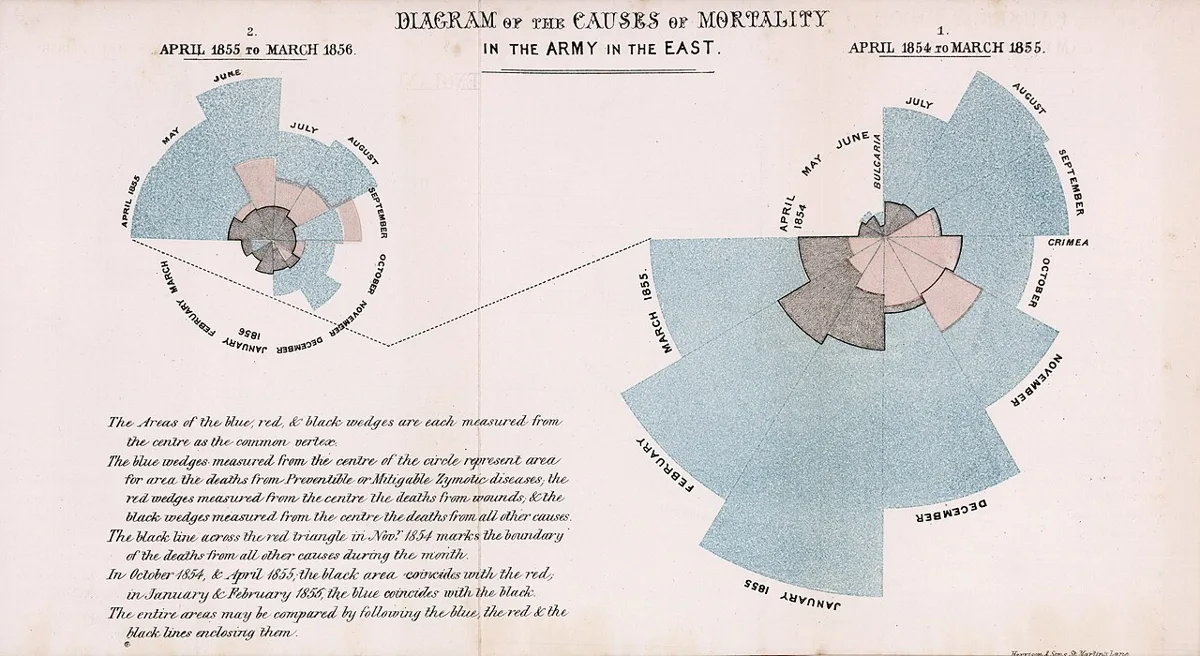
フローレンス・ナイチンゲール(1820–1910)はイギリスの看護師・統計家である。1854年、クリミア戦争のさなか、看護団を率いてトルコのスクタリの陸軍病院に入った。そこでは負傷そのものより、不潔・過密・換気の悪さによる感染症で兵士が死んでいた。
帰国後、1859年に『看護覚え書』を書き、1860年にはロンドンの聖トマス病院に看護学校を開いた。看護を、宗教的な奉仕や家事の延長から、訓練を受けた専門職へと変えた人である。
ナイチンゲールの最大の武器は統計だった。彼女は陸軍の死亡記録を分析し、死因を「戦傷」「予防できた病気」「その他」に分けて月ごとに示す図(扇形を組み合わせた鶏頭図)を作った。この図は、兵士の死の大部分が予防できる病気によるものだったことを一目で示し、政府と軍に病院の衛生改革を迫る強い証拠になった。データを集めるだけでなく、政策を動かす形で見せた点で、彼女は今のデータ可視化の先駆者でもある。
なお、スクタリで死亡率が下がったのは、彼女の看護と並んで、本国から派遣された衛生委員会が下水と換気を改善したことが大きかったと考えられている。彼女自身ものちにその分析から衛生環境こそが生死を分けると確信し、以後は病院の設計や陸軍・インドの衛生行政の改革に力を注いだ。彼女は細菌説には懐疑的で、考え方は瘴気説に近かったが、それでも清潔と換気という対策は正しく働いた。
臨床では:病院の院内感染対策、感染症の発生率を数えて改善を測るサーベイランス、病院の質を数値で示すQI 指標は、ナイチンゲールの「病院を数で評価する」発想の延長にある。また、病院の病床配置や換気が感染に関わるという考えは、新型コロナウイルス感染症の流行で改めて注目された。
English version
Core
Florence Nightingale (1820–1910) was a British nurse and statistician. In 1854, during the Crimean War, she led a group of nurses to the army hospital at Scutari in Turkey. There, more soldiers were dying of infections caused by dirt, overcrowding and poor ventilation than of their wounds.
After returning, she wrote Notes on Nursing (1859), and in 1860 opened a school of nursing at St Thomas’ Hospital in London. She changed nursing from religious service or an extension of housework into a trained profession.
Going further
Her strongest weapon was statistics. She analysed army death records and made a diagram showing, month by month, deaths from wounds, from preventable disease and from other causes (the polar area diagram, or “rose” diagram). It showed at a glance that most soldiers died of preventable disease, and it became strong evidence pushing the government and army to reform hospital hygiene. She did not just collect data — she presented it in a way that moved policy, so she was also a pioneer of data visualisation.
It is now thought that the fall in deaths at Scutari owed much to a sanitary commission sent from Britain that improved the drains and ventilation, as well as to her nursing. Her own later analysis convinced her that the sanitary environment decides life and death, and she spent the rest of her life on hospital design and on reforming sanitary administration in the army and in India. She was sceptical of germ theory, and her ideas were close to miasma theory, but her measures — cleanliness and ventilation — still worked.
In the clinic
Infection control in hospitals, surveillance that counts infection rates to measure improvement, and quality indicators that show hospital quality in numbers all extend Nightingale’s idea of judging hospitals by numbers. The idea that bed layout and ventilation affect infection gained new attention during the COVID-19 pandemic.
まとめ
| パリ学派の誕生 — 革命が内科と外科を一つにした | フランス革命は、医師・外科医・病院・古いアカデミーや医学部といった旧体制の制度を一度すべて廃止した。 |
|---|---|
| 身体診察の4つ — 視診・触診・打診・聴診 | パリの病院では、医師は患者の話(症状)だけに頼らず、医師が自分で確かめられる徴候を探すようになった。 |
| ラエンネックと聴診器 — 結核をひとつの病気にまとめる | 4つ目の、そして最も新しい手段が間接聴診である。 |
| 臨床病理相関 — モルガーニとビシャ | 1761年は、アウエンブルッガーの打診の本と同じ年に、もう一冊の重要な本が出た年でもある。 |
| ルイの「数量的方法」— 瀉血を数で確かめる | パリ学派の3本目の柱は数えることである。 |
| 病院が医学教育の中心に — 回診・研修医制度・ジョンズ・ホプキンズ | パリで学んだ数千人の学生は、イギリス・ドイツ・オーストリア・イタリア・アメリカ・オランダへ帰り、医学校や病院を作った。 |
| 精神医学と病院 — ピネルの「道徳療法」から大規模収容へ | 一般病院の発展から長く取り残されたのが精神医学である。 |
| ナイチンゲール — 看護と病院の衛生を変え、統計で訴えた人 | フローレンス・ナイチンゲール(1820–1910)はイギリスの看護師・統計家である。 |
このノートは医学生が授業の内容を自分の言葉でまとめたもので、診療の判断に使うものではありません。誤りに気づいたらお知らせください。