- 分権型医療(ドイツ)と社会化医療(スウェーデン)
- 医療制度の4つの型 — 出来高払いの米国を含めて並べる
- 中国 — 社会主義医療から市場型の医療へ
- なぜ平均寿命が健康の最良の単一指標なのか
分権型医療(ドイツ)と社会化医療(スウェーデン)
ドイツ=分権型(社会保険方式・ビスマルク型)——財源は労使折半の保険料。運営は多数の疾病金庫(非営利の保険者)で、国は直接運営しない。病院は公立・非営利・営利が混在。患者の選択の幅が広く、待機時間は短い。医師密度は高い。
スウェーデン=社会化医療(税方式・ベヴァリッジ型)——財源は税(主に地方税)。運営はregion(広域自治体)が担い、病院の多くが公立で医師は公務員的。自己負担は上限付きで低く、公平性が高い。ただし選択的な手術の待機時間が長い。
対比の軸は「誰が払うか(保険料か税か)」「誰が運営するか(保険者か自治体か)」「選択と待機のどちらを取るか」。
どちらも国民皆保険である点は共通し、米国の市場型とは根本的に違う。
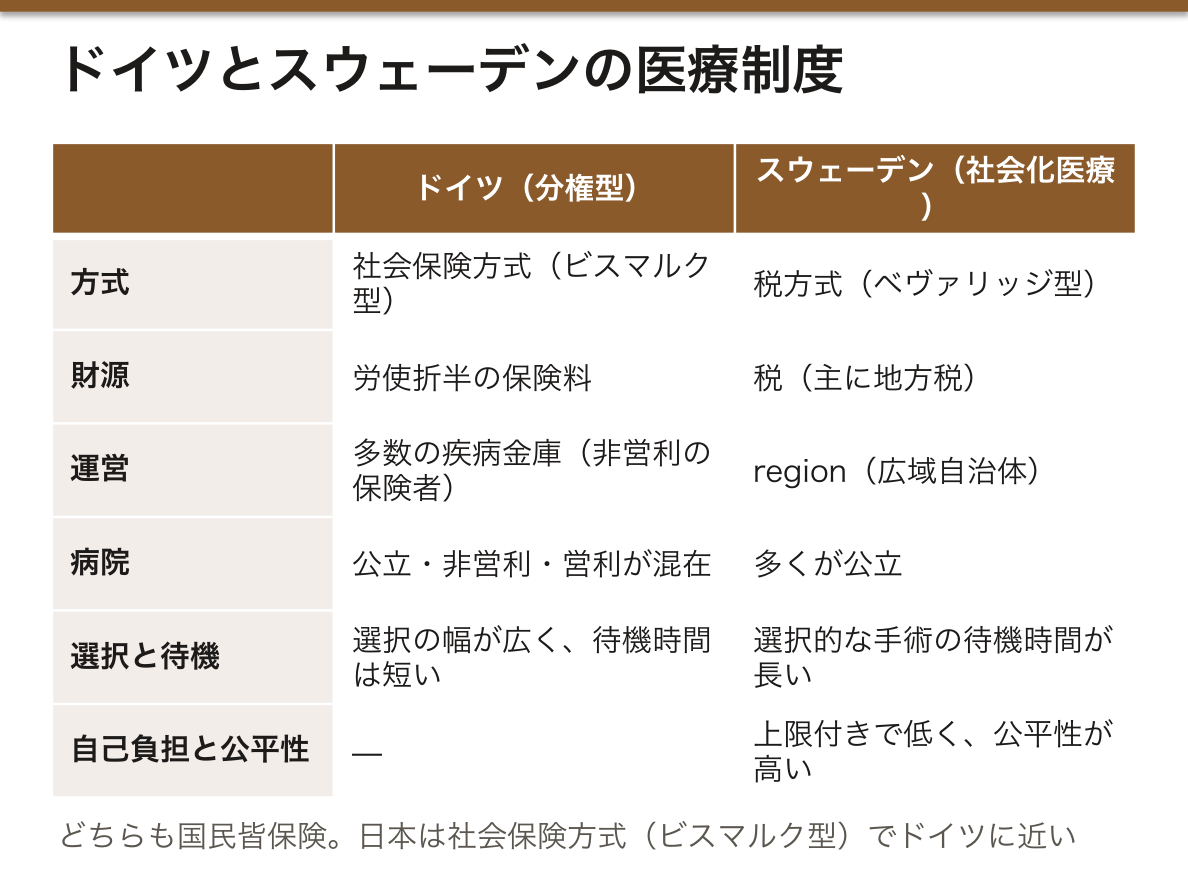
ラトビアは税方式に近い国営型だが、公的支出の割合が低く自己負担が大きいことが課題として挙げられる。日本は社会保険方式(ビスマルク型)でドイツに近い——日本の制度と対比して説明できると強い。
English version
Core
Germany = decentralised (social insurance, the Bismarck model) — the funding is contributions shared between employer and employee. It is run by many sickness funds (non-profit insurers), and the state does not run it directly. Hospitals are a mixture of public, non-profit and for-profit. The range of patient choice is wide and waiting times are short. The density of doctors is high.
Sweden = socialised medicine (taxation, the Beveridge model) — the funding is taxation (chiefly local). It is run by the regions, and most hospitals are public with doctors on a public-service footing. Co-payments are low with a ceiling, and equity is high. But waiting times for elective surgery are long.
The axes of the contrast are "who pays (contributions or tax)", "who runs it (insurers or authorities)", and "which is preferred, choice or waiting".
Both share universal coverage, and both differ fundamentally from the market model of the United States.
Going further
Latvia is a state-run system close to the tax model, and its problem is said to be that the share of public expenditure is low and out-of-pocket payment large. Japan is a social insurance (Bismarck) system, close to Germany — being able to explain it by contrast with the Japanese system is strong.
医療制度の4つの型 — 出来高払いの米国を含めて並べる
Cockerham は各国の医療制度を、政府の役割で4つの型に分ける。
| 政府の役割 | 出来高払い型 | 社会化医療 | 分権型の国民医療 | 社会主義医療 |
|---|---|---|---|---|
| 規制 | 限定的 | 直接 | 間接 | 直接 |
| 医療者への支払い | 限定的 | 直接 | 間接(支払いを規制) | 直接 |
| 施設の所有 | 民間と公立 | 民間と公立(多くは公立) | 民間と公立 | 公立 |
| 国民の受診保障 | 保障なし | 保障 | 保障 | 保障 |
| 私費の医療 | 主流 | 一部 | 一部 | なし |
| 例 | 米国 | 英国・スウェーデン・カナダ | ドイツ・日本・メキシコ | キューバ・北朝鮮(旧ソ連・旧中国) |
米国は出来高払い型の代表である。政府の関与は限られ、受診は保障されず、民間の医療が主流になる。公的な給付が始まったのは1965年の Medicare(高齢者)と Medicaid(貧困層)からで、それも一部の人に限られた。医療費は世界で最も高く、2019年には GDP の17.7%(他の先進国は多くが10〜12%)。人工股関節置換術はスペインの4倍以上、ある抗がん剤の1か月分は英国の8倍以上かかる。それでも乳児死亡率(2018年に出生千あたり5.7)と平均寿命(男性76.3歳・女性81.4歳)は、比べた30か国の中で下位にある。
なぜ米国だけが違うのか。ヨーロッパの政府が19世紀後半から社会保険を整えたのは、健康な国民が経済力と軍事力になり、労働者の不満と革命の脅威を和らげるためでもあった(ドイツが1883年に最初の国民健康保険)。同じころ米国の政府は経済にも医療にも深く関わらず、人々は政府の福祉より民間の企業に問題の解決を期待した。高齢者以外が福祉を受けることは今も「普通」とされず、受ける人はスティグマを負いやすい。米国は個人主義、ヨーロッパは政府をより集団的・保護的なものと見る——制度の違いは価値観の違いの表れである。
ここから言えるのは、医療制度は真空の中で生まれるのではなく、その国の歴史・文化・政治思想・福祉と国家の役割への態度を映すということである。お金をかけるほど健康になるわけではないことを、米国の数字が示している。
日本は「分権型の国民医療」に入る。1961年に国民皆保険を達成し、政府は直接運営するより、保険者と医療機関のあいだで診療報酬(価格)を決めて規制する。医療費の GDP 比は米国よりずっと低く、平均寿命は世界最高水準である。比べる型を持っておくと、自国の制度の特徴を説明できる。
English version
Core
Cockerham sorts national health systems into four types by the role of government.
| Role of government | Fee-for-service | Socialized medicine | Decentralized national health | Socialist medicine |
|---|---|---|---|---|
| Regulation | Limited | Direct | Indirect | Direct |
| Payments to providers | Limited | Direct | Indirect (regulates payment) | Direct |
| Ownership of facilities | Private and public | Private and public (mostly public) | Private and public | Public |
| Public access | Not guaranteed | Guaranteed | Guaranteed | Guaranteed |
| Private care | Dominant | Limited | Limited | Unavailable |
| Examples | USA | UK, Sweden, Canada | Germany, Japan, Mexico | Cuba, North Korea (former USSR, former China) |
The United States is the main fee-for-service example. Government plays a limited role, access is not guaranteed, and private care dominates. Public benefits began only in 1965 with Medicare (the elderly) and Medicaid (the poor), and only for some. US health spending is the highest in the world: 17.7% of GDP in 2019 (most rich countries spend 10–12%). A hip replacement costs over four times more than in Spain, and a month of one cancer drug over eight times more than in the UK. Yet infant mortality (5.7 per 1,000 live births in 2018) and life expectancy (men 76.3, women 81.4 years) rank low among the 30 countries compared.
Going further
Why is the US different? European governments built social insurance from the late 19th century partly because a healthy population meant economic and military power, and partly to calm workers and reduce the threat of revolution (Germany had the first national health insurance in 1883). At that time the US government was not deeply involved in the economy or health care, and people preferred private business to government welfare. Outside old age, receiving welfare is still not seen as normal and can bring stigma. Americans stress individualism; Europeans see government in a more collective, protective way — the systems reflect these values.
The lesson: health systems do not arise in a vacuum. They reflect each country’s history, culture, political ideas and attitudes to welfare and the state. US figures show that spending more does not automatically make people healthier.
In the clinic
Japan belongs to the “decentralized national health” type. It reached universal health insurance in 1961, and the government regulates fees between insurers and providers rather than running care directly. Its health spending as a share of GDP is much lower than the US, and its life expectancy is among the highest in the world. Having these types in mind helps you explain your own country’s system.
中国 — 社会主義医療から市場型の医療へ
社会主義医療は、国がすべての施設を所有し、医療者を国が雇い、国家予算で全員に無料の医療を出す型である。1989〜91年に東欧と旧ソ連で共産主義が崩れるとほぼ姿を消し、残る共産主義国のうちこの型を保つのはキューバと北朝鮮だけになった。中国は政治的には社会主義のままだが、経済の市場化に合わせて医療制度は根本から変わった。
1949年の革命の前、西洋医学の医師は少なく都市に集中し、住民の多くは民間の治療者に頼っていた。平均寿命は35歳ほどだった。共産党政権はまず愛国衛生運動(ハエの駆除・ごみの除去・衛生の改善)を進め、伝統中国医学を復興させた。中国は伝統医学と西洋医学を法的に対等に扱う唯一の国とされる。さらに約180万人の「はだしの医者」を養成して農村に送り、基礎的な治療と予防を担わせた(実際には裸足でも医師でもなかった)。文化大革命(1966〜70年ごろ)では医学研究と教育がほぼ止まり、医学教育は短縮されて質が落ちた。
1980年代、集団農場から世帯単位の農業へ移ると、農村の協同医療が崩れた。診療所は閉じ、はだしの医者の多くは医療を離れるか開業し、費用は家計の自己負担になった。払えない人は医療を受けられなかった。
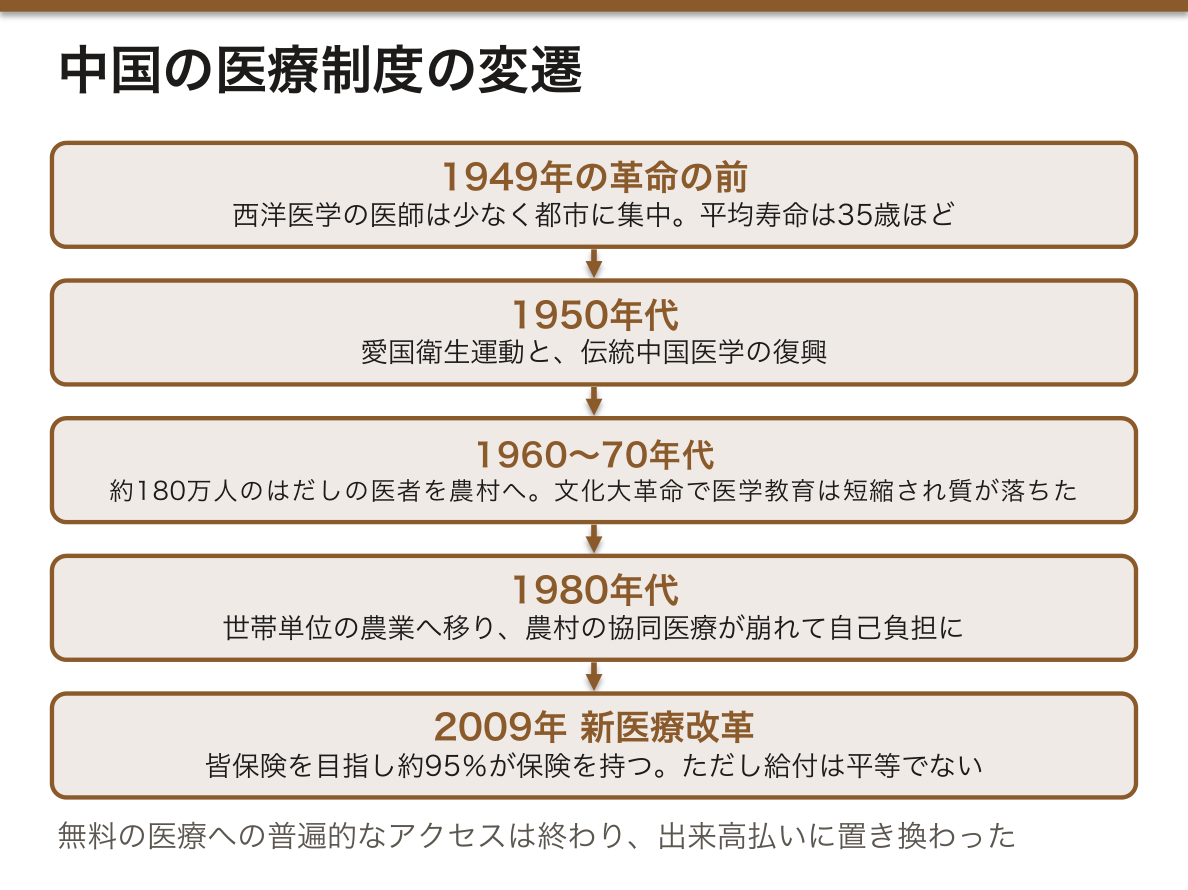
2009年の新医療改革は、都市の被用者・住民向けの基本医療保険と、農村の新型農村合作医療によって皆保険を目指した。料金表の導入、薬の調達での競争、農村での薬の上乗せ利益の禁止なども行われ、いまは人口の約95%が保険を持つ。ただし保険料の高い保険ほど給付が厚く、平等ではない。中央政府が負担する医療費は全体の1%に満たず、責任は省と県に任され、病院は患者の支払い(とくに薬と検査)で収入を得る。その結果、無料の医療への普遍的なアクセスは終わり、出来高払いに置き換わった。都市と農村の貧困層がもっとも不利である。
健康の面では、米国と逆の社会経済的勾配が見られた。急速な発展の中で、高所得・高学歴の比較的若い世代のほうが、脂肪と糖の多い食事・座りがちな生活・喫煙・飲酒を「豊かさの特権」として取り入れ、健康が悪かった(ただし教育は、予想どおり長寿と結びつく)。2型糖尿病の急増、成人男性の喫煙率が5割を超えること、北部の石炭による大気汚染が課題で、国営のたばこ専売が政府の大きな税収源でもあるという矛盾を抱える。2018年の平均寿命は男性74.5歳・女性79.1歳、乳児死亡率は出生千あたり11.8で、1991年の50.2から大きく下がった。
中国の経験は、経済の制度が変わると、医療へのアクセスと健康行動の両方が変わることを示す。ロシアでは体制転換の中で労働者階級の男性の飲酒が死亡を押し上げ(「健康の社会的決定要因」の章)、中国では豊かになった層の生活習慣が慢性疾患を増やした。どの階層が危険な生活習慣を担うかは、社会によって違うのである。
English version
Core
Socialist medicine means the state owns all facilities, employs health workers, and gives free care to all from the national budget. It almost disappeared when communism collapsed in Eastern Europe and the USSR in 1989–91; among the remaining communist countries, only Cuba and North Korea keep it. China is still socialist politically, but its health system changed completely with the move to a market economy.
Before the 1949 revolution, there were few Western-trained doctors, mostly in cities, and most people used folk healers. Life expectancy was about 35 years. The communist government started the Patriotic Health Movement (killing flies, removing rubbish, improving sanitation) and revived traditional Chinese medicine. China is said to be the only country that treats traditional and scientific medicine as legally equal. It also trained about 1.8 million “barefoot doctors” for basic treatment and prevention in rural areas (they were neither barefoot nor doctors). During the Cultural Revolution (about 1966–70), medical research and training almost stopped, medical education was shortened, and quality fell.
In the 1980s, when farming moved from collective farms to households, rural cooperative health care collapsed. Clinics closed, many barefoot doctors left health care or went private, and households had to pay out of pocket. People who could not pay went without care.
Going further
The 2009 New Health Reform aimed at universal coverage through basic insurance for urban employees and residents, and the New Rural Cooperative Medical System. It also set fee schedules, opened drug supply to competition and banned drug mark-ups in rural areas. About 95% of people now have insurance, but more expensive plans give better benefits, so coverage is not equal. The central government pays less than 1% of health spending; provinces and counties are responsible, and hospitals earn income from patient fees (especially drugs and tests). The result is the end of universal free care and its replacement by fee-for-service. The urban and rural poor are the most disadvantaged.
For health, China showed a socioeconomic gradient opposite to the US. In rapid development, recent cohorts with higher income and education adopted high-fat, high-sugar diets, sedentary life, smoking and drinking as “privileges,” and had worse health (though education still predicted longer life, as expected). Problems include a rapid rise in type 2 diabetes, more than half of adult men smoking, and coal-based air pollution in the north; the state tobacco monopoly is also a major source of government revenue, which creates a conflict of interest. In 2018 life expectancy was 74.5 years for men and 79.1 for women, and infant mortality was 11.8 per 1,000 live births, down from 50.2 in 1991.
In the clinic
China shows that when economic institutions change, both access to care and health behaviour change. In Russia, drinking by working-class men pushed up deaths during the transition (see the chapter on social determinants of health); in China, the lifestyles of the newly rich increased chronic disease. Which class carries risky lifestyles differs by society.
なぜ平均寿命が健康の最良の単一指標なのか
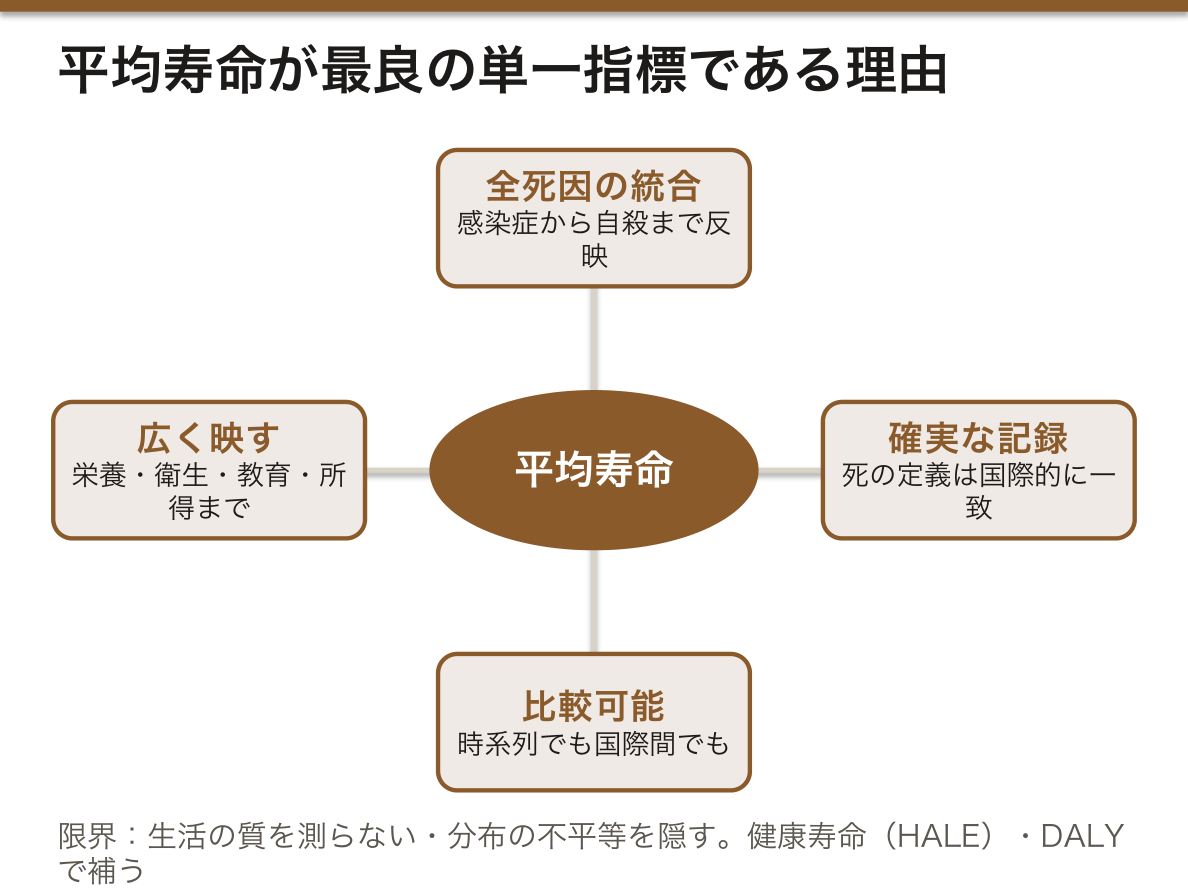
理由——①あらゆる死因を統合した結果である(感染症・慢性疾患・事故・自殺のすべてが反映される)②死亡は最も確実に記録される事象で、定義が国際的に一致している——疾病の有無は診断体制に左右されるが、死は左右されない③比較可能(時系列でも国際間でも)④医療だけでなく、栄養・衛生・教育・所得・治安・環境まで映す。
限界も必ず添える——①生活の質を測らない(長く生きても不健康な期間が長いかもしれない)②平均なので分布の不平等を隠す③変化が遅れて現れる④乳児死亡率に強く影響される。
そこで補う指標が健康寿命(HALE)、DALY、乳児死亡率、群間の格差。
「単一指標としては最良だが、単独では足りない」——この形で答える。
「健康の社会的決定要因」の章のポストソビエトの物語が、平均寿命が社会変動を鋭敏に捉えることの実例になる。
English version
Core
The reasons — ① it is the result of integrating every cause of death (infection, chronic disease, accident and suicide are all reflected) ② death is the event most reliably recorded and its definition agrees internationally — whether a disease is present depends on the diagnostic system; death does not ③ it is comparable (over time and between countries) ④ it reflects not only medicine but nutrition, sanitation, education, income, safety and the environment.
Always add the limits too — ① it does not measure quality of life (a long life may include a long period in poor health) ② being a mean, it hides inequality in the distribution ③ changes appear with a lag ④ it is strongly influenced by infant mortality.
The indices that supplement it are healthy life expectancy (HALE), DALYs, infant mortality and differences between groups.
"The best single index, and not sufficient alone" — answer in that form.
Going further
The post-Soviet story of the chapter on the social determinants of health is the instance showing how sensitively life expectancy captures social change.
まとめ
| 分権型医療(ドイツ)と社会化医療(スウェーデン) | ドイツ=分権型(社会保険方式・ビスマルク型)——財源は労使折半の保険料。 |
|---|---|
| 医療制度の4つの型 — 出来高払いの米国を含めて並べる | Cockerham は各国の医療制度を、政府の役割で4つの型に分ける。 |
| 中国 — 社会主義医療から市場型の医療へ | 社会主義医療は、国がすべての施設を所有し、医療者を国が雇い、国家予算で全員に無料の医療を出す型である。 |
| なぜ平均寿命が健康の最良の単一指標なのか | 理由——①あらゆる死因を統合した結果である(感染症・慢性疾患・事故・自殺のすべてが反映される)②死亡は最も確実に記録される事象で、定義が国際的に一致している——疾病の有無は診断体制… |
このノートは医学生が授業の内容を自分の言葉でまとめたもので、診療の判断に使うものではありません。誤りに気づいたらお知らせください。