生化学は有機化学から始まる。生化学の分子はすべて有機化合物なので、「どの官能基を持つか」を見れば、その分子が何をするかがおおよそ決まる——これがこの章の主題である。
国試の生化学は「代謝経路」から入るが、経路の矢印は1本ずつが官能基の変換である。解糖でカルボニルがどう動くか、β酸化でカルボキシ基がどう短くなるかは、ここで扱う数種類の反応の組み合わせにすぎない。
この章の芯は「同じ原子の集まりでも、並び方が違えば別の物質になる」ことである。異性体は化学の抽象論ではなく、薬が効くか効かないか・毒になるかならないかを実際に決めている。
- 官能基 — 分子の性質を決める部品
- 官能基が溶けやすさを決める — 極性・水素結合と、両親媒性の分子
- 構造異性体 — 同じ分子式で骨格が違う
- 立体異性体 — 並び方が違うだけで、別の薬になる
- 有機化合物の命名 — 名前から構造が読める
- 構造式の描き方と炭素の番号 — 数字の系統とギリシャ文字の系統
官能基 — 分子の性質を決める部品
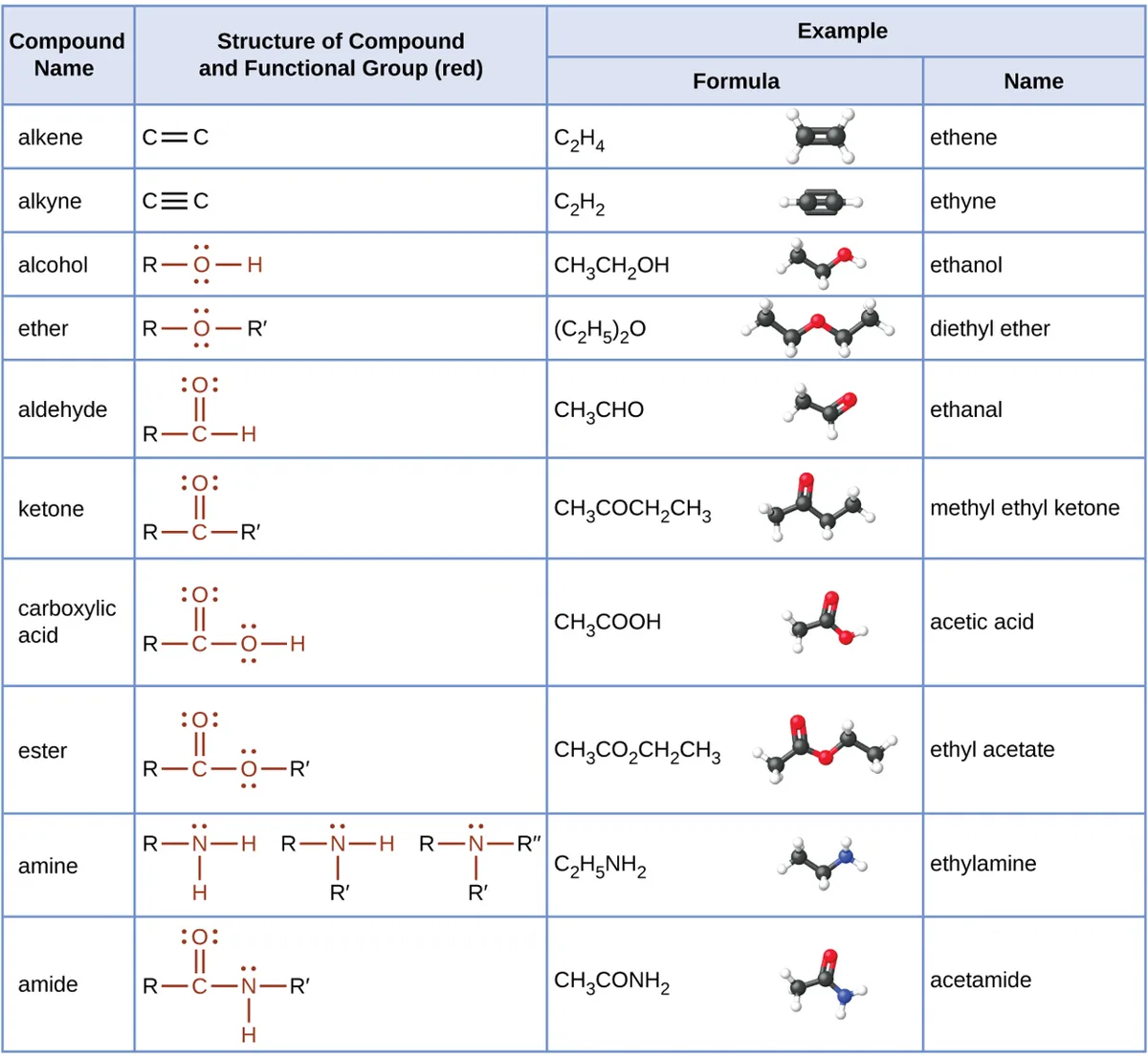
炭素骨格に付いて、その分子の反応性・溶解性・酸塩基性を決める原子団。生体分子は数種類の官能基の組み合わせでできている。
| 官能基 | 構造 | 性質 | 生体での例 |
|---|---|---|---|
| ヒドロキシ基 | –OH | 親水性・水素結合 | 糖・セリン・コレステロール |
| アルデヒド基 | –CHO | 還元性・酸化されやすい | グルコース(アルドース) |
| ケトン基 | >C=O | アルデヒドより安定 | フルクトース・アセトン |
| カルボキシ基 | –COOH | 酸性(生理的pHで –COO⁻) | 脂肪酸・アミノ酸 |
| アミノ基 | –NH₂ | 塩基性(生理的pHで –NH₃⁺) | アミノ酸・ヌクレオチド塩基 |
| スルフヒドリル基 | –SH | 酸化されて S–S を作る | システイン・CoA |
| リン酸基 | –OPO₃²⁻ | 強い負電荷・高エネルギー結合 | ATP・リン脂質・核酸 |
官能基の見分けが、そのまま生化学の分類になっている。アミノ酸はアミノ基とカルボキシ基を両方持つから両性電解質になり、等電点が決まり、電気泳動で分離できる(この章から、後の蛋白質の章まで一本で繋がる)。
リン酸基が「高エネルギー」と呼ばれる理由は、結合そのものが特別なのではなく、加水分解した後の生成物が安定だからである。①負電荷どうしの反発が解ける、②生成物が共鳴で安定化する、③溶媒和が有利になる——この3つで ΔG が大きく負になる。「高エネルギーリン酸結合」という言い方は結果の要約であって、原因ではない。
–SH は生体で「可逆のスイッチ」として働く。2つが酸化されると ジスルフィド結合(S–S) になり、蛋白の立体構造を固定する。細胞質は還元的なので S–S はほとんど無く、小胞体内腔と細胞外は酸化的なので S–S が保たれる——だから分泌蛋白と細胞外の蛋白(抗体・インスリン)は S–S を持ち、細胞質の蛋白は持たない。
English version
Core
The groups of atoms attached to the carbon skeleton that decide the reactivity, solubility and acid–base behaviour of the molecule. Biological molecules are combinations of a few functional groups.
| Group | Structure | Property | Example |
|---|---|---|---|
| Hydroxyl | –OH | Hydrophilic, hydrogen bonding | Sugars, serine, cholesterol |
| Aldehyde | –CHO | Reducing, readily oxidised | Glucose (an aldose) |
| Ketone | >C=O | More stable than an aldehyde | Fructose, acetone |
| Carboxyl | –COOH | Acidic (–COO⁻ at physiological pH) | Fatty acids, amino acids |
| Amino | –NH₂ | Basic (–NH₃⁺ at physiological pH) | Amino acids, nucleotide bases |
| Sulfhydryl | –SH | Oxidised to form S–S | Cysteine, CoA |
| Phosphate | –OPO₃²⁻ | Strong negative charge, high-energy bonds | ATP, phospholipids, nucleic acids |
Going further
Recognising the functional group is itself the classification of biochemistry. An amino acid carries both an amino and a carboxyl group, so it is amphoteric, has an isoelectric point, and can be separated by electrophoresis — a single thread running from this chapter to the later chapter on proteins.
The reason a phosphate bond is called "high-energy" is not that the bond itself is special but that the products of its hydrolysis are stable: ① the repulsion between negative charges is relieved ② the products are stabilised by resonance ③ solvation is favourable. These three make ΔG strongly negative. "High-energy phosphate bond" is a summary of the result, not the cause.
–SH acts in the body as a reversible switch. Two of them oxidised become a disulphide bond (S–S), fixing the conformation of a protein. The cytosol is reducing, so it holds almost no S–S; the lumen of the endoplasmic reticulum and the extracellular space are oxidising, so S–S is preserved there. Hence secreted and extracellular proteins (antibody, insulin) have disulphide bonds and cytosolic proteins do not.
官能基が溶けやすさを決める — 極性・水素結合と、両親媒性の分子
分子が水に溶けるかどうかは、水と水素結合を作れる極性の官能基を、炭素骨格の大きさに比べてどれだけ持っているかで決まる。
| 官能基 | 極性 | 水素結合 | 水への溶けやすさ |
|---|---|---|---|
| –OH(ヒドロキシ基) | 大きい | 供与も受容もできる | 溶けやすくする |
| –CHO・>C=O(カルボニル基) | 中くらい | 受容だけ | やや溶けやすくする |
| –COOH(カルボキシ基) | 大きい。生理的 pH では –COO⁻ | 供与も受容も。イオンならさらに強く水和 | とても溶けやすくする |
| –NH₂(アミノ基) | 大きい。生理的 pH では –NH₃⁺ | 供与も受容も | とても溶けやすくする |
| –CH₃・–CH₂–(炭化水素) | ほぼ無い | 作れない | 溶けにくくする(疎水性) |
糖は炭素ごとに –OH を持つので水によく溶け、脂肪酸は炭化水素の長い鎖を持つので水に溶けずベンゼンのような無極性の溶媒に溶ける。「似たものは似たものに溶ける」と覚えるとよい。
両親媒性の分子は、1つの分子の中に親水部と疎水部を両方持つ。リン脂質(リン酸を含む頭部+脂肪酸の尾2本)・胆汁酸塩・脂肪酸の塩(石けん)がその例で、水の中では疎水部どうしを内側に集めてミセルや脂質二重層を作る。
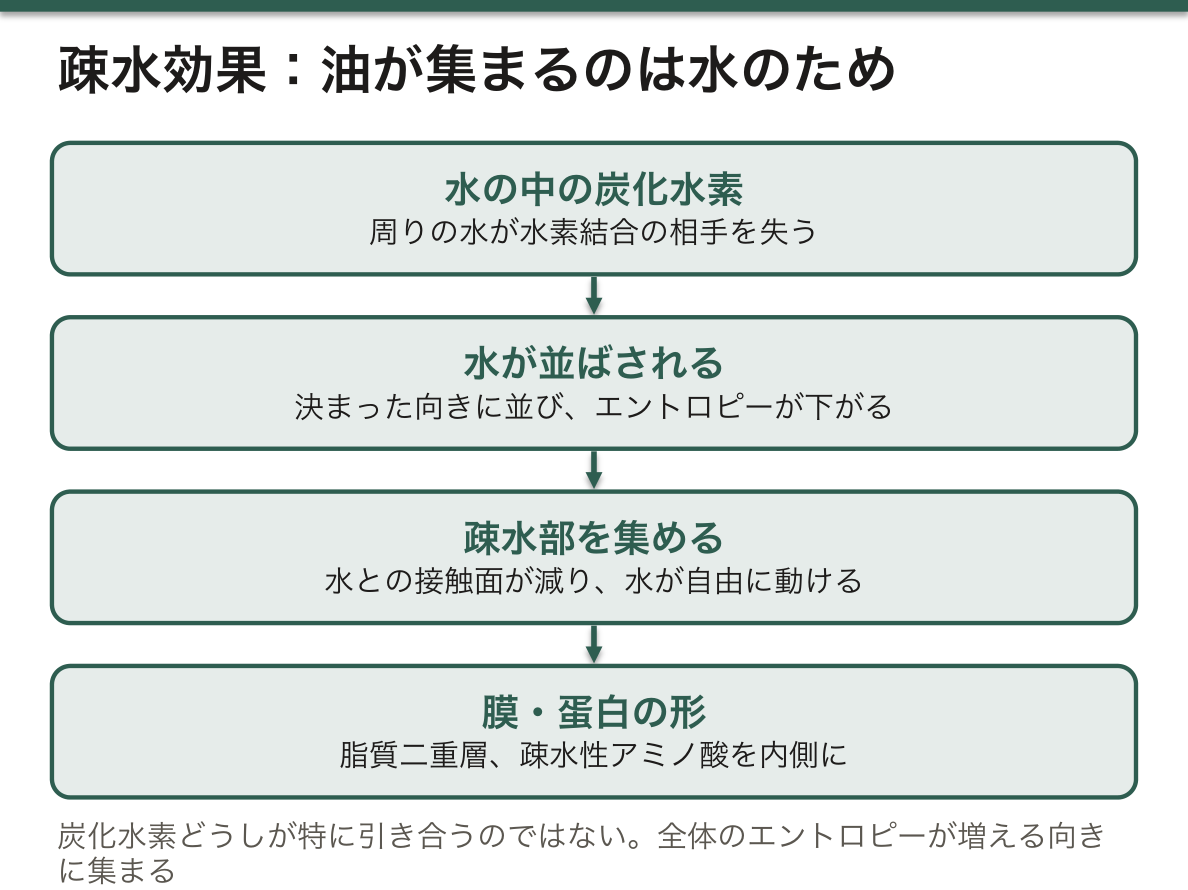
なぜ疎水性の部分どうしは集まるのか。炭化水素どうしが特に引き合うからではない。水の中に炭化水素があると、周りの水分子が水素結合の相手を失い、決まった向きに並ばされる(エントロピーが下がる)。疎水部をまとめて水との接触面を減らすと、解放された水分子が自由に動けるようになり、全体のエントロピーが増える。この「疎水効果」が、膜ができる理由であり、蛋白が疎水性のアミノ酸を内側に折りたたむ理由でもある。
トリアシルグリセロールは、グリセロールの3つの –OH がすべて脂肪酸とエステルになって極性を失っているので、両親媒性ではなく完全に疎水性になる。だから膜は作れず、細胞の中では油滴として固まって貯蔵される。リン脂質は3つ目の位置にリン酸の頭部を残しているので、膜を作れる。
薬が膜を通るには脂溶性が要り、血液に溶けて運ばれるには水溶性が要る。多くの薬はその間の性質に作られていて、肝の代謝(–OH の付加やグルクロン酸の抱合)は、脂溶性の分子に極性の官能基を足して水に溶かし、尿や胆汁へ捨てる仕組みである。
English version
Core
Whether a molecule dissolves in water depends on how many polar groups able to hydrogen-bond with water it has, compared with the size of its carbon skeleton.
| Group | Polarity | Hydrogen bonds | Water solubility |
|---|---|---|---|
| –OH (hydroxyl) | High | Donor and acceptor | Increases |
| –CHO, >C=O (carbonyl) | Medium | Acceptor only | Increases somewhat |
| –COOH (carboxyl) | High; –COO⁻ at body pH | Donor and acceptor; ions are strongly hydrated | Increases strongly |
| –NH₂ (amino) | High; –NH₃⁺ at body pH | Donor and acceptor | Increases strongly |
| –CH₃, –CH₂– (hydrocarbon) | Almost none | None | Decreases (hydrophobic) |
Sugars have an –OH on every carbon and dissolve well in water; fatty acids have long hydrocarbon chains and dissolve in non-polar solvents such as benzene instead. ‘Like dissolves like.’
Amphipathic molecules have both a polar and a non-polar part: phospholipids (phosphate head + two fatty acid tails), bile salts, fatty acid salts (soap). In water they gather their non-polar parts inside, forming micelles or a lipid bilayer.
Going further
Why do non-polar parts come together? Not because hydrocarbons strongly attract each other. Around a hydrocarbon in water, water molecules lose hydrogen-bond partners and are forced into fixed orientations (lower entropy). Gathering the non-polar parts reduces the contact surface and frees those water molecules, so total entropy rises. This hydrophobic effect builds membranes and makes proteins fold with hydrophobic amino acids inside.
In triacylglycerol all three –OH groups of glycerol are esterified, so it has lost its polarity and is fully hydrophobic, not amphipathic. It cannot form membranes and is stored as fat droplets. Phospholipids keep a phosphate head at the third position, so they can form membranes.
In the clinic
A drug needs fat solubility to cross membranes and water solubility to travel in blood; most drugs are designed in between. Liver metabolism (adding –OH, conjugating glucuronic acid) adds polar groups to fat-soluble molecules so they dissolve and leave in urine or bile.
構造異性体 — 同じ分子式で骨格が違う
分子式は同じだが、原子の繋がり方が違うもの。3種類に分ける。
- 連鎖異性(骨格の枝分かれが違う)— ロイシンとイソロイシン
- 位置異性(官能基の位置が違う)— グルコース1-リン酸とグルコース6-リン酸
- 官能基異性(官能基そのものが違う)— グルコース(アルドース)とフルクトース(ケトース)はどちらも C₆H₁₂O₆
互変異性 tautomerism は特別な構造異性で、水素とπ結合が移動して2つの形が平衡にある。ケト形とエノール形が代表。
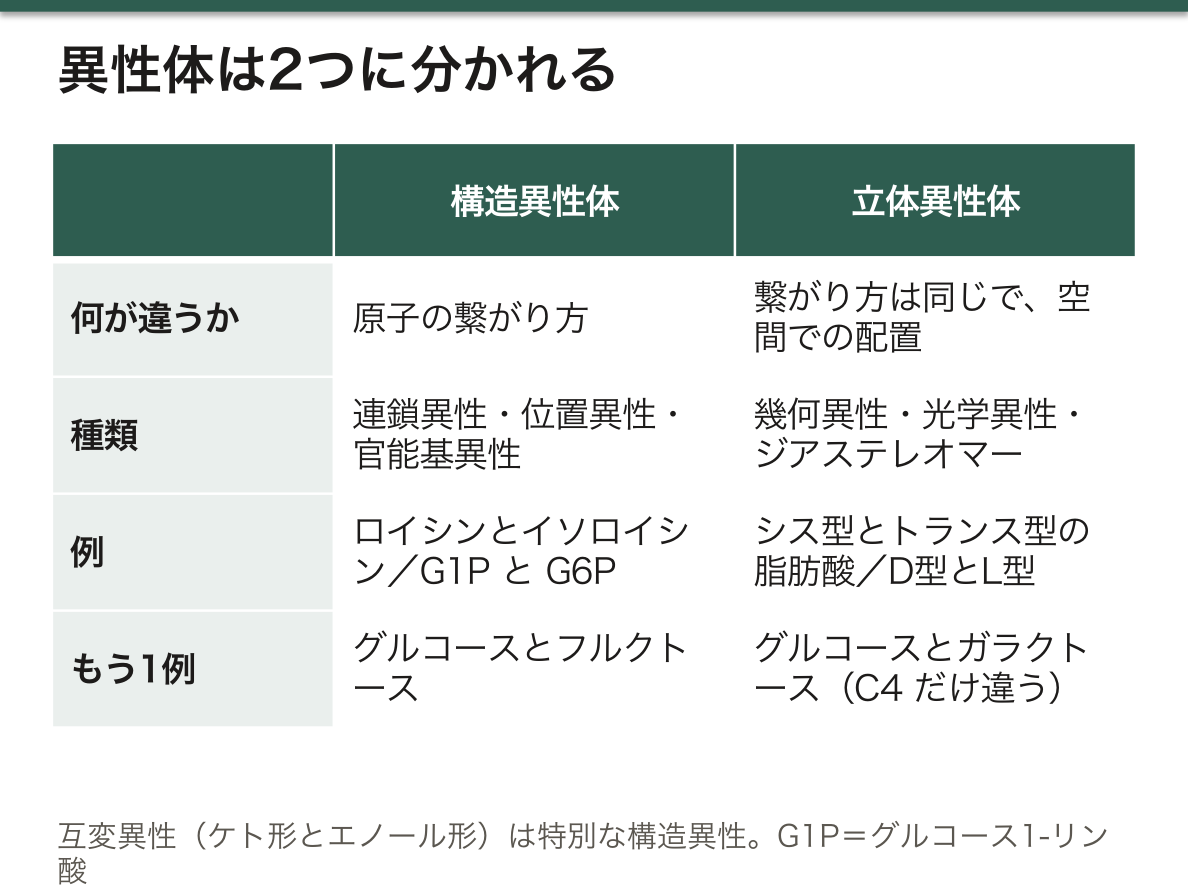
互変異性が、糖の還元性を説明する。フルクトースはケトースだから本来アルデヒドを持たないが、アルカリ性ではエンジオールを経てアルドースへ異性化する(Lobry de Bruyn 転位)。だから Fehling 反応・Tollens 反応で陽性になる——還元糖の検出で、ケトースが陽性に出る理由がここにある。
核酸でも互変異性が効く。塩基は通常ケト形(またはアミノ形)で存在し、これが Watson-Crick の塩基対を成り立たせている。まれにエノール形(イミノ形)を取ると誤った対合が起こり、それが自然突然変異の一因になる。5-ブロモウラシルのような塩基類似体が変異原になるのは、エノール形を取りやすいからである。
位置異性は代謝の分かれ道である。グルコース6-リン酸とグルコース1-リン酸は原子の数も種類も同じだが、前者は解糖・ペントースリン酸経路へ、後者はグリコーゲン合成へ向かう。ホスホグルコムターゼが1つの結合の位置を変えるだけで、分子の運命が変わる。
English version
Core
The same molecular formula with the atoms connected differently. Three kinds.
- Chain isomerism (a different branching of the skeleton) — leucine and isoleucine.
- Positional isomerism (a functional group in a different place) — glucose 1-phosphate and glucose 6-phosphate.
- Functional group isomerism (a different group altogether) — glucose (an aldose) and fructose (a ketose), both C₆H₁₂O₆.
Tautomerism is a special case in which a hydrogen and a π bond move and two forms exist in equilibrium — keto and enol forms being the classic pair.
Going further
Tautomerism explains the reducing power of sugars. Fructose is a ketose and properly has no aldehyde, but in alkali it isomerises to an aldose through an enediol (the Lobry de Bruyn transformation). So it is positive in Fehling’s and Tollens’ tests — the reason a ketose gives a positive result in tests for reducing sugars.
Tautomerism tells in the nucleic acids too. The bases normally exist in the keto (or amino) form, and this is what makes Watson–Crick pairing possible. Rarely they take the enol (or imino) form, mispairing occurs, and this is one cause of spontaneous mutation. Base analogues such as 5-bromouracil are mutagenic because they take the enol form readily.
Positional isomerism is a parting of the ways in metabolism. Glucose 6-phosphate and glucose 1-phosphate have identical atoms in identical numbers, but the first goes to glycolysis and the pentose phosphate pathway and the second to glycogen synthesis. Phosphoglucomutase moves the position of one bond, and the fate of the molecule changes.
立体異性体 — 並び方が違うだけで、別の薬になる
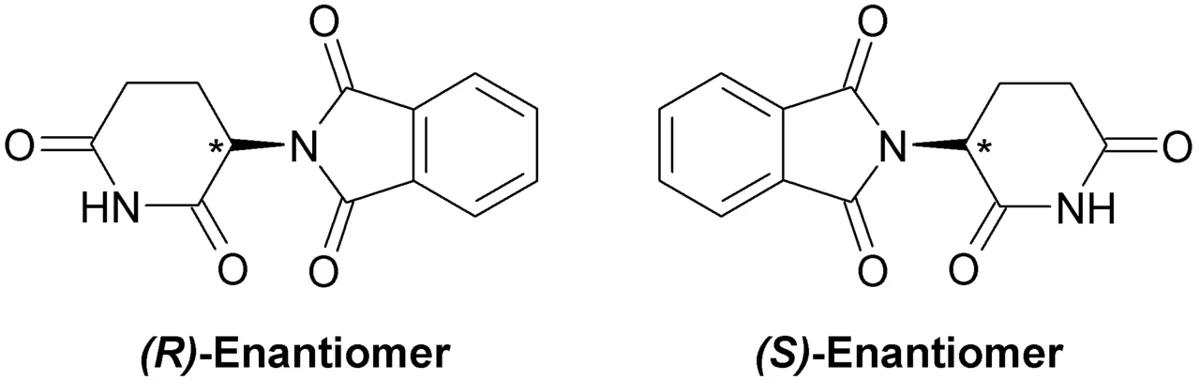
原子の繋がり方は同じだが、空間での配置が違うもの。
- 幾何異性(シス・トランス)— 二重結合や環のまわりで回転できないためにできる。不飽和脂肪酸のシス型とトランス型
- 光学異性(鏡像異性・エナンチオマー)— 不斉炭素(4つの異なる基が付いた炭素)があるとき、重ね合わせられない鏡像の関係になる。D 型と L 型
- ジアステレオマー— 不斉炭素が複数あり、その一部だけが違う。グルコースとガラクトース(C4 だけ違う)
生体は徹底して片方だけを使う——糖は D 型、アミノ酸は L 型。酵素の活性部位が立体特異的だからである。
「なぜ片方だけか」は酵素の側から説明できる。酵素の活性部位は3点で基質を捉えるので、鏡像は3点すべてを同時に合わせられない(three-point attachment model)。だから代謝も薬も、鏡像体では効き方がまったく違う。
臨床で決定的だった例が3つ。①サリドマイド——R 体に鎮静作用、S 体に催奇形性。しかも体内でラセミ化するので、R 体だけを投与しても防げなかった。②L-DOPA——D 体は無効で毒性がある。③D-ペニシラミン——L 体はピリドキシンの働きを阻害する。
トランス脂肪酸が問題になるのも立体異性である。天然の不飽和脂肪酸はほぼシス型で、二重結合の位置で鎖が折れ曲がる。この折れ曲がりが膜の流動性を生む。トランス型は直線に近いので飽和脂肪酸のように詰まり、LDL を上げ HDL を下げる。形が詰まり方を決め、詰まり方が代謝を決める。
D 型アミノ酸が全く無いわけではない。細菌の細胞壁のペプチドグリカン(D-Ala、D-Glu)に含まれる——ヒトのプロテアーゼが分解できないので、細菌にとっては防御になり、ヒトにとっては薬の標的になる(バンコマイシンは D-Ala-D-Ala に結合する)。
English version
Core
The atoms are connected in the same way but arranged differently in space.
- Geometric (cis–trans) — arising because there is no rotation about a double bond or within a ring. The cis and trans forms of unsaturated fatty acids.
- Optical (enantiomers) — where there is an asymmetric carbon (one bearing four different groups), giving non-superimposable mirror images. D and L forms.
- Diastereomers — several asymmetric carbons of which only some differ. Glucose and galactose (differing only at C4).
The body uses one form throughout — sugars D, amino acids L — because the active site of an enzyme is stereospecific.
Going further
"Why only one form?" is explained from the side of the enzyme. The active site grasps the substrate at three points, and a mirror image cannot match all three at once (the three-point attachment model). So both metabolism and drugs behave quite differently with the two enantiomers.
Three examples were decisive clinically. ① Thalidomide — the R form is sedative, the S form teratogenic; and since it racemises in the body, giving the R form alone did not prevent it. ② L-DOPA — the D form is inactive and toxic. ③ D-penicillamine — the L form inhibits the action of pyridoxine.
Trans fatty acids are a problem of stereoisomerism too. Natural unsaturated fatty acids are almost all cis, and the chain bends at the double bond. That bend creates the fluidity of the membrane. The trans form is nearly straight and packs like a saturated fatty acid, raising LDL and lowering HDL. The shape decides the packing, and the packing decides the metabolism.
D-amino acids are not entirely absent. They occur in the peptidoglycan of bacterial cell walls (D-Ala, D-Glu) — human proteases cannot degrade them, so they are a defence for the bacterium and a target for drugs in us (vancomycin binds D-Ala-D-Ala).
有機化合物の命名 — 名前から構造が読める
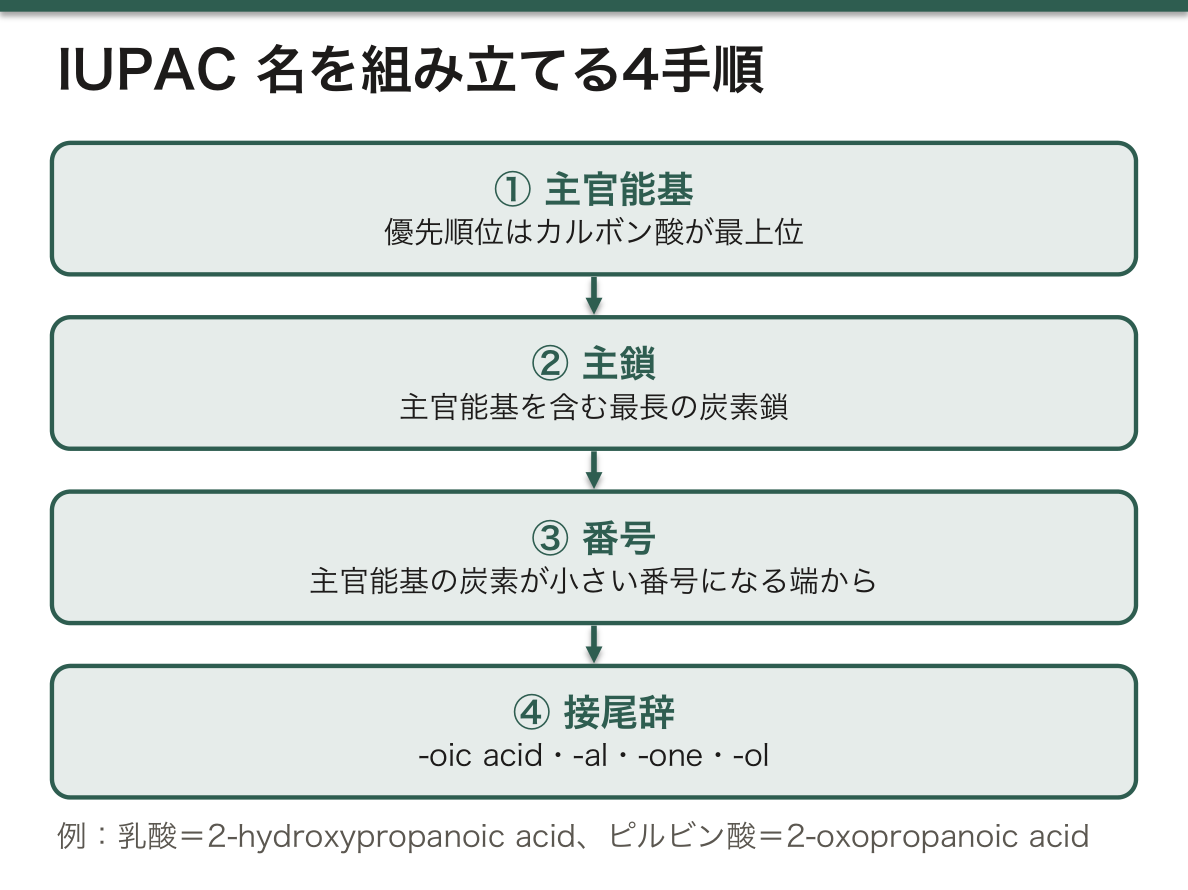
IUPAC 名は「主鎖 + 不飽和 + 主官能基」で組み立てる。
- 主官能基を決める(優先順位:カルボン酸 > エステル > アミド > アルデヒド > ケトン > アルコール > アミン)
- それを含む最長の炭素鎖を主鎖にする(meth-1・eth-2・prop-3・but-4・pent-5・hex-6…)
- 主官能基の炭素ができるだけ小さい番号になるよう端から数える
- 接尾辞(-oic acid / -al / -one / -ol / -amine)と置換基を付ける
生化学では慣用名が主流だが、対応を知っておく:酢酸=ethanoic acid、乳酸=2-hydroxypropanoic acid、ピルビン酸=2-oxopropanoic acid。
脂肪酸の表記は3通りあり、意味が違う。
| 表記 | 数える起点 | 例(リノール酸) |
|---|---|---|
| C:D 表記 | — | 18:2 |
| Δ 表記 | カルボキシ基側(C1) | 18:2 Δ9,12 |
| ω(n-)表記 | メチル末端側 | 18:2 ω-6 |
ω 表記がなぜ栄養学で使われるか。ヒトはメチル末端から数えて9番目より内側にしか二重結合を入れられない(Δ9 不飽和化酵素しか持たない)。だから ω-3 と ω-6 は体内で作れず必須脂肪酸になる。「どちら側から数えるか」が、そのまま合成できるかどうかの境界を表している——ω 表記は栄養学の都合で選ばれた記法である。
接頭辞は生化学の用語にそのまま生きている。keto-(>C=O)はケト酸・ケトン体、hydroxy-(–OH)はヒドロキシ酪酸、amino-(–NH₂)はアミノ基転移、oxo- は 2-oxoglutarate(=α-ケトグルタル酸、TCA 回路)。用語を分解できると、初めて見る物質名でも構造が推測できる。
English version
Core
An IUPAC name is built as parent chain + unsaturation + principal functional group.
- Decide the principal group (priority: carboxylic acid > ester > amide > aldehyde > ketone > alcohol > amine).
- Take the longest carbon chain containing it as the parent (meth- 1, eth- 2, prop- 3, but- 4, pent- 5, hex- 6 …).
- Number from the end that gives the carbon of the principal group the lowest number.
- Add the suffix (-oic acid / -al / -one / -ol / -amine) and the substituents.
Trivial names predominate in biochemistry, but know the correspondences: acetic acid = ethanoic acid, lactic acid = 2-hydroxypropanoic acid, pyruvic acid = 2-oxopropanoic acid.
Going further
There are three ways of writing a fatty acid, and they mean different things.
| Notation | Counted from | Linoleic acid |
|---|---|---|
| C:D | — | 18:2 |
| Δ | The carboxyl end (C1) | 18:2 Δ9,12 |
| ω (n-) | The methyl end | 18:2 ω-6 |
Why nutrition uses the ω notation. Humans can introduce a double bond no further out than the ninth carbon counted from the methyl end (we have only a Δ9 desaturase). So ω-3 and ω-6 cannot be made in the body and are essential fatty acids. Which end you count from expresses exactly the boundary of what can be synthesised — the ω notation was chosen for the convenience of nutrition.
The prefixes survive in biochemical terminology. keto- (>C=O) in keto acids and ketone bodies; hydroxy- (–OH) in hydroxybutyrate; amino- (–NH₂) in transamination; oxo- in 2-oxoglutarate (= α-ketoglutarate, of the TCA cycle). Take a term apart and the structure of an unfamiliar substance can be guessed.
構造式の描き方と炭素の番号 — 数字の系統とギリシャ文字の系統
生化学では、分子を骨格式(線角式)で描くことが多い。決まりは3つ:①線の折れ目と端が炭素、②炭素に付く水素は描かない(炭素は手が4本なので、足りない分は水素と考える)、③炭素と水素以外の原子(O・N・S・P)と、それに付く水素は必ず描く。
炭素の番号には2つの系統がある。
| 系統 | 数え方 | 例 |
|---|---|---|
| 数字(1, 2, 3…) | 主な官能基の炭素を1とする(カルボン酸なら –COOH の炭素が C1) | 脂肪酸の Δ9、グルコースの C1〜C6、3-ヒドロキシ酪酸 |
| ギリシャ文字(α, β, γ…) | 主な官能基が付いた炭素の隣を α とする | α-アミノ酸、β-ヒドロキシ酪酸、γ-アミノ酪酸(GABA) |
| ω(オメガ) | 官能基から最も遠い端の炭素 | ω-3・ω-6 脂肪酸、ω 酸化 |
同じ炭素でも、数字では C2、ギリシャ文字では α になる——ギリシャ文字は数字より1つずれる。3-ヒドロキシ酪酸と β-ヒドロキシ酪酸は同じ物質である。
名前に残ったギリシャ文字は、反応の場所を教えてくれる。β 酸化は、脂肪酸の β 炭素(C3)が酸化されてケトンになり、α 炭素と β 炭素の間で切れる反応である。だから2炭素ずつ(アセチル CoA として)短くなる。α-アミノ酸は、アミノ基がカルボキシ基の隣の炭素に付いていることを示し、タンパク質を作るアミノ酸はすべてこの形である。β-ラクタム系抗菌薬の名前は、β 位の窒素で閉じた4員環のアミド(ラクタム)を持つことから来ている。
練習には、知っている分子を骨格式に描き直すのがよい。リシンなら、α 炭素から伸びる側鎖が –CH₂– 4つの後に –NH₂(ε-アミノ基)で終わるジグザグになる。リノール酸なら、18 本のジグザグの C9 と C12 に、折れ曲がったシス形の二重結合を描く。
English version
Core
Biochemistry often draws molecules as skeletal (line-angle) formulas. Three rules: (1) every corner and end of a line is a carbon; (2) hydrogens on carbon are not drawn (carbon has four bonds; missing ones are H); (3) atoms other than C and H (O, N, S, P) and their hydrogens are always drawn.
There are two numbering systems for carbons.
| System | How to count | Examples |
|---|---|---|
| Numbers (1, 2, 3…) | The carbon of the main functional group is 1 (for a carboxylic acid, the –COOH carbon is C1) | Δ9 of fatty acids; C1–C6 of glucose; 3-hydroxybutyrate |
| Greek letters (α, β, γ…) | The carbon next to the main functional group is α | α-amino acid, β-hydroxybutyrate, γ-aminobutyrate (GABA) |
| ω (omega) | The carbon at the far end from the functional group | ω-3 and ω-6 fatty acids, ω-oxidation |
The same carbon is C2 in numbers and α in Greek letters — Greek letters are shifted by one. 3-Hydroxybutyrate and β-hydroxybutyrate are the same compound.
Going further
Greek letters left in names tell you where reactions happen. In β-oxidation the β carbon (C3) of a fatty acid is oxidised to a ketone and the chain is cut between α and β, so it shortens by two carbons (as acetyl-CoA). ‘α-Amino acid’ means the amino group is on the carbon next to the carboxyl group, as in all protein amino acids. β-Lactam antibiotics are named for their four-membered cyclic amide (lactam) closed at the β position.
Practise by redrawing known molecules. Lysine: from the α carbon a zigzag of four –CH₂– ending in –NH₂ (the ε-amino group). Linoleic acid: an 18-carbon zigzag with bent cis double bonds at C9 and C12.
まとめ
| 官能基 — 分子の性質を決める部品 | 炭素骨格に付いて、その分子の反応性・溶解性・酸塩基性を決める原子団。 |
|---|---|
| 官能基が溶けやすさを決める — 極性・水素結合と、両親媒性の分子 | 分子が水に溶けるかどうかは、水と水素結合を作れる極性の官能基を、炭素骨格の大きさに比べてどれだけ持っているかで決まる。 |
| 構造異性体 — 同じ分子式で骨格が違う | 分子式は同じだが、原子の繋がり方が違うもの。 |
| 立体異性体 — 並び方が違うだけで、別の薬になる | 原子の繋がり方は同じだが、空間での配置が違うもの。 |
| 有機化合物の命名 — 名前から構造が読める | IUPAC 名は「主鎖 + 不飽和 + 主官能基」で組み立てる。 |
| 構造式の描き方と炭素の番号 — 数字の系統とギリシャ文字の系統 | 生化学では、分子を骨格式(線角式)で描くことが多い。 |
このノートは医学生が授業の内容を自分の言葉でまとめたもので、診療の判断に使うものではありません。誤りに気づいたらお知らせください。