免疫を細胞の物語として学ぶ前に、分子としての構造を押さえておくと、検査値も薬も読みやすくなる。
抗体は1つの分子で「捕まえる」と「知らせる」を兼ねる設計になっており、補体は凝固と同じくカスケードによる増幅を使う。どちらも「特異性と増幅の両立」という同じ課題を、別の方法で解いている。
- 免疫グロブリン — 2つの端が、別の仕事をする
- 補体 — 3つの入口と、1つの出口
- HLA — 自分の細胞の中身を、外へ見せている分子
- 抗体医薬 — 名前の末尾が、何でできているかを教えている
- 免疫グロブリンのクラス — 場所と時期で使い分けられている
- 補体を止める仕組み — 自分を攻撃させないための装置
免疫グロブリン — 2つの端が、別の仕事をする
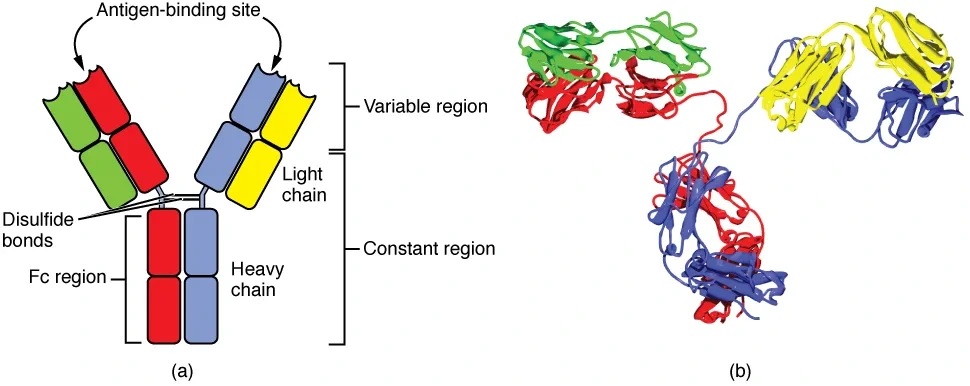
基本構造:H鎖2本+L鎖2本。パパインで切るとFab 2つとFc 1つに分かれる。
- Fab(可変部を含む)——抗原を捕まえる。多様性はV(D)J組換えによる
- Fc(定常部)——効果を起こす。補体の活性化・食細胞のFc受容体への結合・胎盤通過
| クラス | 形 | 要点 |
|---|---|---|
| IgG | 単量体 | 血中で最多・唯一胎盤を通る・二次応答 |
| IgM | 五量体 | 一次応答で最初に出る・補体活性化が最も強い |
| IgA | 二量体(分泌片) | 粘膜・初乳 |
| IgE | 単量体 | マスト細胞・I型アレルギー・寄生虫 |
| IgD | 単量体 | B細胞の表面 |
「IgMは五量体だから補体が強い」——理由はC1qが結合するには、Fcが2つ以上近接している必要があるからである。単量体のIgGでは、抗原上に複数のIgGが並んで初めて条件が満たされる。五量体のIgMは1分子で条件を満たす。構造が機能を決めることの分かりやすい例である。
IgGが胎盤を通る仕組みも分子で説明できる。胎盤の栄養膜細胞にある新生児Fc受容体(FcRn)が、IgGを能動的に運ぶ。ここから複数の臨床事項が導ける。
- 母体からの移行抗体が生後数か月の乳児を守る——だから予防接種の開始時期が決まる
- 母体のIgG型自己抗体が胎児に病気を起こす——新生児Basedow病・新生児重症筋無力症・新生児ループス(先天性房室ブロック)
- 血液型不適合妊娠でIgGが問題になる——ABO不適合よりRh不適合が重いのは、抗D抗体がIgGだからである(自然抗体の抗A・抗BはIgMが主体で通らない)
- FcRnはIgGを分解から守ってもいる——だからIgGの半減期は約3週間と長い。この受容体を阻害する薬が、自己抗体を減らす治療として実用化されつつある
単クローン性免疫グロブリン血症を見たときの考え方も、構造から出る。L鎖だけが過剰に作られると、腎から濾過されてBence Jones蛋白になる。試験紙は主にアルブミンを見るので陰性——免疫電気泳動か遊離L鎖の測定が要る(尿の生化学の章)。
English version
Core
Basic structure: two heavy and two light chains. Cut with papain it gives two Fab and one Fc.
- Fab (containing the variable region) — catches the antigen. The diversity comes from V(D)J recombination.
- Fc (the constant region) — produces the effect: activation of complement, binding to Fc receptors of phagocytes, and passage across the placenta.
| Class | Form | Point |
|---|---|---|
| IgG | Monomer | The commonest in blood; the only one to cross the placenta; the secondary response |
| IgM | Pentamer | First in the primary response; the strongest activator of complement |
| IgA | Dimer (with secretory component) | Mucosa and colostrum |
| IgE | Monomer | Mast cells; type I allergy; parasites |
| IgD | Monomer | On the surface of B cells |
Going further
"IgM is a pentamer, so its complement activation is strong" — the reason is that C1q requires two or more Fc regions close together. A monomeric IgG satisfies this only when several IgG are lined up on an antigen; a pentameric IgM satisfies it in one molecule. A clear example of structure deciding function.
How IgG crosses the placenta is also explained at the molecular level: the neonatal Fc receptor (FcRn) on the trophoblast transports it actively. Several clinical points follow.
- Transferred maternal antibody protects the infant for some months — which is why the timing of immunisation is what it is.
- Maternal IgG autoantibody can cause disease in the fetus — neonatal Graves’ disease, neonatal myasthenia, neonatal lupus (congenital heart block).
- In blood group incompatibility it is IgG that matters — Rhesus incompatibility is more severe than ABO because anti-D is IgG (the natural anti-A and anti-B are chiefly IgM and do not cross).
- FcRn also protects IgG from degradation — hence the long half-life of about three weeks. Drugs inhibiting this receptor are coming into use as a way of reducing autoantibody.
How to think on seeing a monoclonal gammopathy also comes from the structure. If light chains alone are made in excess they are filtered by the kidney and become Bence Jones protein. The dipstick chiefly sees albumin and reads negative — immunoelectrophoresis or free light chain measurement is required.
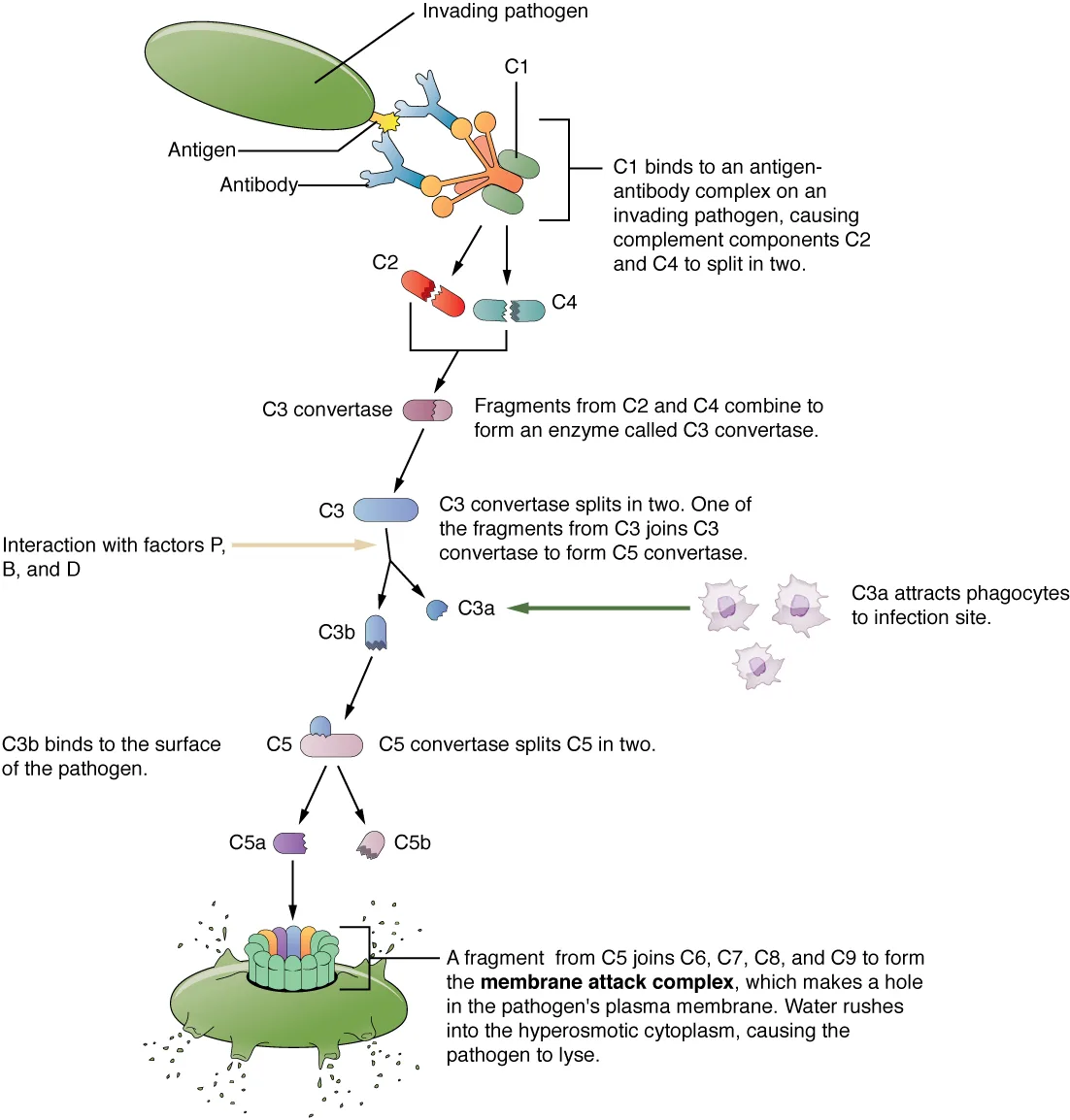
補体 — 3つの入口と、1つの出口
| 経路 | 引き金 | 特徴 |
|---|---|---|
| 古典経路 | 抗原抗体複合体(IgM・IgG) | C1q → C1r・C1s → C4 → C2 |
| レクチン経路 | 病原体の糖鎖(マンノース結合レクチン) | 抗体が要らない |
| 第二経路 | 常に少量が自然に活性化している | C3の自発的加水分解 |
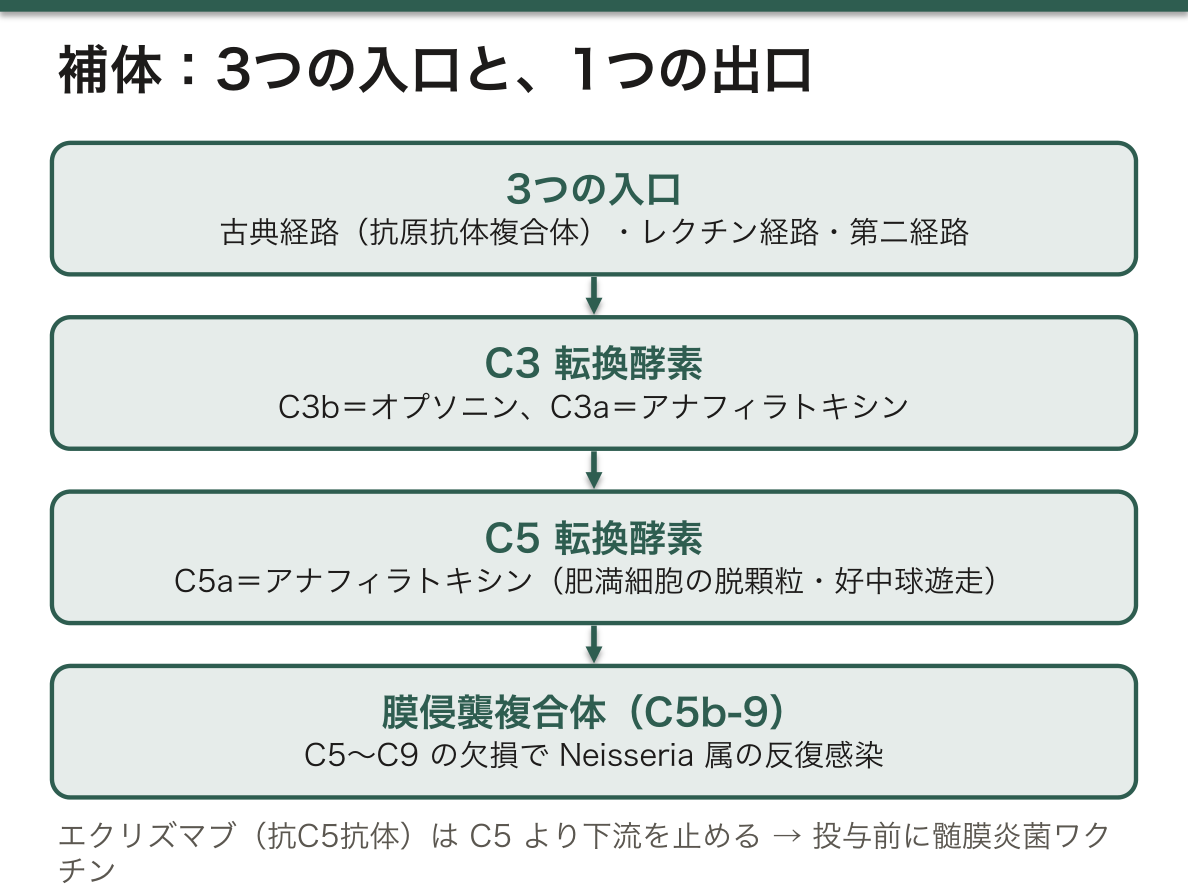
いずれもC3転換酵素に集まり、C5転換酵素 → 膜侵襲複合体(C5b-9)へ。
- C3a・C5aはアナフィラトキシン(肥満細胞の脱顆粒・好中球遊走)
- C3bはオプソニン
- C5〜C9の欠損——Neisseria属(髄膜炎菌)の反復感染
- C1インヒビター欠損——遺伝性血管性浮腫
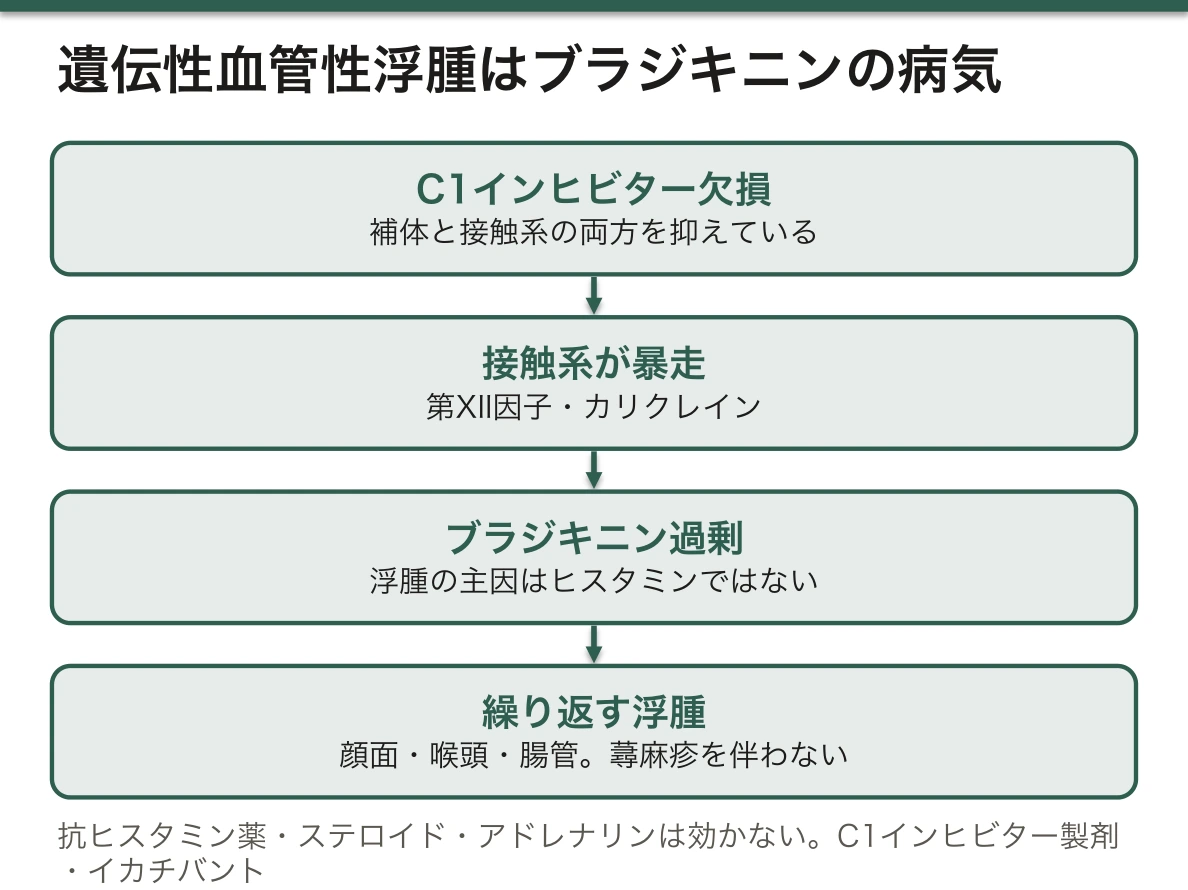
遺伝性血管性浮腫は、アレルギーと誤診されやすく、誤診すると救えない——臨床で最も重要な補体関連疾患である。
- C1インヒビターは補体だけでなく、接触系(第XII因子・カリクレイン)も抑えている
- 欠損すると、ブラジキニンが過剰に産生される
- だから浮腫の主因はヒスタミンではなくブラジキニン
- 抗ヒスタミン薬・ステロイド・アドレナリンが効かない
- 治療はC1インヒビター製剤、ブラジキニンB2受容体拮抗薬(イカチバント)
「蕁麻疹を伴わない、繰り返す顔面・喉頭・腸管の腫れ」で疑う。腹痛発作で開腹手術を受けてしまうことがある点は、急性ポルフィリン症と同じ構図である。アンジオテンシン変換酵素阻害薬による血管性浮腫も、同じブラジキニンの機序である。
発作性夜間ヘモグロビン尿症は、補体の制御の破綻として理解する。PIGA遺伝子の後天的変異により、GPIアンカーが作れなくなる。するとGPIで膜に繋がっているCD55とCD59が赤血球表面から失われる。
- CD55はC3転換酵素を、CD59は膜侵襲複合体を止めている
- 失われると、第二経路による持続的な補体活性化から赤血球を守れず、血管内溶血が続く
- 治療はエクリズマブ(抗C5抗体)——C5より下流を止めるので、髄膜炎菌感染のリスクが上がる。投与前のワクチン接種が必須
「薬の作用点を知っていれば、副作用も予測できる」——補体欠損症で髄膜炎菌感染が増えるという知識が、そのまま投与前の準備を決めている。
English version
Core
| Pathway | Trigger | Features |
|---|---|---|
| Classical | Antigen–antibody complexes (IgM, IgG) | C1q → C1r, C1s → C4 → C2 |
| Lectin | Sugars of the pathogen (mannose-binding lectin) | No antibody required |
| Alternative | A small amount is always active spontaneously | Spontaneous hydrolysis of C3 |
All converge on the C3 convertase, then the C5 convertase → the membrane attack complex (C5b-9).
- C3a and C5a are anaphylatoxins (mast cell degranulation, neutrophil chemotaxis).
- C3b is an opsonin.
- Deficiency of C5–C9 — recurrent Neisseria (meningococcal) infection.
- C1 inhibitor deficiency — hereditary angioedema.
Going further
Hereditary angioedema is readily misdiagnosed as allergy, and misdiagnosed it cannot be saved — the most important complement disease clinically.
- C1 inhibitor restrains not only complement but the contact system (factor XII, kallikrein).
- Its deficiency leads to excessive production of bradykinin.
- So the oedema is caused by bradykinin, not histamine.
- Antihistamines, steroids and adrenaline do not work.
- Treatment is C1 inhibitor concentrate or a bradykinin B2 receptor antagonist (icatibant).
Suspect it from "recurrent swelling of face, larynx or gut without urticaria". Patients have undergone laparotomy for the attacks of abdominal pain — the same pattern as acute porphyria. Angioedema from ACE inhibitors is the same bradykinin mechanism.
Paroxysmal nocturnal haemoglobinuria is understood as a failure of complement regulation. An acquired mutation of PIGA means the GPI anchor cannot be made, and CD55 and CD59, tethered by GPI, are lost from the red cell surface.
- CD55 stops the C3 convertase; CD59 stops the membrane attack complex.
- Without them the red cell cannot be protected from continuous alternative pathway activation and intravascular haemolysis continues.
- Treatment is eculizumab (anti-C5) — stopping the pathway below C5 raises the risk of meningococcal infection. Vaccination before treatment is essential.
"Know the site of action of a drug and the adverse effect can be predicted" — the knowledge that complement deficiency increases meningococcal infection is itself what decides the preparation before treatment.
HLA — 自分の細胞の中身を、外へ見せている分子
| クラスI(A・B・C) | クラスII(DR・DQ・DP) | |
|---|---|---|
| どの細胞に | ほぼ全ての有核細胞 | 抗原提示細胞のみ(樹状細胞・マクロファージ・B細胞) |
| 見せるもの | 細胞内で作られた蛋白(ウイルス・自己・腫瘍) | 取り込んだ外来の蛋白 |
| 相手 | CD8陽性T細胞 | CD4陽性T細胞 |
| ペプチドの長さ | 8〜10 個 | 13〜25 個 |
| 処理する場所 | プロテアソーム → 小胞体 | エンドソーム・リソソーム |
きわめて多型性が高い(個人差が大きい)。第6染色体短腕にある。
赤血球は核が無いので HLA を出さない——だから輸血では ABO と Rh を、移植では HLA を合わせる。
「中で作ったものはI、外から取り込んだものはII」という原則で、免疫の設計が読める。だから細胞内寄生体は CD8 が、細胞外の病原体は CD4 が担当する(抗原提示の章)——「感染の場所が、動員される細胞を決めている」。
NK 細胞は、この原則の裏を突いている。クラスI を失った細胞(ウイルスや腫瘍が提示を止めた細胞)を、失っていることを理由に殺す(NK細胞の章)——「見せないという逃げ方に、別の網が掛けてある」。
多型性が高いことが、移植の難しさそのものになる(移植免疫の章)——「兄弟で一致する確率が 1/4 になるのは、ハプロタイプが一括で伝わるから」。
特定の型が病気と結び付くことも多い。
| 型 | 疾患 |
|---|---|
| B27 | 強直性脊椎炎・反応性関節炎 |
| DR4 | 関節リウマチ・1型糖尿病 |
| DQ2/DQ8 | セリアック病 |
| B*57:01 | アバカビル過敏症 |
(膠原病の章)——「投与前に型を測る薬が、実際にある」。
English version
Core
| Class I (A, B, C) | Class II (DR, DQ, DP) | |
|---|---|---|
| On which cells | Almost every nucleated cell | Antigen-presenting cells only (dendritic cells, macrophages, B cells) |
| What it shows | Protein made within the cell (viral, self, tumour) | Protein taken up from outside |
| To whom | CD8+ T cells | CD4+ T cells |
| Peptide length | 8–10 | 13–25 |
| Where processed | Proteasome → endoplasmic reticulum | Endosome, lysosome |
Extremely polymorphic; on the short arm of chromosome 6. Red cells have no nucleus and display no HLA — so transfusion is matched for ABO and Rh, and transplantation for HLA.
Going further
With the principle "made inside means class I, taken in from outside means class II", the design of immunity can be read. So intracellular parasites are the business of CD8 and extracellular pathogens of CD4 — the site of the infection deciding which cells are mobilised.
The NK cell exploits the converse of that principle: it kills a cell that has lost class I (a cell in which a virus or tumour has stopped presenting) for the very reason that it has lost it — another net cast over the escape of not showing.
The high polymorphism is itself the difficulty of transplantation — the probability of a match between siblings is 1 in 4 because the haplotype is transmitted as a block.
Particular types are often tied to disease.
| Type | Disease |
|---|---|
| B27 | Ankylosing spondylitis, reactive arthritis |
| DR4 | Rheumatoid arthritis, type 1 diabetes |
| DQ2 / DQ8 | Coeliac disease |
| B*57:01 | Abacavir hypersensitivity |
There are drugs for which the type is actually measured before treatment.
抗体医薬 — 名前の末尾が、何でできているかを教えている
一般名の語尾に規則がある。
| 語尾 | 作り | 免疫原性 | 例 |
|---|---|---|---|
| -ximab | キメラ(可変部がマウス) | 高い | リツキシマブ・インフリキシマブ |
| -zumab | ヒト化(相補性決定領域のみマウス) | 中 | トラスツズマブ・ベバシズマブ |
| -umab | 完全ヒト | 低い | アダリムマブ・ニボルマブ |
| -cept | 受容体とFcの融合蛋白 | 低い | エタネルセプト・アバタセプト |
働き方も分けられる——①中和(相手に結合して働かせない) ②細胞を壊す(ADCC・補体) ③薬を運ぶ(抗体薬物複合体)。
IgG なので半減期が長い(約3週間)——投与間隔が数週間になる。
「どこまでヒトの配列か」が、そのまま副作用の型を決めている。マウスの配列が多いほど、それに対する抗体(抗薬物抗体)ができて効果が落ち、輸注反応が起きる(分子標的薬の章)——「語尾を見れば、免疫原性の見当がつく」。
Fc 部分が残っていることが、半減期を長くしている。新生児 Fc 受容体(FcRn)が取り込んだ IgG を分解せずに戻すので、他の蛋白より長く残る(この章の免疫グロブリンの項)——「同じ仕組みで、母体の IgG が胎盤を通る」。
だから抗体医薬の効果は、中止しても数か月続くことがある(免疫抑制薬の章)——「生ワクチンや手術の予定は、その期間を考えて組む」。
標的が免疫の要であるほど、感染の型が決まる。抗 TNF 薬では結核の再燃、抗 CD20 薬では B型肝炎の再活性化と低ガンマグロブリン血症(抗酸菌の章)——「投与前のスクリーニングは、標的から逆算できる」。
免疫チェックポイント阻害薬は、逆に免疫を外す薬になる(腫瘍免疫の章)——「副作用が自己免疫の形(免疫関連有害事象)で出るのは、機序どおりになる」。
English version
Core
There is a rule in the ending of the generic name.
| Ending | Construction | Immunogenicity | Examples |
|---|---|---|---|
| -ximab | Chimeric (variable region murine) | High | Rituximab, infliximab |
| -zumab | Humanised (only the CDRs murine) | Intermediate | Trastuzumab, bevacizumab |
| -umab | Fully human | Low | Adalimumab, nivolumab |
| -cept | A fusion of receptor with Fc | Low | Etanercept, abatacept |
They also divide by how they work — ① neutralising (binding the target so it cannot act) ② destroying cells (ADCC, complement) ③ carrying a drug (antibody–drug conjugates).
Being IgG, the half-life is long (about three weeks) — hence dosing intervals of weeks.
Going further
How far the sequence is human decides directly the type of adverse effect. The more murine sequence, the more antibody is raised against it (anti-drug antibody), the effect falls and infusion reactions occur — the ending gives an idea of the immunogenicity.
That the Fc region remains is what makes the half-life long. The neonatal Fc receptor (FcRn) takes up IgG and returns it undegraded, so it persists longer than other proteins — the same mechanism by which maternal IgG crosses the placenta.
So the effect of an antibody drug can persist for months after it is stopped — plan live vaccines and operations with that period in mind.
The more central the target is to immunity, the more fixed the type of infection. With anti-TNF agents, reactivation of tuberculosis; with anti-CD20, reactivation of hepatitis B and hypogammaglobulinaemia — the pre-treatment screening can be worked backwards from the target.
The checkpoint inhibitors, conversely, take the brakes off immunity — that the adverse effects take the form of autoimmunity (immune-related adverse events) follows from the mechanism.
免疫グロブリンのクラス — 場所と時期で使い分けられている
| クラス | 形 | 特徴 |
|---|---|---|
| IgG | 単量体 | 血中で最多。唯一胎盤を通る。半減期が長い(約3週)。補体を活性化する |
| IgM | 五量体 | 最初に作られる。補体を最も強く活性化する。胎盤を通らない |
| IgA | 二量体(分泌型) | 粘膜と初乳。分泌成分が蛋白分解から守る |
| IgE | 単量体 | 肥満細胞に結合。I 型アレルギーと寄生虫 |
| IgD | 単量体 | B細胞の表面 |
クラススイッチは重鎖の定常部だけを変える——抗原の認識部位(可変部)は変わらない。
IgG のサブクラス——IgG1〜4。IgG4 関連疾患が独立した疾患概念になっている。
「認識は変えずに、働き方だけを変える」というのがクラススイッチの意味になる。同じ抗原に対して、必要な場所と機能に合わせて道具を替えている(B細胞の章)——「T細胞からの助けとサイトカインが、どのクラスへ替えるかを決める」。
IgM が胎盤を通らないことが、母子感染の診断の根拠になる(母子感染の章)——「新生児の IgM 陽性は、児自身が作ったことを意味する」。
IgG の半減期が長いことは、移行抗体の持続と、抗体医薬の投与間隔の両方を決めている(抗体医薬の項)——「生後 6 か月頃に移行抗体が切れ、予防接種の時期がそこに合わせてある」。
分泌型 IgA の欠損が、最も多い原発性免疫不全になる(免疫不全の章)——「多くは無症状だが、輸血や免疫グロブリン製剤でアナフィラキシーを起こしうる」。
IgM が五量体であることは、検査の性質に現れる(異常蛋白の章)——「Waldenström マクログロブリン血症で過粘稠度症候群が起こるのは、分子が大きいからになる」。
English version
Core
| Class | Form | Features |
|---|---|---|
| IgG | Monomer | Commonest in blood. The only one to cross the placenta. Long half-life (about 3 weeks). Activates complement |
| IgM | Pentamer | Made first. The strongest activator of complement. Does not cross the placenta |
| IgA | Dimer (secretory) | Mucosa and colostrum. The secretory component protects it from proteolysis |
| IgE | Monomer | Binds mast cells. Type I allergy and parasites |
| IgD | Monomer | On the B cell surface |
Class switching changes only the constant region of the heavy chain — the antigen-recognising variable region does not change.
Subclasses of IgG — IgG1–4. IgG4-related disease has become a disease entity in its own right.
Going further
The meaning of class switching is "keep the recognition, change only the way of acting" — for the same antigen, the tool is changed to suit the place and the function needed; help from T cells and the cytokines decide which class it switches to.
That IgM does not cross the placenta is the basis of the diagnosis of congenital infection — IgM positive in a newborn means the child made it.
The long half-life of IgG decides both the persistence of transferred antibody and the dosing interval of antibody drugs — the transferred antibody wanes at about six months and the schedule of immunisation is fitted to that.
Deficiency of secretory IgA is the commonest primary immunodeficiency — usually asymptomatic, but it can cause anaphylaxis to transfusion or to immunoglobulin preparations.
That IgM is a pentamer shows in the properties of the tests — hyperviscosity syndrome occurs in Waldenström’s macroglobulinaemia because the molecule is large.
補体を止める仕組み — 自分を攻撃させないための装置
補体は自己増幅する系なので、止める装置が無ければ自分の細胞を壊す。
| 制御因子 | 場所 | 働き |
|---|---|---|
| C1 インヒビター | 血漿 | C1r・C1s と、接触系(第XII因子・カリクレイン)を止める |
| H 因子・I 因子 | 血漿 | C3 転換酵素を壊す(第二経路の制御) |
| CD55(DAF) | 細胞膜(GPI アンカー) | C3 転換酵素を解離させる |
| CD59 | 細胞膜(GPI アンカー) | 膜侵襲複合体の形成を止める |
これらが失われると、補体が自己の細胞を攻撃する。
「制御が外れる病気」として並べると、まとまって理解できる。
| 欠ける/壊れるもの | 疾患 |
|---|---|
| CD55・CD59(GPI アンカーが作れない) | 発作性夜間ヘモグロビン尿症 |
| H 因子など第二経路の制御 | 非典型溶血性尿毒症症候群 |
| C1 インヒビター | 遺伝性血管性浮腫 |
(補体の章)——「攻撃側ではなく、ブレーキ側の異常として覚える」。
遺伝性血管性浮腫は、蕁麻疹とはまったく別の病態になる(アナフィラキシーの章)——「ブラジキニンによるので、痒みが無く、抗ヒスタミン薬もステロイドもアドレナリンも効かない」。
だから治療は C1 インヒビター製剤やブラジキニン受容体拮抗薬になる(中毒と特異的治療の章)——「同じ喉頭浮腫でも、機序が違えば薬が変わる」。
ACE 阻害薬による血管性浮腫も、ブラジキニンの分解が滞ることによる(降圧薬の章)——「投与開始から何年も経ってから出ることがある」。
C5 を止める薬は、上の3疾患をまたいで使われる(分子標的薬の章)——「共通の下流を止めるので、莢膜を持つ細菌への感染が共通の副作用になる」。
English version
Core
Complement is a self-amplifying system, and without devices to stop it, it would destroy our own cells.
| Regulator | Where | Function |
|---|---|---|
| C1 inhibitor | Plasma | Stops C1r and C1s, and the contact system (factor XII, kallikrein) |
| Factors H and I | Plasma | Destroy the C3 convertase (control of the alternative pathway) |
| CD55 (DAF) | Cell membrane (GPI-anchored) | Dissociates the C3 convertase |
| CD59 | Cell membrane (GPI-anchored) | Stops the formation of the membrane attack complex |
Lose these and complement attacks the body’s own cells.
Going further
Set them out as diseases in which control is lost and they can be understood together.
| What is lost or broken | Disease |
|---|---|
| CD55 and CD59 (the GPI anchor cannot be made) | Paroxysmal nocturnal haemoglobinuria |
| Factor H and other regulators of the alternative pathway | Atypical haemolytic uraemic syndrome |
| C1 inhibitor | Hereditary angioedema |
Learn them as abnormalities of the brake rather than of the attack.
Hereditary angioedema is an entirely different condition from urticaria — being due to bradykinin there is no itch, and neither antihistamines nor steroids nor adrenaline work. So the treatment is C1 inhibitor concentrate or a bradykinin receptor antagonist — the same laryngeal oedema, but a different mechanism means a different drug.
Angioedema from ACE inhibitors is likewise the failure to degrade bradykinin — and it can appear years after the drug was started.
Drugs blocking C5 are used across all three of these diseases — stopping a common downstream point, so infection with encapsulated organisms is the common adverse effect.
まとめ
| 免疫グロブリン — 2つの端が、別の仕事をする | 基本構造:H鎖2本+L鎖2本。パパインで切るとFab 2つとFc 1つに分かれる。 |
|---|---|
| 補体 — 3つの入口と、1つの出口 | 経路引き金特徴古典経路抗原抗体複合体(IgM・IgG)C1q → C1r・C1s → C4 → C2レクチン経路病原体の糖鎖(マンノース結合レクチン)抗体が要らない第二経路常に少量… |
| HLA — 自分の細胞の中身を、外へ見せている分子 | クラスI(A・B・C)クラスII(DR・DQ・DP)どの細胞にほぼ全ての有核細胞抗原提示細胞のみ(樹状細胞・マクロファージ・B細胞)見せるもの細胞内で作られた蛋白(ウイルス・自己・… |
| 抗体医薬 — 名前の末尾が、何でできているかを教えている | 一般名の語尾に規則がある。語尾作り免疫原性例-ximabキメラ(可変部がマウス)高いリツキシマブ・インフリキシマブ-zumabヒト化(相補性決定領域のみマウス)中トラスツズマブ・ベ… |
| 免疫グロブリンのクラス — 場所と時期で使い分けられている | クラス形特徴IgG単量体血中で最多。唯一胎盤を通る。 |
| 補体を止める仕組み — 自分を攻撃させないための装置 | 補体は自己増幅する系なので、止める装置が無ければ自分の細胞を壊す。 |
このノートは医学生が授業の内容を自分の言葉でまとめたもので、診療の判断に使うものではありません。誤りに気づいたらお知らせください。