「病気をどう捉えるか」という枠組みそのものを問う章である。
生物医学モデルは間違いではなく、強力だが不完全である。何ができて何ができないかを分けて言えることが要点。
- 生物医学モデル — 成り立ちと4つの批判
- 生物医学モデルと陰謀論 — なぜ拒まれるのか
- 葛藤理論 — 医療に階級闘争はどう現れるか
- ポストトゥルース時代の医学 — Covid-19 と反ワクチン
- 生物心理社会モデル — Engel の主張
- 生物心理生態モデル
- 生物心理社会スピリチュアルモデル
生物医学モデル — 成り立ちと4つの批判
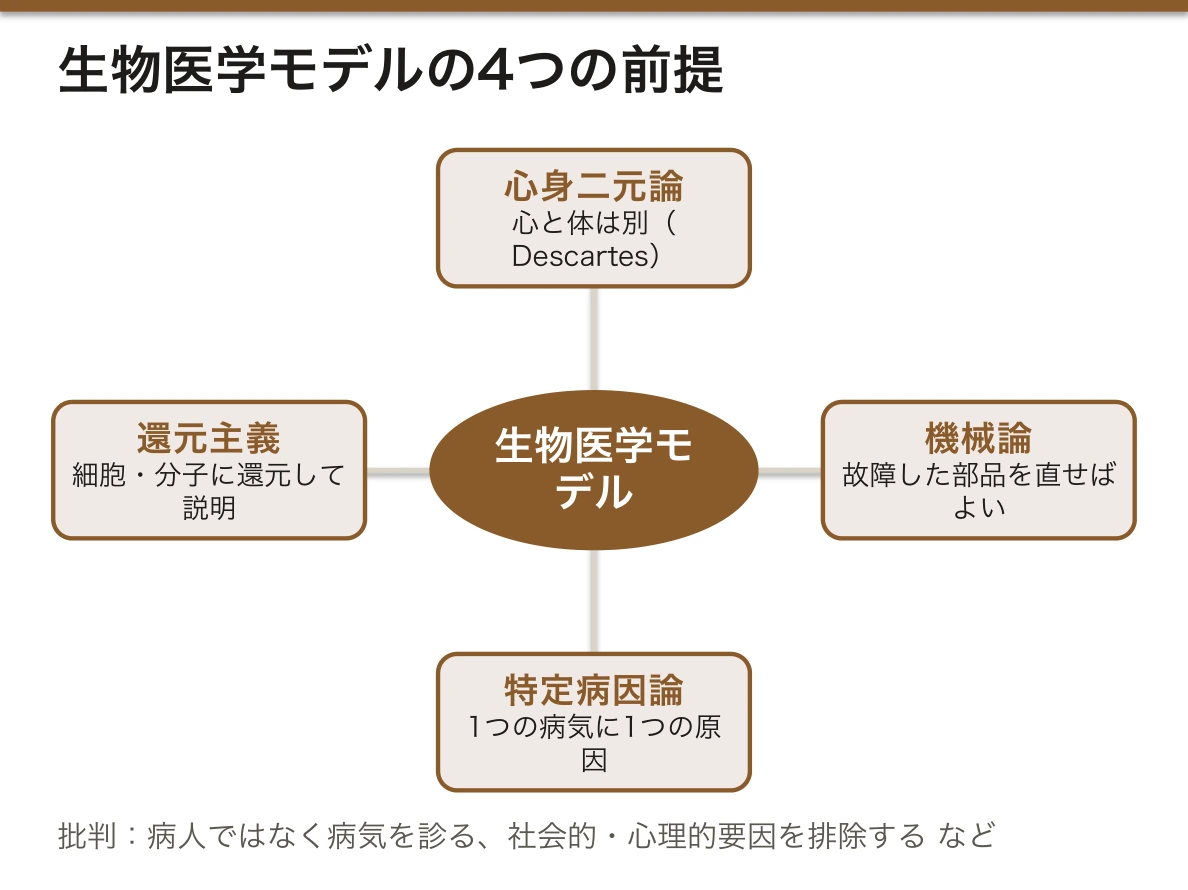
生物医学モデル(biomedical model)の前提:
- 心身二元論——心と体は別(Descartes)
- 機械論——体は部品からなる機械で、故障した部品を直せばよい
- 特定病因論(doctrine of specific aetiology)——1つの病気には1つの原因がある(細菌学の成功に由来)
- 還元主義——病気は細胞・分子のレベルに還元して説明できる
成立の背景:啓蒙主義の合理主義、解剖と病理の発達(「臨床のまなざし」)、19世紀の細菌学(Pasteur・Koch)の圧倒的な成功。
主な批判:①病人ではなく病気を診る、②社会的・心理的要因を排除する、③健康を「病気がないこと」としか定義できない、④医師の権威を過度に高め患者を受動的にする。
「1病因1疾患」が通用しなくなったことが、モデル転換の直接の引き金である。結核菌に感染しても大多数は発病しない。心血管疾患・癌・糖尿病は多因子性で、単一の原因を特定できない。細菌学の成功をもたらした前提が、慢性疾患の時代にはむしろ足枷になった。
George Engel(1977)の生物心理社会モデル(bio-psycho-social model)は、一般システム理論を援用して分子 → 細胞 → 組織 → 個人 → 家族 → 共同体 → 社会という階層を想定し、どの階層の変化も他の階層に影響すると主張した。「生物学を捨てるのではなく、生物学だけでは足りないと言っている」点が肝心である。
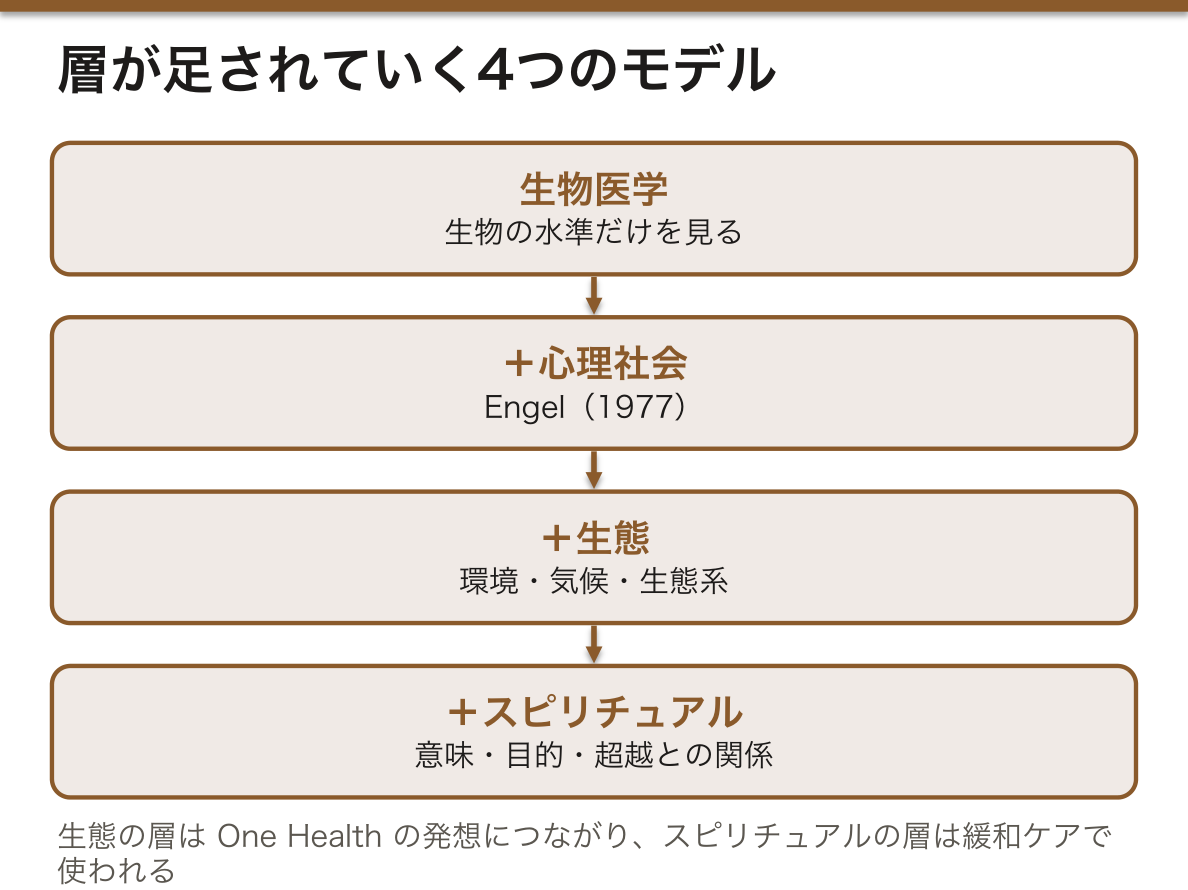
拡張版:bio-psycho-ecological model(環境・気候・生態系を加える。ワンヘルスの発想に繋がる)、bio-psycho-social-spiritual model(意味・信仰・死生観を加える。緩和ケアで実際に使われる)。
葛藤理論(conflict / political economy theory)は別の角度からの批判である。医療を階級闘争の場と見て、医療産業の利潤動機・製薬企業の影響・医療へのアクセスの階級差を問題にする。「病気の原因を個人の生物学に求めることが、社会的不平等から目を逸らさせる働きをしている」という指摘が核心である。
ポスト真実の時代(健康の社会的決定要因・医学の黄金時代の章にも続く)では、生物医学モデルへの信頼そのものが政治的争点になった。反ワクチン運動と陰謀論は「専門知への不信」であり、単なる知識不足ではなく権威の正統性をめぐる社会現象として分析される。
English version
Core
The premises of the biomedical model:
- Mind–body dualism — mind and body are separate (Descartes).
- Mechanism — the body is a machine of parts; mend the broken part.
- The doctrine of specific aetiology — one disease has one cause (from the success of bacteriology).
- Reductionism — disease can be explained by reduction to the level of cells and molecules.
The background of its formation: the rationalism of the Enlightenment, the development of anatomy and pathology ("the clinical gaze"), and the overwhelming success of nineteenth-century bacteriology (Pasteur, Koch).
The chief criticisms: ① it sees the disease and not the person, ② it excludes social and psychological factors, ③ it can define health only as the absence of disease, ④ it raises the doctor’s authority excessively and makes the patient passive.
Going further
That "one cause, one disease" ceased to hold was the direct trigger of the change of model. Most people infected with the tubercle bacillus do not fall ill. Cardiovascular disease, cancer and diabetes are multifactorial and no single cause can be identified. The premise that produced the success of bacteriology became, in the age of chronic disease, a hindrance.
George Engel’s (1977) bio-psycho-social model drew on general systems theory to posit a hierarchy of molecule → cell → tissue → person → family → community → society, and argued that a change at any level affects the others. The essential point is that it does not discard biology but says biology alone is not enough.
Extended versions: the bio-psycho-ecological model (adding environment, climate and ecosystem; leading to the idea of One Health), and the bio-psycho-social-spiritual model (adding meaning, faith and views of death; actually used in palliative care).
Conflict (political economy) theory criticises from another angle. It sees medicine as an arena of class struggle and takes issue with the profit motive of the medical industry, the influence of pharmaceutical companies and class differences in access. The core of the point is that locating the cause of disease in individual biology works to turn the eye away from social inequality.
In the post-truth age (continued in the chapters on the social determinants of health and the golden age of medicine), trust in the biomedical model itself became a political issue. The anti-vaccine movement and conspiracy theories are a distrust of expertise, and are analysed not as mere lack of knowledge but as a social phenomenon about the legitimacy of authority.
生物医学モデルと陰謀論 — なぜ拒まれるのか
生物医学モデルは身体を機械とみなし、病気を部品の故障として扱う。強力だが、その権威そのものが反発の的になる。
陰謀論が拒むのは主に3点。①専門家への不信——製薬企業や国家と結びついた利益とみなす。②還元主義への反発——「人を数値でしか見ない」。③個人の自律の主張——「自分の身体は自分で決める」。
反論として「科学が間違えた歴史」が持ち出される(サリドマイド、タバコ会社の資金提供研究)。実際にあった失敗が、全否定の材料に使われるという構図を説明できることが求められる。
この論点は「健康の社会的決定要因」・「医学の黄金時代」の章のポストトゥルースと地続き。科学的知識も社会的に構成されるというポストモダンの主張が、皮肉にも反科学の言い分に流用される——この「意図せぬ帰結」まで触れられると強い。
English version
Core
The biomedical model treats the body as a machine and disease as a failure of a part. It is powerful, and its very authority becomes a target of rejection.
What conspiracy theories reject is chiefly three things. ① Distrust of experts — they are taken to be bound up with the interests of pharmaceutical companies and the state. ② Reaction against reductionism — "they see a person only as numbers". ③ The assertion of individual autonomy — "my body is mine to decide about".
"The history of science getting it wrong" is brought forward as a counter-argument (thalidomide, studies funded by tobacco companies). It is required to be able to explain the structure by which failures that really happened are used as material for total rejection.
Going further
This point runs continuously into post-truth in the chapters on the social determinants of health and the golden age of medicine. The postmodern claim that scientific knowledge too is socially constructed is, ironically, appropriated by anti-science argument — being able to touch on this unintended consequence makes the answer strong.
葛藤理論 — 医療に階級闘争はどう現れるか
Marx に由来する葛藤理論(政治経済学的視角)は、医療を資本主義の利害が争う場として見る。
現れ方は3つ。①健康格差——労働条件・住居・食が階級で決まり、そのまま寿命の差になる。②医療の商品化——ケアが売り物になり、支払える者だけが受けられる。③医療化による統制——不満や逸脱を「病気」として個人の問題に還元し、社会構造への異議申し立てを封じる。
Navarro は「医療の失敗は資源不足ではなく分配の問題だ」と論じた。McKeown テーゼ(死亡率の低下は医療ではなく栄養と衛生の改善による)も、この立場を支える定番の証拠として引かれる。
批判としては、階級に還元しすぎる点、そして社会主義国でも健康格差が消えなかった点が挙げられる。
English version
Core
Conflict theory (the political economy perspective), deriving from Marx, sees medicine as an arena in which the interests of capitalism contend.
It appears in three ways. ① Health inequality — working conditions, housing and food are set by class, and that becomes the difference in lifespan directly. ② The commodification of medicine — care becomes an article for sale, received only by those who can pay. ③ Control through medicalisation — discontent and deviance are reduced to individual problems as "illness", silencing objection to social structure.
Navarro argued that the failures of medicine are a problem not of scarce resources but of distribution. The McKeown thesis (that the fall in mortality was due to nutrition and sanitation rather than medicine) is also cited as standard evidence supporting this position.
Going further
As criticism, it is said to reduce too much to class, and that health inequalities did not disappear in socialist states either.
ポストトゥルース時代の医学 — Covid-19 と反ワクチン
ポストトゥルースとは、客観的事実よりも感情と個人的信念が世論を動かす状態。
Covid-19 が残したもの——①専門家の権威の低下(知見が更新されるたび「前と言うことが違う」と受け取られた)②SNS による情報の分断③医療従事者への敵意。
反ワクチン運動の根は古く、1998年 Wakefield の MMR 論文(後に撤回・医師免許剥奪)が象徴。撤回されても信念は残る——訂正が届かないことが問題の核心である。
社会学的に重要なのは、これを「無知」と片づけないこと。不信は制度への信頼の問題であり、知識を足しても解けない。
「医学の黄金時代」の章の医学の未来とつながる論点。対策として挙げられるのは、透明性(不確実性を隠さない)、信頼できる媒介者を通す、否定ではなく対話。
English version
Core
Post-truth is the condition in which emotion and personal belief move public opinion more than objective fact.
What COVID-19 left — ① a decline in the authority of experts (each time the evidence was updated it was received as "they said something different before") ② the fragmentation of information through social media ③ hostility towards healthcare workers.
The roots of the anti-vaccine movement are old, symbolised by Wakefield’s MMR paper of 1998 (later retracted, with the author struck off). Belief remains after retraction — that corrections do not reach people is the core of the problem.
What matters sociologically is not to dismiss this as ignorance. Distrust is a problem of trust in institutions and cannot be solved by adding knowledge.
Going further
A point connecting to the future of medicine in the chapter on the golden age of medicine. The measures raised are transparency (not hiding uncertainty), working through trusted intermediaries, and dialogue rather than denial.
生物心理社会モデル — Engel の主張
George Engel(1977, Science)が提唱。生物医学モデルは還元主義・心身二元論に立つため、病いの経験を説明できないと批判した。
主張の柱は一般システム理論——人間は分子 → 細胞 → 組織 → 器官 → 個人 → 家族 → 地域 → 社会という入れ子の階層をなし、どの層の変化も上下の層に及ぶ。したがって生物・心理・社会の3水準を同時に見なければ診療は成り立たない。
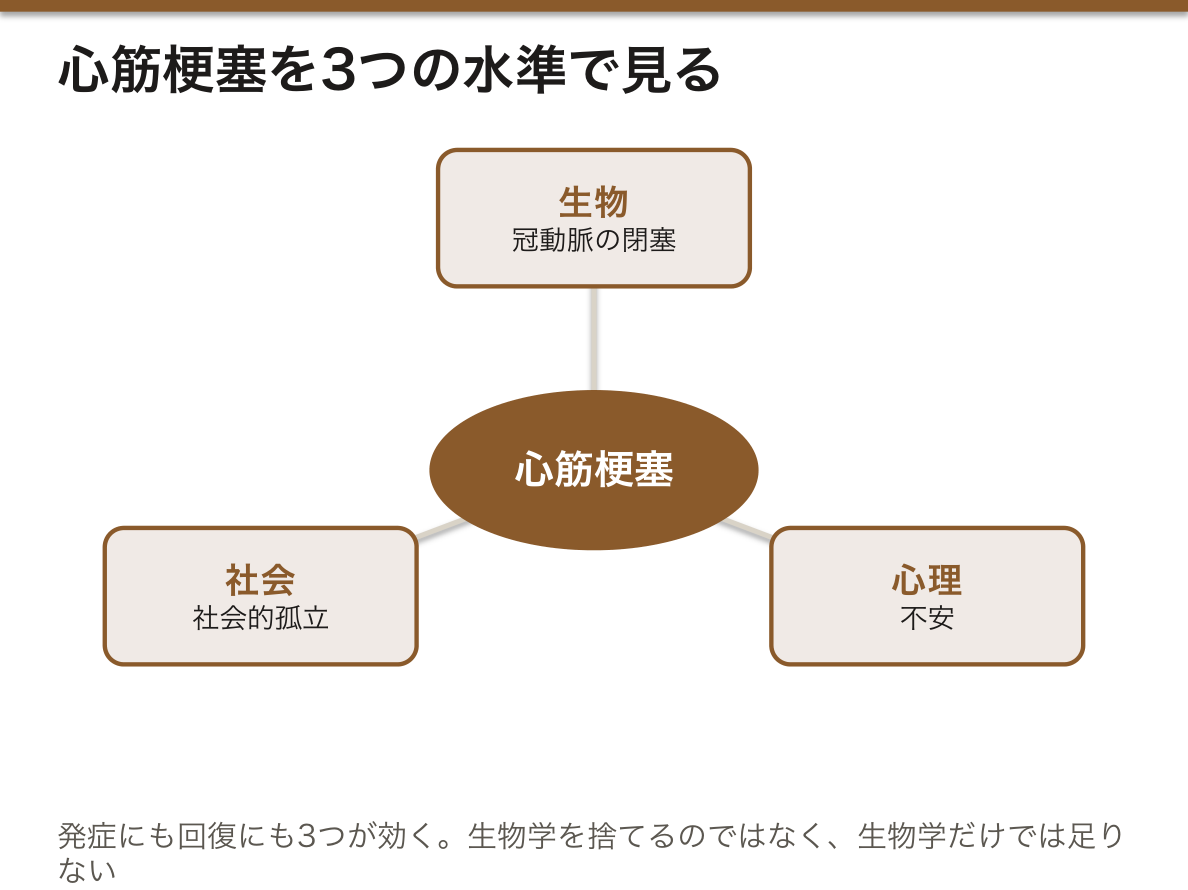
有名な例——心筋梗塞は冠動脈の閉塞(生物)だが、その発症には不安(心理)と社会的孤立(社会)が寄与し、回復にも同じ3つが効く。
「生物学を捨てるのではなく、生物学だけでは足りない」という主張である点を外さないこと。
批判もある——3水準の重みづけが曖昧で、実務では結局「生物」に偏る、という指摘。ここから生態モデル・スピリチュアルモデルへの拡張が出てくる。
English version
Core
Proposed by George Engel (1977, Science). He criticised the biomedical model as standing on reductionism and mind–body dualism and therefore unable to account for the experience of illness.
The pillar of the argument is general systems theory — a human being forms a nested hierarchy of molecule → cell → tissue → organ → person → family → community → society, and a change at any level reaches the levels above and below. Therefore practice does not work unless the biological, psychological and social levels are seen at once.
The famous example — a myocardial infarction is occlusion of a coronary artery (biological), and anxiety (psychological) and social isolation (social) contribute to its occurrence, and the same three tell in recovery.
Do not lose the point that the claim is "not to discard biology, but that biology alone is not enough".
Going further
There is criticism too — that the weighting of the three levels is vague and that in practice it still leans to "the biological". From here come the extensions to ecological and spiritual models.
生物心理生態モデル
Engel の3水準に「環境・生態」を明示的に足したもの。個人を取り巻く自然環境(気候・大気・水・生物多様性)を健康の規定因として組み込む。
背景には気候変動・大気汚染・人獣共通感染症がある。プラネタリーヘルスや One Health(ヒト・動物・環境の健康は一つ)と同じ発想。
社会モデルでは「社会」に押し込まれていた環境要因を、独立した層として扱うのが要点。
「医学の黄金時代」の章の医学の未来(環境リスク)と直結する。
English version
Core
Engel’s three levels with "environment and ecology" added explicitly. The natural environment surrounding the individual (climate, air, water, biodiversity) is built in as a determinant of health.
Behind it lie climate change, air pollution and zoonoses. The same idea as planetary health and One Health (the health of humans, animals and the environment is one).
The point is to treat as an independent level the environmental factors that the social model had pushed into "the social".
Going further
It connects directly to the future of medicine (environmental risk) in the chapter on the golden age of medicine.
生物心理社会スピリチュアルモデル
さらにスピリチュアリティ(意味・目的・超越との関係)を加えたもの。宗教とは同じではない——信仰を持たない人にも、意味づけの次元はある。
特に力を持つ場面は終末期医療と緩和ケア。「なぜ私なのか」という問いは生物学でも心理学でも答えられず、そこを扱わないケアは不完全だという主張。WHO の緩和ケアの定義にも spiritual が入っている。
4モデルは「生物 → +心理社会(Engel)→ +生態 → +スピリチュアル」と、層が足されていく順で整理して答える。
批判は測定できるのかという点と、医師が扱う領域かという線引きの問題。
English version
Core
A further addition of spirituality (meaning, purpose, relation to the transcendent). It is not the same as religion — a person without faith still has a dimension of meaning.
Where it tells most is end-of-life and palliative care. The question "why me" can be answered neither by biology nor by psychology, and the claim is that care which does not address it is incomplete. The WHO definition of palliative care includes the spiritual.
Answer the four models arranged in the order in which the layers are added: biological → + psychosocial (Engel) → + ecological → + spiritual.
Going further
The criticisms are whether it can be measured and the question of demarcation, whether it is a domain for doctors.
まとめ
| 生物医学モデル — 成り立ちと4つの批判 | 生物医学モデル(biomedical model)の前提:心身二元論——心と体は別(Descartes)機械論——体は部品からなる機械で、故障した部品を直せばよい特定病因論(doc… |
|---|---|
| 生物医学モデルと陰謀論 — なぜ拒まれるのか | 生物医学モデルは身体を機械とみなし、病気を部品の故障として扱う。 |
| 葛藤理論 — 医療に階級闘争はどう現れるか | Marx に由来する葛藤理論(政治経済学的視角)は、医療を資本主義の利害が争う場として見る。 |
| ポストトゥルース時代の医学 — Covid-19 と反ワクチン | ポストトゥルースとは、客観的事実よりも感情と個人的信念が世論を動かす状態。 |
| 生物心理社会モデル — Engel の主張 | George Engel(1977, Science)が提唱。 |
| 生物心理生態モデル | Engel の3水準に「環境・生態」を明示的に足したもの。 |
| 生物心理社会スピリチュアルモデル | さらにスピリチュアリティ(意味・目的・超越との関係)を加えたもの。 |
このノートは医学生が授業の内容を自分の言葉でまとめたもので、診療の判断に使うものではありません。誤りに気づいたらお知らせください。