SDOH は公衆衛生の中核概念で、日本の国試(公衆衛生)にもそのまま出る。
この章の背骨は「健康は医療ではなく、社会条件が決めている」という命題である。医療の寄与は健康格差の一部にすぎない。
- 健康の社会的決定要因(SDOH)
- ポストソビエトの物語 — 1990年代前半の男性死亡率
- 精神保健の定義 — WHO と DSM-5
- 精神保健の医学モデルと社会学モデル
- Rosenhan とラベリング理論(Scheff)
- 近代とポストモダン — 啓蒙の世界観はなぜ揺らいだか
- 科学知識の社会的構成と、Derrida の脱構築
- Foucault — 知は権力である
- Baudrillard — シミュラークルと健康主義
健康の社会的決定要因(SDOH)
SDOH=人が生まれ、育ち、働き、生活し、老いる条件と、それを形づくる政治・経済・社会の仕組み(WHO)。
主な要因(5つ以上言えるように):①所得と社会的地位 ②教育 ③雇用と労働条件 ④住居と物理的環境 ⑤社会的支援と社会的包摂 ⑥食料の確保 ⑦保健医療へのアクセス ⑧幼少期の環境 ⑨差別(人種・性・障害)。
健康格差(health inequalities)は勾配(gradient)を作る——最下層だけが悪いのではなく、社会階層が1段上がるごとに健康が良くなる(Whitehall 研究)。
「ポスト・ソビエトの物語」は SDOH の最も劇的な自然実験である。1990年代前半、ロシアと旧ソ連諸国で男性の平均寿命が約6〜7歳低下した(63歳 → 57歳前後)。感染症でも医療崩壊でもなく、原因は急激な体制転換による失業・社会的支援の崩壊・将来の見通しの喪失、そしてアルコール(特にスピリッツ)の消費急増だった。死因は心血管疾患・外因死(事故・自殺・他殺)に集中し、男性に偏った。「社会の崩壊が、数年で人口全体の寿命を動かす」ことを示した事例で、ラトビアも同じ経過をたどった。
精神保健の社会学:WHO の「精神的健康」=単に精神疾患が無い状態ではなく、自分の能力を発揮し、日常のストレスに対処し、生産的に働き、共同体に貢献できる状態。DSM-5 の「精神疾患」=認知・情動制御・行動に臨床的に意味のある障害があり、社会的・職業的機能に支障をきたすもの。
| 医学モデル | 社会学モデル | |
|---|---|---|
| 原因 | 脳の機能異常・遺伝 | 社会的ストレス・不平等・ラベリング |
| 診断 | 客観的な分類 | 社会的に構成されたカテゴリー |
| 対応 | 薬物・治療 | 社会条件の変更・脱施設化 |
Rosenhan の実験(1973)——健常な研究者が「声が聞こえる」とだけ訴えて精神科病院に入院し、全員が診断を受けた。入院後は正常に振る舞ったが誰も見破られず、退院時の診断は「寛解中の統合失調症」だった。Scheff のラベリング理論(精神疾患は残余的逸脱にラベルが貼られたものである)を支持する証拠として広く引用された。この実験には方法論的な批判もあるが、「診断が文脈に依存する」という論点は残った。
ポストモダン:Derrida の脱構築(医学の言語が持つ二項対立を解体する)、Foucault の「知は権力である」(生権力 biopower——人口を管理する権力として医学が機能する)、Baudrillard のシミュラークル(「自然な美しさ」「健康的な見た目」という実体のない基準が現実を置き換える=healthism)。
English version
Core
SDOH = the conditions in which people are born, grow, work, live and age, and the political, economic and social arrangements that shape them (WHO).
The chief determinants (be able to name five or more): ① income and social position ② education ③ employment and working conditions ④ housing and physical environment ⑤ social support and social inclusion ⑥ food security ⑦ access to health care ⑧ early childhood environment ⑨ discrimination (race, sex, disability).
Health inequalities form a gradient — it is not that only the lowest are worse off; health improves with every step up the social hierarchy (the Whitehall studies).
Going further
"The post-Soviet story" is the most dramatic natural experiment in SDOH. In the early 1990s, male life expectancy in Russia and the former Soviet states fell by about six or seven years (from 63 to around 57). The cause was neither infection nor the collapse of health services but unemployment from an abrupt change of system, the collapse of social support, the loss of any view of the future, and a surge in alcohol (spirits especially). The causes of death concentrated in cardiovascular disease and external causes (accident, suicide, homicide) and fell on men. A case showing that the collapse of a society can move the life expectancy of a whole population within a few years — and Latvia followed the same course.
The sociology of mental health: the WHO’s "mental health" = not merely the absence of mental illness but a state in which one realises one’s abilities, copes with the ordinary stresses of life, works productively and contributes to the community. DSM-5’s "mental disorder" = a clinically significant disturbance of cognition, emotional regulation or behaviour, causing impairment of social or occupational functioning.
| The medical model | The sociological model | |
|---|---|---|
| Cause | Abnormal brain function, genes | Social stress, inequality, labelling |
| Diagnosis | An objective classification | A socially constructed category |
| Response | Drugs, treatment | Changing social conditions, deinstitutionalisation |
Rosenhan’s experiment (1973) — healthy researchers were admitted to psychiatric hospitals complaining only of "hearing a voice", and all received a diagnosis. They behaved normally after admission, and none was detected; the diagnosis at discharge was "schizophrenia in remission". It was widely cited as evidence supporting Scheff’s labelling theory (that mental illness is residual deviance to which a label has been attached). The experiment has been criticised methodologically, and the point that diagnosis depends on context remained.
Postmodernism: Derrida’s deconstruction (dismantling the binary oppositions of medical language), Foucault’s "knowledge is power" (biopower — medicine functioning as a power that manages populations), Baudrillard’s simulacrum (standards without substance, such as "natural beauty" and "a healthy look", replacing reality = healthism).
ポストソビエトの物語 — 1990年代前半の男性死亡率
SDOH の劇的な実例。ソ連崩壊後(1990年代前半)、ロシアとバルト三国で男性の平均寿命が数年のうちに5〜7年短くなった。ロシア男性は約64歳から57歳台へ落ちた。
医療の崩壊では説明できない(女性の低下ははるかに小さい)。挙げられる要因は——①急激な社会変動によるストレス(失業、年金の消滅、地位の喪失)②アルコール(特に蒸留酒の暴飲)③社会的紐帯の断絶④ショック療法的な経済改革。主因は循環器疾患と外因死(事故・自殺・他殺)。
「社会構造の変化が、これほど速く死亡率に現れうる」ことを示した自然実験として引かれる。
Cockerham はこれを健康ライフスタイル理論で説明する——構造の激変が選択の幅(chances)を狭め、飲酒という選択(choices)に集約された、と。「健康ライフスタイル理論」の論点とつながる。
English version
Core
The dramatic instance of SDOH. After the collapse of the Soviet Union (the early 1990s), male life expectancy in Russia and the Baltic states fell by five to seven years within a few years. Russian men fell from about 64 to the high 50s.
It cannot be explained by a collapse of health services (the fall among women was far smaller). The factors named are — ① stress from abrupt social change (unemployment, the disappearance of pensions, loss of status) ② alcohol (binge drinking of spirits especially) ③ the severing of social ties ④ shock-therapy economic reform. The chief causes were circulatory disease and external causes (accident, suicide, homicide).
It is cited as the natural experiment showing how quickly a change in social structure can appear in mortality.
Going further
Cockerham explains it with health lifestyle theory — the upheaval of structure narrowed the range of chances, and this was concentrated into the choice of drinking. It connects with the topic of health lifestyle theory.
精神保健の定義 — WHO と DSM-5
WHO の「精神的健康」——単に精神疾患が無い状態ではなく、自分の能力を発揮し、生活上のストレスに対処し、生産的に働き、地域に貢献できる well-being の状態。積極的な定義である点が要点。
DSM-5 の「精神疾患」——認知・情動制御・行動に臨床的に意味のある障害があり、それが心理的・生物学的・発達的な機能不全を反映するもの。
DSM-5 が明示的に除外するもの——①予期される(文化的に承認された)喪失反応(死別の悲嘆)②社会からの逸脱や政治的対立そのもの。この除外規定は「精神医学が政治利用された歴史」への歯止めであり、必ず押さえておく。
社会学からの批判は「機能不全」の線引きが社会的に決まるという点。同性愛は1973年まで DSM に載っていた。
English version
Core
The WHO’s "mental health" — not merely the absence of mental illness but a state of well-being in which one realises one’s abilities, copes with the stresses of life, works productively and contributes to one’s community. The point is that it is a positive definition.
DSM-5’s "mental disorder" — a clinically significant disturbance of cognition, emotional regulation or behaviour, reflecting a dysfunction in psychological, biological or developmental processes.
What DSM-5 explicitly excludes — ① an expectable (culturally sanctioned) response to a loss (grief in bereavement) ② social deviance or political conflict as such. This exclusion is a check against the history of psychiatry being used politically and must be grasped without fail.
Going further
The criticism from sociology is that where the line of "dysfunction" falls is socially decided. Homosexuality was in the DSM until 1973.
精神保健の医学モデルと社会学モデル
医学モデル——精神疾患は個人の中にある脳の病気。原因は神経伝達物質や遺伝子。介入は診断と治療(薬物・精神療法)。専門家が判定する。
社会学モデル——精神疾患は社会関係の中で生じ、社会が定義する。原因は社会的ストレス・貧困・差別・孤立。介入は社会条件の改善。誰が病者とされるかは権力関係で決まる。
対比の型——「個人の中 vs 社会の中」「発見される vs 構成される」「治療 vs 社会変革」。
どちらか一方が正しいのではない。統合失調症の生物学的基盤は否定できないが、診断される確率が階級と民族で偏ることも事実である——この両立を言えると強い。
社会学モデルの根拠として引かれる古典が Faris & Dunham(1939)——シカゴの都心部ほど統合失調症の入院率が高かった。社会的原因説か、社会的漂流説かの論争が続いた。
English version
Core
The medical model — mental illness is a disease of the brain within the individual. The causes are neurotransmitters and genes. The intervention is diagnosis and treatment (drugs, psychotherapy). Experts adjudicate.
The sociological model — mental illness arises within social relations and is defined by society. The causes are social stress, poverty, discrimination, isolation. The intervention is improving social conditions. Who is counted as ill is decided by relations of power.
The pattern of the contrast — "within the individual vs within society", "discovered vs constructed", "treatment vs social change".
Neither one alone is right. The biological basis of schizophrenia cannot be denied, and it is also a fact that the probability of being diagnosed is skewed by class and ethnicity — being able to state that both hold is strong.
Going further
The classic cited in support of the sociological model is Faris & Dunham (1939) — admission rates for schizophrenia were higher the nearer the centre of Chicago. The debate over social causation or social drift continued.
Rosenhan とラベリング理論(Scheff)
Rosenhan『狂気の場所で正気でいること』(1973)——健康な8人が「声が聞こえる」とだけ訴えて精神病院を受診し、全員が入院させられた。入院後は正常に振る舞ったが、誰も見抜かれず、平均19日で「寛解した統合失調症」として退院した。普通の行動までが病気の徴候として記録された(メモを取る→「筆記行動」)。
Scheff のラベリング理論——精神疾患は「残余的逸脱」(他のどの規則違反にも当てはまらないズレ)に社会がラベルを貼ることで成立する。ラベルは自己成就的で、本人も周囲もそれに沿って振る舞い始める。
Rosenhan はラベリング理論の実証として引かれる——診断が付いた瞬間、その人の行動すべてが診断を通して読まれる。
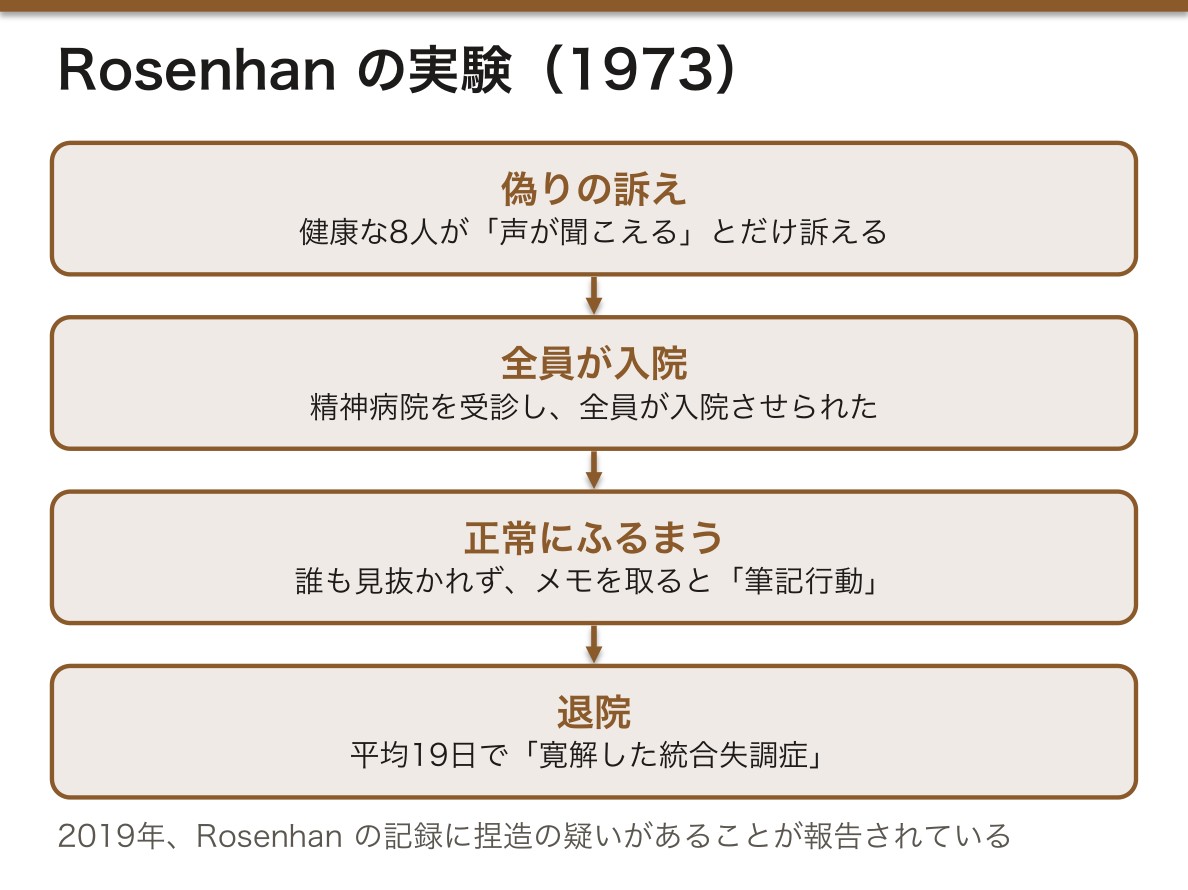
反論もある。Spitzer は「症状を偽って訴えたのだから、診断は妥当だった」と批判した。また2019年、Rosenhan の記録に捏造の疑いがあることが報告されている——この論争自体を知っていると評価が高い。
English version
Core
Rosenhan, "On Being Sane in Insane Places" (1973) — eight healthy people presented at psychiatric hospitals complaining only of "hearing a voice", and all were admitted. They behaved normally after admission, and none was detected; they were discharged after an average of 19 days as "schizophrenia in remission". Even ordinary behaviour was recorded as a sign of illness (taking notes → "writing behaviour").
Scheff’s labelling theory — mental illness comes about when society attaches a label to "residual deviance" (a departure that fits no other category of rule-breaking). The label is self-fulfilling: the person and those around them begin to act in accordance with it.
Rosenhan is cited as evidence for labelling theory — the moment a diagnosis is given, everything the person does is read through it.
Going further
There are rebuttals. Spitzer objected that "the symptom was falsely reported, so the diagnosis was valid". And in 2019 it was reported that Rosenhan’s records may have been fabricated — knowing this controversy itself is well regarded.
近代とポストモダン — 啓蒙の世界観はなぜ揺らいだか
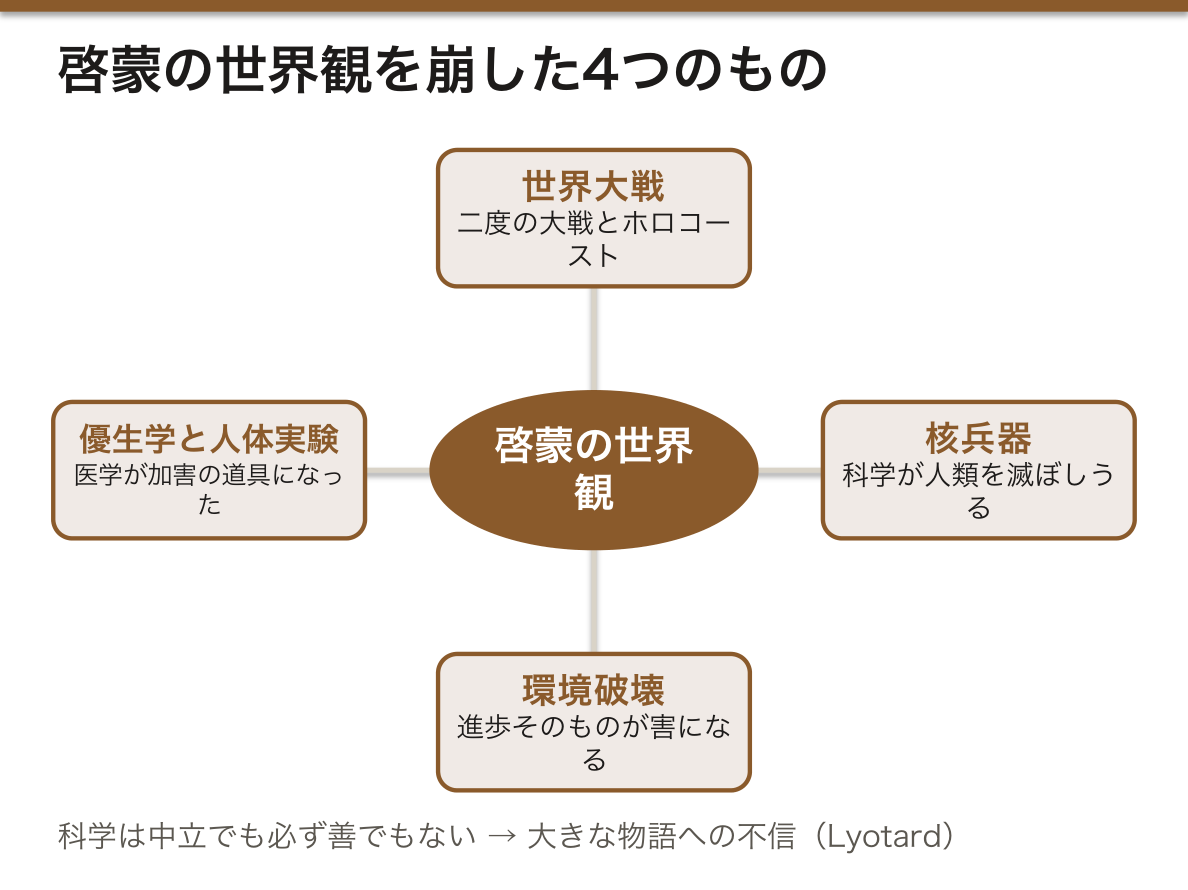
啓蒙の世界観とは、理性と科学によって人類は進歩し続けるという確信。近代医学もその産物である。
20世紀にこれを崩したもの——①二度の世界大戦とホロコースト(最も科学の進んだ国が最も組織的な殺戮を行った)②核兵器(科学が人類を滅ぼしうる)③環境破壊(進歩そのものが害になる)④優生学と人体実験(医学が加害の道具になった)。
要点は「科学は中立でも必ず善でもない」と分かってしまったこと。ここからポストモダンの懐疑——大きな物語への不信(Lyotard)——が始まる。
医学史ではナチスの人体実験 → ニュルンベルク綱領(1947)→ ヘルシンキ宣言という流れが、この危機への応答にあたる。生命倫理という分野そのものが、この不信から生まれた。
English version
Core
The Enlightenment worldview is the conviction that humanity progresses continually through reason and science. Modern medicine is a product of it.
What broke it in the twentieth century — ① two world wars and the Holocaust (the most scientifically advanced nation carried out the most organised killing) ② nuclear weapons (science can destroy humanity) ③ environmental destruction (progress itself becomes harm) ④ eugenics and human experimentation (medicine became an instrument of harm).
The point is that it became known that science is neither neutral nor necessarily good. From here begins the postmodern scepticism — incredulity towards grand narratives (Lyotard).
Going further
In the history of medicine the sequence Nazi human experimentation → the Nuremberg Code (1947) → the Declaration of Helsinki is the response to this crisis. The field of bioethics itself was born from this distrust.
科学知識の社会的構成と、Derrida の脱構築
科学的知識も社会的に構成される——事実は自然から拾われるのではなく、その時代の関心・言語・制度の中で作られるという主張。固定した確実性は無い。
そこで重んじられるのが主観性と語り——「客観的な一つの真実」ではなく、複数の視点を並べる。
Derrida の脱構築——テクストに潜む二項対立を暴き、一方が他方を従属させていることを示す方法。医学の言語に当てると:健康/病気、正常/異常、精神/身体、医師/患者——いずれも前者が優位に置かれ、後者は「欠如」として定義されている。「異常」は「正常でないもの」としてしか語られない。
脱構築の狙いは対立を逆転させることではなく、その線引きが自明でないと示すこと。
危うさもある——「すべては構成物」とすれば、ワクチンの有効性も一つの物語だと言えてしまう。「生物医学モデル」の章のポストトゥルースは、この副作用として読める。
English version
Core
Scientific knowledge too is socially constructed — the claim that facts are not picked up from nature but made within the interests, language and institutions of their age. There is no fixed certainty.
What is therefore valued is subjectivity and narrative — setting out several viewpoints rather than "one objective truth".
Derrida’s deconstruction — a method that exposes the binary oppositions latent in a text and shows that one subordinates the other. Applied to the language of medicine: health/disease, normal/abnormal, mind/body, doctor/patient — in every case the first is placed above and the second defined as a lack. "Abnormal" can be spoken of only as "not normal".
The aim of deconstruction is not to invert the opposition but to show that the line drawn is not self-evident.
Going further
There is a danger too — if everything is a construct, the efficacy of a vaccine can be called one narrative among others. The post-truth of the chapter on the biomedical model can be read as this side effect.
Foucault — 知は権力である
Foucault の中心命題は「知と権力は不可分」(power/knowledge)。何かを知る枠組みを作ることが、それを支配することである。
臨床のまなざし le regard médical——18世紀末に医学は「患者の語り」から「身体を見る」へ移り、患者は診るべき対象になった。
健康の専門家の役割——医師は病気を治すだけでなく、何が正常かを定義し、人々を分類し、規律する。
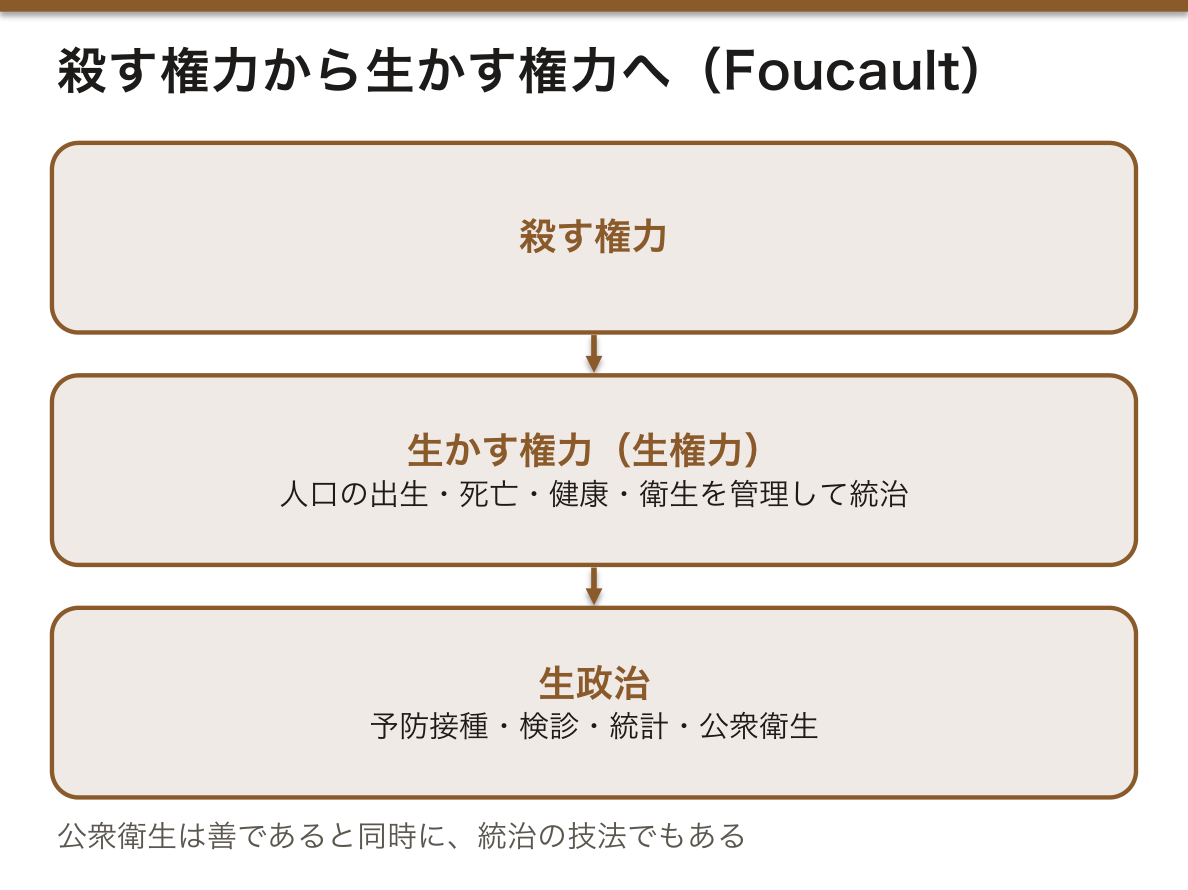
生権力 biopower——「殺す権力」から「生かす権力」へ。近代国家は人口の出生・死亡・健康・衛生を管理することで統治する。その政策的実践が生政治 biopolitics(予防接種、検診、統計、公衆衛生)。
「公衆衛生は善であると同時に統治の技法でもある」という両義性を言えることが要点。
Covid-19 の行動制限・追跡アプリ・ワクチンパスは、生政治の教科書的な例として必ず引かれる。
English version
Core
Foucault’s central thesis is that knowledge and power are inseparable (power/knowledge). To create the framework by which something is known is to govern it.
The clinical gaze (le regard médical) — at the end of the eighteenth century medicine moved from "the patient’s account" to "looking at the body", and the patient became an object to be viewed.
The role of the health expert — the doctor not only cures disease but defines what is normal, classifies people and disciplines them.
Biopower — from a power that kills to a power that makes live. The modern state governs by managing the birth, death, health and hygiene of the population. Its practice in policy is biopolitics (vaccination, screening, statistics, public health).
The point is to be able to state the ambivalence that "public health is at once a good and a technique of government".
Going further
The restrictions, tracing apps and vaccine passes of COVID-19 are cited without fail as textbook examples of biopolitics.
Baudrillard — シミュラークルと健康主義
Baudrillard:現代では記号が現実を置き換える。シミュラークルとは原本の無い複製で、それが現実より現実らしく(ハイパーリアル)機能する。
医療・美容での現れ——「自然な美しさ」は加工された画像を模したものであり、「健康そうな見た目 healthy look」は健康の指標ではなく健康の記号である。日焼けした痩身は、実際には皮膚癌のリスクを上げうる。
健康主義 healthism——健康を最高の道徳的価値とし、健康であることを個人の責任と義務にする考え方。病むことが自己管理の失敗として非難される。
健康主義は SDOH を見えなくする——構造の問題を個人の努力の問題にすり替えるため。ここが批判の核心。
Zola と Crawford が healthism の概念を提示した。「医療化」と対で理解しておくとよい。
English version
Core
Baudrillard: in the modern world signs replace reality. A simulacrum is a copy without an original, functioning as more real than the real (hyperreal).
How it appears in medicine and beauty — "natural beauty" imitates a processed image, and "a healthy look" is a sign of health rather than an index of it. A tanned, slim body may in fact raise the risk of skin cancer.
Healthism — the outlook that makes health the supreme moral value and being healthy an individual responsibility and duty. Falling ill is blamed as a failure of self-management.
Healthism makes SDOH invisible — because it converts a problem of structure into a problem of individual effort. This is the core of the criticism.
Going further
Zola and Crawford introduced the concept of healthism. It is best understood paired with "medicalisation".
まとめ
| 健康の社会的決定要因(SDOH) | SDOH=人が生まれ、育ち、働き、生活し、老いる条件と、それを形づくる政治・経済・社会の仕組み(WHO)。 |
|---|---|
| ポストソビエトの物語 — 1990年代前半の男性死亡率 | SDOH の劇的な実例。ソ連崩壊後(1990年代前半)、ロシアとバルト三国で男性の平均寿命が数年のうちに5〜7年短くなった。 |
| 精神保健の定義 — WHO と DSM-5 | WHO の「精神的健康」——単に精神疾患が無い状態ではなく、自分の能力を発揮し、生活上のストレスに対処し、生産的に働き、地域に貢献できる well-being の状態。 |
| 精神保健の医学モデルと社会学モデル | 医学モデル——精神疾患は個人の中にある脳の病気。 |
| Rosenhan とラベリング理論(Scheff) | Rosenhan『狂気の場所で正気でいること』(1973)——健康な8人が「声が聞こえる」とだけ訴えて精神病院を受診し、全員が入院させられた。 |
| 近代とポストモダン — 啓蒙の世界観はなぜ揺らいだか | 啓蒙の世界観とは、理性と科学によって人類は進歩し続けるという確信。 |
| 科学知識の社会的構成と、Derrida の脱構築 | 科学的知識も社会的に構成される——事実は自然から拾われるのではなく、その時代の関心・言語・制度の中で作られるという主張。 |
| Foucault — 知は権力である | Foucault の中心命題は「知と権力は不可分」(power/knowledge)。 |
| Baudrillard — シミュラークルと健康主義 | Baudrillard:現代では記号が現実を置き換える。 |
このノートは医学生が授業の内容を自分の言葉でまとめたもので、診療の判断に使うものではありません。誤りに気づいたらお知らせください。