医学の進歩は人を対象とする研究なしにはありえない。だが研究は、目の前の患者のためではなく将来の患者のために行われる。この目的のずれが、研究に固有の倫理的問題を生む。
この章では、研究倫理がどんな不祥事から生まれたかを確認し、現在の国際的な基準であるヘルシンキ宣言(2024年版)の柱、倫理委員会と科学的妥当性、研究での同意と「治療との誤解」、臨床試験の倫理、研究における正義、そして研究公正を順に見る。日本の臨床研究法やディオバン事件とも結びつけて押さえる。
一言でまとめるなら「悪い科学は悪い倫理」。科学的に欠陥のある研究は、それだけで被験者への不正になる。
- 研究倫理の成り立ち — 不祥事が規範を生んだ
- ヘルシンキ宣言 — 医学研究の国際的な倫理原則
- 研究倫理委員会と科学的妥当性 — 「悪い科学は悪い倫理」
- 研究における自律と「治療との誤解」
- 臨床試験の倫理 — 無作為化・均衡・プラセボ
- 研究における正義・搾取・差別
- 研究公正 — 捏造・改ざん・盗用
研究倫理の成り立ち — 不祥事が規範を生んだ
研究倫理は、人を対象とする研究で生じる倫理的な問題を体系的に扱う分野で、20世紀の非倫理的な人体実験への反省から生まれた。研究者や資金提供者は、科学への熱意のあまり、被験者(しばしば患者や、研究者に依存する立場の人)が負う危険を見落としてきた。
| 出来事 | 何が起きたか | 生まれた規範 |
|---|---|---|
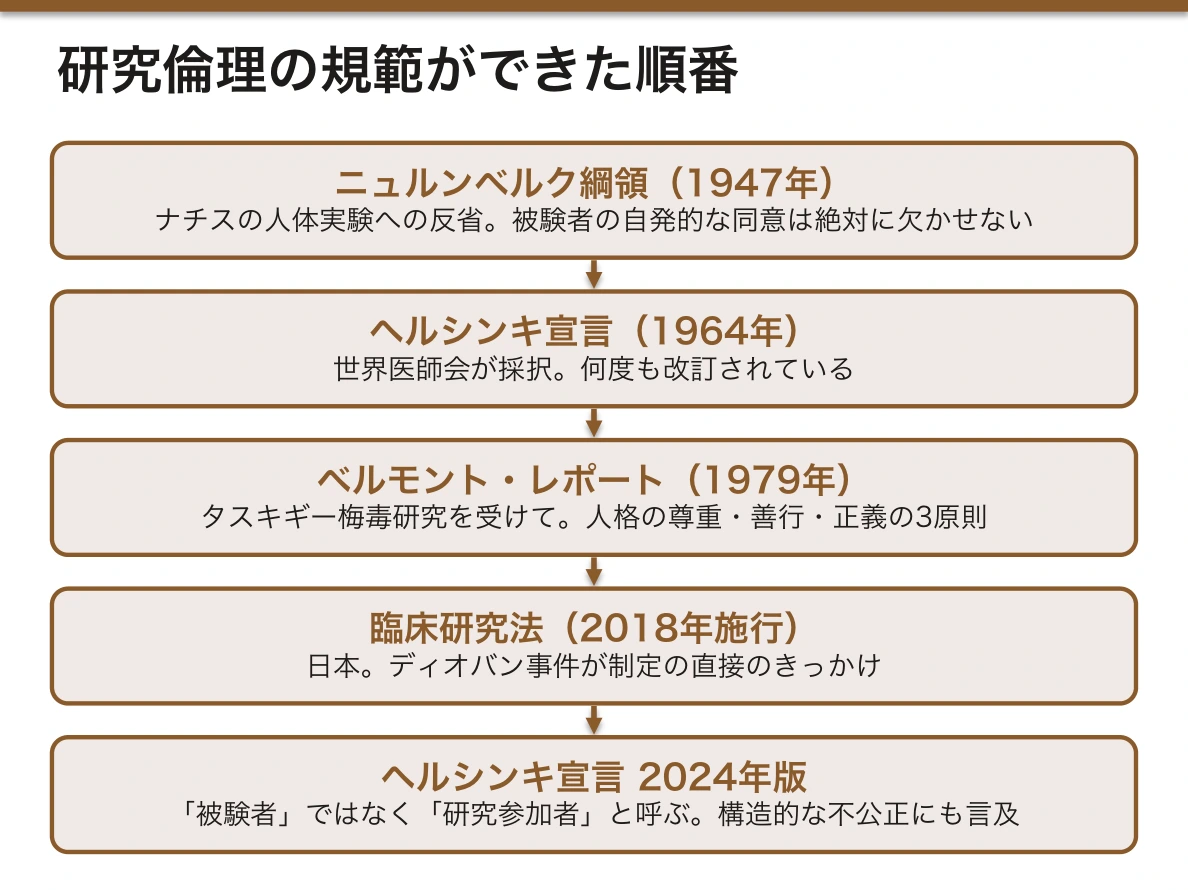
| ナチス・ドイツの医師による人体実験 | 収容所の人々を凍死させる・低酸素にさらすなどの実験 | ニュルンベルク綱領(1947年) |
| 旧日本軍の731部隊 | 捕虜に致死的な病原体を感染させる実験 | (戦後、データと引き換えに訴追が見送られた) |
| 米国タスキギー梅毒研究(1932〜1972年) | アフリカ系米国人男性の梅毒を、ペニシリンが標準治療になった後も治療せず経過を観察 | ベルモント・レポート(1979年) |
ニュルンベルク綱領は人体実験の最初の国際的な規範で、10項目からなる。第1項は「被験者の自発的な同意は絶対に欠かせない」である。ほかに、被験者がいつでも実験を中止できること、不必要な苦痛を避けること、危険が人道的な重要性を超えないことなどを定めた。
ニュルンベルク綱領の「同意は絶対に必要」を文字どおり適用すると、困ったことが起きる。幼い子ども、認知障害のある人、意識のない救急患者を対象とする研究が一切できなくなり、その人たちのための医療が進まない。そこで後の規範は、判断能力のない人を対象にする場合に別の条件を置いた。危険が最小限であること、そしてその患者群自身の利益につながる研究であること(小児の研究は小児医療の改善のため)である。
ベルモント・レポートは、研究倫理の3原則として人格の尊重・善行・正義を掲げた。これは後の4原則アプローチと重なる。不祥事の多くは「悪人」が起こしたのではなく、科学的な成果を重んじるあまり被験者が見えなくなった研究者が起こしたものだった。だから外部の独立した審査が必要になる。
日本にとって研究倫理は他人事ではない。731部隊の歴史に加え、サリドマイドをはじめとする薬害は、薬の承認と臨床試験の規制を強める大きなきっかけになった。現在、治験は GCP(医薬品の臨床試験の実施の基準)に、それ以外の臨床研究は臨床研究法(2018年施行)や人を対象とする生命科学・医学系研究に関する倫理指針に従って行われる。
English version
Core
Research ethics deals systematically with the ethical problems of research on humans. It grew out of reflection on unethical human experiments in the twentieth century. Researchers and funders, carried away by scientific enthusiasm, failed to see the risks to participants — often patients or others who depended on the researchers.
| Event | What happened | Resulting norm |
|---|---|---|
| Experiments by Nazi doctors | Prisoners frozen to death, starved of oxygen, etc. | The Nuremberg Code (1947) |
| Japanese Army Unit 731 | Prisoners infected with deadly pathogens | (After the war, prosecution was dropped in exchange for the data) |
| US Tuskegee syphilis study (1932–1972) | Syphilis in African American men left untreated and observed, even after penicillin became standard | The Belmont Report (1979) |
The Nuremberg Code was the first international code for human experiments, with ten points. The first: ‘The voluntary consent of the human subject is absolutely essential.‘ Others: the subject may stop the experiment at any time; unnecessary suffering must be avoided; the risk must not exceed the humanitarian importance of the problem.
Going further
Applied literally, ‘consent is absolutely essential’ causes a problem. Research on young children, people with cognitive impairment, or unconscious emergency patients would become impossible, and care for them could not improve. Later codes therefore set other conditions for people who cannot consent: the risk must be minimal, and the research must benefit that patient group (research on children should improve paediatric care).
The Belmont Report named three principles: respect for persons, beneficence and justice. These overlap with the later four principles. Most scandals were not caused by ‘bad people’ but by researchers who lost sight of the participants because they valued scientific results so highly. That is why independent outside review is needed.
In the clinic
Research ethics is not someone else’s problem for Japan. Besides the history of Unit 731, drug disasters such as thalidomide were a major reason for stricter control of drug approval and clinical trials. Today, drug trials follow GCP (Good Clinical Practice); other clinical research follows the Clinical Trials Act (in force from 2018) and the ethical guidelines for medical and life-science research involving human subjects.
ヘルシンキ宣言 — 医学研究の国際的な倫理原則
ヘルシンキ宣言は世界医師会(WMA)が1964年に採択した、人を対象とする医学研究の倫理原則である。何度も改訂され、最新の2024年版では対象を「被験者(subjects)」ではなく「研究参加者(participants)」と呼ぶようになった。医師が採択した宣言だが、研究に関わるすべての個人・組織が守るべきだとしている。主な柱は次のとおりである。
| 柱 | 要点 |
|---|---|
| 参加者の保護が最優先 | 研究の目的(知識の獲得)は、個々の参加者の権利と利益に決して優先しない。保護の責任は同意した参加者ではなく、常に研究者が負う |
| 危険・負担と利益 | 目的の重要性が危険と負担を上回る場合に限り行う。危険は事前に評価し、研究中も監視する |
| 弱い立場の人 | その人たちの健康上の必要に応え、その人たちが成果の恩恵を受ける場合に限り正当化される。除外することの害も考える |
| 科学的妥当性と計画書 | 科学的に健全な計画で、資金源・利益相反・補償などを計画書に記す |
| 研究倫理委員会 | 開始前に独立した委員会の承認を得る。委員会は監視・中止の権限をもつ |
| 自由意思によるインフォームド・コンセント | 平易な言葉で説明し、いつでも不利益なく撤回できると伝える |
| プラセボ・試験後の措置・登録と公表 | 原則として最善の既存治療と比べる。有益と分かった介入を試験後も受けられるようにする。研究は事前に登録し、否定的な結果も公表する |
宣言の背後にある緊張は、医療と研究の目的の違いである。医療の目的は目の前の患者の利益であり、研究の目的は将来の患者のための一般的な知識である。医師が研究者を兼ねるとき、2つの役割がぶつかる。宣言が「研究への参加を断っても、患者と医師の関係や標準的な医療に不利益が及んではならない」と書くのは、このためである。
2024年版で目立つのは、構造的な不公正への言及である。研究は不平等な社会の中で行われるので、利益・危険・負担がどう分配されるかを慎重に考え、参加者やその地域社会と研究の前・最中・後に意味のある関わりをもつよう求めている。また、研究に参加する機会が乏しい集団には適切な参加の機会を与えるべきだとする。守ることだけでなく、研究から締め出されないことも公正の一部になった。
臨床医にとって身近なのは、宣言の最後に置かれた未承認の介入の臨床での使用の項目である。承認された治療が効かず、治験にも参加できない患者に、まだ証明されていない治療を試すことは許されうる。ただし専門家の助言を求め、危険と利益を比べ、インフォームド・コンセントを得て、のちにその介入を研究の対象にする必要がある。研究の保護をすり抜ける抜け道に使ってはならない。
English version
Core
The Declaration of Helsinki was adopted by the World Medical Association (WMA) in 1964 as ethical principles for medical research involving humans. It has been revised many times. The latest version (2024) calls people ‘participants’ rather than ‘subjects’. It was adopted by physicians, but says everyone involved in research should follow it. Its main pillars:
| Pillar | Key points |
|---|---|
| Protection of participants comes first | The aim of research (new knowledge) never takes precedence over the rights and interests of individual participants. Responsibility for protection always lies with researchers, never with participants, even after consent |
| Risks, burdens and benefits | Research is done only if the importance of its aim outweighs the risks and burdens. Risks are assessed beforehand and monitored throughout |
| Vulnerable people | Justified only if it responds to their health needs and they stand to benefit. The harms of exclusion must also be weighed |
| Scientific validity and protocol | Sound design; funding, conflicts of interest and compensation stated in the protocol |
| Research ethics committee | Approval by an independent committee before starting; the committee can monitor and suspend |
| Free and informed consent | Explained in plain language; participants may withdraw at any time without reprisal |
| Placebo, post-trial provisions, registration and publication | Compare with the best proven intervention in principle; keep beneficial interventions available after the trial; register in advance and publish negative results too |
Going further
Behind the declaration lies a tension: medicine and research have different aims. Medicine aims at the benefit of the patient in front of us; research aims at general knowledge for future patients. When a doctor is also a researcher, the two roles collide. That is why the declaration says that refusing to join research must never harm the patient–doctor relationship or standard care.
A notable point of the 2024 version is its attention to structural inequity. Research takes place in unequal societies, so researchers must think carefully about how benefits, risks and burdens are shared, and engage meaningfully with participants and their communities before, during and after research. Groups that are under-represented should be given appropriate access to participation. Fairness now includes not only protection but also not being shut out of research.
In the clinic
For clinicians, the last section matters: unproven interventions in clinical practice. When approved treatments fail and a trial is not available, trying an unproven treatment can be acceptable. But one must seek expert advice, weigh risks and benefits, obtain informed consent, and later make the intervention the subject of research. It must never be used to get around the protections of research.
研究倫理委員会と科学的妥当性 — 「悪い科学は悪い倫理」
人を対象とする研究は、始める前に研究倫理委員会(米国では IRB:施設内審査委員会)の審査と承認を受けなければならない。委員会は医学・科学の専門家に加え、専門外の一般の委員を含み、研究者・資金提供者その他の不当な影響から独立していなければならない。研究計画の危険と利益の比、説明文書のわかりやすさ、被験者の選び方を審査し、承認しない・修正を求める・途中で中止させる権限をもつ。
審査の柱の一つが科学的妥当性である。研究の設計と方法が目的を達成でき、信頼できる結果を生めること。科学的に欠陥のある研究に人を参加させること自体が非倫理的である。役に立つ答えが出ないのに、危険と負担だけを負わせるからだ。
委員会には構造的な難しさがある。独立性:病院が自前で委員会を置くと、自施設の研究に甘くなりうる。営利の審査委員会は、客を集めるために基準を緩める誘因をもつ。専門と一般の釣り合い:一般委員が少なく萎縮すれば専門家の論理だけで決まり、逆に科学の理解が足りなければ計画の欠陥を見抜けない。
「価値」の問題もある。既存薬とほとんど同じで特許を回避するためだけの「ゾロ新薬(me-too drug)」の試験は、商業的な動機しかないのに患者を被験者として使う。一方、すぐには役立たない基礎研究がなければ科学は進まず、将来の治療も生まれない。研究の価値は、目先の実用性だけでは測れない。サンプル数が少なすぎて統計的な結論が出ない研究は、科学的妥当性を欠く典型例である。
日本では、臨床研究法のもとで一定の臨床研究(未承認薬の研究や、製薬企業から資金を受けた医薬品の研究)は、国が認定した認定臨床研究審査委員会の審査を受ける。研修医や学生が症例報告を書く場合も、患者の同意や個人情報の扱いについて施設の規則を確かめる習慣をつけておくとよい。
English version
Core
Research involving humans must be reviewed and approved by a research ethics committee (in the US, an IRB, institutional review board) before it begins. The committee includes medical and scientific experts and lay members, and it must be independent of undue influence from researchers, sponsors and others. It reviews the balance of risks and benefits, the clarity of information sheets and how participants are chosen. It can refuse approval, require changes or stop a study.
One pillar of review is scientific validity: the design and methods can achieve the aims and give reliable results. Enrolling people in scientifically flawed research is itself unethical, because it gives them risks and burdens without a useful answer.
Going further
Committees face structural problems. Independence: a committee set up by a hospital may be soft on its own institution’s research; a for-profit board may lower its standards to attract customers. Balance between experts and lay members: if lay members are few and overawed, only expert logic decides; if scientific understanding is weak, flaws in the protocol go unseen.
There is also the question of worth. Trials of ‘me-too’ drugs, almost identical to existing drugs and made only to get around a patent, use patients as subjects for purely commercial reasons. Yet without basic research that has no immediate use, science cannot progress and future treatments will not appear. The worth of research cannot be measured by short-term usefulness alone. A study with too few participants to give a statistical conclusion is a typical case of poor scientific validity.
In the clinic
In Japan, under the Clinical Trials Act, certain clinical research (studies of unapproved drugs, or drug studies funded by pharmaceutical companies) must be reviewed by a government-certified review board. Even when residents or students write a case report, it is a good habit to check the hospital’s rules on patient consent and personal information.
研究における自律と「治療との誤解」
研究における自律とは、インフォームド・コンセントを通じて参加者の自己決定を尊重することである。治療の場合よりも同意はさらに重要になる。研究には、参加者本人への確かな利益がないことが多いからだ。同意は判断能力のある人の、十分な情報に基づく自発的なものでなければならない。「参加しないと今の治療が受けられなくなる」とほのめかすのは強制である。
同意をむしばむ代表的な落とし穴が治療との誤解(therapeutic misconception)である。参加者が、研究の主な目的は自分を治すことだと思い込んでしまうことを指す。利益の保証はないと説明されても、そう信じてしまう。安全性を確かめる初期の臨床試験に、「新しい薬で治るはずだ」と期待して参加するのが典型である。
なぜ治療との誤解が起きるのか。説明が不十分なことに加えて、研究の場の構造そのものが誤解を招く。研究者が主治医でもあり、場所が病院で、手続きが診療と似ている。患者は「医師は自分のために最善を選ぶ」という診療での信頼を、そのまま研究に持ち込む。だが研究では、無作為割付で治療が決まり、プラセボ群に入るかもしれず、計画書に従って用量が固定される。どれも「この患者に最善」という基準では決まっていない。
対策として、ヘルシンキ宣言は、参加者が研究者に依存する関係にある場合(患者と主治医、学生と教員)には、その関係から独立した適切な人が同意を取るよう求めている。説明では、無作為化やプラセボの意味、研究と治療の違いをはっきり伝える必要がある。
終末期のがん患者が第I相試験への参加を希望する場面は、治療との誤解が最も強く出やすい。期待をむやみに打ち砕く必要はないが、試験の目的が主に安全な用量を探すことであること、効果が出る見込みは高くないこと、緩和ケアという別の道があることを伝えるのが、誠実な同意の取り方である。
English version
Core
Autonomy in research means respecting participants’ self-determination through informed consent. Consent matters even more than in treatment, because research often offers no definite benefit to the participant. Consent must be given voluntarily by a competent person with enough information. Suggesting ‘if you don’t join, you may lose your current care’ is coercion.
A classic trap that undermines consent is the therapeutic misconception: participants believe that the main purpose of the research is to treat them, even after being told there is no guaranteed benefit. A typical case is joining an early safety trial expecting the new drug to cure them.
Going further
Why does it happen? Besides poor explanations, the setting itself invites it. The researcher may also be the patient’s doctor, the place is a hospital, and the procedures look like care. Patients carry their clinical trust — ‘my doctor chooses what is best for me’ — into research. But in research, treatment is decided by randomisation, the patient may get a placebo, and doses are fixed by the protocol. None of these is decided by ‘what is best for this patient’.
As a safeguard, the Declaration of Helsinki says that when the participant is in a dependent relationship with the researcher (patient and doctor, student and teacher), consent should be taken by a qualified person independent of that relationship. The explanation should state clearly what randomisation and placebo mean and how research differs from treatment.
In the clinic
A patient with end-stage cancer who wants to join a phase I trial is where the therapeutic misconception is strongest. There is no need to crush hope, but honest consent means explaining that the trial’s main aim is to find a safe dose, that the chance of benefit is not high, and that palliative care is another path.
臨床試験の倫理 — 無作為化・均衡・プラセボ
臨床試験の標準はランダム化比較試験(RCT)である。患者を無作為に介入群と対照群(標準治療またはプラセボ)に分け、二重盲検では研究者も参加者もどちらの群かを知らない。偏りを除いて科学的に妥当な結果を得るための最善の方法とされるが、固有の倫理的問題を抱える。
| 問題 | 中身 |
|---|---|
| プラセボの使用 | 有効な治療がある病気でプラセボ群に入れば、治療を受けない危険を負う |
| 臨床的均衡(equipoise) | 比べる治療のどちらが優れているか、専門家の間で本当に不確かでなければ、劣ると分かっている側に患者を割り付けることになる |
| 商業的な動機 | 治療上の利益より市場の都合で試験が組まれる。研究者への勧誘報酬、参加者への過大な謝礼は不当な誘因になる |
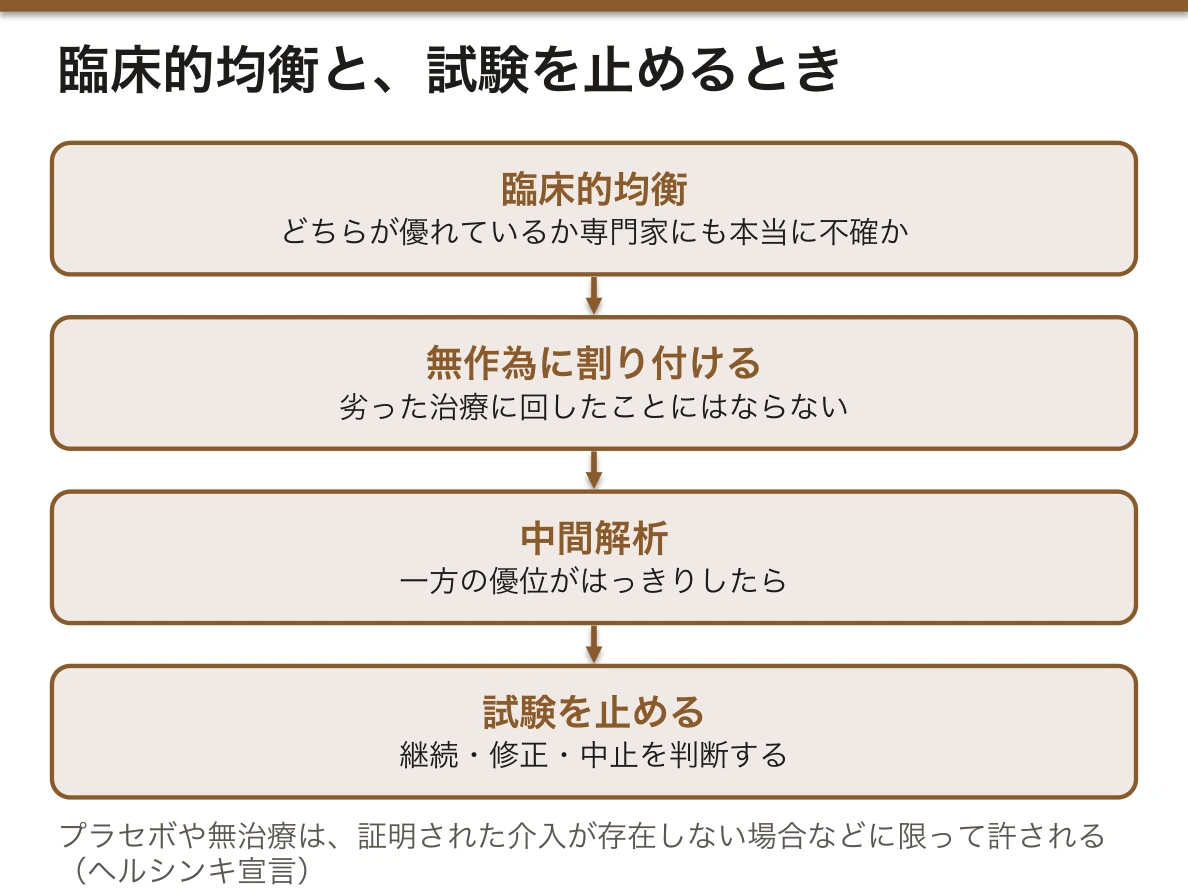
ヘルシンキ宣言は、新しい介入は原則として証明された最善の介入と比較しなければならないとする。プラセボや無治療が許されるのは、①証明された介入が存在しない場合、または②方法論上やむを得ない理由があり、かつ最善の介入を受けないことで重大または不可逆的な害の危険が加わらない場合に限られる。
臨床的均衡の考え方は、RCT と医師の義務を両立させる鍵である。医師は患者に最善の治療を与える義務を負うが、どちらが最善か誰にも分からないなら、無作為に割り付けても患者を劣った治療に回したことにはならない。逆に言えば、試験の途中で一方の優位がはっきりしたら(中間解析)、試験を止めなければならない。宣言が「決定的な結果が得られたら、継続・修正・中止を判断する」と書くのはこのためである。
手術を比べる臨床試験の場合、盲検化が難しく、「偽手術」を対照にすることの是非が議論になる。麻酔と皮膚切開の危険を、利益のない対照群に負わせるからだ。この危険を正当化できるのは、本当に必要な知識が得られ、危険が小さく、十分な説明がある場合に限られる。学術論文を読むときも、対照が何で、その選び方が倫理的に妥当かという目で見るとよい。
English version
Core
The standard clinical trial is the randomised controlled trial (RCT). Patients are randomly assigned to an intervention group or a control group (standard treatment or placebo). In a double-blind trial neither researchers nor participants know who is in which group. It is seen as the best way to remove bias and get valid results, but it has its own ethical problems.
| Problem | Content |
|---|---|
| Use of placebo | If an effective treatment exists, patients on placebo bear the risk of going untreated |
| Clinical equipoise | Unless experts are genuinely uncertain which treatment is better, some patients are assigned to the one known to be worse |
| Commercial motives | Trials designed for the market rather than therapeutic gain; payments to doctors per recruit and excessive payments to participants are undue inducements |
Going further
The Declaration of Helsinki says a new intervention should in principle be tested against the best proven intervention. Placebo or no treatment is acceptable only (1) when no proven intervention exists, or (2) for compelling methodological reasons, and only if those not receiving the best intervention face no additional risk of serious or irreversible harm.
Clinical equipoise is the key to reconciling RCTs with a doctor’s duty. Doctors must give patients the best treatment, but if nobody knows which is best, random assignment does not send anyone to an inferior treatment. Conversely, if one arm clearly proves better during the trial (interim analysis), the trial must stop. That is why the declaration says researchers must decide whether to continue, modify or stop when there is conclusive proof.
In the clinic
In surgical trials, blinding is hard, and using ‘sham surgery’ as a control is debated: it puts the risks of anaesthesia and incision on a control group with no benefit. This is justifiable only when the knowledge is really needed, the risk is small and the explanation is full. When reading papers, it helps to ask what the control was and whether choosing it was ethically sound.
研究における正義・搾取・差別Iustitia
研究における正義とは、研究の利益と負担を公正に分配することである。具体的には、被験者の選び方が公正であること、そして研究の成果が、被験者を出した集団に還元されることを求める。扱いやすいから、断りにくいから、という理由で被験者を選んではならない。
| 不正義の形 | 中身 | 例 |
|---|---|---|
| 搾取 | 参加者の弱さや不運な境遇につけ込み、過大な危険や負担を負わせる | 極度に貧しい人に高額の謝礼で危険な試験への参加を誘う(不当な誘因) |
| 差別(不当な包含) | ある集団だけが危険を負い、利益は他の集団が受ける | 貧しい国で試験を行い、完成した薬は豊かな国でしか買えない |
| 差別(不当な除外) | ある集団が研究の利益から締め出される | 女性や高齢者を心疾患の試験から外し、その人たちに合う根拠が生まれない |
研究のグローバル化は、搾取の危険を大きくした。豊かな国の製薬企業が行う臨床試験の多くが国外で行われ、規制の厳しさを逃れて低・中所得国に試験を委託する動きもある。そうした国では、参加者が貧しく、自分の権利を知らず、医師の収入が研究者報酬に頼っていることもある。HIV/AIDS の薬をめぐっては、参加者も参加国も貧しすぎて、完成した薬を試験後に使えないということが起きた。ヘルシンキ宣言が試験後の措置を求め、弱い立場の集団の研究はその集団の必要に応え、その集団が恩恵を受ける場合に限るとしているのはこのためである。
さらに大きな視点として「10/90格差」がある。世界の健康研究費の1割未満しか、世界の疾病負担の9割を占める問題に使われていない、という1990年代の指摘である。何を研究するか(研究の優先順位)も、正義の問題なのである。
不当な除外は臨床の根拠を偏らせる。かつて妊娠可能な女性は初期の臨床試験から広く除外され、高齢者や多くの薬を併用する患者も除外されがちだった。その結果、目の前の患者に当てはまる根拠がないことが珍しくない。臨床試験の論文を読むときは、組み入れ・除外基準を見て、自分の患者がその母集団に入るかを確かめる習慣が大切である。
English version
Core
Justice in research means sharing the benefits and burdens of research fairly. Participants must be selected fairly, and the results should benefit the group from which participants came. People must not be chosen just because they are easy to manage or find it hard to refuse.
| Form of injustice | Content | Example |
|---|---|---|
| Exploitation | Taking unfair advantage of participants’ vulnerability or misfortune to make them bear excessive risks or burdens | Offering a very poor person a large payment to join a dangerous trial (undue inducement) |
| Discrimination (unfair inclusion) | One group bears the risks while another receives the benefits | Testing in a poor country, then selling the drug only in rich countries |
| Discrimination (unfair exclusion) | A group is shut out of the benefits of research | Excluding women or older people from heart disease trials, so no evidence fits them |
Going further
The globalisation of research has increased the risk of exploitation. Many trials by companies in rich countries take place abroad, and some are outsourced to low- and middle-income countries to escape strict regulation. There, participants may be poor and unaware of their rights, and doctors may depend on research payments. In some HIV/AIDS drug trials, participants and their countries were too poor to use the drug after the trial. This is why the Declaration of Helsinki requires post-trial provisions and allows research on vulnerable groups only if it responds to their needs and they stand to benefit.
A wider view is the ’10/90 gap’, pointed out in the 1990s: less than 10% of world health research spending goes to the problems that cause 90% of the global disease burden. What we choose to research is also a question of justice.
In the clinic
Unfair exclusion distorts clinical evidence. Women who could become pregnant were once widely excluded from early trials, and older patients or those on many drugs were often excluded too. As a result, there is often no evidence that fits the patient in front of us. When reading a trial, check the inclusion and exclusion criteria to see whether your patient belongs to the studied population.
研究公正 — 捏造・改ざん・盗用
研究公正(research integrity)とは、研究の実施・報告・発表において、道徳的原則と専門職の規範を守ることである。科学は、科学者が正直に研究し、正直に報告することに決定的に依存している。不正の主な型は次のとおりである。
| 型 | 中身 |
|---|---|
| 捏造(fabrication) | 存在しないデータや結果を作り上げる |
| 改ざん(falsification) | データや画像を操作する、都合の悪いデータを除く、不適切な統計で結論をゆがめる |
| 盗用(plagiarism) | 他人のアイデア・文章・データを、出典を示さず自分のものとして使う。査読で知った他人の研究を先取りするのも含む |
| 不適切なオーサーシップ | 研究に関わっていない者を著者に入れる(ギフト・オーサーシップ)、企業が書いた論文に有名な研究者の名を借りる(ゴーストライティング) |
研究不正は増えているとみられる。画期的な成果、とくに商業的に価値のある成果を求める圧力と、有力誌への掲載が昇進を左右する競争があるからだ。2000年代半ばには、韓国の研究者がヒトのクローン胚から幹細胞を樹立したと発表し、のちにすべて虚偽と分かった。国家の威信をかけて大きく報道されたことが、問題をさらに大きくした。
メディアへの誇張も研究公正の一部である。結果を過大に宣伝すれば、社会の期待と判断をゆがめる。遺伝研究で特定の民族集団に「暴力の遺伝子」があるかのような報道がなされ、根拠の乏しい主張が偏見を強めた例もある。科学の誠実さは、論文の中だけでなく、どう伝えるかにまで及ぶ。謙虚さと慎重さは、科学者が育てるべき徳である。
日本でも、降圧薬の臨床研究でデータ操作と製薬企業の関与が問題になったディオバン事件(2013年に発覚)は、臨床研究法制定の直接のきっかけになった。2014年には、新しい万能細胞の作製を報告した論文が不正を指摘されて撤回された。文部科学省のガイドラインは、捏造・改ざん・盗用を「特定不正行為」と定めている。臨床試験の結果は、それをもとに治療を受ける患者の安全に直結する。
English version
Core
Research integrity means keeping to moral principles and professional standards in doing, reporting and publishing research. Science depends critically on scientists being honest in their work and their reports. The main types of misconduct:
| Type | Content |
|---|---|
| Fabrication | Inventing data or results that do not exist |
| Falsification | Manipulating data or images, removing inconvenient data, or distorting conclusions with improper statistics |
| Plagiarism | Using others’ ideas, text or data as one’s own without credit, including taking ideas from manuscripts one reviews |
| Improper authorship | Listing people who did no work (gift authorship); putting a famous researcher’s name on a paper written by a company (ghost writing) |
Going further
Misconduct seems to be increasing, driven by pressure for breakthroughs — especially commercially valuable ones — and by competition in which publication in top journals decides careers. In the mid-2000s, a Korean researcher announced stem cell lines from cloned human embryos; it later proved entirely false. Heavy national publicity made the damage worse.
Media hype is also part of research integrity. Exaggerated claims distort public expectations and judgement. In one case, reports suggested that an ethnic group carried a ‘warrior gene’ for violence; a weakly supported claim reinforced prejudice. Scientific honesty reaches beyond the paper to how findings are communicated. Humility and caution are virtues scientists should cultivate.
In the clinic
In Japan, the Diovan affair (exposed in 2013), involving data manipulation and drug-company involvement in clinical studies of an antihypertensive, led directly to the Clinical Trials Act. In 2014, papers reporting a new way to make pluripotent cells were retracted after misconduct was found. Government guidelines define fabrication, falsification and plagiarism as ‘specific misconduct’. The results of clinical trials directly affect the safety of patients treated on that evidence.
まとめ
| 研究倫理の成り立ち — 不祥事が規範を生んだ | 研究倫理は、人を対象とする研究で生じる倫理的な問題を体系的に扱う分野で、20世紀の非倫理的な人体実験への反省から生まれた。 |
|---|---|
| ヘルシンキ宣言 — 医学研究の国際的な倫理原則 | ヘルシンキ宣言は世界医師会(WMA)が1964年に採択した、人を対象とする医学研究の倫理原則である。 |
| 研究倫理委員会と科学的妥当性 — 「悪い科学は悪い倫理」 | 人を対象とする研究は、始める前に研究倫理委員会(米国では IRB:施設内審査委員会)の審査と承認を受けなければならない。 |
| 研究における自律と「治療との誤解」 | 研究における自律とは、インフォームド・コンセントを通じて参加者の自己決定を尊重することである。 |
| 臨床試験の倫理 — 無作為化・均衡・プラセボ | 臨床試験の標準はランダム化比較試験(RCT)である。 |
| 研究における正義・搾取・差別 | 研究における正義とは、研究の利益と負担を公正に分配することである。 |
| 研究公正 — 捏造・改ざん・盗用 | 研究公正(research integrity)とは、研究の実施・報告・発表において、道徳的原則と専門職の規範を守ることである。 |
このノートは医学生が授業の内容を自分の言葉でまとめたもので、診療の判断に使うものではありません。誤りに気づいたらお知らせください。