- 身体の社会的規制(Turner)と文明化の過程(Elias)
- 身体の存在論 — 「身体とは何か」が分からなくなった時代
- 身体という企て(Shilling)と身体化(Lived body)
身体の社会的規制(Turner)と文明化の過程(Elias)
Turner——社会は身体を統治するために4つの課題を解く。時間軸(世代を超えるか/個体内か)と対象(集団か/個人か)の2軸で整理される:人口の再生産、空間における身体の規制、内的な欲望の抑制、身体の外的な表象。
Elias『文明化の過程』——中世から近代にかけて、暴力・排泄・食事・性に関する作法が段階的に厳しくなり、その規制が外部の強制から内面の自己規制(恥と嫌悪の感覚)へ移った。暴力の独占(国家)と相互依存の網の拡大がその条件。
医学への含意——衛生・清潔・身体管理の規範は「自然な感覚」ではなく歴史的に作られた。手洗いや口臭への嫌悪は文明化の産物である。
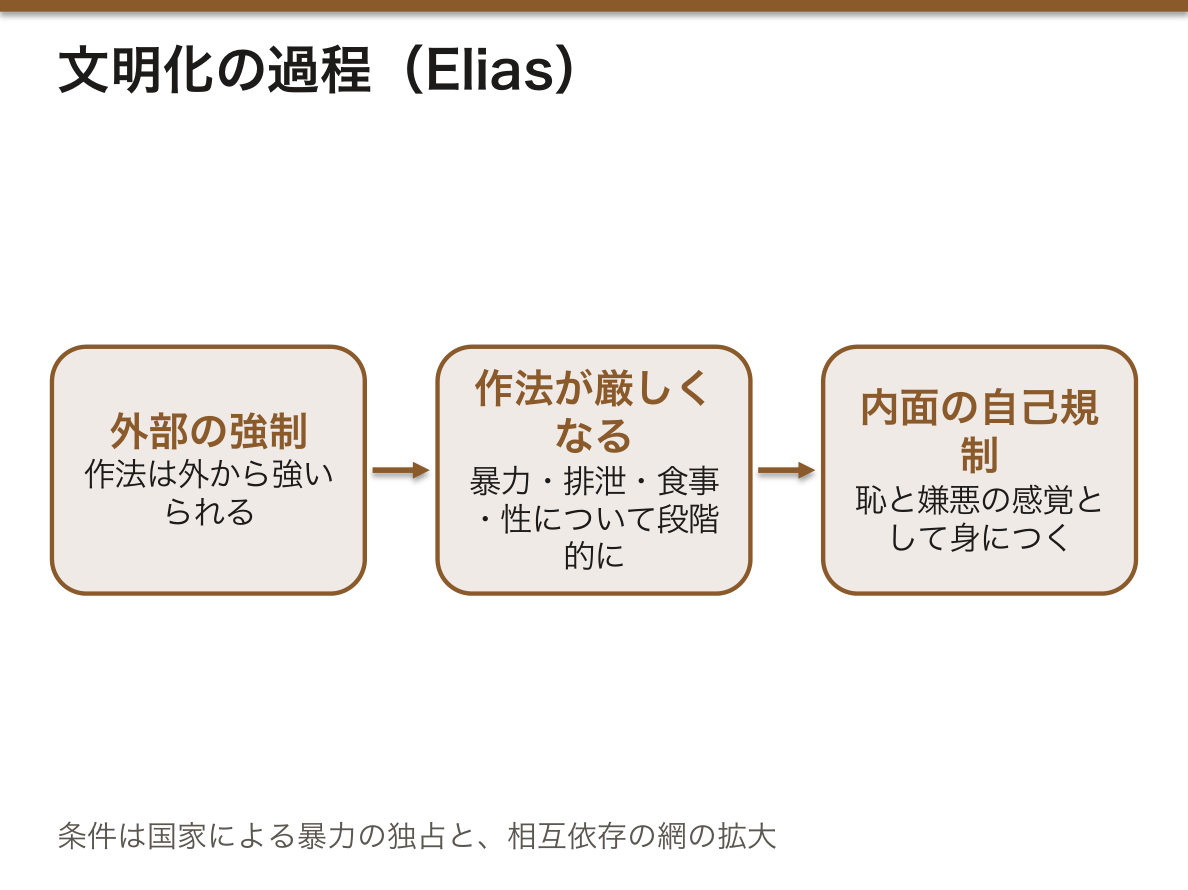
Elias と Foucault はどちらも「規律が内面化される」と論じるが、Elias は長期の社会過程、Foucault は権力の技法を強調する点で違う。
English version
Core
Turner — society solves four tasks in order to govern the body. They are arranged on two axes, time (across generations or within the individual) and object (the population or the individual): the reproduction of populations, the regulation of bodies in space, the restraint of internal desire, and the external representation of bodies.
Elias, The Civilising Process — from the Middle Ages into modern times, manners concerning violence, excretion, eating and sexuality became progressively stricter, and that regulation moved from external compulsion to internal self-regulation (the senses of shame and disgust). Its conditions were the monopoly of violence (the state) and the widening web of interdependence.
The implication for medicine — the norms of hygiene, cleanliness and bodily management are not "natural sensations" but historically made. Handwashing and disgust at bad breath are products of the civilising process.
Going further
Elias and Foucault both argue that discipline is internalised, and differ in that Elias emphasises a long social process and Foucault the techniques of power.
身体の存在論 — 「身体とは何か」が分からなくなった時代
身体の社会学には3つの見方がある。①身体が社会にどう規制されるか(Turner・Elias・Foucault)、②身体とはそもそも何か(存在論 ontology)、③身体がどう生きられ、経験されるか(身体化)。ここでは②を扱う。
出発点の対立は、自然主義と社会構築主義である。自然主義は、身体を物理学・生物学が扱う「与えられた自然」と見る。社会構築主義は、身体は多かれ少なかれ社会によって作られると見る。構築主義にも強弱があり、身体は言説(語られ方)の産物にすぎないとする強い立場(Armstrong)から、歩き方・しぐさ・体型などの特徴が社会と文化に影響されるとする穏やかな立場まである。
実りある枠組みは、どちらか一方ではなく生物としての身体と社会関係の相互作用を見るものである。たとえばジェンダーについて、「ジェンダーが生物学を形づくる」と「生物学がジェンダーを形づくる」を、互いに作り合う過程として扱う考え方がある。これは「自然か社会か」という行き詰まりを抜け、ジェンダーによる健康格差がどう働くかを説明できる。
なぜ後期近代で「身体とは何か」が不確かになったのか。後期近代の特徴はリスクと疑いである(Beck・Douglas・Giddens)。社会が先の見えないものになるほど、身体は自己を支える「錨」になる。Giddens によれば、かつて身体は人の手がほとんど及ばない自然の一部で「与えられたもの」だったが、専門家の知識と技術が入り込むにつれ、働きかけて作り変えられるものになった(Shilling の「身体という企て」はその延長)。皮肉なことに、身体を変える自由と技術が増えるほど、身体の境界がどこにあるのかは分からなくなる。
2つの具体例がある。①柔軟な免疫(Emily Martin)——人々は「強い免疫」を、変化に適応し続ける柔軟なものとして語る。免疫学そのものも、「自己か非自己か」を守る壁から、書き換え可能なネットワークへと見方を変えた。移植やワクチンのように、免疫には「外のものを受け入れる」開かれた面もある。②仮想の身体——Frank は、診断の実際は患者のベッドではなく画面の前で行われ、画面の画像が「本当の患者」になったと述べた。米国の Visible Human Project は献体を薄い間隔で断面にして完全な3次元データにしたもので、Waldby はこれを、現実と仮想・生と死の境界をぼかす生権力の延長と見た。身体はデータベースになり、商業的な価値(バイオバリュー)を生む。
画像診断や電子カルテの時代には、検査値や画像を「患者そのもの」と取り違えやすい。画面の上の所見と、目の前の人が訴える経験とがずれたときにどちらを信じるかは、この議論の実践版である。
English version
Core
The sociology of the body has three views: (1) how society regulates the body (Turner, Elias, Foucault), (2) what the body is (ontology), and (3) how the body is lived and experienced (embodiment). This item is about (2).
The basic opposition is naturalism versus social constructionism. Naturalism sees the body as a natural given, studied by physics and biology. Social constructionism sees the body as more or less made by society. There are strong and weak versions: the strong view says the body is only a product of discourse (Armstrong); the weaker view says features such as gait, gestures and shape are influenced by society and culture.
Useful frameworks look at the interplay between the biological body and social relations, not one side only. For gender, one approach treats “gender shaping biology” and “biology shaping gender” as processes that make each other. This moves past the “nature or society” deadlock and helps explain gender inequalities in health.
Going further
Why has “what is the body?” become uncertain in late modernity? Late modern society is marked by risk and doubt (Beck, Douglas, Giddens). When society feels out of control, the body becomes an anchor for the self. Giddens says the body used to be part of nature, a “given” that people could hardly change; with expert knowledge and technology, it became something to work on and remake (Shilling’s “body project” follows from this). Ironically, the more freedom and technology we have to change the body, the less sure we are where its boundaries are.
Two examples. (1) Flexible immunity (Emily Martin): people describe a “strong immune system” as flexible and always adapting. Immunology itself moved from a wall that defends “self” against “non-self” to a network that can be rewritten. Transplantation and vaccination show that immunity also has an open side that accepts what comes from outside. (2) Virtual bodies: Frank said that real diagnosis now happens at the screen, not the bedside, and the image becomes the “true” patient. The US Visible Human Project cut donated bodies into thin sections to make complete 3D data. Waldby saw this as an extension of biopower that blurs the lines between real and virtual, living and dead. The body becomes a database and creates commercial value (biovalue).
In the clinic
In the age of imaging and electronic records, it is easy to mistake test values and images for the patient. When the findings on the screen and the experience of the person in front of you do not match, which do you trust? This is the practical version of the debate.
身体という企て(Shilling)と身体化(Lived body)
Shilling『身体という企て the body as a project』——後期近代において、身体は与えられたものではなく、個人が生涯かけて作り上げる未完のプロジェクトになった。運動・食事・美容・整形・タトゥー——自己アイデンティティの中心が身体に移った。
なぜそうなったか——伝統的な拠り所(宗教・階級・共同体)が弱まり、確かなものが自分の身体しか残らなかったから。
身体化 embodiment / 生きられた身体 lived body(Merleau-Ponty の現象学)——「身体を持つ」のではなく「身体である」。身体は世界を経験する媒体であり、通常は意識されない。
病いとは、この当たり前だった身体が「対象」として立ち現れること——歩けていた足を、初めて「足」として意識する。この視点は、病いの語りが必要になる理由も説明する。
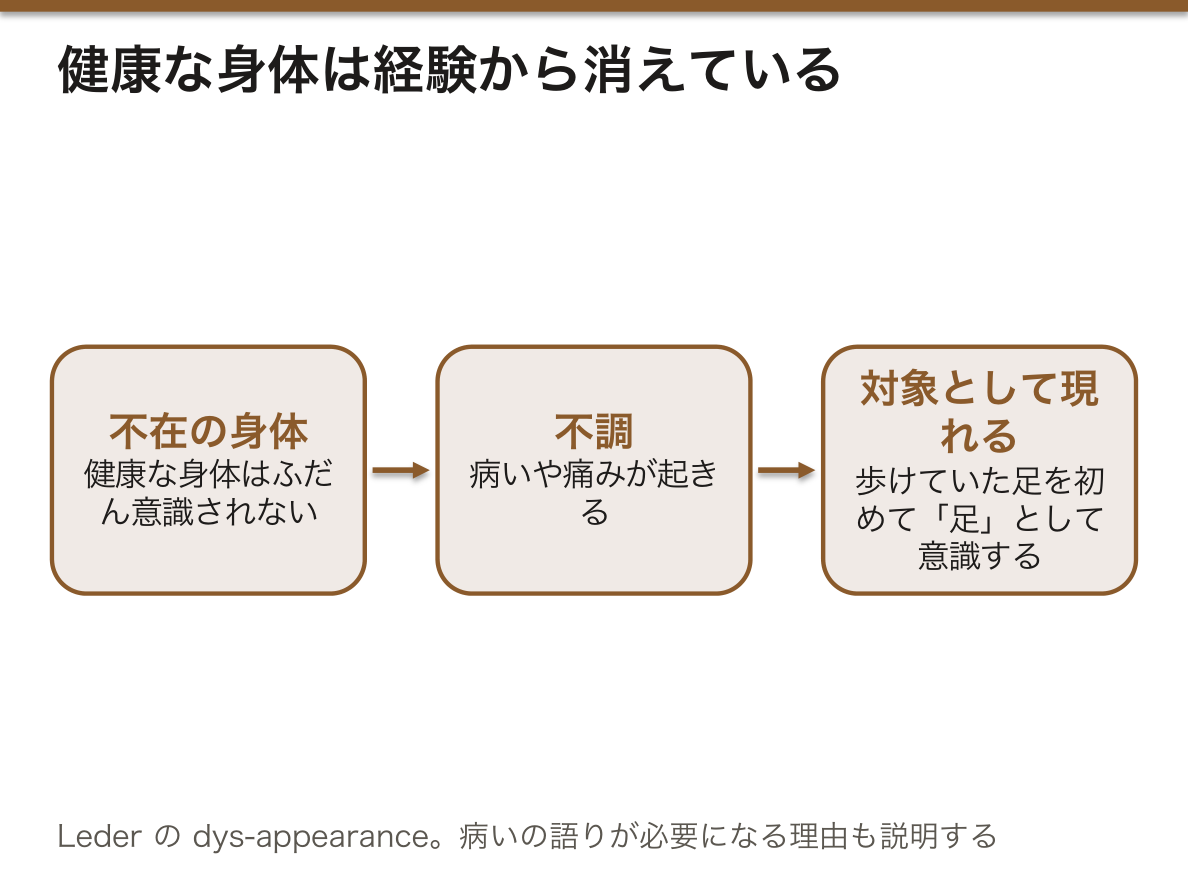
Leder の「不在の身体」——健康な身体は経験から消えており、不調によって初めて姿を現す(dys-appearance)。この語は覚えておくと使える。
English version
Core
Shilling, "the body as a project" — in late modernity the body has become not something given but an unfinished project the individual builds over a lifetime. Exercise, diet, cosmetics, surgery, tattoos — the centre of self-identity has moved to the body.
Why this happened — the traditional supports (religion, class, community) weakened, and nothing certain was left but one’s own body.
Embodiment / the lived body (the phenomenology of Merleau-Ponty) — one does not "have" a body, one "is" a body. The body is the medium through which the world is experienced and is normally not attended to.
Illness is this body, hitherto taken for granted, standing forth as an "object" — the leg one walked on is noticed for the first time as "a leg". This view also explains why illness narratives become necessary.
Going further
Leder’s "absent body" — the healthy body has disappeared from experience and shows itself only through disorder (dys-appearance). The term is worth remembering and usable.
まとめ
| 身体の社会的規制(Turner)と文明化の過程(Elias) | Turner——社会は身体を統治するために4つの課題を解く。 |
|---|---|
| 身体の存在論 — 「身体とは何か」が分からなくなった時代 | 身体の社会学には3つの見方がある。①身体が社会にどう規制されるか(Turner・Elias・Foucault)、②身体とはそもそも何か(存在論 ontology)、③身体がどう生き… |
| 身体という企て(Shilling)と身体化(Lived body) | Shilling『身体という企て the body as a project』——後期近代において、身体は与えられたものではなく、個人が生涯かけて作り上げる未完のプロジェクトになっ… |
このノートは医学生が授業の内容を自分の言葉でまとめたもので、診療の判断に使うものではありません。誤りに気づいたらお知らせください。