DNAの配列はただの文字列ではなく、場所ごとに意味の違う文書である。アミノ酸を指定する部分、転写を始める合図、読む量を調節する部分、そして何も指定しない大量の繰り返し。この章では、まず遺伝暗号(3文字の読み方の規則)を確かめ、次に1つの遺伝子の中にどんな区画があるか、最後にゲノム全体がどう構成されているかを見る。
注意したいのは用語である。「遺伝暗号」はコドンとアミノ酸の対応表のことで、ある人のDNA配列全体(ゲノム)を指す言葉ではない。また、ヒトのゲノムのうちタンパク質を指定する部分は2%に満たない。残りの98%が「ごみ」ではなく、調節の配列や動く遺伝子の名残として病気にもかかわることが、この章のもう1つの主題になる。
- 遺伝暗号 — 4文字を3つずつ読み、64通りで20種を指す
- 遺伝子の構造 — プロモーターからポリA付加シグナルまで
- ORFと読み枠 — 6通りの読み方から、本物を1つ選ぶ
- エンハンサー・サイレンサー・LCR — 遠くから発現を上げ下げする配列
- 遺伝子の種類 — 1つだけの遺伝子、家族、偽物、ずらりと並ぶ遺伝子
- ヒト核ゲノムの構成 — 遺伝子は2%未満、残りは何か
- トランスポゾン — ゲノムの中を動く配列
- ミトコンドリアと原核のゲノム — 小さくまとまったゲノムと、lacオペロン
遺伝暗号 — 4文字を3つずつ読み、64通りで20種を指す
遺伝暗号は、DNAやRNAの塩基配列からタンパク質のアミノ酸配列を決める読み方の規則である。塩基は4種類なので、3つ並んだコドン(トリプレット)は4×4×4=64通りになる。これが20種類のアミノ酸と、合成の開始・終了の合図に割り当てられている。コドンは重ならずに端から順に読まれる。
開始コドンはAUGでメチオニンを指定する。終止コドンはUAA・UAG・UGAの3つで、どのアミノ酸も指定しない(ただし特別な合図がある場合、UGAはセレノシステインとして読み替えられる)。ほかのアミノ酸の多くは複数のコドンで指定され、その違いはふつう3文字目にある。これを暗号の縮重という。この規則は、ほぼすべての生物で共通である。
なぜ縮重は3文字目に集中しているのか。tRNAのアンチコドンは、コドンの1・2文字目とは厳密に対を組むが、3文字目とは多少ゆるい組み方(ゆらぎ)を許す。そのため3文字目が多少違っても同じtRNAで読める。結果として、3文字目の1塩基置換はアミノ酸を変えないことが多く、変異の害を和らげる緩衝材になっている。逆に1文字目・2文字目の置換はアミノ酸を変えやすい。
「ほぼ」共通というのは例外があるからで、代表はミトコンドリアである。ヒトのミトコンドリアではUGAが終止ではなくトリプトファン、AUAがイソロイシンではなくメチオニンを指定し、AGAとAGGはアルギニンではなく終止として扱われる。ミトコンドリアの遺伝子を核の暗号表で読むと、途中で止まったり別のアミノ酸になったりするので注意する。
English version
Core
The genetic code is the reading rule that turns a base sequence in DNA or RNA into an amino acid sequence. There are four bases, so a group of three, a codon (triplet), has 4×4×4 = 64 combinations. These are assigned to 20 amino acids and to start and stop signals. Codons are read without overlapping, one after another from the start.
The start codon is AUG, coding for methionine. The stop codons are UAA, UAG and UGA; they code for no amino acid (but with a special signal, UGA is read as selenocysteine). Most other amino acids have several codons, which usually differ in the third letter. This is called the degeneracy of the code. The rule is shared by almost all living things.
Going further
Why is degeneracy concentrated in the third letter? The tRNA anticodon pairs strictly with the first and second letters of the codon, but allows a looser pairing with the third (wobble). So one tRNA can read codons that differ in the third letter. As a result, a single base change in the third position often does not change the amino acid, which softens the harm of mutations. Changes in the first or second letter are more likely to change the amino acid.
“Almost” all, because there are exceptions. The main one is mitochondria. In human mitochondria, UGA codes for tryptophan, not stop; AUA codes for methionine, not isoleucine; and AGA and AGG are treated as stop, not arginine. If you read a mitochondrial gene with the nuclear code table, it stops early or gives the wrong amino acids.
遺伝子の構造 — プロモーターからポリA付加シグナルまで
分子のことばでいえば、遺伝子とは働くタンパク質またはRNAを1つ作るのに必要な染色体上のDNA配列である。アミノ酸を指定するエクソンだけでなく、イントロンと転写を調節する領域も含む。多くの遺伝子はタンパク質を指定するが、tRNAやrRNAなど、RNAそのものが産物になる遺伝子もある。
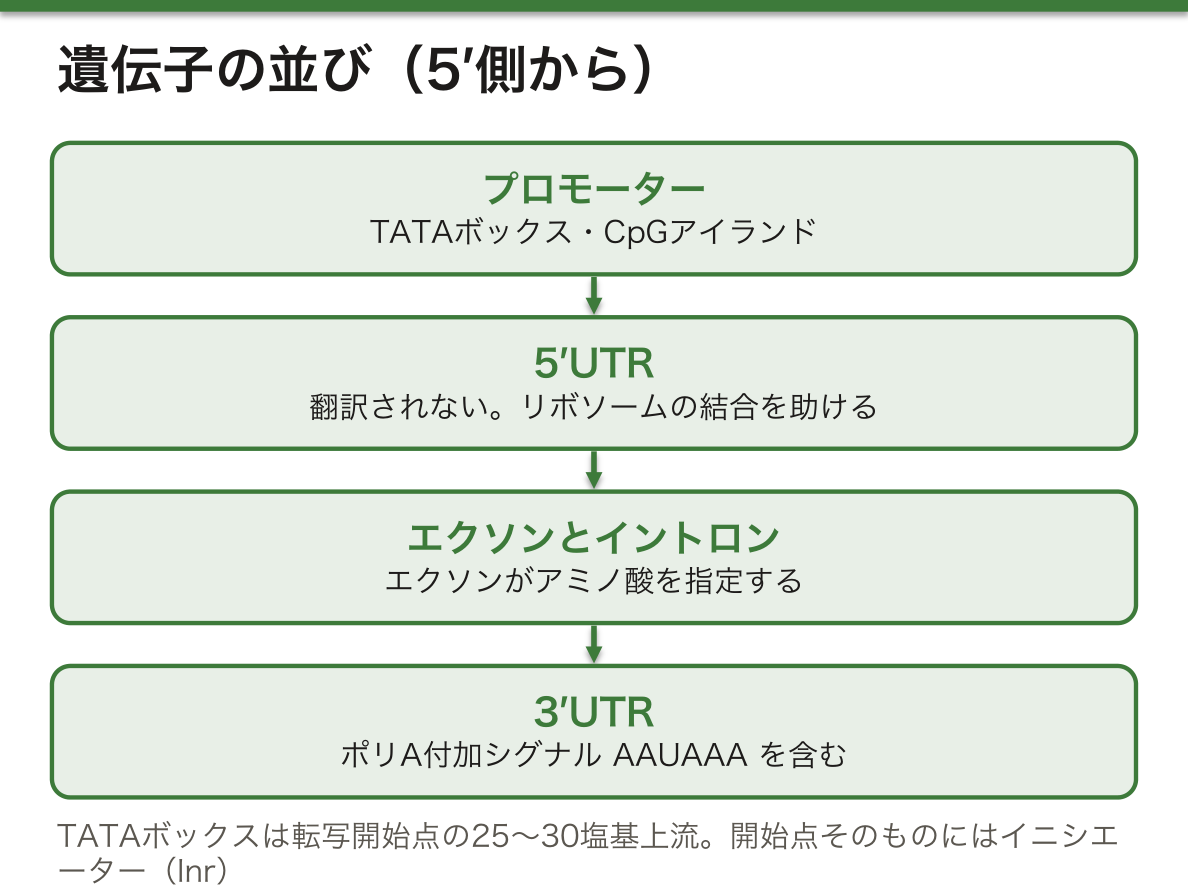
5′側から順に見ると次のようになる。プロモーターは転写を正しく始めるための配列で、その中に多くの遺伝子に共通する要素がある。TATAボックスは転写開始点の25〜30塩基上流にあるTATAAAで、開始の位置を決める。CpGアイランドはCとGに富む区間で、ヒトの遺伝子の約7割にあり、転写因子が結合する一方、メチル化されると遺伝子が黙る。転写開始点そのものにはイニシエーター(Inr)という配列がある。その先に、翻訳されない5′UTR、エクソンとイントロンの並び、3′UTRが続き、3′UTRの中のポリA付加シグナル(AAUAAA)がmRNAの端を切って尾をつける合図になる。
TATAボックスをもつ遺伝子はヒトでは少数派(2割前後)で、多くは特定の組織で必要なときに強く発現する遺伝子である。いつでも一定量が要るハウスキーピング遺伝子は、ふつうTATAボックスをもたない。なぜか——TATAボックスは開始点を1か所に絞り、短時間に大量の転写を起こすのに向く「強いスイッチ」で、常に少しずつ読み続ける遺伝子には要らないと考えると整理しやすい。
UTRは「翻訳されないから重要でない」わけではない。5′UTRにはリボソームの結合を助ける配列があり、3′UTRにはmRNAを速く分解させる配列や、翻訳の量を調節する配列(miRNAの結合部位など)がある。同じタンパク質を作る遺伝子でも、UTRが違えば作られる量と時間が変わる。
English version
Core
In molecular terms, a gene is the DNA sequence on a chromosome needed to make one working protein or RNA. It includes not only the exons that code for amino acids, but also introns and regions that control transcription. Most genes code for proteins, but some, such as tRNA and rRNA genes, have RNA itself as the product.
From the 5′ side: the promoter is the sequence for starting transcription correctly, and it contains elements shared by many genes. The TATA box is TATAAA, about 25–30 bases upstream of the start site, and it sets the start position. A CpG island is a stretch rich in C and G, found in about 70% of human genes. Transcription factors bind it, but when it is methylated, the gene is silenced. The start site itself has a sequence called the initiator (Inr). Then come the untranslated 5′UTR, the exons and introns, and the 3′UTR. The polyadenylation signal (AAUAAA) in the 3′UTR marks where the mRNA end is cut and a tail is added.
Going further
In humans, genes with a TATA box are a minority (about one in five). Most of them are genes strongly expressed in certain tissues when needed. Housekeeping genes, needed in steady amounts all the time, usually have no TATA box. Why? One way to see it: the TATA box is a “strong switch” that fixes one start point and allows a lot of transcription in a short time. Genes that are read a little at a time, all the time, do not need it.
UTRs are not unimportant just because they are not translated. The 5′UTR has sequences that help ribosomes bind. The 3′UTR has sequences that make the mRNA break down quickly and sequences that control how much is translated (such as miRNA binding sites). Two genes for the same protein can give different amounts at different times if their UTRs differ.
ORFと読み枠 — 6通りの読み方から、本物を1つ選ぶ
二本鎖DNAのどの区間にも、読み枠は6通りある。片方の鎖で3通り(1文字目から・2文字目から・3文字目から)、もう片方の鎖で3通りである。このうち開始コドンから終止コドンまで途切れずに続く区間をオープンリーディングフレーム(ORF)という。DNAで見るなら、開始はATG、終止はTAA・TAG・TGAである。真核生物の遺伝子ではふつう1つの読み枠だけが使われ、それは最も長いORFであることが多い。
mRNAと同じ配列(TをUに替えたもの)をもつ鎖をセンス鎖(コード鎖)、転写の型として読まれる鎖をアンチセンス鎖(鋳型鎖)という。
手順で考える。例として、次の短い配列を考えよう。
5′-CTATCAGGGTTTCCAAGCCAT-3′
①相補鎖を書く。向きを逆にして並べると 3′-GATAGTCCCAAAGGTTCGGTA-5′ になる。②どちらの鎖も5′→3′に読む。相補鎖を5′側から書き直すと 5′-ATGGCTTGGAAACCCTGATAG-3′ である。③ATGを探す。元の鎖にはATGが無いが、相補鎖の先頭にある。④3つずつ区切る。ATG GCT TGG AAA CCC TGA → Met–Ala–Trp–Lys–Pro–終止。したがってこの区間では、相補鎖のほうがセンス鎖で、最初に与えた鎖がアンチセンス鎖になる。mRNAはセンス鎖と同じ並びで、5′-AUGGCUUGGAAACCCUGAUAG-3′ となる。
なぜ両方の鎖を調べる必要があるのか。遺伝子はどちらの鎖に載っていてもよく、隣り合う遺伝子が逆向きに並ぶことも珍しくないからである。「紙に書かれた上の鎖が遺伝子」と思いこむと、本物のORFを見落とす。
変異の影響を読むときにもこの手順を使う。1塩基の置換がORFの中で終止コドンを作れば、その先のタンパク質は作られない。1〜2塩基の挿入や欠失は読み枠そのものをずらし、以降のアミノ酸をすべて変える。遺伝子検査の報告書の「c.」(コード配列上の位置)と「p.」(タンパク質上の位置)という書き方は、このORFを基準にした番地である。
English version
Core
Any stretch of double-stranded DNA has six reading frames: three on one strand (starting at the first, second or third letter) and three on the other. A stretch that runs unbroken from a start codon to a stop codon is an open reading frame (ORF). In DNA, the start is ATG and the stops are TAA, TAG and TGA. A eukaryotic gene usually uses only one frame, often the longest ORF.
The strand with the same sequence as the mRNA (with T in place of U) is the sense (coding) strand. The strand read as the template for transcription is the antisense (template) strand.
Going further
Work through the steps. Take this short sequence as an example:
5′-CTATCAGGGTTTCCAAGCCAT-3′
(1) Write the complementary strand. Lined up below it, it reads 3′-GATAGTCCCAAAGGTTCGGTA-5′. (2) Read both strands 5′→3′. Rewritten from its 5′ end, the complementary strand is 5′-ATGGCTTGGAAACCCTGATAG-3′. (3) Look for ATG. The original strand has none; the complementary strand starts with one. (4) Split into threes. ATG GCT TGG AAA CCC TGA → Met–Ala–Trp–Lys–Pro–stop. So here the complementary strand is the sense strand, and the strand we were given is the antisense strand. The mRNA has the same order as the sense strand: 5′-AUGGCUUGGAAACCCUGAUAG-3′.
Why check both strands? A gene can sit on either strand, and neighbouring genes often point in opposite directions. If you assume the top strand on the page is the gene, you can miss the real ORF.
In the clinic
The same steps are used to judge the effect of a variant. If one base change creates a stop codon inside the ORF, the rest of the protein is not made. Inserting or deleting one or two bases shifts the reading frame itself and changes every amino acid after it. In genetic test reports, “c.” (position in the coding sequence) and “p.” (position in the protein) are addresses based on this ORF.
エンハンサー・サイレンサー・LCR — 遠くから発現を上げ下げする配列
真核細胞の遺伝子がどれだけ読まれるかは、ふつう転写を促す因子(アクチベーター)と抑える因子(リプレッサー)のつり合いで決まる。その足場になるのが、遺伝子の外側(隣接領域)にある調節配列である。
エンハンサーは、特定の転写因子が結合すると関連する遺伝子の転写を高める配列である。サイレンサーは、リプレッサーが結合すると転写を止める配列である。どちらもプロモーターから遠く離れていてよく、向きも問わない。さらに遺伝子座制御領域(LCR)は、近くに並ぶ一群の遺伝子の発現をまとめて高める領域で、グロビン遺伝子群の上流にあるものがよく知られる。
なぜ何万塩基も離れた配列が、プロモーターに効くのか。答えはDNAが折れ曲がるからである。クロマチンがループをつくると、遠いエンハンサーに結合した転写因子が、プロモーターの上の転写装置に直接触れられる。このループは前に述べたTAD(よく接触しあう区画)の内側でつくられやすく、TADの境界はエンハンサーが隣の区画の遺伝子を誤って動かさないための仕切りにもなる。境界が欠けると、本来関係のない遺伝子が別の組織で発現して病気になる例が知られている。
グロビンのLCRは、胎児期にはγグロビン、出生後はβグロビンと、時期によってつなぐ相手を切り替える。同じ調節配列が、ループの組み替えで発生の段階を表しているのである。
この仕組みはそのまま治療になった。鎌状赤血球症とβサラセミアに対して、赤血球でだけ働くBCL11A遺伝子のエンハンサーをゲノム編集で壊す治療が承認されている。BCL11Aは胎児型ヘモグロビンのγグロビンを抑えるリプレッサーなので、そのエンハンサーを壊すと、赤血球でだけ胎児型ヘモグロビンが再び作られ、異常なβグロビンの穴を埋める。遺伝子そのものではなく調節配列を狙った点が新しい。
English version
Core
How much a eukaryotic gene is read usually depends on the balance between factors that promote transcription (activators) and factors that block it (repressors). Their footholds are regulatory sequences in the regions next to the gene.
An enhancer is a sequence that, when bound by certain transcription factors, raises transcription of an associated gene. A silencer is a sequence that, when bound by a repressor, turns transcription off. Both can be far from the promoter, in either orientation. A locus control region (LCR) raises the expression of a whole group of nearby genes together. The best-known example lies upstream of the globin gene clusters.
Going further
Why can a sequence tens of thousands of bases away act on a promoter? Because DNA bends. When chromatin forms a loop, transcription factors bound to a distant enhancer can touch the transcription machinery on the promoter directly. These loops form easily inside the TADs described earlier (regions that often contact each other). TAD borders also keep an enhancer from wrongly switching on genes in the next region. Cases are known where a missing border lets an unrelated gene be expressed in another tissue and cause disease.
The globin LCR switches partners with time: γ-globin before birth, β-globin after birth. The same regulatory sequence expresses the stage of development by rearranging its loops.
In the clinic
This mechanism has become a treatment. For sickle cell disease and β-thalassaemia, a therapy has been approved that uses genome editing to break the enhancer of the BCL11A gene that works only in red blood cells. BCL11A is a repressor of γ-globin, part of fetal haemoglobin. Breaking its enhancer makes fetal haemoglobin return only in red blood cells, filling the gap left by the faulty β-globin. What is new is that it targets a regulatory sequence, not the gene itself.
遺伝子の種類 — 1つだけの遺伝子、家族、偽物、ずらりと並ぶ遺伝子
タンパク質をコードする遺伝子は、ゲノムの中のあり方でいくつかに分かれる。単一遺伝子は一倍体ゲノムに1コピーだけある遺伝子である。重複遺伝子はよく似ているが同一ではない配列が5〜50 kbほどの距離に並ぶもので、その一群を遺伝子ファミリーという。α-グロビン遺伝子群(16番)とβ-グロビン遺伝子群(11番)が代表例である。偽遺伝子は、働く遺伝子の複数のエクソンに相当する配列をもちながら、機能を失った欠陥コピーである。rRNA・tRNA・snRNA・ヒストンの遺伝子は、ほぼ同じものが何十も縦列に繰り返して並ぶ。
働き方による分け方もある。
| 構成的(ハウスキーピング)遺伝子 | 条件的遺伝子 | |
|---|---|---|
| 役割 | 細胞が生きるために常に必要な機能 | 発生段階・細胞周期・環境に応じて必要な機能 |
| 発現 | ほぼ一定、環境に左右されにくい | 誘導される、組織特異的なことが多い |
| プロモーター | 比較的単純、TATAボックスをもたない | 複雑、何段階もの調節を受ける |
| 例 | 遺伝子発現・代謝・細胞骨格・シグナルの基本装置 | グロビン、ホルモン、組織ごとの酵素 |
なぜ遺伝子は重複して家族をつくるのか。重複すると、片方のコピーが元の仕事を続けているあいだに、もう片方は変異を貯めても困らない。その結果、少し違う性質をもつ新しい遺伝子が生まれる。グロビン遺伝子群では、こうして胎児期用(酸素を強くつかむ)と成人用のグロビンが分かれ、胎盤ごしに母から酸素を受け取れるようになった。一方、変異を貯めたまま働かなくなったものが偽遺伝子である。重複は進化の材料であり、偽遺伝子はその失敗作と考えるとよい。
偽遺伝子は臨床検査の落とし穴になる。副腎の21-水酸化酵素の遺伝子(CYP21A2)のすぐ近くには、よく似た偽遺伝子があり、2つの間で配列が写し替わる(遺伝子変換)と、偽遺伝子の欠陥が本物に持ちこまれて先天性副腎過形成の原因になる。また、似た配列が2か所にあるため、検査で本物と偽物を取り違えないような工夫が必要になる。
English version
Core
Protein-coding genes fall into groups by how they sit in the genome. A solitary gene has only one copy in the haploid genome. Duplicated genes are similar but not identical sequences about 5–50 kb apart; such a set is a gene family. The α-globin cluster (chromosome 16) and β-globin cluster (chromosome 11) are classic examples. A pseudogene is a broken copy that has sequences matching several exons of a working gene but has lost its function. Genes for rRNA, tRNA, snRNA and histones are found as dozens of nearly identical copies repeated in tandem.
Genes can also be grouped by how they work.
| Constitutive (housekeeping) genes | Facultative genes | |
|---|---|---|
| Role | Functions the cell always needs to live | Functions needed at certain stages, in the cell cycle, or in response to the environment |
| Expression | Fairly constant, little affected by the environment | Inducible, often tissue-specific |
| Promoter | Fairly simple, no TATA box | Complex, with many steps of control |
| Examples | Basic machinery of gene expression, metabolism, cytoskeleton, signalling | Globins, hormones, tissue-specific enzymes |
Going further
Why do genes duplicate and form families? After duplication, one copy keeps doing the old job while the other can collect mutations without harm. A new gene with slightly different properties may result. In the globin clusters, this is how fetal globins (which hold oxygen strongly) and adult globins separated, so the fetus can take oxygen from the mother across the placenta. Copies that collected mutations and stopped working are pseudogenes. Duplication is raw material for evolution, and pseudogenes are its failures.
In the clinic
Pseudogenes are a trap in lab testing. Next to the gene for adrenal 21-hydroxylase (CYP21A2) lies a very similar pseudogene. When sequence is copied from one to the other (gene conversion), defects from the pseudogene are brought into the real gene and cause congenital adrenal hyperplasia. Because the similar sequence exists in two places, tests must be designed so they do not confuse the real gene with the copy.
ヒト核ゲノムの構成 — 遺伝子は2%未満、残りは何か
ゲノムとは、ある生物がもつ遺伝情報の全体である。真核生物では一倍体の染色体1組、細菌では1本の染色体、ウイルスではそのDNAまたはRNAがこれにあたる。ヒトのゲノムは核ゲノム(約30億塩基対)とミトコンドリアゲノムからなる。
ヒトの核ゲノムには、タンパク質をコードする遺伝子が約2万個あるが、そのコード部分はゲノムの2%に満たない。遺伝子の大きさは極端に違い、SRYはエクソン1つ・約0.9 kbで204アミノ酸のタンパク質を作るのに対し、TTN(タイチン)はエクソン363個・約280 kbにわたり、34,350アミノ酸の巨大なタンパク質を作る。全体のおよそ半分は反復配列で、そのうちトランスポゾン由来の配列が約45%を占める。
単純な反復配列には長さの違う3種がある。サテライトDNAはヘテロクロマチンにある長い反復(セントロメアのαサテライトは171塩基単位)、ミニサテライトは染色体の末端近くに多い数十塩基程度の単位、マイクロサテライトは1〜数塩基の単位で全染色体に散らばり、遺伝子の調節領域やイントロン、エクソンの中にもある。
遺伝子はゲノムにまんべんなく散っているわけではない。遺伝子の多い染色体・領域と、少ない領域がはっきり分かれ、複製の時期や発現の性質が似た領域が寄り集まる傾向がある。複雑な生物ほど、ゲノムあたりの遺伝子の密度は低い。細菌のゲノムが遺伝子でぎっしり詰まっているのと対照的である。
マイクロサテライトは複製のときにずれやすい。同じ短い単位が続くと、ポリメラーゼが鋳型の上で1単位すべったまま合成を続けられるからで、そのため繰り返しの回数は人ごとに違う。これが個人識別や親子鑑定に使われる理由であり、同時に、繰り返しが病的に伸びる病気の原因でもある。
脆弱X症候群は、X染色体のFMR1遺伝子の5′UTRにあるCGGの繰り返しが伸びて起きる、遺伝性の知的障害の代表である。繰り返しが200を超える(完全変異)とプロモーターがメチル化されて遺伝子が黙り、タンパク質が作られない。一方、55〜200の前変異では遺伝子は読まれるが、伸びたRNAが細胞に害をなし、50歳以降の男性に脆弱X関連振戦/失調症候群(FXTAS)を起こす。同じ繰り返しでも、長さによって「足りない」病気と「害になる」病気に分かれる点が重要である。
English version
Core
A genome is all the genetic information of an organism: in eukaryotes, one haploid set of chromosomes; in bacteria, the single chromosome; in viruses, their DNA or RNA. The human genome consists of the nuclear genome (about 3 billion base pairs) and the mitochondrial genome.
The human nuclear genome has about 20,000 protein-coding genes, but their coding parts make up less than 2% of the genome. Gene sizes vary hugely. SRY has one exon of about 0.9 kb and makes a protein of 204 amino acids. TTN (titin) has 363 exons spread over about 280 kb and makes a giant protein of 34,350 amino acids. About half the genome is repeats, and sequences derived from transposons make up about 45%.
Simple repeats come in three lengths. Satellite DNA consists of long repeats in heterochromatin (centromeric α-satellite has a 171-base unit). Minisatellites have units of a few tens of bases and are common near chromosome ends. Microsatellites have units of one to a few bases and are scattered over all chromosomes, including gene regulatory regions, introns and exons.
Going further
Genes are not spread evenly over the genome. There are clear gene-rich and gene-poor chromosomes and regions, and regions with similar replication timing and expression tend to cluster. The more complex the organism, the lower its gene density. This contrasts with bacterial genomes, which are packed with genes.
Microsatellites easily slip during replication. When the same short unit repeats, the polymerase can slide one unit along the template and keep going. So the number of repeats differs from person to person. This is why they are used for personal identification and paternity testing, and also why some diseases arise when repeats grow abnormally long.
In the clinic
Fragile X syndrome, a leading inherited cause of intellectual disability, is caused by expansion of a CGG repeat in the 5′UTR of the FMR1 gene on the X chromosome. When the repeat exceeds 200 (full mutation), the promoter is methylated, the gene is silenced, and no protein is made. With a premutation of 55–200, the gene is still read, but the long RNA harms the cell and causes fragile X-associated tremor/ataxia syndrome (FXTAS) in men over 50. The key point: the same repeat gives a “too little protein” disease or a “toxic RNA” disease depending on its length.
トランスポゾン — ゲノムの中を動く配列
トランスポゾン(転移因子)は、ゲノムの別の場所へ移動できるDNA配列である。動き方で2つに分かれる。
レトロトランスポゾンはコピー&ペーストで動く。自分のRNAの写しを作り、逆転写酵素でDNA(cDNA)に戻して別の場所に組みこむので、元の場所にも残り、数が増える。LINE(長い散在反復配列)の完全なLINE-1は6 kbを超え、RNA結合タンパク質と、逆転写酵素とエンドヌクレアーゼの両方の活性をもつ酵素を自分でコードする。SINE(短い散在反復配列)は100〜400塩基で、タンパク質を何もコードせず自力では動けない。代表はAluである。両端に長い反復(LTR)をもつレトロウイルス様因子もある。
DNAトランスポゾンはRNAを経ずにDNAのままカット&ペーストで動く。ただしS期に動くと、複製済みの場所と未複製の場所の間で移ることになり、結果として数が増えることがある。
なぜ自分では何も作れないAluが、ゲノムに100万コピー近くもあるのか。Aluは、LINE-1が作る逆転写酵素とエンドヌクレアーゼを借りて動くからである。LINE-1が「運転手」、Aluが「相乗り客」という関係で、LINE全体がゲノムの約2割、SINEが1割強を占めるまでに増えた。ヒトの遺伝子の約8割には、多くはイントロンの中に、LINE-1の断片が少なくとも1つ入りこんでいる。
トランスポゾンの働きは短期的には有害、長期的には進化の原動力である。似た配列があちこちにあるため、減数分裂のときにずれた位置どうしで組み換え(不等交差)が起き、欠失・重複・逆位が生まれる。個体にとっては病気の原因になりうるが、種にとっては遺伝子の新しい組み合わせを生む源になる。
動いたトランスポゾンが遺伝子の中に入りこむと病気になる。最初に見つかった例の1つは、血液凝固第VIII因子の遺伝子にLINE-1が挿入されて起きた血友病Aである。Aluどうしの不等交差による欠失も、家族性高コレステロール血症の原因遺伝子などで知られている。
English version
Core
A transposon (transposable element) is a DNA sequence that can move to another place in the genome. There are two kinds, by how they move.
Retrotransposons move by copy and paste. They make an RNA copy of themselves, turn it back into DNA (cDNA) with reverse transcriptase, and insert it elsewhere. The original stays, so the number grows. A full-length LINE-1 (long interspersed nuclear element) is over 6 kb and codes for its own RNA-binding protein and an enzyme with both reverse transcriptase and endonuclease activity. SINEs (short interspersed nuclear elements) are 100–400 bases, code for no protein, and cannot move on their own. The main example is Alu. There are also retrovirus-like elements with long terminal repeats (LTRs) at both ends.
DNA transposons move as DNA, without RNA, by cut and paste. But if they move during S phase, from a copied region to a not-yet-copied one, their number can increase.
Going further
Why is Alu, which makes nothing itself, present in nearly a million copies? Because Alu borrows the reverse transcriptase and endonuclease made by LINE-1. LINE-1 is the “driver” and Alu the “passenger”. LINEs now make up about 20% of the genome and SINEs a little over 10%. About 80% of human genes contain at least one piece of LINE-1, mostly in introns.
Transposons are harmful in the short term and a driving force of evolution in the long term. Because similar sequences are found in many places, recombination between mismatched positions (unequal crossing-over) can happen in meiosis and create deletions, duplications and inversions. For an individual this can cause disease; for the species it is a source of new gene combinations.
In the clinic
Disease results when a moving transposon lands inside a gene. One of the first examples found was haemophilia A caused by insertion of LINE-1 into the clotting factor VIII gene. Deletions from unequal crossing-over between Alu elements are also known, for example in a gene that causes familial hypercholesterolaemia.
ミトコンドリアと原核のゲノム — 小さくまとまったゲノムと、lacオペロン
ヒトのミトコンドリアゲノムは16.6 kbの環状の二本鎖DNAで、37個の遺伝子(タンパク質13・tRNA 22・rRNA 2)をもつ。GC含量は全体で44%だが、2本の鎖は組成が大きく違い、Gに富む重鎖(H鎖)に28個、Cに富む軽鎖(L鎖)に9個の遺伝子が載っている。
原核生物の遺伝子は真核生物より単純で、イントロンをもたない。プロモーターには開始点の約10塩基上流(TATAAT、Pribnowボックス)と約35塩基上流(TTGACA)の2つの要素がある。ゲノム全体にわたる単純な反復配列は無く、トランスポゾンも挿入配列(IS)など少数に限られる。そして似た働きの遺伝子がまとめて並び、1つの単位として一緒に調節される。これをオペロンという。
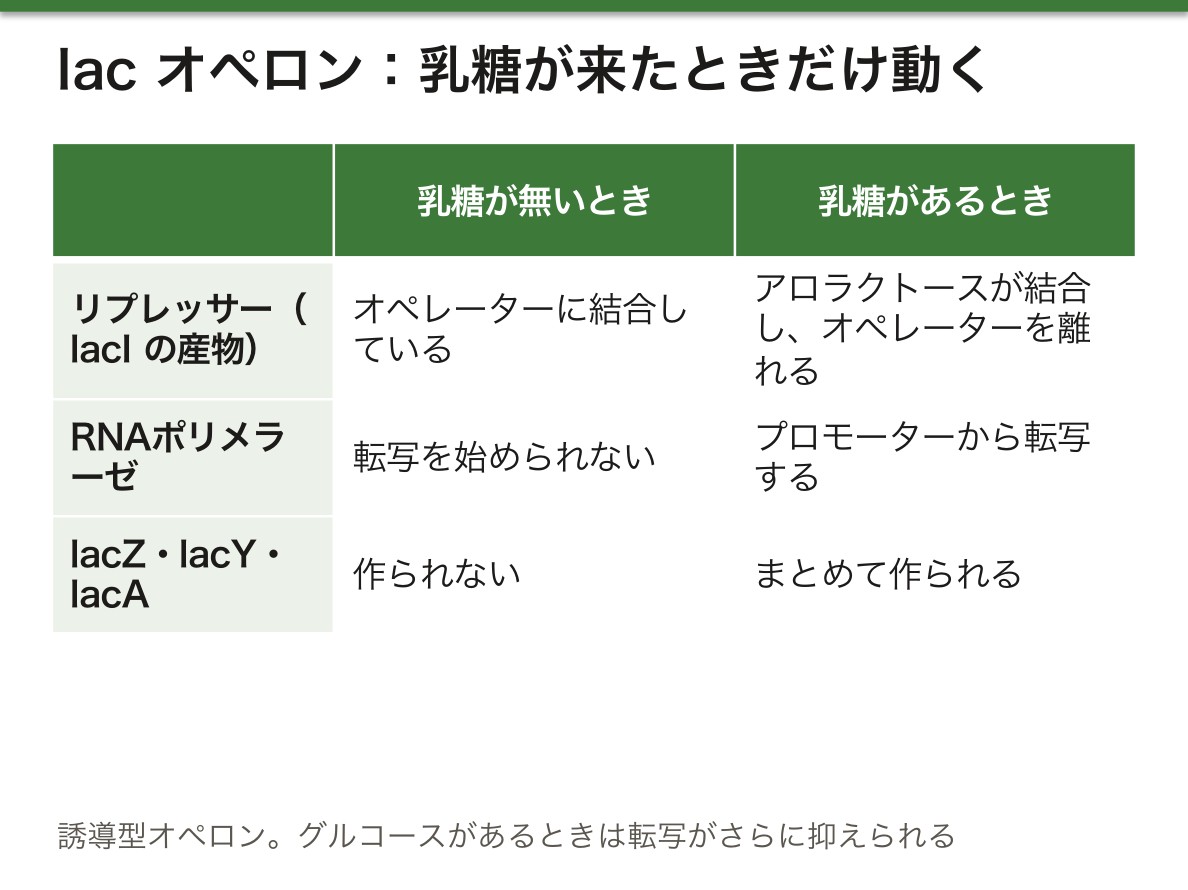
代表例が大腸菌のlacオペロンで、乳糖(ラクトース)を分解する酵素を作る。構成は、リプレッサーを作るlacIと、3つの機能遺伝子lacZ・lacY・lacA、そしてRNAポリメラーゼが結合するプロモーターと、リプレッサーが結合するオペレーターである。リプレッサーは常に作られていて、オペレーターに結合している間はRNAポリメラーゼが転写を始められない。乳糖が入ってくると、その変換産物(アロラクトース)がリプレッサーに結合し、リプレッサーはオペレーターを離れる。こうしてふだんは止まっていて、誘導物質があるときだけ動く(誘導型オペロン)。
なぜこのような仕組みが必要なのか。酵素を作るには大量のエネルギーと材料が要る。乳糖が無いのに分解酵素を作り続けるのは無駄で、増殖の競争で不利になる。「材料が来たときだけ道具を作る」ことで、細菌は限られた資源を増殖に回せる。グルコースがあるときにはさらに転写が抑えられ、より使いやすい糖が優先される。
English version
Core
The human mitochondrial genome is a 16.6 kb circular double-stranded DNA with 37 genes (13 proteins, 22 tRNAs, 2 rRNAs). Its overall GC content is 44%, but the two strands differ greatly: the G-rich heavy (H) strand carries 28 genes and the C-rich light (L) strand carries 9.
Prokaryotic genes are simpler than eukaryotic ones and have no introns. The promoter has two elements: about 10 bases upstream (TATAAT, the Pribnow box) and about 35 bases upstream (TTGACA). There are no genome-wide simple repeats, and transposons are few, such as insertion sequences (IS). Genes with related jobs sit together and are controlled as one unit, called an operon.
Going further
The classic example is the lac operon of E. coli, which makes enzymes that break down lactose (milk sugar). It has lacI, which makes a repressor; three working genes, lacZ, lacY and lacA; a promoter, where RNA polymerase binds; and an operator, where the repressor binds. The repressor is always made. While it sits on the operator, RNA polymerase cannot start transcription. When lactose enters, a product made from it (allolactose) binds the repressor, and the repressor leaves the operator. So the operon is normally off and works only when an inducer is present (an inducible operon).
Why is this needed? Making enzymes costs a lot of energy and material. Making lactose-digesting enzymes when there is no lactose is a waste and a disadvantage in the race to grow. By making tools only when the material arrives, bacteria can spend limited resources on growth. When glucose is present, transcription is reduced further, so the easier sugar is used first.
まとめ
| 遺伝暗号 — 4文字を3つずつ読み、64通りで20種を指す | 遺伝暗号は、DNAやRNAの塩基配列からタンパク質のアミノ酸配列を決める読み方の規則である。 |
|---|---|
| 遺伝子の構造 — プロモーターからポリA付加シグナルまで | 分子のことばでいえば、遺伝子とは働くタンパク質またはRNAを1つ作るのに必要な染色体上のDNA配列である。 |
| ORFと読み枠 — 6通りの読み方から、本物を1つ選ぶ | 二本鎖DNAのどの区間にも、読み枠は6通りある。 |
| エンハンサー・サイレンサー・LCR — 遠くから発現を上げ下げする配列 | 真核細胞の遺伝子がどれだけ読まれるかは、ふつう転写を促す因子(アクチベーター)と抑える因子(リプレッサー)のつり合いで決まる。 |
| 遺伝子の種類 — 1つだけの遺伝子、家族、偽物、ずらりと並ぶ遺伝子 | タンパク質をコードする遺伝子は、ゲノムの中のあり方でいくつかに分かれる。 |
| ヒト核ゲノムの構成 — 遺伝子は2%未満、残りは何か | ゲノムとは、ある生物がもつ遺伝情報の全体である。 |
| トランスポゾン — ゲノムの中を動く配列 | トランスポゾン(転移因子)は、ゲノムの別の場所へ移動できるDNA配列である。 |
| ミトコンドリアと原核のゲノム — 小さくまとまったゲノムと、lacオペロン | ヒトのミトコンドリアゲノムは16.6 kbの環状の二本鎖DNAで、37個の遺伝子(タンパク質13・tRNA 22・rRNA 2)をもつ。 |
このノートは医学生が授業の内容を自分の言葉でまとめたもので、診療の判断に使うものではありません。誤りに気づいたらお知らせください。