最初の型は枕元の医学である。古代ギリシャには病院も医学校もなく、医師は患者の家に出向き、その人の暮らしぶりまで含めて全体を見た。解剖はほとんど行われず、頼りになったのは体の表面の観察と、病気の行く末を見通す力(予後)だった。
Bynum の区分ではここがすべての出発点になる。ヒポクラテスの著作群とガレノスの体系は、四体液説・植物由来の薬・病気を自然の原因で説明する態度という3つの遺産を残し、それは18世紀まで西洋医学の土台であり続けた。
今の外来診療、とくにプライマリ・ケアは、この「患者の家で全体を診る」医学の直系の子孫と考えてよい。
- ヒポクラテス — コス島の医師、「医学の父」
- 自然主義 —『神聖病について』と、心の座は脳か心臓か
- 四体液説 — 血液・黄胆汁・黒胆汁・粘液のつり合い
- 自然治癒力 —「助けよ、少なくとも害をなすな」と瀉血
- 『空気・水・場所』と『流行病』— 環境と集団への目
- ガレノス — 1000年以上続いた権威と、動物解剖の限界
- 古代医学の3つの遺産 — 体液・植物の薬・自然の説明
ヒポクラテス — コス島の医師、「医学の父」
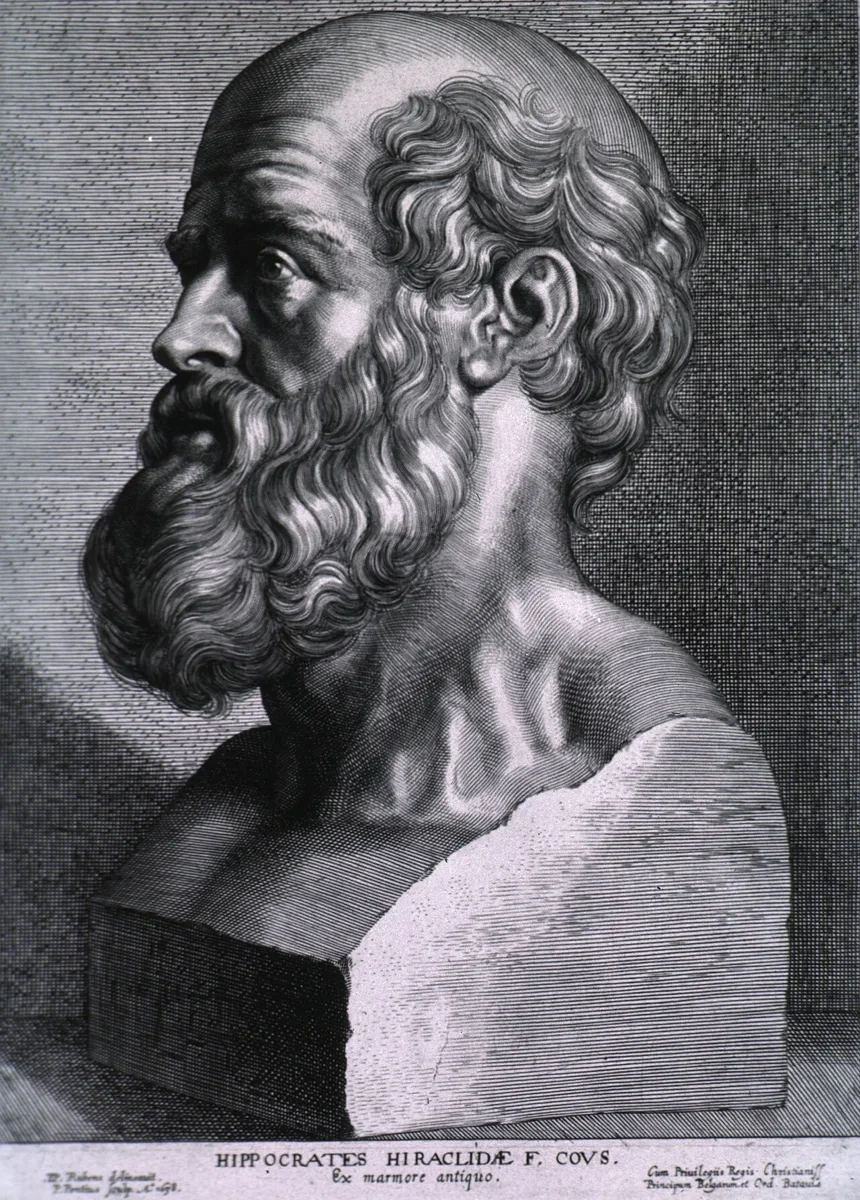
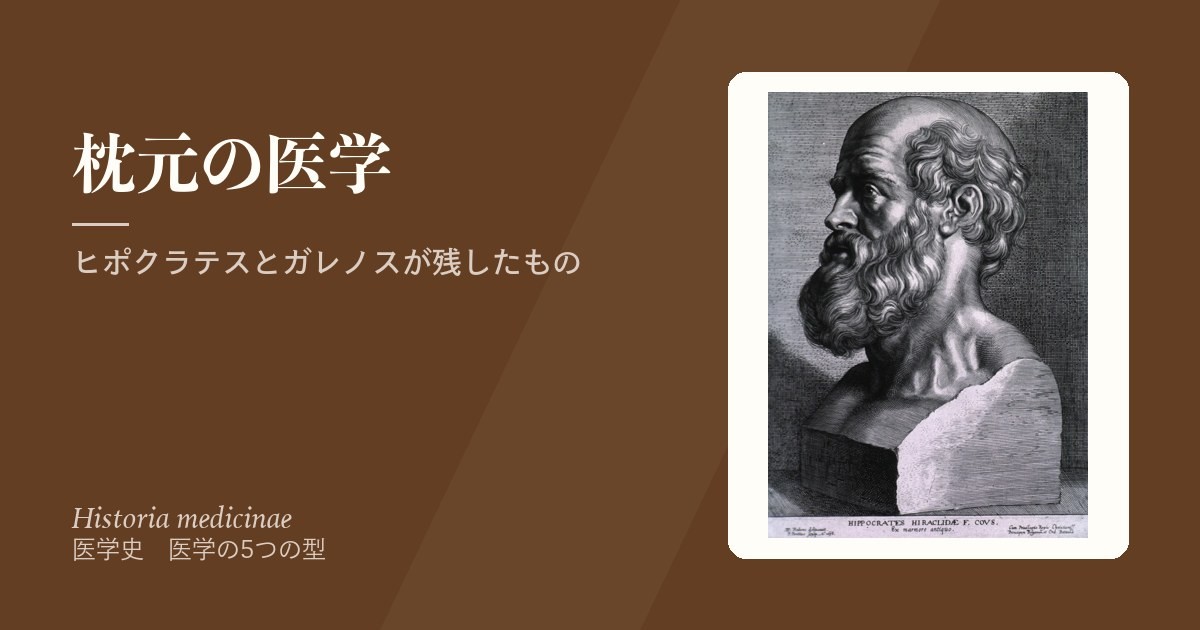
ヒポクラテスは紀元前460年ごろから370年ごろ、エーゲ海のコス島(今のトルコ沿岸の沖)に生きた医師である。弟子を取って教え、名声もあったことはわかっているが、それ以上の伝記はほとんど残っていない。
彼の名で伝わる約60の著作——ヒポクラテス全集(Corpus Hippocraticum)——は、実際には約2世紀にわたり多くの無名の書き手が書いたもので、互いに矛盾も多い。診断・治療・外科・食事と生活の助言・環境と健康まで、範囲は広い。
ではなぜ、ばらばらの著作が一人の「父」にまとめられたのか。実像がぼんやりしているからこそ、後世の人がそれぞれ自分の理想を彼に重ねられたからである。病院の専門医も、ホメオパシーや自然療法の実践者も、みなヒポクラテスを自分たちの祖と呼ぶ。「ヒポクラテス医学」とは、後の時代が全集から主題を選んで組み立てた歴史上の構築物なのだ。
それでも全集に一貫して流れる特徴がある。患者を丸ごと診る全人的(holistic)な態度である。医師は患者の社会的・経済的な状況、家族、ふだんの飲食、旅の有無、自由人か奴隷か、どんな病気にかかりやすいかまで知ろうとした。解剖を嫌う文化のもとでは体の奥は見えないので、外から見えるものを徹底して読むしかなかった。その中心にあったのが、患者が回復するかどうかを見通す予後の技術である。
臨床では:問診で生活歴・職業歴・旅行歴・家族歴を取るのは、まさにこの伝統である。輸入感染症を疑うときの渡航歴、職業性肺疾患を疑うときの職歴など、「その人がどう暮らしているか」が診断の手がかりになるという考え方は2400年前から変わっていない。
English version
Core
Hippocrates lived from about 460 to about 370 BCE on the island of Cos, near the Turkish coast. We know that he took pupils for a fee and was famous, but almost nothing more about his life.
About 60 works carry his name — the Hippocratic Corpus. In fact they were written by many unknown authors over about two centuries, and they often disagree. They cover diagnosis, treatment, surgery, advice on diet and lifestyle, and the effect of the environment on health.
Going further
Why were such mixed writings gathered under one “father”? Because the real man is unclear, later people could project their own ideals onto him. Hospital specialists, homeopaths and naturopaths all call Hippocrates their founder. “Hippocratic medicine” is a historical construction, built later by choosing themes from the Corpus.
Still, one feature runs through the whole Corpus: a holistic approach to the whole patient. The doctor wanted to know the patient’s social and economic situation, family, usual food and drink, travel, whether he was free or a slave, and his tendency to illness. Because Greek culture disliked dissection, the inside of the body could not be seen, so doctors had to read everything visible from outside. At the centre was the skill of prognosis — foreseeing whether the patient would recover.
In the clinic
Taking a social history, occupational history, travel history and family history is exactly this tradition. Travel history when you suspect an imported infection, work history when you suspect an occupational lung disease — the idea that how a person lives is a clue to diagnosis has not changed in 2,400 years.
自然主義 —『神聖病について』と、心の座は脳か心臓か
古代オリエントの医学では、病気は神の怒り・罪・呪術の結果とされ、祭司が医師を兼ねることが多かった。ギリシャにも医神アスクレピオスの神殿があり、患者は神殿で眠って見た夢を祭司に解釈してもらった。
ヒポクラテス全集はこれと違い、病気には自然の原因があることを前提にしている。それをはっきり言葉にしたのが、てんかん(epilepsia)を扱った『神聖病について』である。発作が劇的なので「神聖な病」と呼ばれていたが、著者はほかの病気より神聖なわけではなく、自然の原因から起こると述べ、原因を脳の中で粘液が詰まることに求めた。
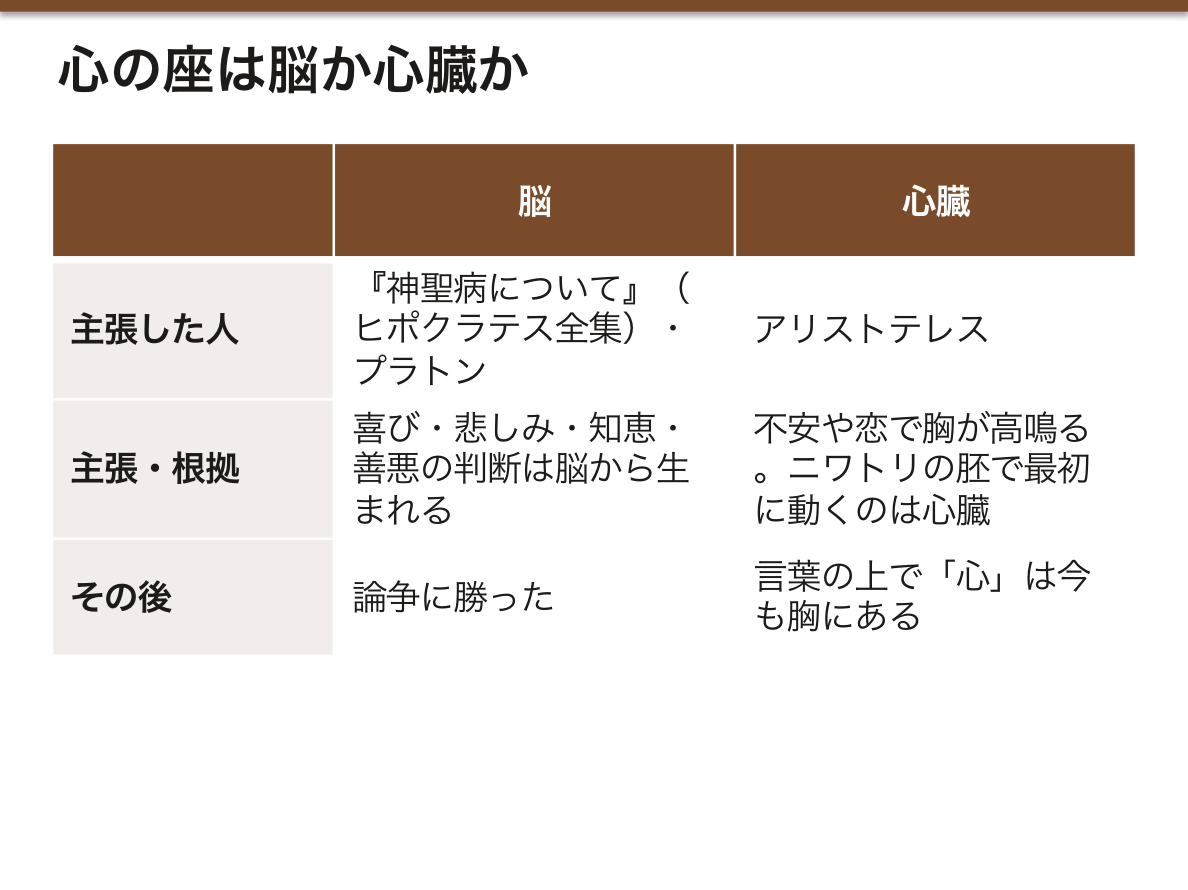
この主張の要点は、宗教を否定したのではなく、「神聖さ」を説明の道具から外したことにある。珍しく不思議な病気だから神のせいにする、という理屈を認めると、理解できない病気はすべて神聖になってしまう。わからないことを「わからない自然現象」として扱う——この態度が科学としての医学の出発点になった。
同じ著作は、喜び・悲しみ・知恵・善悪の判断が脳から生まれるとも書いている。これは当時の常識ではなかった。アリストテレスは心臓こそ感情と精神の座だと考えた。不安や恋で胸が高鳴ること、ニワトリの胚で最初に動くのが心臓であることが根拠だった。言葉の上では今も「心」は胸にあるが、論争に勝ったのはヒポクラテスとプラトンの側である。
臨床では:てんかんは今でも偏見の強い病気で、患者が就労や運転の場面で不利益を受けることがある。「特別な病気ではなく、脳の電気的な異常による一般的な神経疾患である」と説明することは、2400年前の『神聖病について』と同じ仕事を今の医師がしている、ということでもある。
English version
Core
In the ancient Near East, disease was usually seen as the result of divine anger, sin or magic, and priests often worked as doctors. Greece also had temples of Asclepius, the god of healing, where patients slept and priests interpreted their dreams.
The Hippocratic Corpus is different. It assumes that disease has natural causes. This is said most clearly in On the Sacred Disease, about epilepsy (epilepsia). Because the fits were dramatic, people called it “sacred”. The author said that it is no more divine than other diseases and comes from a natural cause, and he blamed a blockage of phlegm in the brain.
Going further
The key point is that he did not deny religion; he removed “sacredness” as a tool of explanation. If you blame the gods for a disease because it is rare and strange, every disease you cannot understand becomes sacred. Treating the unknown as “a natural thing we do not yet understand” — this attitude was the starting point of medicine as a science.
The same text says that joy, sorrow, wisdom and the sense of good and bad come from the brain. This was not common belief. Aristotle thought the heart was the seat of feeling and thought, because the chest beats faster in fear or love, and because the heart is the first thing that moves in a chick embryo. In everyday language the “heart” still holds our feelings, but Hippocrates and Plato won the argument.
In the clinic
Epilepsy still carries strong stigma, and patients can face unfair treatment in work and driving. When a doctor explains that it is not a special disease but a common neurological disorder caused by abnormal electrical activity in the brain, he is doing the same job as the author of On the Sacred Disease.
四体液説 — 血液・黄胆汁・黒胆汁・粘液のつり合いHumores
ヒポクラテス派の生理学と病理学の中心にあったのが四体液説である。体には血液・黄胆汁・黒胆汁・粘液の4つの体液があり、そのつり合いがとれていれば健康、どれかが多すぎる・少なすぎる・質が悪くなると病気になる、と考えた。全集のすべてに書かれているわけではないが、ガレノスがこれを医学理論の中心に据え、18世紀まで支配的な枠組みになった。
| 体液 | 性質 | 元素 | 臓器 | 気質(後世) |
|---|---|---|---|---|
| 血液 | 熱・湿 | 空気 | 心臓 | 多血質(陽気) |
| 黄胆汁 | 熱・乾 | 火 | 肝臓 | 胆汁質(短気) |
| 黒胆汁 | 冷・乾 | 土 | 脾臓 | 憂うつ質 |
| 粘液 | 冷・湿 | 水 | 脳 | 粘液質(鈍重) |
なぜ「液体」が病気の理論の中心になったのか。病人の枕元で目に見える変化の多くが、液体の変化だったからである。熱で顔が赤くなる、痰や血を吐く、涙や鼻水が出る、黄疸や脱水で尿の色が濃くなる、冷や汗、下痢、嘔吐。解剖をしない医学にとって、体の奥の固い臓器より、外に出てくる液体のほうがずっと観察しやすかった。見えるものから理論を作ったという意味で、四体液説はきわめて経験的な理論だった。
この理論は、つり合い(balance)と節度(moderation)という、西洋医学に長く残る2つの考えを生んだ。また、熱・冷・乾・湿の軸で病気や人生の段階まで読めるので、医師にも一般の人にも使いやすい「何でも説明できる」体系になった。説明力が高すぎたことが、逆に1000年以上疑われにくかった理由でもある。
臨床では:英語の sanguine(楽天的)や melancholy(憂うつ, 「黒い胆汁」の意)、choleric(怒りっぽい, ギリシャ語の胆汁 cholē から)など、気質の言葉に名残がある。「体を冷やすと風邪をひく」という民間の感覚も熱・冷の軸の名残で、患者の病気の理解の枠組みが医師の枠組みと違うことを意識すると、説明がすれ違いにくくなる。
English version
Core
At the centre of Hippocratic physiology and pathology was humoral theory. The body has four humours — blood, yellow bile, black bile and phlegm. When they are in balance you are healthy. When one is too much, too little or of bad quality, you are ill. Not every Hippocratic text has this theory, but Galen made it the centre of medical theory, and it ruled until the 18th century.
| Humour | Qualities | Element | Organ | Temperament (later) |
|---|---|---|---|---|
| Blood | Hot, wet | Air | Heart | Sanguine |
| Yellow bile | Hot, dry | Fire | Liver | Choleric |
| Black bile | Cold, dry | Earth | Spleen | Melancholic |
| Phlegm | Cold, wet | Water | Brain | Phlegmatic |
Going further
Why were fluids at the centre of a theory of disease? Because most changes you can see at a sick bed are changes in fluids. Fever reddens the face; the sick bring up sputum or blood; tears and nasal discharge flow; urine darkens with jaundice or dehydration; there is cold sweat, diarrhoea and vomiting. Without dissection, fluids that come out of the body were much easier to observe than solid organs deep inside. In that sense, humoral theory was built from what could be seen — it was a very empirical theory.
It gave Western medicine two lasting ideas: balance and moderation. And because the axes of hot–cold and wet–dry could explain diseases and even the stages of life, it became a system that could explain everything, easy for doctors and lay people to use. Its power to explain everything was also why nobody seriously doubted it for more than a thousand years.
In the clinic
Traces remain in words for temperament: sanguine (cheerful), melancholy (literally “black bile”), choleric (quick to anger). The folk idea that “getting cold gives you a cold” also comes from the hot–cold axis. Remember that the patient’s way of understanding illness may differ from the doctor’s — it helps explanations not to miss each other.
自然治癒力 —「助けよ、少なくとも害をなすな」と瀉血Vis medicatrix naturae
ヒポクラテス派は、病気のときに出てくる膿・汗・痰・濃い尿・嘔吐物・下痢を、体が悪い体液を「煮詰めて」外へ出そうとする自然の防御と見た。ここから自然治癒力(vis medicatrix naturae)という考えが生まれた。治療の役目は、体が自分で治ろうとする働きを手伝うことである。
この立場から生まれたのが、全集『流行病』にある「病気については2つのことを習慣にせよ。助けること、少なくとも害をなさないこと」という格言である。
自然治癒力の考えは、今の医学ともよく合う。多くの病気は治療してもしなくても自然に治る(19世紀に「自己限定性疾患」と呼ばれるようになった)。風邪薬は楽にしてくれるが、原因のウイルスを片づけるのは体自身である。ところが患者は、薬を飲んだあとに治ると「薬が効いた」と思う。「後に起きたから、そのせいで起きた」(post hoc ergo propter hoc)という推論の誤りで、臨床医学は昔からこれに頼ってきた面がある。
一方で、体液を外へ出すことを手伝うという同じ理屈から、瀉血・吐剤・下剤が長く主力の治療になった。炎症で赤く腫れた部分や熱っぽい顔は「血が多すぎる」しるしだったからである。瀉血は19世紀半ばまで主要な治療であり続け、患者が失神しかけるまで血を抜くことさえあった。自然を助けるという控えめな原理が、場合によっては強い介入を正当化した。
臨床では:薬の効果を確かめるのに対照群を置いたランダム化比較試験が必要なのは、自然に治る分と「後だからそのせい」の錯覚を取り除くためである。かぜに抗菌薬を出さない、という今の方針も「自然に治る病気に、害になりうる治療を足さない」という同じ格言の現代版と読める。
English version
Core
The Hippocratics saw pus, sweat, phlegm, dark urine, vomit and diarrhoea in illness as the body’s natural defence — “cooking” the bad humours and pushing them out. From this came the idea of the healing power of nature (vis medicatrix naturae). The job of treatment was to help the body heal itself.
From the same view came the saying in the Hippocratic Epidemics: “As to diseases, make a habit of two things — to help, or at least to do no harm.”
Going further
The idea fits modern medicine well. Most illnesses get better with or without treatment (in the 19th century these were called “self-limited diseases”). Cold medicine makes you feel better, but the body itself clears the virus. Yet when a patient gets better after taking a medicine, he thinks the medicine worked. This is the logical error “after this, therefore because of this” (post hoc ergo propter hoc), and clinical medicine has long depended on it.
On the other hand, the same logic of “helping the body push humours out” made bloodletting, emetics and purgatives the main treatments for centuries. A red, swollen, inflamed area or a feverish face was a sign of “too much blood”. Bloodletting stayed a major treatment until the middle of the 19th century, and sometimes blood was taken until the patient nearly fainted. A modest principle — help nature — could also justify strong interventions.
In the clinic
We need randomised controlled trials with a control group to test a drug precisely because we must remove natural recovery and the post hoc illusion. Today’s rule of not giving antibiotics for a common cold can be read as a modern version of the same saying: do not add a possibly harmful treatment to an illness that heals by itself.
『空気・水・場所』と『流行病』— 環境と集団への目
ヒポクラテス派は枕元で個人を診るだけでなく、病気が地域全体を襲うことにもよく気づいていた。老若男女、貧富、痩せた人も太った人も同時に倒れる。この経験をまとめたのが『流行病』の数巻と『空気・水・場所』である。
『空気・水・場所』は、町の向き・風・水の質・季節が住民の健康にどう影響するかを論じ、家は水はけのよい土地に、冷たい風を避けて建てよ、と助言した。健康を環境から説明する西洋の考え方の出発点とされる著作である。
この著作はまた、環境が人の体つきや肌の色まで変え、その変化が子に伝わると考えていた(後世の言葉でいう「ラマルク的」な考え)。人は環境次第で変わりうるという楽観は、生活を整えれば病気は防げるという治療への自信とつながっていた。一方で『流行病』の症例記録には、手の施しようのない重症例も率直に書かれている。
なぜこの著作が重要か。「悪い空気・悪い土地が病気を生む」という発想は、2000年以上あとの19世紀の瘴気説(ミアズマ説)の土台になったからである。瘴気説は病原体という点では誤りだったが、下水と上水を整え町をきれいにする改革を動かし、結果として多くの命を救った。理論が間違っていても対策が当たることがある、という医学史の典型例である。
臨床では:今の疫学の「人・場所・時間」で流行を記述する方法や、住環境・大気汚染・水質といった環境保健の発想はこの系譜にある。マラリア(malaria=「悪い空気」というイタリア語が語源)という病名そのものが、空気を原因と考えた時代の名残である。
English version
Core
The Hippocratics did not only treat individuals at the bedside. They knew well that disease can sweep through a whole community, striking people of every age, income and build at the same time. They wrote about this in the books of Epidemics and in Airs, Waters, Places.
Airs, Waters, Places discusses how the direction a town faces, its winds, the quality of its water and the seasons affect the health of its people. It advises building houses on well-drained ground, away from cold winds. It is seen as the starting point of the Western idea of explaining health by the environment.
Going further
The text also believed that the environment could change body shape and skin colour, and that such changes passed to children (what we would later call a “Lamarckian” idea). This optimism — that people can change with their surroundings — went with confidence that a good way of life could prevent disease. At the same time, the case notes in Epidemics honestly record severe cases where nothing could be done.
Why does this matter? The idea that bad air and bad places cause disease became the base of the miasma theory of the 19th century, more than 2,000 years later. Miasma theory was wrong about the cause, but it drove reforms of sewers, water supply and clean streets, and saved many lives. A wrong theory can still lead to the right action — a classic lesson of medical history.
In the clinic
Describing an outbreak by “person, place and time” in modern epidemiology, and the field of environmental health (housing, air pollution, water quality), belong to this line. Even the name malaria — Italian for “bad air” — is a trace of the age that blamed the air.
ガレノス — 1000年以上続いた権威と、動物解剖の限界
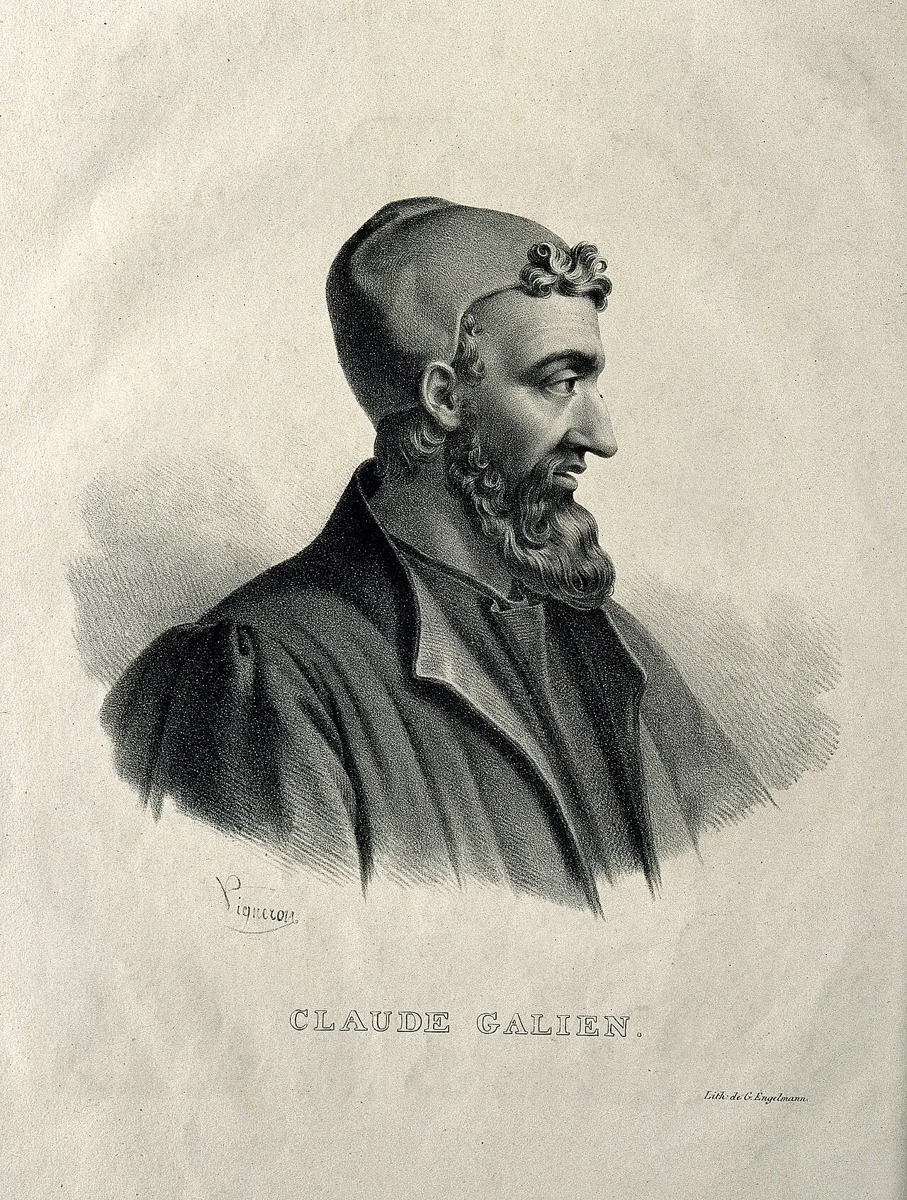
ガレノスはペルガモン(今のトルコ)出身で、ローマで活躍した医師である(129年–210年ごろ)。ヒポクラテスから500年以上あとの人だが、ヒポクラテスの医学はその多くがガレノスを通じて後世に伝わった。古代の書き手の中で最も多くの文章が残っており、診断・治療・養生・医学哲学まであらゆる分野を書いた。
ガレノスは四体液説を体系化しただけでなく、動物を使った解剖と実験を医学に持ち込み、正常な体の働きを説明する生理学を組み立てた。その体系は17世紀ごろまで1000年以上、疑われることの少ない権威だった。
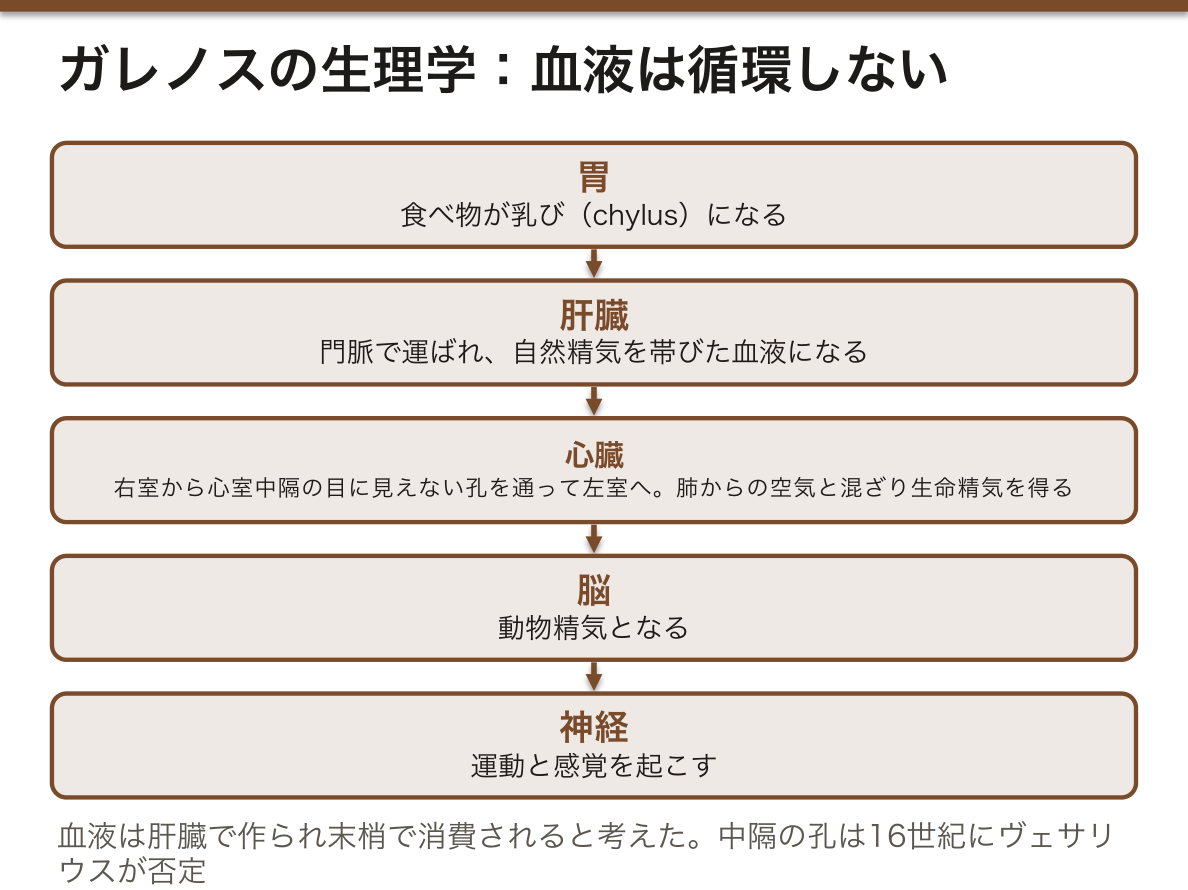
彼の生理学は3種類の「精気」(プネウマ)で体を説明した。食べ物は胃で乳び(chylus)になり、門脈で肝臓へ運ばれて自然精気を帯びた血液になる。血液の一部は心臓へ行き、右室から左室へ心室中隔の目に見えない孔を通ってしみ出し、肺から来た空気と混ざって生命精気を得る。それが脳へ行って動物精気となり、神経を通って運動と感覚を起こす。血液は循環せず、肝臓で作られて末梢で消費されるという考えである。
弱点は解剖の材料にあった。当時は人体解剖が禁じられていたため、彼はブタやサルなどの動物を解剖し、それを人体の記述として書いた。しかも出典を明記しなかった。その結果、後世の信奉者は「ガレノスが解剖してから人体が変わったのだ」とまで言い、最後には自分の目を信じる解剖学者たちの格好の標的になった。心室中隔の孔がないこと、肝臓が何葉にも分かれていないことは、16世紀にヴェサリウスが人体で示すことになる。
臨床では:動物実験の結果をそのまま人に当てはめられないという問題は、今も新薬開発の大きな壁である。動物で効いた候補薬の多くが臨床試験で失敗する。「何で調べた知識なのか」を明示し、確かめ直すことの大切さを、ガレノスの例はよく示している。
English version
Core
Galen came from Pergamon (in present-day Turkey) and worked in Rome (129–c. 210). He lived more than 500 years after Hippocrates, but much of Hippocratic medicine reached later ages through Galen. More of his writing survives than that of any other ancient author, and his writing covers every corner of the field, from finding out what is wrong to treating it, from healthy living to theory.
He did not only organise humoral theory. He brought dissection and experiments on animals into medicine and built a physiology to explain how the normal body works. His system was an authority that few questioned for more than a thousand years, until about the 17th century.
Going further
His physiology explained the body with three kinds of “spirit” (pneuma). Food becomes chyle in the stomach and goes through the portal vein to the liver, where it becomes blood with natural spirit. Some blood goes to the heart; it seeps from the right ventricle to the left through invisible pores in the septum, mixes with air from the lungs and gains vital spirit. In the brain it becomes animal spirit, which travels along nerves to cause movement and sensation. In this model blood does not circulate; it is made in the liver and used up in the tissues.
The weak point was his material. Human dissection was forbidden, so he dissected pigs, apes and other animals and wrote the results as if they described humans — without saying where they came from. Some later admirers even said that people’s bodies had altered since his day. In the end he became an easy target for anatomists who trusted their own eyes. In the 16th century, Vesalius would show in humans that the septum has no pores and that the liver is not divided into many lobes.
In the clinic
The problem that animal results cannot simply be applied to humans is still a big barrier in drug development; many candidate drugs that work in animals fail in clinical trials. Galen’s case shows why we must state what the knowledge was based on, and check it again.
古代医学の3つの遺産 — 体液・植物の薬・自然の説明
ヒポクラテスとガレノスの間にもさまざまな学派があったが、ギリシャ医学全体が近代まで残した原則は3つにまとめられる。
①四体液説——健康と病気を体液のつり合いで説明する枠組み。②植物を基本とする薬——1世紀のディオスコリデスは『薬物誌』(De materia medica)で古代の薬草知識を整理し、この本はルネサンス期まで重んじられた。③病気を世俗的・自然的に理解する態度——医師が信心深くても、病人を前にしたら自分の知識と技術で治そうとした。
②について、植物の薬には理論と違う特徴があった。植物は生える場所が決まっているので、後世の医師は古典を読むだけでは済まず、自分の土地の野山で薬草を探す必要があった。ある土地にしかない薬草は他の土地へ売れるので、薬の輸出入が商売になった。発汗・嘔吐・下剤・睡眠・鎮痛を起こす植物の中には、アヘン(opium)のように長く使われ続けたものもある。
③は目立たないが重要である。宗教や呪術は病気の理解に影響し続けたし、今でも病気は「なぜ自分が」という道徳的・宗教的な問いとして経験される。それでも医学の枠組みそのものは自然主義だった。英語の physician(医師)と physics(物理学)が同じギリシャ語の「自然」(physis)から来ているのは、その名残である。
臨床では:今も多くの薬が植物由来か、植物の成分をもとに作られている。アヘンのモルヒネ、ヤナギの樹皮のサリチル酸(アスピリンの元)、ジギタリス、キナの樹皮のキニーネなどである。生薬学・薬理学で「天然物由来」の薬を学ぶとき、ディオスコリデス以来の2000年の流れの上にいると思うと覚えやすい。
English version
Core
There were many schools between Hippocrates and Galen, but taken together, the Greeks handed on three principles that lasted until modern times.
(1) Humoral theory — explaining health and disease by the balance of fluids. (2) Drugs based on plants — in the 1st century, Dioscorides organised ancient knowledge of medicinal plants in De materia medica, a book still valued in the Renaissance. (3) A secular, natural understanding of disease — even religious doctors used their own knowledge and skill when facing a sick person.
Going further
Plant drugs were different from theory in one way: a plant grows only in certain places. Later doctors could not just read the classics; they had to search for herbs in their own fields and forests. A herb found only in one region could be sold to others, so the import and export of drugs became a business. Among plants that caused sweating, vomiting, purging, sleep or pain relief, some, like opium, stayed in use for a very long time.
Number (3) is less visible but important. Religion and magic kept influencing ideas about illness, and even today illness is often felt as a moral or religious question: “Why me?” Still, the framework of medicine itself was naturalistic. The English words physician and physics both come from the Greek word for nature (physis).
In the clinic
Many drugs today still come from plants or were developed from plant substances: morphine from opium, salicylic acid (the origin of aspirin) from willow bark, digitalis, quinine from cinchona bark. When you study drugs of natural origin in pharmacognosy and pharmacology, remember that you stand on a 2,000-year line that goes back to Dioscorides.
まとめ
| ヒポクラテス — コス島の医師、「医学の父」 | ヒポクラテスは紀元前460年ごろから370年ごろ、エーゲ海のコス島(今のトルコ沿岸の沖)に生きた医師である。 |
|---|---|
| 自然主義 —『神聖病について』と、心の座は脳か心臓か | 古代オリエントの医学では、病気は神の怒り・罪・呪術の結果とされ、祭司が医師を兼ねることが多かった。 |
| 四体液説 — 血液・黄胆汁・黒胆汁・粘液のつり合い | ヒポクラテス派の生理学と病理学の中心にあったのが四体液説である。 |
| 自然治癒力 —「助けよ、少なくとも害をなすな」と瀉血 | ヒポクラテス派は、病気のときに出てくる膿・汗・痰・濃い尿・嘔吐物・下痢を、体が悪い体液を「煮詰めて」外へ出そうとする自然の防御と見た。 |
| 『空気・水・場所』と『流行病』— 環境と集団への目 | ヒポクラテス派は枕元で個人を診るだけでなく、病気が地域全体を襲うことにもよく気づいていた。 |
| ガレノス — 1000年以上続いた権威と、動物解剖の限界 | ガレノスはペルガモン(今のトルコ)出身で、ローマで活躍した医師である(129年–210年ごろ)。 |
| 古代医学の3つの遺産 — 体液・植物の薬・自然の説明 | ヒポクラテスとガレノスの間にもさまざまな学派があったが、ギリシャ医学全体が近代まで残した原則は3つにまとめられる。 |
このノートは医学生が授業の内容を自分の言葉でまとめたもので、診療の判断に使うものではありません。誤りに気づいたらお知らせください。