ローマ帝国が衰えてからルネサンスまでのおよそ1000年は、古典を守り、訳し、注釈する時代だった。医師の仕事の中心は、ヒポクラテスやガレノスの本文を正しく読むことにあった。これが書庫の医学である。
停滞の時代と思われがちだが、Bynum が強調するように、この時代は今の医療の骨組みを3つ残した。病院、医師の職業的な階層、そして医師を養成する大学である。さらにその終わりには、古典を疑い自分の目で確かめる動き——人体解剖・血液循環・病気の分類——が始まる。
この章の後半(解剖学・ハーヴィー・シデナム)は、「本を読む医学」から「見て数える医学」への橋渡しとして読むとよい。
- 写本と翻訳の千年 — ギリシャ語からアラビア語、そしてラテン語へ
- イスラーム医学 — ラーズィー・イブン・スィーナー・イブン・ルシュド
- 病院の起源 — 「もてなし」の場所から、治療の場所へ
- 大学と医師の階層 — 内科医・外科医・薬剤師
- 解剖学の発見 — モンディーノからヴェサリウスへ
- ハーヴィー — 血液循環の発見(1628年)
- パラケルススと、化学・物理で体を見る人たち
- シデナムと病気の分類 — 患者から「病気」を切り離す
写本と翻訳の千年 — ギリシャ語からアラビア語、そしてラテン語へ
古代の文章が今に残っていること自体が奇跡に近い。写本は手で書き写すしかなく、高価で数が少なく、戦争・腐敗・不注意で失われた。古代最大の図書館だったアレクサンドリアも、2世紀から少しずつ壊れ、7世紀には廃墟になっていた。大切にされた本ほど何度も写され、そのぶん生き残った。
ローマ以後、西ヨーロッパに残った医学書はわずかで、学問の重心は東のビザンツ帝国(首都コンスタンティノープル)へ移った。その地域がイスラーム世界に入ると、8世紀後半から約3世紀にわたる大翻訳運動でギリシャ語の医学書がアラビア語・シリア語・ペルシャ語に訳された。11世紀にはアフリカのコンスタンティヌス(1098年以前に没)らがそれをラテン語に訳し戻し、南イタリアのサレルノ医学校(11世紀)やのちの大学の教科書になった。
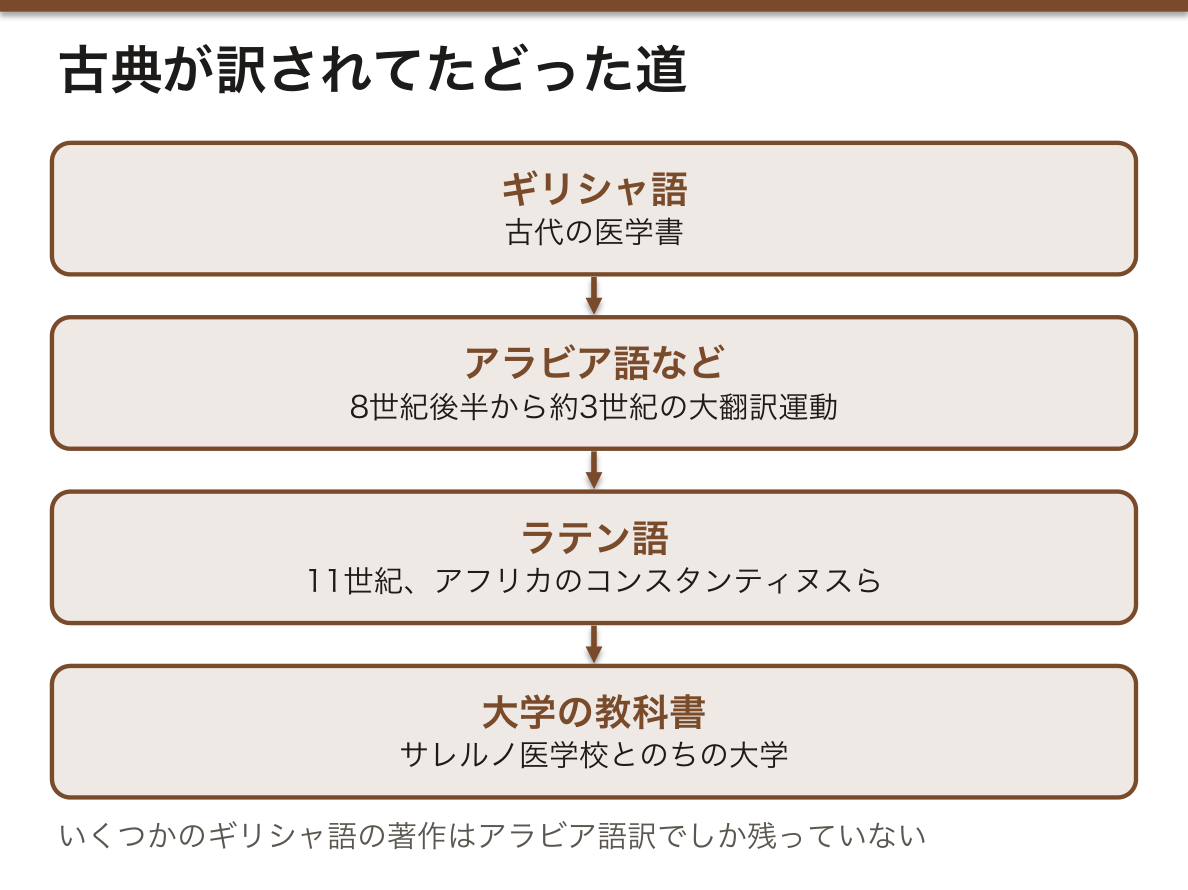
この流れから大事な教訓が2つ読み取れる。一つは、いくつかのギリシャ語の著作はアラビア語訳でしか残っていないことである。イスラーム世界がなければ、ヨーロッパはガレノスの多くを失っていた。もう一つは、知識は訳されるたびに少しずつ形を変えたことである。訳者は意味のわからない箇所を補い、自分たちの経験を書き足した。「保存」は単なるコピーではなく、そのつどの読み直しだった。
Bynum が書庫の医学の象徴にアフリカのコンスタンティヌスを挙げるのは、彼が東西の知識をつなぐ結節点にいたからである。医学を一つの文明の財産ではなく、言語をまたいで受け継がれたものとして見る視点がここにある。
臨床では:今の医師が毎日使う医学用語の多くは、ギリシャ語・ラテン語・アラビア語をくぐってきた言葉である。例えば alcohol や elixir はアラビア語経由の語である。また、論文が英語で書かれ各国語に訳されて臨床に届くという今の知識の流れも、言語をまたぐ翻訳の上に立っている。
English version
Core
It is almost a miracle that ancient writings survive at all. Manuscripts had to be copied by hand. They were expensive and few, and were lost through war, decay and carelessness. The greatest library of the ancient world, at Alexandria, was slowly destroyed from the 2nd century and was in ruins by the 7th. The more a book was valued, the more often it was copied, and the more likely it was to survive.
After Rome, few medical books remained in Western Europe, and the centre of learning moved east to the Byzantine Empire, with its capital at Constantinople. When these lands came under Islam, a great translation movement, from the late 8th century for about three centuries, put Greek medical books into Arabic, Syriac and Persian. In the 11th century Constantine the African (died before 1098) and others translated them back into Latin. These became the textbooks of the medical school at Salerno in southern Italy and, later, of the universities.
Going further
Two lessons follow. First, some Greek works survive only in Arabic translation. Without the Islamic world, Europe would have lost much of Galen. Second, knowledge changed shape a little with each translation. Translators filled in passages they did not understand and added their own experience. “Preserving” was not just copying; it was reading again each time.
Bynum uses Constantine the African as the symbol of library medicine because he stood at the meeting point of Eastern and Western knowledge. Here we see medicine not as the property of one civilisation but as something passed on across languages.
In the clinic
Many of the medical terms doctors use every day came through Greek, Latin and Arabic; alcohol and elixir, for example, came through Arabic. Today’s flow of knowledge — papers written in English and translated before they reach the clinic — also rests on translation across languages.
イスラーム医学 — ラーズィー・イブン・スィーナー・イブン・ルシュド
中世イスラーム医学は、ギリシャの本を運んだだけの「通り道」ではない。ギリシャ医学を自分たちの文脈で組み直し、新しい観察・薬・手技を加えた活発な学問だった。代表的な3人を押さえる。
| 人物 | 時代・地域 | 何をした人か |
|---|---|---|
| ラーズィー(英語名 Rhazes) | 865年ごろ–925年ごろ、今のイラン | 臨床の観察眼で知られ、天然痘(variola)と麻疹(morbilli)を初めて区別して記述した |
| イブン・スィーナー(英語名 Avicenna) | 980–1037年 | 『医学典範』(Canon)で理論・治療・衛生・外科・薬をまとめ、ヨーロッパで長く教科書として使われた |
| イブン・ルシュド(英語名 Averroes) | 1126–1198年、イスラーム期のスペイン・モロッコ | アリストテレス哲学に通じ、解剖から治療までを扱う百科的な医学書を書いた |
『医学典範』がなぜこれほど長く使われたのか。中身の新しさ以上に、ギリシャの知恵とイスラームの経験を論理的に並べ直し、一冊で医学全体が学べる形にしたからである。教科書として何より大事なのは「体系」であり、典範はその点で群を抜いていた。ラテン語訳はヨーロッパの大学で数百年読まれ、今もユナニ医学(伝統的イスラーム医学)で学ばれている。
ラーズィーの天然痘と麻疹の区別は、「熱と発疹」というひとまとまりの症状から別々の病気を切り出した点で重要である。病気を見分けることが治療と予後の出発点になる——この発想は、のちのシデナムやパリ学派の仕事へつながっていく。
臨床では:発疹を伴う発熱の鑑別(麻疹・風疹・水痘・突発性発疹など)は、今も小児科と感染症の基本である。麻疹は感染力がきわめて強く、日本では感染症法で全数届出の対象になっている。1000年前に始まった「似た発疹を見分ける」仕事は、今も公衆衛生の現場に直結している。
English version
Core
Medieval Islamic medicine was not just a “passage” that carried Greek books. It was an active field that rebuilt Greek medicine for its own world and added new observations, drugs and procedures. Here are three key figures.
| Person | Time and place | What he did |
|---|---|---|
| Rhazes (al-Razi) | c. 865–c. 925, present-day Iran | Known for clinical observation; first to describe smallpox (variola) and measles (morbilli) as different diseases |
| Avicenna (Ibn Sina) | 980–1037 | The Canon of Medicine covered theory, treatment, hygiene, surgery and drugs; used as a textbook in Europe for centuries |
| Averroes (Ibn Rushd) | 1126–1198, Islamic Spain and Morocco | Expert in Aristotle; wrote an encyclopaedic medical book from anatomy to therapy |
Going further
Why was the Canon used for so long? More than for new content, because it put Greek wisdom and Islamic experience into a logical order, so the whole of medicine could be learned from one book. What matters most in a textbook is the system, and the Canon was outstanding in that. Its Latin translation was read in European universities for hundreds of years, and it is still studied in Unani (traditional Islamic) medicine.
Rhazes’s separation of smallpox and measles matters because he cut separate diseases out of one group of symptoms, “fever and rash”. Telling diseases apart is the start of treatment and prognosis — an idea that leads to Sydenham and the Paris school later.
In the clinic
The differential diagnosis of fever with rash (measles, rubella, chickenpox, roseola and others) is still basic in paediatrics and infectious disease. Measles is extremely contagious, and in Japan every case must be reported under the Infectious Diseases Control Law. The work of telling similar rashes apart, begun a thousand years ago, links directly to public health today.
病院の起源 — 「もてなし」の場所から、治療の場所へValetudinarium
「病院」の起点は、何を病院と呼ぶかで変わる。古代ローマには負傷・病気の兵士を収容するヴァレトゥディナリウム(valetudinarium)があったが、戦役や流行に合わせた一時的な施設だった。
英語の hospital は hospitality(もてなし)・hostel・hotel と同じ語源で、ラテン語の hospes(客・客をもてなす主人)から来る。キリスト教世界の初期の「病院」は修道会が営む宗教施設で、巡礼者や困窮者を泊める場所だった。病人の世話は付属の診療室で行われたにすぎない。パリのオテル・デュー(Hôtel-Dieu, 「神の家」)、ロンドンの聖バーソロミュー病院など、今も続く病院の名前にその出自が残る。イスラーム世界の病院はより医療色が強く、11世紀には眼病や精神病の病棟をもち、医学生も集まった。
もう一つの起源が隔離である。ハンセン病(lepra)の診断は、社会的な追放と「法的な死」を意味し、患者はラザレット(福音書のラザロに由来)に閉じ込められ、外出時は鳴子を鳴らして人に知らせることを強いられた。そのラザレットは、14世紀の黒死病(ペスト, pestis)以後はペストの隔離病院に転用された。ここに「慈愛」と「排除」という病院の二面性がよく表れている。同じ時代に、修道士や修道女が自ら患者の中で暮らし、世話に一生をささげてもいた。
なぜ病院は宗教から生まれたのか。中世の病院は治すための施設ではなく、世話をし、看取り、守るための施設だったからである。治療の場としての病院が成立するのは、19世紀のパリまで待たなければならない。
臨床では:日本のハンセン病政策は、隔離の負の歴史をそのまま映している。らい予防法による強制隔離は1996年の法廃止まで続き、2001年には熊本地裁が国の責任を認めた。ハンセン病は感染力が弱く、治療薬で治る病気である。「隔離」が科学ではなく恐れと偏見で決まった例として、医師が知っておくべき歴史である。
English version
Core
Where the “hospital” began depends on what you call a hospital. Ancient Rome had valetudinaria for wounded and sick soldiers, but they were temporary, built for a campaign or an outbreak.
The English word hospital has the same root as hospitality, hostel and hotel — the Latin hospes, meaning both guest and host. In Christian Europe, early “hospitals” were religious houses run by religious orders, places to stay for pilgrims and the poor. Care of the sick happened only in an attached infirmary. Names such as the Hôtel-Dieu (“house of God”) in Paris and St Bartholomew’s in London still show this origin. Hospitals in the Islamic world were more medical; by the 11th century some had wards for eye disease or mental illness, and medical students came to learn.
Going further
Another origin is isolation. A diagnosis of leprosy (lepra) meant social exile and “legal death”. Patients were shut in a lazaretto (named after Lazarus in the Gospel) and had to sound a rattle to warn people when they went out. After the Black Death (plague, pestis) of the 14th century, lazarettos were turned into plague hospitals. This shows the two faces of the hospital: charity and exclusion. In the same period, monks and nuns chose to live among the patients and gave their lives to caring for them.
Why did hospitals grow out of religion? Because the medieval hospital was not a place for curing but for caring, for accompanying the dying, and for protecting. The hospital as a place of treatment had to wait until 19th-century Paris.
In the clinic
Japan’s leprosy policy reflects the dark side of isolation. Forced isolation under the Leprosy Prevention Law continued until the law was abolished in 1996, and in 2001 the Kumamoto District Court ruled that the state was responsible. Leprosy is weakly infectious and curable with drugs. Doctors should know this history as a case where isolation was decided by fear and prejudice, not by science.
大学と医師の階層 — 内科医・外科医・薬剤師
中世のもう一つの遺産が大学である。11世紀のサレルノはまだ医師養成の「学校」だったが、12〜13世紀にボローニャ・パリ・オックスフォード・サラマンカなどに大学ができ、15世紀末にはヨーロッパに約50を数えた。多くの大学に、教養・神学・法学と並んで医学部が置かれた。
大学の医学教育は、ギリシャ・イスラームの古典の本文を読み、討論することが中心で、実習や実験はほとんどなかった。まさに書庫の医学の典型である。
大学から、ラテン語を読みガレノスとイブン・スィーナーを論じる内科医(physician)が生まれた。長く高価な教育は「紳士」の身分をもたらし、手を使う仕事は品位に欠けるとされた。そこで手術は外科医(surgeon)、薬の調合は薬剤師(apothecary)の仕事となり、どちらも徒弟制で育った。都市の外科医は、肉屋やパン屋と同じような職人のギルドを作った。この内科医>外科医・薬剤師という階層は、19世紀まで続いた。
ただし境界はいつも固かったわけではない。農村では内科医が自分で薬を作り手術もした——つまり今でいう一般医(GP)として働いた。階層を最終的に崩したのは、後で見るフランス革命後のパリで内科と外科が一つの教育に統合されたことと、麻酔と無菌法で外科ができることが急に増えたことである。
臨床では:イギリスでは今も外科の専門医を Dr ではなくMr / Ms と呼ぶ習慣があり、職人ギルドの出自の名残とされる。日本の医師法と薬剤師法が処方(医師)と調剤(薬剤師)を分ける医薬分業も、職能を分けるという点でこの歴史と響き合う。
English version
Core
Another legacy of the Middle Ages is the university. Salerno in the 11th century was still a “school” for training doctors, but in the 12th and 13th centuries universities appeared at Bologna, Paris, Oxford, Salamanca and elsewhere. By the late 15th century Europe had about 50. Many had a faculty of medicine next to arts, theology and law.
University medical teaching was centred on reading and debating classical Greek and Islamic texts, with almost no practical training or experiment — a typical example of library medicine.
Going further
The university produced the physician, who read Latin and debated Galen and Avicenna. A long, expensive education gave him the status of a gentleman, and work with the hands was seen as beneath him. So operations became the work of the surgeon, and making medicines the work of the apothecary. Both learned by apprenticeship. Surgeons in towns formed guilds, like butchers or bakers. This ranking — physician above surgeon and apothecary — lasted until the 19th century.
The borders were not always fixed. In the countryside, physicians made their own drugs and operated — they worked as what we now call general practitioners. What finally broke the ranking was the joining of medicine and surgery in one education in Paris after the French Revolution, and the sudden growth of what surgeons could do after anaesthesia and asepsis.
In the clinic
In Britain, surgeons are still called Mr or Ms, not Dr — said to be a trace of their guild origins. In Japan, the law separates prescribing (doctors) from dispensing (pharmacists). This division of roles echoes the same history.
解剖学の発見 — モンディーノからヴェサリウスへDe humani corporis fabrica
14世紀、大学の医学部は公開解剖を始めた。最初の記録は1315年ごろボローニャのモンディーノ・デ・ルッツィで、翌年には解剖学の本も書いた。当時の公開解剖は、身分の低い執刀者が(多くは処刑された罪人の)遺体を開き、教授が高い席からガレノスの本文を読み上げる形式だった。腐敗を遅らせるため冬に行い、腐りやすい腹部から胸部・脳・四肢の順に進めた。
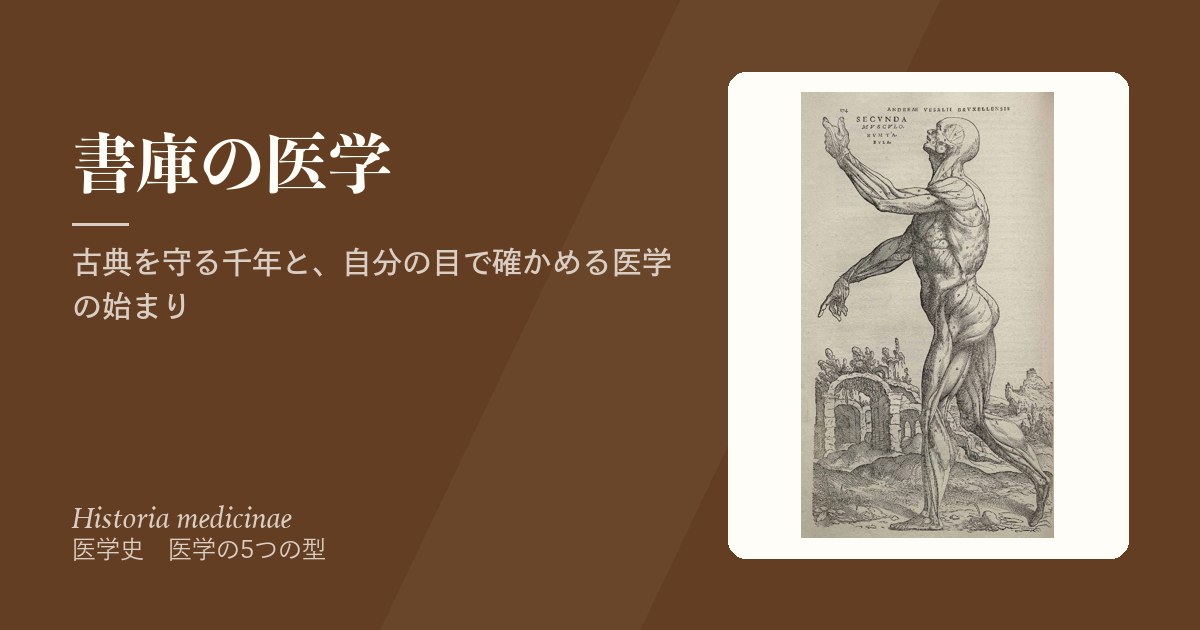
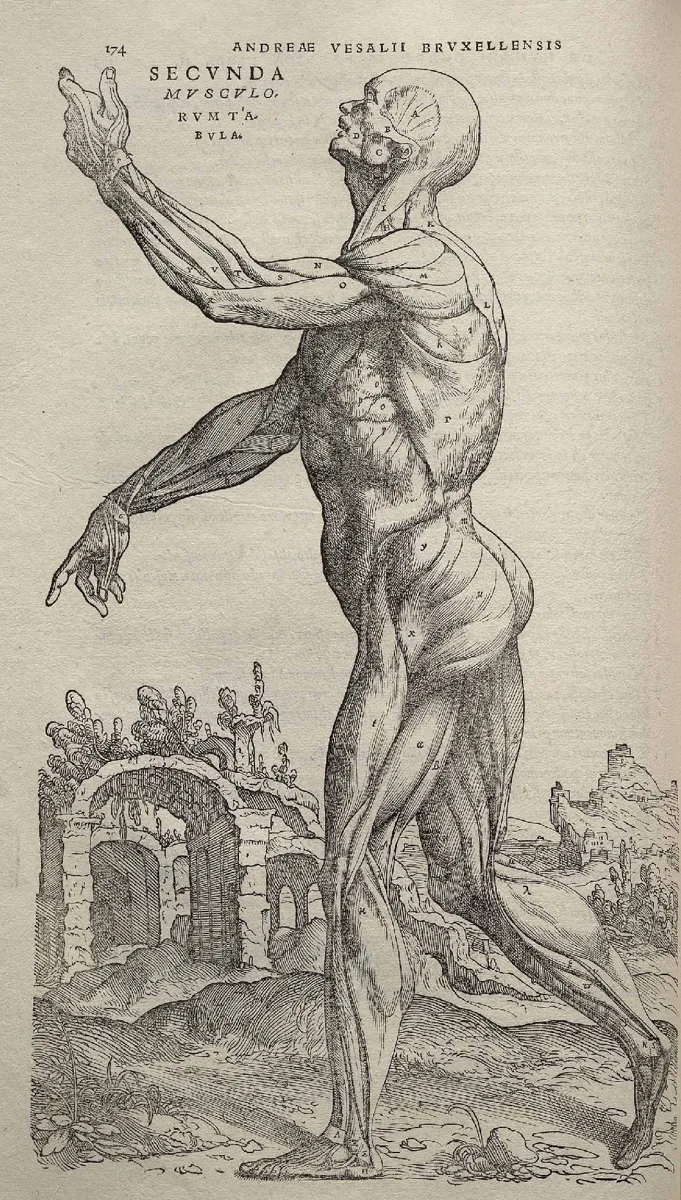
転機はアンドレアス・ヴェサリウス(1514–1564)である。パドヴァ大学の解剖学・外科学の教授だった彼は、自分の手で解剖し、1543年に『人体の構造について』(De humani corporis fabrica)を出した。図が本文より重要な最初の医学書と言われる。
ヴェサリウスの新しさは、人体はいつもガレノスの書いたとおりではないと言い、それを図で示したことにある。心室中隔は厚く、血液が通る孔はない。肝臓はガレノスが(ブタなどから)書いたように何葉にも分かれていない。胸骨・子宮などもヴェサリウスが初めて正確に記述した。教授が本を読み、執刀者が切る、という「本が先、体が後」の順番を逆転させたのである。解剖学史はヴェサリウスを境に前後に分けられる。
これを支えたのが印刷術である。15世紀半ば、グーテンベルクが活版印刷をヨーロッパに広めると、本は大量に作れるようになり、ふつうの医師も何冊か持てるようになった。木版や銅版の図を刷り込めるので、体の部分を読むだけでなく「見る」ことができた。図版は同じものが何百部も配られるので、誰でも同じ図で検証できる——知識の検証可能性を高めたのである。解剖学は以後約3世紀、「医学の女王」と呼ばれ、ファロピオ・ファブリキウスなど新しい構造に名を残す解剖学者が続いた。
臨床では:解剖学の進歩は遺体の入手と切り離せず、イギリスでは墓あばきや殺人まで起きたため、1832年に解剖法が作られた。日本の解剖実習は献体(本人の生前の意思による遺体の提供)に支えられ、1983年の献体法がその仕組みを定めている。ご遺体への敬意は、この歴史を知るとより重みをもつ。
English version
Core
In the 14th century, university medical faculties began public dissections. The first record is around 1315 in Bologna, by Mondino de’ Liuzzi, who also wrote a dissection manual the next year. A low-ranking assistant did the cutting, usually on the body of someone who had been hanged, and the professor sat above and read out Galen. Dissections were held in winter to slow decay, starting with the abdomen, which rots first, then the chest, brain and limbs.
The turning point was Andreas Vesalius (1514–1564). As professor of anatomy and surgery at Padua, he dissected with his own hands, and in 1543 published De humani corporis fabrica (“On the fabric of the human body”). It is said to be the first medical book in which the pictures matter more than the text.
Going further
What was new was that Vesalius said the human body is not always as Galen described it — and showed it in pictures. The ventricular septum is thick and has no pores for blood. The liver is not divided into many lobes, as Galen wrote from pigs and other animals. He also described the sternum, the uterus and other structures accurately for the first time. He reversed the order “book first, body second”, in which a professor read and a prosector cut. The history of anatomy is divided into before and after Vesalius.
Behind this was printing. In the mid-15th century Gutenberg spread movable-type printing in Europe. Books could be made in large numbers, and ordinary doctors could own a few. Woodcuts and engravings could be printed in them, so readers could not only read about the parts of the body but see them. Because hundreds of identical copies were sent out, anyone could check the same picture — printing made knowledge testable. For about three centuries anatomy was called “the queen of medical sciences”, and anatomists such as Fallopio and Fabricius gave their names to new structures.
In the clinic
Progress in anatomy depended on getting bodies. In Britain this led to grave-robbing and even murder, and an Anatomy Act was passed in 1832. Dissection classes in Japan depend on body donation (kentai) — a body given by the person’s own wish before death — set out in the 1983 Body Donation Act. Knowing this history gives more weight to respect for the donors.
ハーヴィー — 血液循環の発見(1628年)De motu cordis
ウィリアム・ハーヴィー(1578–1657)はイギリスの内科医で、パドヴァでファブリキウスに学んだ。1628年の『心臓の運動について』(De motu cordis)で、血液は心臓から動脈を通って全身へ出て、静脈を通って心臓へ戻る——循環することを示した。ガレノスの「血液は肝臓で作られ末梢で消費される」という考えを覆したのである。
内科医でありながら自分の手で解剖・観察したことにも意味がある。彼はヘビやカエルなど変温動物の心拍がゆっくりであることを利用して、心臓の動きを細かく観察した。
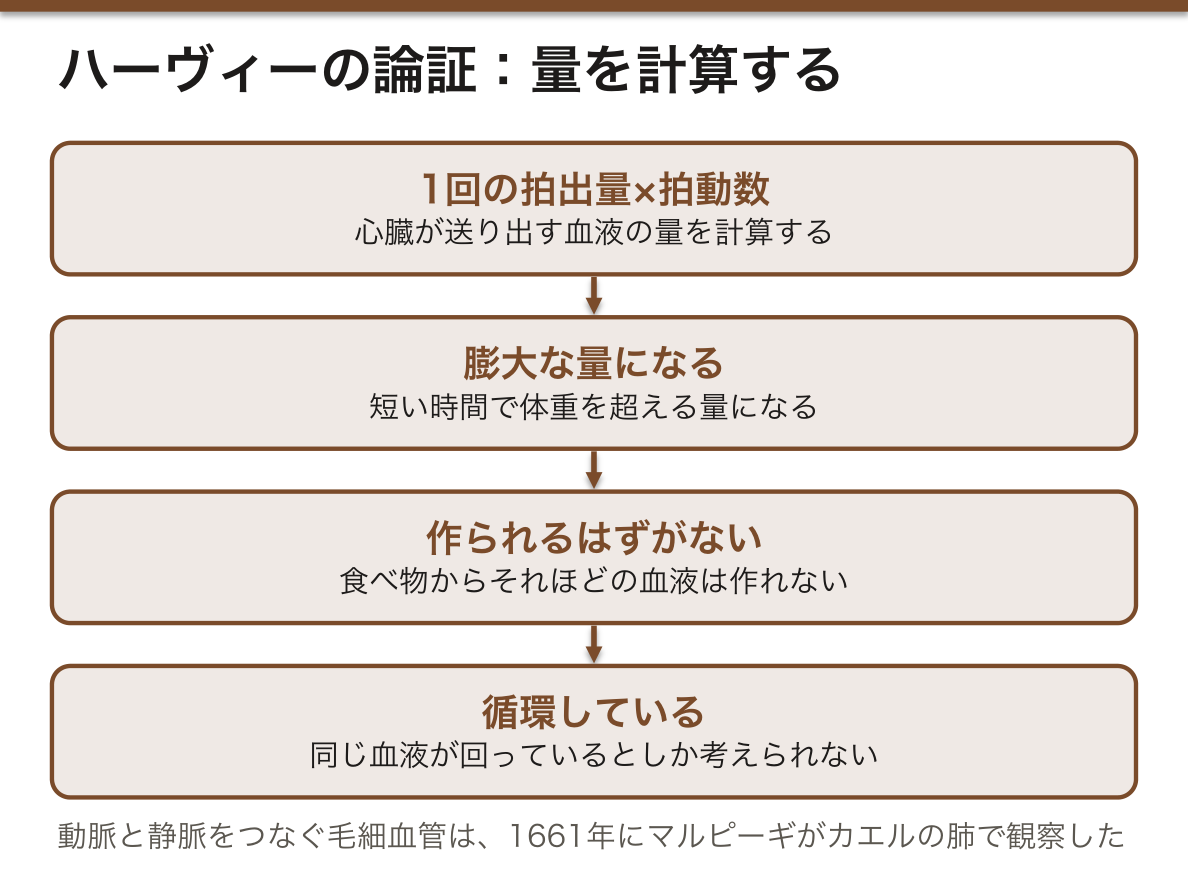
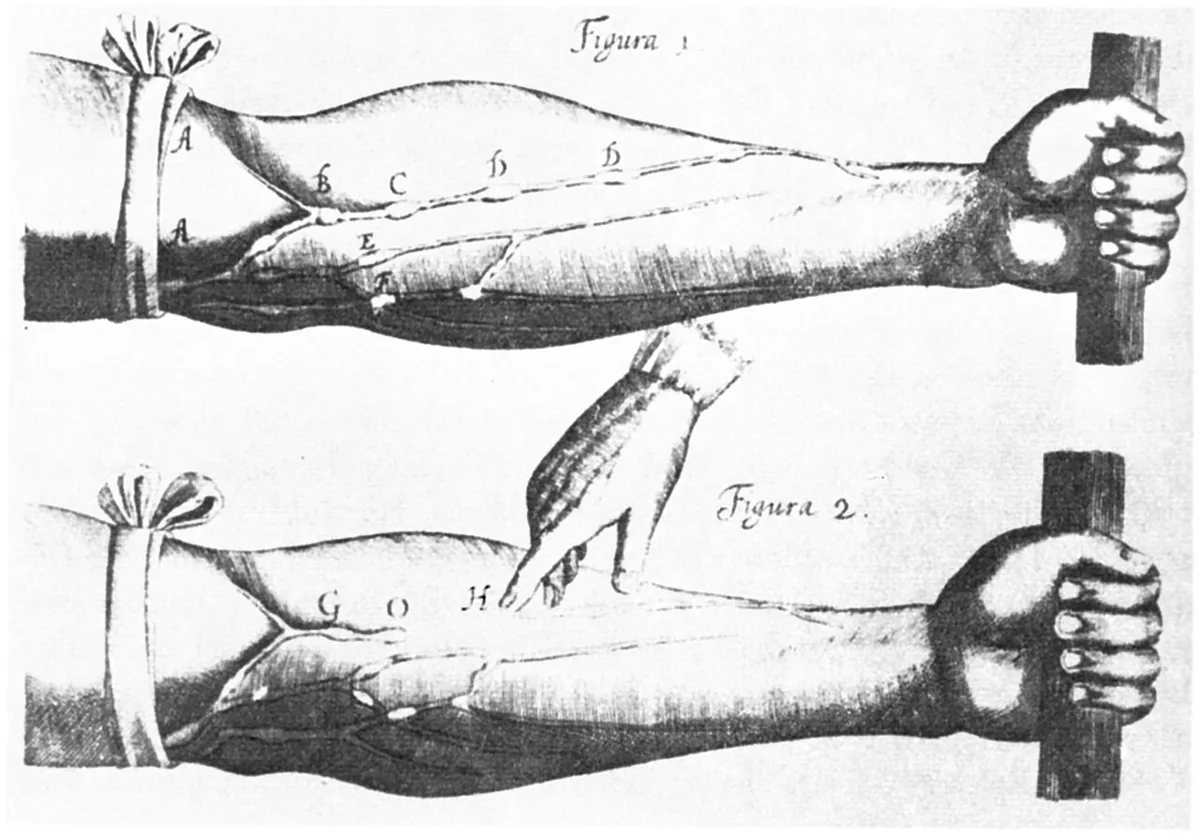
ハーヴィーの論証で最も重要なのは、量を計算したことである。1回の拍動で心臓が送り出す血液の量に拍動数を掛けると、短い時間で体の全血液量どころか体重を超える量になる。食べ物からそれほどの血液が毎時作られるはずがない。だから同じ血液が回っているとしか考えられない。さらに、静脈の弁が血液を心臓の方向にしか流さないこと、腕を縛ると静脈が弁の位置でふくらむことを示した。観察だけでなく数による推論で古い理論を崩した点で、ハーヴィーは実験医学の先駆けでもある。
ただし、動脈と静脈をつなぐ通路は彼には見えなかった。それを顕微鏡で見つけたのは、1661年にカエルの肺で毛細血管を観察したマルピーギである。理論が予言した構造を、新しい道具があとから確かめた——科学の典型的な進み方である。
臨床では:心拍出量=1回拍出量×心拍数という生理学の基本式は、ハーヴィーの計算そのものである。採血で駆血帯を巻くと静脈が浮き出るのも、彼が示した静脈弁と血流の向きで説明できる。毎日の手技の中に、400年前の実験が生きている。
English version
Core
William Harvey (1578–1657) was an English physician who studied under Fabricius at Padua. In De motu cordis (“On the motion of the heart”, 1628) he showed that blood leaves the heart through the arteries to the whole body and returns through the veins — it circulates. This overturned Galen’s view that blood is made in the liver and used up in the tissues.
It also matters that, though a physician, he dissected and observed with his own hands. He used cold-blooded animals such as snakes and frogs, whose hearts beat slowly, to study the heart’s movements in detail.
Going further
The most important part of Harvey’s argument is that he calculated quantities. Multiply the blood pushed out in one beat by the number of beats, and in a short time you get more than the body’s total blood — more than the body’s weight. Food could not make so much blood every hour. So the same blood must be going round. He also showed that valves in the veins let blood flow only toward the heart, and that when you tie an arm the veins swell at the valves. He broke an old theory by reasoning with numbers, not only by looking, and so he was also a pioneer of experimental medicine.
But he could not see the link between arteries and veins. Malpighi found it with a microscope in 1661, when he saw capillaries in the lung of a frog. A new tool later confirmed a structure that the theory had predicted — a typical path of science.
In the clinic
The basic formula of physiology, cardiac output = stroke volume × heart rate, is Harvey’s calculation. When you put on a tourniquet to take blood and the veins stand out, the reason is the venous valves and the direction of flow that he showed. A 400-year-old experiment lives in an everyday procedure.
パラケルススと、化学・物理で体を見る人たち
ルネサンスは科学革命の時代でもあり、医学には化学と物理学が入ってきた。
化学の流れを始めたのはスイスのパラケルスス(1493年ごろ–1541)である。古典の権威を嫌い、バーゼルで教えた短い期間に古典の書物を公衆の前で燃やしたと伝えられる。彼は化学で体の働きを理解し、化学で薬を作ることを唱え、植物だけでなく水銀やヒ素などの金属を治療に使った。弟子たちは医化学派(iatrochemists)と呼ばれる。少し遅れて、ガリレオやニュートンを手本に体を精巧な機械と見る医物理学派(iatrophysicists)が現れ、筋肉の力を計算し、消化を「すりつぶし」として説明した。
パラケルススの名で最もよく知られるのは、「すべてのものは毒であり、毒でないものはない。量だけが毒かどうかを決める」という趣旨の言葉である。これは今の毒性学・薬理学の基本——用量反応関係——を先取りしている。一方、彼の「病気は外から来るもの」という考えを細菌説の先駆けと呼ぶのは無理があり、実際には錬金術的・神秘的な自然観に根ざしていた。
この時代、理論は大きく変わったが、実際の治療はあまり変わらなかった。その例外の一つが梅毒(syphilis)である。1490年代にナポリで突然流行し、新大陸から来たと考えられた(起源は今も議論がある)。皮膚病の薬だった水銀が使われ、症状は抑えたが、よだれが止まらない・歯が抜けるなどの強い毒性があった。
臨床では:「量が毒を決める」は、治療域と中毒域の幅が狭い薬(ジゴキシン・リチウム・テオフィリンなど)で血中濃度を測る理由そのものである。梅毒は日本で近年ふたたび増えており、感染症法の全数届出の対象である。かつての水銀に代わり、今はペニシリンで治る。
English version
Core
The Renaissance was also the time of the Scientific Revolution, and chemistry and physics entered medicine.
The chemical line began with the Swiss Paracelsus (c. 1493–1541). He disliked the authority of the classics, and during a short time teaching in Basel he is said to have burned classical books in public. He argued for understanding the body through chemistry and making drugs by chemistry, and used metals such as mercury and arsenic, not only plants. His followers were called iatrochemists. A little later came the iatrophysicists, who took Galileo and Newton as models and saw the body as a fine machine. They calculated the force of muscles and explained digestion as grinding.
Going further
Paracelsus is best known for the idea that “everything is poison, and nothing is without poison; only the dose decides”. This anticipates the basic rule of modern toxicology and pharmacology — the dose–response relationship. On the other hand, calling his idea that “disease comes from outside” a forerunner of germ theory goes too far; it was really rooted in an alchemical, mystical view of nature.
Theory changed greatly in this period, but actual treatment changed little. One exception was syphilis. It broke out suddenly in Naples in the 1490s and was thought to have come from the New World (its origin is still debated). Mercury, a medicine for skin disease, was used. It suppressed symptoms but was highly toxic, causing heavy salivation and loss of teeth.
In the clinic
“The dose decides” is exactly why we measure blood levels of drugs with a narrow gap between the therapeutic and toxic range (digoxin, lithium, theophylline and others). Syphilis has been rising again in Japan in recent years, and every case must be reported. Instead of mercury, it is now cured with penicillin.
シデナムと病気の分類 — 患者から「病気」を切り離す
トマス・シデナム(1624–1689)は「イギリスのヒポクラテス」と呼ばれる臨床医である。理論より病気の注意深い臨床記述を重んじ、痛風・ヒステリー・天然痘などの詳しい記録を残した。正しく診断できれば治療は経験的に探せる、という立場である。
彼は新大陸の薬キナの樹皮(ペルーの樹皮・イエズス会の樹皮とも呼ばれた。有効成分はキニーネ)を間欠熱(今でいうマラリア)の治療に広めた。
キナの樹皮は彼の病気の考え方を根本から変えた。どの患者でも、この一つの病気だけを劇的に止めてしまう——特定の病気に特定の薬が効くのである。ここから彼は、病気は植物の種のように分類できると考えた。人ごとの症状の違いは、同じスミレの花の個体差のような偶然にすぎない。賢者がかかっても愚者がかかっても、同じ病気なら同じ現象が出る。
これは大きな転換である。ヒポクラテス派は病気をその人に起きた出来事としてしか見なかったが、シデナムは人から切り離せる「病気」という単位を考えた。皮肉なことに彼自身は忠実なヒポクラテス派のつもりだった。しかし彼の考えは、一人ひとりの個性を大切にしながら、一般化された科学的な診断と治療を当てはめるという、今の医学が抱える課題を初めて突きつけた。18世紀にはライデンのブールハーフェが病床での教育で名を上げ、その弟子リンネは生物の二名法を作り、病気の分類(疾病分類学, nosologia)も盛んになった。ただし当時の分類は症状中心で、「熱」はそれ自体が一つの病気だった。
臨床では:WHO の国際疾病分類(ICD)は、死因統計と診療の共通言語として、この「病気を分類する」伝統の延長にある。また、細菌の学名(Staphylococcus aureus など)はリンネの二名法である。「病気」と「病人」を区別しつつ両方を見ることは、ガイドラインと個別の患者の間で迷うたびに戻ってくる問いである。
English version
Core
Thomas Sydenham (1624–1689) was a clinician called “the English Hippocrates”. He valued careful clinical description of disease above theory, and left detailed records of gout, hysteria, smallpox and other illnesses. His view was that if you diagnose correctly, you can find the treatment by experience.
He promoted a New World remedy, cinchona bark (also called Peruvian bark or Jesuits’ bark; the active substance is quinine), for intermittent fevers — what we now call malaria.
Going further
Cinchona changed his idea of disease completely. It stopped this one disease, dramatically, in every patient — a specific drug worked for a specific disease. From this he thought that diseases can be classified like species of plants. Differences in symptoms between people are just chance, like differences between individual violets. A wise man and a fool with the same disease show the same signs.
This was a big shift. The Hippocratics saw disease only as something that happened to a person. Sydenham imagined “a disease” as a unit separate from the person. Ironically, he thought of himself as a faithful Hippocratic. But his idea first raised the problem that medicine still faces: how to respect each patient as an individual while applying general, scientific diagnosis and treatment. In the 18th century, Boerhaave at Leiden became famous for bedside teaching, and his pupil Linnaeus created binomial names for living things. Classifications of disease (nosology) flourished too, but they were based on symptoms; “fever” was itself a disease.
In the clinic
The WHO International Classification of Diseases (ICD), the common language of death statistics and clinical care, continues this tradition of classifying disease. Bacterial names such as Staphylococcus aureus follow Linnaeus’s binomial system. Telling “the disease” from “the patient” while looking at both is a question we return to whenever a guideline and a real patient do not fit.
まとめ
| 写本と翻訳の千年 — ギリシャ語からアラビア語、そしてラテン語へ | 古代の文章が今に残っていること自体が奇跡に近い。 |
|---|---|
| イスラーム医学 — ラーズィー・イブン・スィーナー・イブン・ルシュド | 中世イスラーム医学は、ギリシャの本を運んだだけの「通り道」ではない。 |
| 病院の起源 — 「もてなし」の場所から、治療の場所へ | 「病院」の起点は、何を病院と呼ぶかで変わる。 |
| 大学と医師の階層 — 内科医・外科医・薬剤師 | 中世のもう一つの遺産が大学である。11世紀のサレルノはまだ医師養成の「学校」だったが、12〜13世紀にボローニャ・パリ・オックスフォード・サラマンカなどに大学ができ、15世紀末には… |
| 解剖学の発見 — モンディーノからヴェサリウスへ | 14世紀、大学の医学部は公開解剖を始めた。 |
| ハーヴィー — 血液循環の発見(1628年) | ウィリアム・ハーヴィー(1578–1657)はイギリスの内科医で、パドヴァでファブリキウスに学んだ。 |
| パラケルススと、化学・物理で体を見る人たち | ルネサンスは科学革命の時代でもあり、医学には化学と物理学が入ってきた。 |
| シデナムと病気の分類 — 患者から「病気」を切り離す | トマス・シデナム(1624–1689)は「イギリスのヒポクラテス」と呼ばれる臨床医である。 |
このノートは医学生が授業の内容を自分の言葉でまとめたもので、診療の判断に使うものではありません。誤りに気づいたらお知らせください。