5. NODAĻA「ES ĒDU KARTUPEĻUS」。ここで最初に習う新しい格が対格である。
ここまでは処格(どこで・いつ)と与格(誰にとって)だけで足りていた。対格が入って初めて「私は◯◯を食べる」という、動作の対象を持つ文が書けるようになる。「与えられた語を正しい形にする」練習の中心はここである。
- 対格 — 動作が及ぶ先を示す
- 第1活用 — 数は少ないが不規則
- 数詞と名詞の一致 — 数も格変化する
対格 — 動作が及ぶ先を示すAkuzatīvs
対格は疑問詞 ko?(何を)に答える形である。Ko jūs ēdat? → Es ēdu kartupeļus.(何を食べますか → じゃがいもを食べます)
| 変化型 | 主格 単数 | 主格 複数 | 対格 単数 | 対格 複数 |
|---|---|---|---|---|
| 第1(男性 -s) | saldējums | saldējumi | saldējumu | saldējumus |
| 第2(男性 -is) | kartupelis | kartupeļi | kartupeli | kartupeļus |
| 第3(男性 -us) | tirgus | tirgi | tirgu | tirgus |
| 第4(女性 -a) | ola | olas | olu | olas |
| 第5(女性 -e) | maize | maizes | maizi | maizes |
| 第6(女性 -s) | zivs | zivis | zivi | zivis |
単数の語尾は -u か -i の2つしかない。第1・3・4変化が -u、第2・5・6変化が -i。この分け方だけ覚えれば単数は終わる。
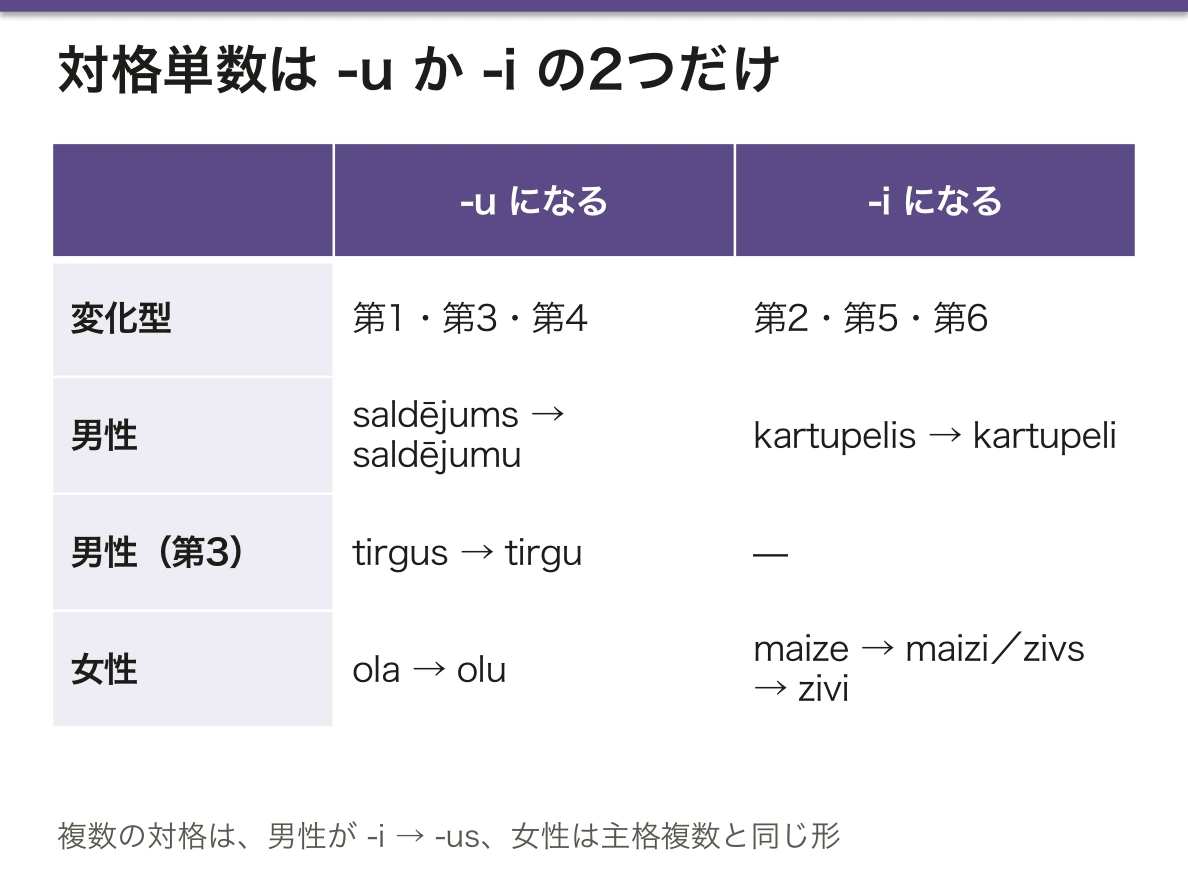
複数の対格は、主格の複数とよく似ていて紛らわしい。男性は -i → -us と変わるが、女性は主格複数と対格複数が同じ形である:
| 主格 複数 | 対格 複数 | 同じか | |
|---|---|---|---|
| 男性(第1〜3) | saldējumi | saldējumus | 違う |
| 女性 第4 | olas | olas | 同じ |
| 女性 第5 | maizes | maizes | 同じ |
| 女性 第6 | zivis | zivis | 同じ |
だから Vai tev garšo (zivis / zivi / zivīs)? の正解は zivis ではなく zivi である——garšo の構文では魚は主語なので主格、しかも1匹ぶんの話なら単数……に見えるが、実際は主格複数 zivis が正解になる。garšo / patīk / sāp / ir の後ろは対格ではないという規則が、対格の規則より優先する。
対格を使うのは、この3つの場面だけである:
| 場面 | 例 |
|---|---|
| ① 動作の直接の対象(ko?) | Es dzeru ūdeni. Viņa tīra zobus. |
| ② 前置詞 ar / uz / par / pret / pa / starp +単数 | kafija ar cukuru/Es braucu uz veikalu. |
| ③ 期間と頻度(cik ilgi? cik bieži?) | Es studēšu piecus gadus. Katru dienu. |
⚠️ ②の前置詞は単数のときだけ対格。複数になると全部の前置詞が与格に変わる——ar draugu(友人と・単数対格)だが ar draugiem(友人たちと・複数与格)。この切り替えは 7. NODAĻA まで繰り返し出る。
English version
Core
The accusative answers the question word ko? (what). Ko jūs ēdat? → Es ēdu kartupeļus. (What do you eat? → I eat potatoes.)
| Declension | Nom. sg. | Nom. pl. | Acc. sg. | Acc. pl. |
|---|---|---|---|---|
| 1st (m. -s) | saldējums | saldējumi | saldējumu | saldējumus |
| 2nd (m. -is) | kartupelis | kartupeļi | kartupeli | kartupeļus |
| 3rd (m. -us) | tirgus | tirgi | tirgu | tirgus |
| 4th (f. -a) | ola | olas | olu | olas |
| 5th (f. -e) | maize | maizes | maizi | maizes |
| 6th (f. -s) | zivs | zivis | zivi | zivis |
The singular ending is only -u or -i. Declensions 1, 3 and 4 take -u; 2, 5 and 6 take -i. Learn that division alone and the singular is finished.
Going further
The accusative plural closely resembles the nominative plural and is confusing. The masculine changes -i → -us, but in the feminine the nominative and accusative plural are the same:
| Nom. pl. | Acc. pl. | Same? | |
|---|---|---|---|
| Masculine (1st–3rd) | saldējumi | saldējumus | Different |
| Feminine 4th | olas | olas | Same |
| Feminine 5th | maizes | maizes | Same |
| Feminine 6th | zivis | zivis | Same |
So the answer in Vai tev garšo (zivis / zivi / zivīs)? is the nominative plural zivis — in the garšo construction the fish is the subject and takes the nominative. The rule that garšo / patīk / sāp / ir are not followed by the accusative overrides the rule of the accusative.
The accusative is used in only three situations:
| Situation | Example |
|---|---|
| ① The direct object of an action (ko?) | Es dzeru ūdeni. Viņa tīra zobus. |
| ② The prepositions ar / uz / par / pret / pa / starp with a singular | kafija ar cukuru / Es braucu uz veikalu. |
| ③ Duration and frequency (cik ilgi? cik bieži?) | Es studēšu piecus gadus. Katru dienu. |
⚠️ The prepositions in ② take the accusative only in the singular. In the plural every preposition switches to the dative — ar draugu (with a friend, accusative singular) but ar draugiem (with friends, dative plural). This switch recurs up to 7. NODAĻA.
第1活用 — 数は少ないが不規則Ēst un dzert
第1活用は語幹が短く、活用のたびに母音や子音が変わる不規則な一群である。数は多くないので、出てくるたびに丸ごと覚えるのが結局いちばん速い。5. NODAĻA で出るのは ēst(食べる)と dzert(飲む)の2つ。
| ēst 現在 | ēst 過去 | ēst 未来 | dzert 現在 | dzert 過去 | dzert 未来 | |
|---|---|---|---|---|---|---|
| es | ēdu | ēdu | ēdīšu | dzeru | dzēru | dzeršu |
| tu | ēd | ēdi | ēdīsi | dzer | dzēri | dzersi |
| viņš / viņi | ēd | ēda | ēdīs | dzer | dzēra | dzers |
| mēs | ēdam | ēdām | ēdīsim | dzeram | dzērām | dzersim |
| jūs | ēdat | ēdāt | ēdīsiet | dzerat | dzērāt | dzersiet |
⚠️ ēst は「私は食べる」と「私は食べた」が同じ ēdu になる。区別できるのは時を表す語だけ——Šodien es ēdu … , vakar es ēdu …。だから 4. NODAĻA で覚えた vakar / šodien / rīt がここで効いてくる。
dzert は過去で母音が伸びる(dzeru → dzēru)。ēst は逆に、複数の過去だけ伸びる(ēdam → ēdām)。長短が人称で動くので、書くときは長音符の有無まで正確に書き分ける。
未来はどの活用も同じ作り方である。ここは救いになるところで、語幹+-šu / -si / -s / -sim / -siet を付けるだけ:
| 不定詞 | es(-šu) | viņš(-s) | jūs(-siet) |
|---|---|---|---|
| ēst | ēdīšu | ēdīs | ēdīsiet |
| dzert | dzeršu | dzers | dzersiet |
| iet | iešu | ies | iesiet |
| domāt | domāšu | domās | domāsiet |
| gribēt | gribēšu | gribēs | gribēsiet |
ēdienreizes(食事)は文の中で処格になる——Brokastīs es ēdu olu.(朝食に卵を食べる)。食べる場面は処格、食べる物は対格で、1つの文に両方が出る。5. NODAĻA 演習9はこの2つを取り違えさせる作りになっている(Brokastis / Brokastīs / Brokastu の正解は Brokastīs)。
English version
Core
The first conjugation has short stems and is an irregular group in which vowels and consonants change as it is conjugated. There are not many, so learning each whole as it comes is in the end the fastest. 5. NODAĻA gives two, ēst (to eat) and dzert (to drink).
| ēst present | ēst past | ēst future | dzert present | dzert past | dzert future | |
|---|---|---|---|---|---|---|
| es | ēdu | ēdu | ēdīšu | dzeru | dzēru | dzeršu |
| tu | ēd | ēdi | ēdīsi | dzer | dzēri | dzersi |
| viņš / viņi | ēd | ēda | ēdīs | dzer | dzēra | dzers |
| mēs | ēdam | ēdām | ēdīsim | dzeram | dzērām | dzersim |
| jūs | ēdat | ēdāt | ēdīsiet | dzerat | dzērāt | dzersiet |
⚠️ For ēst, "I eat" and "I ate" are both ēdu. Only the time word distinguishes them — Šodien es ēdu …, vakar es ēdu … . So the vakar / šodien / rīt learned in 4. NODAĻA tell here.
Going further
dzert lengthens its vowel in the past (dzeru → dzēru). ēst does the reverse: only the plural past lengthens (ēdam → ēdām). Length moves with the person, so in writing the presence of the macron must be got right.
The future is formed the same way in every conjugation. This is the relief: simply add -šu / -si / -s / -sim / -siet to the stem:
| Infinitive | es (-šu) | viņš (-s) | jūs (-siet) |
|---|---|---|---|
| ēst | ēdīšu | ēdīs | ēdīsiet |
| dzert | dzeršu | dzers | dzersiet |
| iet | iešu | ies | iesiet |
| domāt | domāšu | domās | domāsiet |
| gribēt | gribēšu | gribēs | gribēsiet |
ēdienreizes (the meals) go into the locative in a sentence — Brokastīs es ēdu olu. (At breakfast I eat an egg.) The occasion of eating is locative and the thing eaten accusative, and both appear in one sentence. Exercise 9 of 5. NODAĻA is built to make the two be confused (the answer among Brokastis / Brokastīs / Brokastu is Brokastīs).
数詞と名詞の一致 — 数も格変化するDivus ābolus
ラトビア語では数詞も名詞と同じ格・性に変わる。「りんごを2つ」と言うとき、2 のほうも対格になる。
| 男性名詞 | 女性名詞 |
|---|---|
| Man, lūdzu, vienu banānu. | Man, lūdzu, vienu kafiju. |
| Es ēdu divus ābolus. | Es ēdu divas zemenes. |
| Viņa gribētu trīs apelsīnus. | Viņa gribētu trīs konfektes. |
| Viņš ēd desmit cepumus. | Viņš ēd piecpadsmit vīnogas. |
1〜9 は性で形が割れる(viens/viena、divi/divas、četri/četras …)。3 と 10 以上は形が1つ(trīs、desmit、divpadsmit …)なので、そこは楽になる。
「何個」だけでなく「何回」「何年間」も対格である。6. NODAĻA の cik ilgi?(どのくらいの間)と cik bieži?(どのくらいの頻度で)はそのまま対格で答える:
| Cik ilgi?(期間) | Cik bieži?(頻度) |
|---|---|
| vienu nedēļu 1週間 | vienu reizi nedēļā 週に1回 |
| divas stundas 2時間 | divas reizes nedēļā 週に2回 |
| desmit gadus 10年間 | trīs reizes gadā 年に3回 |
| visu dienu 一日中 | katru dienu 毎日 |
reizi / reizes は対格、そのあとの nedēļā / mēnesī / gadā は処格。1つの句に2つの格が同居する形で、これは丸ごと覚えたほうが速い。
問診でそのまま使う。Cik ilgi jums jau ir sāpes?(痛みはいつからですか)/Cik bieži jums ir galvassāpes?(頭痛の頻度は)/Cik ilgi jūs jau smēķējat?(喫煙歴は何年ですか)→ Es smēķēju sešus gadus.(6年です)
English version
Core
In Latvian the numeral declines with the noun in case and gender. Saying "two apples", the "two" goes into the accusative as well.
| Masculine noun | Feminine noun |
|---|---|
| Man, lūdzu, vienu banānu. | Man, lūdzu, vienu kafiju. |
| Es ēdu divus ābolus. | Es ēdu divas zemenes. |
| Viņa gribētu trīs apelsīnus. | Viņa gribētu trīs konfektes. |
| Viņš ēd desmit cepumus. | Viņš ēd piecpadsmit vīnogas. |
1 to 9 split by gender (viens/viena, divi/divas, četri/četras …). 3 and everything from 10 up have one form (trīs, desmit, divpadsmit …), which makes it easier there.
Going further
Not only "how many" but "how many times" and "for how many years" take the accusative. The cik ilgi? (how long) and cik bieži? (how often) of 6. NODAĻA are answered in the accusative:
| Cik ilgi? (duration) | Cik bieži? (frequency) |
|---|---|
| vienu nedēļu for a week | vienu reizi nedēļā once a week |
| divas stundas for two hours | divas reizes nedēļā twice a week |
| desmit gadus for ten years | trīs reizes gadā three times a year |
| visu dienu all day | katru dienu every day |
reizi / reizes are accusative, and the nedēļā / mēnesī / gadā that follows is locative. Two cases live together in one phrase, and it is faster to learn the whole thing by heart.
It is used directly in taking a history. Cik ilgi jums jau ir sāpes? (How long have you had the pain?) / Cik bieži jums ir galvassāpes? (How often do you get headaches?) / Cik ilgi jūs jau smēķējat? (How long have you smoked?) → Es smēķēju sešus gadus. (Six years.)
まとめ
| 対格 — 動作が及ぶ先を示す | 対格は疑問詞 ko?(何を)に答える形である。 |
|---|---|
| 第1活用 — 数は少ないが不規則 | 第1活用は語幹が短く、活用のたびに母音や子音が変わる不規則な一群である。 |
| 数詞と名詞の一致 — 数も格変化する | ラトビア語では数詞も名詞と同じ格・性に変わる。 |
このノートは医学生が授業の内容を自分の言葉でまとめたもので、診療の判断に使うものではありません。誤りに気づいたらお知らせください。