pH は医学で最もよく使う化学の数字である。血液の pH は 7.35〜7.45 という狭い範囲に保たれ、0.1 ずれるだけで意識や心臓のリズムに影響が出る。その数字を読むには、酸と塩基とは何か、強い・弱いとはどういうことか、pH はどう計算するかを一続きで理解しておく必要がある。
この章では、ブレンステッド–ローリーの定義と共役酸・共役塩基、水の自己解離と pH、Ka と pKa、強酸・弱酸の pH 計算、中和後の pH、塩の加水分解を扱い、最後に体液の pH と酸・塩基が体に及ぼす害につなげる。緩衝液は次の次の章で扱う。
- 酸と塩基の定義 — アレニウス・ブレンステッド–ローリー・ルイス
- 水の自己解離と pH — 1 違えば [H⁺] は10倍
- 酸・塩基の強さ — Ka・pKa と「強い」と「濃い」の違い
- pH の計算 — 強酸・強塩基・弱酸・弱塩基
- 中和と混合後の pH — 余ったものが pH を決める
- 塩の加水分解 — 塩の水溶液はいつも中性とは限らない
- 酸・塩基と体 — アシドーシス・アルカローシスと化学損傷
酸と塩基の定義 — アレニウス・ブレンステッド–ローリー・ルイス
酸と塩基の定義は3段階に広がってきた。
| 定義 | 酸 | 塩基 | 広さ |
|---|---|---|---|
| アレニウス | 水中で H+ を出す | 水中で OH− を出す | 水溶液だけ。NH3 が塩基である理由を説明できない |
| ブレンステッド–ローリー | H+(プロトン)を与える | H+ を受け取る | 水以外でも使える。医化学の標準 |
| ルイス | 電子対を受け取る | 電子対を与える | 最も広い。H+ が関わらない反応(錯体の生成)も含む |
水中の H+ は裸では存在できず、水分子に結合してオキソニウムイオン H3O+ になっている。H+ と書くのはその略記である。
ブレンステッドの定義では、酸が H+ を渡したあとの残りは、H+ を受け取り直せるので塩基になる。この組を共役酸–共役塩基対という。HCl/Cl−、CH3COOH/CH3COO−、H2CO3/HCO3−、HCO3−/CO32−、NH4+/NH3、H3O+/H2O、H2O/OH−。
HCl + H2O → H3O+ + Cl− では水が塩基、NH3 + H2O ⇄ NH4+ + OH− では水が酸として働く。このように相手によって酸にも塩基にもなる物質を両性物質と呼び、水、HCO3−、H2PO4−、アミノ酸がその例である。アミノ酸は分子の中に酸(−COOH)と塩基(−NH2)を両方もち、中性付近では両方が電荷を帯びた双性イオンになっている。
強さには裏返しの関係がある。強い酸の共役塩基は弱く、弱い酸の共役塩基は比較的強い。HCl はほぼ完全に H+ を手放すので Cl− は H+ をほとんど受け取らず、酢酸は H+ を放しにくいので CH3COO− は H+ を取り戻しやすい。これが塩の加水分解と緩衝液の理解の鍵になる。
English version
Core
The definition of acids and bases has widened in three stages.
| Definition | Acid | Base | Scope |
|---|---|---|---|
| Arrhenius | gives H+ in water | gives OH− in water | water solutions only; cannot explain why NH3 is a base |
| Brønsted–Lowry | donates H+ (a proton) | accepts H+ | works outside water too; the standard in medical chemistry |
| Lewis | accepts an electron pair | donates an electron pair | widest; includes reactions without H+ (complex formation) |
In water, a bare H+ cannot exist; it is bound to a water molecule as the hydronium (oxonium) ion H3O+. Writing H+ is a shorthand.
Going further
In the Brønsted view, what is left after an acid gives away H+ can take H+ back, so it is a base. Such a pair is a conjugate acid–base pair: HCl/Cl−, CH3COOH/CH3COO−, H2CO3/HCO3−, HCO3−/CO32−, NH4+/NH3, H3O+/H2O, H2O/OH−.
In HCl + H2O → H3O+ + Cl−, water acts as a base; in NH3 + H2O ⇄ NH4+ + OH−, water acts as an acid. A substance that can be either, depending on its partner, is amphiprotic: water, HCO3−, H2PO4− and amino acids are examples. An amino acid has both an acid (−COOH) and a base (−NH2) in one molecule, and near neutral pH both are charged — a zwitterion.
Strength works in reverse: the conjugate base of a strong acid is weak; the conjugate base of a weak acid is fairly strong. HCl gives up H+ almost completely, so Cl− hardly takes it back; acetic acid holds its H+, so CH3COO− takes H+ back readily. This is the key to salt hydrolysis and buffers.
水の自己解離と pH — 1 違えば [H⁺] は10倍
水はわずかに自己解離している:H2O ⇄ H+ + OH−。25 °C で Kw = [H+][OH−] = 1.0 × 10⁻¹⁴(水のイオン積)。純水では [H+] = [OH−] = 1.0 × 10⁻⁷ mol/L。
pH = −log[H+]、pOH = −log[OH−]、pH + pOH = 14(25 °C)。[H+] = 10−pH。[H+] = [OH−] なら中性(pH 7)、[H+] > [OH−] なら酸性(pH < 7)、[H+] < [OH−] なら塩基性(pH > 7)。pH が1下がると [H+] は10倍になる。
なぜ対数をとるのか。[H+] は胃液の約 10−1〜10−2 mol/L から強い塩基の 10−13 mol/L まで、何けたにもわたって変わる。対数にすると扱いやすい0〜14の数になる。裏を返せば、pH 7.4 と 7.1 の差は「0.3」ではなく [H+] で約2倍(100.3 ≈ 2)であり、小さく見える数字の差が大きな変化を意味する。
Kw は温度で変わる。水の解離は吸熱なので温度が上がると Kw は大きくなり、37 °C では約 2.4 × 10⁻¹⁴。このとき中性の pH は約 6.8 になる。「中性 = pH 7」は 25 °C での話である。
pH は pH 計(ガラス電極の電位差を pH に換算する)、pH 試験紙、指示薬で測る。指示薬は色の変わる pH 範囲が決まっていて、フェノールフタレインは約8.2〜10で無色→赤紫、メチルオレンジは約3.1〜4.4で赤→黄に変わる。
体液の pH は場所ごとに大きく違う。
| 体液 | おおよその pH |
|---|---|
| 胃液 | 1〜2 |
| 尿 | 4.5〜8(ふつう6前後) |
| 唾液 | 6.5〜7 前後 |
| 血液(動脈血) | 7.35〜7.45 |
| 膵液・腸液 | 約8 |
血液の pH は [H+] にすると約 40 nmol/L(pH 7.40)で、ナトリウム(約140 mmol/L)の300万分の1ほどしかない。それでも酵素や蛋白の電荷を変えるので、厳密に調節されている。
English version
Core
Water ionises slightly: H2O ⇄ H+ + OH−. At 25 °C, Kw = [H+][OH−] = 1.0 × 10⁻¹⁴ (the ion product of water). In pure water, [H+] = [OH−] = 1.0 × 10⁻⁷ mol/L.
pH = −log[H+], pOH = −log[OH−], pH + pOH = 14 (25 °C), and [H+] = 10−pH. [H+] = [OH−] is neutral (pH 7); [H+] > [OH−] is acidic (pH < 7); [H+] < [OH−] is basic (pH > 7). When pH falls by 1, [H+] becomes ten times larger.
Going further
Why use a logarithm? [H+] ranges over many orders of magnitude, from about 10−1–10−2 mol/L in gastric juice to 10−13 mol/L in strong base. The log gives a handy number from 0 to 14. This also means that the difference between pH 7.4 and 7.1 is not “0.3” but about two-fold in [H+] (100.3 ≈ 2). A small-looking difference is a big change.
Kw changes with temperature. Water’s ionisation is endothermic, so Kw rises with temperature; at 37 °C it is about 2.4 × 10⁻¹⁴, and neutral pH is about 6.8. “Neutral = pH 7” is true at 25 °C.
pH is measured with a pH meter (it converts the potential of a glass electrode into pH), pH paper or indicators. Each indicator changes colour over a set pH range: phenolphthalein from colourless to pink at about 8.2–10, methyl orange from red to yellow at about 3.1–4.4.
In the clinic
Body fluids differ greatly in pH.
| Fluid | Approximate pH |
|---|---|
| Gastric juice | 1–2 |
| Urine | 4.5–8 (usually about 6) |
| Saliva | about 6.5–7 |
| Blood (arterial) | 7.35–7.45 |
| Pancreatic and intestinal juice | about 8 |
Blood pH 7.40 is an [H+] of about 40 nmol/L — about three-millionth of the sodium concentration (about 140 mmol/L). Even so it changes the charges of enzymes and proteins, so it is tightly controlled.
酸・塩基の強さ — Ka・pKa と「強い」と「濃い」の違い
酸の強さは、水の中でどれだけ H+ を手放すかで決まり、電離定数 Ka = [H+][A−]/[HA] で表す。pKa = −log Ka で、Ka が大きい(pKa が小さい)ほど強い酸である。塩基も同様に Kb・pKb で表す。
| 酸 | pKa(25 °C の目安) |
|---|---|
| HCl、HNO3、H2SO4(第1段) | 負(強酸、ほぼ完全に電離) |
| H3PO4 | 2.1(第1)、7.2(第2)、12.3(第3) |
| HCOOH(ギ酸) | 3.75 |
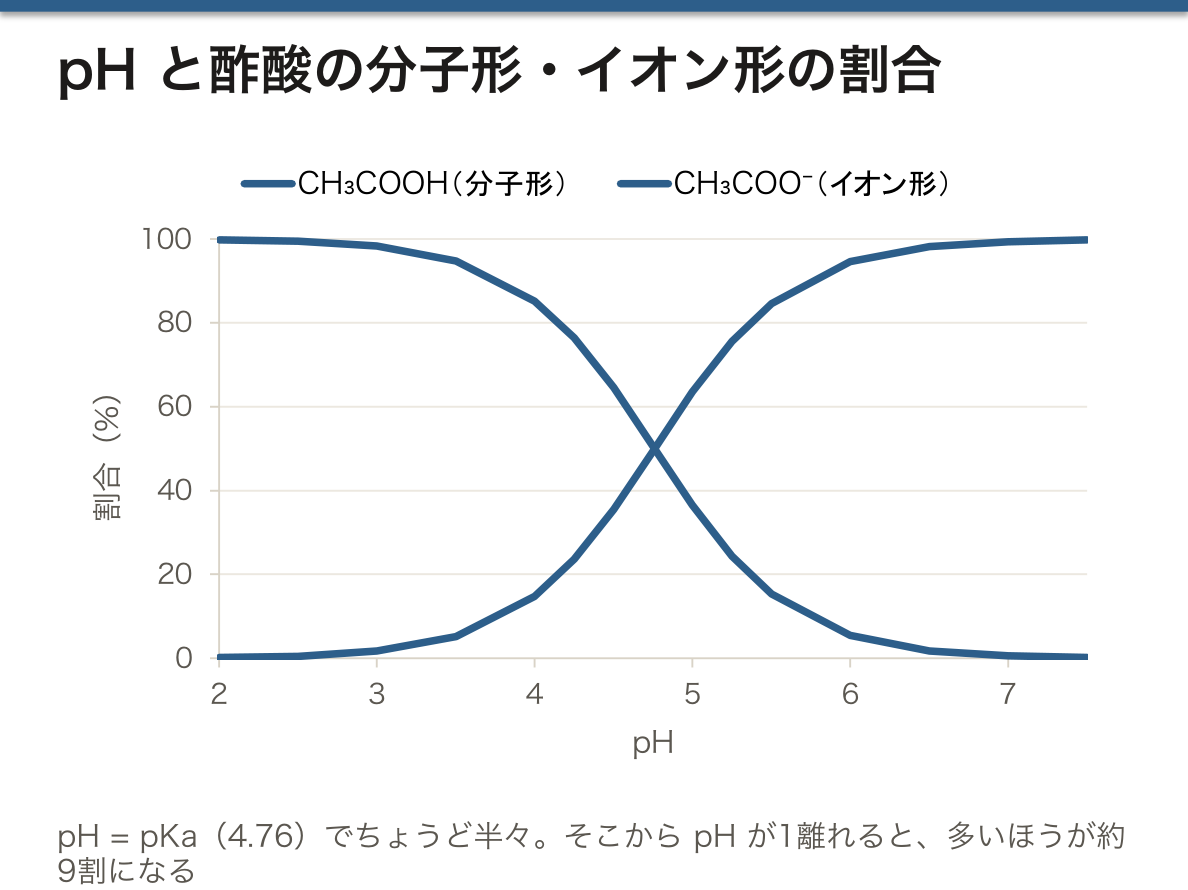
| CH3COOH(酢酸) | 4.76 |
| H2CO3(炭酸) | 6.35(第1) |
| NH4+(アンモニウムイオン) | 9.25 |
「強い・弱い」と「濃い・薄い」は別の軸である。強さは電離のしやすさ(Ka)、濃さは溶かした量(c)を表す。12 mol/L の濃塩酸は濃い強酸、胃液(約0.1 mol/L の HCl)は薄い強酸、酢(約0.8 mol/L の酢酸)は薄い弱酸である。同じ濃度で比べれば、強い酸ほど pH が低い。
共役酸–共役塩基対では Ka × Kb = Kw、つまり pKa + pKb = 14(25 °C)。酢酸(pKa 4.76)の共役塩基 CH3COO− の pKb は 9.24 で、弱いが無視できない塩基である。多価の酸(H3PO4、H2CO3)は H+ を1つずつ段階的に放し、段階ごとに Ka が小さくなる。一度 H+ を放して負に帯電した粒子から、さらに正の H+ を引き離すのは難しいからである。
多くの薬は弱酸か弱塩基で、イオンになっていない分子形だけが細胞膜を通りやすい。尿の pH を変えると、尿中で薬がイオン形に閉じこめられる割合が変わる(イオントラッピング)。アスピリン(サリチル酸)中毒で炭酸水素ナトリウムを使って尿をアルカリ性にするのは、弱酸のサリチル酸を尿中でイオン形にして再吸収させず、排泄を早めるためである。
English version
Core
Acid strength is how readily an acid gives up H+ in water, shown by the dissociation constant Ka = [H+][A−]/[HA]. With pKa = −log Ka, a larger Ka (smaller pKa) means a stronger acid. Bases use Kb and pKb in the same way.
| Acid | pKa (approx., 25 °C) |
|---|---|
| HCl, HNO3, H2SO4 (1st step) | negative (strong; almost fully dissociated) |
| H3PO4 | 2.1 (1st), 7.2 (2nd), 12.3 (3rd) |
| HCOOH (formic acid) | 3.75 |
| CH3COOH (acetic acid) | 4.76 |
| H2CO3 (carbonic acid) | 6.35 (1st) |
| NH4+ (ammonium ion) | 9.25 |
Going further
“Strong/weak” and “concentrated/dilute” are different axes. Strength is how easily it dissociates (Ka); concentration is how much is dissolved (c). 12 mol/L hydrochloric acid is a concentrated strong acid; gastric juice (about 0.1 mol/L HCl) is a dilute strong acid; vinegar (about 0.8 mol/L acetic acid) is a dilute weak acid. At the same concentration, a stronger acid has a lower pH.
For a conjugate pair, Ka × Kb = Kw, so pKa + pKb = 14 (25 °C). Acetate CH3COO−, the conjugate base of acetic acid (pKa 4.76), has pKb 9.24: weak, but not negligible. Polyprotic acids (H3PO4, H2CO3) give up H+ one at a time, and Ka gets smaller at each step, because it is harder to pull a positive H+ away from a particle that is already negatively charged.
In the clinic
Many drugs are weak acids or weak bases, and only the un-ionised form crosses cell membranes easily. Changing urine pH changes how much of a drug is trapped in urine in its ionised form (ion trapping). In aspirin (salicylate) poisoning, sodium bicarbonate is used to make the urine alkaline: the weak acid salicylate becomes ionised in urine, is not reabsorbed, and is excreted faster.
pH の計算 — 強酸・強塩基・弱酸・弱塩基
まず物質が強いか弱いか、酸か塩基かを決め、次の4つの型のどれかで計算する(z は1分子が出す H+ または OH− の数)。
| 型 | [H+] または [OH−] | pH |
|---|---|---|
| 強酸 | [H+] = z · c(α がわかれば z · α · c) | pH = −log[H+] |
| 強塩基 | [OH−] = z · c | pH = 14 − pOH |
| 弱酸 | [H+] = √(Ka · c) | pH = (pKa − log c) / 2 |
| 弱塩基 | [OH−] = √(Kb · c) | pOH = (pKb − log c) / 2、pH = 14 − pOH |
例:0.010 mol/L HCl → pH 2.00。0.050 mol/L Ba(OH)2 → [OH−] = 0.10、pOH 1.00、pH 13.00。0.010 mol/L 酢酸(pKa 4.76)→ pH = (4.76 + 2.00)/2 = 3.38。
弱酸の式はどこから来るのか。HA ⇄ H+ + A− で [H+] = [A−]、電離はわずかなので [HA] ≈ c とおけば、Ka = [H+]2 / c、すなわち [H+] = √(Ka · c)。両辺の −log をとって pH = (pKa − log c)/2 となる。近似が使えるのは電離度が小さい(目安5%未満)ときで、とても薄い溶液や比較的強い弱酸では誤差が大きくなる。
強酸を10倍に薄めると pH は1上がる(0.0010 mol/L → 0.00010 mol/L で pH 3 → 4)。弱酸を10倍に薄めると、電離度が増えるので pH は0.5しか上がらない(式の「÷2」)。ただし酸をどれだけ薄めても中性を越えて塩基性にはならない。10−8 mol/L の HCl の pH は「8」ではなく、水自身の H+ が効いて7よりわずかに小さい。
問題を解く順は「w% → m → n → cM → pH」。体積が書かれていなければ 1 L と仮定し、pH から濃度を求めるときは [H+] = 10−pH で逆にたどる。
English version
Core
First decide whether the substance is strong or weak, acid or base, then use one of four patterns (z is the number of H+ or OH− per molecule).
| Type | [H+] or [OH−] | pH |
|---|---|---|
| Strong acid | [H+] = z · c (z · α · c if α is known) | pH = −log[H+] |
| Strong base | [OH−] = z · c | pH = 14 − pOH |
| Weak acid | [H+] = √(Ka · c) | pH = (pKa − log c) / 2 |
| Weak base | [OH−] = √(Kb · c) | pOH = (pKb − log c) / 2; pH = 14 − pOH |
Examples: 0.010 mol/L HCl → pH 2.00. 0.050 mol/L Ba(OH)2 → [OH−] = 0.10, pOH 1.00, pH 13.00. 0.010 mol/L acetic acid (pKa 4.76) → pH = (4.76 + 2.00)/2 = 3.38.
Going further
Where does the weak-acid formula come from? In HA ⇄ H+ + A−, [H+] = [A−]; dissociation is small, so take [HA] ≈ c. Then Ka = [H+]2 / c, so [H+] = √(Ka · c). Taking −log of both sides gives pH = (pKa − log c)/2. The approximation works when the degree of dissociation is small (below about 5%); for very dilute solutions or fairly strong weak acids the error grows.
Diluting a strong acid ten-fold raises pH by 1 (0.0010 → 0.00010 mol/L: pH 3 → 4). Diluting a weak acid ten-fold raises pH by only 0.5, because the degree of dissociation increases (the “÷2” in the formula). But however much you dilute an acid, it never becomes basic. The pH of 10−8 mol/L HCl is not 8; water’s own H+ matters, and the pH is just below 7.
Work in the order “w% → m → n → cM → pH”. If no volume is given, assume 1 L. To get concentration from pH, go backwards with [H+] = 10−pH.
中和と混合後の pH — 余ったものが pH を決める
酸と塩基を混ぜたあとの pH は、①それぞれの物質量(n = c · V)を出す、②反応式の比で中和させる、③余ったものを全体積で割って濃度にする、④その濃度から pH を出す、の順で求める。体積は足し算になる。
例:0.100 mol/L HCl 50.0 mL と 0.100 mol/L NaOH 30.0 mL を混ぜる。n(H+) = 5.00 × 10⁻³、n(OH−) = 3.00 × 10⁻³ mol。H+ が 2.00 × 10⁻³ mol 余り、全体積 80.0 mL なので [H+] = 0.0250 mol/L、pH = 1.60。
余るものによって、その後の計算の型が変わる。
| 混ぜたもの | 結果 | pH の求め方 |
|---|---|---|
| 強酸 + 強塩基(ちょうど当量) | 中性の塩と水 | pH 7(25 °C) |
| 強酸 + 強塩基(どちらかが余る) | 余った強酸または強塩基 | 強酸・強塩基の式 |
| 弱酸 + 強塩基(弱酸が余る) | 弱酸とその塩が共存=緩衝液 | ヘンダーソン–ハッセルバルヒの式 |
| 弱酸 + 強塩基(ちょうど当量) | 弱酸の塩だけ | 塩の加水分解で塩基性 |
酸と酸、塩基と塩基のように同じ側どうしを混ぜたときも、H+(または OH−)の物質量を足して全体積で割ればよい。pH の値そのものを平均してはいけない。pH 1 と pH 3 の液を同量混ぜても pH 2 にはならず、約1.3になる([H+] は0.1 と 0.001 の平均で約0.05)。
English version
Core
To find the pH after mixing an acid and a base: ① find the moles of each (n = c · V); ② neutralise using the ratio in the equation; ③ divide what is left over by the total volume; ④ get the pH from that concentration. Volumes add.
Example: mix 50.0 mL of 0.100 mol/L HCl with 30.0 mL of 0.100 mol/L NaOH. n(H+) = 5.00 × 10⁻³, n(OH−) = 3.00 × 10⁻³ mol. 2.00 × 10⁻³ mol of H+ is left in 80.0 mL, so [H+] = 0.0250 mol/L and pH = 1.60.
Going further
What is left over decides the type of calculation that follows.
| Mixed | Result | How to get pH |
|---|---|---|
| Strong acid + strong base (exactly equivalent) | neutral salt and water | pH 7 (25 °C) |
| Strong acid + strong base (one in excess) | excess strong acid or base | strong acid/base formula |
| Weak acid + strong base (weak acid in excess) | weak acid with its salt = a buffer | Henderson–Hasselbalch equation |
| Weak acid + strong base (exactly equivalent) | only the salt of the weak acid | basic, by salt hydrolysis |
When mixing two acids, or two bases, add the moles of H+ (or OH−) and divide by the total volume. Never average the pH values themselves: equal volumes of pH 1 and pH 3 do not give pH 2 but about 1.3 ([H+] is the average of 0.1 and 0.001, about 0.05).
塩の加水分解 — 塩の水溶液はいつも中性とは限らない
塩の水溶液の pH は、その塩がどんな酸と塩基からできたかで決まる。
| もとの酸 + 塩基 | 例 | 水溶液 |
|---|---|---|
| 強酸 + 強塩基 | NaCl、KNO3、Na2SO4 | 中性 |
| 強酸 + 弱塩基 | NH4Cl、(NH4)2SO4、FeCl3 | 酸性 |
| 弱酸 + 強塩基 | CH3COONa、Na2CO3、NaHCO3 | 塩基性 |
覚え方は「強いほうの性質が出る」。強酸と弱塩基の塩なら酸性、弱酸と強塩基の塩なら塩基性である。
なぜそうなるのか。塩は水に溶けると完全にイオンに分かれる。このとき弱い酸・弱い塩基に由来するイオンだけが水と反応する。CH3COO− は弱酸の共役塩基なので、水から H+ を受け取る:CH3COO− + H2O ⇄ CH3COOH + OH−。OH− が残るので塩基性になる。NH4+ は弱塩基の共役酸なので、水に H+ を渡す:NH4+ + H2O ⇄ NH3 + H3O+。だから酸性になる。Fe3+ のような電荷の大きい金属イオンは、まわりの水分子から H+ を押し出し(Fe3+ + H2O ⇄ FeOH2+ + H+)、酸性を示す。
一方、Cl− や Na+ は強酸・強塩基に由来し、共役の相手としての力がほとんどないので水と反応しない。NaCl の液が中性なのはこのためである。加水分解は弱酸の滴定で当量点の pH が7からずれる理由でもある(次の章)。
炭酸水素ナトリウム(重曹、NaHCO3)は弱酸の塩なので弱い塩基性を示し、胃酸を中和する制酸薬や、代謝性アシドーシスの補正、尿のアルカリ化に使われる。乳酸リンゲル液の乳酸ナトリウムも、乳酸イオンが肝で代謝されて HCO3− を生むので、アシドーシスに傾くのを防ぐ。
English version
Core
The pH of a salt solution depends on which acid and which base the salt came from.
| Parent acid + base | Examples | Solution |
|---|---|---|
| Strong acid + strong base | NaCl, KNO3, Na2SO4 | neutral |
| Strong acid + weak base | NH4Cl, (NH4)2SO4, FeCl3 | acidic |
| Weak acid + strong base | CH3COONa, Na2CO3, NaHCO3 | basic |
A simple rule: the stronger parent wins. A salt of a strong acid and weak base is acidic; a salt of a weak acid and strong base is basic.
Going further
Why? A salt dissolves into ions completely, and only the ions from a weak acid or weak base react with water. CH3COO− is the conjugate base of a weak acid, so it takes H+ from water: CH3COO− + H2O ⇄ CH3COOH + OH−. OH− is left, so the solution is basic. NH4+ is the conjugate acid of a weak base, so it gives H+ to water: NH4+ + H2O ⇄ NH3 + H3O+, so the solution is acidic. Highly charged metal ions such as Fe3+ push H+ off the water molecules around them (Fe3+ + H2O ⇄ FeOH2+ + H+), so they are acidic.
Cl− and Na+, from a strong acid and a strong base, have almost no strength as conjugate partners and do not react with water. That is why NaCl solution is neutral. Hydrolysis is also why the pH at the equivalence point of a weak-acid titration is not 7 (next chapter).
In the clinic
Sodium bicarbonate (NaHCO3) is a salt of a weak acid, so it is weakly basic. It is used as an antacid, to correct metabolic acidosis, and to make urine alkaline. The sodium lactate in lactated Ringer’s also helps: lactate is metabolised in the liver to produce HCO3−, which prevents a shift towards acidosis.
酸・塩基と体 — アシドーシス・アルカローシスと化学損傷
血液の pH が 7.35 より下がった状態をアシデミア、それを起こす過程をアシドーシス、7.45 より上がった状態をアルカレミア、その過程をアルカローシスという。原因が CO2(呼吸)にあれば呼吸性、HCO3− や不揮発酸(代謝)にあれば代謝性と呼ぶ。中心にあるのは CO2 + H2O ⇄ H2CO3 ⇄ H+ + HCO3− の平衡である(詳しくは緩衝液の章)。
pH がずれると、蛋白(酵素・イオンチャネル・受容体)のアミノ酸側鎖の電荷が変わり、形と働きが変わる。だから体は pH をわずかな幅に保っている。
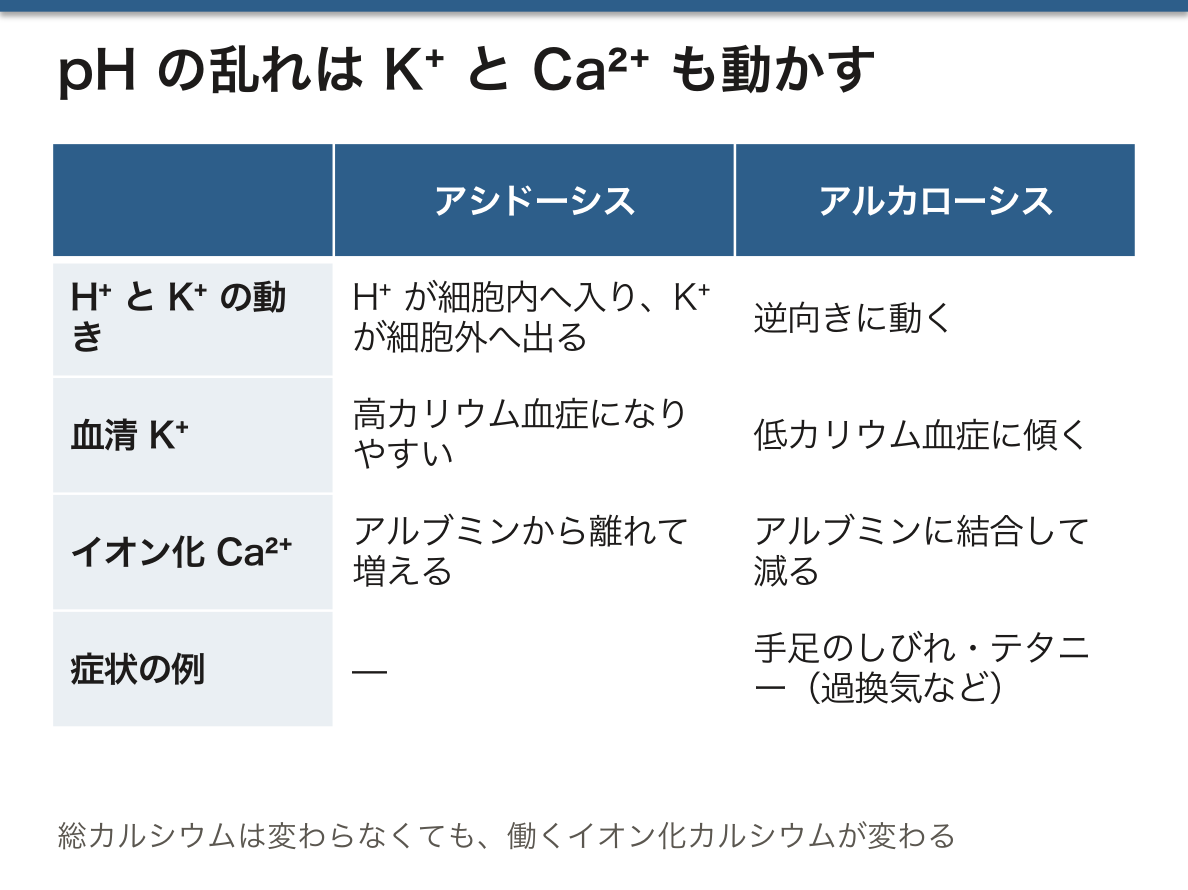
pH の乱れは電解質も動かす。アシドーシスでは H+ が細胞内に入る代わりに K+ が細胞外に出て、高カリウム血症になりやすい。アルカローシスでは逆に低カリウム血症に傾く。またアルカローシスでは、アルブミンが H+ を放した場所に Ca2+ が結合しやすくなり、イオン化カルシウムが減る。過換気で手足がしびれたりテタニーが起きたりするのはこのためで、総カルシウムは変わらないのに作用するカルシウムが減っている。どちらも「H+ の濃度が変われば、H+ と結合を争う他のイオンの分布も変わる」という平衡の考え方で説明できる。
強酸・強塩基は直接組織を壊す。酸は蛋白を凝固させて表面に硬いかさぶたを作る(凝固壊死)ので比較的浅くとどまりやすく、アルカリは蛋白を溶かし脂肪をけん化して組織を軟らかく崩す(融解壊死)ので深くまで進みやすい。眼の化学損傷はアルカリのほうが重い。応急処置は大量の水で長く洗い流すことで、反対の性質の薬品で中和しようとしてはいけない(中和熱で熱傷が加わり、量の調整もできない)。誤飲では吐かせない(食道をもう一度傷つける)。
English version
Core
A blood pH below 7.35 is acidaemia, and the process causing it is acidosis; a pH above 7.45 is alkalaemia, caused by alkalosis. If the cause is CO2 (breathing) it is respiratory; if it is HCO3− or non-volatile acids (metabolism) it is metabolic. At the centre is the equilibrium CO2 + H2O ⇄ H2CO3 ⇄ H+ + HCO3− (see the buffer chapter).
When pH shifts, the charges on amino-acid side chains of proteins (enzymes, ion channels, receptors) change, and so do their shape and function. That is why the body keeps pH in a narrow range.
Going further
pH disturbances also move electrolytes. In acidosis, H+ enters cells and K+ leaves them in exchange, so hyperkalaemia is common; alkalosis tends towards hypokalaemia. In alkalosis, albumin releases H+ and binds more Ca2+ in its place, so ionised calcium falls. This is why hyperventilation causes tingling and tetany: total calcium is unchanged, but the active calcium is lower. Both follow from equilibrium: when [H+] changes, so does the distribution of other ions that compete with H+ for binding.
In the clinic
Strong acids and bases destroy tissue directly. Acids coagulate proteins and form a hard crust (coagulative necrosis), so the injury tends to stay shallower; alkalis dissolve proteins and saponify fats, softening and breaking down tissue (liquefactive necrosis), so they penetrate deeper. Alkali injuries of the eye are more severe. First aid is rinsing with plenty of water for a long time. Do not try to neutralise with a chemical of the opposite kind (the heat of neutralisation adds a burn, and the amount cannot be controlled). After swallowing, do not induce vomiting (it injures the oesophagus a second time).
まとめ
| 酸と塩基の定義 — アレニウス・ブレンステッド–ローリー・ルイス | 酸と塩基の定義は3段階に広がってきた。定義酸塩基広さアレニウス水中で H+ を出す水中で OH− を出す水溶液だけ。 |
|---|---|
| 水の自己解離と pH — 1 違えば [H⁺] は10倍 | 水はわずかに自己解離している:H2O ⇄ H+ + OH−。 |
| 酸・塩基の強さ — Ka・pKa と「強い」と「濃い」の違い | 酸の強さは、水の中でどれだけ H+ を手放すかで決まり、電離定数 Ka = [H+][A−]/[HA] で表す。 |
| pH の計算 — 強酸・強塩基・弱酸・弱塩基 | まず物質が強いか弱いか、酸か塩基かを決め、次の4つの型のどれかで計算する(z は1分子が出す H+ または OH− の数)。 |
| 中和と混合後の pH — 余ったものが pH を決める | 酸と塩基を混ぜたあとの pH は、①それぞれの物質量(n = c · V)を出す、②反応式の比で中和させる、③余ったものを全体積で割って濃度にする、④その濃度から pH を出す、の… |
| 塩の加水分解 — 塩の水溶液はいつも中性とは限らない | 塩の水溶液の pH は、その塩がどんな酸と塩基からできたかで決まる。 |
| 酸・塩基と体 — アシドーシス・アルカローシスと化学損傷 | 血液の pH が 7.35 より下がった状態をアシデミア、それを起こす過程をアシドーシス、7.45 より上がった状態をアルカレミア、その過程をアルカローシスという。 |
このノートは医学生が授業の内容を自分の言葉でまとめたもので、診療の判断に使うものではありません。誤りに気づいたらお知らせください。