「この溶液にどれだけ入っているか」を数字で答えるのが定量分析である。この章では、医化学の基本になる2つの方法を扱う。1つは、濃度のわかった溶液と過不足なく反応させ、使った体積から相手の量を逆算する滴定。もう1つは、溶液が吸収する光の量から濃度を求める吸光光度法である。
どちらも、前の章までの道具(化学量論、モル濃度、有効数字、検量線)を組み合わせて使う。そして病院の検査室で毎日動いている自動分析装置も、ほとんどがこの2つの原理の延長にある。
- 滴定の原理 — 当量点・終点と指示薬
- 滴定の計算 — 過マンガン酸カリウムで Fe²⁺ をはかる
- 光の吸収とランベルト–ベールの法則 — A = εlc
- 検量線法 — 標準液から未知の濃度を読む
滴定の原理 — 当量点・終点と指示薬
滴定は、濃度を正確に知っている溶液(滴定液)をビュレットから少しずつ加え、試料中の物質(被滴定物質)とちょうど過不足なく反応した点を見つけて、加えた体積から試料の量を求める方法である。
反応がちょうど終わった点を当量点、実際に色の変化などで「終わった」と判断した点を終点という。両者ができるだけ一致するように、色・温度・電位などの目に見える変化を利用する。多くは指示薬を加えて色で知る。
器具の役割は決まっている。試料はホールピペット(+安全ピペッター)で正確に取って三角フラスコへ入れ、滴定液はビュレットから加え、フラスコを振り混ぜながら1滴ずつ近づける。
滴定に使える反応には条件がある。速く進む、最後まで進む、化学量論(反応の比)がはっきりしている、そして終点がはっきりわかることである。この条件を満たす反応の種類ごとに滴定法がある。
| 種類 | 反応 | 終点の見つけ方 |
|---|---|---|
| 中和滴定 | 酸 + 塩基 | pH 指示薬、または pH 計(電位差滴定) |
| 酸化還元滴定(過マンガン酸法) | MnO4− + Fe2+ など | MnO4− 自身の紫色(自己指示)。淡い赤紫が消えずに残った点 |
| ヨウ素滴定 | I2 + 2S2O32− → 2I− + S4O62− | ヨウ素の褐色の消失(デンプンを加えると青紫の消失でより鋭い) |
| キレート滴定 | 金属イオン + EDTA(1 : 1) | 金属指示薬の色の変化 |
同じ試料を3回ほど滴定し、そろった値の平均を使う。1回目はおおよその終点を知るための予備と考えてよい。
English version
Core
In titration, a solution of exactly known concentration (the titrant) is added from a burette little by little to the substance in the sample (the analyte). We find the point where they have reacted exactly, with nothing left over, and use the added volume to calculate the amount in the sample.
The point where the reaction is exactly complete is the equivalence point; the point where we see that it is complete, from a colour change or similar, is the end point. We use a visible change — colour, temperature, potential — so that the two agree as closely as possible. Often an indicator is added to show it by colour.
Each piece of glassware has its job. Take the sample exactly with a volumetric pipette (and a pipette filler) into a conical flask, add titrant from the burette, and swirl the flask while approaching the end drop by drop.
Going further
A reaction must meet conditions to be used for titration: it must be fast, go to completion, have clear stoichiometry, and have a clear end point. There is a type of titration for each kind of reaction that meets them.
| Type | Reaction | How to find the end point |
|---|---|---|
| Acid–base | acid + base | pH indicator, or a pH meter (potentiometric titration) |
| Redox (permanganate) | MnO4− + Fe2+, etc. | the purple colour of MnO4− itself (self-indicating): a pale pink that stays |
| Iodometric | I2 + 2S2O32− → 2I− + S4O62− | the brown iodine colour disappears (sharper with starch: the blue-black disappears) |
| Complexometric | metal ion + EDTA (1 : 1) | colour change of a metal indicator |
Titrate the same sample about three times and average the results that agree. The first run can be seen as a rough trial to find the approximate end point.
滴定の計算 — 過マンガン酸カリウムで Fe²⁺ をはかる
硫酸で酸性にした Fe2+(FeSO4)の溶液を、濃度のわかった KMnO4 で滴定する。反応は
MnO4− + 5Fe2+ + 8H+ → Mn2+ + 5Fe3+ + 4H2O(MnO4− : Fe2+ = 1 : 5)
MnO4− は濃い紫だが、Fe2+ と反応すると無色の Mn2+ になる。Fe2+ がなくなった瞬間から、加えた MnO4− が残って淡い赤紫が消えなくなる。これが終点で、指示薬はいらない。
計算例:試料 100.0 mL から 10.00 mL を取り、0.0200 mol/L KMnO4 で滴定して平均 7.50 mL を要した。n(MnO4−) = 0.0200 × 0.00750 = 1.50 × 10⁻⁴ mol → n(Fe2+) = 5 × 1.50 × 10−4 = 7.50 × 10⁻⁴ mol → c(Fe2+) = 7.50 × 10⁻⁴ / 0.01000 = 0.0750 mol/L。100.0 mL 全体では 7.50 × 10⁻³ mol、FeSO4(M = 151.9 g/mol)として 1.14 g。
なぜ硫酸で酸性にするのか。MnO4− がどこまで還元されるかは液の酸性度で変わるからである。酸性では Mn2+(無色、電子5個を受け取る)まで還元されるが、中性では褐色の MnO2 の沈殿(電子3個)が生じ、色で終点が見えなくなるうえに反応の比も変わってしまう。比が一定で、色の変化がはっきりした条件を選ぶことが、滴定の精度そのものである。硫酸や水を加えても試料中の Fe2+ の量は変わらないので、加える量は正確でなくてよい。
計算の最後で「取り分けた 10.00 mL」と「元の 100.0 mL」を取り違えないこと。滴定で求まるのは取り分けた分の量で、全体はその10倍である(分取の倍率)。ビュレットの読みは小数第2位まで記録し、結果は滴定液の濃度(3桁)に合わせて3桁で答える。
English version
Core
A solution of Fe2+ (FeSO4), made acidic with sulfuric acid, is titrated with KMnO4 of known concentration. The reaction is
MnO4− + 5Fe2+ + 8H+ → Mn2+ + 5Fe3+ + 4H2O (MnO4− : Fe2+ = 1 : 5)
MnO4− is deep purple, but reacting with Fe2+ it becomes colourless Mn2+. As soon as Fe2+ is used up, added MnO4− remains and a pale pink no longer disappears. This is the end point; no indicator is needed.
Example: take 10.00 mL from 100.0 mL of sample and titrate with 0.0200 mol/L KMnO4; the mean volume is 7.50 mL. n(MnO4−) = 0.0200 × 0.00750 = 1.50 × 10⁻⁴ mol → n(Fe2+) = 5 × 1.50 × 10−4 = 7.50 × 10⁻⁴ mol → c(Fe2+) = 7.50 × 10⁻⁴ / 0.01000 = 0.0750 mol/L. The whole 100.0 mL contains 7.50 × 10⁻³ mol, or 1.14 g of FeSO4 (M = 151.9 g/mol).
Going further
Why add sulfuric acid? How far MnO4− is reduced depends on the acidity. In acid it goes to Mn2+ (colourless, taking 5 electrons); in neutral solution brown MnO2 precipitates (3 electrons). The precipitate hides the colour change, and the reaction ratio changes too. Choosing conditions with a fixed ratio and a clear colour change is what makes a titration precise. Adding sulfuric acid or water does not change the amount of Fe2+ in the sample, so these volumes need not be exact.
At the end, do not confuse “the 10.00 mL taken” with “the original 100.0 mL”. The titration gives the amount in the portion taken; the whole is ten times as much (the aliquot factor). Record burette readings to two decimals, and give the result to three significant figures to match the titrant concentration.
光の吸収とランベルト–ベールの法則 — A = εlc
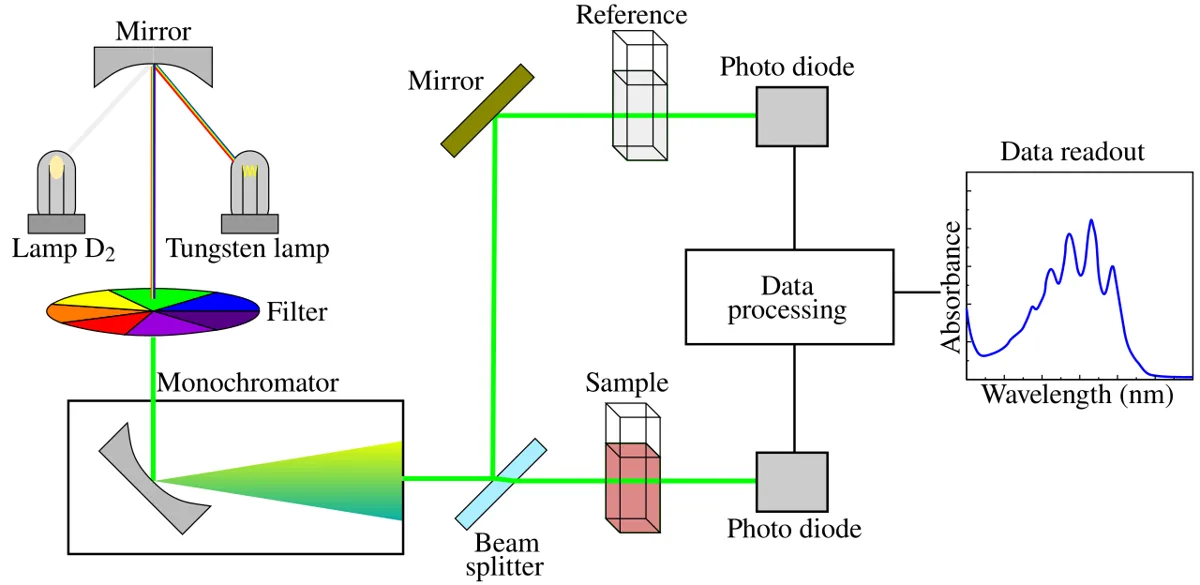
色のついた溶液は、特定の波長の光を吸収する。溶液に入る光の強さを I0、出てくる光の強さを I とすると、透過率 T = I / I0、吸光度 A = log(I0 / I) = −log T である。
ランベルト–ベールの法則:A = ε · l · c(ε:モル吸光係数、l:光が通る長さ(セルの幅、ふつう 1 cm)、c:濃度)。吸光度は濃度に比例するので、吸光度を測れば濃度がわかる。
測る波長は、その物質がいちばん強く吸収する波長(極大吸収波長 λmax)を選ぶ。溶液の見た目の色は吸収された色の補色で、黄色いリボフラビン(ビタミン B2)は青い光(440 nm 付近)を吸収する。
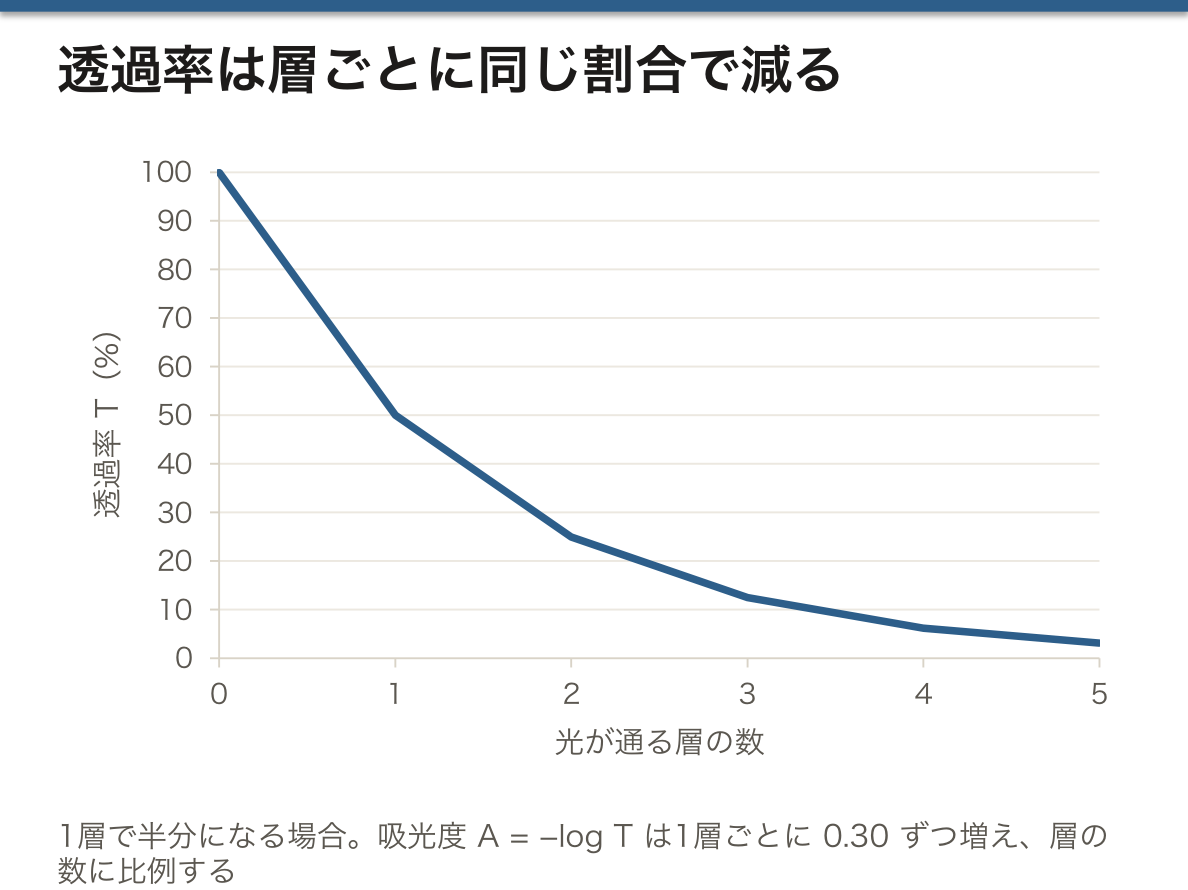
なぜ透過率ではなく、対数をとった吸光度を使うのか。溶液の薄い層を1枚通るごとに、光は同じ「割合」ずつ弱まる。1層で半分になるなら、2層で1/4、3層で1/8と、透過率は濃度や長さに対して指数関数的に減る。対数をとるとこれが直線になり、濃度に比例する量が得られる。A = 1 なら光の10%、A = 2 なら1%しか通っていない。
測定の前に、溶媒だけを入れたセル(ブランク)で吸光度を0に合わせる。セルや溶媒自体の吸収を差し引き、溶質による吸収だけを測るためである。セルは光の通る透明な面に触れず、すりガラスの面を持つ。指紋や水滴も光を吸収・散乱して誤差になる。比例関係が成り立つのは薄い溶液の範囲で、濃すぎると直線からはずれる。
English version
Core
A coloured solution absorbs light of certain wavelengths. If I0 is the light going in and I the light coming out, transmittance T = I / I0 and absorbance A = log(I0 / I) = −log T.
The Beer–Lambert law: A = ε · l · c (ε: molar absorption coefficient; l: path length, the width of the cuvette, usually 1 cm; c: concentration). Absorbance is proportional to concentration, so measuring A gives the concentration.
Choose the wavelength the substance absorbs most strongly (λmax). The colour we see is the complement of the absorbed colour: yellow riboflavin (vitamin B2) absorbs blue light (around 440 nm).
Going further
Why use absorbance, a logarithm, instead of transmittance? Each thin layer of solution weakens the light by the same fraction. If one layer halves it, two layers leave 1/4 and three leave 1/8: transmittance falls exponentially with concentration and length. Taking the log turns this into a straight line and gives a quantity proportional to concentration. A = 1 means only 10% of the light passes; A = 2 means 1%.
Before measuring, set the absorbance to zero with a cuvette of solvent only (the blank). This removes absorption by the cuvette and solvent, so only the solute is measured. Hold the cuvette by its frosted sides, not the clear sides the light passes through; fingerprints and drops also absorb or scatter light. The proportional relation holds for dilute solutions; when too concentrated, it departs from the line.
検量線法 — 標準液から未知の濃度を読む
ε を使わずに濃度を求める実用的な方法が検量線法である。手順は、①濃度のわかった原液を段階的に薄めて標準液を数本作る、②ブランクで0を合わせて各標準液の吸光度を測る、③吸光度(y)対 濃度(x)のグラフを描き、原点の近くを通る近似直線(検量線)を引く、④未知試料の吸光度を測り、検量線から濃度を読む、の4段階である。
例:原液 0.0400 mg/mL を 1.00 mL 取り水 9.00 mL と混ぜれば、0.0400 × 1.00/10.00 = 0.00400 mg/mL の標準液ができる。検量線が A = 25.0γ なら、A = 0.300 の試料は γ = 0.300/25.0 = 0.0120 mg/mL。
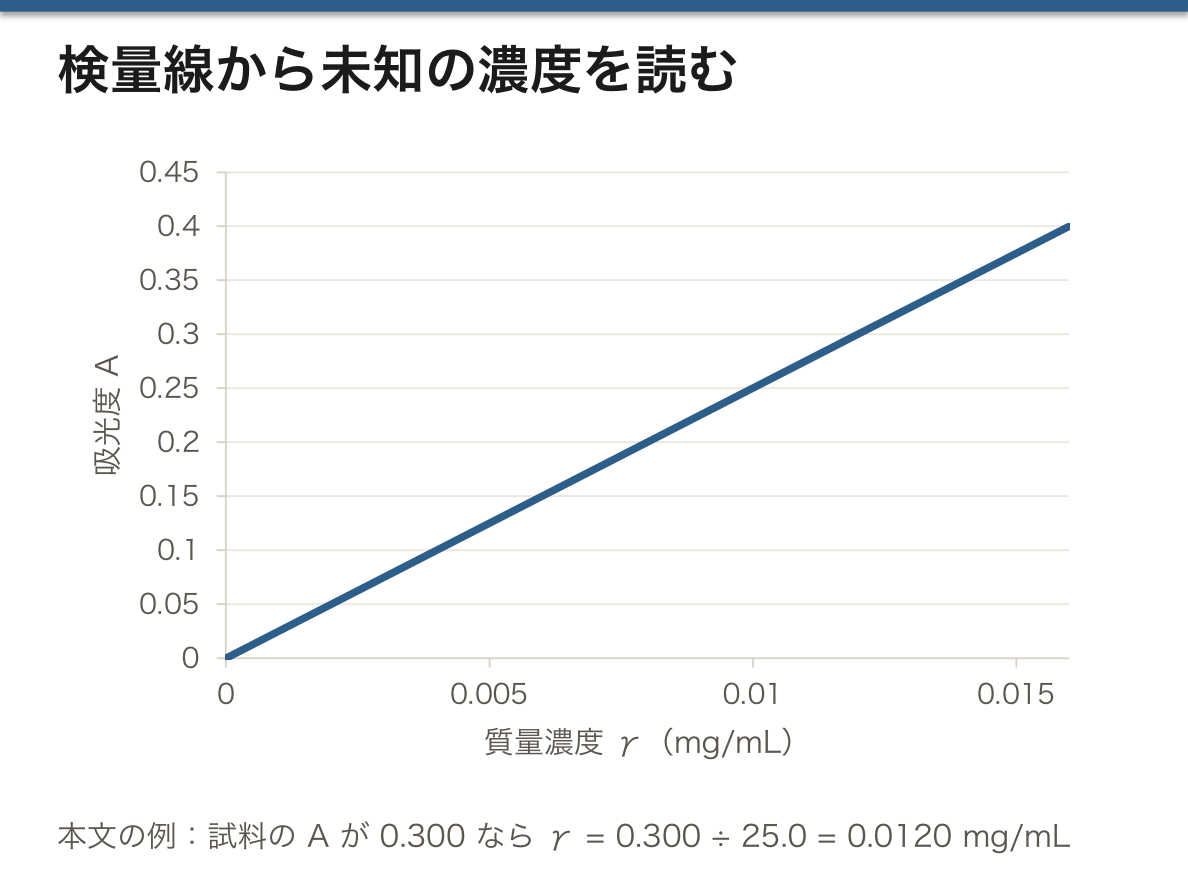
検量線法の利点は、装置や条件のくせ(セルの幅、波長のわずかなずれ、試薬の色)が標準液と試料に同じようにかかるので、打ち消し合うことである。だから標準液と試料は、同じ日に同じ条件で測る。
未知試料の吸光度が最も濃い標準液より大きければ、検量線の外(外挿)になるので読まない。試料を正確に薄めて範囲内に入れ、読んだ濃度に希釈倍率を掛けて戻す。手描きとソフトで検量線を描き比べると、手描きは点の並びのくせ(1点だけ外れている、上のほうで曲がる)に気づきやすく、ソフトは式と R2 が正確に出る。
臨床化学の多くの項目は、吸光光度法で測っている。代表は NADH が 340 nm の光を吸収し、NAD+ は吸収しないことを使う方法で、AST・ALT・LD や、ヘキソキナーゼ法の血糖などは、反応で増減する NADH の吸光度の変化から求める。パルスオキシメーターも吸光の応用で、酸素と結合したヘモグロビンとしていないヘモグロビンで赤色光(約660 nm)と赤外光(約940 nm)の吸収が違うことから、動脈血の酸素飽和度を計算している。
English version
Core
The practical way to find concentration without knowing ε is the calibration-curve method. ① Dilute a stock of known concentration step by step to make several standards. ② Zero with the blank and measure each standard. ③ Plot absorbance (y) against concentration (x) and draw a best-fit line (calibration line) passing near the origin. ④ Measure the unknown and read its concentration from the line.
Example: 1.00 mL of a 0.0400 mg/mL stock plus 9.00 mL of water gives 0.0400 × 1.00/10.00 = 0.00400 mg/mL. If the line is A = 25.0γ, a sample with A = 0.300 has γ = 0.300/25.0 = 0.0120 mg/mL.
Going further
The advantage is that the quirks of the instrument and conditions (cuvette width, small wavelength shifts, reagent colour) affect the standards and the sample in the same way, so they cancel out. That is why standards and samples are measured on the same day under the same conditions.
If the unknown absorbs more than the strongest standard, it is outside the line (extrapolation), so do not read it. Dilute the sample exactly to bring it into range, then multiply the result by the dilution factor. Comparing a hand-drawn and a software line: by hand you notice patterns (one point off, bending at the top); software gives the exact equation and R2.
In the clinic
Many clinical chemistry tests use spectrophotometry. A key method uses the fact that NADH absorbs light at 340 nm and NAD+ does not: AST, ALT, LD and glucose by the hexokinase method are measured from the change in NADH absorbance during the reaction. A pulse oximeter also uses absorption: oxygenated and deoxygenated haemoglobin absorb red light (about 660 nm) and infrared light (about 940 nm) differently, and from this the oxygen saturation of arterial blood is calculated.
まとめ
| 滴定の原理 — 当量点・終点と指示薬 | 滴定は、濃度を正確に知っている溶液(滴定液)をビュレットから少しずつ加え、試料中の物質(被滴定物質)とちょうど過不足なく反応した点を見つけて、加えた体積から試料の量を求める方法であ… |
|---|---|
| 滴定の計算 — 過マンガン酸カリウムで Fe²⁺ をはかる | 硫酸で酸性にした Fe2+(FeSO4)の溶液を、濃度のわかった KMnO4 で滴定する。 |
| 光の吸収とランベルト–ベールの法則 — A = εlc | 色のついた溶液は、特定の波長の光を吸収する。 |
| 検量線法 — 標準液から未知の濃度を読む | ε を使わずに濃度を求める実用的な方法が検量線法である。 |
このノートは医学生が授業の内容を自分の言葉でまとめたもので、診療の判断に使うものではありません。誤りに気づいたらお知らせください。