緩衝液は、強酸や強塩基を少し加えても pH があまり変わらない溶液である。中身は弱酸とその共役塩基(または弱塩基とその共役酸)の組で、片方が加えられた酸を、もう片方が加えられた塩基を引き受ける。
体の中では、代謝で毎日大量の酸が生まれるのに、血液の pH は 7.35〜7.45 に保たれる。その第一線が炭酸–炭酸水素イオン緩衝系で、肺と腎臓がそれを支えている。この章の式 pH = pKa + log([A−]/[HA]) は、そのまま血液ガスの読み方の式になる。
- 緩衝液のしくみ — 弱酸と共役塩基が酸も塩基も引き受ける
- ヘンダーソン–ハッセルバルヒの式 — 緩衝液の pH は比で決まる
- 強酸・強塩基を加えたときの pH — 比が少しずれるだけ
- 緩衝能と有効な緩衝範囲 — pKa ± 1
- 血液の緩衝系 — 炭酸–炭酸水素イオン系はなぜ強いのか
- 酸塩基平衡の乱れと代償 — 4つの型
緩衝液のしくみ — 弱酸と共役塩基が酸も塩基も引き受ける
緩衝液は2つの成分からなる。酸を中和する成分(塩基として働く)と、塩基を中和する成分(酸として働く)で、実際には次のような組である。
| 型 | 例 |
|---|---|
| 弱酸 + その塩 | CH3COOH / CH3COONa(酢酸緩衝液) |
| 弱塩基 + その塩 | NH4OH / NH4Cl(アンモニア緩衝液) |
| 多価の弱酸 + その塩 | H2CO3 / NaHCO3(炭酸緩衝液) |
| 多価の酸の塩どうし | NaH2PO4 / Na2HPO4(リン酸緩衝液) |
強酸を加えると共役塩基が H+ を受け取る:H+ + CH3COO− → CH3COOH。強塩基を加えると弱酸が OH− を中和する:OH− + CH3COOH → CH3COO− + H2O。どちらの場合も、強い酸・塩基が弱い酸・塩基に置き換わるだけなので、[H+] はわずかしか変わらない。
緩衝液がうまく働くには、両成分がどちらも十分な量あることが必要である。酢酸だけの溶液では共役塩基(CH3COO−)がわずかしかなく、酸を加えると引き受け手がない。そこに塩(CH3COONa、強電解質で完全に電離)を加えると、共通イオン効果で酢酸の電離がさらに抑えられ、液の中は「ほぼ分子のままの酢酸」と「塩から来た酢酸イオン」が両方たっぷりある状態になる。だから計算では [HA] ≈ 加えた酸の濃度、[A−] ≈ 加えた塩の濃度とおける。
強酸とその塩(HCl / NaCl)は緩衝液にならない。Cl− は H+ をほとんど受け取らない(強酸の共役塩基は非常に弱い)からである。弱酸に強塩基を半分ほど加えても緩衝液ができる(CH3COOH の一部が CH3COONa に変わる)。滴定曲線の緩衝域は、まさにこの状態である。
English version
Core
A buffer has two components: one that neutralises acid (acting as a base) and one that neutralises base (acting as an acid). In practice they are pairs such as these.
| Type | Example |
|---|---|
| Weak acid + its salt | CH3COOH / CH3COONa (acetate buffer) |
| Weak base + its salt | NH4OH / NH4Cl (ammonia buffer) |
| Polyprotic weak acid + its salt | H2CO3 / NaHCO3 (carbonate buffer) |
| Two salts of a polyprotic acid | NaH2PO4 / Na2HPO4 (phosphate buffer) |
When strong acid is added, the conjugate base takes the H+: H+ + CH3COO− → CH3COOH. When strong base is added, the weak acid neutralises the OH−: OH− + CH3COOH → CH3COO− + H2O. Either way, a strong acid or base is simply replaced by a weak one, so [H+] changes only a little.
Going further
For a buffer to work, both components must be present in good amounts. A solution of acetic acid alone has very little conjugate base (CH3COO−), so added acid has nothing to react with. Adding the salt (CH3COONa, a strong electrolyte, fully dissociated) suppresses the acid’s dissociation further by the common ion effect. The solution then holds plenty of both “acetic acid almost all as molecules” and “acetate from the salt”. So in calculations we can take [HA] ≈ the acid concentration added and [A−] ≈ the salt concentration added.
A strong acid and its salt (HCl / NaCl) is not a buffer, because Cl− hardly accepts H+ (the conjugate base of a strong acid is very weak). Adding about half as much strong base to a weak acid also makes a buffer (part of CH3COOH becomes CH3COONa). The buffer region of a titration curve is exactly this state.
ヘンダーソン–ハッセルバルヒの式 — 緩衝液の pH は比で決まる
弱酸の Ka = [H+][A−]/[HA] を変形し、−log をとると
pH = pKa + log([A−] / [HA]) = pKa + log(c塩 / c酸)
弱塩基の緩衝液では pOH = pKb + log(c塩 / c塩基)、pH = 14 − pOH。両成分は同じ溶液の中にあるので、濃度の比は物質量の比 n(塩)/ n(酸)でそのまま計算してよい。
例:酢酸 0.10 mol と酢酸ナトリウム 0.20 mol を含む緩衝液(pKa 4.76)は、pH = 4.76 + log 2 = 4.76 + 0.30 = 5.06。両者が等量なら log 1 = 0 で pH = pKa。
この式から緩衝液の性質が3つ読める。
①pH は pKa と成分の比で決まり、濃度そのものにはよらない。だから緩衝液を水で薄めても、比が変わらないので pH はほとんど変わらない(ただし後で見るように、薄めると緩衝能は下がる)。
②目的の pH の緩衝液を作るには、pKa がその pH に近い弱酸を選び、比を調節する。比を10倍にすれば pH は1上がる。同じ濃度の酸と塩を混ぜるなら、体積の比がそのまま成分の比になる。
③比が1から大きくずれるほど、少しの酸・塩基で比が大きく動く。比が 1 : 1 のときがいちばん動きにくい(緩衝能が最大)。
弱酸に強塩基を加えて作るときは、まず中和で「残った弱酸」と「できた塩」の物質量を出してから式に入れる。0.020 mol の酢酸に NaOH 0.010 mol を加えれば、酸 0.010 mol と塩 0.010 mol が残り、pH = pKa となる。
English version
Core
Rearrange the weak acid’s Ka = [H+][A−]/[HA] and take −log:
pH = pKa + log([A−] / [HA]) = pKa + log(csalt / cacid)
For a weak-base buffer, pOH = pKb + log(csalt / cbase), and pH = 14 − pOH. Both components are in the same solution, so the concentration ratio can be calculated directly as the mole ratio n(salt)/n(acid).
Example: a buffer with 0.10 mol of acetic acid and 0.20 mol of sodium acetate (pKa 4.76) has pH = 4.76 + log 2 = 4.76 + 0.30 = 5.06. With equal amounts, log 1 = 0 and pH = pKa.
Going further
The equation shows three properties of buffers.
① pH depends on pKa and the ratio of the components, not on their concentration. So diluting a buffer with water hardly changes the pH, because the ratio stays the same (although, as we will see, dilution lowers the buffer capacity).
② To make a buffer of a target pH, choose a weak acid with pKa near that pH and adjust the ratio. A ten-fold change in the ratio moves pH by 1. If acid and salt solutions have the same concentration, the ratio of volumes is the ratio of components.
③ The further the ratio is from 1, the more a little acid or base moves it. At 1 : 1 it moves least (maximum buffer capacity).
When making a buffer by adding strong base to a weak acid, first use the neutralisation to find the moles of “weak acid left” and “salt formed”, then use the equation. Adding 0.010 mol of NaOH to 0.020 mol of acetic acid leaves 0.010 mol acid and 0.010 mol salt, so pH = pKa.
強酸・強塩基を加えたときの pH — 比が少しずれるだけ
緩衝液に強酸や強塩基を加えたときは、反応で成分の物質量がどう変わるかを先に計算してから、ヘンダーソン–ハッセルバルヒの式に入れる。
強酸(H+ を n mol)を加えた:塩が n 減り、酸が n 増える。pH = pKa + log((n塩 − n) / (n酸 + n))
強塩基(OH− を n mol)を加えた:酸が n 減り、塩が n 増える。pH = pKa + log((n塩 + n) / (n酸 − n))
例:酢酸・酢酸ナトリウム各 0.100 mol を含む 1.00 L の緩衝液(pH 4.76)に HCl 0.010 mol を加える。pH = 4.76 + log(0.090/0.110) = 4.76 − 0.09 = 4.67。同じ HCl を純水 1.00 L に加えれば [H+] = 0.010 mol/L で pH は 7 から 2.00 まで下がる。
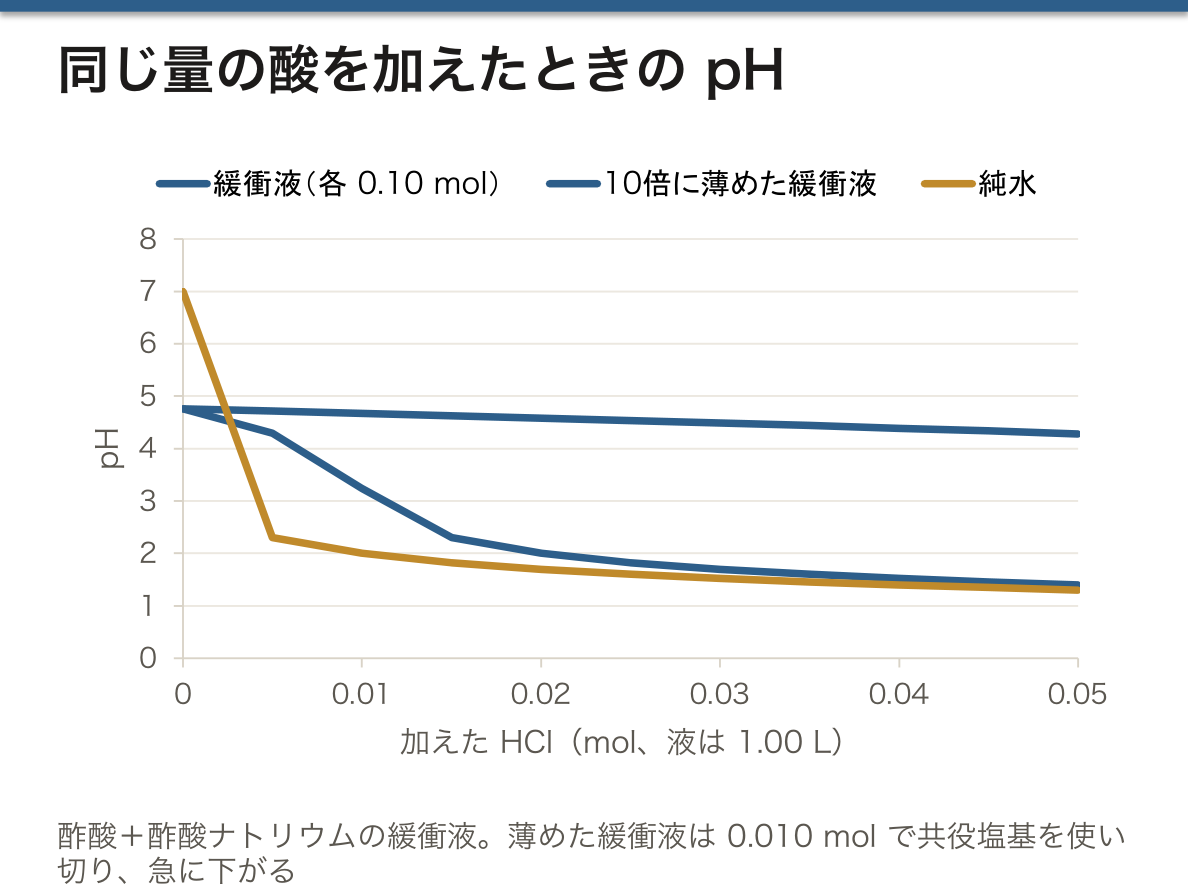
なぜ緩衝液ではほとんど動かないのか。純水では加えた H+ がそのまま残るが、緩衝液では加えた H+ のほとんどが共役塩基に捕まって弱酸の分子になり、遊離の H+ として残らないからである。pH を決めるのは成分の比で、0.100 : 0.100 が 0.090 : 0.110 になる程度の変化では、log の値はわずかしか動かない。
ただし、加えた強酸の量が塩(共役塩基)の量を超えると、引き受け手がなくなり pH は急に下がる。これが緩衝の限界で、滴定曲線で緩衝域を過ぎると当量点の跳躍が来るのと同じことである。実験で緩衝液・薄めた緩衝液・純水に同じ量の酸と塩基を加えて比べると、純水は大きく、薄めた緩衝液はやや大きく、濃い緩衝液はほとんど pH が動かない。
English version
Core
When strong acid or base is added to a buffer, first calculate how the reaction changes the moles of the components, then use the Henderson–Hasselbalch equation.
Strong acid added (n mol of H+): salt falls by n and acid rises by n. pH = pKa + log((nsalt − n) / (nacid + n))
Strong base added (n mol of OH−): acid falls by n and salt rises by n. pH = pKa + log((nsalt + n) / (nacid − n))
Example: add 0.010 mol of HCl to 1.00 L of buffer with 0.100 mol each of acetic acid and sodium acetate (pH 4.76). pH = 4.76 + log(0.090/0.110) = 4.76 − 0.09 = 4.67. The same HCl in 1.00 L of pure water gives [H+] = 0.010 mol/L, and the pH falls from 7 to 2.00.
Going further
Why does the buffer barely move? In pure water the added H+ stays as it is; in a buffer almost all the added H+ is caught by the conjugate base and becomes weak-acid molecules, so it does not remain as free H+. The pH is set by the ratio, and a change from 0.100 : 0.100 to 0.090 : 0.110 moves the log only a little.
But if the added strong acid is more than the salt (conjugate base), nothing is left to take it up, and the pH falls sharply. This is the limit of buffering — the same as the jump at the equivalence point after the buffer region of a titration curve. If you add the same acid and base to a concentrated buffer, a diluted buffer and pure water, pure water changes a lot, the diluted buffer somewhat, and the concentrated buffer hardly at all.
緩衝能と有効な緩衝範囲 — pKa ± 1
緩衝能 β は、緩衝液がどれだけ酸・塩基を受け止められるかの尺度で、緩衝液 1 L の pH を 1 変えるのに要する強酸または強塩基の物質量である。
β = n(加えた H+ または OH−)/ (V(緩衝液)× ΔpH)(単位 mol/L)
前の項目の例では、0.010 mol の HCl で ΔpH = 0.087 なので、β = 0.010 / (1.00 × 0.087) ≈ 0.11 mol/L。
緩衝能は、①成分の総濃度が高いほど大きい、②成分の比が 1 : 1(pH = pKa)のとき最大。有効に働くのは比が 10 : 1 から 1 : 10 の間、つまり pH = pKa ± 1 の範囲である。
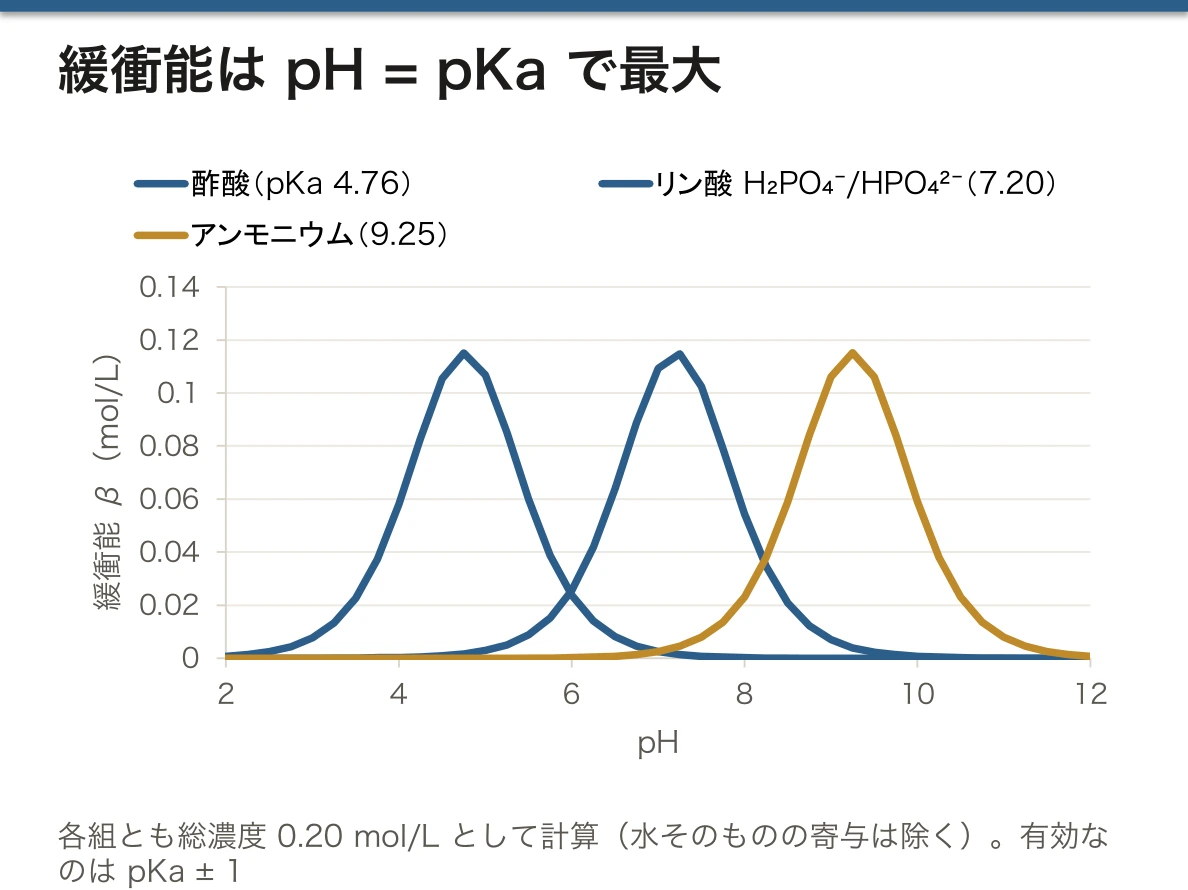
なぜ ±1 なのか。比が 10 : 1 を超えると少ない側の成分がほとんど残っておらず、その向きの酸・塩基を少し加えただけで使い切ってしまう。緩衝液を選ぶときは、まず目的の pH に pKa が近い組を選ぶ:酢酸(4.76)なら pH 4〜6 付近、リン酸の H2PO4−/HPO42−(7.20)なら pH 6〜8 付近、アンモニウム(9.25)なら pH 8〜10 付近。
薄めた緩衝液の pH は変わらないが、緩衝能は濃度に比例して下がる。10倍に薄めた緩衝液は、同じ量の酸で10倍近く pH が動く。「pH は比が決め、耐える力は量が決める」と分けて覚えるとよい。
実験や医療で使う液の多くは緩衝されている。細胞や組織を扱うときのリン酸緩衝生理食塩水(PBS)は pH 7.4 付近に保たれ、注射剤や点眼剤も pH が緩衝で調整されている。採血後の検体も、そのまま放置すると細胞の代謝で乳酸がたまり pH が下がるので、血液ガスはすぐに測るか冷やして運ぶ。
English version
Core
Buffer capacity β measures how much acid or base a buffer can take: the moles of strong acid or strong base needed to change the pH of 1 L of buffer by 1.
β = n(added H+ or OH−) / (V(buffer) × ΔpH) (unit mol/L)
In the previous example, 0.010 mol of HCl gave ΔpH = 0.087, so β = 0.010 / (1.00 × 0.087) ≈ 0.11 mol/L.
Buffer capacity is ① larger when the total concentration of the components is higher, and ② largest when the ratio is 1 : 1 (pH = pKa). A buffer works well for ratios from 10 : 1 to 1 : 10, that is, pH = pKa ± 1.
Going further
Why ±1? Beyond a ratio of 10 : 1, very little of the minor component remains, and a small addition of acid or base in that direction uses it all up. To choose a buffer, first pick a pair with pKa near the target pH: acetate (4.76) for about pH 4–6, phosphate H2PO4−/HPO42− (7.20) for about pH 6–8, ammonium (9.25) for about pH 8–10.
Diluting a buffer leaves its pH unchanged, but the capacity falls in proportion to concentration. A ten-fold diluted buffer moves almost ten times as much with the same acid. Remember: “the ratio sets the pH; the amount sets how much it can take.”
In the clinic
Many fluids used in labs and medicine are buffered. Phosphate-buffered saline (PBS), used with cells and tissues, is kept near pH 7.4, and injections and eye drops have their pH adjusted with buffers. A blood sample left standing builds up lactate from cell metabolism and its pH falls, so blood gases are measured at once or carried on ice.
血液の緩衝系 — 炭酸–炭酸水素イオン系はなぜ強いのか
血液の主な緩衝系は次の4つである。
| 緩衝系 | おもな場所と特徴 |
|---|---|
| 炭酸–炭酸水素イオン系(CO2・H2CO3 / HCO3−) | 血漿・間質液。最も量が多く、肺と腎で調節できる |
| ヘモグロビン系 | 赤血球内。ヒスチジン残基が H+ を受け止める。CO2 の運搬と一体 |
| リン酸系(H2PO4− / HPO42−、pKa 7.2) | 細胞内と尿で重要。血漿では濃度が低い |
| 血漿蛋白(アルブミンなど) | 多数の側鎖が H+ を出し入れする |
炭酸系にヘンダーソン–ハッセルバルヒの式を当てはめると、pH = 6.1 + log([HCO3−] / (0.03 × PaCO2))(HCO3− は mmol/L、PaCO2 は mmHg、0.03 は CO2 の溶解係数)。正常値 [HCO3−] 24 mmol/L、PaCO2 40 mmHg を入れると、24 / 1.2 = 20、log 20 ≈ 1.3、pH ≈ 7.4。
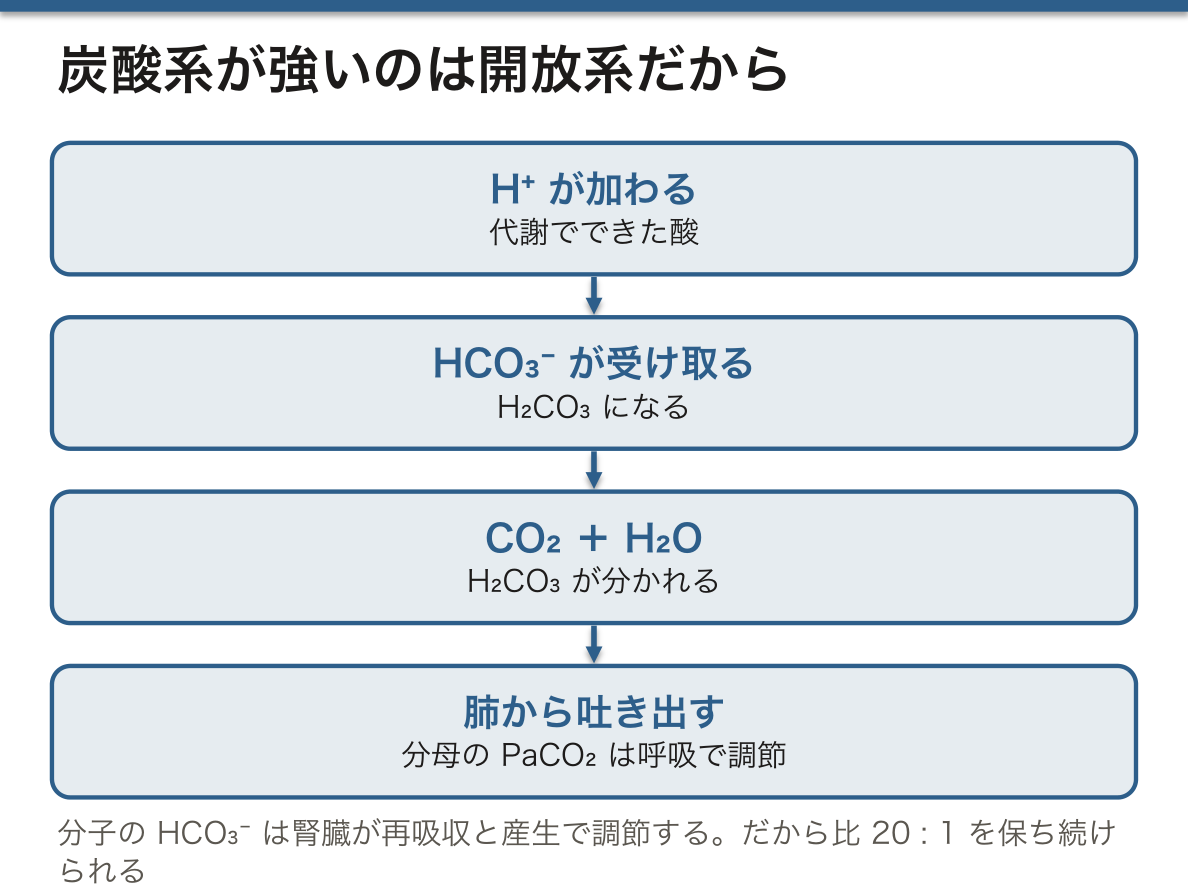
不思議なのは、pKa が 6.1 で血液の pH 7.4 から 1 以上離れており、「pKa ± 1」の有効範囲の端にあるのに、炭酸系が最強の緩衝系である点である。理由は開放系だからである。H+ が加わって H2CO3 が増えても、それは CO2 と水に分かれて肺から吐き出される。HCO3− の量は腎臓が再吸収と新しい産生で調節する。閉じた試験管の緩衝液なら比が崩れていくが、体では分母(CO2)を呼吸で、分子(HCO3−)を腎で別々に動かせるので、比 20 : 1 を保ち続けられる。
なお 6.1 は 37 °C の血漿での見かけの pKa で、25 °C の水で測る炭酸の pKa(約6.35)と少し違う。式の中の 0.03 × PaCO2 は、溶けている CO2(と少量の H2CO3)を mmol/L に直したものである。
この式が血液ガスの読み方の骨格である。pH は「腎が決める HCO3−」と「肺が決める PaCO2」の比で決まり、どちらか一方が動けば、もう一方が同じ向きに動いて比を戻そうとする(代償)。国試や CBT で血液ガスを読むとき、まず pH、次に PaCO2 と HCO3− のどちらが原因の向きに動いているかを見るのは、この比の式を頭の中でたどっているからである。
English version
Core
Blood has four main buffer systems.
| Buffer system | Main site and features |
|---|---|
| Carbonic acid–bicarbonate (CO2, H2CO3 / HCO3−) | plasma and interstitial fluid; the largest, and controlled by lungs and kidneys |
| Haemoglobin | inside red cells; histidine residues take up H+; works together with CO2 transport |
| Phosphate (H2PO4− / HPO42−, pKa 7.2) | important inside cells and in urine; low concentration in plasma |
| Plasma proteins (albumin, etc.) | many side chains give and take H+ |
Applying the Henderson–Hasselbalch equation to the carbonate system: pH = 6.1 + log([HCO3−] / (0.03 × PaCO2)) (HCO3− in mmol/L, PaCO2 in mmHg, 0.03 = solubility of CO2). With normal values [HCO3−] 24 mmol/L and PaCO2 40 mmHg: 24 / 1.2 = 20, log 20 ≈ 1.3, so pH ≈ 7.4.
Going further
Strangely, the pKa of 6.1 is more than 1 unit from blood pH 7.4 — at the edge of the “pKa ± 1″ range — yet the carbonate system is the strongest buffer. The reason is that it is an open system. When H+ is added and H2CO3 rises, it splits into CO2 and water, and the CO2 is breathed out by the lungs. The amount of HCO3− is controlled by the kidneys through reabsorption and new production. In a closed test tube the ratio would drift, but the body can move the denominator (CO2) by breathing and the numerator (HCO3−) by the kidneys separately, and so keeps the ratio at 20 : 1.
6.1 is the apparent pKa in plasma at 37 °C, a little different from the pKa of carbonic acid in water at 25 °C (about 6.35). The term 0.03 × PaCO2 converts dissolved CO2 (with a little H2CO3) into mmol/L.
In the clinic
This equation is the skeleton of blood-gas interpretation. pH is set by the ratio of HCO3− (set by the kidneys) to PaCO2 (set by the lungs). If one moves, the other moves in the same direction to restore the ratio (compensation). When reading blood gases, you look first at pH, then at whether PaCO2 or HCO3− has moved in the direction of the cause — because you are following this ratio equation in your head.
酸塩基平衡の乱れと代償 — 4つの型
炭酸系の式の分子(HCO3−)と分母(PaCO2)のどちらが先に動いたかで、乱れは4つに分かれる。
| 型 | 最初の変化 | 代表的な原因 | 代償 |
|---|---|---|---|
| 呼吸性アシドーシス | PaCO2 ↑ | COPD の増悪、呼吸抑制(薬物・神経筋疾患) | 腎が HCO3− を増やす(数日) |
| 呼吸性アルカローシス | PaCO2 ↓ | 過換気(不安・疼痛・低酸素・高地) | 腎が HCO3− を減らす |
| 代謝性アシドーシス | HCO3− ↓ | 糖尿病ケトアシドーシス、乳酸アシドーシス、腎不全、下痢 | 換気が増えて PaCO2 ↓(数分〜数時間) |
| 代謝性アルカローシス | HCO3− ↑ | 嘔吐(胃酸の喪失)、利尿薬 | 換気が減って PaCO2 ↑ |
代償は比を元に戻す向きに働き、普通は pH を完全には正常に戻さない(元の乱れの向きに少し残る)。肺による代償は速く、腎による代償は遅い。代謝性アシドーシスで呼吸が深く速くなる(クスマウル呼吸)のは、PaCO2 を下げて分母を小さくし、比を戻そうとしているからである。
代謝性アシドーシスでは、原因を分けるのにアニオンギャップ AG = Na+ − (Cl− + HCO3−)(基準はおよそ 12 ± 2 mEq/L)を使う。血漿の陽イオンと陰イオンの電荷は等しいので、AG は測らない陰イオン(アルブミン、リン酸、乳酸、ケトン体など)の量を表す。ケトン体や乳酸のような酸が増えると、その陰イオンが HCO3− の代わりに入るので AG が開く。下痢で HCO3− を失う場合は Cl− が代わりに増えるので AG は正常のままである。化学量論で学んだ電気的中性が、そのまま診断の道具になっている。
輸液の選び方にもこの考え方が出てくる。生理食塩液を大量に入れると Cl− が増えて HCO3− が下がり、AG 正常の代謝性アシドーシスになりうる。乳酸リンゲル液の乳酸は肝で代謝されて HCO3− になるので、この傾きを和らげる。嘔吐が続く患者では胃酸(HCl)を失って代謝性アルカローシスになり、Cl− の補充(生理食塩液)で改善することが多い。
English version
Core
Depending on whether the numerator (HCO3−) or the denominator (PaCO2) of the carbonate equation moves first, disorders fall into four types.
| Type | First change | Typical causes | Compensation |
|---|---|---|---|
| Respiratory acidosis | PaCO2 ↑ | COPD exacerbation, depressed breathing (drugs, neuromuscular disease) | kidneys raise HCO3− (days) |
| Respiratory alkalosis | PaCO2 ↓ | hyperventilation (anxiety, pain, hypoxia, altitude) | kidneys lower HCO3− |
| Metabolic acidosis | HCO3− ↓ | diabetic ketoacidosis, lactic acidosis, renal failure, diarrhoea | more ventilation, PaCO2 ↓ (minutes to hours) |
| Metabolic alkalosis | HCO3− ↑ | vomiting (loss of gastric acid), diuretics | less ventilation, PaCO2 ↑ |
Going further
Compensation works to restore the ratio, and usually does not bring pH fully back to normal (a little of the original shift remains). Lung compensation is fast; kidney compensation is slow. Deep, fast breathing in metabolic acidosis (Kussmaul breathing) lowers PaCO2, making the denominator smaller to restore the ratio.
To sort the causes of metabolic acidosis, use the anion gap AG = Na+ − (Cl− + HCO3−) (normal about 12 ± 2 mEq/L). Plasma positive and negative charges are equal, so the AG represents the unmeasured anions (albumin, phosphate, lactate, ketone bodies and others). When acids such as ketones or lactate build up, their anions replace HCO3−, so the AG widens. When HCO3− is lost in diarrhoea, Cl− rises in its place, so the AG stays normal. Electroneutrality, learned in stoichiometry, becomes a diagnostic tool.
In the clinic
The same thinking guides fluid choice. Large volumes of normal saline raise Cl− and lower HCO3−, which can cause a normal-AG metabolic acidosis. The lactate in lactated Ringer’s is metabolised in the liver to HCO3−, softening this effect. A patient with persistent vomiting loses gastric acid (HCl) and develops metabolic alkalosis, which often improves with chloride replacement (normal saline).
まとめ
| 緩衝液のしくみ — 弱酸と共役塩基が酸も塩基も引き受ける | 緩衝液は2つの成分からなる。酸を中和する成分(塩基として働く)と、塩基を中和する成分(酸として働く)で、実際には次のような組である。 |
|---|---|
| ヘンダーソン–ハッセルバルヒの式 — 緩衝液の pH は比で決まる | 弱酸の Ka = [H+][A−]/[HA] を変形し、−log をとるとpH = pKa + log([A−] / [HA]) = pKa + log(c塩 / c酸)弱塩基の緩… |
| 強酸・強塩基を加えたときの pH — 比が少しずれるだけ | 緩衝液に強酸や強塩基を加えたときは、反応で成分の物質量がどう変わるかを先に計算してから、ヘンダーソン–ハッセルバルヒの式に入れる。 |
| 緩衝能と有効な緩衝範囲 — pKa ± 1 | 緩衝能 β は、緩衝液がどれだけ酸・塩基を受け止められるかの尺度で、緩衝液 1 L の pH を 1 変えるのに要する強酸または強塩基の物質量である。 |
| 血液の緩衝系 — 炭酸–炭酸水素イオン系はなぜ強いのか | 血液の主な緩衝系は次の4つである。緩衝系おもな場所と特徴炭酸–炭酸水素イオン系(CO2・H2CO3 / HCO3−)血漿・間質液。 |
| 酸塩基平衡の乱れと代償 — 4つの型 | 炭酸系の式の分子(HCO3−)と分母(PaCO2)のどちらが先に動いたかで、乱れは4つに分かれる。 |
このノートは医学生が授業の内容を自分の言葉でまとめたもので、診療の判断に使うものではありません。誤りに気づいたらお知らせください。