酸化還元反応は電子の受け渡しである。電子を失うのが酸化、受け取るのが還元で、片方だけが起こることはない。この章では、酸化数で「誰が電子を失い、誰が受け取ったか」を見分け、半反応式で式をつり合わせ、標準電極電位で反応の向きを予想する。
生体のエネルギー獲得は、本質的には食物の電子を酸素に渡す長い酸化還元反応である。ミトコンドリアの電子伝達系、活性酸素とそれを消す酵素、消毒薬の作用、メトヘモグロビン血症まで、すべてこの章の言葉で説明できる。
- 酸化と還元 — 酸化剤は還元され、還元剤は酸化される
- 酸化数 — 電子の行き先を数える帳簿
- 半反応式で式をつり合わせる — 原子と電荷の両方をそろえる
- 液の性質で生成物が変わる — 酸性・中性・塩基性の過マンガン酸イオン
- 標準電極電位 E° — 酸化剤の強さの物差し
- 生体の酸化還元 — 電子伝達系と活性酸素
酸化と還元 — 酸化剤は還元され、還元剤は酸化される
酸化は電子を失うこと(酸化数が増える)、還元は電子を受け取ること(酸化数が減る)である。電子は消えないので、酸化と還元は必ず同時に起こる。
相手を酸化する物質が酸化剤で、自分は電子を受け取って還元される。相手を還元する物質が還元剤で、自分は電子を失って酸化される。Fe + CuCl2 → FeCl2 + Cu では、Fe が電子2個を失って Fe2+ に酸化され(還元剤)、Cu2+ が電子を受け取って Cu に還元される(酸化剤)。
「酸化剤なのに還元される」が混乱のもとである。名前は相手に何をするか、変化は自分に何が起きるかと分けて覚える。英語の語呂 OIL RIG(Oxidation Is Loss, Reduction Is Gain)も便利である。
歴史的には「酸素と結びつく=酸化」「水素と結びつく=還元」と定義されていた。C + O2 → CO2 で C は酸化される。電子の定義はこれを含み、酸素が関わらない反応(Zn + Cl2 → ZnCl2 で Zn が酸化される)まで扱える、より広い定義である。生化学で「脱水素=酸化」と言うのも同じことで、有機物から H(実際には電子2個と H+)が外れると、その物質は酸化されている。
English version
Core
Oxidation is losing electrons (the oxidation number goes up); reduction is gaining electrons (it goes down). Electrons do not vanish, so oxidation and reduction always happen together.
A substance that oxidises another is an oxidising agent; it gains electrons and is reduced. A substance that reduces another is a reducing agent; it loses electrons and is oxidised. In Fe + CuCl2 → FeCl2 + Cu, Fe loses two electrons and is oxidised to Fe2+ (reducing agent), and Cu2+ gains them and is reduced to Cu (oxidising agent).
Going further
“The oxidising agent is reduced” is the usual confusion. Remember: the name says what it does to the other; the change says what happens to itself. The phrase OIL RIG (Oxidation Is Loss, Reduction Is Gain) helps.
Historically, “combining with oxygen” was oxidation and “combining with hydrogen” was reduction: in C + O2 → CO2, C is oxidised. The electron definition includes this and also covers reactions without oxygen (in Zn + Cl2 → ZnCl2, Zn is oxidised). In biochemistry, “dehydrogenation = oxidation” means the same thing: when H (really two electrons and H+) leaves an organic molecule, that molecule is oxidised.
酸化数 — 電子の行き先を数える帳簿
酸化数は、結合の電子をすべて電気陰性度の大きい側に割り当てたときの、各原子の見かけの電荷である。決め方の規則は次のとおり。
①単体の原子は 0。②単原子イオンはその電荷(Fe3+ は +3)。③O はふつう −2(過酸化物 H2O2 では −1)。④H はふつう +1(金属の水素化物では −1)。⑤F は常に −1。⑥化合物では合計が0、多原子イオンでは合計がイオンの電荷。
例:MnO4− の Mn は x + 4 × (−2) = −1 より +7。Cr2O72− の Cr は 2x − 14 = −2 より +6。SO32− の S は +4、SO42− の S は +6。
酸化数の役割は、反応式のどこで電子が動いたかを見つけることである。酸化数が増えた原子が酸化され、減った原子が還元された。変化した数が、その原子1個が失った・受け取った電子の数になる。
| Mn を含む粒子 | Mn の酸化数 | 色 |
|---|---|---|
| MnO4−(過マンガン酸イオン) | +7 | 赤紫 |
| MnO42−(マンガン酸イオン) | +6 | 緑 |
| MnO2(二酸化マンガン) | +4 | 褐色(固体) |
| Mn2+ | +2 | ほぼ無色(淡い桃色) |
最も高い酸化数(Mn の +7)にある原子はもう電子を失えないので酸化剤にしかなれず、最も低い状態の原子は還元剤にしかなれない。中間の酸化数をもつものは両方になれる。H2O2 の O(−1)は、強い酸化剤の前では O2(0)に酸化されて還元剤として働き、I− の前では H2O(−2)に還元されて酸化剤として働く。
English version
Core
The oxidation number is the apparent charge of an atom when all bonding electrons are given to the more electronegative atom. The rules:
① An atom in an element is 0. ② A single-atom ion has its charge (Fe3+ is +3). ③ O is usually −2 (−1 in peroxides such as H2O2). ④ H is usually +1 (−1 in metal hydrides). ⑤ F is always −1. ⑥ The sum is 0 in a compound and equals the ion’s charge in a polyatomic ion.
Examples: Mn in MnO4−: x + 4 × (−2) = −1, so +7. Cr in Cr2O72−: 2x − 14 = −2, so +6. S is +4 in SO32− and +6 in SO42−.
Going further
Oxidation numbers show where electrons moved in an equation. An atom whose oxidation number goes up is oxidised; one whose number goes down is reduced. The size of the change is the number of electrons that one atom lost or gained.
| Mn species | Oxidation number of Mn | Colour |
|---|---|---|
| MnO4− (permanganate) | +7 | purple |
| MnO42− (manganate) | +6 | green |
| MnO2 (manganese dioxide) | +4 | brown (solid) |
| Mn2+ | +2 | almost colourless (very pale pink) |
An atom at its highest oxidation number (Mn at +7) cannot lose more electrons, so it can only be an oxidising agent; an atom at its lowest state can only be a reducing agent. Species in between can be both. The O in H2O2 (−1) is oxidised to O2 (0) by a strong oxidising agent, acting as a reducing agent, but with I− it is reduced to H2O (−2), acting as an oxidising agent.
半反応式で式をつり合わせる — 原子と電荷の両方をそろえる
酸化還元の式は、酸化と還元を別々の半反応式に分けて、それぞれをつり合わせてから足し合わせる。
①液が酸性・中性・塩基性のどれかを決める。②酸化される粒子と還元される粒子を見つけ、半反応式を書く(O は H2O で、H は酸性なら H+ で合わせ、塩基性なら OH− を使う)。電子 e− で電荷を合わせる。③両方の電子の数が同じになるように整数倍する。④足し合わせ、両辺に共通する電子・H+・H2O を消す。⑤原子の数と電荷の合計が両辺でそろっているか確かめる。
例:酸性で MnO4− が SO32− を酸化する。
還元:MnO4− + 8H+ + 5e− → Mn2+ + 4H2O (×2)
酸化:SO32− + H2O → SO42− + 2H+ + 2e− (×5)
足して整理すると 2MnO4− + 5SO32− + 6H+ → 2Mn2+ + 5SO42− + 3H2O。電荷は左 (−2) + (−10) + (+6) = −6、右 (+4) + (−10) = −6 でそろう。
なぜ電子の数をそろえるのか。酸化剤が受け取る電子は、還元剤が失った電子そのものだからである。電子が余ったり足りなかったりする式は、電荷保存に反する。最後の電荷の確認は省かない。原子の数だけそろっていて電荷が合わない式は、どこかの係数か H+ の数がまちがっている。つり合った式の係数は、そのまま滴定の量的関係(MnO4− 2 mol で SO32− 5 mol)になる。
English version
Core
Split a redox equation into separate half-equations for oxidation and reduction, balance each one, then add them.
① Decide whether the solution is acidic, neutral or basic. ② Find the species oxidised and reduced, and write the half-equations (balance O with H2O; balance H with H+ in acid, or use OH− in base). Balance the charge with electrons e−. ③ Multiply so that both have the same number of electrons. ④ Add them and cancel electrons, H+ and H2O that appear on both sides. ⑤ Check that atoms and total charge are the same on both sides.
Going further
Example: in acid, MnO4− oxidises SO32−.
Reduction: MnO4− + 8H+ + 5e− → Mn2+ + 4H2O (×2)
Oxidation: SO32− + H2O → SO42− + 2H+ + 2e− (×5)
Adding and tidying gives 2MnO4− + 5SO32− + 6H+ → 2Mn2+ + 5SO42− + 3H2O. Charge: left (−2) + (−10) + (+6) = −6; right (+4) + (−10) = −6. They match.
Why make the electrons equal? The electrons the oxidising agent gains are exactly those the reducing agent loses. An equation with extra or missing electrons breaks conservation of charge. Never skip the final charge check. If atoms balance but charges do not, a coefficient or the number of H+ is wrong. The coefficients of the balanced equation are the amounts used in titration (2 mol MnO4− with 5 mol SO32−).
液の性質で生成物が変わる — 酸性・中性・塩基性の過マンガン酸イオン
同じ MnO4− でも、液が酸性・中性・塩基性のどれかで還元のされ方(受け取る電子の数)と生成物が変わる。色の変化で見分けられる。
| 液 | 半反応式 | 電子 | 見た目 |
|---|---|---|---|
| 酸性(H2SO4) | MnO4− + 8H+ + 5e− → Mn2+ + 4H2O | 5 | 赤紫 → ほぼ無色 |
| 中性(H2O) | MnO4− + 2H2O + 3e− → MnO2 + 4OH− | 3 | 赤紫 → 褐色の沈殿 |
| 塩基性(NaOH) | MnO4− + e− → MnO42− | 1 | 赤紫 → 緑 |
SO32− を還元剤にすると、全体の式はそれぞれ次のようになる。
酸性:2MnO4− + 5SO32− + 6H+ → 2Mn2+ + 5SO42− + 3H2O
中性:2MnO4− + 3SO32− + H2O → 2MnO2 + 3SO42− + 2OH−
塩基性:2MnO4− + SO32− + 2OH− → 2MnO42− + SO42− + H2O
酸性で最も強い酸化剤になるのはなぜか。酸性の半反応式では H+ が反応物として8個も消費される。H+ が多いほど平衡が右に押され(ルシャトリエの原理)、MnO4− が電子を受け取る傾向、つまり電位が高くなる。反応の比が一定で、生成物が無色で終点が見やすいので、滴定には酸性の条件を使う。この「H+ が式に入っている半反応は pH で強さが変わる」という性質は MnO4− に限らず、Cr2O72− なども同じである。一方、Fe3+/Fe2+ のように H+ を含まない半反応は、pH の影響をほとんど受けない。
English version
Core
The same MnO4− is reduced differently, taking a different number of electrons and giving different products, depending on whether the solution is acidic, neutral or basic. The colour tells you which.
| Medium | Half-equation | Electrons | What you see |
|---|---|---|---|
| Acidic (H2SO4) | MnO4− + 8H+ + 5e− → Mn2+ + 4H2O | 5 | purple → almost colourless |
| Neutral (H2O) | MnO4− + 2H2O + 3e− → MnO2 + 4OH− | 3 | purple → brown precipitate |
| Basic (NaOH) | MnO4− + e− → MnO42− | 1 | purple → green |
Going further
With SO32− as the reducing agent, the full equations are:
Acidic: 2MnO4− + 5SO32− + 6H+ → 2Mn2+ + 5SO42− + 3H2O
Neutral: 2MnO4− + 3SO32− + H2O → 2MnO2 + 3SO42− + 2OH−
Basic: 2MnO4− + SO32− + 2OH− → 2MnO42− + SO42− + H2O
Why is it the strongest oxidising agent in acid? The acidic half-equation uses eight H+ as reactants. More H+ pushes the equilibrium to the right (Le Chatelier), so MnO4− takes electrons more readily — its potential is higher. The ratio is fixed and the product is colourless, giving a clear end point, so titrations use acidic conditions. Any half-equation that contains H+ changes strength with pH; Cr2O72− behaves the same way. Half-equations without H+, such as Fe3+/Fe2+, are hardly affected by pH.
標準電極電位 E° — 酸化剤の強さの物差し
半反応「酸化型 + ne− → 還元型」の電子の受け取りやすさを、標準水素電極(2H+ + 2e− → H2 を 0 V とする)と比べた値が標準電極電位 E° である。E° が大きい(正に大きい)ほど電子を受け取りやすく、強い酸化剤、E° が小さい(負に大きい)ほど還元型が電子を出しやすく、強い還元剤である。
| 半反応 | E°(V) |
|---|---|
| MnO4− + 8H+ + 5e− → Mn2+ + 4H2O | +1.51 |
| Cl2 + 2e− → 2Cl− | +1.36 |
| Cr2O72− + 14H+ + 6e− → 2Cr3+ + 7H2O | +1.33 |
| Fe3+ + e− → Fe2+ | +0.77 |
| I2 + 2e− → 2I− | +0.54 |
| Cu2+ + 2e− → Cu | +0.34 |
| 2H+ + 2e− → H2 | 0.00 |
| Zn2+ + 2e− → Zn | −0.76 |
反応の向きは、E° の大きい組の酸化型が、E° の小さい組の還元型を酸化すると読む。MnO4−(+1.51)は Fe2+(+0.77)も I−(+0.54)も酸化できるが、I2 は Fe2+ を酸化できない。酸化剤の強さの順は表の上から MnO4− > Cl2 > Cr2O72− > Fe3+ > I2 となる。
電位の差は ΔG とつながっている:ΔG° = −nFE°cell(n:移動する電子の mol、F = 96 485 C/mol、E°cell = E°(酸化剤側)− E°(還元剤側))。E°cell > 0 なら ΔG° < 0 で自発的に進む。熱力学の章の「ΔG の符号で向きが決まる」が、電気化学では「電位の差の符号で向きが決まる」と言い換えられている。なお表の値は標準状態(1 mol/L、25 °C、H+ を含む反応は pH 0)のもので、実際の電位は濃度と pH で動く。
消毒薬の多くは酸化剤である。過酸化水素(オキシドール)、ポビドンヨード、次亜塩素酸ナトリウムは、微生物の蛋白や膜の成分を酸化して壊す。強い酸化剤ほど効くが、同じ理由で人の組織も傷つけるので、粘膜や創部への使い方に注意がいる。
English version
Core
The standard electrode potential E° measures how readily the half-reaction “oxidised form + ne− → reduced form” takes electrons, compared with the standard hydrogen electrode (2H+ + 2e− → H2, set at 0 V). The larger (more positive) E°, the more readily it takes electrons — a stronger oxidising agent. The smaller (more negative) E°, the more readily the reduced form gives electrons — a stronger reducing agent.
| Half-reaction | E° (V) |
|---|---|
| MnO4− + 8H+ + 5e− → Mn2+ + 4H2O | +1.51 |
| Cl2 + 2e− → 2Cl− | +1.36 |
| Cr2O72− + 14H+ + 6e− → 2Cr3+ + 7H2O | +1.33 |
| Fe3+ + e− → Fe2+ | +0.77 |
| I2 + 2e− → 2I− | +0.54 |
| Cu2+ + 2e− → Cu | +0.34 |
| 2H+ + 2e− → H2 | 0.00 |
| Zn2+ + 2e− → Zn | −0.76 |
Going further
Read the direction like this: the oxidised form of the couple with higher E° oxidises the reduced form of the couple with lower E°. MnO4− (+1.51) can oxidise both Fe2+ (+0.77) and I− (+0.54), but I2 cannot oxidise Fe2+. The order of oxidising strength, from the top of the table, is MnO4− > Cl2 > Cr2O72− > Fe3+ > I2.
The potential difference is linked to ΔG: ΔG° = −nFE°cell (n: moles of electrons moved; F = 96 485 C/mol; E°cell = E°(oxidising side) − E°(reducing side)). If E°cell > 0, ΔG° < 0 and the reaction is spontaneous. “The sign of ΔG decides the direction” from thermodynamics becomes “the sign of the potential difference decides the direction” in electrochemistry. Table values are for standard conditions (1 mol/L, 25 °C, pH 0 for reactions with H+); real potentials move with concentration and pH.
In the clinic
Many disinfectants are oxidising agents. Hydrogen peroxide, povidone-iodine and sodium hypochlorite destroy microbes by oxidising their proteins and membrane components. Stronger oxidising agents work better, but for the same reason they also damage human tissue, so care is needed on mucosa and wounds.
生体の酸化還元 — 電子伝達系と活性酸素
細胞は栄養素を酸化して得た電子を、まず補酵素 NAD+(→ NADH)や FAD(→ FADH2)に渡す。NADH の電子はミトコンドリア内膜の電子伝達系を順に流れ、最後に O2 に渡されて H2O ができる。流れる間に放出されるエネルギーで H+ が膜の外へくみ出され、その濃度勾配で ATP が作られる(酸化的リン酸化)。
電子の流れる向きは電位で決まっている。生化学の標準電位(pH 7)で NAD+/NADH は約 −0.32 V、O2/H2O は約 +0.82 V。電子は電位の低い側から高い側へと「坂を下る」。
この電位差 1.14 V を ΔG に直すと、NADH 1 mol(電子 2 mol)あたり ΔG°′ = −2 × 96 485 × 1.14 ≈ −220 kJ/mol。ATP 1 mol を作るのに要る約 +30.5 kJ/mol に比べてずっと大きい。電子伝達系がこれを一度に放出せず、複合体 I〜IV で数段に分けて受け渡すのは、熱力学の章で見た「燃焼のように一度に熱を出す反応は細胞では使えない」という制約への答えである。
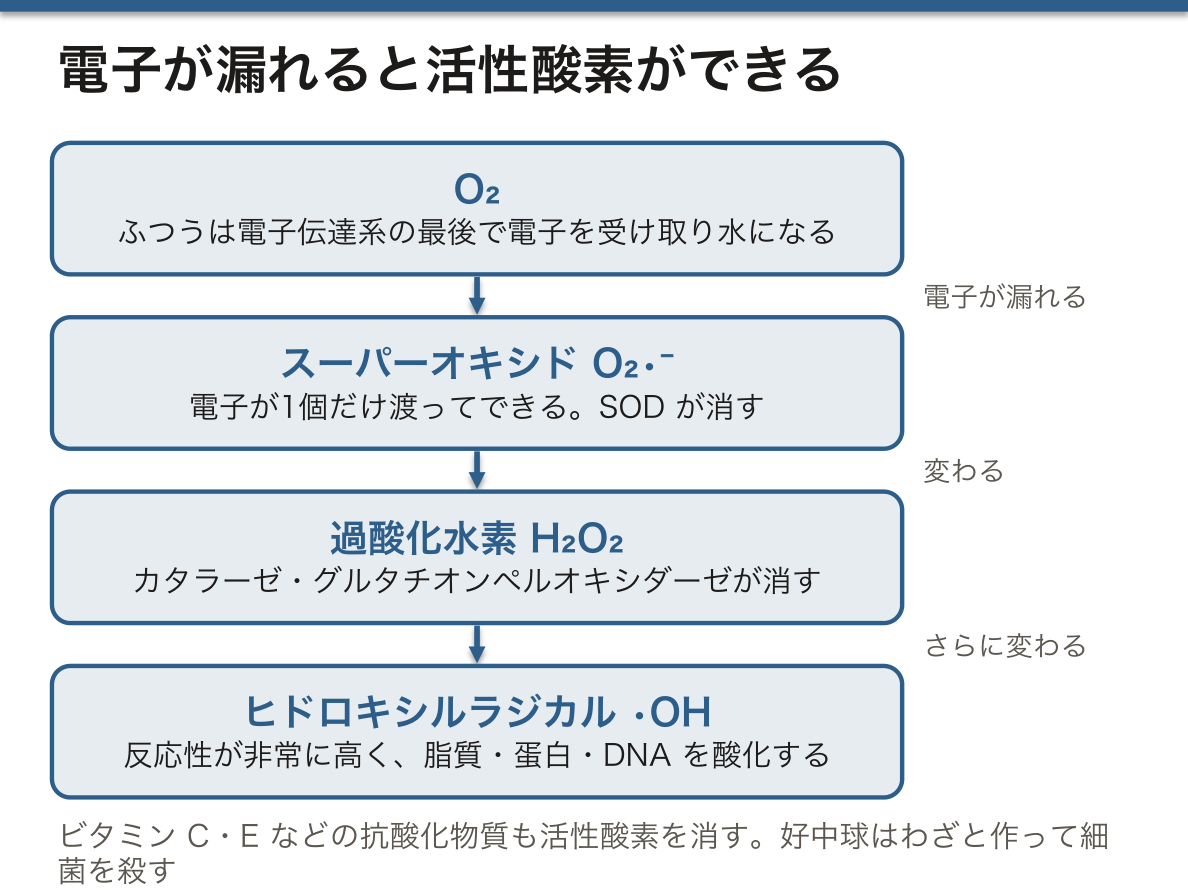
電子が途中で漏れて O2 に1個だけ渡ると、スーパーオキシド O2•− ができる。これが過酸化水素 H2O2、さらに非常に反応性の高いヒドロキシルラジカル •OH に変わる。これらをまとめて活性酸素と呼び、脂質・蛋白・DNA を酸化して傷つける。体はスーパーオキシドジスムターゼ(SOD)・カタラーゼ・グルタチオンペルオキシダーゼと、ビタミン C・E などの抗酸化物質でこれを消している。
活性酸素は虚血再灌流障害(血流が戻った瞬間に組織障害が強まる)や炎症、老化に関わり、好中球はわざと活性酸素を作って細菌を殺す。シアン化物は電子伝達系の最後の酵素(シトクロム c オキシダーゼ)を止め、酸素があっても使えなくする。またヘモグロビンの Fe2+ が Fe3+ に酸化されたメトヘモグロビンは酸素を運べず、亜硝酸塩や一部の薬で増えてチアノーゼを起こす(治療は還元を助けるメチレンブルー)。
English version
Core
Cells pass electrons taken from nutrients first to the coenzymes NAD+ (→ NADH) and FAD (→ FADH2). Electrons from NADH flow step by step through the electron transport chain in the inner mitochondrial membrane and finally go to O2, making H2O. The energy released on the way pumps H+ out across the membrane, and this gradient makes ATP (oxidative phosphorylation).
The direction of flow is set by potentials. At the biochemical standard (pH 7), NAD+/NADH is about −0.32 V and O2/H2O about +0.82 V. Electrons “run downhill” from low to high potential.
Going further
This 1.14 V difference as ΔG: per mole of NADH (2 mol electrons), ΔG°′ = −2 × 96 485 × 1.14 ≈ −220 kJ/mol, much larger than the about +30.5 kJ/mol needed to make 1 mol of ATP. The chain does not release this all at once but passes electrons through complexes I–IV in steps. This answers the limit seen in thermodynamics: a cell cannot use a reaction that releases heat all at once, like burning.
If an electron leaks on the way and only one is given to O2, superoxide O2•− forms. It turns into hydrogen peroxide H2O2 and then the very reactive hydroxyl radical •OH. Together these are reactive oxygen species (ROS), which oxidise and damage lipids, proteins and DNA. The body removes them with superoxide dismutase (SOD), catalase and glutathione peroxidase, and with antioxidants such as vitamins C and E.
In the clinic
ROS are involved in ischaemia–reperfusion injury (tissue damage increases when blood flow returns), inflammation and ageing; neutrophils make ROS on purpose to kill bacteria. Cyanide blocks the last enzyme of the chain (cytochrome c oxidase), so oxygen cannot be used even when present. Methaemoglobin — haemoglobin whose Fe2+ has been oxidised to Fe3+ — cannot carry oxygen. It rises with nitrites and some drugs and causes cyanosis; treatment is methylene blue, which helps reduction.
まとめ
| 酸化と還元 — 酸化剤は還元され、還元剤は酸化される | 酸化は電子を失うこと(酸化数が増える)、還元は電子を受け取ること(酸化数が減る)である。 |
|---|---|
| 酸化数 — 電子の行き先を数える帳簿 | 酸化数は、結合の電子をすべて電気陰性度の大きい側に割り当てたときの、各原子の見かけの電荷である。 |
| 半反応式で式をつり合わせる — 原子と電荷の両方をそろえる | 酸化還元の式は、酸化と還元を別々の半反応式に分けて、それぞれをつり合わせてから足し合わせる。 |
| 液の性質で生成物が変わる — 酸性・中性・塩基性の過マンガン酸イオン | 同じ MnO4− でも、液が酸性・中性・塩基性のどれかで還元のされ方(受け取る電子の数)と生成物が変わる。 |
| 標準電極電位 E° — 酸化剤の強さの物差し | 半反応「酸化型 + ne− → 還元型」の電子の受け取りやすさを、標準水素電極(2H+ + 2e− → H2 を 0 V とする)と比べた値が標準電極電位 E° である。 |
| 生体の酸化還元 — 電子伝達系と活性酸素 | 細胞は栄養素を酸化して得た電子を、まず補酵素 NAD+(→ NADH)や FAD(→ FADH2)に渡す。 |
このノートは医学生が授業の内容を自分の言葉でまとめたもので、診療の判断に使うものではありません。誤りに気づいたらお知らせください。