熱力学は反応が「起こりうるか」と「どれだけのエネルギーが出入りするか」を扱う。答えを出す量は3つで、熱の出入りを表すエンタルピー変化 ΔH、乱雑さの変化を表すエントロピー変化 ΔS、その2つを温度でまとめて自発性を判定するギブズエネルギー変化 ΔG = ΔH − TΔS である。
生体は食物の化学エネルギーを ATP に移し、それを使って筋収縮・物質輸送・合成を行う。ΔG が正の反応を、ΔG が負の反応と組み合わせて進める(共役)——生化学の代謝図はすべてこの原理の上に描かれている。なお熱力学は「起こるかどうか」は教えるが、「どれだけ速く起こるか」は教えない。速さは次の章(反応速度)の仕事である。
- 系と外界・熱力学第一法則 — エネルギーは形を変えるだけ
- エンタルピー変化 ΔH — 発熱反応と吸熱反応
- ヘスの法則 — 道筋によらず ΔH は同じ
- 熱量測定(カロリメトリー)と中和熱
- エントロピーと熱力学第二法則 — 乱雑さは増える向きに進む
- ギブズエネルギー ΔG = ΔH − TΔS — 反応は起こりうるか
- 共役反応と ATP — 進まない反応を進める仕組み
系と外界・熱力学第一法則 — エネルギーは形を変えるだけ
注目する部分を系、それ以外を外界と呼び、境界をはさんで何をやりとりするかで系を3つに分ける。
| 系 | エネルギー | 物質 | 例 |
|---|---|---|---|
| 開放系 | 出入りする | 出入りする | 生物、ふたのないビーカー |
| 閉鎖系 | 出入りする | 出入りしない | 密閉した容器 |
| 孤立系 | 出入りしない | 出入りしない | 理想的な魔法瓶、宇宙全体 |
熱力学第一法則(エネルギー保存則):系と外界を合わせたエネルギーの総量は一定である。エネルギーは作られも消えもせず、光・熱・化学・電気・力学的エネルギーの間で形を変え、系と外界の間を移るだけである。
生体はエネルギー変換装置である。植物は光エネルギーを化学エネルギーに変え(光合成)、動物はそれを食べて化学エネルギーを取り込み、筋では化学エネルギー → 力学的エネルギー、神経では化学エネルギー → 電気エネルギー(イオンの濃度勾配と膜電位)に変える。細胞がエネルギーを使う目的は、構造を作り保つこと、運動、膜を隔てた濃度勾配と電気勾配を作ること、体温を保つことに大きく分けられる。
どの変換も効率は100%にならず、一部は必ず熱として外界に出ていく。これは第一法則に反するのではなく(総量は保存されている)、次の第二法則の帰結である。
人体は典型的な開放系で、食物(物質とエネルギー)を取り込み、熱・CO2・水・尿を外へ出す。摂取エネルギーと消費エネルギーの差が体重の変化になり、変換で生じた熱が体温を保つ。発熱時や甲状腺機能亢進症で代謝が上がると熱産生も増え、汗や呼吸で熱を逃がす仕組みが追いつかないと体温が上がる。
English version
Core
The part we study is the system; everything else is the surroundings. By what crosses the boundary, there are three kinds of system.
| System | Energy | Matter | Examples |
|---|---|---|---|
| Open | exchanged | exchanged | living organisms, an open beaker |
| Closed | exchanged | not exchanged | a sealed container |
| Isolated | not exchanged | not exchanged | an ideal vacuum flask, the universe |
The first law of thermodynamics (conservation of energy): the total energy of the system plus surroundings is constant. Energy is neither made nor destroyed; it only changes form (light, heat, chemical, electrical, mechanical) and moves between system and surroundings.
Going further
Living things are energy converters. Plants turn light into chemical energy (photosynthesis). Animals eat and take in chemical energy, then muscles turn chemical into mechanical energy and nerves turn chemical into electrical energy (ion gradients and membrane potential). Cells use energy to build and keep their structure, to move, to make concentration and electrical gradients across membranes, and to keep body temperature.
No conversion is 100% efficient; part of the energy always leaves as heat. This does not break the first law (the total is kept). It follows from the second law.
In the clinic
The human body is a typical open system. It takes in food (matter and energy) and gives out heat, CO2, water and urine. The difference between energy taken in and energy used becomes a change in body weight, and the heat from conversions keeps body temperature. In fever or hyperthyroidism, metabolism and heat production rise; if sweating and breathing cannot remove the heat fast enough, temperature goes up.
エンタルピー変化 ΔH — 発熱反応と吸熱反応
エンタルピー H は系のもつ熱の含量で、一定圧力のもとで反応によって出入りする熱がエンタルピー変化 ΔH(kJ/mol)である。
ΔH < 0:発熱反応(外界に熱を出し、周りの温度が上がる)。ΔH > 0:吸熱反応(外界から熱を奪い、周りの温度が下がる)。符号は系の側から見て付ける。系がエネルギーを失えば負である。
熱化学方程式では状態を書き、ΔH を添える。CH4(g) + 2O2(g) → CO2(g) + 2H2O(l) ΔH = −890 kJ/mol。係数を2倍すれば ΔH も2倍、逆向きに書けば符号が反転する。グルコースの完全酸化は約 −2800 kJ/mol で、その逆の光合成は同じ大きさの吸熱になる。
各物質の標準生成エンタルピー ΔfH°(標準状態で、その物質 1 mol を単体から作るときの ΔH)を表から引けば、反応の ΔH は次式で求まる。
ΔrH° = Σ ΔfH°(生成物)− Σ ΔfH°(反応物)(それぞれ係数を掛ける)
標準状態の単体(O2(g)、黒鉛の C など)の ΔfH° は0と決めてある。標準状態は 298.15 K(25 °C)、100 kPa、溶質なら 1 mol/L で、記号の「°」がその印である。溶解熱・蒸発熱・燃焼熱・中和熱なども、すべて「特定の過程の ΔH」として同じ扱いになる。
English version
Core
Enthalpy H is the heat content of a system. The heat that goes in or out during a reaction at constant pressure is the enthalpy change ΔH (kJ/mol).
ΔH < 0: exothermic (heat goes out; the surroundings get warmer). ΔH > 0: endothermic (heat is taken in; the surroundings get cooler). The sign is given from the system’s point of view: if the system loses energy, it is negative.
A thermochemical equation shows the states and ΔH: CH4(g) + 2O2(g) → CO2(g) + 2H2O(l), ΔH = −890 kJ/mol. Doubling the coefficients doubles ΔH; writing it backwards changes the sign. Complete oxidation of glucose is about −2800 kJ/mol, and photosynthesis, its reverse, absorbs the same amount.
Going further
With the standard enthalpy of formation ΔfH° of each substance (ΔH to make 1 mol from its elements under standard conditions), the ΔH of a reaction is:
ΔrH° = Σ ΔfH°(products) − Σ ΔfH°(reactants) (multiply each by its coefficient)
ΔfH° of an element in its standard state (O2(g), graphite C) is zero by definition. Standard conditions are 298.15 K (25 °C), 100 kPa and 1 mol/L for solutes; the symbol “°” marks them. Heats of solution, vaporisation, combustion and neutralisation are all just the ΔH of a particular process.
ヘスの法則 — 道筋によらず ΔH は同じ
ヘスの法則:反応全体の ΔH は、それを構成する個々の段階の ΔH の和に等しい。最初と最後の状態が同じなら、1段階で進んでも何段階に分けても ΔH は同じである。
直接測りにくい反応の ΔH を、測りやすい反応の組み合わせから求められる。C(黒鉛)+ ½O2 → CO は、CO2 ができてしまうため単独では測りにくい。そこで
① C + O2 → CO2 ΔH = −393.5 kJ/mol
② CO + ½O2 → CO2 ΔH = −283.0 kJ/mol
① − ② より C + ½O2 → CO の ΔH = −393.5 − (−283.0) = −110.5 kJ/mol。
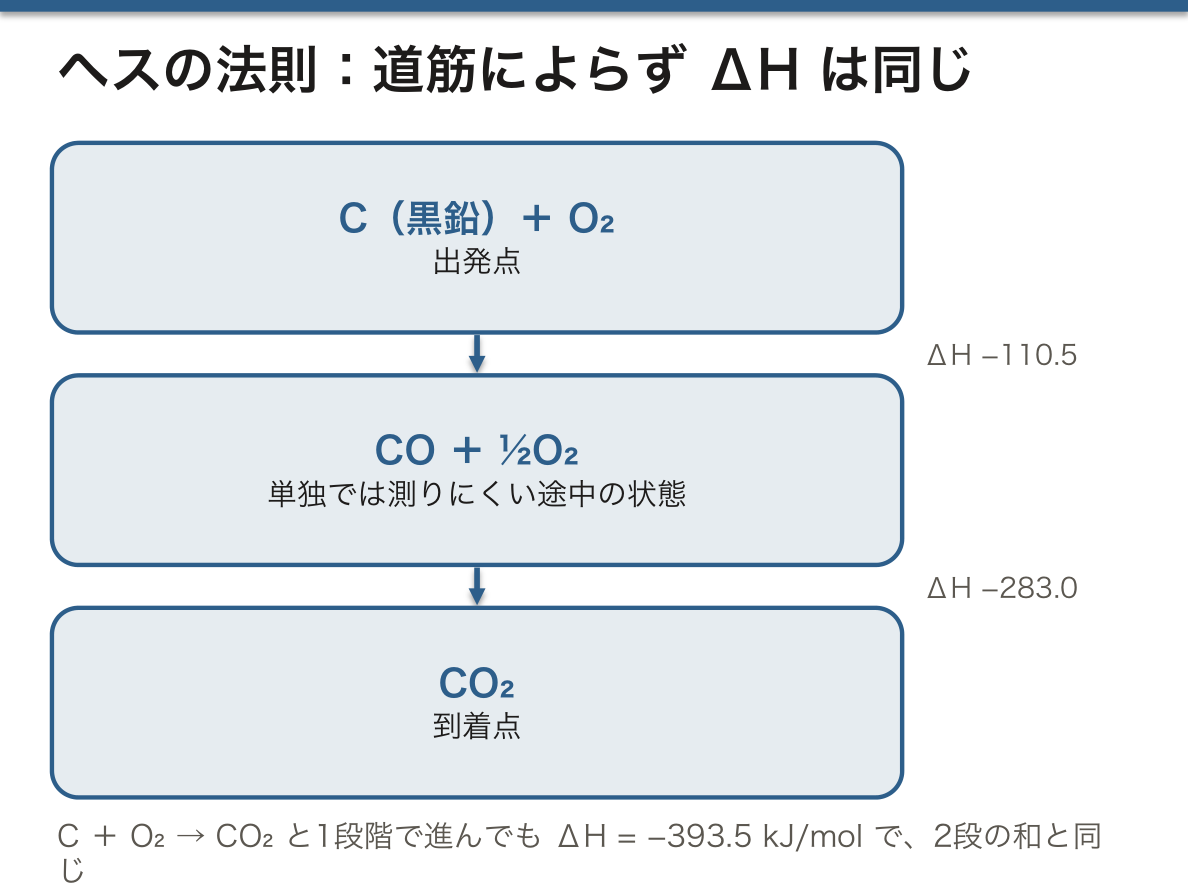
なぜ道筋によらないのか。エンタルピーは状態量(いまの状態だけで決まる量)だからである。山の標高差が登山道の選び方によらないのと同じで、出発点と到着点の H の差だけが ΔH を決める。逆に、途中で外界にした仕事や逃げた熱の内訳は道筋によって変わる。
前の項目の「Σ生成物 − Σ反応物」の式も、実はヘスの法則の使い方の1つである。反応物をいったん単体にばらし(−ΔfH)、そこから生成物を組み立てる(+ΔfH)という架空の道筋を通っている。
食品のエネルギー(kcal)は、ヘスの法則に支えられている。体内でグルコースを何十もの酵素反応で少しずつ酸化しても、ボンベ熱量計で一気に燃やしても、CO2 と H2O になるなら出る総エネルギーは同じだからである。ただし蛋白質は、体内では窒素が尿素として捨てられて CO2・H2O・N2 まで燃えきらないので、燃焼熱(約5.6 kcal/g)より体内で得られる量(約4 kcal/g)が小さい。到着点が違えば ΔH も違う、という例である。
English version
Core
Hess’s law: the ΔH of an overall reaction equals the sum of the ΔH of its steps. If the start and end states are the same, ΔH is the same whether the reaction goes in one step or many.
So we can find ΔH for a reaction that is hard to measure from reactions that are easy to measure. C (graphite) + ½O2 → CO is hard to measure alone, because CO2 also forms. Use
① C + O2 → CO2, ΔH = −393.5 kJ/mol
② CO + ½O2 → CO2, ΔH = −283.0 kJ/mol
① − ② gives C + ½O2 → CO, ΔH = −393.5 − (−283.0) = −110.5 kJ/mol.
Going further
Why does the path not matter? Enthalpy is a state function — it depends only on the present state. Like the height difference of a mountain, which does not depend on the trail, only the H of the start and end points decides ΔH. The split between work done and heat lost along the way does depend on the path.
The “Σ products − Σ reactants” equation is itself a use of Hess’s law. It follows an imaginary path: break the reactants down into elements (−ΔfH), then build the products from them (+ΔfH).
In the clinic
Food energy values (kcal) depend on Hess’s law. Whether glucose is oxidised slowly in dozens of enzyme steps in the body or burned at once in a bomb calorimeter, the total energy is the same if the products are CO2 and H2O. Protein is different: in the body the nitrogen is lost as urea, so it is not burned all the way. The body gets about 4 kcal/g, less than the heat of combustion (about 5.6 kcal/g). A different end point gives a different ΔH.
熱量測定(カロリメトリー)と中和熱
熱量測定は、反応で出入りした熱を溶液の温度変化から求める方法である。
q = m · c · ΔT(q:熱 J、m:溶液の質量 g、c:比熱 J/(g·K)、ΔT:温度変化 K)。水溶液では c ≈ 4.184 J/(g·K)、密度 ≈ 1.00 g/mL と近似する。反応 1 mol あたりに直して ΔH = −q / n(n は限定反応物の物質量)。負の符号は「溶液が温まった=系が熱を出した」ことを表す。
例:1.0 mol/L の HCl 50.0 mL と 1.0 mol/L の NaOH 50.0 mL を混ぜて 6.7 K 上がったとする。q = 100 × 4.184 × 6.7 ≈ 2.8 × 10³ J、n = 0.050 mol、ΔH ≈ −56 kJ/mol。
強酸と強塩基の中和熱は、酸や塩基の種類によらずほぼ −57 kJ/mol になる。正味のイオン反応式がどれも H+ + OH− → H2O で同じだからである。弱酸や弱塩基では、反応の途中で分子を電離させるのにエネルギーを使うぶん、発熱が小さくなる。
簡易な熱量計(コップを二重にしたもの)では、熱が少しずつ外へ逃げ、容器自体も温まるので、測定値は理論値より小さく出やすい。最高温度を読むだけでなく、温度–時間のグラフを描いて混合の瞬間まで外挿すると補正できる。1 cal = 4.184 J で、栄養学の「kcal」は、この単位で表した熱量である。
また燃焼や中和のように一度に大量の熱を出す反応は、細胞の中ではそのままの形では起こせない。生体はグルコースの酸化を多数の段階に分け、出るエネルギーを少しずつ ATP に移している。
English version
Core
Calorimetry finds the heat of a reaction from the temperature change of the solution.
q = m · c · ΔT (q: heat in J; m: mass of solution in g; c: specific heat in J/(g·K); ΔT: temperature change in K). For water solutions take c ≈ 4.184 J/(g·K) and density ≈ 1.00 g/mL. Per mole of reaction, ΔH = −q / n, where n is the moles of the limiting reactant. The minus sign means “the solution got warmer, so the system gave out heat”.
Example: mix 50.0 mL of 1.0 mol/L HCl with 50.0 mL of 1.0 mol/L NaOH; the temperature rises by 6.7 K. q = 100 × 4.184 × 6.7 ≈ 2.8 × 10³ J, n = 0.050 mol, ΔH ≈ −56 kJ/mol.
Going further
The heat of neutralisation of a strong acid and strong base is about −57 kJ/mol for any pair, because the net ionic equation is always H+ + OH− → H2O. With a weak acid or base, part of the energy is used to ionise the molecules during the reaction, so less heat is released.
In a simple calorimeter (two cups, one inside the other), heat slowly escapes and the cup itself warms, so the measured value tends to be smaller than the theoretical value. Instead of only reading the highest temperature, draw a temperature–time graph and extrapolate back to the moment of mixing. 1 cal = 4.184 J; the nutritional “kcal” is heat in this unit.
Also, reactions that release a lot of heat at once, such as combustion or neutralisation, cannot happen in that form inside a cell. The body splits the oxidation of glucose into many steps and moves the energy into ATP little by little.
エントロピーと熱力学第二法則 — 乱雑さは増える向きに進む
エントロピー S(J/(mol·K))は系の乱雑さ(とりうる配置の多さ)の尺度である。同じ物質なら S(固体)< S(液体)≪ S(気体)。
ΔS の符号は次のように予想できる。蒸発・融解・溶解(NaCl が水に溶ける)、気体の加熱、気体分子の数が増える反応は ΔS > 0。凍結・凝縮、気体の圧縮、気体分子の数が減る反応は ΔS < 0。計算は ΔH と同じ形で、ΔrS° = Σ S°(生成物)− Σ S°(反応物)。
熱力学第二法則:系と外界を合わせた全体のエントロピーは、自発的な変化では必ず増える。
ΔH と違い、単体でも S° は0ではない(0 になるのは絶対零度の完全な結晶だけ)。表の値をそのまま足し引きする。また S は J 単位、H は kJ 単位で載っていることが多く、あとで ΔG を計算するときに単位をそろえ忘れるのが最大の落とし穴である。
第二法則は「系のエントロピーが必ず増える」とは言っていない。系のエントロピーが減っても、それ以上に外界のエントロピーが増えれば変化は進む。生物の体は非常に秩序だった(エントロピーの低い)構造だが、これを保つために食物を分解し、熱・CO2・水という乱雑なかたちで外界へ捨て続けている。生きていることは、外界の乱雑さを増やすことで内側の秩序を買っている状態と言える。エネルギー変換の効率が100%にならないのも、一部を熱として捨ててエントロピーを増やす必要があるからである。
English version
Core
Entropy S (J/(mol·K)) measures the disorder (number of possible arrangements) of a system. For one substance, S(solid) < S(liquid) ≪ S(gas).
You can predict the sign of ΔS. Evaporation, melting, dissolving (NaCl in water), heating a gas and reactions that increase the number of gas molecules have ΔS > 0. Freezing, condensing, compressing a gas and reactions that reduce gas molecules have ΔS < 0. Calculate it like ΔH: ΔrS° = Σ S°(products) − Σ S°(reactants).
The second law of thermodynamics: in a spontaneous change, the total entropy of system plus surroundings always increases.
Going further
Unlike ΔH, S° of an element is not zero (it is zero only for a perfect crystal at absolute zero), so use table values directly. Also, S is usually listed in J and H in kJ. Forgetting to match units is the biggest trap when you later calculate ΔG.
The second law does not say the entropy of the system must rise. The system’s entropy may fall, as long as the entropy of the surroundings rises more. A living body is a very ordered (low-entropy) structure. To keep it, the body breaks down food and keeps throwing heat, CO2 and water — disordered forms — into the surroundings. Being alive means buying inner order by increasing outer disorder. Energy conversion is never 100% efficient because part must be released as heat to increase entropy.
ギブズエネルギー ΔG = ΔH − TΔS — 反応は起こりうるか
ΔH と ΔS を温度でまとめたのがギブズエネルギー変化 ΔG = ΔH − TΔS(T は K)である。一定の温度と圧力のもとで、
ΔG < 0:自発的に進む(発エルゴン反応)/ΔG = 0:平衡状態(見かけ上どちらにも進まない)/ΔG > 0:自発的には進まない(吸エルゴン反応)。外からエネルギーを与えなければ進まず、放っておけば逆向きに進む。逆反応の ΔG は符号が反転する。
| ΔH | ΔS | ΔG | 自発性 |
|---|---|---|---|
| − | + | 常に − | どの温度でも進む |
| + | − | 常に + | どの温度でも進まない |
| − | − | 低温で − | 低温で進む |
| + | + | 高温で − | 高温で進む |
ΔH と ΔS の符号が同じときは、温度が勝負を決める。ΔG = 0 となる温度は T = ΔH / ΔS で、これより上か下かで向きが入れ替わる。氷の融解(ΔH = +6.01 kJ/mol、ΔS = +22.0 J/(mol·K))なら T = 6010 / 22.0 ≈ 273 K。25 °C(298 K)では ΔG = 6.01 − 298 × 0.0220 ≈ −0.55 kJ/mol で融ける。−10 °C(263 K)では ΔG ≈ +0.22 kJ/mol で融けない。0 °C ちょうどで氷と水が共存する——日常の事実が式から出てくる。
ΔG は ΔrG° = Σ ΔfG°(生成物)− Σ ΔfG°(反応物)としても計算できる。ΔS を J から kJ に直す(÷1000)のを忘れないこと。そして、ΔG < 0 は「起こりうる」であって「速く起こる」ではない。ダイヤモンドが黒鉛に変わる反応は ΔG < 0 だが、室温では事実上進まない。
蛋白質の折りたたみも ΔG の釣り合いで保たれている。ほどける(変性する)と鎖が自由に動けるので ΔS は大きく正になり、温度が上がるほど −TΔS の項が効いて変性が進みやすくなる。高体温が危険な理由の1つはここにある。
English version
Core
Combining ΔH and ΔS with temperature gives the Gibbs energy change ΔG = ΔH − TΔS (T in K). At constant temperature and pressure:
ΔG < 0: proceeds spontaneously (exergonic) / ΔG = 0: equilibrium (no net change) / ΔG > 0: not spontaneous (endergonic). It needs energy from outside; left alone it runs backwards. The reverse reaction has the opposite sign of ΔG.
| ΔH | ΔS | ΔG | Spontaneity |
|---|---|---|---|
| − | + | always − | at any temperature |
| + | − | always + | never |
| − | − | − at low T | at low temperature |
| + | + | − at high T | at high temperature |
Going further
When ΔH and ΔS have the same sign, temperature decides. ΔG = 0 at T = ΔH / ΔS; above and below this the direction switches. For melting ice (ΔH = +6.01 kJ/mol, ΔS = +22.0 J/(mol·K)), T = 6010 / 22.0 ≈ 273 K. At 25 °C (298 K), ΔG = 6.01 − 298 × 0.0220 ≈ −0.55 kJ/mol, so ice melts. At −10 °C (263 K), ΔG ≈ +0.22 kJ/mol, so it does not. At exactly 0 °C ice and water coexist — an everyday fact comes out of the equation.
ΔG can also be calculated as ΔrG° = Σ ΔfG°(products) − Σ ΔfG°(reactants). Remember to change ΔS from J to kJ (÷1000). And ΔG < 0 means “can happen”, not “happens fast”. Diamond turning into graphite has ΔG < 0, but at room temperature it practically does not happen.
In the clinic
Protein folding is also held by a balance in ΔG. When a protein unfolds (denatures), the chain moves freely, so ΔS is large and positive. The higher the temperature, the more the −TΔS term matters, and the easier denaturation becomes. This is one reason why very high body temperature is dangerous.
共役反応と ATP — 進まない反応を進める仕組み
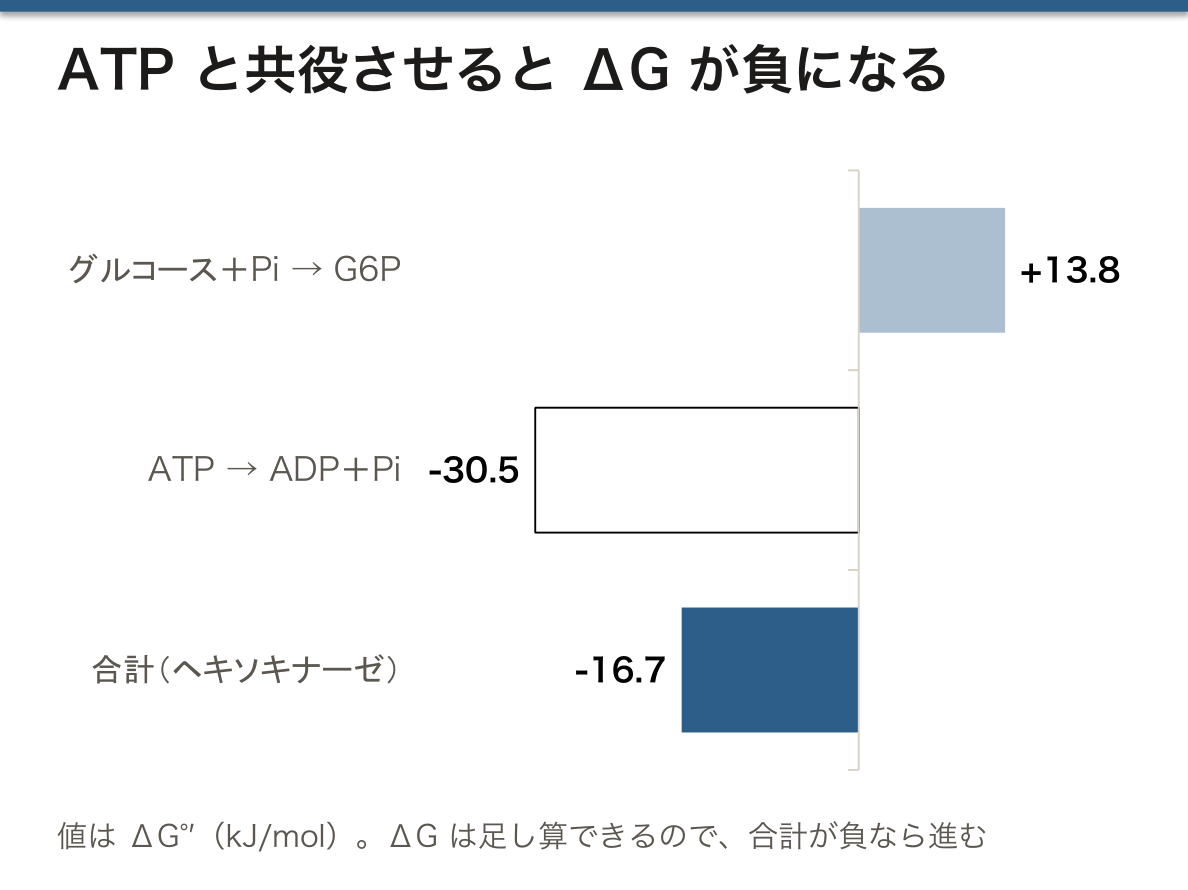
ΔG > 0 の反応も、ΔG < 0 の大きな反応と組み合わせ(共役させ)、合計の ΔG を負にすれば進む。ΔG は足し算できる(ヘスの法則と同じ理由で、G も状態量)からである。
生体で「負の ΔG を供給する」役を担うのが ATP の加水分解で、ATP + H2O → ADP + Pi の ΔG°′ は約 −30.5 kJ/mol(−7.3 kcal/mol)。たとえばグルコース + Pi → グルコース6-リン酸(ΔG°′ ≈ +13.8 kJ/mol)は単独では進まないが、ATP の加水分解と組み合わせると合計 ≈ −16.7 kJ/mol となり進む(ヘキソキナーゼの反応)。
逆向きに、ATP を作る反応(ΔG°′ ≈ +30.5 kJ/mol)も、それより大きな負の ΔG をもつ反応と共役させれば進む。クレアチンリン酸 → クレアチン + Pi の ΔG°′ は約 −43 kJ/mol なので、クレアチンリン酸 + ADP → クレアチン + ATP は合計 ≈ −13 kJ/mol で自発的に進む。解糖系の基質レベルのリン酸化(ホスホエノールピルビン酸、1,3-ビスホスホグリセリン酸)も同じ原理である。
「°′」は、生化学の標準状態(pH 7、25 °C、水と H+ 以外は 1 mol/L)での値を示す。細胞内の実際の濃度では ATP の加水分解の ΔG はさらに大きく負(−50 kJ/mol 前後)になる。代謝の不可逆段階や調節点は、この ΔG の大きいところに置かれている。
筋は運動を始めた最初の数秒、クレアチンリン酸からクレアチンキナーゼ(CK)で ATP をすばやく補充する。この CK は筋細胞が壊れると血中に漏れ出すので、急性心筋梗塞(CK-MB)や横紋筋融解症で血清 CK が上がる。熱力学の例として出てくる反応が、そのまま臨床検査の項目になっている。
English version
Core
A reaction with ΔG > 0 can still go if it is paired (coupled) with a reaction of large negative ΔG, so that the total ΔG is negative. ΔG values can be added, because G is a state function, for the same reason as Hess’s law.
In the body, ATP hydrolysis supplies the negative ΔG: ATP + H2O → ADP + Pi has ΔG°′ of about −30.5 kJ/mol (−7.3 kcal/mol). For example, glucose + Pi → glucose 6-phosphate (ΔG°′ ≈ +13.8 kJ/mol) does not go alone, but coupled to ATP hydrolysis the total is ≈ −16.7 kJ/mol and it goes (the hexokinase reaction).
Going further
In the other direction, making ATP (ΔG°′ ≈ +30.5 kJ/mol) also goes if coupled to a reaction with a larger negative ΔG. Creatine phosphate → creatine + Pi has ΔG°′ of about −43 kJ/mol, so creatine phosphate + ADP → creatine + ATP has a total of ≈ −13 kJ/mol and is spontaneous. Substrate-level phosphorylation in glycolysis (phosphoenolpyruvate, 1,3-bisphosphoglycerate) works the same way.
“°′” means the biochemical standard state (pH 7, 25 °C, 1 mol/L for everything except water and H+). At real cell concentrations, ATP hydrolysis has an even more negative ΔG (around −50 kJ/mol). The irreversible and controlling steps of metabolism are placed where ΔG is large.
In the clinic
In the first few seconds of exercise, muscle refills ATP quickly from creatine phosphate using creatine kinase (CK). CK leaks into the blood when muscle cells are damaged, so serum CK rises in acute myocardial infarction (CK-MB) and rhabdomyolysis. A textbook example of thermodynamics is also a routine lab test.
まとめ
| 系と外界・熱力学第一法則 — エネルギーは形を変えるだけ | 注目する部分を系、それ以外を外界と呼び、境界をはさんで何をやりとりするかで系を3つに分ける。 |
|---|---|
| エンタルピー変化 ΔH — 発熱反応と吸熱反応 | エンタルピー H は系のもつ熱の含量で、一定圧力のもとで反応によって出入りする熱がエンタルピー変化 ΔH(kJ/mol)である。 |
| ヘスの法則 — 道筋によらず ΔH は同じ | ヘスの法則:反応全体の ΔH は、それを構成する個々の段階の ΔH の和に等しい。 |
| 熱量測定(カロリメトリー)と中和熱 | 熱量測定は、反応で出入りした熱を溶液の温度変化から求める方法である。 |
| エントロピーと熱力学第二法則 — 乱雑さは増える向きに進む | エントロピー S(J/(mol·K))は系の乱雑さ(とりうる配置の多さ)の尺度である。 |
| ギブズエネルギー ΔG = ΔH − TΔS — 反応は起こりうるか | ΔH と ΔS を温度でまとめたのがギブズエネルギー変化 ΔG = ΔH − TΔS(T は K)である。 |
| 共役反応と ATP — 進まない反応を進める仕組み | ΔG > 0 の反応も、ΔG < 0 の大きな反応と組み合わせ(共役させ)、合計の ΔG を負にすれば進む。 |
このノートは医学生が授業の内容を自分の言葉でまとめたもので、診療の判断に使うものではありません。誤りに気づいたらお知らせください。