窓の雨粒が丸くなる、水面に軽い虫が立てる、細い管を水が昇る——どれも液体の表面だけが持つ性質、表面張力のしわざである。表面の分子は内側の分子と違って片側からしか引かれないので、液体は表面積をできるだけ小さくしようとする。
医学でこの話が決定的に効くのは肺胞である。肺胞の内面は薄い水の膜で覆われ、その表面張力は肺胞をつぶそうとする。小さい肺胞ほどつぶれやすいというラプラスの法則と、それを防ぐサーファクタントの仕組みは、新生児呼吸窮迫症候群の理解にそのままつながる。
式は3本:F = σl(力)、E = σS(エネルギー)、ΔP = 2σ/r(圧力)。どれも同じ σ を別の角度から見たものである。
- 凝集力と付着力 — 濡れるか、玉になるか
- 表面張力と表面エネルギー — 液体は表面を小さくしたがる
- 界面活性剤 — 表面張力を下げる分子
- ラプラスの法則と肺胞 — 小さい泡ほどつぶれやすい
- 毛細管現象 — 細い管ほど高く昇る
- 表面張力の測り方 — 輪を引きはがす力から求める
凝集力と付着力 — 濡れるか、玉になるか
分子間には引力がはたらく。同じ種類の分子どうしの引力を凝集力(cohesion)、違う種類の分子(液体と壁など)の間の引力を付着力(adhesion)という。水は極性分子で水素結合を作るので凝集力が強い。
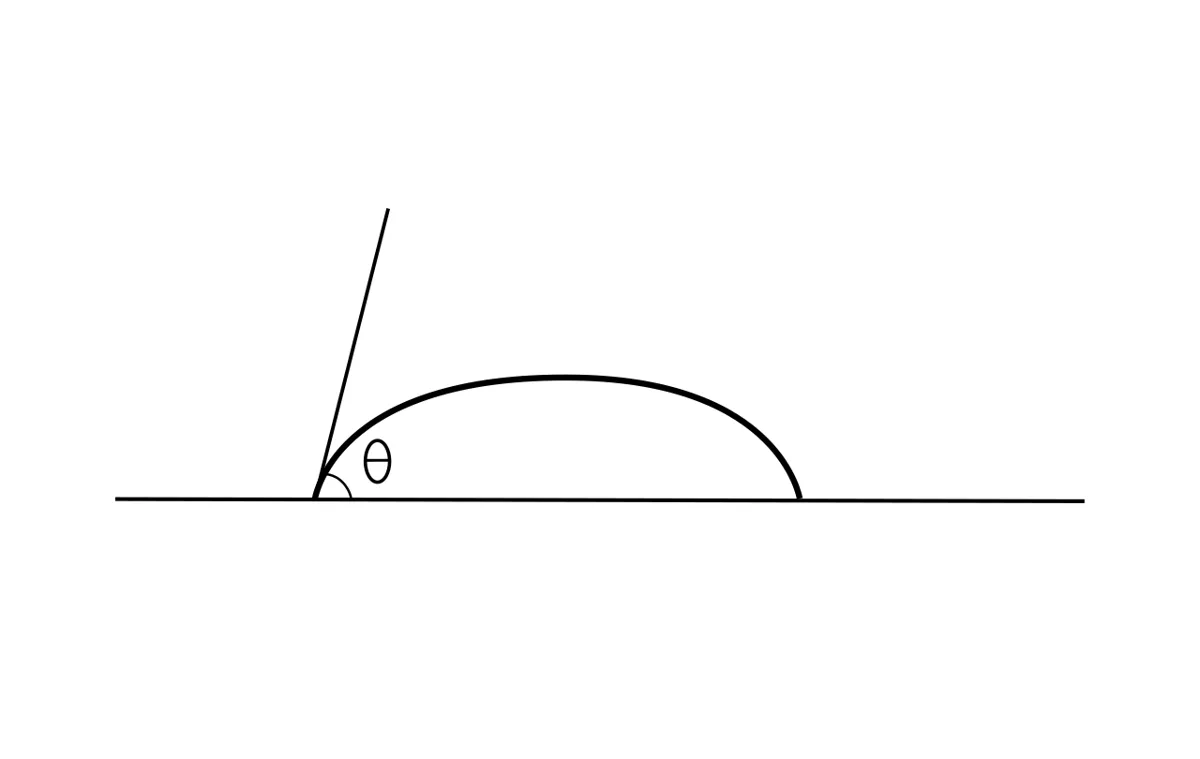
液体が固体の上でどう広がるかは、この2つの力比べで決まる。液滴の縁で液面と固体面がなす角を接触角 θ という。
| 力の大小 | 接触角 | 表面の性質 | 例 |
|---|---|---|---|
| 付着力 > 凝集力 | 小さい(90°未満) | 親水性:濡れて広がる | きれいなガラスと水 |
| 凝集力 > 付着力 | 大きい(90°超) | 疎水性:玉になる | ワックスや油の面と水 |
同じ力比べがメニスカス(管の中の液面の形)を決める。ガラス管の水は付着力が勝つので壁を這い上がり、液面は下に凹む(凹メニスカス)。水銀は凝集力が付着力よりずっと強いので壁から離れようとし、液面は上に凸(凸メニスカス)になる。
「親水性なのは凝集力が付着力より大きいとき」は逆である。壁に引かれる力が勝てば濡れる、と覚えればよい。表面加工で接触角を大きく(超撥水)したり小さく(親水コート)したりできるのも、固体側の付着のしやすさを変えているからである。
医療材料では濡れやすさが性能を左右する。カテーテルや人工血管の表面を親水性にすると摩擦が減り、血液成分の付着のしかたも変わる。眼の表面では涙が角膜を一様に濡らす必要があり、涙液の油層・ムチン層の異常で濡れが悪くなるとドライアイの症状が出る。
English version
Core
Molecules attract each other. Attraction between molecules of the same kind is cohesion; attraction between different kinds (a liquid and a wall, for example) is adhesion. Water is a polar molecule that forms hydrogen bonds, so its cohesion is strong.
How a liquid spreads on a solid depends on these two forces. The angle between the liquid surface and the solid at the edge of a drop is the contact angle θ.
| Forces | Contact angle | Surface | Example |
|---|---|---|---|
| Adhesion > cohesion | Small (under 90°) | Hydrophilic: wets and spreads | Water on clean glass |
| Cohesion > adhesion | Large (over 90°) | Hydrophobic: beads up | Water on wax or oil |
Going further
The same contest decides the meniscus (the shape of the liquid surface in a tube). Water in a glass tube climbs the wall because adhesion wins, and the surface curves down (concave meniscus). Mercury’s cohesion is much stronger than its adhesion, so it pulls away from the wall and the surface curves up (convex meniscus).
“A surface is hydrophilic when cohesion is larger than adhesion” is backwards. Remember: if the pull of the wall wins, it wets. Surface coatings can make the contact angle large (super-water-repellent) or small (hydrophilic coating) because they change how easily the solid attracts the liquid.
In the clinic
In medical materials, wettability affects performance. A hydrophilic surface on a catheter or vascular graft lowers friction and changes how blood components stick. On the eye, tears must wet the cornea evenly; when the oil or mucin layer of the tear film is abnormal, wetting is poor and dry-eye symptoms appear.
表面張力と表面エネルギー — 液体は表面を小さくしたがる
液体の内部の分子は四方から同じように引かれて力が打ち消し合う。表面の分子は内側と横からしか引かれないので、正味で内向きの力を受ける。その結果、表面は引き伸ばされた膜のようにふるまう。
表面張力は、表面上の長さ l の線に垂直にはたらく力で表す。
F = σ·l σ:表面張力係数(N/m)
表面を広げるには分子を内部から表面へ引き出す仕事が要るので、表面は余分な位置エネルギーを持つ。
E = σ·S(S:表面積) σ の単位は J/m2 とも書ける(N/m と同じ)。
水(室温)は約 0.072 N/m、せっけん水はその半分前後。
なぜ水滴は丸いのか。系はエネルギーが最も小さい状態に落ち着く。E = σS を小さくするには、同じ体積で表面積が最小の形——球——になればよい。
表面のエネルギーを減らす方法は2つ:表面積 S を減らすか、σ そのものを下げる(界面活性剤を加える)。
σ を決める因子:液体の種類(分子間の結合が強いほど大きい)、温度(上がると小さい。分子間の距離が開き、熱運動が引力に勝つため)、混ざり物(塩は少し上げ、せっけんや油は下げる)、接している相手の物質。表面の大きさや形が分子より十分大きければ、σ は形によらない。
軽い虫が水面に立ち、針が水に浮くのは表面張力による(毛細管現象ではない)。体では、肺胞の内面を覆う水の膜の表面張力が肺の弾性収縮力の大きな部分を占める。肺を生理食塩水で満たすと空気で膨らませるよりずっと楽に広がるのは、気液界面が消えて表面張力がなくなるからである。
English version
Core
A molecule inside a liquid is pulled equally from all sides, and the forces cancel. A molecule at the surface is pulled only from inside and from the sides, so it feels a net inward force. As a result, the surface behaves like a stretched film.
Surface tension is expressed as the force acting perpendicular to a line of length l on the surface.
F = σ·l, where σ is the surface tension coefficient (N/m)
Enlarging the surface needs work to pull molecules from inside to the surface, so the surface holds extra potential energy.
E = σ·S (S: surface area). The unit of σ can also be written J/m2 (the same as N/m).
Water at room temperature is about 0.072 N/m; soapy water is around half of that.
Going further
Why are water drops round? A system settles in its lowest-energy state. To make E = σS small, the liquid takes the shape with the smallest surface for a given volume — a sphere.
There are two ways to reduce surface energy: reduce the area S, or lower σ itself (add a surfactant).
Factors setting σ: the kind of liquid (stronger bonds between molecules give a larger σ), temperature (higher temperature gives a smaller σ, because molecules move apart and thermal motion beats attraction), impurities (salt raises it slightly; soap and oil lower it), and the substance in contact. If the surface is much larger than the molecules, σ does not depend on its shape.
In the clinic
Light insects stand on water and a needle floats because of surface tension (not capillarity). In the body, the surface tension of the water film lining the alveoli makes up a large part of the elastic recoil of the lung. A lung filled with saline expands much more easily than one inflated with air, because the air–liquid interface disappears and so does surface tension.
界面活性剤 — 表面張力を下げる分子
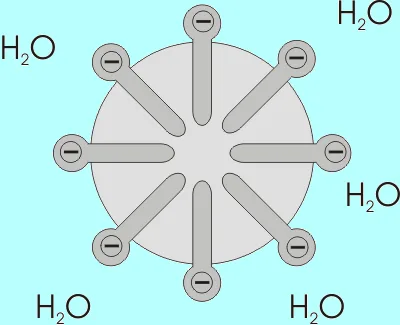
界面活性剤(surfactant)は表面張力を下げる物質である。1つの分子に親水性の部分(頭)と疎水性の部分(尾)を持ち、水の表面に集まって頭を水に、尾を空気(または油)に向けて並ぶ。
水中で濃度が高くなると、尾を内側に集めた球状の集まりミセルをつくる。せっけん・洗剤・乳化剤・湿潤剤・起泡剤はみなこの仲間である。
水の σ は約0.072 N/m だが、せっけんを溶かすと半分程度まで下がる。
なぜ表面張力が下がるのか。表面に割り込んだ界面活性剤の分子が、水分子どうしの引き合いを邪魔するからである。表面の水分子が互いを引く相手が減り、内向きの正味の力が弱まる。同じ1円玉の上に載る水滴の量が、せっけん水では少なくなるのはこのためである。
せっけんの泡が乾いた指で割れやすいのも同じ話である。皮膚の油分が膜の分子の並びを乱し、液が皮膚側へ広がって薄い膜が切れる。逆に、界面活性剤があるからこそ薄い膜が安定して泡ができる。洗剤が油汚れを落とすのは、ミセルの内側(疎水性)に油を取り込んで水に分散させるからである。
体の中の代表的な界面活性剤が肺サーファクタント(II型肺胞上皮細胞がつくるリン脂質と蛋白質の混合物)と胆汁酸である。胆汁酸は脂肪をミセルにして消化・吸収を助ける。胆汁の流れが途絶えると脂肪の吸収が落ち、脂肪便や脂溶性ビタミン(A・D・E・K)の欠乏が起こる。
English version
Core
A surfactant is a substance that lowers surface tension. One molecule has a hydrophilic part (head) and a hydrophobic part (tail); at the water surface the molecules line up with heads in the water and tails toward the air (or oil).
At high concentration in water they form spheres with the tails gathered inside, called micelles. Soaps, detergents, emulsifiers, wetting agents and foaming agents all belong here.
Water’s σ is about 0.072 N/m, but dissolving soap lowers it to about half.
Going further
Why does surface tension fall? Surfactant molecules pushed into the surface get in the way of water molecules attracting each other. Surface water molecules have fewer partners to pull, so the net inward force weakens. This is why fewer drops of soapy water than plain water fit on the same coin.
A soap bubble bursting at the touch of a dry finger is the same story. Oil on the skin disturbs the arrangement of molecules in the film, the liquid spreads onto the skin, and the thin film breaks. In turn, surfactants are exactly what keep thin films stable so that bubbles can form. Detergents remove oily dirt by taking oil into the hydrophobic inside of micelles and spreading it through water.
In the clinic
The main surfactants in the body are pulmonary surfactant (a mixture of phospholipids and proteins made by type II alveolar cells) and bile acids. Bile acids turn fat into micelles and help digestion and absorption. When bile flow stops, fat absorption falls, causing fatty stools and deficiency of fat-soluble vitamins (A, D, E, K).
ラプラスの法則と肺胞 — 小さい泡ほどつぶれやすい
曲がった液面の内側と外側には、表面張力による圧力差が生じる。球形の気泡(1つの面)では
ΔP = 2σ/r (ラプラスの法則)
(せっけん玉のように膜の内外に2つの面がある場合は 4σ/r。生理学では σ を T と書くことが多い。)
半径が小さいほど内側の圧力は高い。肺胞(alveoli pulmonis)の内面の水の膜も、この圧力で肺胞を縮めようとする。
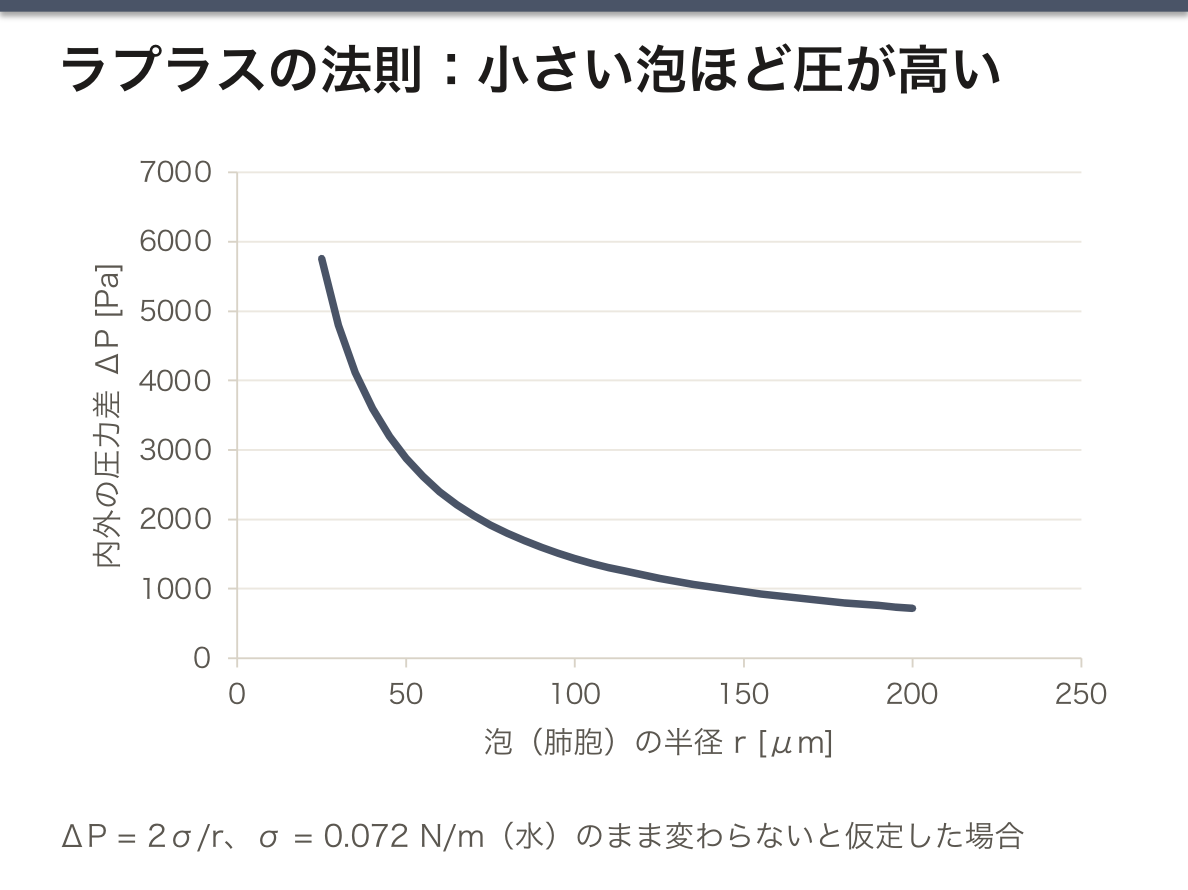
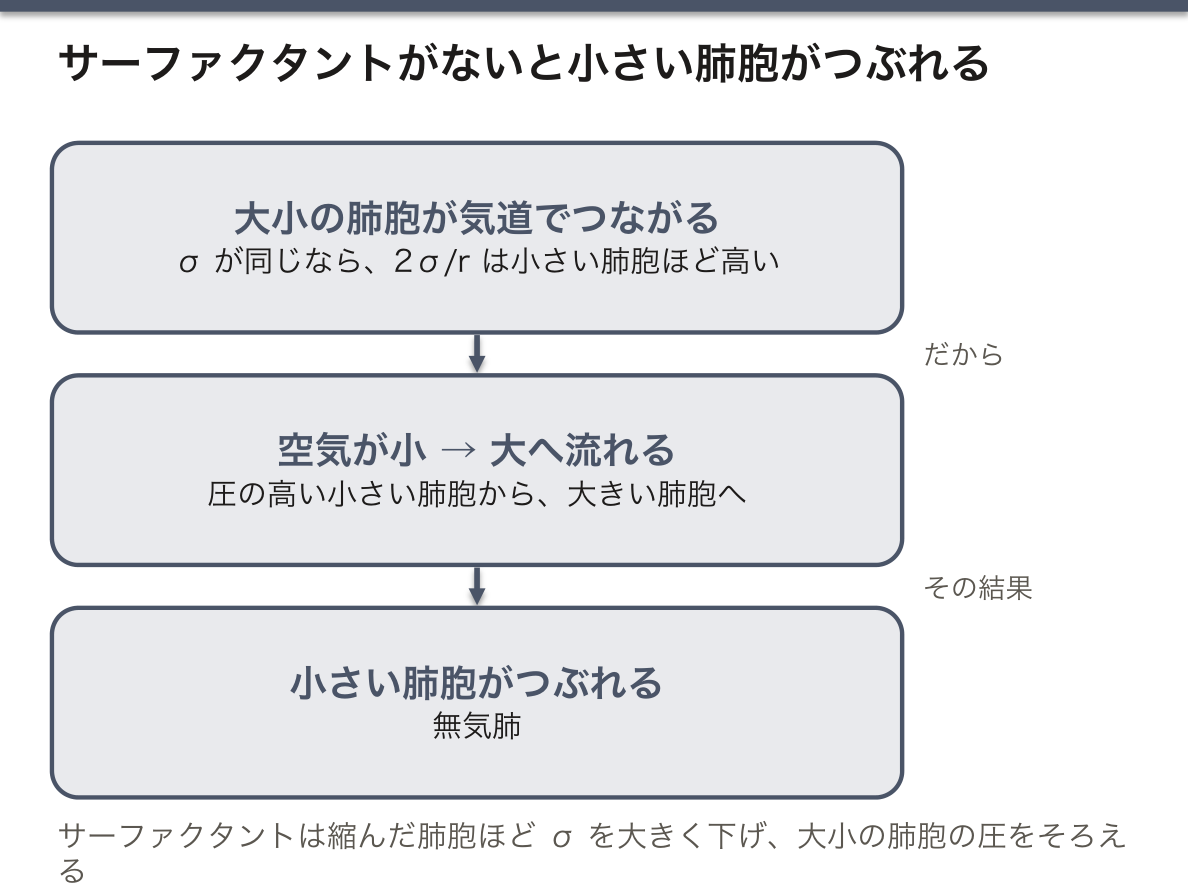
なぜこれが問題なのか。大小2つの肺胞が気道でつながっているとする。σ が同じなら、小さい肺胞のほうが圧力が高いので、空気は小さい肺胞から大きい肺胞へ流れ込み、小さいほうはますます縮んでつぶれる(無気肺)。
サーファクタントがこれを防ぐ。肺胞が縮むと表面のサーファクタント分子が密に詰まり、σ が大きく下がる。小さくなった肺胞ほど σ が小さくなるので、2σ/r の増加が打ち消され、大小の肺胞の圧力がそろう。さらに全体の σ が下がるので、吸気に必要な力が減り(コンプライアンスが上がり)、表面張力が肺胞内に水を引き込む力も弱まって肺胞が乾いて保たれる。
サーファクタントは妊娠後期にII型肺胞上皮細胞で十分につくられるようになる。早く生まれた児では不足して肺胞がつぶれ、新生児呼吸窮迫症候群(RDS)になる。治療はサーファクタントを気管チューブから肺に直接投与すること。早産が予想される母体には副腎皮質ステロイドを投与して胎児の肺の成熟(サーファクタント産生)を促す。
English version
Core
A curved liquid surface creates a pressure difference between its inside and outside because of surface tension. For a spherical bubble (one surface):
ΔP = 2σ/r (Laplace’s law)
(For a film with two surfaces, like a soap bubble, it is 4σ/r. Physiology often writes σ as T.)
The smaller the radius, the higher the inside pressure. The water film lining the alveoli (alveoli pulmonis) also uses this pressure to shrink them.
Going further
Why is this a problem? Imagine a small and a large alveolus connected by an airway. With the same σ, the small one has the higher pressure, so air flows from the small one into the large one, and the small one shrinks more and collapses (atelectasis).
Surfactant prevents this. As an alveolus shrinks, the surfactant molecules at its surface pack tightly and σ falls sharply. The smaller the alveolus, the smaller its σ, so the rise in 2σ/r is cancelled and the pressures of small and large alveoli become equal. Also, because overall σ falls, less force is needed to breathe in (compliance rises), and the pull of surface tension drawing fluid into the alveoli weakens, so the alveoli stay dry.
In the clinic
Type II alveolar cells begin to make enough surfactant late in pregnancy. Infants born early lack it, their alveoli collapse, and they develop neonatal respiratory distress syndrome (RDS). Treatment is to give surfactant directly into the lungs through a tracheal tube. When preterm birth is expected, the mother is given corticosteroids to speed up maturation of the fetal lung (surfactant production).
毛細管現象 — 細い管ほど高く昇る
細い管を液体に立てると、液面が管の中で上がったり(毛細管上昇)下がったり(毛細管降下)する。付着力が勝つ水とガラスでは上がり、凝集力が勝つ水銀とガラスでは下がる。
上がる高さは、表面張力が液柱を引き上げる力と、液柱の重さのつり合いで決まる。
h = 2σ·cosθ/(ρ·g·r)
高さは表面張力に比例し、管の半径・液体の密度・重力加速度に反比例する。
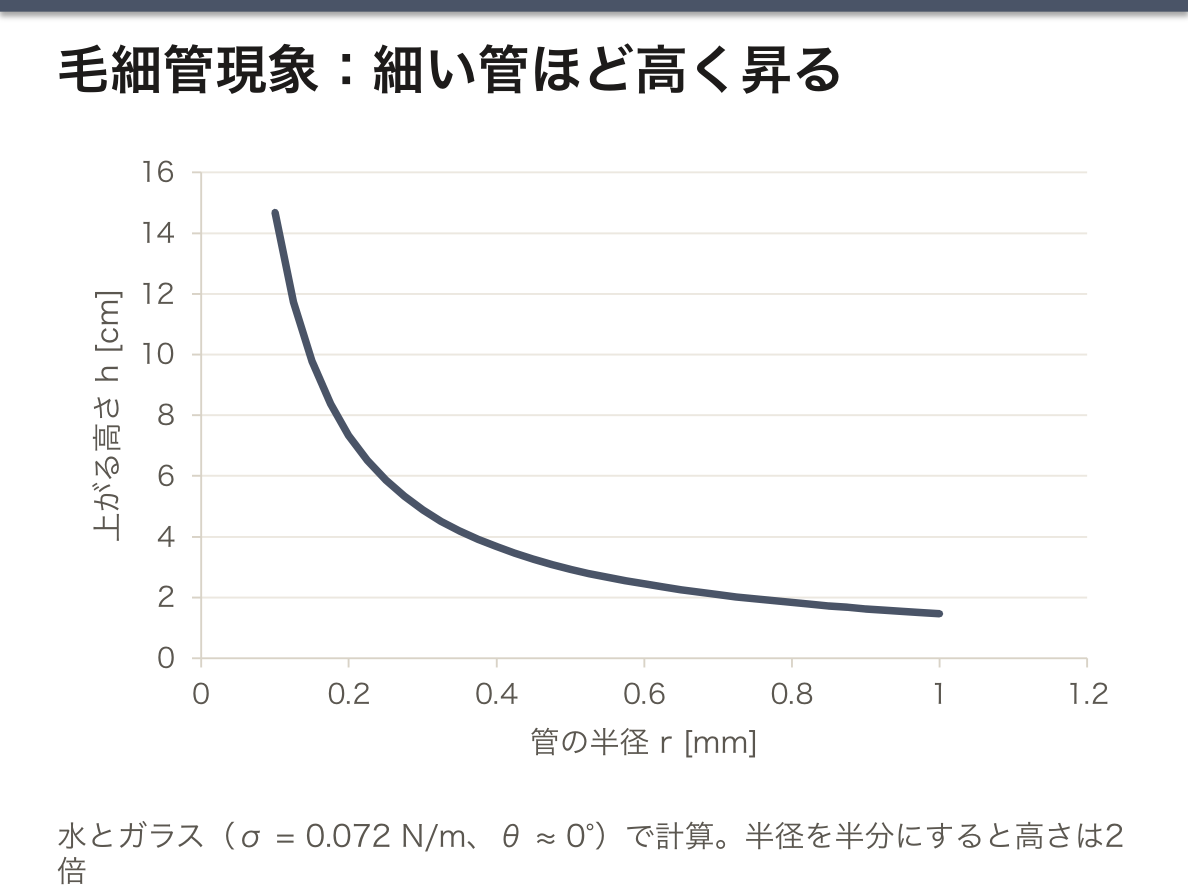
なぜ細い管ほど高いのか。引き上げる力は管の縁の長さ(周 2πr)に比例するが、持ち上げる液柱の重さは断面積(πr2)に比例する。半径を半分にすると、引き上げる力は半分にしかならないのに、同じ高さの液柱の重さは1/4になる。だから2倍の高さまで昇れる。
理論上の高さより短い管を立てても、水が上からあふれ出ることはない。液面が管の口に達すると、メニスカスの曲率半径が大きくなって(平らに近づいて)引き上げる力が減り、そこで止まる。毛細管現象だけで永久に水を汲み上げることはできない。
毛細管現象は、指先からの採血で細いガラス管に血液が自然に入る仕組みや、ガーゼ・紙が液体を吸い取る仕組みとして使われる。一方、体の血液を毛細血管まで流しているのは毛細管現象ではない。血流を生むのは心臓のポンプがつくる圧力の差であり、毛細血管は物質交換の場である。
English version
Core
When a thin tube stands in a liquid, the level in the tube rises (capillary rise) or falls (capillary depression). Water in glass rises because adhesion wins; mercury in glass falls because cohesion wins.
The height is set by the balance between the surface-tension force pulling the column up and the weight of the column.
h = 2σ·cosθ/(ρ·g·r)
The height is proportional to surface tension and inversely proportional to the tube radius, the liquid density and gravity.
Going further
Why higher in thinner tubes? The lifting force is proportional to the length of the edge (the circumference 2πr), but the weight of the column is proportional to the cross-section (πr2). Halve the radius and the lifting force only halves, while the weight of a column of the same height becomes a quarter. So the liquid can climb twice as high.
If the tube is shorter than the theoretical height, water does not overflow from the top. When the surface reaches the top, the radius of curvature of the meniscus grows (it flattens), the lifting force falls, and it stops there. Capillary action alone cannot pump water forever.
In the clinic
Capillary action is how blood enters a thin glass tube by itself in fingertip sampling, and how gauze and paper soak up liquid. But it is not capillary action that moves blood through the body’s capillaries. Blood flow is driven by pressure differences made by the heart’s pumping; capillaries are the sites of exchange.
表面張力の測り方 — 輪を引きはがす力から求める
輪環法(ring method):細い金属の輪を液面に触れさせ、ゆっくり引き上げる。輪が液面から離れる直前、輪には液の膜が付いて下向きに引く。その最大の力を力計で読み、輪だけの重さを差し引くと、表面張力の力 ΔF が得られる。
膜は輪の内側と外側の両方の縁に付くので、力がかかる線の長さは
l = π(d1 + d2)(d1:内径、d2:外径)
よって σ = ΔF/l。輪の大きさを変えて ΔF と l のグラフを描けば、傾きが σ になる。
輪と、同じ直径の硬貨ではどちらが強く引かれるか。輪である。硬貨は外周の縁しか液面と接しないが、輪は内側にも縁があり、膜の付く線が長いからである。表面張力の力は面積ではなく縁の長さに比例する。
誤差の原因:輪が水平でない(片側から先に離れる)、引き上げの速さが一定でない、温度が変わる(σ は温度で下がる)、液や輪の汚れ(油は σ を大きく下げる)。実測値が文献値(水で約0.072 N/m)より低く出たら、まず汚れと輪の傾きを疑う。ほかに、細い管から落ちる液滴の数から求める滴数法や、毛細管上昇の高さから求める方法もある。
English version
Core
The ring method: touch a thin metal ring to the liquid surface and lift it slowly. Just before the ring leaves the surface, a liquid film clings to it and pulls down. Read the maximum force on a force meter and subtract the weight of the ring alone to get the surface-tension force ΔF.
The film clings to both the inner and outer edges of the ring, so the length of the line on which the force acts is
l = π(d1 + d2) (d1: inner diameter, d2: outer diameter)
So σ = ΔF/l. Using rings of different sizes and plotting ΔF against l, the slope is σ.
Going further
A ring and a coin of the same diameter — which is pulled harder? The ring. The coin touches the surface only along its outer edge, but the ring has an inner edge too, so the line where the film clings is longer. The surface-tension force is proportional to the length of the edge, not to the area.
Sources of error: the ring is not level (one side leaves first), the lifting speed is not steady, the temperature changes (σ falls with temperature), and dirt on the liquid or ring (oil lowers σ a lot). If the measured value is lower than the literature value (about 0.072 N/m for water), suspect dirt and a tilted ring first. Other methods are the drop-count method, using the number of drops falling from a thin tube, and the height of capillary rise.
まとめ
| 凝集力と付着力 — 濡れるか、玉になるか | 分子間には引力がはたらく。同じ種類の分子どうしの引力を凝集力(cohesion)、違う種類の分子(液体と壁など)の間の引力を付着力(adhesion)という。 |
|---|---|
| 表面張力と表面エネルギー — 液体は表面を小さくしたがる | 液体の内部の分子は四方から同じように引かれて力が打ち消し合う。 |
| 界面活性剤 — 表面張力を下げる分子 | 界面活性剤(surfactant)は表面張力を下げる物質である。 |
| ラプラスの法則と肺胞 — 小さい泡ほどつぶれやすい | 曲がった液面の内側と外側には、表面張力による圧力差が生じる。 |
| 毛細管現象 — 細い管ほど高く昇る | 細い管を液体に立てると、液面が管の中で上がったり(毛細管上昇)下がったり(毛細管降下)する。 |
| 表面張力の測り方 — 輪を引きはがす力から求める | 輪環法(ring method):細い金属の輪を液面に触れさせ、ゆっくり引き上げる。 |
このノートは医学生が授業の内容を自分の言葉でまとめたもので、診療の判断に使うものではありません。誤りに気づいたらお知らせください。