人の体は、食べ物の化学エネルギーを運動と熱に変え、余った熱を外に捨てて 37 ℃前後を保つ熱機関である。この章では、その収支を熱力学の言葉で整理する。
前半は基礎:温度と熱の違い、熱の伝わり方(伝導・対流・放射、そして体では蒸発)、熱力学の法則(エネルギーは保存され、熱は高温から低温へ流れる)。後半は応用:体のエネルギー収支と体温調節、そして物体の冷え方を表すニュートンの冷却則——死亡推定時刻の推定や、新生児の低体温の理解に使われる。
冷却則の要点は「温度差に比例して冷える」の一言で、そこから指数関数の冷え方が出てくる。減衰振動・放射性崩壊と同じ形である。
- 温度と熱 — 似ているが別の量
- 熱の伝わり方 — 伝導・対流・放射、そして蒸発
- 熱力学の法則 — エネルギーは保存され、乱雑さは増える
- 体のエネルギー収支 — 第1法則を体にあてはめる
- 体温調節 — 熱をどこから捨てているか
- ニュートンの冷却則 — 温度差に比例して冷える
温度と熱 — 似ているが別の量
温度は物体をつくる分子の平均の運動エネルギーの目安である。単原子気体では1分子の平均運動エネルギーは Ek = (3/2)kT(k = 1.38×10⁻²³ J/K:ボルツマン定数、T:絶対温度)。
熱は、温度差によって高温の物体から低温の物体へ移動するエネルギーで、単位はジュール(J)。内部エネルギー U は物体内の分子の運動エネルギーと位置エネルギーの総和である。
温度の目盛:K = ℃ + 273.15、℃ = (°F − 32)/1.8。水の凝固点は 0 ℃ = 273.15 K = 32 °F、沸点は 100 ℃ = 373.15 K = 212 °F。絶対零度は 0 K = −273.15 ℃。
温度と熱を混同しないこと。浴槽の 40 ℃ のお湯と、カップの 80 ℃ のお茶では、温度はお茶が高いが、持っている内部エネルギー(熱として渡せる量)は浴槽のほうがずっと大きい。温度は「1分子あたり」、内部エネルギーは「全体の量」である。
物理の式では必ず絶対温度(K)を使う。分子の運動エネルギーは絶対温度に比例するので、0 ℃ を基準にした数字では比が意味を持たない(20 ℃ は 10 ℃ の「2倍熱い」わけではない)。温度差だけを扱うときは、1 K の差 = 1 ℃ の差なのでどちらでもよい。
English version
Core
Temperature measures the average kinetic energy of the molecules in a body. For a monatomic gas, the average kinetic energy of one molecule is Ek = (3/2)kT (k = 1.38×10⁻²³ J/K: Boltzmann’s constant; T: absolute temperature).
Heat is energy that moves from a hotter body to a colder one because of a temperature difference; its unit is the joule (J). Internal energy U is the total of the kinetic and potential energies of the molecules in a body.
Temperature scales: K = °C + 273.15, °C = (°F − 32)/1.8. Water freezes at 0 °C = 273.15 K = 32 °F and boils at 100 °C = 373.15 K = 212 °F. Absolute zero is 0 K = −273.15 °C.
Going further
Do not mix up temperature and heat. A bathtub of water at 40 °C and a cup of tea at 80 °C: the tea has the higher temperature, but the bath holds far more internal energy (the amount it can give as heat). Temperature is “per molecule”; internal energy is “the total”.
Physics formulas always use absolute temperature (K). Molecular kinetic energy is proportional to absolute temperature, so ratios of Celsius numbers mean nothing (20 °C is not “twice as hot” as 10 °C). When only a temperature difference matters, either works, because a difference of 1 K equals a difference of 1 °C.
熱の伝わり方 — 伝導・対流・放射、そして蒸発
| 方法 | しくみ | 例 |
|---|---|---|
| 伝導 | エネルギーの高い粒子が隣の粒子にエネルギーを渡す。固体の中や、触れた物体どうしで起こる | 金属は良導体、気体は不良導体。真空では起きない |
| 対流 | 温まった液体・気体そのものが動いて熱を運ぶ。液体と気体だけ | 暖房の上昇気流、湯の対流、熱気球 |
| 放射 | 電磁波(主に赤外線)でエネルギーを送る。媒質が要らず真空も通る | 太陽の熱、たき火の暖かさ |
体の表面ではこれに蒸発が加わる。水が液体から気体に変わるには大きなエネルギー(気化熱、潜熱:体温付近で約2.4 kJ/g)が要り、それを皮膚から奪う。
温かい空気は膨張して密度が小さく軽いので上昇し、冷たい空気が下に入る——これが対流の駆動力である。
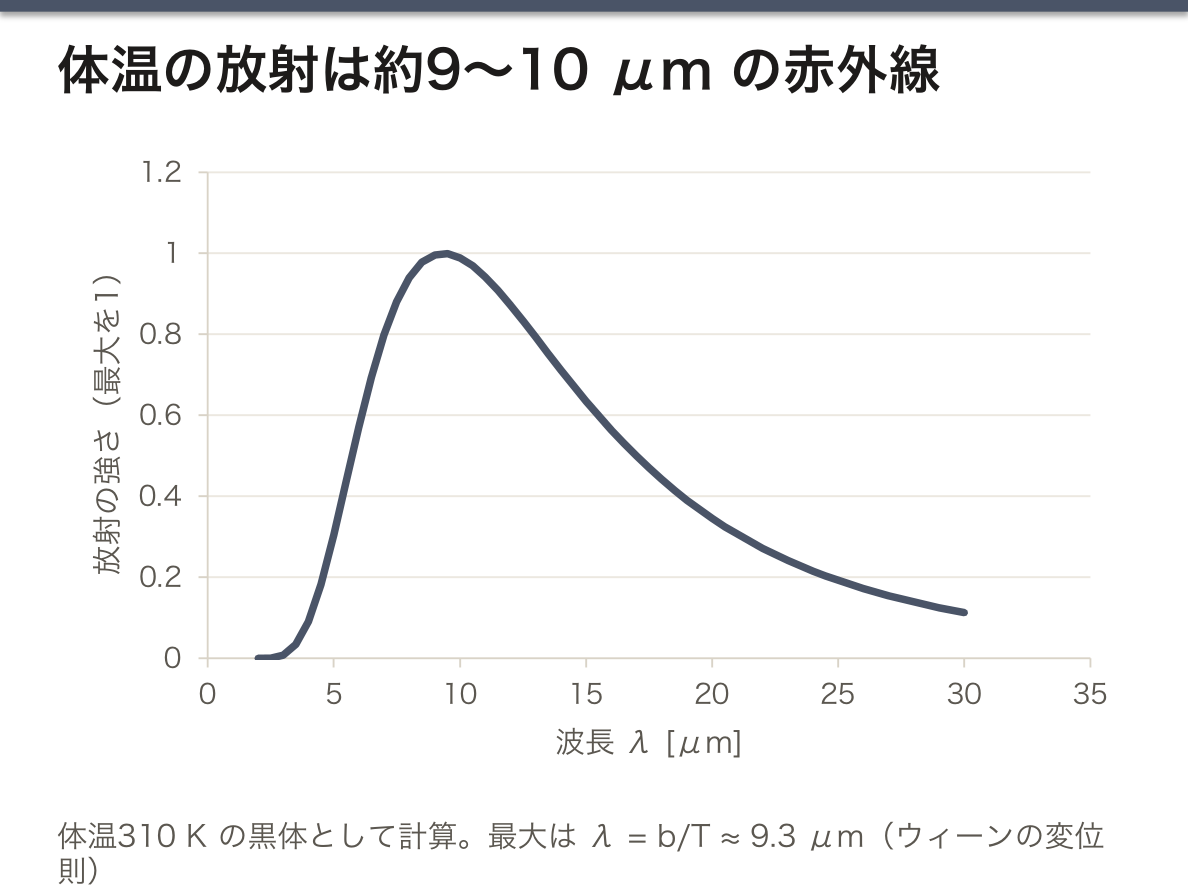
放射で出るエネルギーは絶対温度の4乗に比例する(シュテファン・ボルツマンの法則 P = εσAT4)。最も強く出る波長は温度に反比例し(ウィーンの変位則 λmax = b/T、b ≈ 2.9×10⁻³ m·K)、体温 310 K では約 9〜10 μm の赤外線になる。
潜熱は、物質の状態を変える(固体→液体→気体)ために、分子どうしを結びつけている力に打ち勝つのに使われるエネルギーで、単位は J(または J/kg)。この間、温度は変わらない。
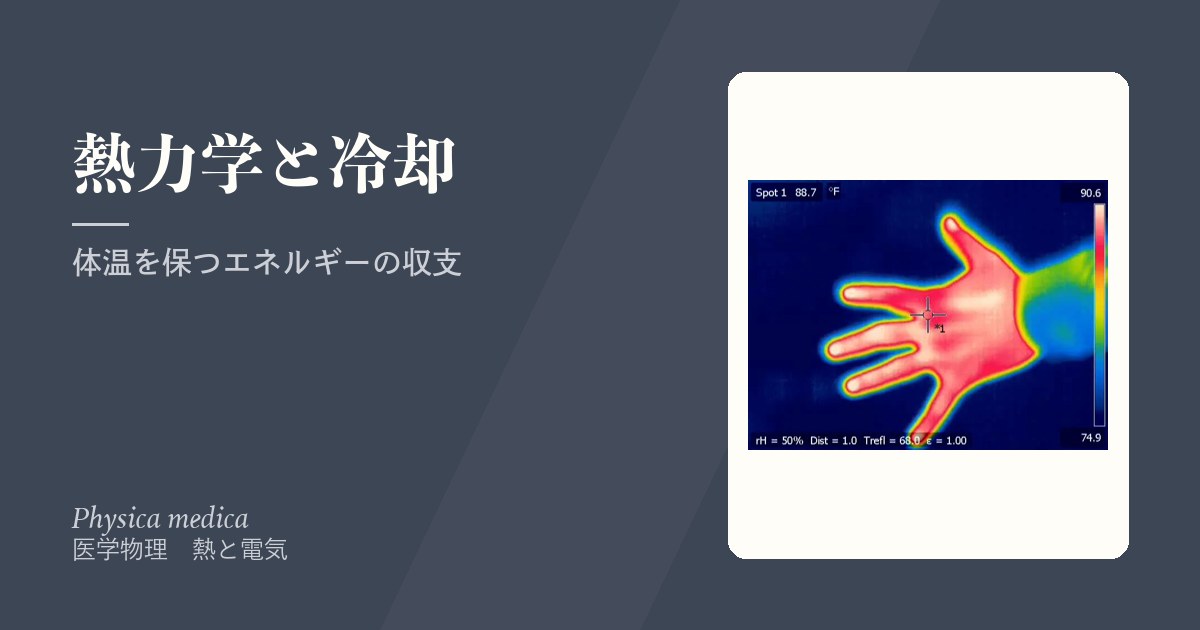
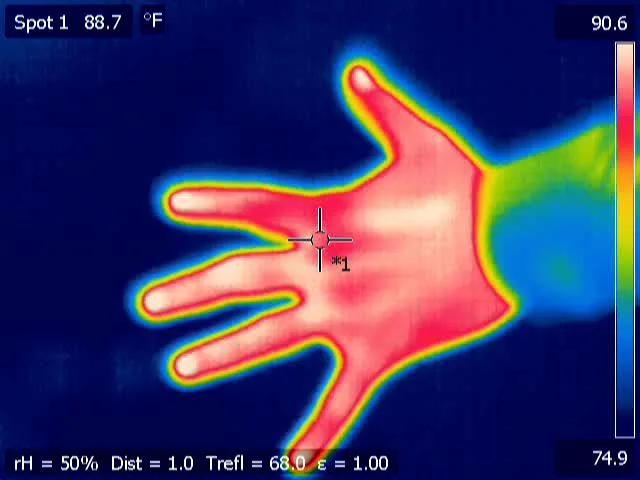
赤外線サーモグラフィは、皮膚から出る赤外線を検出して表面温度の分布を画像にする。血流の低下した部位(凍傷、末梢循環障害)は冷たく、炎症部位は温かく写る。耳式・額式の非接触体温計も放射を測っている。
English version
Core
| Mode | Mechanism | Examples |
|---|---|---|
| Conduction | High-energy particles pass energy to neighboring particles; happens inside solids and between touching bodies | Metals conduct well, gases poorly; none in vacuum |
| Convection | Warmed liquid or gas itself moves and carries heat; only in liquids and gases | Rising air over a heater, boiling water, hot-air balloons |
| Radiation | Energy sent by electromagnetic waves (mostly infrared); needs no medium and crosses vacuum | Heat from the sun, warmth of a campfire |
At the body surface, evaporation is added. Turning water from liquid to gas needs a lot of energy (heat of vaporization, latent heat: about 2.4 kJ/g near body temperature), and this is taken from the skin.
Going further
Warm air expands, becomes less dense and lighter, so it rises and cold air moves in below — this drives convection.
Radiated energy is proportional to the fourth power of absolute temperature (Stefan–Boltzmann law, P = εσAT4). The wavelength radiated most strongly is inversely proportional to temperature (Wien’s displacement law, λmax = b/T, b ≈ 2.9×10⁻³ m·K); at body temperature, 310 K, it is infrared at about 9–10 μm.
Latent heat is the energy used to overcome the forces holding molecules together when a substance changes state (solid → liquid → gas). Its unit is J (or J/kg). The temperature does not change during this.
In the clinic
Infrared thermography detects infrared from the skin and images the distribution of surface temperature. Areas with low blood flow (frostbite, poor peripheral circulation) look cold; inflamed areas look warm. Non-contact ear and forehead thermometers also measure radiation.
熱力学の法則 — エネルギーは保存され、乱雑さは増える
系の種類:開放系(物質もエネルギーも出入りする)、閉鎖系(エネルギーだけ)、孤立系(どちらも出入りしない)。人の体は食べ、呼吸し、熱を交換するので開放系である。
| 法則 | 中身 |
|---|---|
| 第0法則 | A と C、B と C がそれぞれ熱平衡なら、A と B も熱平衡(温度計が使える根拠) |
| 第1法則 | エネルギーは形を変えるだけで、生まれも消えもしない:ΔU = Q − W |
| 第2法則 | 熱は自然には高温から低温へだけ流れる。孤立系のエントロピー(乱雑さ)は増える |
| 第3法則 | 完全な結晶のエントロピーは 0 K で 0。絶対零度には到達できない |
ΔU:内部エネルギーの変化、Q:系に加えた熱、W:系が外にした仕事。
第2法則の意味。エネルギーの総量は保存されるが、使える形(集中した形)から使えない形(散らばった熱)へと一方向に変わっていく。片付けた部屋は放っておけば散らかり、果物は腐る。秩序を保つには外からエネルギーを入れ続ける必要がある。冷蔵庫は電気を使って低温側から高温側へ熱を汲み出すが、これは第2法則に反しない(仕事を加えているから)。
状態の変化では、氷が融けて水になるとエントロピーは増え、凍ると減る。固体 < 液体 < 気体の順にエントロピーは大きい。
生きている細胞は、ATP のエネルギーを使い続けて濃度勾配や複雑な構造という秩序を保っている。代謝が止まれば、イオンの勾配は崩れ、構造は壊れていく——死後の変化はエントロピーの増大そのものと見ることができる。
English version
Core
Types of systems: open (matter and energy enter and leave), closed (energy only) and isolated (neither). The human body eats, breathes and exchanges heat, so it is an open system.
| Law | Content |
|---|---|
| Zeroth | If A and C, and B and C, are each in thermal equilibrium, A and B are too (why thermometers work) |
| First | Energy only changes form; it is neither created nor destroyed: ΔU = Q − W |
| Second | Heat flows naturally only from hot to cold. The entropy (disorder) of an isolated system increases |
| Third | The entropy of a perfect crystal is zero at 0 K. Absolute zero cannot be reached |
ΔU: change in internal energy; Q: heat added to the system; W: work done by the system.
Going further
What the second law means. The total amount of energy is conserved, but it changes in one direction, from useful (concentrated) forms to useless (spread-out heat). A tidy room left alone gets messy; fruit rots. Keeping order needs a constant supply of energy from outside. A refrigerator uses electricity to pump heat from the cold side to the hot side; this does not break the second law, because work is put in.
In changes of state, ice melting into water increases entropy, and freezing decreases it. Entropy increases in the order solid < liquid < gas.
In the clinic
Living cells keep order — concentration gradients and complex structures — by using ATP energy all the time. When metabolism stops, ion gradients collapse and structures break down; changes after death can be seen as the increase of entropy itself.
体のエネルギー収支 — 第1法則を体にあてはめる
体はエネルギーをつくらない。食べ物(糖質・脂質・蛋白質)の化学エネルギーを、酸化によって取り出し、ATP を介して別の形に変えているだけである(第1法則)。
行き先は:運動エネルギー(筋の収縮)、電気的エネルギー(神経の信号)、化学的な仕事(合成・輸送)、そして熱(体温の維持)。最後はほとんどが熱になって外へ出る。
食べ物のエネルギーはキロカロリーで表す:1 kcal = 1 kg の水を1 ℃上げる熱量 ≈ 4.18 kJ。食品表示の「カロリー」はふつう kcal のことである。
第1法則 ΔU = Q − W を体に当てはめると、摂取 > 消費なら余りは脂肪として蓄えられ(体重増加)、摂取 < 消費なら蓄えた脂肪を燃やす(体重減少)、等しければ体重は変わらない。余ったエネルギーを捨てる特別な仕組みはなく、組織として蓄えるしかない。
筋が化学エネルギーを機械的な仕事に変える効率はおよそ20〜25%で、残りは熱になる。運動すると体が熱くなるのはこのためで、寒いときのふるえは、仕事をせずに筋を収縮させて熱だけをつくる仕組みである。
1日の消費エネルギーの大部分は基礎代謝(安静でも生命維持に使う分)で、甲状腺ホルモンで増減する。甲状腺機能亢進症では代謝が上がって体重が減り暑がりに、低下症では代謝が下がって寒がりになる。脂肪1 kg はおよそ 7000 kcal にあたるので、体重を落とすには長期の収支の差が要る。
English version
Core
The body does not create energy. It takes chemical energy from food (carbohydrates, fats, proteins) by oxidation and changes it into other forms through ATP — that is all (the first law).
It goes to: kinetic energy (muscle contraction), electrical energy (nerve signals), chemical work (synthesis, transport) and heat (keeping body temperature). In the end almost all of it leaves as heat.
Food energy is given in kilocalories: 1 kcal = the heat to warm 1 kg of water by 1 °C ≈ 4.18 kJ. “Calories” on food labels usually means kcal.
Going further
Applying the first law ΔU = Q − W to the body: if intake > use, the extra is stored as fat (weight gain); if intake < use, stored fat is burned (weight loss); if equal, weight stays the same. There is no special way to throw away extra energy; it can only be stored as tissue.
Muscles turn chemical energy into mechanical work with an efficiency of about 20–25%; the rest becomes heat. This is why exercise makes you hot, and shivering in the cold contracts muscles without doing work, only to make heat.
In the clinic
Most daily energy use is the basal metabolism (what is used to stay alive even at rest), which thyroid hormone raises or lowers. In hyperthyroidism metabolism rises, weight falls and the patient feels hot; in hypothyroidism metabolism falls and the patient feels cold. One kilogram of body fat is about 7000 kcal, so losing weight needs a long-term difference in the balance.
体温調節 — 熱をどこから捨てているか
体の深部でつくられた熱は、主に血流によって皮膚へ運ばれる(脂肪や血流の少ない組織は熱をよく伝えない、つまり断熱材として働く)。皮膚からは4つの経路で外へ出る。
室温で安静にしているとき、熱の放散のおよその内訳は放射 約60%、蒸発 約20〜25%、対流と伝導 合わせて約15〜20%。
暑いときは皮膚の血管を広げて皮膚に熱を運び、発汗で蒸発による放熱を増やす。寒いときは皮膚の血管を縮めて熱を逃がさず、ふるえで熱をつくる。
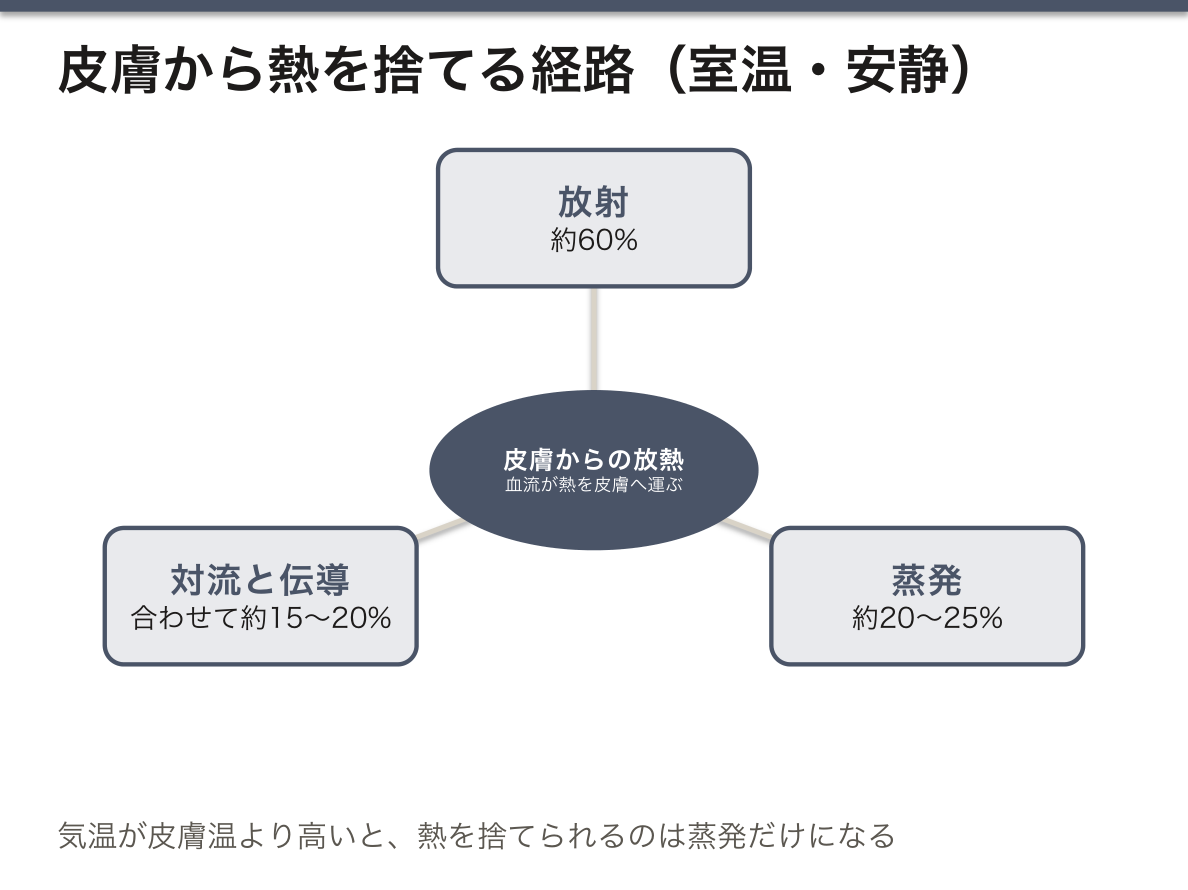
気温が皮膚温より高くなると、放射・伝導・対流ではむしろ熱が体に入ってくる。そのとき熱を捨てられる経路は蒸発だけになる。汗1 L が蒸発すると約580 kcal の熱が奪われる。
だから湿度が決定的になる。湿った空気では汗が蒸発しにくく、流れ落ちるだけで熱を奪わない。乾いた気候のほうが体温を下げやすいのは、対流ではなく蒸発が進むからである。
濡れた服で寒く感じるのは、水が蒸発するときに体から熱を奪う(蒸発は吸熱過程)ことと、水が空気より熱をよく伝えることの両方による。濡れた服の水が皮膚より冷たいからではない。
熱中症は高温多湿で蒸発による放熱が追いつかず、体温が上がり続ける状態である。治療の要は体を濡らして風を当てる(蒸発と対流を最大にする)、氷で太い血管の通る部位を冷やすことで、放熱経路の物理そのものを使っている。逆に偶発性低体温症は、濡れた体・風・冷たい地面(伝導)で起こりやすい。
English version
Core
Heat made deep in the body is carried to the skin mainly by blood flow (fat and tissue with little blood conduct heat poorly and act as insulation). From the skin it leaves by four routes.
At rest at room temperature, heat loss is roughly radiation about 60%, evaporation about 20–25%, and convection and conduction together about 15–20%.
When hot, the body widens skin vessels to bring heat to the skin and increases evaporative loss by sweating. When cold, it narrows skin vessels to keep heat in and makes heat by shivering.
Going further
When the air is hotter than the skin, radiation, conduction and convection actually bring heat into the body. Then evaporation is the only route for losing heat. One liter of sweat evaporating removes about 580 kcal.
So humidity is decisive. In humid air, sweat hardly evaporates; it just runs off without taking heat. It is easier to lower body temperature in a dry climate because evaporation works better, not because of convection.
Wet clothes feel cold for two reasons: evaporating water takes heat from the body (evaporation absorbs heat), and water conducts heat better than air. It is not because the water in wet clothes is colder than the skin.
In the clinic
Heat stroke is a state in which evaporative heat loss cannot keep up in hot, humid conditions and body temperature keeps rising. The key treatment is to wet the body and blow air on it (maximizing evaporation and convection), and to cool areas over large vessels with ice — using the physics of heat loss directly. In contrast, accidental hypothermia develops easily with a wet body, wind and cold ground (conduction).
ニュートンの冷却則 — 温度差に比例して冷える
物体の温度の変化の速さは、物体と周囲の温度差に比例する。
dT/dt = −k(T − Tout)
(T:物体の温度、Tout:周囲の温度、k:正の比例定数)。この式を解くと
T(t) = Tout + (T0 − Tout)·e−kt
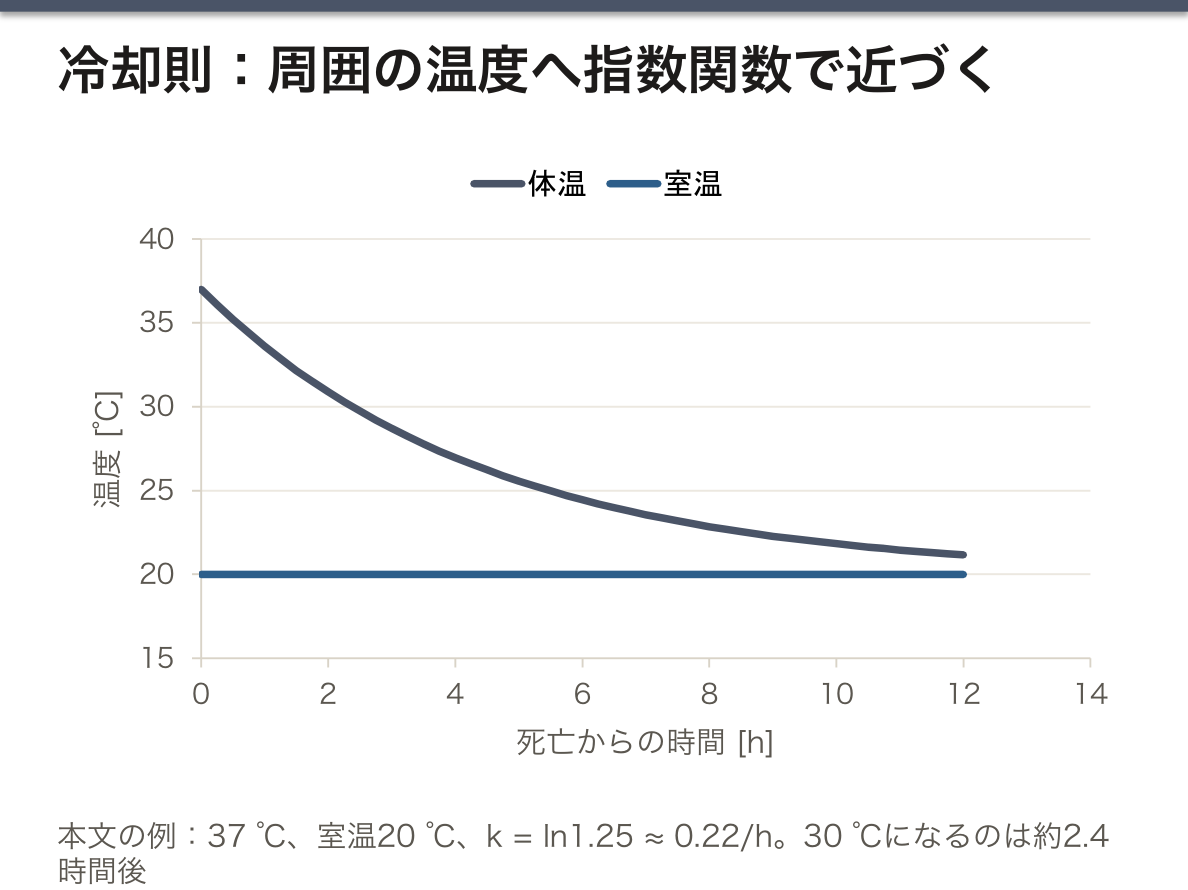
温度は周囲の温度に向かって指数関数的に近づく。最初は速く、温度差が小さくなるほどゆっくり冷え、最後は周囲と熱平衡になる。冷える速さは一定でも直線的でもない。
確かめ方:ln(T − Tout) を時間に対してプロットすると、傾き −k の直線になる。直線に乗れば冷却則が成り立っている。
k は物体の大きさ・形・材質で決まる。体積に対する表面積の比が大きい(小さい)物体ほど速く冷える。熱は体積に比例してたまり、表面積に比例して逃げるからである。同じ材質の円柱なら、小さいほうが速く冷める。
例(死亡推定時刻):22時に体温30 ℃、23時に28 ℃、室温20 ℃、死亡時37 ℃ とする。(30−20)/(28−20) = ek·1h より k = ln 1.25 ≈ 0.22/h。30 = 20 + 17e−kt を解くと t = ln(1.7)/0.22 ≈ 2.4 時間——22時の約2時間20分前、19時40分ごろと推定される。
法医学ではこの考え方で死後経過時間を推定するが、実際の遺体は死後しばらく体温がほとんど下がらない時期があり、着衣・体格・環境で k が大きく変わるので、幅をもった推定になる。新生児、とくに早産児は体積に対する表面積が大きく皮下脂肪も少ないので、すぐに体温を失う。保育器や出生直後に体を拭いて温めることが低体温を防ぐ基本である。
English version
Core
The rate at which an object’s temperature changes is proportional to the temperature difference between the object and its surroundings.
dT/dt = −k(T − Tout)
(T: object temperature, Tout: surrounding temperature, k: a positive constant). Solving it gives
T(t) = Tout + (T0 − Tout)·e−kt
The temperature approaches the surrounding temperature exponentially: fast at first, then more slowly as the difference shrinks, until it reaches thermal equilibrium. The cooling rate is neither constant nor linear.
Going further
How to check: plot ln(T − Tout) against time; you get a straight line with slope −k. If the points lie on a line, the cooling law holds.
k depends on the size, shape and material of the object. Objects with a larger surface area for their volume (smaller objects) cool faster, because heat is stored in proportion to volume and lost in proportion to surface area. Of two cylinders of the same material, the smaller one cools faster.
Example (time of death): body temperature 30 °C at 22:00 and 28 °C at 23:00, room 20 °C, 37 °C at death. From (30−20)/(28−20) = ek·1h, k = ln 1.25 ≈ 0.22/h. Solving 30 = 20 + 17e−kt gives t = ln(1.7)/0.22 ≈ 2.4 hours — about 2 hours 20 minutes before 22:00, so death is estimated at around 19:40.
In the clinic
Forensic medicine uses this idea to estimate the time since death, but a real body has a period after death when its temperature barely falls, and clothing, body size and environment change k a lot, so the estimate has a wide range. Newborns, especially preterm infants, have a large surface area for their volume and little fat under the skin, so they lose heat quickly. Incubators, and drying and warming the baby right after birth, are the basics of preventing hypothermia.
まとめ
| 温度と熱 — 似ているが別の量 | 温度は物体をつくる分子の平均の運動エネルギーの目安である。 |
|---|---|
| 熱の伝わり方 — 伝導・対流・放射、そして蒸発 | 方法しくみ例伝導エネルギーの高い粒子が隣の粒子にエネルギーを渡す。 |
| 熱力学の法則 — エネルギーは保存され、乱雑さは増える | 系の種類:開放系(物質もエネルギーも出入りする)、閉鎖系(エネルギーだけ)、孤立系(どちらも出入りしない)。 |
| 体のエネルギー収支 — 第1法則を体にあてはめる | 体はエネルギーをつくらない。食べ物(糖質・脂質・蛋白質)の化学エネルギーを、酸化によって取り出し、ATP を介して別の形に変えているだけである(第1法則)。 |
| 体温調節 — 熱をどこから捨てているか | 体の深部でつくられた熱は、主に血流によって皮膚へ運ばれる(脂肪や血流の少ない組織は熱をよく伝えない、つまり断熱材として働く)。 |
| ニュートンの冷却則 — 温度差に比例して冷える | 物体の温度の変化の速さは、物体と周囲の温度差に比例する。 |
このノートは医学生が授業の内容を自分の言葉でまとめたもので、診療の判断に使うものではありません。誤りに気づいたらお知らせください。