2人のヒトのゲノムを並べると、数百万か所でちがいが見つかる。その大部分は何も起こさないが、ごく一部が病気を起こし、薬の効き方を変える。この章では、変化がどこから生まれ(自然に起きるか、外から引き起こされるか)、どんな種類があり、タンパク質と細胞にどう響くかを、1塩基の置換から染色体の数の異常まで、小さい順に見ていく。
最初に言葉を正確に使うことから始める。「正常」「突然変異」「多型」は日常語としては便利だが、遺伝の検査報告では誤解のもとになる。報告書に書かれた c.1222C>T や p.Arg408Trp を読めるようになることが、この章の実用的なゴールである。
- 用語 — 「正常」「突然変異」を使わない理由
- 変化はどこから生まれるか — 自然に起きる誤りと、外からの傷
- 配列の変化の種類 — 1塩基から数百万塩基まで
- 塩基置換の帰結 — ミスセンス・サイレント・ナンセンス・スプライス部位
- 挿入・欠失・フレームシフトと動的変異 — 3の倍数かどうか、繰り返しが伸びるかどうか
- 機能から見た分類と、バリアントの解釈
- 染色体の数の異常 — 異数性と倍数性
- 染色体の構造の異常 — 均衡型と不均衡型
用語 — 「正常」「突然変異」を使わない理由
遺伝子座(ローカス)は、ある遺伝子が染色体上にある位置である。そこに入る配列のちがう版をアレル(対立遺伝子)という。2つのアレルが同じならホモ接合、ちがえばヘテロ接合、対になる相手がそもそも無い場合(男性のX連鎖遺伝子など)はヘミ接合である。
集団の中で最も多いアレルを野生型、それと配列がちがうものをバリアント(アレル変異体)と呼ぶ。ちがいを見つけるには基準が要る。それが参照ゲノムで、ヒトゲノム計画の後も改訂が続き、現在はGRCh38(hg38)が広く使われている。
表記はHGVSという国際的な規則に従う。c.はコーディング配列上の位置、p.はタンパク質上の位置を表す。c.1222C>Tは「コーディング配列の1222番目のCがTに置き換わった」、p.Arg408Trpは「408番目のアルギニンがトリプトファンになった」という意味である。
なぜ「正常」「突然変異」「多型」を避けるのか。最も多いアレルを「正常」と呼ぶと、それ以外は「異常」だと響くが、実際には多くのバリアントは何の害も無い。「突然変異(mutation)」は、「変化」という意味と「病気を起こす変化」という意味の両方で使われてきたので、どちらを指すのかがあいまいになる。「多型(polymorphism)」も分野によって「病気を起こさない変化」の意味だったり、「集団の1%以上にみられる変化」の意味だったりする。だから報告書では、意味を含まない「バリアント」「変化」という言葉が使われる。言葉が判断を先取りしないように、という配慮である。
English version
Core
A locus is the position of a gene on a chromosome. The different versions of the sequence at that position are alleles. If the two alleles are the same, the person is homozygous; if different, heterozygous; if there is no partner copy at all (such as X-linked genes in males), hemizygous.
The most common allele in a population is the wild type; a version with a different sequence is a variant. To find differences you need a standard: the reference genome. It has been revised since the Human Genome Project; today GRCh38 (hg38) is widely used.
Notation follows the international HGVS rules. c. means a position in the coding sequence; p. means a position in the protein. c.1222C>T means “C at coding position 1222 is replaced by T”; p.Arg408Trp means “arginine 408 has become tryptophan”.
Going further
Why avoid “normal”, “mutation” and “polymorphism”? Calling the most common allele “normal” makes the others sound “abnormal”, but most variants do no harm. “Mutation” has been used both for “a change” and for “a disease-causing change”, so it is unclear which is meant. “Polymorphism” means “a change that does not cause disease” in some fields and “a change found in 1% or more of a population” in others. So reports use neutral words such as “variant” or “change”, so that the word does not make the judgement in advance.
変化はどこから生まれるか — 自然に起きる誤りと、外からの傷
すべての遺伝的な多様性は、ゲノムが変わる過程(変異の過程)から生まれる。その起こり方は2つに分けられる。
自然に起きるもの:最も多いのはDNA複製の誤りで、ふつうはDNAポリメラーゼの校正で直される。短い繰り返し配列(マイクロサテライト)では、合成中の鎖がずれる複製のすべりが起きやすい。さらに、修復の誤り、減数分裂での組み換えの誤り、分裂のときの染色体の分配の誤りがある。
外から引き起こされるもの:物理的には紫外線(隣り合うピリミジンが結合する二量体をつくる)や電離放射線、化学的には酸化ストレス・芳香族アミン・脱アミノ化を起こす物質、生物学的には転移因子やウイルスが原因になる。
| 染色体の異常 | DNA配列の変化 | |
|---|---|---|
| 何が変わるか | 染色体の数や構造 | 塩基の並び |
| 規模 | 多くの遺伝子をまとめて含む | ふつうは1つの遺伝子か、非コード領域の一部 |
変化が体細胞で起きれば、その人の中で積み重なり、癌の原因になりうる。生殖細胞で起きれば、次の世代に伝わる。
生殖細胞での塩基置換の頻度は、1世代・1塩基あたり1.1〜1.7×10⁻⁸と見積もられている。小さな数に見えるが、子は父と母から合わせて約60億塩基を受け取るので、6×109×(1.1〜1.7)×10−8≒66〜102、つまり1人の新生児は、両親のどちらにも無い新しい塩基置換を数十個以上もって生まれてくる計算になる。そのうちタンパク質をコードする部分(ゲノムの約1.5%)に当たるのは、平均で1〜2個ほどである。小さな挿入・欠失の頻度は塩基置換の約8%とされる。変化は珍しい事故ではなく、毎世代必ず起きていることがわかる。
父親の年齢が高いほど、子の新しい塩基置換は増える。精子のもとになる細胞は思春期から一生分裂を続け、そのたびに複製の誤りの機会があるからである。
English version
Core
All genetic variation comes from the process that changes the genome (the mutation process). It happens in two ways.
Spontaneous: the most common source is errors in DNA replication, usually fixed by DNA polymerase proofreading. In short repeats (microsatellites), the new strand can slip out of place (replication slippage). Other sources are repair errors, recombination errors in meiosis, and errors in sharing chromosomes at cell division.
Induced from outside: physical causes are UV light (which joins neighbouring pyrimidines into dimers) and ionising radiation; chemical causes are oxidative stress, aromatic amines and substances that cause deamination; biological causes are transposable elements and viruses.
| Chromosomal aberration | DNA sequence change | |
|---|---|---|
| What changes | Number or structure of chromosomes | The order of bases |
| Scale | Includes many genes at once | Usually one gene or part of a non-coding region |
Going further
A change in a somatic cell builds up in that person and can lead to cancer. A change in a germ cell passes to the next generation.
The rate of base substitutions in germ cells is estimated at 1.1–1.7×10⁻⁸ per base per generation. This looks tiny, but a child receives about 6 billion bases from the two parents together: 6×109 × (1.1–1.7)×10−8 ≈ 66–102. So every newborn carries dozens of new base substitutions that neither parent has. On average only 1–2 of them fall in protein-coding parts (about 1.5% of the genome). Small insertions and deletions occur at about 8% of the substitution rate. Change is not a rare accident; it happens in every generation.
In the clinic
The older the father, the more new base substitutions the child has. The cells that make sperm keep dividing from puberty for life, and each division is another chance for replication errors.
配列の変化の種類 — 1塩基から数百万塩基まで
DNA配列の変化は、大きさと仕組みで次のように分けられる。
| 種類 | 大きさ | アレルの数 | 内容 |
|---|---|---|---|
| 1塩基の置換(以前のSNP) | 1塩基 | ふつう2 | コード領域にも非コード領域にも起きる。アミノ酸を変えるもの(非同義)と変えないもの(同義)がある |
| 挿入・欠失(以前のindel) | 1〜100塩基ほど | ふつう2 | ゲノムの断片が入る、または抜ける |
| 短い縦列反復(以前のSTR) | 2〜4塩基の単位の繰り返し | 多数(5以上) | マイクロサテライト。繰り返しの回数が人によってちがう |
| コピー数の変化(CNV) | 約200塩基〜1.5 Mb | 2〜多数 | 大きな区間が有るか無いか。コード領域を含むこともある |
| 可動因子の挿入 | 数百〜数千塩基 | ふつう2 | LINEやAluなどが逆転写を経て新しい場所に入る |
短い縦列反復はアレルの数が多いことが特徴である。1つの座位に何通りもの繰り返し回数があり、それを十数か所組み合わせると、同じ組み合わせをもつ他人は事実上いなくなる。なぜ繰り返し配列は人によって回数がばらつくのか。同じ単位が並んでいると、複製のときに鎖がずれても再び対をつくれてしまう。ずれたまま合成が進むと、回数が1つ増えたり減ったりする。そのため変化の頻度が他の場所よりずっと高く、個人差が生まれやすい。
CNVは1つ1つの塩基は正常でも、遺伝子のコピー数が変わる。量に敏感な遺伝子が含まれると、多すぎても少なすぎても影響が出る。
短い縦列反復の組み合わせは、個人識別(法医学)や親子鑑定、骨髄移植のあとに血液がドナー由来になったかを確かめる検査に使われる。CNVは、発達の遅れなどの原因を調べるマイクロアレイ染色体検査で見つかる。
English version
Core
DNA sequence changes can be grouped by size and mechanism as follows.
| Type | Size | Alleles | Content |
|---|---|---|---|
| Single base substitution (formerly SNP) | 1 base | Usually 2 | In coding or non-coding regions. Some change an amino acid (nonsynonymous), some do not (synonymous) |
| Insertion or deletion (formerly indel) | About 1–100 bases | Usually 2 | A piece of the genome is added or lost |
| Short tandem repeat (formerly STR) | Repeats of 2–4 base units | Many (5 or more) | Microsatellites; the number of repeats differs between people |
| Copy number variation (CNV) | About 200 bases to 1.5 Mb | 2 or many | A large segment is present or absent; may include coding regions |
| Mobile element insertion | Hundreds to thousands of bases | Usually 2 | LINEs or Alu elements enter a new site through reverse transcription |
Going further
Short tandem repeats have many alleles. One locus can have many different repeat numbers. Combine a dozen or so loci, and practically no one else shares the same combination. Why do repeat numbers vary so much between people? When the same unit is lined up again and again, a strand that slips during replication can still pair up. If synthesis continues after slipping, the count goes up or down by one. So these sites change much more often than others, and individual differences arise easily.
In a CNV, each base may be normal, but the number of gene copies changes. If a dose-sensitive gene is included, both too many and too few copies have effects.
In the clinic
Combinations of short tandem repeats are used for identifying individuals (forensic medicine), paternity testing, and checking whether blood has become donor-derived after bone marrow transplantation. CNVs are found by chromosomal microarray testing when looking for causes of developmental delay and similar problems.
塩基置換の帰結 — ミスセンス・サイレント・ナンセンス・スプライス部位
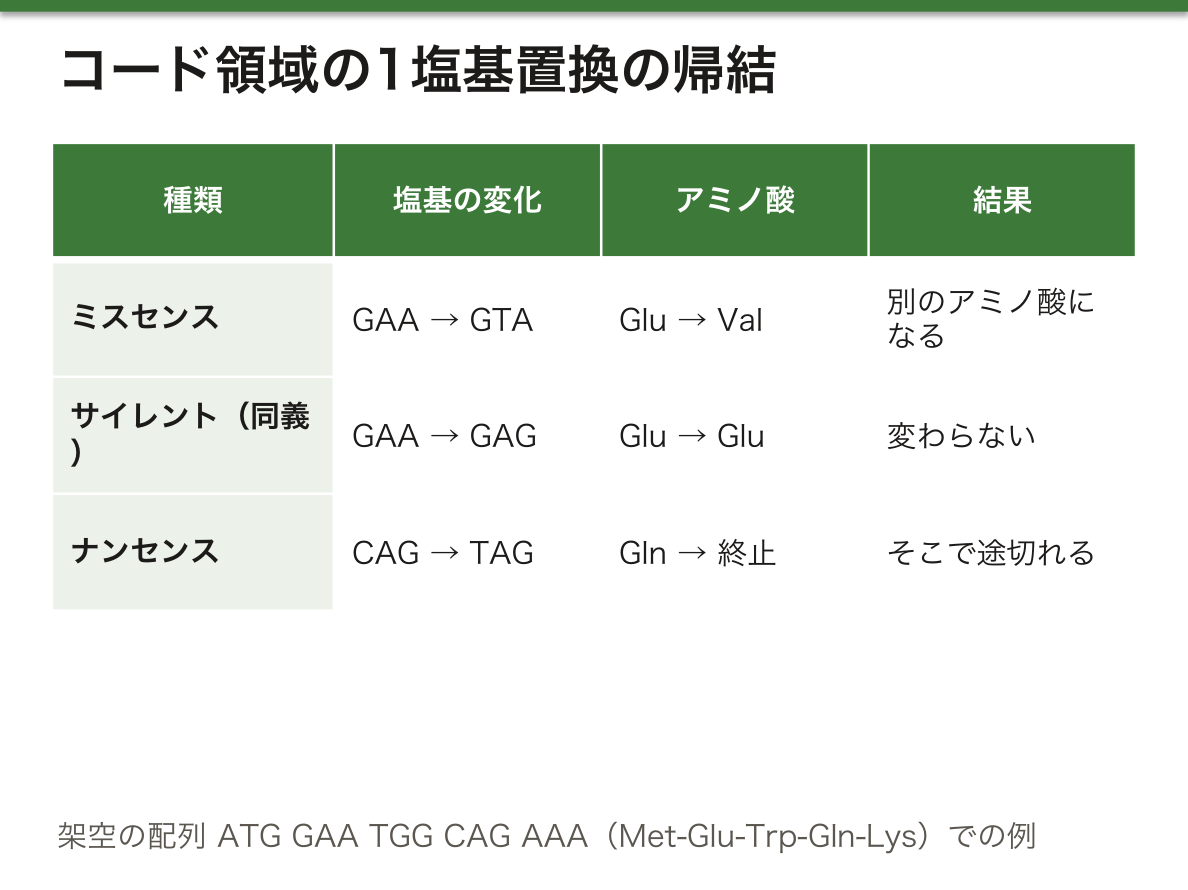
コード領域の1塩基の置換は、遺伝暗号への効き方で分類される。
架空の配列 5′-ATG GAA TGG CAG AAA-3′(Met-Glu-Trp-Gln-Lys)で考える。ミスセンス:GAAがGTAになると、GluがValに変わる(非同義置換)。サイレント(同義置換):GAAがGAGになっても、どちらもGluなので変わらない。ナンセンス:CAGがTAGになると、Glnの代わりに終止コドンができ、タンパク質はそこで途切れる。
このほか、エクソンとイントロンの境目にあるスプライス部位の変化は、イントロンを正しく切り出す合図を壊す。アミノ酸のコドンそのものが変わらなくても、イントロンが残ったりエクソンが飛ばされたりして、まったくちがうmRNAができる。
なぜサイレント置換はほとんど無害なのか。遺伝暗号は縮重していて、1つのアミノ酸を複数のコドンが指定する。その多くは3文字目だけがちがう。だから3文字目の置換はアミノ酸を変えないことが多い。ただし「ほとんど」であり、同義置換でもスプライシングの合図や翻訳の速さを変えて病気になる例がある。
ミスセンスの影響は、どのアミノ酸が何に変わったかで決まる。性質の似たアミノ酸どうし(たとえば疎水性どうし)なら影響は小さく、電荷をもつアミノ酸が疎水性のものに変わるような置換は、折りたたみや結合面を大きく変える。
鎌状赤血球症は、βグロビンのコドンGAGがGTGになり、グルタミン酸がバリンに置き換わるミスセンスで起きる。伝統的には「6番目」のアミノ酸と呼ばれるが、HGVSでは開始のメチオニンも数えるのでp.Glu7Valと書かれる。電荷のある残基が疎水性の残基になり、脱酸素状態のヘモグロビンどうしがくっついて線維をつくる。フェニルケトン尿症の代表的なバリアントc.1222C>T(p.Arg408Trp)はフェニルアラニン水酸化酵素の安定性と折りたたみを損なう機能喪失型で、新生児マススクリーニングで見つけて食事療法を始めれば、知的発達への障害を防げる。
English version
Core
A single base substitution in a coding region is classed by its effect on the genetic code.
Take a made-up sequence 5′-ATG GAA TGG CAG AAA-3′ (Met-Glu-Trp-Gln-Lys). Missense: if GAA becomes GTA, Glu becomes Val (nonsynonymous). Silent (synonymous): if GAA becomes GAG, both code Glu, so nothing changes. Nonsense: if CAG becomes TAG, a stop codon replaces Gln and the protein ends there.
A change at a splice site, at the border of an exon and an intron, breaks the signal for cutting out the intron correctly. Even if no amino acid codon changes, an intron may stay in or an exon may be skipped, and a very different mRNA is made.
Going further
Why are silent substitutions almost harmless? The genetic code is degenerate: several codons specify the same amino acid, and many of them differ only in the third letter. So a change in the third letter often does not change the amino acid. But “almost” matters: some synonymous changes alter splicing signals or translation speed and cause disease.
The effect of a missense change depends on which amino acid becomes which. Between similar amino acids (both hydrophobic, for example) the effect is small. A change from a charged amino acid to a hydrophobic one can greatly change folding or binding surfaces.
In the clinic
Sickle cell disease is caused by a missense change in β-globin: codon GAG becomes GTG, and glutamic acid is replaced by valine. It is traditionally called amino acid “6”, but HGVS counts the starting methionine, so it is written p.Glu7Val. A charged residue becomes hydrophobic, and deoxygenated haemoglobin molecules stick together into fibres. A common variant in phenylketonuria, c.1222C>T (p.Arg408Trp), damages the stability and folding of phenylalanine hydroxylase (loss of function). If it is found by newborn screening and a diet is started, harm to intellectual development can be prevented.
挿入・欠失・フレームシフトと動的変異 — 3の倍数かどうか、繰り返しが伸びるかどうか
塩基が1つ以上抜けるのが欠失、入るのが挿入である。特に害が大きいのは、抜けた・入った数が3の倍数でない場合である。読み枠がずれ(フレームシフト)、そこから先のコドンがすべて変わる。先の架空の配列 ATG GAA TGG CAG… の4文字目のGが抜けると、ATG AAT GGC AGA…と読まれ、2つ目以降のアミノ酸がすべて別物になる。多くの場合、やがて早すぎる終止コドンに行き当たる。
LINEやAluの可動因子の挿入もフレームシフトを起こし、病気の原因として報告されている。
動的変異は、CGGやCAGのような3塩基の繰り返しが伸びていく変化で、主に配偶子ができるときに伸びる。世代を経るごとに長くなり、発症が早く、症状が重くなる(表現促進)。
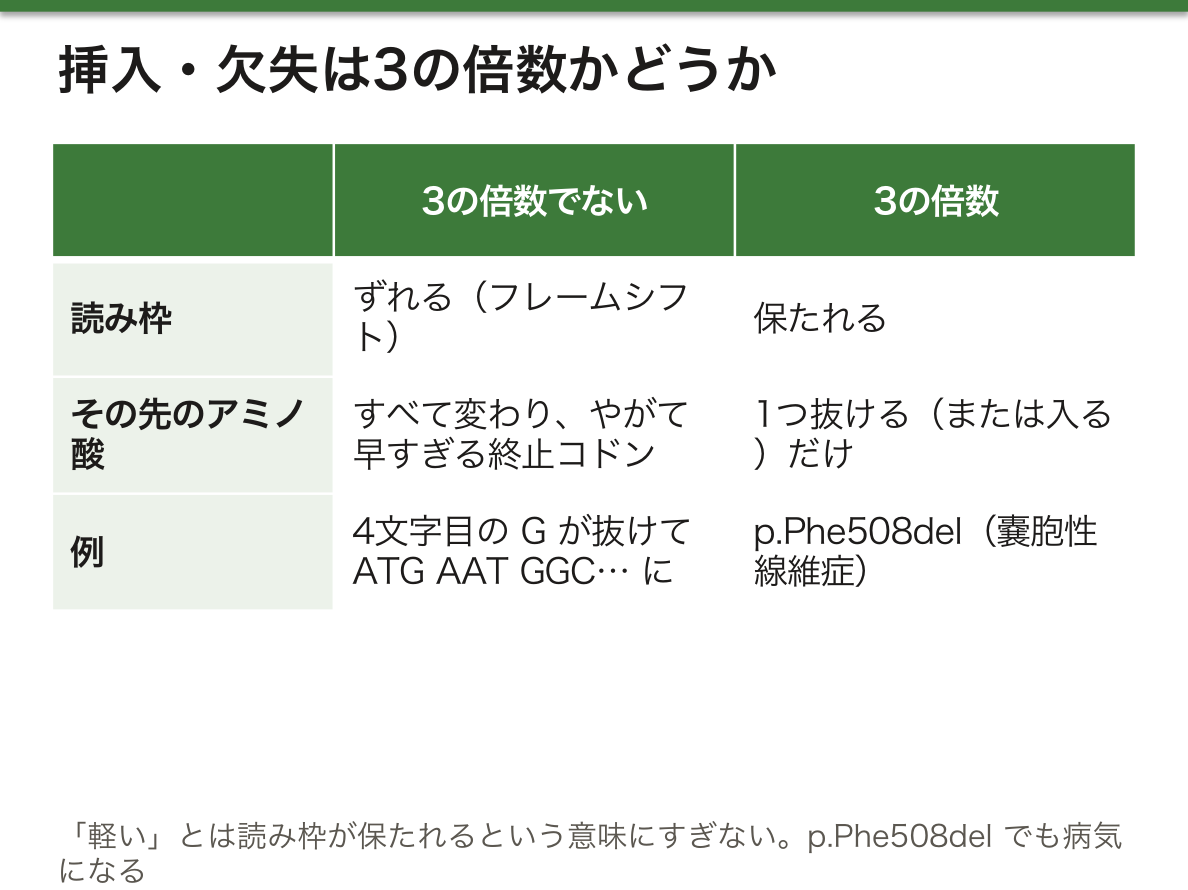
なぜ3の倍数のずれは比較的軽いことが多いのか。3塩基の欠失は1つのアミノ酸が抜けるだけで、その後の読み枠は保たれるからである。嚢胞性線維症の代表的なバリアントp.Phe508delがその例で、フェニルアラニンが1つ抜ける。それでも折りたたみが崩れて病気になるので、「軽い」とは「読み枠が保たれる」という意味にすぎない。
早すぎる終止コドンをもつmRNAの多くは、細胞の点検の仕組み(ナンセンス変異依存mRNA分解)で壊される。切れ端のタンパク質が悪さをする前に処分されるので、結果としてそのアレルは「作られない」のと同じ機能喪失になることが多い。
脆弱X症候群では、FMR1遺伝子の5′UTRにあるCGGの繰り返しが、前変異(約55〜200回)から完全変異(200回超)へと母親を通して伝わるときに伸びる。完全変異ではプロモーターがメチル化されて遺伝子が黙り、知的障害の原因になる。前変異をもつ高齢の男性には振戦や運動失調を示す別の神経変性症が起きる。Huntington病はHTTのコード領域のCAGの伸長で、ポリグルタミンの長いタンパク質が凝集する。こちらは父親から伝わるときに伸びやすく、若年発症例は父由来が多い。
English version
Core
Loss of one or more bases is a deletion; gain is an insertion. They are most harmful when the number of bases is not a multiple of three. The reading frame shifts (frameshift) and every codon after that changes. In the made-up sequence ATG GAA TGG CAG…, if the G at position 4 is lost, it reads ATG AAT GGC AGA…, and every amino acid from the second one on is different. Usually a premature stop codon comes up soon.
Insertions of mobile elements such as LINEs or Alu can also cause frameshifts and have been reported as causes of disease.
A dynamic mutation is a change in which a three-base repeat such as CGG or CAG grows longer, mainly when gametes are made. It gets longer with each generation, and the disease starts earlier and becomes more severe (anticipation).
Going further
Why are changes in multiples of three often milder? Losing three bases removes just one amino acid, and the reading frame after it is kept. The common cystic fibrosis variant p.Phe508del is an example: one phenylalanine is missing. Folding still fails and disease results, so “milder” only means “the frame is kept”.
Most mRNAs with a premature stop codon are destroyed by the cell’s checking system (nonsense-mediated mRNA decay). The shortened protein is removed before it can do harm, so the result is often a loss of function, the same as if the allele made nothing.
In the clinic
In fragile X syndrome, the CGG repeat in the 5′UTR of the FMR1 gene grows from a premutation (about 55–200 repeats) to a full mutation (over 200) when passed through the mother. In the full mutation, the promoter is methylated and the gene is silenced, causing intellectual disability. Older men with a premutation can develop a different neurodegenerative disease with tremor and ataxia. Huntington’s disease is caused by a CAG expansion in the coding region of HTT; the protein with a long polyglutamine stretch forms aggregates. This repeat tends to grow when passed from the father, and juvenile cases are mostly inherited from the father.
機能から見た分類と、バリアントの解釈
変化がタンパク質の働きにどう響くかで、3つに分ける。
機能獲得型:新しい働きをもつ産物ができる、作られすぎる、あるいは作られるべきでない時や場所で作られる。機能喪失型:産物の働きが失われる。ドミナントネガティブ型:異常な産物が、もう一方のアレルから作られた正常な産物の働きまで邪魔する。
見つかった変化が病気の原因かどうかは、5段階で判定して報告される。病的(pathogenic)、おそらく病的、意義不明(VUS)、おそらく良性、良性である。
なぜドミナントネガティブは、遺伝子がまるごと無いより重くなることがあるのか。いくつかのサブユニットが集まって働くタンパク質を考える。I型コラーゲンは、α1鎖2本とα2鎖1本の三重らせんである。α1鎖の遺伝子の片方がまったく作られないなら、量は半分になるが、できたコラーゲンは正常である。ところが片方が異常な鎖を作ると、α1鎖の半分が異常なので、2本とも正常になる確率は1/2×1/2=1/4しか無い。残りの3/4は壊れた三重らせんになる。実際に骨形成不全症では、作られないタイプは軽く、グリシンが置き換わる異常な鎖のタイプは重い。4量体で働くp53なら、正常な4量体は(1/2)4=1/16にまで減る。
VUSは「わからない」という意味であり、治療や予防的な手術の判断に使ってはならない。情報が増えると後で分類が変わることがあり、多くは良性側に動く。結果を受け取った人に、この不確かさを正しく伝えることも医師の仕事である。
English version
Core
Changes are divided into three groups by their effect on protein function.
Gain of function: a product with a new function is made, too much is made, or it is made at the wrong time or place. Loss of function: the product’s activity is lost. Dominant negative: the abnormal product also blocks the normal product made from the other allele.
Whether a change causes disease is judged and reported on a five-level scale: pathogenic, likely pathogenic, uncertain significance (VUS), likely benign, benign.
Going further
Why can a dominant negative change be worse than losing the gene entirely? Think of a protein that works as several subunits. Type I collagen is a triple helix of two α1 chains and one α2 chain. If one α1 allele makes nothing, the amount is halved, but the collagen that is made is normal. If one allele makes an abnormal chain, half of the α1 chains are abnormal, so the chance that both α1 chains are normal is only 1/2 × 1/2 = 1/4. The other 3/4 are broken helices. In osteogenesis imperfecta, the “makes nothing” type is mild and the type with glycine replaced in an abnormal chain is severe. For p53, which works as a tetramer, normal tetramers fall to (1/2)4 = 1/16.
In the clinic
A VUS means “we do not know”. It must not be used to decide treatment or preventive surgery. The class may change later as more information appears, and most move toward benign. Explaining this uncertainty correctly to the person who gets the result is also part of a doctor’s job.
染色体の数の異常 — 異数性と倍数性Trisomia
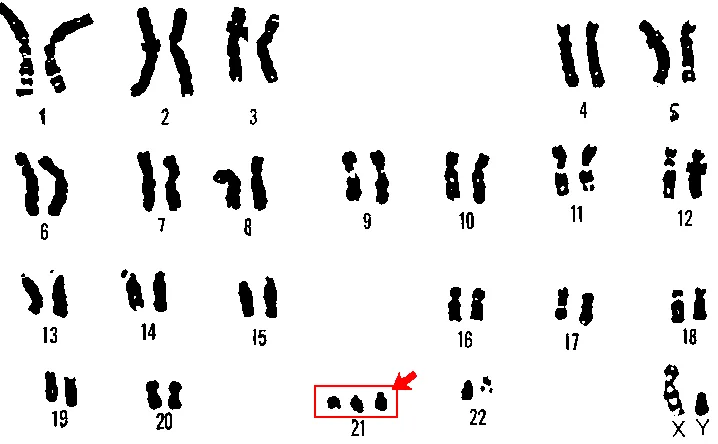
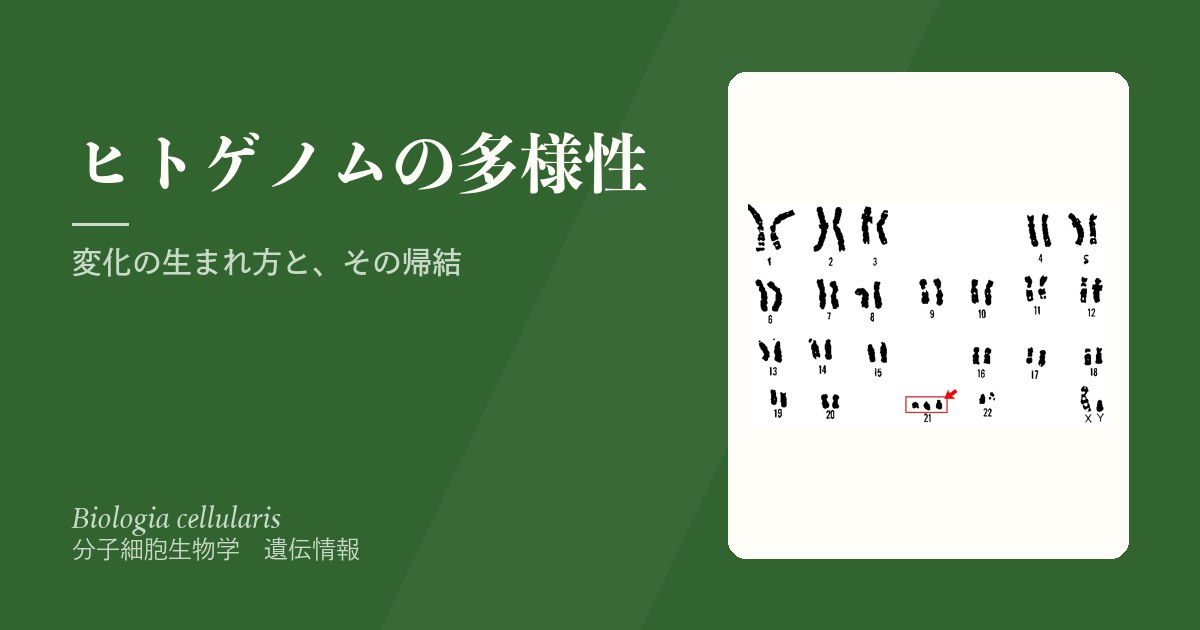
染色体が1本増える(2n+1、トリソミー)、または1本減る(2n−1、モノソミー)のが異数性で、ヒトで最もよくみられる染色体の変化である。原因は、分裂のときに対になった染色体が正しく分かれない不分離である。生殖細胞の分裂で起きれば、21トリソミー(Down症候群)のような状態になる。
染色体の組が完全にそろっている状態を正倍数性という(一倍体23本、二倍体46本)。組そのものが増えるのが倍数性で、三倍体(3n=69本)や四倍体(4n=92本)がある。減数分裂や受精直後の分裂の失敗で生じる。
なぜ生まれてくることのできるトリソミーは、13・18・21番などに限られるのか。これらは遺伝子の少ない染色体だからである。量に敏感な遺伝子が1.5倍になると、それが調節の網の目全体を少しずつ狂わせる。遺伝子の多い染色体ほど狂いが大きく、胎児は育たない。常染色体のモノソミーはさらに重く、生まれることはない。性染色体では、X1本の45,Xが生まれうる唯一のモノソミーで、余分なXは不活性化されるので性染色体のトリソミーは比較的軽い。
Down症候群では、21番の重要領域にある遺伝子の量が問題になる。その中のDYRK1AとRCAN1(DSCR1)は、どちらもNFATという転写因子の経路を抑える方向に働く。2つが同時に1.5倍になると、抑えが重なってNFATの働きが大きく下がり、発生のさまざまな過程に影響すると考えられている。「1つの遺伝子の量のちがいは小さくても、同じ経路に重なると大きくなる」ことの例である。
21トリソミーはおよそ800〜1,000出生に1人で、母親の年齢とともに増える。卵母細胞は胎児期に減数分裂を始めて途中で止まり、排卵まで数十年待つので、その間に染色体を束ねる仕組みが弱ることが一因と考えられている。三倍体は流産の原因として珍しくない。
English version
Core
Gaining one chromosome (2n+1, trisomy) or losing one (2n−1, monosomy) is aneuploidy, the most common chromosomal change in humans. It is caused by nondisjunction, when paired chromosomes fail to separate correctly at division. If it happens during germ cell division, it leads to conditions such as trisomy 21 (Down syndrome).
Having complete sets of chromosomes is euploidy (haploid 23, diploid 46). Gaining whole sets is polyploidy: triploidy (3n = 69) or tetraploidy (4n = 92). It comes from failed meiosis or failed division just after fertilisation.
Going further
Why are the trisomies that survive to birth limited to chromosomes such as 13, 18 and 21? Because these are gene-poor chromosomes. When dose-sensitive genes rise to 1.5 times, the whole network of control goes a little wrong. The more genes a chromosome has, the bigger the disturbance, and the foetus cannot develop. Autosomal monosomy is even worse and never reaches birth. For sex chromosomes, 45,X is the only monosomy that can be born, and sex chromosome trisomies are fairly mild because extra X chromosomes are inactivated.
In Down syndrome, the problem is the dose of genes in the critical region of chromosome 21. Two of them, DYRK1A and RCAN1 (DSCR1), both act to hold down the pathway of the transcription factor NFAT. When both rise to 1.5 times together, their effects add up and NFAT activity falls greatly, which is thought to affect many steps of development. It shows that small dose differences can become large when they hit the same pathway.
In the clinic
Trisomy 21 occurs in about 1 in 800–1,000 births and becomes more common with maternal age. Oocytes start meiosis in the foetus, stop halfway, and wait decades until ovulation. During that time, the system that holds chromosomes together is thought to weaken. Triploidy is a common cause of miscarriage.
染色体の構造の異常 — 均衡型と不均衡型
染色体が切れて、つながり方が変わるのが構造の異常である。分裂の途中で相同染色体が正しく並ばなかったり、切れた部分が誤った形で修復されたりして起きる。遺伝物質の総量が変わらないものを均衡型、増減するものを不均衡型という。
| 種類 | 内容 |
|---|---|
| 欠失 | 1か所で切れて先端が失われる(末端欠失)、2か所で切れて間が失われる(中間部欠失)。両端が欠けてつながると環状染色体 |
| 重複 | 一部が余分に入る。不等交差で生じる |
| 転座 | 相同でない染色体の間で部分を交換する。相互転座とRobertson転座(端部着糸型の2本が着糸点付近で融合)。できた染色体を派生染色体という |
| 逆位 | 2か所で切れた断片が180°回って戻る。着糸点を含めば腕間逆位、含まなければ腕内逆位。均衡型 |
均衡型の転座は、およそ500〜1,000人に1人と、最もよくある染色体の異常の1つである。本人は遺伝子の量が足りているので健康なことが多い。なぜ問題になるのか。減数分裂で、転座した染色体と正常な染色体が分かれるとき、組み合わせによっては配偶子が不均衡になるからである。
欠失は重複より重い結果になりやすい。遺伝物質は、多すぎるより足りないほうが害が大きいという原則がある。2コピーが必要な遺伝子が1コピーになると働きが半分になるが、3コピーになっても1.5倍で済むことが多いからである。
流産を繰り返す夫婦では、どちらかが均衡型転座の保因者でないかを染色体検査で調べる。14番と21番のRobertson転座の保因者からは、21番を余分にもつ子が生まれることがあり、家族性のDown症候群になる。体細胞の転座が癌を起こす例として、慢性骨髄性白血病のt(9;22)がある。できたBCR-ABL1融合遺伝子は常に働くチロシンキナーゼを作り、それを狙うイマチニブが治療を大きく変えた。
English version
Core
A structural aberration is when a chromosome breaks and its parts are joined in a new way. It happens when homologous chromosomes line up wrongly during division, or when breaks are repaired in the wrong form. If the total amount of genetic material is unchanged, it is balanced; if material is gained or lost, it is unbalanced.
| Type | Content |
|---|---|
| Deletion | One break loses the tip (terminal deletion); two breaks lose the piece between (interstitial deletion). If both ends are lost and joined, a ring chromosome forms |
| Duplication | Extra copy of a part; arises from unequal crossing over |
| Translocation | Exchange of parts between non-homologous chromosomes: reciprocal and Robertsonian (two acrocentric chromosomes fuse near the centromere). The new chromosomes are derivative chromosomes |
| Inversion | A piece between two breaks turns 180° and goes back. Pericentric if it includes the centromere, paracentric if not. Balanced |
Going further
Balanced translocations occur in about 1 in 500–1,000 people, one of the most common chromosomal aberrations. The carrier usually has enough genes and is healthy. So why is it a problem? In meiosis, when the translocated and normal chromosomes separate, some combinations give unbalanced gametes.
Deletions tend to be worse than duplications. The rule is that too little genetic material is more harmful than too much: if a gene needs two copies and drops to one, activity halves, but with three copies it is often only 1.5 times.
In the clinic
Couples with repeated miscarriages have chromosome tests to see whether one partner carries a balanced translocation. A carrier of a Robertsonian translocation between chromosomes 14 and 21 may have a child with an extra 21, giving familial Down syndrome. A somatic translocation that causes cancer is t(9;22) in chronic myeloid leukaemia. The resulting BCR-ABL1 fusion gene makes an always-active tyrosine kinase, and imatinib, which targets it, changed treatment greatly.
まとめ
| 用語 — 「正常」「突然変異」を使わない理由 | 遺伝子座(ローカス)は、ある遺伝子が染色体上にある位置である。 |
|---|---|
| 変化はどこから生まれるか — 自然に起きる誤りと、外からの傷 | すべての遺伝的な多様性は、ゲノムが変わる過程(変異の過程)から生まれる。 |
| 配列の変化の種類 — 1塩基から数百万塩基まで | DNA配列の変化は、大きさと仕組みで次のように分けられる。 |
| 塩基置換の帰結 — ミスセンス・サイレント・ナンセンス・スプライス部位 | コード領域の1塩基の置換は、遺伝暗号への効き方で分類される。 |
| 挿入・欠失・フレームシフトと動的変異 — 3の倍数かどうか、繰り返しが伸びるかどうか | 塩基が1つ以上抜けるのが欠失、入るのが挿入である。 |
| 機能から見た分類と、バリアントの解釈 | 変化がタンパク質の働きにどう響くかで、3つに分ける。 |
| 染色体の数の異常 — 異数性と倍数性 | 染色体が1本増える(2n+1、トリソミー)、または1本減る(2n−1、モノソミー)のが異数性で、ヒトで最もよくみられる染色体の変化である。 |
| 染色体の構造の異常 — 均衡型と不均衡型 | 染色体が切れて、つながり方が変わるのが構造の異常である。 |
このノートは医学生が授業の内容を自分の言葉でまとめたもので、診療の判断に使うものではありません。誤りに気づいたらお知らせください。