臨床用語はギリシャ語由来の部品を組み合わせて作る(解剖用語がラテン語中心なのに対して)。部品を知っていれば、初めて見る語でも意味が取れる——これがこの科目の実用的な到達点である。
📍 この2章はラテン語である。解剖学・組織学の用語はこの先ずっとラテン語なので、参照用としていつでも引けるようにしておく。ラトビア語は ラトビア語の章 から始まる。
- 語の3つの部品 — 接頭辞・語根・接尾辞
- 処方せんのラテン語と、略号
- 解剖用語の語順 — 読み解く手順
- 方向と位置の用語 — 対で覚える
- 処方せんのラテン語 — 命令法と略号
語の3つの部品 — 接頭辞・語根・接尾辞
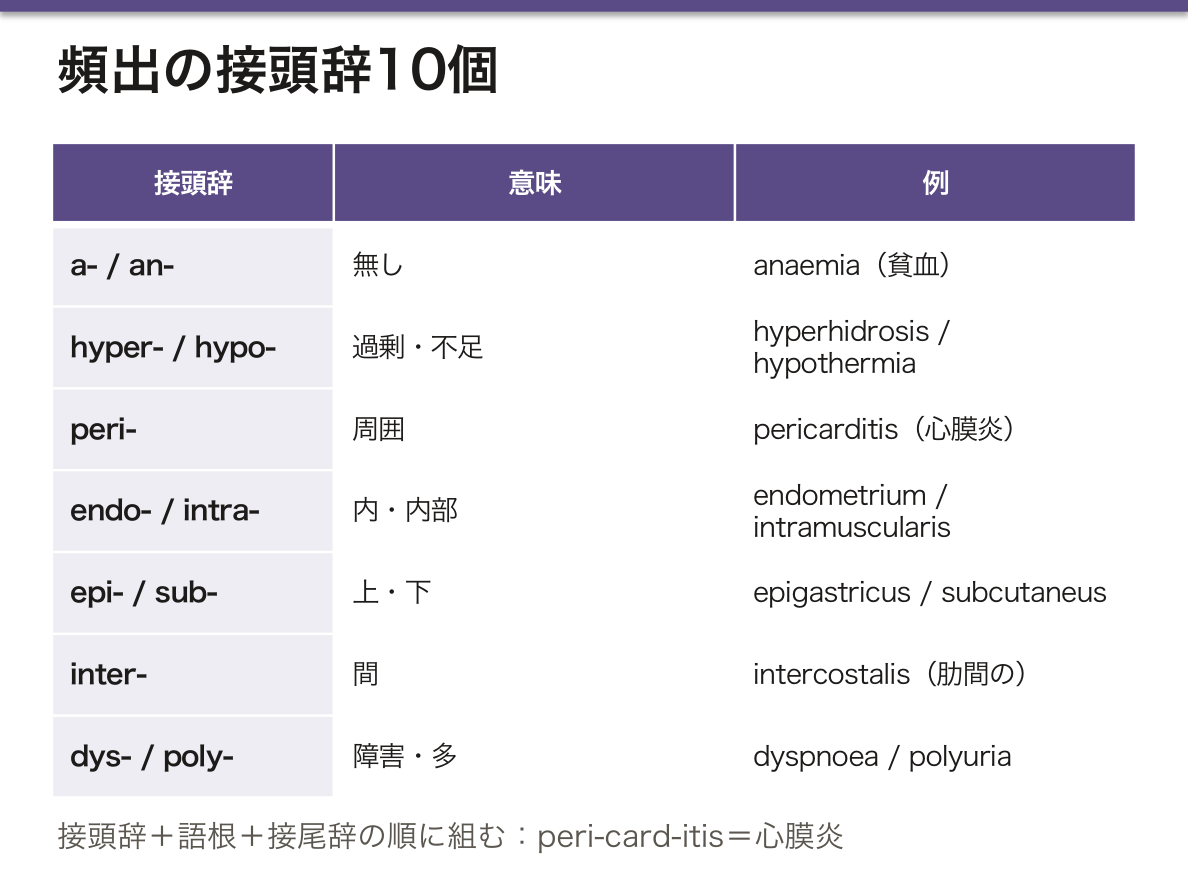
接頭辞(位置・量・否定)+ 語根(臓器・組織)+ 接尾辞(状態・処置)の順に組む。
例:peri-card-itis = 周りの(peri-)+ 心臓(card)+ 炎症(-itis)= 心膜炎。chole-cyst-ectomy = 胆汁(chole)+ 袋(cyst)+ 切除(-ectomy)= 胆嚢摘出術。
| 接尾辞 | 意味 | 例 |
|---|---|---|
| -itis | 炎症 | appendicitis |
| -osis | 状態・増加(非炎症性) | arthrosis, fibrosis |
| -oma | 腫瘍 | lipoma, carcinoma |
| -pathia | 疾患(一般) | neuropathia |
| -ectomia | 切除する | gastrectomia |
| -tomia | 切り開く | laparotomia |
| -stomia | 孔を作る | colostomia |
| -plastica | 形成する | rhinoplastica |
| -scopia | 見る | gastroscopia |
| -graphia | 記録する | angiographia |
| -megalia | 腫大 | splenomegalia |
| -penia | 減少 | leucopenia |
-tomia・-ectomia・-stomia の3つを取り違えないこと。切り開く・切り取る・穴を開けてつなぐ——手術の内容がまったく違う。Tracheotomia(気管を切開する)と tracheostomia(気管に永久的な孔を作る)は臨床でも区別される。
-itis と -osis の対比も重要である。Arthritis(関節炎・炎症性、関節リウマチ)と arthrosis(関節症・変性、変形性関節症)はまったく別の疾患群で、治療も予後も違う。語尾ひとつが鑑別診断を分けている。
同じ臓器にラテン語系とギリシャ語系の2つの語根があるのが混乱のもとである。腎=ren(ラテン)/nephros(ギリシャ)——解剖は renalis、臨床は nephritis・nephrectomia。胃=ventriculus(ラテン)/gaster(ギリシャ)。子宮=uterus/metra・hystera(hysterectomia)。「解剖名はラテン、病名と術式はギリシャ」という大まかな棲み分けを知っておくと迷わない。
接頭辞の頻出10個:a-/an-(無し・anaemia)、hyper-/hypo-(過剰・不足)、peri-(周囲)、endo-(内)、epi-(上)、sub-(下)、inter-(間)、intra-(内部)、dys-(障害・dyspnoea)、poly-(多・polyuria)。
English version
Core
They are built in the order prefix (position, quantity, negation) + root (organ, tissue) + suffix (state, procedure).
For example, peri-card-itis = around (peri-) + heart (card) + inflammation (-itis) = pericarditis. chole-cyst-ectomy = bile (chole) + bladder (cyst) + excision (-ectomy) = cholecystectomy.
| Suffix | Meaning | Example |
|---|---|---|
| -itis | inflammation | appendicitis |
| -osis | a state or increase (non-inflammatory) | arthrosis, fibrosis |
| -oma | tumour | lipoma, carcinoma |
| -pathia | disease (general) | neuropathia |
| -ectomia | to excise | gastrectomia |
| -tomia | to cut open | laparotomia |
| -stomia | to make an opening | colostomia |
| -plastica | to reshape | rhinoplastica |
| -scopia | to view | gastroscopia |
| -graphia | to record | angiographia |
| -megalia | enlargement | splenomegalia |
| -penia | reduction | leucopenia |
Going further
Do not confuse -tomia, -ectomia and -stomia. To cut open, to cut out, to make an opening and join — the operations are entirely different. Tracheotomia (incising the trachea) and tracheostomia (making a permanent opening into it) are distinguished in the clinic too.
The contrast of -itis and -osis matters too. Arthritis (inflammatory, as in rheumatoid arthritis) and arthrosis (degenerative, as in osteoarthritis) are entirely different groups of disease, with different treatment and prognosis. One ending divides a differential diagnosis.
That one organ has two roots, one Latin and one Greek, is the source of confusion. Kidney = ren (Latin) / nephros (Greek) — anatomy renalis, the clinic nephritis and nephrectomia. Stomach = ventriculus (Latin) / gaster (Greek). Uterus = uterus / metra, hystera (hysterectomia). "Anatomical names are Latin; disease names and operations are Greek" as a rough division keeps one from getting lost.
The ten commonest prefixes: a-/an- (without, anaemia), hyper-/hypo- (excess, deficiency), peri- (around), endo- (within), epi- (upon), sub- (below), inter- (between), intra- (inside), dys- (disordered, dyspnoea), poly- (many, polyuria).
処方せんのラテン語と、略号
処方はラテン語の命令形と対格で書く伝統がある。
| 語 | 意味 |
|---|---|
| Recipe(Rp.) | 「取れ」=処方の開始 |
| Da(D.) | 「与えよ」 |
| Signa(S.) | 「表示せよ」=用法の指示 |
| Misce(M.) | 「混ぜよ」 |
| Da tales doses numero(D.t.d. N.) | 「この用量のものを◯個与えよ」 |
用法の略号:q.d.(1日1回)・b.i.d.(1日2回)・t.i.d.(3回)・q.i.d.(4回)・p.o.(経口)・p.r.n.(必要時)・a.c./p.c.(食前・食後)・h.s.(就寝時)。
剤形もラテン語で言う:tabuletta(錠剤)・capsula(カプセル)・solutio(溶液)・suspensio(懸濁液)・unguentum(軟膏)・suppositorium(坐薬)・pulvis(散剤)・injectio(注射)。属格で薬名を書くのが伝統的な形(Tabulettae Analgini 0,5=アナルギン0.5gの錠剤)。
⚠️ 略号は医療安全の問題でもある。WHO と各国の安全機関は「使ってはいけない略号」を定めている——U(unit の略。0 と読み違えて10倍量になる)、QD/QOD(読み違え)、μg(mg と誤読)、末尾のゼロ(1.0 mg を 10 mg と読む)、先頭のゼロの省略(.5 mg を 5 mg と読む)。ラテン語の伝統を学ぶことと、それを実際に使うことは別である——この科目で覚えるのは「読めるようにするため」であって、自分が書くときは各国の現行の規則に従う。
日本の処方せんはラテン語を使わない。日本語で用法用量を書く。だが国試や臨床実習で欧米の文献・薬剤情報を読むときには必要になるので、読解のためには要る。ラトビアでは処方にラテン語の伝統が残っているので、この科目は実習でそのまま使われる。
English version
Core
Prescriptions are traditionally written in Latin, in the imperative and the accusative.
| Word | Meaning |
|---|---|
| Recipe (Rp.) | "take" = the beginning of the prescription |
| Da (D.) | "give" |
| Signa (S.) | "label" = the directions for use |
| Misce (M.) | "mix" |
| Da tales doses numero (D.t.d. N.) | "give this many doses of this kind" |
Abbreviations for directions: q.d. (once a day), b.i.d. (twice), t.i.d. (three times), q.i.d. (four times), p.o. (by mouth), p.r.n. (as required), a.c./p.c. (before / after food), h.s. (at bedtime).
Going further
The dosage forms are named in Latin too: tabuletta (tablet), capsula (capsule), solutio (solution), suspensio (suspension), unguentum (ointment), suppositorium (suppository), pulvis (powder), injectio (injection). The drug name is written in the genitive in the traditional form (Tabulettae Analgini 0,5 = tablets of analgin 0.5 g).
⚠️ Abbreviations are also a question of patient safety. The WHO and national safety bodies specify abbreviations that must not be used — U (for unit; misread as 0 it gives a tenfold dose), QD/QOD (misread), μg (misread as mg), a trailing zero (1.0 mg read as 10 mg), an omitted leading zero (.5 mg read as 5 mg). Learning the Latin tradition and actually using it are different things — what is learned here is so that it can be read, and when writing one follows the current rules of one’s own country.
Japanese prescriptions do not use Latin. The directions are written in Japanese. But it is needed when reading Western literature and drug information in the national examination and in clinical attachments, so it is needed for reading. In Latvia the Latin tradition remains in prescribing, so this subject is used directly in the attachments.
解剖用語の語順 — 読み解く手順Ordo verborum
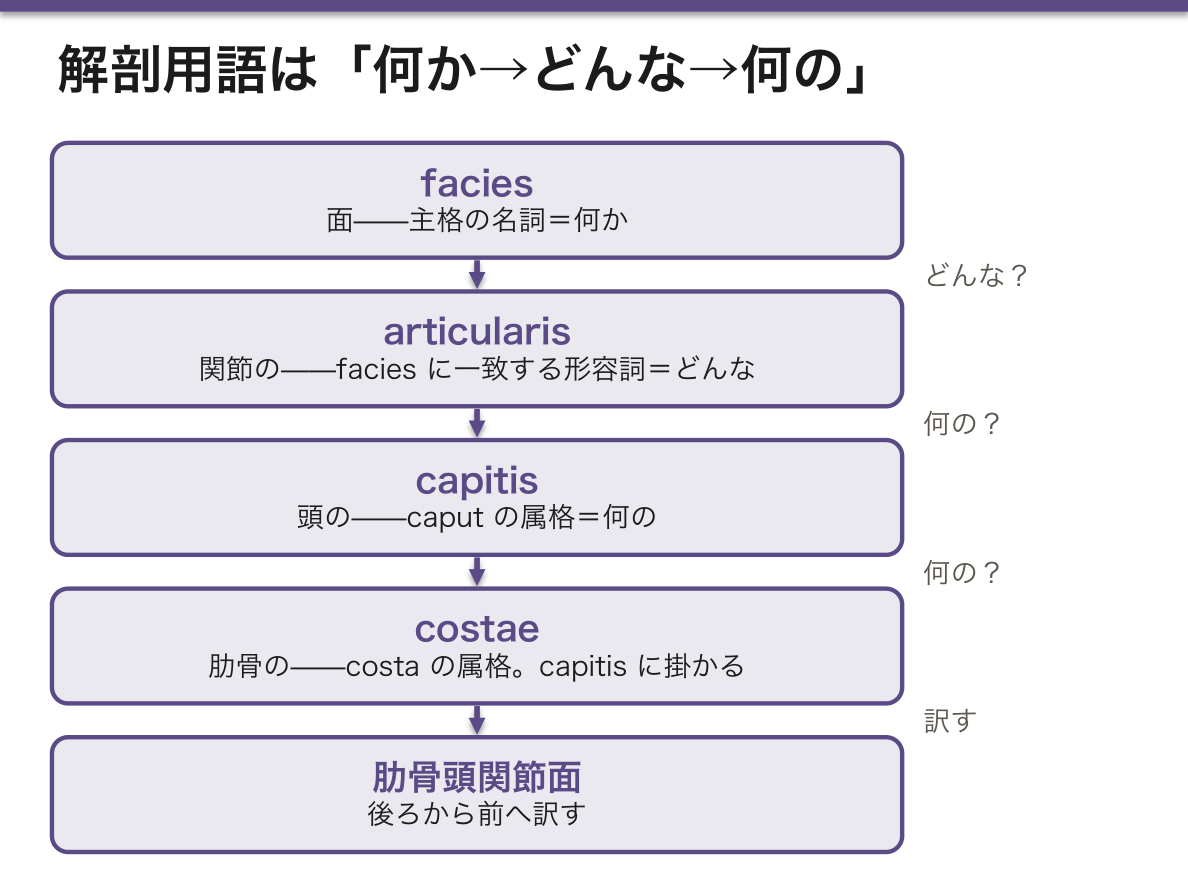
ラテン語の解剖用語は「主になる名詞 → 形容詞 → 属格の名詞」の順に並ぶ。日本語とは逆から読む。
手順——①先頭の主格の名詞を見つける(それが「何か」)②それに一致する形容詞を探す(どんな)③属格の語を探す(何の)。
例——Arteria carotis communis:arteria(動脈)+ carotis(頸の)+ communis(総)=総頸動脈。Facies articularis capitis costae:facies(面)+ articularis(関節の)+ capitis costae(肋骨頭の)=肋骨頭関節面。
複数の属格が連なるときは、後ろから前へ掛かる——capitis costae は「肋骨の頭の」。
形容詞の順序にも規則がある——大きさ・形 → 位置 → 方向。Musculus rectus abdominis(腹直筋)は「まっすぐな筋・腹の」。
属格か形容詞かで意味が変わることがある——arteria vertebralis(椎骨動脈=椎骨に関係する動脈)と corpus vertebrae(椎体=その椎骨の体)。形容詞は種類を、属格は所属を示す。
English version
Core
Latin anatomical terms line up in the order "principal noun → adjective → noun in the genitive". They are read from the back relative to Japanese.
The procedure — ① find the nominative noun at the front (what it is) ② look for the adjective agreeing with it (what kind) ③ look for the genitive (of what).
Examples — Arteria carotis communis: arteria (artery) + carotis (of the neck) + communis (common) = the common carotid artery. Facies articularis capitis costae: facies (surface) + articularis (articular) + capitis costae (of the head of the rib) = the articular surface of the head of the rib.
Where several genitives follow one another, they attach backwards to forwards — capitis costae is "of the head of the rib".
The order of adjectives has rules too — size and shape → position → direction. Musculus rectus abdominis (rectus abdominis) is "the straight muscle, of the abdomen".
Going further
Genitive or adjective can change the meaning — arteria vertebralis (the vertebral artery, the artery related to the vertebrae) and corpus vertebrae (the vertebral body, the body of that vertebra). The adjective states a kind, the genitive a belonging.
方向と位置の用語 — 対で覚えるTermini directionis
解剖の記述はすべて解剖学的正位(直立・手掌を前)を基準にする。
| ラテン語 | 意味 | 対 |
|---|---|---|
| superior / cranialis | 上・頭側 | inferior / caudalis 下・尾側 |
| anterior / ventralis | 前・腹側 | posterior / dorsalis 後・背側 |
| medialis | 正中に近い | lateralis 外側 |
| proximalis | 体幹に近い | distalis 遠い |
| superficialis | 浅い | profundus 深い |
| internus | 内 | externus 外 |
| dexter | 右 | sinister 左 |
medialis と medianus は別物——medialis は「より内側の」(比較)、medianus は「正中の」(正中線そのもの)。fissura mediana anterior は正中の裂、epicondylus medialis は内側の上顆。ここが最頻出の誤り。
手足では特別な語を使う——手掌 palmaris/足底 plantaris/手背・足背 dorsalis。前腕は radialis(橈側)/ ulnaris(尺側)、下腿は tibialis / fibularis。
断面——sectio sagittalis(矢状)、frontalis / coronalis(前頭・冠状)、transversalis / horizontalis(横断)。画像診断の用語もこれに従う。
English version
Core
Every anatomical description is referred to the anatomical position (upright, palms forward).
| Latin | Meaning | Opposite |
|---|---|---|
| superior / cranialis | above, towards the head | inferior / caudalis (below, towards the tail) |
| anterior / ventralis | in front, towards the belly | posterior / dorsalis (behind, towards the back) |
| medialis | nearer the midline | lateralis (to the side) |
| proximalis | nearer the trunk | distalis (further) |
| superficialis | superficial | profundus (deep) |
| internus | inner | externus (outer) |
| dexter | right | sinister (left) |
medialis and medianus are different — medialis is "more towards the middle" (a comparison), medianus is "in the midline" (the midline itself). fissura mediana anterior is the midline fissure; epicondylus medialis is the medial epicondyle. This is the commonest error.
Special words are used in the limbs — palm palmaris / sole plantaris / back of hand and foot dorsalis. In the forearm, radialis / ulnaris; in the leg, tibialis / fibularis.
Going further
The planes — sectio sagittalis (sagittal), frontalis / coronalis (frontal, coronal), transversalis / horizontalis (transverse). The terms of diagnostic imaging follow these.
処方せんのラテン語 — 命令法と略号Praescriptio
処方の指示は命令法か接続法で書かれる。
Recipe(Rp.)=「取れ」——処方の冒頭。Da(D.)=与えよ。Signa(S.)=表示せよ(患者への指示)。Misce(M.)=混ぜよ。Da tales doses numero(D.t.d. N.)=このような用量を…個与えよ。
用量は対格で書く——Recipe: Aspirini 0,5(属格)のように、量を示す数字と共に薬名は属格になる。「アスピリンの 0.5 g を取れ」という構文。
頻用の略号——aa.(ana、各々等量)、q.s.(quantum satis、適量)、ad(〜まで)、p.o.(per os、経口)、b.i.d.(bis in die、1日2回)、t.i.d.(ter in die、3回)、q.i.d.(quater in die、4回)、p.r.n.(pro re nata、必要時)、a.c. / p.c.(食前・食後)、h.s.(hora somni、就寝時)。
ラテン語の略号は誤読による事故の原因でもある。q.d.(1日1回)と q.i.d.(1日4回)の取り違えが典型で、多くの国が略号を使わず平文で書くことを推奨している。読めることは必要だが、書くときは避ける——この両面を答えられるとよい。
English version
Core
The instructions of a prescription are written in the imperative or the subjunctive.
Recipe (Rp.) = "take" — the opening of the prescription. Da (D.) = give. Signa (S.) = label (the instruction to the patient). Misce (M.) = mix. Da tales doses numero (D.t.d. N.) = give this number of such doses.
The quantity is written in the accusative — as in Recipe: Aspirini 0,5 (genitive), the drug name goes into the genitive together with the figure of the amount. The construction is "take 0.5 g of the aspirin".
The common abbreviations — aa. (ana, of each in equal amount), q.s. (quantum satis, a sufficient quantity), ad (up to), p.o. (per os, by mouth), b.i.d. (bis in die, twice a day), t.i.d. (ter in die, three times), q.i.d. (quater in die, four times), p.r.n. (pro re nata, as required), a.c. / p.c. (before / after food), h.s. (hora somni, at bedtime).
Going further
The Latin abbreviations are also a cause of accidents through misreading. Confusing q.d. (once a day) with q.i.d. (four times a day) is the type case, and many countries recommend writing it out rather than abbreviating. Being able to read them is necessary; when writing, avoid them — it is good to be able to answer with both sides.
まとめ
| 語の3つの部品 — 接頭辞・語根・接尾辞 | 接頭辞(位置・量・否定)+ 語根(臓器・組織)+ 接尾辞(状態・処置)の順に組む。 |
|---|---|
| 処方せんのラテン語と、略号 | 処方はラテン語の命令形と対格で書く伝統がある。 |
| 解剖用語の語順 — 読み解く手順 | ラテン語の解剖用語は「主になる名詞 → 形容詞 → 属格の名詞」の順に並ぶ。 |
| 方向と位置の用語 — 対で覚える | 解剖の記述はすべて解剖学的正位(直立・手掌を前)を基準にする。 |
| 処方せんのラテン語 — 命令法と略号 | 処方の指示は命令法か接続法で書かれる。Recipe(Rp.)=「取れ」——処方の冒頭。 |
このノートは医学生が授業の内容を自分の言葉でまとめたもので、診療の判断に使うものではありません。誤りに気づいたらお知らせください。