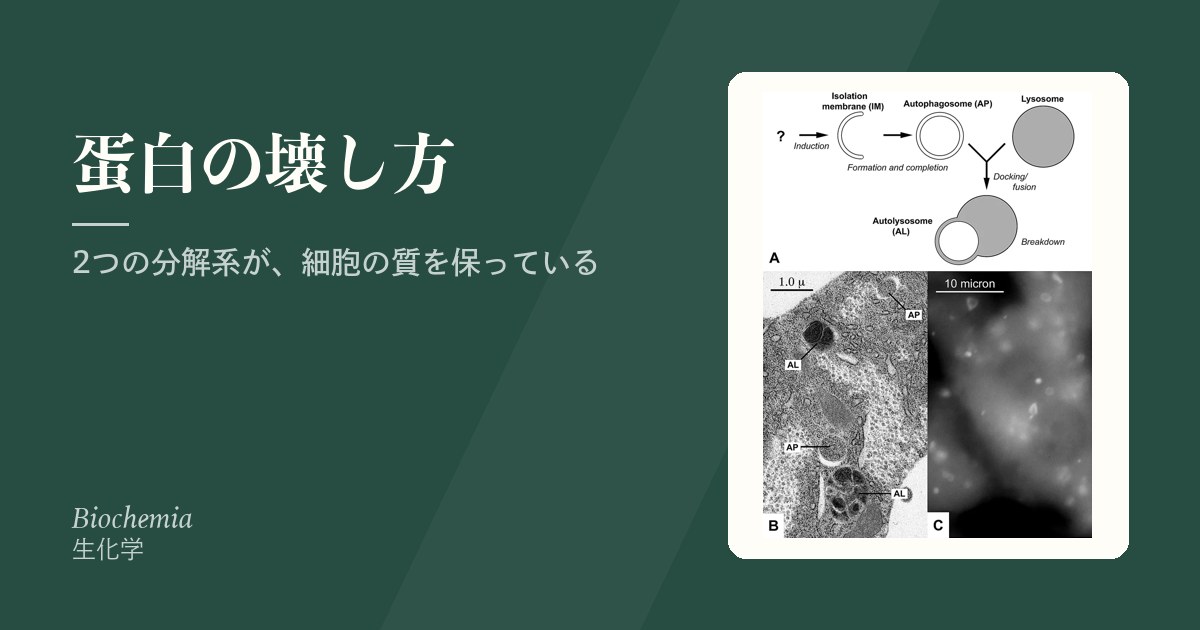
細胞は蛋白を作り続けているが、同じ速さで壊してもいる。壊す仕組みが2系統あり、対象と目的が違う。
- ユビキチン・プロテアソーム系——個々の蛋白を、選んで、速く壊す
- オートファジー・リソソーム系——まとめて、細胞小器官ごと壊す
どちらが破綻しても異常な蛋白が溜まる——神経変性疾患の多くが、この視点で理解できる。
- プロテアソーム — 選んで壊す
- オートファジー — まとめて壊し、飢餓を生き延びる
- シャペロンと小胞体ストレス — 折り畳めない蛋白の行き先
- アミロイド — 配列の違う蛋白が、同じ形に壊れる
- プロテアソーム阻害薬は、なぜ骨髄腫にだけ効くのか
- 壊す仕組みを乗っ取って、狙った蛋白を消す薬
プロテアソーム — 選んで壊す
ユビキチンが4個以上つながった鎖が「壊せ」の合図になり、26Sプロテアソームが筒の内側でペプチドへ切り刻む。
- ATPを消費する——選択的に、制御された分解
- 壊す対象:不良品の蛋白・役目を終えた調節蛋白(サイクリン・転写因子)・短寿命の蛋白
- 抗原提示にも使われる——細胞内で作られた蛋白の断片がMHCクラスIに載る
| 疾患 | 関わる分子 | 要点 |
|---|---|---|
| 若年性パーキンソン病 | parkin(E3リガーゼ) | 選んで壊せない |
| 子宮頸癌 | ヒトパピローマウイルスE6 | p53をユビキチン化して壊す |
| von Hippel-Lindau病 | VHL(E3リガーゼ) | 低酸素誘導因子を壊せず、血管新生が進む |
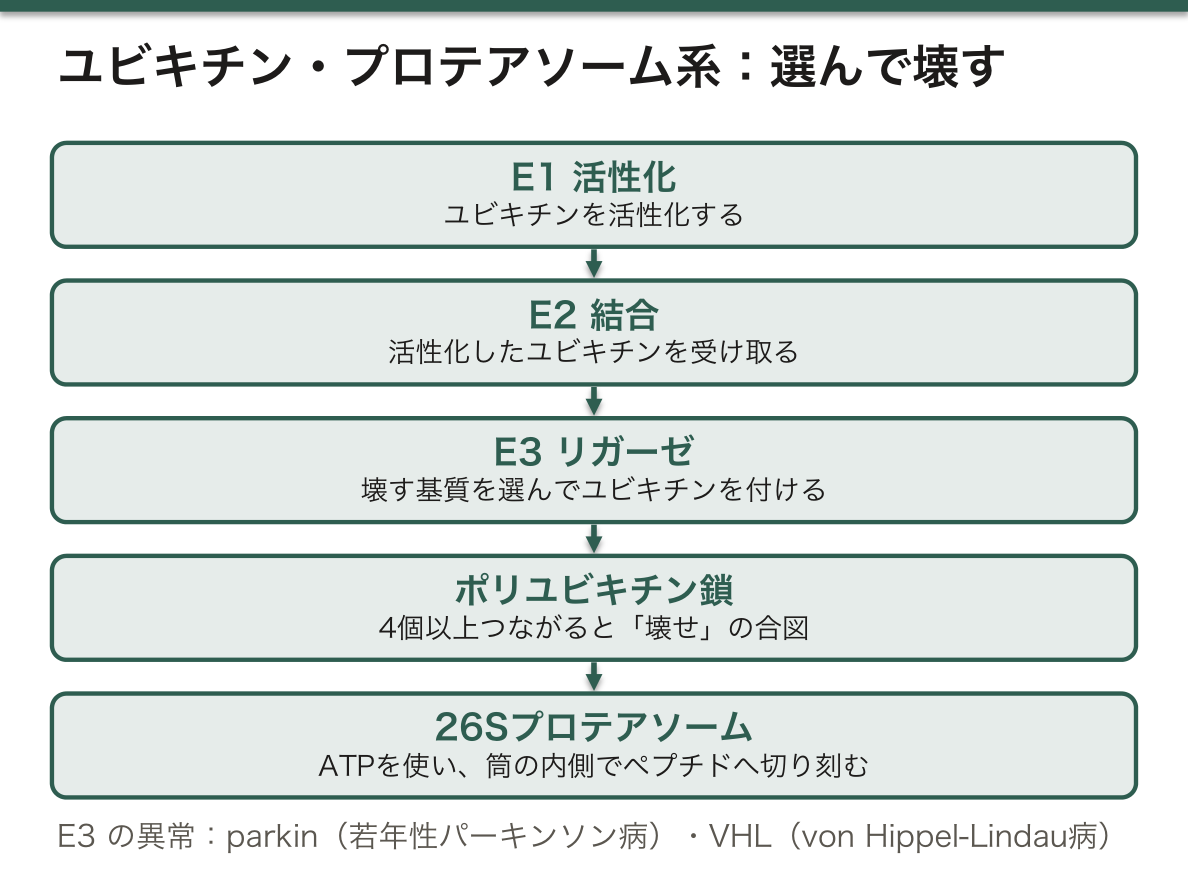
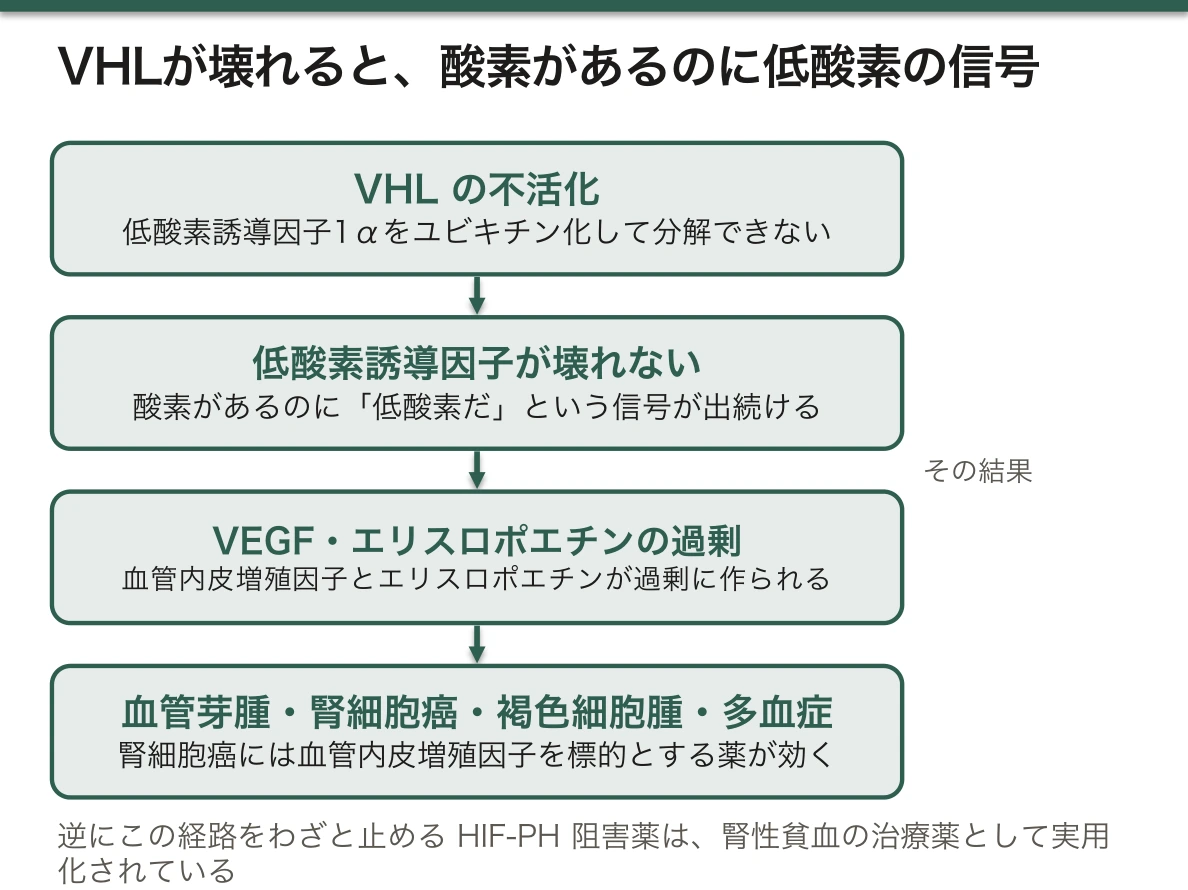
von Hippel-Lindau病の機序は、分子標的薬の設計にそのまま繋がっている。VHL蛋白は酸素がある条件で低酸素誘導因子1αをユビキチン化して分解するE3リガーゼの一部である。VHLが壊れると酸素があるのに「低酸素だ」という信号が出続ける。
- 血管内皮増殖因子とエリスロポエチンが過剰に作られる
- 結果として血管芽腫・腎細胞癌・褐色細胞腫と、多血症
- だから腎細胞癌には血管内皮増殖因子を標的とする薬が効く
散発性の腎細胞癌でもVHLの不活化が多いため、遺伝性疾患の研究が、はるかに多い散発例の治療を生んだ——稀少疾患を研究する意義の実例である。
ヒトパピローマウイルスのE6・E7も同じ枠組みで理解できる。E6はp53を分解に回し、E7はRb蛋白を不活化する。癌抑制遺伝子に変異が無くても、蛋白として消されれば同じことになる。ウイルスが宿主の分解系を乗っ取るという戦略である。
低酸素誘導因子を安定化させる薬(HIF-PH阻害薬)は、腎性貧血の治療薬として実用化されている。VHLの経路をわざと止めて、内因性のエリスロポエチンを増やす——病気の機序を治療に転用した例である。
English version
Core
A chain of four or more ubiquitins is the signal "destroy this", and the 26S proteasome chops it into peptides inside its barrel.
- It uses ATP — selective, controlled degradation.
- What it destroys: defective proteins, regulatory proteins whose work is done (cyclins, transcription factors), short-lived proteins.
- It is used in antigen presentation too — fragments of proteins made within the cell are loaded on MHC class I.
| Disease | Molecule involved | Key point |
|---|---|---|
| Juvenile parkinsonism | parkin (an E3 ligase) | It cannot select and destroy |
| Cervical cancer | Human papillomavirus E6 | Ubiquitinates p53 and destroys it |
| von Hippel–Lindau disease | VHL (an E3 ligase) | Hypoxia-inducible factor cannot be destroyed and angiogenesis advances |
Going further
The mechanism of von Hippel–Lindau disease leads directly into the design of molecularly targeted drugs. The VHL protein is part of an E3 ligase that ubiquitinates and degrades hypoxia-inducible factor 1α when oxygen is present. When VHL is broken, the signal "this is hypoxia" goes on being issued in the presence of oxygen.
- Vascular endothelial growth factor and erythropoietin are made in excess.
- The result is haemangioblastoma, renal cell carcinoma, phaeochromocytoma, and polycythaemia.
- Hence drugs targeting VEGF work in renal cell carcinoma.
Sporadic renal cell carcinoma also often has VHL inactivated, so research on a hereditary disease produced the treatment of the far commoner sporadic cases — an example of the value of studying rare disease.
The E6 and E7 of human papillomavirus are understood in the same frame. E6 sends p53 to degradation and E7 inactivates the Rb protein. With no mutation in the tumour suppressor gene, having the protein erased comes to the same thing. The strategy of a virus hijacking the host’s degradation system.
Drugs that stabilise hypoxia-inducible factor (HIF-PH inhibitors) are in practical use as treatments for renal anaemia. Deliberately stopping the VHL pathway to increase endogenous erythropoietin — the mechanism of a disease turned into a treatment.
オートファジー — まとめて壊し、飢餓を生き延びる
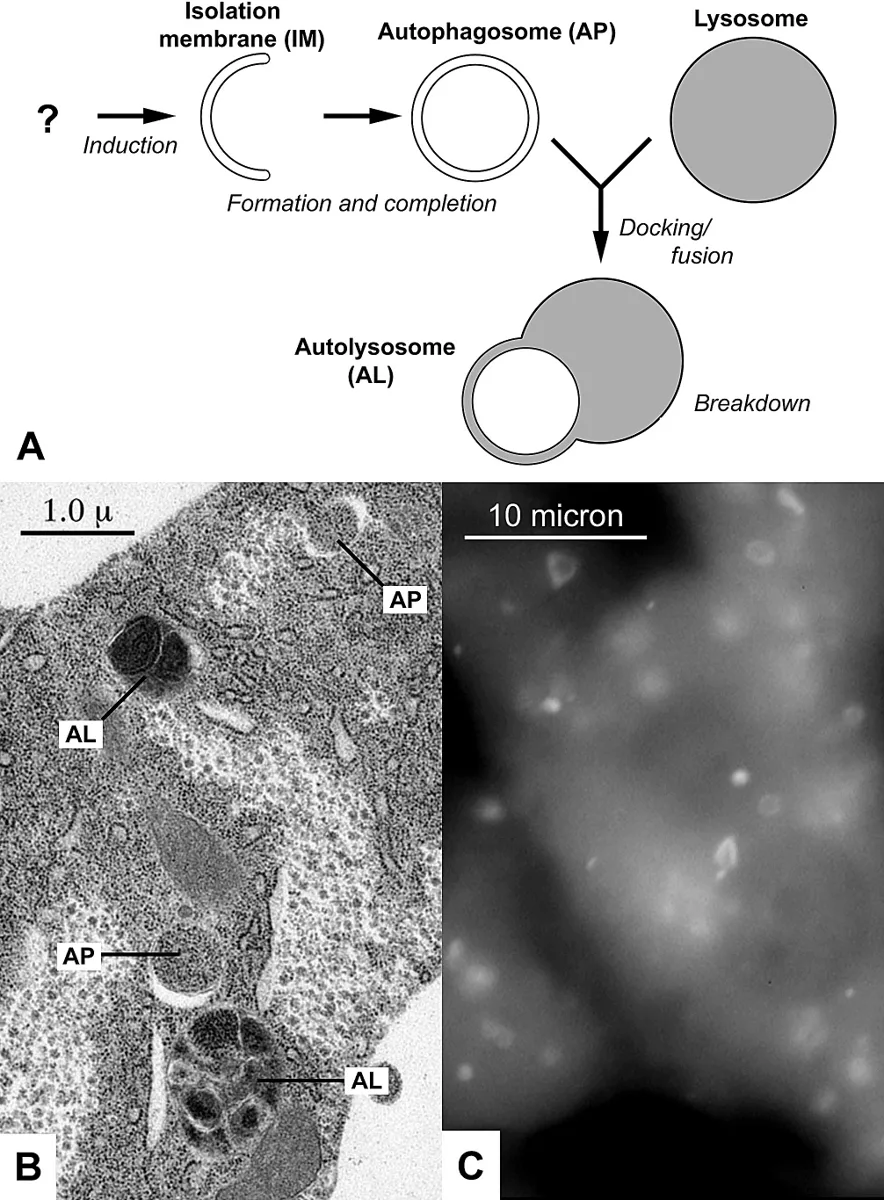
細胞質の一部を二重膜(オートファゴソーム)で囲み、リソソームと融合して分解する。
- 飢餓で強く誘導される——自分を食べてアミノ酸を作り出す
- ミトコンドリアや小胞体など、細胞小器官ごと処理できる(プロテアソームには不可能)
- 細胞内に侵入した細菌の除去にも使われる
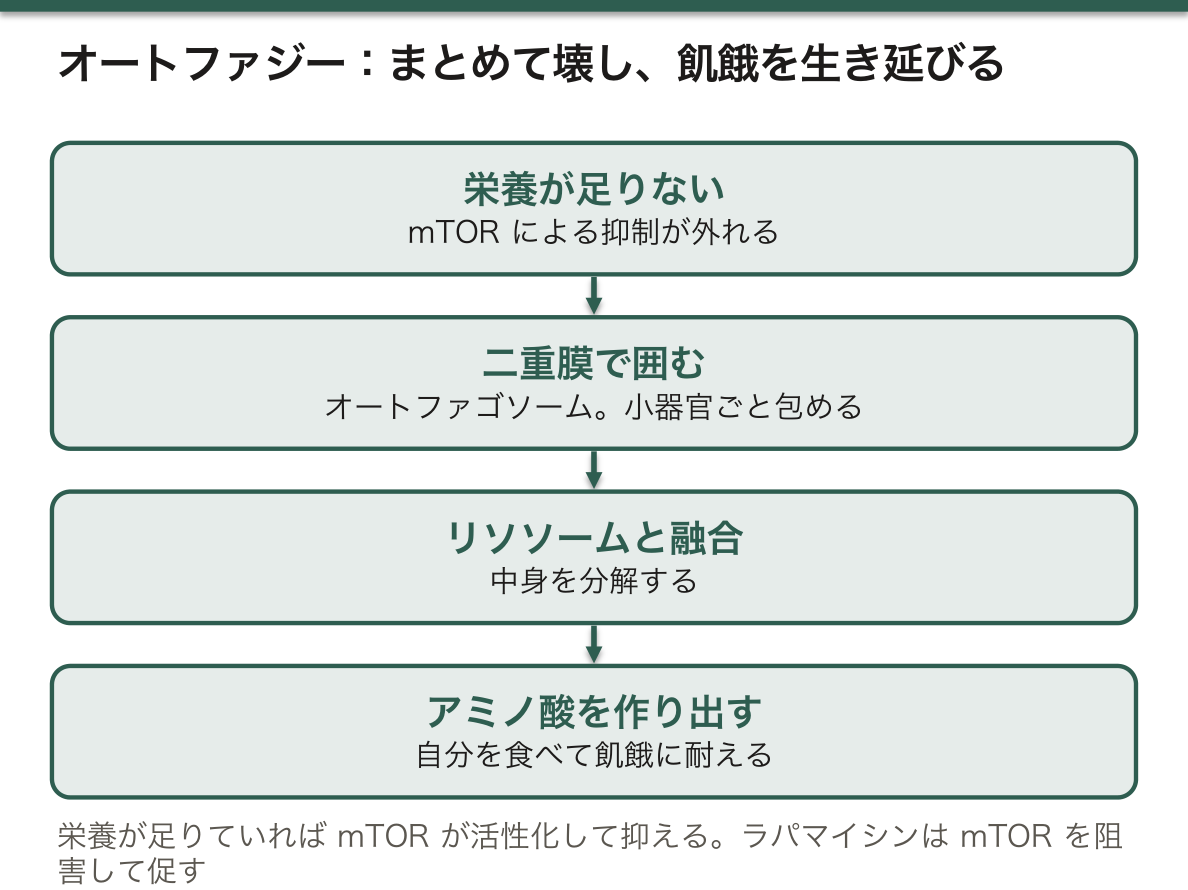
- 制御の中心はmTOR——栄養が足りていればmTORが活性化してオートファジーを抑える
ラパマイシン(シロリムス)はmTORを阻害するので、オートファジーを促す。
飢餓のときに何が起きているかを、時間軸で並べると全体像が見える。
- 数時間——グリコーゲン分解
- 1日——糖新生(材料はアミノ酸。筋蛋白が分解される)
- 数日——ケトン体が主役になり、脳がグルコース依存を減らす。これにより筋の分解が抑えられる
- 細胞内では終始オートファジーがアミノ酸を供給し続けている
ケトン体の意義は「脳の燃料」であると同時に「筋を守ること」である。脳が1日に必要とするグルコースをすべて糖新生で賄えば、筋が急速に失われて数週間で死に至る。ケトン体への切り替えが、ヒトの飢餓耐性を数か月に延ばしている。
オートファジーの破綻と疾患。
- 神経変性疾患——神経細胞は分裂しないので異常蛋白を娘細胞へ薄めることができない。分解に全面的に依存しており、破綻が凝集体(レビー小体・神経原線維変化)として現れる
- Crohn病——ATG16L1など、オートファジー関連遺伝子の多型が感受性に関わる。腸上皮の細胞内細菌を処理しきれない
- 腫瘍——初期には発癌を抑えるが、できた腫瘍にとっては栄養が乏しい環境を生き延びる手段になる。だから状況によって促進も阻害も治療になりうる
mTOR阻害薬が免疫抑制薬でもあり抗腫瘍薬でもあるのは、この経路が「増殖するか、耐えるか」の分岐点そのものだからである。
English version
Core
A part of the cytoplasm is enclosed in a double membrane (an autophagosome), which fuses with a lysosome and is degraded.
- Strongly induced by starvation — eating oneself to produce amino acids.
- Organelles such as mitochondria and endoplasmic reticulum can be disposed of whole (impossible for the proteasome).
- It is used to remove bacteria that have entered the cell.
- The centre of control is mTOR — with enough nutrients mTOR is active and suppresses autophagy.
Rapamycin (sirolimus) inhibits mTOR, so it promotes autophagy.
Going further
Lay out what happens in starvation along a time axis and the whole picture appears.
- Hours — glycogenolysis.
- A day — gluconeogenesis (the material is amino acid; muscle protein is broken down).
- Days — ketone bodies take the leading part and the brain reduces its dependence on glucose. This suppresses the breakdown of muscle.
- Within the cell, autophagy goes on supplying amino acids throughout.
The significance of ketone bodies is at once "fuel for the brain" and "protecting muscle". Were all the glucose the brain needs each day supplied by gluconeogenesis, muscle would be lost rapidly and death would follow in weeks. The switch to ketone bodies extends human tolerance of starvation to months.
Failure of autophagy and disease.
- Neurodegenerative disease — neurons do not divide, so they cannot dilute abnormal protein into daughter cells. They depend wholly on degradation, and its failure appears as aggregates (Lewy bodies, neurofibrillary tangles).
- Crohn’s disease — polymorphisms of autophagy-related genes such as ATG16L1 bear on susceptibility. Intracellular bacteria in the intestinal epithelium cannot be fully disposed of.
- Tumours — early on it suppresses carcinogenesis, but for an established tumour it is a means of surviving an environment poor in nutrients. So according to the situation, either promoting or inhibiting it can be a treatment.
That mTOR inhibitors are both immunosuppressants and antitumour drugs is because this pathway is the very branch point between "proliferate" and "endure".
シャペロンと小胞体ストレス — 折り畳めない蛋白の行き先
蛋白は、配列が正しくても折り畳みに失敗する。それを助けるのがシャペロンになる。
- 熱ショック蛋白(HSP70・HSP90)——熱・低酸素・酸化ストレスで誘導される
- 小胞体では BiP(GRP78)・カルネキシン・カルレティキュリンが働く
折り畳めない蛋白が小胞体に溜まると、小胞体ストレス応答(UPR)が起こる。
| 段階 | やること |
|---|---|
| ① | 翻訳を全体的に止める(流入を減らす) |
| ② | シャペロンの発現を増やす(処理能を上げる) |
| ③ | 小胞体関連分解(ERAD)で細胞質へ戻し、プロテアソームで壊す |
| ④ | それでも収まらなければ、アポトーシス |
「直す・減らす・壊す・諦める」の4段階という順序が、細胞の品質管理の型になっている。同じ順序が、個体の医療の考え方とも重なる(この章のプロテアソームの項)——「処理能を超えたときに、初めて切り捨てる」。
膵β細胞は、この系に最も依存している。インスリンを大量に作るので小胞体の負荷が高く、2型糖尿病では小胞体ストレスがβ細胞の疲弊と死に関わるとされる(インスリン分泌の章)——「作り続ける細胞ほど、品質管理に潰される」。
嚢胞性線維症の最も多い変異(ΔF508)は、この系で説明できる。作られた CFTR は機能を持つのに、折り畳みの検査に落ちて ERAD で壊され、細胞膜まで届かない(チャネル病の章)——「壊れているのは蛋白ではなく、輸送の途中になる」。
だから折り畳みを助ける薬(コレクター)と、開き方を助ける薬(ポテンシエーター)を組み合わせる(分子標的薬の章)——「品質管理の段階ごとに、別の薬が要る」。
多発性骨髄腫でプロテアソーム阻害薬が効くのも、この文脈になる(異常蛋白の章)——「免疫グロブリンを大量に作る細胞は、壊す道を止められると自分の蛋白で死ぬ」。
English version
Core
A protein fails to fold even when the sequence is right. What helps it is the chaperone.
- Heat shock proteins (HSP70, HSP90) — induced by heat, hypoxia and oxidative stress.
- In the endoplasmic reticulum, BiP (GRP78), calnexin and calreticulin work.
When unfoldable protein accumulates in the endoplasmic reticulum, the unfolded protein response (UPR) occurs.
| Stage | What is done |
|---|---|
| ① | Stop translation generally (reduce the inflow) |
| ② | Increase the expression of chaperones (raise the capacity) |
| ③ | Return it to the cytosol by ER-associated degradation (ERAD) and destroy it in the proteasome |
| ④ | If that still does not settle it, apoptosis |
Going further
- The order of the four stages — mend, reduce, destroy, give up — is the pattern of the cell’s quality control. The same order overlaps with the way medicine thinks about a person (the section on the proteasome in this chapter) — only when capacity is exceeded is anything cast off.
- The pancreatic β cell depends on this system most. Making a great deal of insulin, the load on its endoplasmic reticulum is high, and in type 2 diabetes ER stress is held to be involved in the exhaustion and death of the β cell (the chapter on insulin secretion) — the more a cell goes on producing, the more it is crushed by quality control.
- The commonest mutation of cystic fibrosis (ΔF508) is explained by this system. The CFTR made has function and yet fails the folding inspection, is destroyed by ERAD and never reaches the cell membrane (the chapter on channelopathies) — what is broken is not the protein but a stage of its transport.
- Hence a drug that assists folding (a corrector) is combined with one that assists opening (a potentiator) (the chapter on molecularly targeted drugs) — a different drug for each stage of quality control.
- That proteasome inhibitors work in multiple myeloma belongs in this context (the chapter on abnormal proteins) — a cell making a great deal of immunoglobulin, with the route of destruction stopped, dies of its own protein.
アミロイド — 配列の違う蛋白が、同じ形に壊れる
アミロイドとは、特定の分子ではなく「形」の名前になる——βシートが横に並んだ線維(クロスβ構造)。
共通する性質——Congo red 染色で赤橙色、偏光下で緑色の複屈折・水に溶けない・分解されにくい。
| 型 | もとの蛋白 | 背景 |
|---|---|---|
| AL | 免疫グロブリン軽鎖 | 形質細胞腫瘍(骨髄腫など) |
| AA | 血清アミロイドA | 慢性炎症(関節リウマチ・結核・家族性地中海熱) |
| ATTR | トランスサイレチン | 遺伝性/野生型(高齢者の心アミロイドーシス) |
| Aβ | アミロイド前駆体蛋白 | Alzheimer 病 |
| Aβ2M | β2-ミクログロブリン | 長期透析(手根管症候群) |
「配列が違うのに、壊れ方が同じ」という点が、この病態群の核心になる。正しい折り畳みは蛋白ごとに違うが、βシートの積層はどの蛋白でも取りうる安定な形になる(この章のシャペロンの項)——「壊れた形のほうが、正しい形より安定なことがある」。
だから治療の考え方が3つに分かれる。①もとの蛋白を作らせない(AL なら形質細胞を叩く・AA なら炎症を治す) ②安定化させて壊れさせない(タファミジス) ③溜まったものを除く(分子標的薬の章)——「上流・途中・下流のどこを狙うかで、薬が変わる」。
臓器の症状は、どこに溜まるかで決まる——「心(拡張障害・低電位)・腎(ネフローゼ)・神経(多発ニューロパチー・自律神経障害)・舌(巨舌)・消化管(吸収不良)」。
診断は組織を採って染めることになる(沈着症の章)——「腹壁脂肪や直腸粘膜の生検で拾えることがある」。
透析アミロイドーシスは、腎が捨てるはずの分子が残ることで起きる(腎代替療法の章)——「透析歴の長さと手根管症候群が並んだら、これを考える」。
プリオン病も、形が形を伝播させるという点で同じ論理になる(変性疾患の章)——「情報を運ぶのが核酸ではなく、立体構造になっている」。
English version
Core
Amyloid is not the name of a particular molecule but of a form — fibrils of β sheets lying side by side (the cross-β structure).
Shared properties — red-orange with Congo red and apple-green birefringence under polarised light, insoluble in water, resistant to degradation.
| Type | Parent protein | Background |
|---|---|---|
| AL | Immunoglobulin light chain | Plasma cell tumour (myeloma and others) |
| AA | Serum amyloid A | Chronic inflammation (rheumatoid arthritis, tuberculosis, familial Mediterranean fever) |
| ATTR | Transthyretin | Hereditary or wild type (cardiac amyloidosis of the elderly) |
| Aβ | Amyloid precursor protein | Alzheimer’s disease |
| Aβ2M | β2-Microglobulin | Long-term dialysis (carpal tunnel syndrome) |
Going further
- The core of this group of diseases is that the sequences differ and the way they break is the same. Correct folding differs from protein to protein, but stacked β sheets are a stable form that any protein can take (the section on chaperones in this chapter) — the broken form is sometimes more stable than the correct one.
- Hence the approaches to treatment fall into three. ① Stop the parent protein being made (in AL, strike the plasma cells; in AA, treat the inflammation) ② stabilise it so that it does not break (tafamidis) ③ remove what has accumulated (the chapter on molecularly targeted drugs) — the drug changes with whether one aims upstream, midstream or downstream.
- The organ symptoms are decided by where it accumulates — heart (diastolic dysfunction, low voltage), kidney (nephrotic syndrome), nerve (polyneuropathy, autonomic dysfunction), tongue (macroglossia), gut (malabsorption).
- Diagnosis is taking tissue and staining it (the chapter on deposition disorders) — a biopsy of abdominal fat or rectal mucosa may pick it up.
- Dialysis amyloidosis arises from a molecule the kidney should discard remaining (the chapter on renal replacement therapy) — when a long history of dialysis stands beside carpal tunnel syndrome, think of this.
- Prion disease follows the same logic in that a form propagates a form (the chapter on degenerative disease) — what carries the information being not nucleic acid but a conformation.
プロテアソーム阻害薬は、なぜ骨髄腫にだけ効くのか
プロテアソームはすべての細胞に必須である。それを止める薬が、なぜ特定の癌にだけ使えるのか——答えは細胞ごとの「分解の負荷」の違いにある。
- 形質細胞は、免疫グロブリンを大量に作っている——折り畳みに失敗する分も多く、常に大量の不良品を分解し続けている
- 骨髄腫細胞では、それがさらに極端になる
- 分解を止めると、不良蛋白が処理しきれずに溜まり、小胞体ストレスでアポトーシスに至る
正常細胞にも効いているが、耐えられる余裕が違う——選択性は薬の特異性ではなく、細胞の置かれた状況から生まれている。
もう1つの機序として、NF-κB の抑制がある。NF-κB は抑制因子(IκB)がプロテアソームで分解されることで活性化する。分解を止めれば IκB が残り、NF-κB は核へ入れない。骨髄腫細胞の生存は NF-κB に依存しているので、ここも効く。
副作用も機序から読める。
| 末梢神経障害 | ボルテゾミブで多い | 皮下注射にすると軽くなる(濃度の立ち上がりが緩やかになるため) |
| ⚠️ 帯状疱疹 | 細胞性免疫が落ちる | アシクロビルの予防投与が標準になっている |
| 血小板減少 | 巨核球からの血小板放出が障害される | 投与サイクルに合わせて上下し、回復する |
同じ「分解の負荷」という考え方が、他の治療にも応用されている。
- ヒートショック蛋白の阻害——折り畳みを助ける側を止める
- オートファジーの阻害——プロテアソームを止められた細胞はオートファジーに逃げるので、両方を止める併用が試みられている
「必須の仕組みを止める薬でも、負荷の高い細胞を選んで殺せる」——合成致死と並ぶ、選択性の作り方の1つとして押さえておく。
ボルテゾミブを始める患者には、抗ウイルス薬の予防投与を忘れない。帯状疱疹は高頻度で、後神経痛を残す。
English version
Core
The proteasome is essential to every cell. Why can a drug that stops it be used in particular cancers only? The answer lies in the different "degradative load" of different cells.
- The plasma cell makes a great deal of immunoglobulin — much of it fails to fold, and it is constantly degrading a great deal of defective product.
- In a myeloma cell this becomes still more extreme.
- Stop the degradation and defective protein cannot be disposed of, accumulates, and gives apoptosis through ER stress.
It acts on normal cells too, but their margin to endure it differs — the selectivity arises not from the specificity of the drug but from the situation the cell is in.
Going further
Another mechanism is the suppression of NF-κB. NF-κB is activated by its inhibitor (IκB) being degraded in the proteasome. Stop the degradation and IκB remains, and NF-κB cannot enter the nucleus. The survival of myeloma cells depends on NF-κB, so this tells too.
The adverse effects can be read from the mechanism.
| Peripheral neuropathy | Common with bortezomib | Milder when given subcutaneously (the rise in concentration is gentler) |
| ⚠️ Herpes zoster | Cellular immunity falls | Prophylactic aciclovir is standard |
| Thrombocytopenia | The release of platelets from megakaryocytes is impaired | It rises and falls with the cycle and recovers |
The same idea of "degradative load" is applied to other treatments.
- Inhibiting heat shock proteins — stopping the side that assists folding.
- Inhibiting autophagy — a cell whose proteasome is stopped escapes into autophagy, so combinations stopping both are being tried.
"Even a drug that stops an essential mechanism can selectively kill the cells under load" — hold it as one way of creating selectivity, alongside synthetic lethality.
In the clinic
In a patient starting bortezomib, do not forget prophylactic antiviral treatment. Herpes zoster is frequent and leaves post-herpetic neuralgia.
壊す仕組みを乗っ取って、狙った蛋白を消す薬
従来の薬は蛋白の働きを邪魔する(酵素の活性部位を塞ぐ、受容体を遮る)。そのため活性部位を持たない蛋白は標的にできなかった——転写因子や足場蛋白が「創薬できない標的」と呼ばれてきた理由である。
発想を変えて、蛋白そのものを分解させる薬が生まれた。
- 分子糊——2 つの蛋白をくっつける小分子。ユビキチンリガーゼと標的蛋白を無理やり結合させ、標的にユビキチンを付けさせる
- PROTAC——同じ原理を、2 つの結合部位を持つ分子として設計したもの
触媒的に働くのが強みで、1 分子の薬が何度も分解を誘導できる。占有し続ける必要がないので、低い濃度でも効きうる。
この機序は、後から発見された。
サリドマイドとその誘導体(レナリドミドなど)は多発性骨髄腫に著効するが、長く機序が不明だった。2010 年代に、これらが「セレブロン」というユビキチンリガーゼの部品に結合し、本来の基質ではない転写因子を分解させていることが分かった。分子糊の最初の実例が、既に臨床で使われていたことになる。
⚠️ 催奇形性も、同じ仕組みで説明されつつある。四肢の形成に関わる蛋白が分解されるためと考えられており、効果と催奇形性が同じ機序から出ている可能性がある。だからサリドマイド系の薬には、厳格な妊娠回避と登録管理(日本では安全管理手順が定められている)が課されている。
薬害の歴史を、機序として理解しておく意味は大きい。1950〜60 年代に世界で 1 万人以上の児が四肢の異常をもって生まれ、日本でも被害が出た。その薬が、機序の解明を経て、管理された条件下で再び治療に使われている——薬の評価は「安全か危険か」の二分ではなく、どの条件で誰に使うかで決まることを示す例である。
サリドマイド系の薬は、妊娠可能な患者への説明と管理が処方の一部である。手続きを省略しない。
English version
Core
Conventional drugs interfere with what a protein does (blocking the active site of an enzyme, blocking a receptor). Hence a protein with no active site could not be targeted — the reason transcription factors and scaffold proteins were called "undruggable targets".
Changing the idea, drugs were born that have the protein itself degraded.
- Molecular glue — a small molecule that sticks two proteins together. It forces a ubiquitin ligase and the target protein together and has ubiquitin put on the target.
- PROTAC — the same principle designed as a molecule with two binding sites.
They act catalytically, which is their strength: one molecule of the drug can induce degradation many times over. Not needing to stay bound, it can work at a low concentration.
Going further
This mechanism was discovered after the fact.
Thalidomide and its derivatives (lenalidomide and others) work strikingly in multiple myeloma, and the mechanism was long unknown. In the 2010s it emerged that they bind a component of a ubiquitin ligase called cereblon and cause the degradation of transcription factors that are not its proper substrates. The first instance of a molecular glue was already in clinical use.
⚠️ The teratogenicity is coming to be explained by the same mechanism. It is thought to be because proteins involved in limb formation are degraded, so the effect and the teratogenicity may arise from the same mechanism. Hence thalidomide-class drugs carry strict avoidance of pregnancy and registry control (in Japan a safety management procedure is laid down).
There is great value in understanding the history of a drug disaster as a mechanism. In the 1950s and 60s more than 10,000 children worldwide were born with limb abnormalities, and there were victims in Japan. That drug, after its mechanism was elucidated, is used in treatment again under controlled conditions — an example showing that the assessment of a drug is not the dichotomy "safe or dangerous" but under what conditions and for whom it is used.
In the clinic
With a thalidomide-class drug, the explanation and management for a patient who could become pregnant is part of the prescription. Do not omit the procedure.
まとめ
| プロテアソーム — 選んで壊す | ユビキチンが4個以上つながった鎖が「壊せ」の合図になり、26Sプロテアソームが筒の内側でペプチドへ切り刻む。 |
|---|---|
| オートファジー — まとめて壊し、飢餓を生き延びる | 細胞質の一部を二重膜(オートファゴソーム)で囲み、リソソームと融合して分解する。 |
| シャペロンと小胞体ストレス — 折り畳めない蛋白の行き先 | 蛋白は、配列が正しくても折り畳みに失敗する。 |
| アミロイド — 配列の違う蛋白が、同じ形に壊れる | アミロイドとは、特定の分子ではなく「形」の名前になる——βシートが横に並んだ線維(クロスβ構造)。 |
| プロテアソーム阻害薬は、なぜ骨髄腫にだけ効くのか | プロテアソームはすべての細胞に必須である。 |
| 壊す仕組みを乗っ取って、狙った蛋白を消す薬 | 従来の薬は蛋白の働きを邪魔する(酵素の活性部位を塞ぐ、受容体を遮る)。 |
このノートは医学生が授業の内容を自分の言葉でまとめたもので、診療の判断に使うものではありません。誤りに気づいたらお知らせください。