ホルモンを3つの化学種に分けると、受容体の場所・作用の速さ・血中での運ばれ方・半減期・測り方がまとめて決まる。個々のホルモンを覚える前に、この枠を持っておくと迷わない。
分かれ目は脂溶性か水溶性か——細胞膜を通れるかどうかという、たった一つの物理的性質である。
- 3つの型 — ペプチド・ステロイド・アミン
- フィードバックと、ホルモンを測るときの原則
- 遊離型と結合型 — なぜ「フリー」を測るのか
- 受容体の側の調節 — 同じ濃度でも、効き方が変わる
- 1本のペプチドから、複数のホルモンが切り出される
- ホルモンは、届いた先で作り変えられる
3つの型 — ペプチド・ステロイド・アミン
| ペプチド・蛋白 | ステロイド | アミン | |
|---|---|---|---|
| 例 | インスリン・下垂体ホルモン・副甲状腺ホルモン | コルチゾール・アルドステロン・性ホルモン・活性型ビタミンD | カテコラミン/甲状腺ホルモン |
| 溶解性 | 水溶性 | 脂溶性 | カテコラミンは水溶性/甲状腺ホルモンは脂溶性 |
| 受容体 | 細胞膜 | 細胞内・核内 | カテコラミンは細胞膜/甲状腺ホルモンは核内 |
| 作用の速さ | 秒〜分 | 時間〜日 | — |
| 血中 | 遊離 | 結合蛋白に乗る | — |
| 貯蔵 | 顆粒に貯める | 貯めない(作ってすぐ出す) | — |
アミンは出自で分かれる——どちらもチロシン由来だが、カテコラミンはペプチド型のように、甲状腺ホルモンはステロイド型のように振る舞う。
「ステロイドは貯蔵しない」という一点から、臨床の重要事項が複数導かれる。
- 副腎皮質は刺激に応じてその都度合成するので、合成経路のどこかが詰まればすぐ不足する(先天性副腎皮質過形成)
- ステロイドの長期投与で副腎が萎縮すると、急に止めたときに作る能力が無い——副腎クリーゼ。漸減が必須
「結合蛋白に乗る」ことは、検査値の解釈を左右する。
- 働くのは遊離型だけである
- 妊娠・エストロゲン製剤では結合蛋白が増える → 総量は上がるが遊離型は正常。甲状腺機能は正常なのにT₄が高く出る
- ネフローゼ症候群・肝硬変では結合蛋白が減る → 総量は下がる
- だから甲状腺機能は遊離型(FT₃・FT₄)で評価する
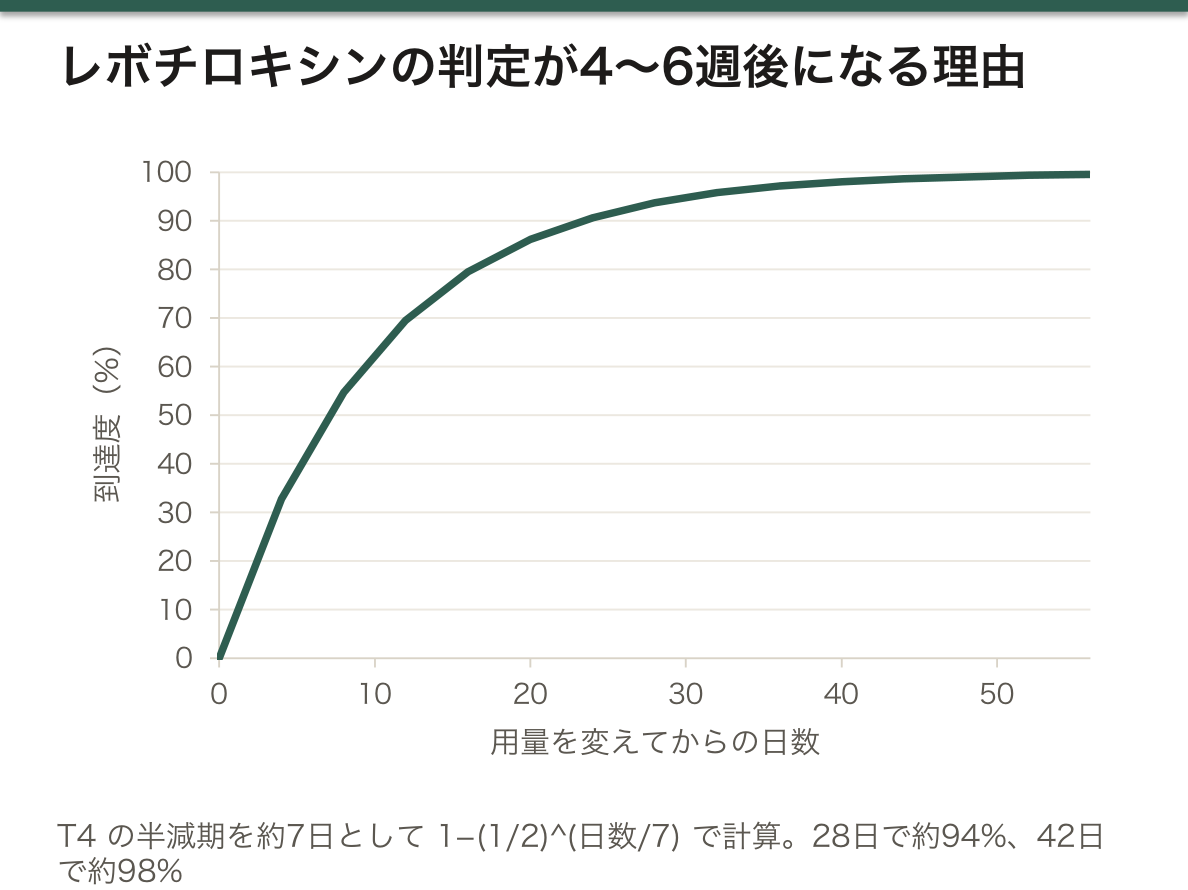
半減期の違いは、投与間隔と検査のタイミングを決める。ペプチドホルモンは数分(インスリンは約5分)なので、持続投与や頻回投与、あるいは修飾による延長が要る。ステロイドは結合蛋白に守られて数時間、甲状腺ホルモンのT₄は約7日——だからレボチロキシンは1日1回でよく、用量を変えてから効果を判定するのに4〜6週かかる。
甲状腺ホルモンだけが「脂溶性のアミン」という例外は、ヨウ素が4つ付いて疎水性になったためである。だから経口投与できる数少ないホルモンでもある——ペプチドホルモンは消化されてしまうので注射になる。
English version
Core
| Peptide / protein | Steroid | Amine | |
|---|---|---|---|
| Examples | Insulin, the pituitary hormones, PTH | Cortisol, aldosterone, sex steroids, active vitamin D | Catecholamines / thyroid hormone |
| Solubility | Water-soluble | Lipid-soluble | Catecholamines water-soluble; thyroid hormone lipid-soluble |
| Receptor | Cell membrane | Cytosol and nucleus | Catecholamines at the membrane; thyroid hormone in the nucleus |
| Speed | Seconds to minutes | Hours to days | — |
| In blood | Free | On binding proteins | — |
| Storage | In secretory granules | Not stored (made and released at once) | — |
The amines divide by their behaviour — both derive from tyrosine, but the catecholamines behave like the peptide class and thyroid hormone like the steroid class.
Going further
From the single point that steroids are not stored, several clinical facts follow.
- The adrenal cortex synthesises to order, so a block anywhere in the pathway causes an immediate shortage (congenital adrenal hyperplasia).
- When the adrenal atrophies under long-term steroid treatment, it has no capacity to make any when the drug is stopped suddenly — adrenal crisis. Tapering is essential.
"Carried on a binding protein" governs the interpretation of the tests.
- Only the free fraction works.
- In pregnancy and with oestrogens the binding protein rises → the total rises but the free is normal. Thyroid function is normal yet T₄ reads high.
- In nephrotic syndrome and cirrhosis the binding protein falls → the total falls.
- So thyroid function is assessed on the free fractions (FT₃, FT₄).
The difference in half-life decides the dosing interval and the timing of tests. Peptide hormones last minutes (insulin about 5), so they need continuous or frequent administration or modification to prolong them. Steroids last hours, protected by their binding proteins; thyroid T₄ about 7 days — hence levothyroxine once daily, and 4–6 weeks before the effect of a dose change can be judged.
Thyroid hormone alone is a lipid-soluble amine, having become hydrophobic by acquiring four iodine atoms. So it is one of the few hormones that can be given by mouth — peptide hormones are digested and must be injected.
フィードバックと、ホルモンを測るときの原則
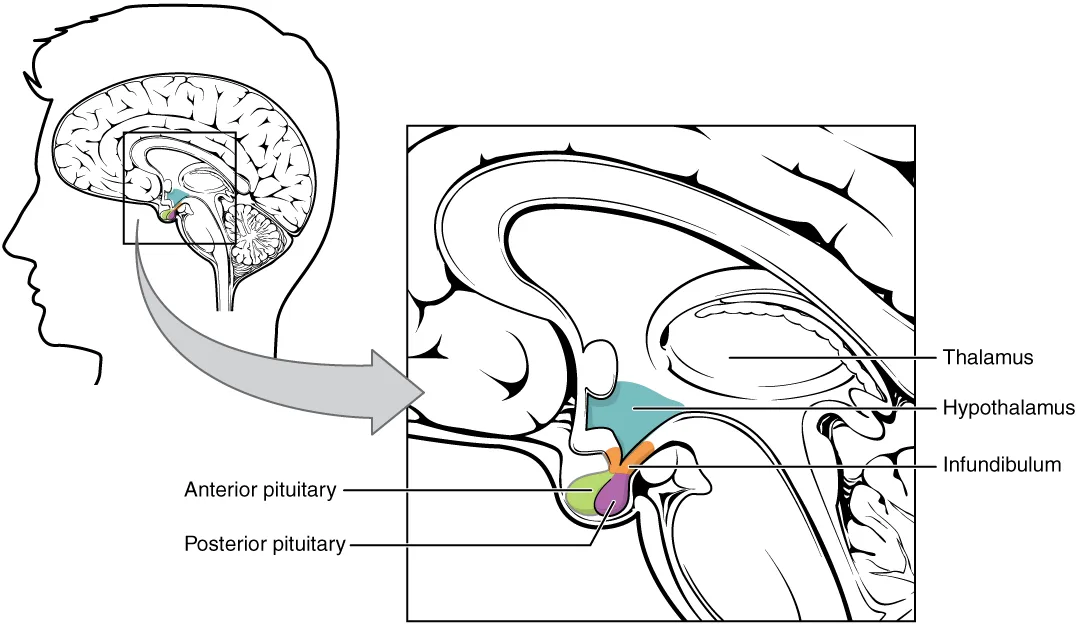
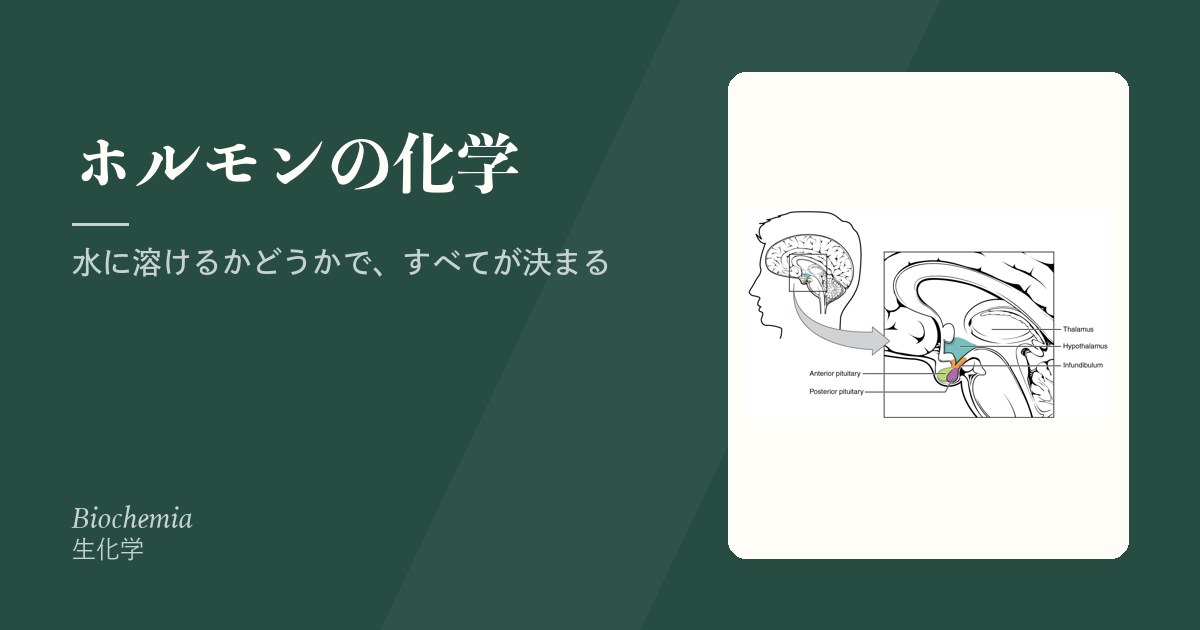
視床下部・下垂体・標的臓器の3階建てで、末梢のホルモンが上位を抑える(負のフィードバック)。
測るときの原則。
- 必ず組で測る——上位と末梢を同時に。片方だけでは原発性か続発性かが決まらない
- 足りないことを疑うなら刺激試験、多すぎることを疑うなら抑制試験
| 末梢ホルモン | 上位ホルモン | 診断 | |
|---|---|---|---|
| 原発性機能低下 | 低い | 高い | 標的臓器の障害 |
| 続発性機能低下 | 低い | 低い〜正常 | 下垂体・視床下部 |
| 原発性機能亢進 | 高い | 低い | 標的臓器の腫瘍 |
| 異所性・下垂体腫瘍 | 高い | 高い | 上位からの過剰刺激 |
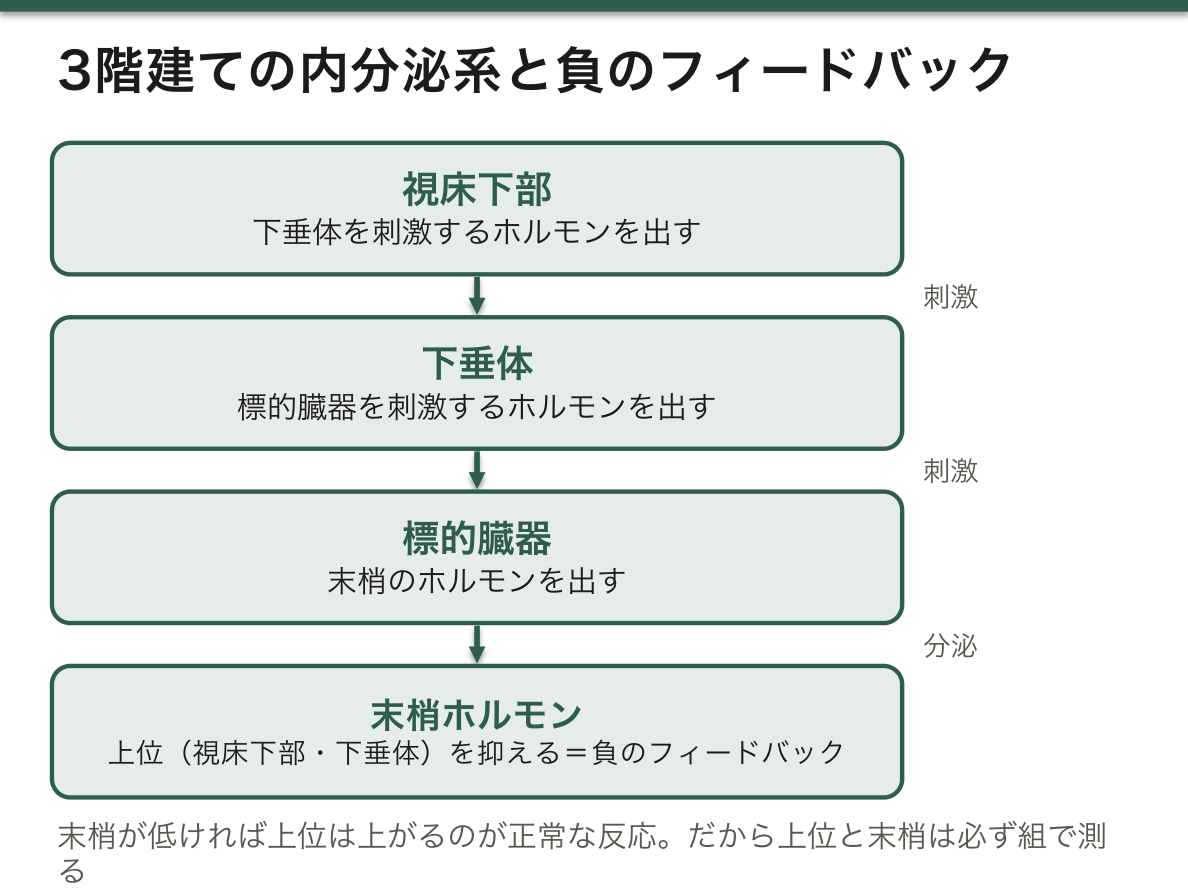
「上位が低いのに末梢も低い」という組み合わせが不自然だと感じられるようになれば、内分泌の検査は読める。末梢が低ければ上位は上がるのが正常な反応なので、上がっていないこと自体が下垂体の異常を意味する。
刺激試験と抑制試験の使い分けは、負のフィードバックの裏返しである。
- 足りないことの証明——刺激しても出ないことを示す。迅速副腎皮質刺激ホルモン試験、インスリン低血糖試験
- 多すぎることの証明——抑えても止まらないことを示す。デキサメタゾン抑制試験、経口ブドウ糖負荷試験(先端巨大症で成長ホルモンが抑制されない)
日内変動と分泌様式も、測る時刻を決める。
- コルチゾールは早朝に高く深夜に低い——深夜の値が下がらないことがCushing症候群の証拠になる
- 成長ホルモンと黄体形成ホルモンは拍動性に出る——1点の測定では意味を持たない
- プロラクチンはストレスと乳頭刺激で上がる——採血そのものが偽高値の原因になりうる
マクロプロラクチン血症は覚えておく価値がある。免疫グロブリンと結合した大きなプロラクチンが測定にかかるもので、高値だが生物活性が無く、無症状である。ポリエチレングリコール処理後に再測定して確認する。不要な下垂体撮影と治療を防ぐ。
English version
Core
A three-storey arrangement of hypothalamus, pituitary and target organ, the peripheral hormone suppressing those above it (negative feedback).
Principles of testing.
- Always measure them as a pair — the higher and the peripheral together. One alone cannot decide primary from secondary.
- Suspecting too little, use a stimulation test; suspecting too much, a suppression test.
| Peripheral | Higher | Diagnosis | |
|---|---|---|---|
| Primary hypofunction | Low | High | Disease of the target organ |
| Secondary hypofunction | Low | Low or normal | Pituitary or hypothalamus |
| Primary hyperfunction | High | Low | Tumour of the target organ |
| Ectopic or pituitary tumour | High | High | Excessive stimulation from above |
Going further
Once the combination "the higher hormone is low and the peripheral is low too" feels unnatural, endocrine tests can be read. If the peripheral is low the higher should rise; that it has not risen is itself the abnormality of the pituitary.
The choice between stimulation and suppression is the converse of negative feedback.
- To prove too little — show that it does not appear on stimulation. The short Synacthen test, the insulin tolerance test.
- To prove too much — show that it does not stop on suppression. The dexamethasone suppression test, the oral glucose load (growth hormone not suppressed in acromegaly).
The diurnal rhythm and the pattern of secretion decide when to measure.
- Cortisol is high in the early morning and low at midnight — that the midnight value does not fall is the evidence of Cushing’s syndrome.
- Growth hormone and LH are secreted in pulses — a single measurement means nothing.
- Prolactin rises with stress and nipple stimulation — the venepuncture itself can create a falsely high value.
Macroprolactinaemia is worth remembering: a large prolactin bound to immunoglobulin that is detected by the assay, high but without biological activity and asymptomatic. Confirm by re-measuring after polyethylene glycol precipitation. It prevents needless pituitary imaging and treatment.
遊離型と結合型 — なぜ「フリー」を測るのか
脂溶性ホルモンは、血中では運搬蛋白に結合している。働けるのは遊離型だけになる。
| ホルモン | 運び屋 | 遊離型の割合 |
|---|---|---|
| 甲状腺ホルモン | サイロキシン結合グロブリン(TBG)・トランスサイレチン・アルブミン | T4 で約 0.03% |
| コルチゾール | コルチゾール結合グロブリン | 約 5% |
| テストステロン・エストロゲン | 性ホルモン結合グロブリン(SHBG) | 約 1〜2% |
| カルシウム(イオン) | アルブミン | 約 50% |
運搬蛋白の量が変わると、総量は動くが遊離型は変わらない。
TBG を増やすもの——妊娠・経口エストロゲン・肝炎。減らすもの——ネフローゼ・肝硬変・アンドロゲン・ステロイド。
「総量が動いても、体は何も感じていない」という点が、検査の読み方を決めている。妊婦の総T4 が高くても、遊離T4 が正常なら甲状腺機能は正常になる(甲状腺の章)——「だから遊離型を測る」。
同じ論理が、カルシウムの補正式にも現れる(カルシウムの章)——「低アルブミン血症では、総カルシウムが低くてもイオン化カルシウムは正常なことが多い」。
SHBG の量が、男性ホルモンの評価を難しくする。肥満やインスリン抵抗性では SHBG が下がり、総テストステロンが低く出る(男性の性腺の章)——「総量だけを見て、性腺機能低下症と診断しない」。
運搬蛋白は、緩衝としても働いている。大きな貯蔵があるので、分泌が一時的に止まっても遊離型は急には変わらない——「甲状腺ホルモンの半減期が長い(T4 で約1週間)ことと合わせて、変化が緩やかになる」。
だから甲状腺ホルモン薬の効果判定は、4〜6週後になる(内分泌の薬の章)——「早く測っても、まだ定常状態に達していない」。
English version
Core
Lipid-soluble hormones circulate bound to carrier proteins. Only the free fraction can act.
| Hormone | Carrier | Free fraction |
|---|---|---|
| Thyroid hormone | Thyroxine-binding globulin (TBG), transthyretin, albumin | About 0.03% for T4 |
| Cortisol | Cortisol-binding globulin | About 5% |
| Testosterone, oestrogen | Sex hormone-binding globulin (SHBG) | About 1–2% |
| Calcium (ionised) | Albumin | About 50% |
When the amount of carrier changes, the total moves but the free does not. TBG is raised by pregnancy, oral oestrogen and hepatitis; lowered by nephrotic syndrome, cirrhosis, androgens and steroids.
Going further
That the total may move while the body feels nothing decides how the tests are read. A high total T4 in pregnancy with a normal free T4 means normal thyroid function — hence the free fraction is measured.
The same logic appears in the correction of calcium — in hypoalbuminaemia the total calcium is low but the ionised calcium is usually normal.
The amount of SHBG makes the assessment of androgens difficult. In obesity and insulin resistance SHBG falls and the total testosterone reads low — do not diagnose hypogonadism from the total alone.
The carrier also acts as a buffer. With a large reserve, a temporary halt in secretion does not change the free fraction quickly — together with the long half-life of thyroid hormone (about a week for T4), change is gradual.
So the effect of thyroid replacement is judged at 4–6 weeks — measured sooner, the steady state has not been reached.
受容体の側の調節 — 同じ濃度でも、効き方が変わる
ホルモンの作用の強さは、濃度だけでは決まらない。受け手の側も変わる。
| 現象 | 起きること | 例 |
|---|---|---|
| ダウンレギュレーション | 刺激が続くと受容体が減る | 高インスリン血症でのインスリン抵抗性 |
| アップレギュレーション | 刺激が乏しいと受容体が増える | 脱神経過敏・β遮断薬中止後の反跳 |
| 脱感作 | 受容体がリン酸化され、βアレスチンが結合して信号を遮る | β刺激薬の連用 |
| 許容作用(permissive) | あるホルモンが、別のホルモンの作用を成立させる | コルチゾールがカテコラミンの血管収縮を可能にする |
持続的な刺激と、拍動性(間欠的)の刺激で、結果が正反対になることがある。
「持続か、間欠か」という違いが、治療の設計そのものになっている。
| ホルモン | 持続投与 | 間欠投与 |
|---|---|---|
| GnRH | 下垂体が脱感作し、性腺を抑える(前立腺癌の治療) | 排卵を誘発する |
| 副甲状腺ホルモン | 骨を壊す | 骨を作る(テリパラチド) |
(内分泌の薬の章)——「同じ分子が、入れ方だけで逆の作用になる」。
許容作用は、副腎不全の病態を説明する。コルチゾールが無いとカテコラミンが効かないので、昇圧薬に反応しないショックになる(内分泌の救急の章)——「輸液にも昇圧薬にも反応しないショックで、副腎クリーゼを思い出す」。
β遮断薬を急にやめてはいけない理由も、この項から出てくる(循環器の薬の章)——「増えていた受容体が一斉に刺激され、狭心症や高血圧が悪化する」。
インスリン抵抗性も、受容体だけの問題ではない(インスリンシグナルの章)——「受容体より下流(IRS-1 のセリンリン酸化)で止まっていることが多い」。
English version
Core
The strength of a hormone’s action is not settled by concentration alone; the receiving side changes too.
| Phenomenon | What happens | Example |
|---|---|---|
| Down-regulation | Continued stimulation reduces the receptors | Insulin resistance in hyperinsulinaemia |
| Up-regulation | Scant stimulation increases them | Denervation supersensitivity; rebound after stopping a beta blocker |
| Desensitisation | The receptor is phosphorylated and β-arrestin blocks the signal | Continuous use of a β agonist |
| Permissive action | One hormone makes another’s action possible | Cortisol enables the vasoconstriction of catecholamines |
Continuous and pulsatile (intermittent) stimulation can give opposite results.
Going further
The difference between continuous and intermittent is itself the design of a treatment.
| Hormone | Given continuously | Given intermittently |
|---|---|---|
| GnRH | Desensitises the pituitary and suppresses the gonad (treatment of prostate cancer) | Induces ovulation |
| PTH | Breaks bone down | Builds bone (teriparatide) |
The same molecule with opposite actions according only to how it is given.
The permissive action explains adrenal insufficiency. Without cortisol the catecholamines do not work, giving a shock that does not respond to vasopressors — in shock that responds neither to fluid nor to vasopressors, think of adrenal crisis.
The reason a beta blocker must not be stopped abruptly also comes from this section — the receptors that had increased are all stimulated at once and angina or hypertension worsens.
Insulin resistance is not a matter of the receptor alone — it is often blocked downstream of the receptor (serine phosphorylation of IRS-1).
1本のペプチドから、複数のホルモンが切り出される
ペプチドホルモンは、はじめから完成形で作られるわけではない。長い前駆体として合成され、切られて活性型になる。
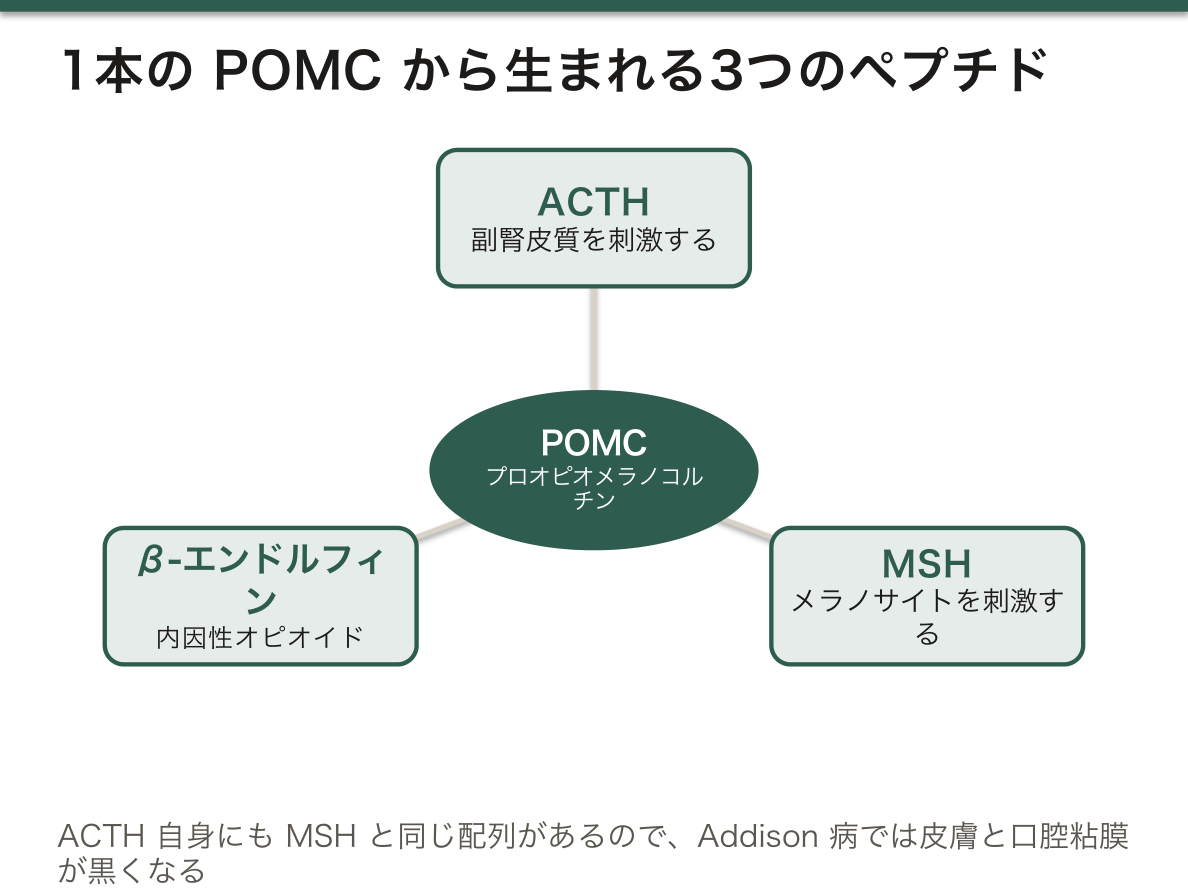
その典型が POMC(プロオピオメラノコルチン)で、1 本の前駆体から、まったく働きの違うペプチドが同時に生まれる。
- ACTH——副腎皮質を刺激する
- MSH——メラノサイトを刺激し、皮膚を黒くする
- β-エンドルフィン——内因性オピオイド
ACTH 自身にも MSH と同じ配列が含まれている。だから ACTH が大量に出ると、ACTH そのものが色素沈着を起こす。
Addison 病(原発性副腎不全)で皮膚と口腔粘膜が黒くなり、下垂体性(続発性)では黒くならない——この鑑別点は、前駆体の構造から導かれている。
切り方が変われば、できるものが変わる。同じ POMC でも、下垂体前葉では主に ACTH、中葉と視床下部では MSH が作られる。組織ごとに違うプロホルモン変換酵素が働いているためである。
他のホルモンにも同じ設計が使われている。
| プロインスリン | インスリン+C-ペプチド | 等モルで出るので、C-ペプチドが内因性分泌の指標になる |
| プログルカゴン | 膵ではグルカゴン、腸ではGLP-1 | 同じ遺伝子から、血糖を上げるホルモンと下げるホルモンが出る |
| プロオキシフィシン類 | オキシトシン/バソプレシンとニューロフィシン | 運搬蛋白と一緒に作られる |
| プロBNP | BNP+NT-proBNP | 切れ端のほうが半減期が長く、心不全の検査に使われている |
「使われない切れ端」が、しばしば良い検査項目になる。活性が無いぶん代謝されにくく、血中に長く留まるからである。C-ペプチドと NT-proBNP は、どちらもその例になっている。
⚠️ 異所性 ACTH 産生腫瘍では、色素沈着が強く出る。小細胞肺癌などが大量の POMC 由来ペプチドを出すためで、急速に進む Cushing 徴候+著明な色素沈着+低カリウム血症という組合せになる。
副腎不全を疑ったら口腔粘膜と手掌の皺を見る。色素沈着があれば原発性、無ければ下垂体性を考える。
English version
Core
A peptide hormone is not made in its finished form. It is synthesised as a long precursor and cut to the active form.
The classic example is POMC (pro-opiomelanocortin), from which one precursor gives rise at once to peptides of quite different function.
- ACTH — stimulates the adrenal cortex.
- MSH — stimulates melanocytes and darkens the skin.
- β-endorphin — an endogenous opioid.
ACTH itself contains the same sequence as MSH. So when a great deal of ACTH is released, the ACTH itself causes pigmentation. The skin and oral mucosa darken in Addison’s disease (primary adrenal failure) and not in pituitary (secondary) failure — a point of differential diagnosis derived from the structure of a precursor.
Going further
Change the cutting and what is produced changes. From the same POMC the anterior pituitary makes chiefly ACTH while the intermediate lobe and hypothalamus make MSH, different prohormone convertases acting in different tissues.
The same design is used for other hormones.
| Precursor | Products | Point |
|---|---|---|
| Proinsulin | Insulin + C-peptide | Released in equimolar amounts, so C-peptide is the index of endogenous secretion |
| Proglucagon | Glucagon in the pancreas, GLP-1 in the gut | From one gene, a hormone that raises the blood glucose and one that lowers it |
| Pro-oxyphysins | Oxytocin / vasopressin with neurophysin | Made together with their carrier protein |
| Pro-BNP | BNP + NT-proBNP | The offcut has the longer half-life and is used to test for heart failure |
The unused offcut often makes the better test, being metabolised less readily for having no activity and remaining longer in the blood. C-peptide and NT-proBNP are both examples.
⚠️ In an ectopic ACTH-producing tumour the pigmentation is marked, small cell lung cancer and others releasing a great deal of POMC-derived peptide: rapidly progressive Cushingoid features with marked pigmentation and hypokalaemia.
In the clinic
Suspecting adrenal insufficiency, look at the buccal mucosa and the creases of the palms. Pigmentation means primary; its absence, pituitary.
ホルモンは、届いた先で作り変えられる
血中を流れているものが、そのまま効いているとは限らない。標的組織に着いてから活性型へ変えられるホルモンがある。つまり「どこにどの酵素があるか」が、効き方の地図になっている。
| T4 → T3 | 脱ヨウ素酵素 | 甲状腺が出すのは大半が T4。活性は T3 のほうが数倍強い |
| テストステロン → DHT | 5α-還元酵素 | 前立腺・毛包・皮脂腺で。外性器の形成に必須 |
| アンドロゲン → エストロゲン | アロマターゼ | 脂肪組織・卵巣・胎盤。閉経後のエストロゲンは主に脂肪組織由来 |
| コルチゾール → コルチゾン | 11β-HSD2 | 腎で不活化する方向。作るのではなく、効かせないための変換 |
変換酵素が薬の標的になっている。ホルモンそのものを操作するより、必要な組織でだけ効き方を変えられるのが利点である。
- 5α-還元酵素阻害薬——前立腺肥大症と男性型脱毛症。テストステロンは保ったまま DHT だけ減らす。先天性の欠損症では、男児が女性型の外性器で生まれ、思春期に男性化する
- アロマターゼ阻害薬——閉経後乳癌。閉経前には使えない(卵巣が別経路でエストロゲンを作り、フィードバックでかえって増えるため)
- 抗甲状腺薬のプロピルチオウラシル——末梢での T4→T3 変換も抑える。甲状腺クリーゼで選ばれる理由の1つ
病気の状態そのものが、変換の向きを変えることもある。
低 T3 症候群(非甲状腺疾患)では、重症疾患・飢餓・手術後にT4 が T3 ではなく、活性の無い rT3 へ回される。代謝を落として消耗を抑える適応と考えられており、甲状腺機能低下症と誤って T3 を投与しても、予後は改善しない。急性期の患者に甲状腺機能検査を出さないのが原則になるのは、このためである。
⚠️ 甘草(グリチルリチン)は 11β-HSD2 を阻害する。コルチゾールが腎で不活化されず、鉱質コルチコイド受容体を刺激して高血圧・低カリウム血症を起こす。漢方薬の服用歴を聞く。
入院中の重症患者で TSH と FT3 の異常を見ても、すぐに甲状腺疾患と判断しない。回復してから測り直す。
English version
Core
What circulates in the blood is not necessarily what acts. Some hormones are converted to the active form after they arrive at the target tissue. That is, where which enzyme is placed is the map of where it works.
| Conversion | Enzyme | Where and why |
|---|---|---|
| T4 → T3 | Deiodinase | The thyroid releases mostly T4; T3 is several times more active |
| Testosterone → DHT | 5α-reductase | Prostate, hair follicle, sebaceous gland. Essential for the formation of the external genitalia |
| Androgen → oestrogen | Aromatase | Adipose tissue, ovary, placenta. After the menopause the oestrogen is chiefly from adipose tissue |
| Cortisol → cortisone | 11β-HSD2 | Inactivation in the kidney — a conversion not to make it work but to stop it working |
Going further
The converting enzymes have become drug targets, the advantage being that the action can be altered only in the tissue where it is wanted.
- 5α-reductase inhibitors — benign prostatic hyperplasia and male pattern baldness; testosterone is preserved while DHT alone is reduced. In congenital deficiency a boy is born with female external genitalia and virilises at puberty.
- Aromatase inhibitors — postmenopausal breast cancer. They cannot be used before the menopause (the ovary makes oestrogen by another route and feedback increases it).
- Propylthiouracil also inhibits the peripheral conversion of T4 to T3 — one reason it is chosen in thyroid storm.
The state of the illness itself can change the direction of conversion. In the low T3 syndrome (non-thyroidal illness), severe illness, starvation or surgery diverts T4 to the inactive rT3 rather than to T3. It is thought to be an adaptation lowering metabolism to limit consumption, and mistaking it for hypothyroidism and giving T3 does not improve the outcome. This is why thyroid function tests are not requested in the acute phase.
⚠️ Liquorice (glycyrrhizin) inhibits 11β-HSD2. Cortisol is not inactivated in the kidney, stimulates the mineralocorticoid receptor and causes hypertension and hypokalaemia. Ask about herbal medicines.
In the clinic
On seeing abnormal TSH and FT3 in a severely ill inpatient, do not conclude thyroid disease at once. Repeat the tests after recovery.
まとめ
| 3つの型 — ペプチド・ステロイド・アミン | ペプチド・蛋白ステロイドアミン例インスリン・下垂体ホルモン・副甲状腺ホルモンコルチゾール・アルドステロン・性ホルモン・活性型ビタミンDカテコラミン/甲状腺ホルモン溶解性水溶性脂溶性… |
|---|---|
| フィードバックと、ホルモンを測るときの原則 | 視床下部・下垂体・標的臓器の3階建てで、末梢のホルモンが上位を抑える(負のフィードバック)。 |
| 遊離型と結合型 — なぜ「フリー」を測るのか | 脂溶性ホルモンは、血中では運搬蛋白に結合している。 |
| 受容体の側の調節 — 同じ濃度でも、効き方が変わる | ホルモンの作用の強さは、濃度だけでは決まらない。 |
| 1本のペプチドから、複数のホルモンが切り出される | ペプチドホルモンは、はじめから完成形で作られるわけではない。 |
| ホルモンは、届いた先で作り変えられる | 血中を流れているものが、そのまま効いているとは限らない。 |
このノートは医学生が授業の内容を自分の言葉でまとめたもので、診療の判断に使うものではありません。誤りに気づいたらお知らせください。