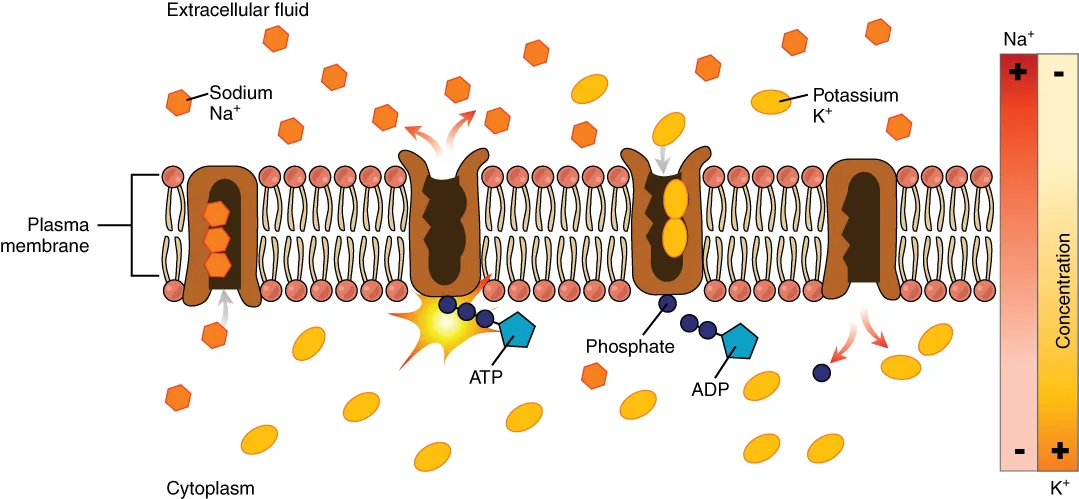
細胞膜の輸送体は3種に分かれる。ポンプ(ATPを使って濃度勾配に逆らう)、チャネル(開けば勾配に沿って流れる)、輸送体(他の物質の勾配を借りる)である。
チャネルは1個の遺伝子産物が電気そのものを担うので、単一遺伝子の変異が、そのまま不整脈やてんかんという表現型になる。分子と臨床が最短距離で結びつく領域である。
- ポンプ・チャネル・輸送体 — 3つの動かし方
- チャネル病 — 1つの遺伝子が、心臓と脳と筋に出る
- 心筋の活動電位とQT — チャネルの遺伝子が、心電図に出る
- 筋のチャネル病 — カリウムが動くと、力が入らなくなる
- 嚢胞性線維症 — 1 つの塩素チャネルが、全身の分泌を変える
- TRP チャネル — 温度と刺激を、電気に変える入口
ポンプ・チャネル・輸送体 — 3つの動かし方
| エネルギー | 速さ | 例 | |
|---|---|---|---|
| ポンプ(一次性能動輸送) | ATPを直接 | 遅い | Na⁺/K⁺-ATPase・H⁺/K⁺-ATPase・筋小胞体Ca²⁺-ATPase |
| 輸送体(二次性能動輸送) | 他の勾配を借りる | 中間 | Na⁺/グルコース共輸送体・Na⁺/Ca²⁺交換体・Na⁺-K⁺-2Cl⁻共輸送体 |
| チャネル | 不要 | 速い | 電位依存性Na⁺・K⁺・Ca²⁺チャネル、アクアポリン |
- Na⁺/K⁺-ATPaseは3個のNa⁺を出し2個のK⁺を入れる → 電気的に外向きで、静止膜電位に直接寄与する
- 細胞のATPの2〜3割をこのポンプが消費する
- ジギタリスはNa⁺/K⁺-ATPaseを阻害する
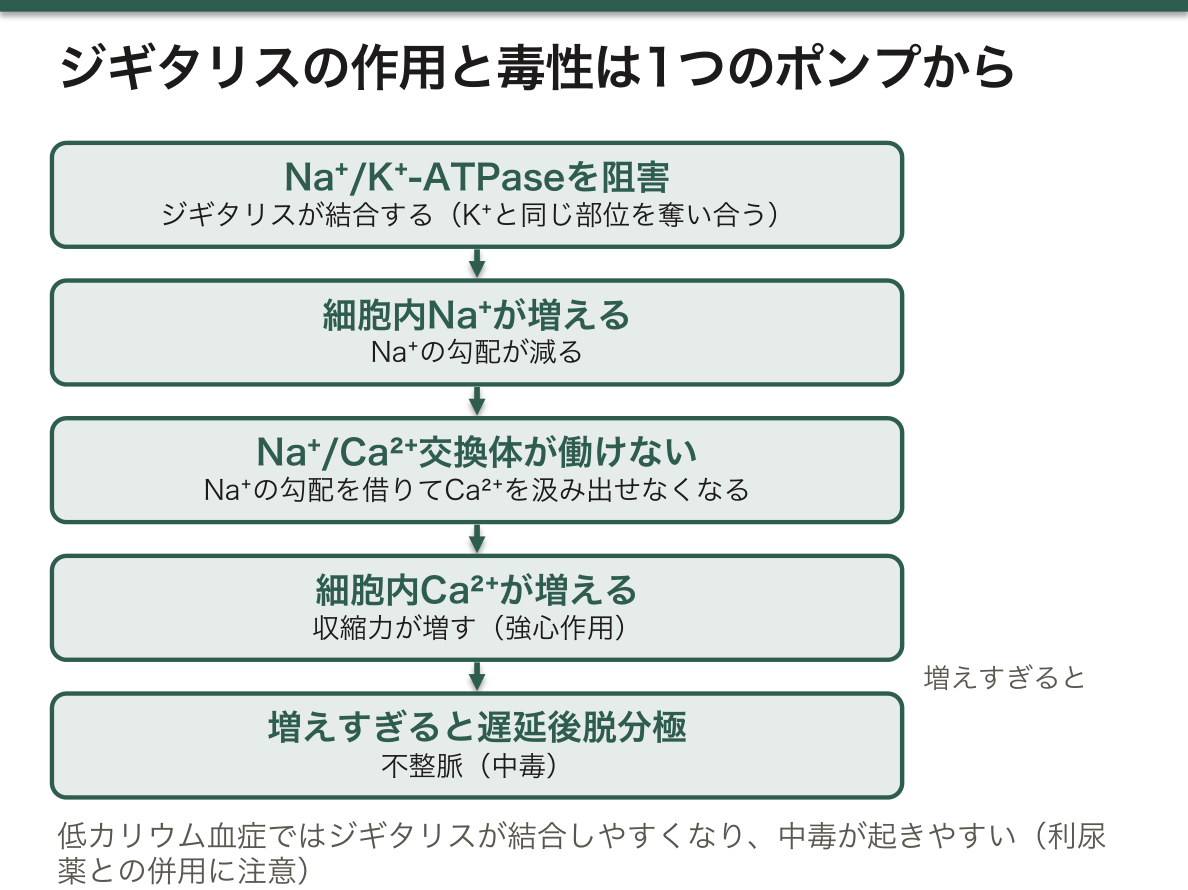
ジギタリスの作用と毒性が、1つのポンプから全部出てくる。
- Na⁺/K⁺-ATPaseを止める → 細胞内Na⁺が増える
- Na⁺/Ca²⁺交換体はNa⁺の勾配を借りてCa²⁺を汲み出しているので、勾配が減ると汲み出せなくなる
- 細胞内Ca²⁺が増える → 収縮力が増す(強心作用)
- 増えすぎると遅延後脱分極 → 不整脈
低カリウム血症で中毒が起きやすいのも同じ図から出る。K⁺とジギタリスはポンプの同じ部位を奪い合うので、K⁺が低いとジギタリスが結合しやすくなる。利尿薬との併用が危険な理由がここにある。
SGLT2阻害薬も輸送体の理解から出る。近位尿細管でNa⁺の勾配を借りてグルコースを再吸収している共輸送体を止めると、グルコースが尿へ出る。ところが実際の効果は血糖降下にとどまらず、心不全と腎保護に及ぶ。尿細管糸球体フィードバック——遠位へ届くナトリウムが増えて糸球体内圧が下がる——が主要な機序と考えられている。
正常血糖ケトアシドーシスという副作用も機序どおりである。グルコースを捨て続けるとインスリンが下がりグルカゴンが上がるので、血糖が正常でもケトン体が産生される。「血糖が高くないからケトアシドーシスではない」と考えると見逃す——手術前の休薬が推奨される理由でもある。
English version
Core
| Energy | Speed | Examples | |
|---|---|---|---|
| Pump (primary active transport) | ATP directly | Slow | Na⁺/K⁺-ATPase, H⁺/K⁺-ATPase, sarcoplasmic reticulum Ca²⁺-ATPase |
| Carrier (secondary active transport) | Borrows another gradient | Intermediate | Na⁺/glucose cotransporter, Na⁺/Ca²⁺ exchanger, Na⁺-K⁺-2Cl⁻ cotransporter |
| Channel | None needed | Fast | Voltage-gated Na⁺, K⁺ and Ca²⁺ channels, aquaporins |
- The Na⁺/K⁺-ATPase puts out three Na⁺ and takes in two K⁺ → it is electrogenic outwards and contributes directly to the resting membrane potential.
- This pump consumes 20–30 per cent of the cell’s ATP.
- Digitalis inhibits the Na⁺/K⁺-ATPase.
Going further
The action and the toxicity of digitalis all come out of one pump.
- Stop the Na⁺/K⁺-ATPase → intracellular Na⁺ rises.
- The Na⁺/Ca²⁺ exchanger pumps Ca²⁺ out by borrowing the Na⁺ gradient, so with the gradient reduced it can no longer pump it out.
- Intracellular Ca²⁺ rises → contractility increases (the inotropic action).
- Too much → delayed afterdepolarisation → arrhythmia.
That toxicity occurs readily in hypokalaemia comes from the same diagram. K⁺ and digitalis compete for the same site on the pump, so with a low K⁺ digitalis binds more readily. Here lies the reason combination with a diuretic is dangerous.
SGLT2 inhibitors also come out of understanding carriers. Stop the cotransporter that reabsorbs glucose in the proximal tubule by borrowing the Na⁺ gradient and glucose passes into the urine. Yet the actual effect does not stop at lowering the blood glucose but extends to heart failure and renal protection. Tubuloglomerular feedback — more sodium reaching the distal tubule lowers the intraglomerular pressure — is thought to be the principal mechanism.
Euglycaemic ketoacidosis, an adverse effect, follows the mechanism too. Keep discarding glucose and insulin falls while glucagon rises, so ketone bodies are produced with a normal blood glucose. Thinking "the glucose is not high, so it is not ketoacidosis" misses it — and it is why withdrawal before surgery is recommended.
チャネル病 — 1つの遺伝子が、心臓と脳と筋に出る
| 疾患 | チャネル | 特徴 |
|---|---|---|
| 先天性QT延長症候群1型 | K⁺(KCNQ1) | 運動・水泳で失神。βしゃ断薬が有効 |
| 2型 | K⁺(KCNH2) | 音・情動が誘因 |
| 3型 | Na⁺(SCN5A) | 睡眠中に多い |
| Brugada症候群 | Na⁺(SCN5A) | 右脚ブロック様+V1〜V3のST上昇。夜間の突然死 |
| 嚢胞性線維症 | Cl⁻(CFTR) | 粘稠な分泌物・汗の塩化物高値 |
| 周期性四肢麻痺 | Ca²⁺/Na⁺ | 低カリウム性・高カリウム性 |
| 悪性高熱症 | リアノジン受容体 | 揮発性麻酔薬・脱分極性筋弛緩薬で誘発 |
同じSCN5Aの変異が、機能亢進ならQT延長症候群3型、機能喪失ならBrugada症候群になる——同じ遺伝子で、変異の向きが逆の病気を作る。この事実は、遺伝子検査の結果を読むときに決定的である。「変異がある」だけでは病気は決まらない。
薬でチャネル病を作ることもできる。後天性QT延長症候群のほうが先天性よりはるかに多く、抗不整脈薬・マクロライド・キノロン・抗精神病薬・制吐薬が原因になる。低カリウム・低マグネシウム・徐脈が重なると torsades de pointes に至る。薬を足すときにQTを確認する習慣が、実務では最も役に立つ。
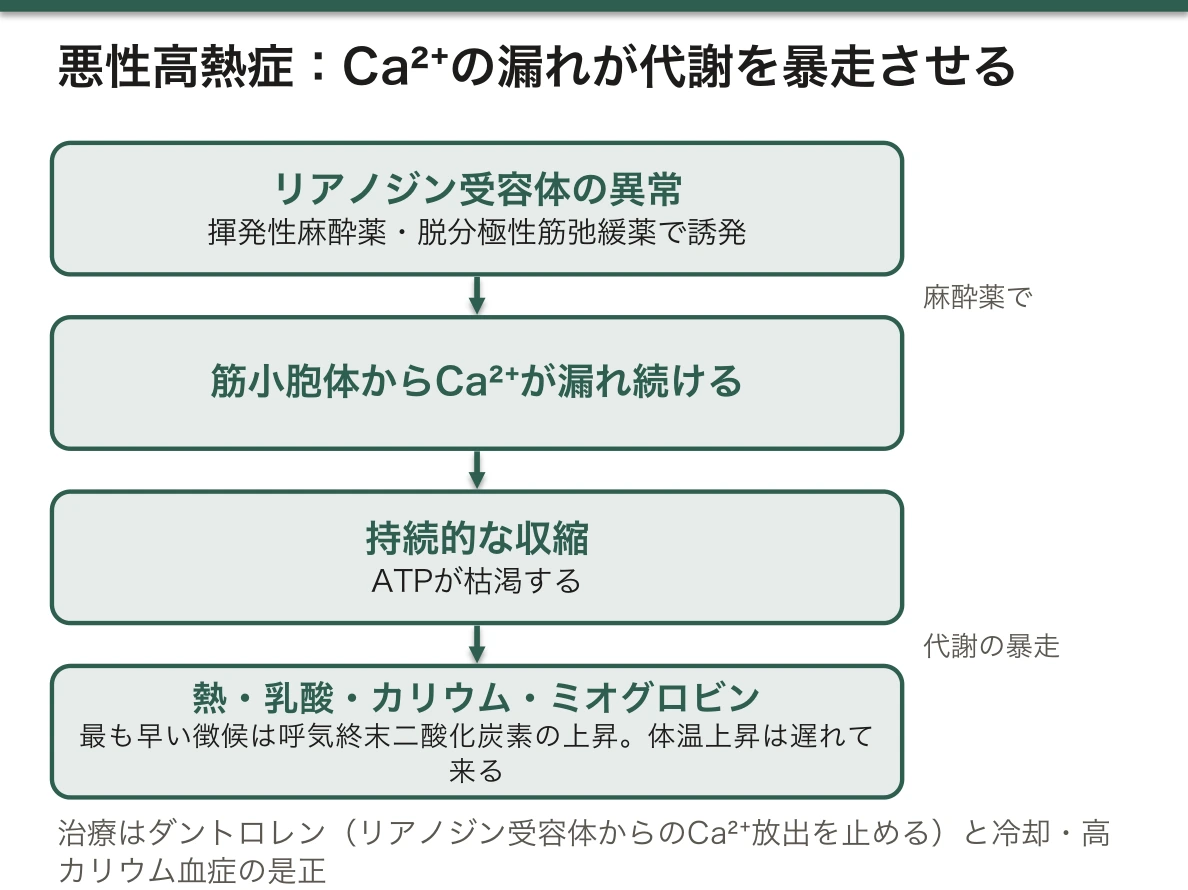
悪性高熱症は、生化学が救命に直結する。リアノジン受容体の異常により筋小胞体からCa²⁺が漏れ続けると、持続的な収縮でATPが枯渇し、熱と乳酸とカリウムとミオグロビンが出る。
- 最も早い徴候は呼気終末二酸化炭素の上昇——代謝が暴走している証拠。体温上昇は遅れて来る
- 治療はダントロレン(リアノジン受容体からのCa²⁺放出を止める)と冷却・高カリウム血症の是正
- 家族歴を必ず聞く——常染色体顕性遺伝である
嚢胞性線維症は日本人に稀だが、機序の理解には最良の教材である。CFTRは塩化物チャネルで、変異により小胞体で分解される型(F508del)と、膜には出るが開かない型がある。型に応じて、折り畳みを助ける薬と、開きやすくする薬を使い分ける——変異の種類で薬を選ぶという、遺伝子医療の実装例になっている。
English version
Core
| Disease | Channel | Features |
|---|---|---|
| Long QT syndrome type 1 | K⁺ (KCNQ1) | Syncope with exercise, especially swimming. β-blockers are effective |
| Type 2 | K⁺ (KCNH2) | Sound and emotion as triggers |
| Type 3 | Na⁺ (SCN5A) | Commonly during sleep |
| Brugada syndrome | Na⁺ (SCN5A) | A right bundle branch block-like pattern with ST elevation in V1–V3. Sudden death at night |
| Cystic fibrosis | Cl⁻ (CFTR) | Viscid secretions, a high sweat chloride |
| Periodic paralysis | Ca²⁺ / Na⁺ | Hypokalaemic and hyperkalaemic forms |
| Malignant hyperthermia | Ryanodine receptor | Triggered by volatile anaesthetics and depolarising muscle relaxants |
Going further
A mutation in the same SCN5A gives long QT syndrome type 3 if it is gain of function and Brugada syndrome if it is loss of function — the same gene making opposite diseases according to the direction of the mutation. This fact is decisive when reading the result of a genetic test. "There is a mutation" does not by itself settle the disease.
A channelopathy can also be made with drugs. Acquired long QT syndrome is far commoner than the congenital, caused by antiarrhythmics, macrolides, quinolones, antipsychotics and antiemetics. With a low potassium, a low magnesium and bradycardia on top, it reaches torsades de pointes. The habit of checking the QT when adding a drug is the most useful thing in practice.
In malignant hyperthermia the biochemistry leads directly to saving a life. With an abnormal ryanodine receptor, Ca²⁺ leaks continuously from the sarcoplasmic reticulum, and sustained contraction exhausts the ATP, releasing heat, lactate, potassium and myoglobin.
- The earliest sign is a rise in end-tidal carbon dioxide — evidence that metabolism has run away. The temperature rises later.
- Treatment is dantrolene (stopping the release of Ca²⁺ from the ryanodine receptor) with cooling and correction of the hyperkalaemia.
- Always ask the family history — it is autosomal dominant.
Cystic fibrosis is rare in Japanese people but is the best teaching material for the mechanism. CFTR is a chloride channel, and mutations give a form degraded in the endoplasmic reticulum (F508del) and a form that reaches the membrane but does not open. According to the form, a drug assisting folding and a drug making it open more readily are used — an implemented example of genomic medicine, choosing the drug by the kind of mutation.
心筋の活動電位とQT — チャネルの遺伝子が、心電図に出る
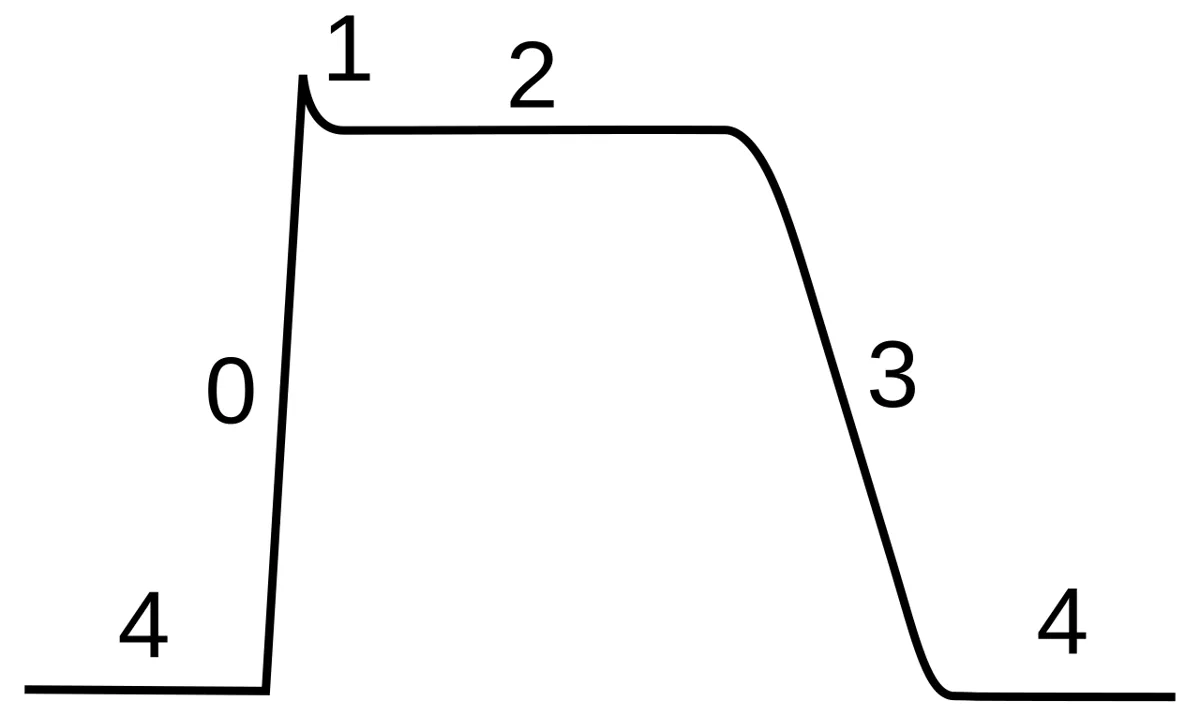
心室筋の活動電位は5相に分ける。
| 相 | 動く電流 | 心電図 |
|---|---|---|
| 0(脱分極) | Na⁺ 内向き | QRS |
| 1 | 一過性外向き K⁺ | — |
| 2(プラトー) | Ca²⁺ 内向き と K⁺ 外向きが釣り合う | ST |
| 3(再分極) | K⁺ 外向き(IKr・IKs) | T波 |
| 4 | 内向き整流 K⁺ | 静止 |
QT 間隔は、脱分極から再分極が終わるまでの時間になる。
先天性 QT 延長症候群——1型(KCNQ1、IKs)・2型(KCNH2、IKr)・3型(SCN5A、Na⁺)が代表になる。
Brugada 症候群も SCN5A の異常——右側胸部誘導の ST 上昇。
「どのチャネルが壊れたか」が、そのまま発作の引き金を決めている。
| 型 | 引き金 |
|---|---|
| 1型 | 運動、とくに水泳 |
| 2型 | 驚愕(目覚まし時計・電話の音) |
| 3型 | 睡眠中・安静時 |
(不整脈の章)——「病歴の聞き方が、遺伝子型の推定になる」。
後天性の QT 延長のほうが、実際にはずっと多い。薬(抗不整脈薬・マクロライド・キノロン・抗精神病薬・制吐薬)と、電解質(低カリウム・低マグネシウム・低カルシウム)(薬の副作用の章)——「複数が重なったときに、torsades de pointes が起こる」。
多くの薬が引っかかるのは、IKr(hERG チャネル)が構造的に多様な分子を通しやすいためになる——「だから新薬の開発では、必ず hERG への作用を調べる」。
プラトー相があることが、心臓の不応期を長くしている(心筋の電気生理の章)——「骨格筋のように強縮しないので、心臓は必ず弛緩して充満できる」。
English version
Core
The ventricular action potential is divided into five phases.
| Phase | Current | ECG |
|---|---|---|
| 0 (depolarisation) | Na⁺ inward | QRS |
| 1 | Transient outward K⁺ | — |
| 2 (plateau) | Ca²⁺ inward balanced against K⁺ outward | ST |
| 3 (repolarisation) | K⁺ outward (IKr, IKs) | T wave |
| 4 | Inward rectifier K⁺ | Rest |
The QT interval is the time from depolarisation to the end of repolarisation.
Congenital long QT syndrome — types 1 (KCNQ1, IKs), 2 (KCNH2, IKr) and 3 (SCN5A, Na⁺) are the representatives.
Brugada syndrome is also an abnormality of SCN5A — ST elevation in the right precordial leads.
Going further
- Which channel is broken decides the trigger of an attack directly.
(the chapter on arrhythmia) — how the history is taken becoming an inference about the genotype.Type Trigger Type 1 Exercise, especially swimming Type 2 Startle (an alarm clock, a telephone ringing) Type 3 During sleep, at rest - Acquired QT prolongation is in fact far commoner. Drugs (antiarrhythmics, macrolides, quinolones, antipsychotics, antiemetics) and electrolytes (low potassium, low magnesium, low calcium) (the chapter on adverse drug effects) — torsades de pointes occurs when several coincide.
- So many drugs are caught because IKr (the hERG channel) readily admits structurally diverse molecules — hence the action on hERG is always tested in the development of a new drug.
- That there is a plateau phase makes the refractory period of the heart long (the chapter on cardiac electrophysiology) — not tetanising as skeletal muscle does, the heart is always able to relax and fill.
筋のチャネル病 — カリウムが動くと、力が入らなくなる
骨格筋の興奮性は、細胞内外のカリウム比で決まる静止膜電位に依存する。
| 低カリウム性周期性四肢麻痺 | 高カリウム性周期性四肢麻痺 | |
|---|---|---|
| 遺伝子 | CACNA1S(Ca²⁺ チャネル)・SCN4A | SCN4A(Na⁺ チャネル) |
| 誘因 | 高炭水化物食・激しい運動の後の休息・寒冷・ストレス | 空腹・運動後・カリウムの摂取 |
| 発作時のカリウム | 低い | 高い〜正常 |
| 持続 | 数時間〜1日 | 数分〜1時間(短い) |
甲状腺中毒性周期性四肢麻痺——東アジアの若年男性に多い。甲状腺機能亢進症に伴う低カリウム性の麻痺。
発作時は意識も感覚も保たれ、呼吸筋と脳神経は通常侵されない。
「血中のカリウムが下がっても上がっても麻痺する」という一見の矛盾が、この項の要点になる。問題は絶対値ではなく、膜電位が興奮できる範囲から外れることになる(膜電位と興奮の章)——「低すぎれば過分極、高すぎれば脱分極性のブロックになる」。
低カリウム性では、カリウムが体外へ失われているわけではない。細胞内へ移動しているだけなので、補正しすぎると回復期に高カリウム血症になる(電解質の実際の章)——「入れた量ではなく、動いた量として考える」。
だから治療は少量ずつ、頻回に測りながら行う——「ブドウ糖を含む輸液は、インスリンを介してさらに細胞内へ押し込むので避ける」。
甲状腺中毒性の型は、甲状腺を治せば再発しない(甲状腺の章)——「若い男性の突然の四肢麻痺で、甲状腺機能を測る理由になる」。
悪性高熱症も、同じ SCN4A/RYR1 の系列の話になる(麻酔の合併症の章)——「筋のカルシウム放出チャネルの異常が、麻酔薬で暴走する」。
English version
Core
The excitability of skeletal muscle depends on the resting membrane potential, which is set by the ratio of potassium across the membrane.
| Hypokalaemic periodic paralysis | Hyperkalaemic periodic paralysis | |
|---|---|---|
| Gene | CACNA1S (Ca²⁺ channel), SCN4A | SCN4A (Na⁺ channel) |
| Triggers | A high-carbohydrate meal, rest after hard exercise, cold, stress | Hunger, after exercise, taking potassium |
| Potassium during an attack | Low | High to normal |
| Duration | Hours to a day | Minutes to an hour (short) |
Thyrotoxic periodic paralysis — common in young East Asian men. A hypokalaemic paralysis accompanying hyperthyroidism.
During an attack consciousness and sensation are preserved, and the respiratory muscles and cranial nerves are usually spared.
Going further
- The point of this section is the apparent contradiction that paralysis follows whether the blood potassium falls or rises. The problem is not the absolute value but the membrane potential leaving the range in which excitation is possible (the chapter on membrane potential and excitation) — too low gives hyperpolarisation, too high a depolarisation block.
- In the hypokalaemic form the potassium is not lost from the body. It has merely moved into the cells, so over-correcting gives hyperkalaemia in the recovery phase (the chapter on electrolytes in practice) — think in terms of how much has moved, not how much was given.
- Hence treatment is in small amounts, repeatedly, with frequent measurement — avoid glucose-containing fluid, which pushes it further inside through insulin.
- The thyrotoxic form does not recur once the thyroid is treated (the chapter on the thyroid) — the reason for measuring thyroid function in a young man with sudden limb paralysis.
- Malignant hyperthermia belongs to the same SCN4A/RYR1 family of stories (the chapter on the complications of anaesthesia) — an abnormality of the calcium release channel of muscle running away under an anaesthetic.
嚢胞性線維症 — 1 つの塩素チャネルが、全身の分泌を変える
CFTR は cAMP で開く塩素チャネルで、分泌上皮に広く分布している。壊れると塩素を出せず、その結果ナトリウムと水も動かなくなる。分泌液が濃く粘くなり、管が詰まる。
| 気道 | 粘液が排出できない | 反復感染(緑膿菌・黄色ブドウ球菌)→ 気管支拡張症 → 呼吸不全。予後を決める |
| 膵 | 膵管が詰まる | 膵外分泌不全——脂肪便・脂溶性ビタミン欠乏・成長障害 |
| 腸 | 胎便が排出されない | 胎便性イレウス——新生児期の初発症状になる |
| 汗腺 | 汗の塩化物を再吸収できない | 汗が塩辛い。汗中塩化物濃度が診断に使われる |
| 精管 | 発生の途中で退縮する | 先天性両側精管欠損——男性のほぼ全例が不妊 |
汗腺だけ向きが逆なのがこの病気の面白いところで、他の臓器では「分泌できない」、汗腺では「再吸収できない」となる。
白人に多く(保因者 25 人に 1 人)、日本人には稀である。国試では出るが、日本で実際に診る機会は少ない。
治療がここ 10 年で大きく変わった。変異の型ごとに、壊れ方が違うことが分かってきたためである。
- class II(ΔF508、最多)——折り畳めず、細胞表面へ辿り着けない。コレクター(形を整える薬)で運ぶ
- class III——表面にはあるが開かない。ポテンシエーター(開きやすくする薬)が効く
- 実際は 2〜3 剤を組み合わせて使う。呼吸機能と生存が明確に改善した——遺伝子型に応じて分子の欠陥を直す治療が成功した、代表的な例になっている
⚠️ 遺伝子型が薬の適応を決める。同じ病名でも、変異の型が合わなければ薬は効かない。「病名で処方する」のではなく「分子の欠陥で処方する」という時代の入口がここにある。
日本で意識すべきなのは、男性不妊の精査で見つかる CFTR 変異である。先天性両側精管欠損の患者には、軽症型の CFTR 変異が見つかることがある。
反復する気道感染+成長障害+脂肪便という組合せは、まとめて1つの病気で説明できないかを考える合図になる。
English version
Core
CFTR is a chloride channel opened by cAMP, distributed widely in secretory epithelium. Broken, chloride cannot be put out, and in consequence sodium and water do not move either. The secretions become thick and viscid and the ducts block.
| Airway | Mucus cannot be cleared | Repeated infection (Pseudomonas, Staph. aureus) → bronchiectasis → respiratory failure. It decides the prognosis |
| Pancreas | The ducts block | Exocrine pancreatic insufficiency — steatorrhoea, deficiency of fat-soluble vitamins, growth failure |
| Gut | Meconium is not passed | Meconium ileus — the presenting symptom in the newborn period |
| Sweat gland | Chloride in sweat cannot be reabsorbed | The sweat is salty. The sweat chloride concentration is used in diagnosis |
| Vas deferens | It involutes during development | Congenital bilateral absence of the vas deferens — almost all males are infertile |
Only the sweat gland runs the other way, which is the interesting part of this disease: in the other organs it is "cannot secrete", in the sweat gland "cannot reabsorb".
Going further
Common in white populations (one carrier in 25) and rare in Japanese people. It appears in the national examination while there is little occasion to see it in Japan.
Treatment has changed greatly in the past ten years, because it became clear that the way it breaks differs with the class of mutation.
- Class II (ΔF508, the commonest) — it cannot fold and never reaches the cell surface. A corrector (a drug that sets the shape right) carries it there.
- Class III — it is at the surface but does not open. A potentiator (making it open more readily) works.
- In practice two or three agents are combined. Lung function and survival have clearly improved — a leading example of a treatment succeeding by repairing the molecular defect according to genotype.
⚠️ The genotype decides the indication for the drug. With the same disease name, the drug does not work if the class of mutation does not match. Here is the entrance to an age of "prescribing for the molecular defect" rather than "prescribing for the disease name".
What to be aware of in Japan is the CFTR mutation found in the investigation of male infertility. In a patient with congenital bilateral absence of the vas deferens, a mild CFTR mutation may be found.
In the clinic
The combination of repeated airway infection, growth failure and steatorrhoea is a signal to ask whether it can all be explained by one disease.
TRP チャネル — 温度と刺激を、電気に変える入口
感覚神経の末端には、物理・化学の刺激で直接開くチャネルがある。TRP チャネルはその代表で、温度域ごとに別のものが担当している。
| TRPV1 | 43 ℃以上の熱・酸 | カプサイシン(唐辛子)で開く。だから辛いものが「熱い」と感じられる |
| TRPM8 | 25 ℃以下の冷たさ | メントールで開く。だからミントが「涼しい」 |
| TRPA1 | 刺激物・強い冷刺激 | ワサビ・シナモン・催涙成分。炎症で強く効くようになる |
味ではなく、温度と痛みの感覚を借りている。辛味は味覚(味蕾)ではなく三叉神経の痛覚で感じており、「辛い」が味の5基本に入らないのはこのためである。
薬として使われている。カプサイシンを塗ると、はじめは灼熱感が出るが、使い続けると神経末端が脱感作されて痛みが減る。高濃度パッチが帯状疱疹後神経痛や糖尿病性神経障害に使われる。刺激することで、最終的に感じなくさせるという逆説的な使い方である。
炎症は、チャネルの閾値を下げる。プロスタグランジン・ブラジキニン・神経成長因子が TRPV1 を感作すると、ふだんは熱いと感じない温度でも痛む——日焼けした皮膚にぬるま湯が痛いのはこれである。痛覚過敏という現象が、1 つのチャネルの閾値の変化として説明できる。
疾患との結びつきも分かってきている。
- TRPV1 と慢性咳嗽——気道の感覚神経が過敏になる。難治性の咳の標的として研究されている
- TRPM8 とオキサリプラチン——投与後に冷たいものに触れると強い痛みが出る。冷たい飲み物を避けるよう指導する
- TRPV4・TRPC6 の変異——遺伝性の神経障害や巣状分節性糸球体硬化症
- カプサイシン受容体の欠損——痛みを感じない先天性疾患の一部
チャネルは電気信号を作る部品であると同時に、「何を感じるか」を決める受容器そのものでもある。
オキサリプラチンを使う患者には、投与後数日は冷たいものを避けるよう具体的に伝える。冷水で手がしびれる、氷を触れないという訴えは予測できる。
English version
Core
At the endings of sensory nerves there are channels opened directly by physical and chemical stimuli. The TRP channels are the representatives, and different ones take charge of different ranges of temperature.
| TRPV1 | Heat above 43 °C, acid | Opened by capsaicin (chilli). Hence spicy food is felt as "hot" |
| TRPM8 | Cold below 25 °C | Opened by menthol. Hence mint feels "cool" |
| TRPA1 | Irritants, strong cold | Wasabi, cinnamon, tear gas. It becomes strongly effective in inflammation |
They borrow not taste but the senses of temperature and pain. Pungency is felt not by taste (the taste buds) but by trigeminal nociception, and this is why "spicy" is not among the five basic tastes.
Going further
It is used as a drug. Applied capsaicin gives a burning sensation at first, but with continued use the nerve endings are desensitised and the pain lessens. A high-concentration patch is used for post-herpetic neuralgia and diabetic neuropathy. A paradoxical use: stimulating in order finally to abolish the sensation.
Inflammation lowers the threshold of the channel. When prostaglandin, bradykinin and nerve growth factor sensitise TRPV1, a temperature not normally felt as hot becomes painful — this is why lukewarm water hurts on sunburnt skin. The phenomenon of hyperalgesia can be explained as a change in the threshold of one channel.
Links with disease are emerging too.
- TRPV1 and chronic cough — the sensory nerves of the airway become hypersensitive. Studied as a target in refractory cough.
- TRPM8 and oxaliplatin — after administration, touching anything cold gives severe pain. Advise the patient to avoid cold drinks.
- Mutations of TRPV4 and TRPC6 — hereditary neuropathy and focal segmental glomerulosclerosis.
- Loss of the capsaicin receptor — part of the congenital disorders of insensitivity to pain.
A channel is at once a component making an electrical signal and the receptor itself that decides what is felt.
In the clinic
Tell a patient receiving oxaliplatin specifically to avoid cold things for some days after the infusion. The complaints of numb hands in cold water, of not being able to touch ice, can be predicted.
まとめ
| ポンプ・チャネル・輸送体 — 3つの動かし方 | エネルギー速さ例ポンプ(一次性能動輸送)ATPを直接遅いNa⁺/K⁺-ATPase・H⁺/K⁺-ATPase・筋小胞体Ca²⁺-ATPase輸送体(二次性能動輸送)他の勾配を借りる… |
|---|---|
| チャネル病 — 1つの遺伝子が、心臓と脳と筋に出る | 疾患チャネル特徴先天性QT延長症候群1型K⁺(KCNQ1)運動・水泳で失神。 |
| 心筋の活動電位とQT — チャネルの遺伝子が、心電図に出る | 心室筋の活動電位は5相に分ける。相動く電流心電図0(脱分極)Na⁺ 内向きQRS1一過性外向き K⁺—2(プラトー)Ca²⁺ 内向き と K⁺ 外向きが釣り合うST3(再分極)K⁺… |
| 筋のチャネル病 — カリウムが動くと、力が入らなくなる | 骨格筋の興奮性は、細胞内外のカリウム比で決まる静止膜電位に依存する。 |
| 嚢胞性線維症 — 1 つの塩素チャネルが、全身の分泌を変える | CFTR は cAMP で開く塩素チャネルで、分泌上皮に広く分布している。 |
| TRP チャネル — 温度と刺激を、電気に変える入口 | 感覚神経の末端には、物理・化学の刺激で直接開くチャネルがある。 |
このノートは医学生が授業の内容を自分の言葉でまとめたもので、診療の判断に使うものではありません。誤りに気づいたらお知らせください。