ホルモンや神経伝達物質は、ほとんどが細胞の中に入らない。外にとどまったまま情報だけを伝える必要があり、そのやり方が3つの型に整理できる。
- Gタンパク質共役型受容体——7回膜を貫通する。セカンドメッセンジャーを作る。薬の3割以上がここを狙う
- 酵素連結型受容体——受容体自身が酵素(多くはチロシンキナーゼ)。インスリンと増殖因子
- イオンチャネル型受容体——結合すると穴が開く。ミリ秒で効く。神経伝達
加えて、細胞の中まで入ってしまうものがある——ステロイド・甲状腺ホルモン(脂溶性)。これらは受容体が転写因子そのものなので、効くまでに時間がかかり、効果が長く続く。
速さの違いは仕組みの違いである。チャネル型はミリ秒、Gタンパク質型は秒、酵素連結型は分、核内受容体は時間。「なぜステロイドは即効性がないのか」の答えが、この並びにある。
- Gタンパク質共役型受容体 — 3種類のαと、そこに効く薬
- チロシンキナーゼ型受容体 — 増殖のスイッチと癌
- 核内受容体 — 遅く効いて、長く残る
- イオンチャネル型受容体 — 最も速い信号は、第二伝令を持たない
- 信号の終わらせ方 — 止める仕組みが壊れると、病気になる
Gタンパク質共役型受容体 — 3種類のαと、そこに効く薬
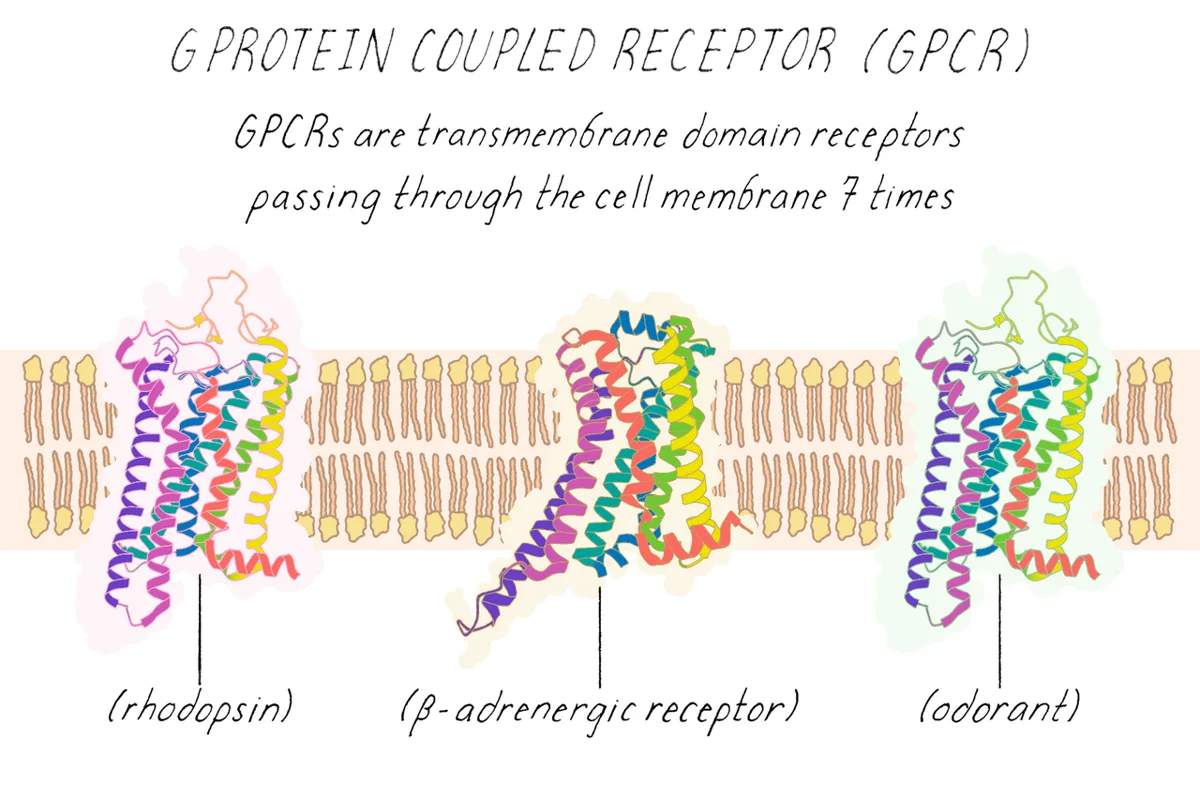
受容体に結合すると三量体Gタンパク質の α サブユニットが GDP を GTP に持ち替えて働く。α の種類で行き先が変わる。
- Gs——アデニル酸シクラーゼを活性化 → cAMP↑ → プロテインキナーゼA
- Gi——アデニル酸シクラーゼを抑制 → cAMP↓
- Gq——ホスホリパーゼC → IP3(カルシウム放出)+ DAG(プロテインキナーゼC)
受容体の対応。β1・β2・V2・H2・グルカゴン=Gs/α2・M2・オピオイド=Gi/α1・M1・M3・V1=Gq。
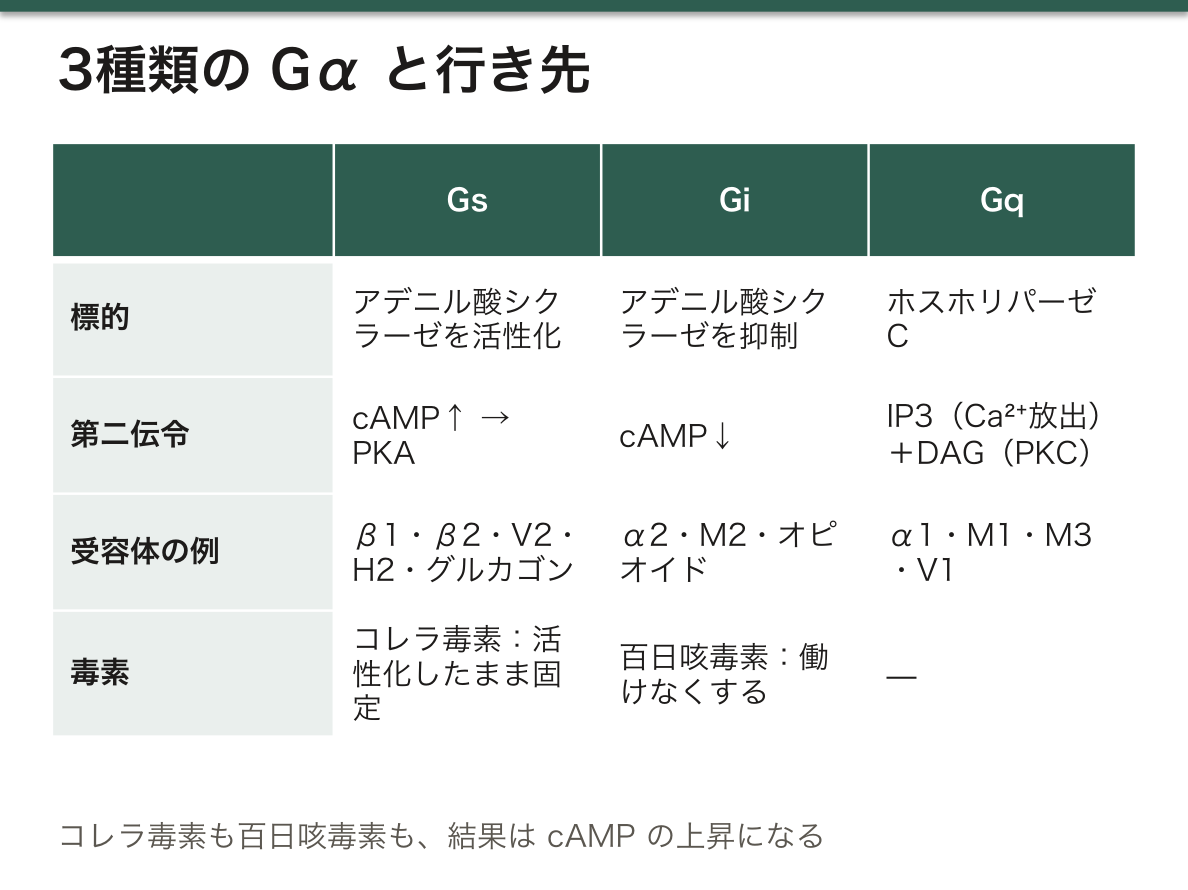
受容体の名前ではなく、繋がっている α で考えると薬の作用が予測できる。
- β2刺激薬(Gs → cAMP↑)——気管支平滑筋を弛緩。平滑筋では cAMP が弛緩、心筋では収縮という一見矛盾も、下流の標的が違うだけで説明がつく
- α1刺激薬(Gq → カルシウム↑)——血管平滑筋を収縮。昇圧薬
- M2(Gi)——心拍数を下げる。だからアトロピン(M遮断)で頻脈になる
細菌毒素がこの系を壊すことで、病態が説明できる。
- コレラ毒素——Gs を活性化したまま固定する(GTP を分解できなくする)。腸管上皮で cAMP が上がりっぱなしになり、塩素イオンと水が出続けて米のとぎ汁様の下痢になる
- 百日咳毒素——Gi を働けなくする。抑制が外れるので、やはり cAMP が上がる
「毒素が cAMP を上げる」という一点から、下痢の性状も治療(経口補水)も導ける——腸粘膜自体は壊れていないので、ナトリウム・グルコース共輸送体は生きており、糖と塩を一緒に与えれば水が吸収できる。経口補水液に糖が入っている理由がここにある。
English version
Core
On binding, the α subunit of the trimeric G protein exchanges GDP for GTP and acts. The kind of α decides the destination.
- Gs — activates adenylate cyclase → cAMP↑ → protein kinase A.
- Gi — inhibits adenylate cyclase → cAMP↓.
- Gq — phospholipase C → IP3 (release of calcium) + DAG (protein kinase C).
The receptors: β1, β2, V2, H2, glucagon = Gs / α2, M2, opioid = Gi / α1, M1, M3, V1 = Gq.
Going further
Think in terms of the α it is coupled to rather than the name of the receptor, and the action of a drug can be predicted.
- β2 agonists (Gs → cAMP↑) — relax bronchial smooth muscle. The apparent contradiction that cAMP relaxes smooth muscle but strengthens cardiac contraction is explained simply by a different downstream target.
- α1 agonists (Gq → Ca²⁺↑) — constrict vascular smooth muscle. Vasopressors.
- M2 (Gi) — lowers the heart rate. Hence atropine (M blockade) causes tachycardia.
Bacterial toxins destroy this system, and the pathology follows.
- Cholera toxin — fixes Gs in the activated state (it cannot hydrolyse GTP). cAMP stays high in the intestinal epithelium and chloride and water pour out, giving rice-water diarrhoea.
- Pertussis toxin — prevents Gi from working. The inhibition is released, so again cAMP rises.
From the single point that the toxin raises cAMP, both the character of the diarrhoea and the treatment (oral rehydration) follow — the mucosa itself is not destroyed, so the sodium–glucose cotransporter still works, and giving sugar with salt allows water to be absorbed. Here is why oral rehydration solution contains sugar.
チロシンキナーゼ型受容体 — 増殖のスイッチと癌
リガンドが結合すると受容体が二量体になり、互いをリン酸化して働き出す。
- インスリン受容体——IRS を介して PI3K → Akt。GLUT4 を細胞膜へ移動させる
- 増殖因子受容体(EGFR・HER2 など)——RAS → RAF → MEK → ERK の経路で増殖へ
この経路の部品が活性化型の変異を起こすと、リガンドが無くてもスイッチが入りっぱなしになる。それが多くの癌の駆動因子である。
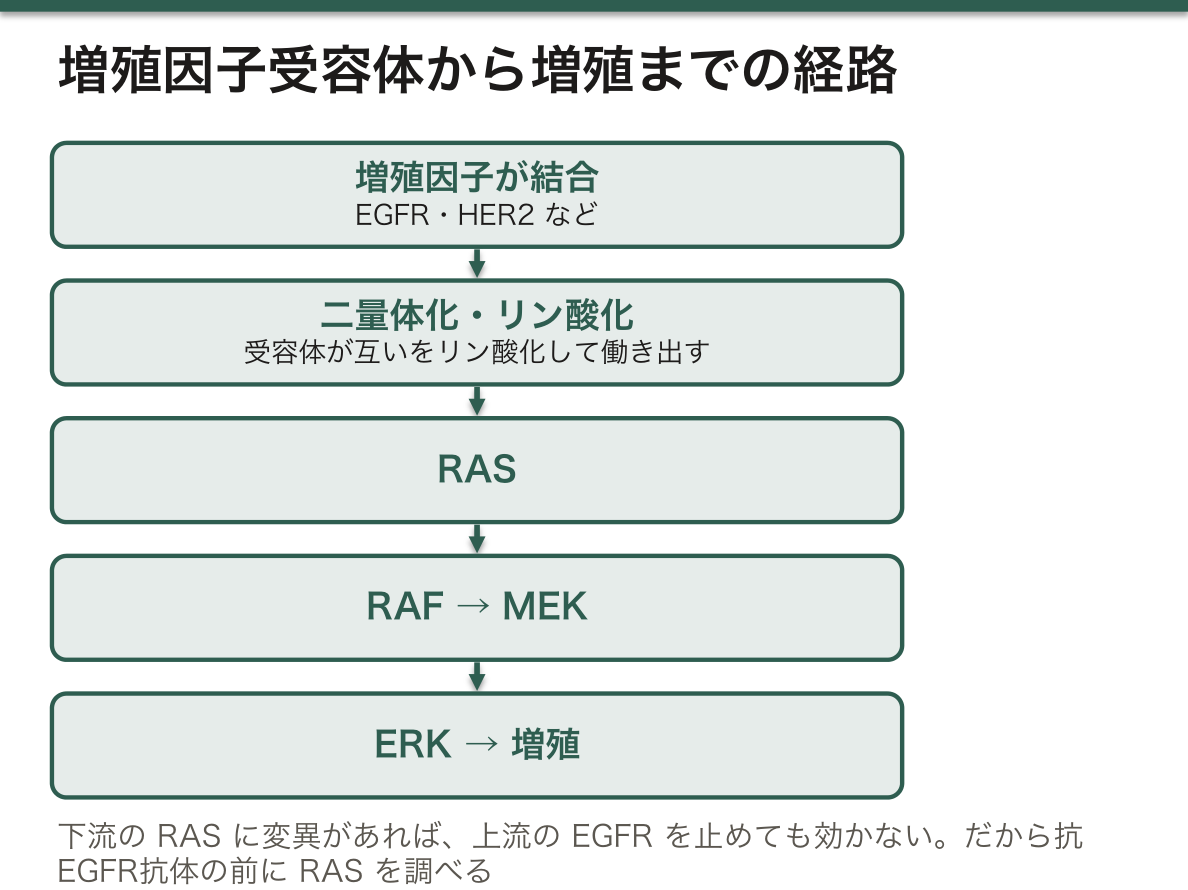
経路のどこが壊れているかで、効く薬が決まる。これが分子標的治療の考え方そのものである。
- EGFR 変異の肺癌 → EGFR阻害薬(ゲフィチニブなど)
- HER2 陽性の乳癌・胃癌 → トラスツズマブ
- BCR-ABL(フィラデルフィア染色体)の慢性骨髄性白血病 → イマチニブ。転座で作られた融合蛋白が常に活性のあるキナーゼになっている
- BRAF V600E の悪性黒色腫 → BRAF阻害薬
ここで重要なのが「経路の下流に別の変異があれば、上流を止めても無駄」という原則である。大腸癌で RAS 変異があると、その上流の EGFR を阻害しても効かない——スイッチが受容体より下で入っているためである。だから抗EGFR抗体を使う前に RAS を調べる。経路図を知っていることが、そのまま検査の順序になる。
English version
Core
On binding the ligand the receptor dimerises, the two halves phosphorylate each other and it begins to work.
- Insulin receptor — through IRS to PI3K → Akt. Moves GLUT4 to the cell membrane.
- Growth factor receptors (EGFR, HER2) — through RAS → RAF → MEK → ERK to proliferation.
When a component of this pathway acquires an activating mutation, the switch stays on with no ligand at all. That is the driver of many cancers.
Going further
Where the pathway is broken decides which drug works — this is molecular targeted therapy itself.
- EGFR-mutant lung cancer → EGFR inhibitors (gefitinib and others).
- HER2-positive breast and gastric cancer → trastuzumab.
- BCR-ABL (the Philadelphia chromosome) chronic myeloid leukaemia → imatinib. The fusion protein made by the translocation is a constitutively active kinase.
- BRAF V600E melanoma → BRAF inhibitors.
The important principle here is that if there is another mutation downstream, blocking upstream is useless. In colorectal cancer with a RAS mutation, inhibiting EGFR above it does not work — the switch is on below the receptor. So RAS is tested before an anti-EGFR antibody is used. Knowing the map of the pathway is itself the order of the investigations.
核内受容体 — 遅く効いて、長く残る
脂溶性のリガンド(ステロイド・甲状腺ホルモン・ビタミンD・レチノイン酸)は細胞膜を通り抜けて、細胞質または核内の受容体に結合する。
受容体は転写因子で、DNA の応答配列に結合して遺伝子の転写を変える。
だから作用には蛋白合成の時間が要る。
- 効き始めるまで数時間
- 効果は数日〜数週間続く
脂溶性なので血中では結合蛋白に運ばれ、遊離型だけが働く。
「遅い」ことが、そのまま臨床判断になる。
- アナフィラキシーにステロイドは第一選択にならない——効き始めるまでに数時間かかるため。まずアドレナリン(GPCR を介して秒で効く)。ステロイドは二相性反応の予防として後から意味を持つ
- 甲状腺クリーゼで抗甲状腺薬だけでは間に合わない——すでに作られてコロイドに貯蔵されているホルモンには効かないので、ヨウ素で放出を止め、β遮断薬で末梢の作用を抑える
結合蛋白の量が変わると、総量と遊離型が乖離するのも実務的に重要である。妊娠やエストロゲン製剤で甲状腺ホルモン結合グロブリンが増えると、総T4は上がるが遊離T4は正常で、甲状腺機能は変わっていない。だから測るのは遊離型である。
核内受容体はステロイドの副作用の説明にもなる。糖質コルチコイド受容体は全身のほぼ全細胞にあるので、抗炎症だけを取り出すことができない。高血糖・骨粗鬆症・易感染性・筋萎縮・満月様顔貌は、別の副作用ではなく、同じ受容体が別の臓器で働いた結果である。
English version
Core
Lipid-soluble ligands (steroids, thyroid hormone, vitamin D, retinoic acid) pass through the cell membrane and bind receptors in the cytosol or the nucleus. The receptor is a transcription factor and binds a response element in the DNA to change transcription.
So the action requires the time of protein synthesis.
- Hours before it begins to work.
- The effect lasts days to weeks.
Being lipid-soluble they are carried in the blood on binding proteins, and only the free fraction acts.
Going further
Being slow is itself a clinical judgement.
- A steroid is not first-line in anaphylaxis — it takes hours to begin working. Adrenaline first (acting in seconds through a GPCR). The steroid has its meaning later, in preventing the biphasic reaction.
- In thyroid storm an antithyroid drug alone is too slow — it does nothing to the hormone already made and stored in the colloid, so iodine is given to stop the release and a beta blocker to suppress the peripheral action.
That a change in the binding protein separates the total from the free is important in practice. Pregnancy and oestrogen raise thyroxine-binding globulin, so the total T4 rises while the free T4 is normal and thyroid function is unchanged. Hence it is the free fraction that is measured.
Nuclear receptors also explain the adverse effects of steroids. The glucocorticoid receptor is in almost every cell of the body, so the anti-inflammatory effect cannot be extracted alone. Hyperglycaemia, osteoporosis, susceptibility to infection, muscle wasting and the moon face are not separate side effects but the result of the same receptor acting in different organs.
イオンチャネル型受容体 — 最も速い信号は、第二伝令を持たない
受容体そのものがイオンチャネルになっている型。リガンドが結合した瞬間に開くので、応答はミリ秒で起こる。
| 受容体 | 通すイオン | 向き | 薬・毒 |
|---|---|---|---|
| ニコチン性アセチルコリン受容体 | Na⁺・K⁺ | 興奮 | 筋弛緩薬・重症筋無力症の自己抗体 |
| GABA-A | Cl⁻ | 抑制 | ベンゾジアゼピン・バルビツール酸 |
| グリシン受容体 | Cl⁻ | 抑制 | ストリキニーネ・破傷風毒素 |
| NMDA・AMPA | Na⁺・Ca²⁺ | 興奮 | ケタミン・メマンチン |
他の2型(Gタンパク質共役型・酵素連結型)と違い、増幅が無い——だから速いが、少量のリガンドでは大きな応答にならない。
「速さと増幅は取引の関係にある」という一点で、3つの型の使い分けが説明できる。
| 型 | 速さ | 増幅 | 使われる場面 |
|---|---|---|---|
| イオンチャネル型 | ミリ秒 | 無い | 神経伝達・筋収縮 |
| Gタンパク質共役型 | 秒 | 大きい | ホルモン・感覚 |
| 核内受容体 | 時間〜日 | — | ステロイド・甲状腺ホルモン |
(この章の核内受容体の項)——「反応の速さの違いが、そのまま薬の効き始めの違いになる」。
だからステロイドは急性期にすぐ効かない(呼吸器の薬の章)——「喘息発作にはまず β刺激薬を吸わせ、ステロイドは数時間後を狙って同時に入れる」。
抑制性のチャネルが Cl⁻ を通すことは、新生児で例外になる(新生児の章)——「未熟な神経では細胞内 Cl⁻ が高く、GABA が興奮性に働きうる」。
破傷風毒素は、抑制性の伝達を止めることで強直を起こす(嫌気性菌の章)——「筋を興奮させているのではなく、ブレーキを外している」。
English version
Core
The type in which the receptor is itself an ion channel. It opens the moment the ligand binds, so the response occurs in milliseconds.
| Receptor | Ion | Effect | Drugs and toxins |
|---|---|---|---|
| Nicotinic acetylcholine | Na⁺, K⁺ | Excitatory | Muscle relaxants; the autoantibody of myasthenia gravis |
| GABA-A | Cl⁻ | Inhibitory | Benzodiazepines, barbiturates |
| Glycine | Cl⁻ | Inhibitory | Strychnine, tetanus toxin |
| NMDA, AMPA | Na⁺, Ca²⁺ | Excitatory | Ketamine, memantine |
Unlike the other two types there is no amplification — so it is fast, but a small amount of ligand does not give a large response.
Going further
The single point that speed and amplification are traded against each other explains the division of labour among the three types.
| Type | Speed | Amplification | Where used |
|---|---|---|---|
| Ion channel | Milliseconds | None | Neurotransmission, muscle contraction |
| G protein-coupled | Seconds | Large | Hormones, the senses |
| Nuclear receptor | Hours to days | — | Steroids, thyroid hormone |
The difference in the speed of response is directly the difference in how quickly a drug begins to work. So a steroid does not act at once in the acute phase — in an asthma attack, give the β agonist by inhalation first and put the steroid in at the same time aiming at some hours later.
That the inhibitory channels pass Cl⁻ has an exception in the newborn — in immature neurones the intracellular Cl⁻ is high and GABA can act as excitatory.
Tetanus toxin causes rigidity by stopping inhibitory transmission — it does not excite the muscle; it removes the brake.
信号の終わらせ方 — 止める仕組みが壊れると、病気になる
信号は、始めるのと同じくらい確実に止められなければならない。止め方は4つある。
| 止め方 | 実体 | 例 |
|---|---|---|
| ①伝達物質を壊す・回収する | 分解酵素・トランスポーター | アセチルコリンエステラーゼ・モノアミン再取り込み |
| ②第二伝令を壊す | ホスホジエステラーゼ | cAMP・cGMP の分解 |
| ③リン酸化を外す | ホスファターゼ | PTEN・SHP-1 |
| ④受容体を減らす | 脱感作・内在化・分解 | βアレスチン・SOCS |
Gタンパク質自身も、GTP を GDP に分解して自分を止める(内在性 GTPase 活性)。
「止める仕組みが壊れると、信号が入りっぱなしになる」という形の病気が、いくつもある。
| 壊れる場所 | 起きること |
|---|---|
| Ras の GTPase 活性 | 癌遺伝子として働き続ける |
| PTEN(ホスファターゼ) | PI3K 経路が止まらない。癌抑制遺伝子として働く |
| コレラ毒素(Gs を止められなくする) | cAMP が上がり続け、腸管へ水が出続ける |
| 百日咳毒素(Gi を働かせなくする) | cAMP が上がる |
(細菌の武器の章)——「毒素の多くは、信号を入れるのではなく、切れなくしている」。
②を薬として使うのが、ホスホジエステラーゼ阻害薬になる(循環作動薬の章)——「PDE3 は心筋と血管、PDE4 は炎症細胞、PDE5 は陰茎と肺血管。型が臓器を選んでいる」。
①を止めるのが、コリンエステラーゼ阻害薬と抗うつ薬になる(向精神薬の章)——「回収を止めることは、放出を増やすのと同じ効果になる」。
有機リン中毒は、その極端な形になる(中毒の章)——「不可逆に酵素が塞がれるので、プラリドキシムで早期に外す必要がある」。
English version
Core
A signal must be stopped as reliably as it is started. There are four ways.
| Way | What does it | Examples |
|---|---|---|
| ① Destroy or recover the transmitter | Degrading enzymes, transporters | Acetylcholinesterase; monoamine reuptake |
| ② Destroy the second messenger | Phosphodiesterase | Breakdown of cAMP and cGMP |
| ③ Remove the phosphate | Phosphatases | PTEN, SHP-1 |
| ④ Reduce the receptors | Desensitisation, internalisation, degradation | β-arrestin, SOCS |
The G protein stops itself too, by hydrolysing GTP to GDP (its intrinsic GTPase activity).
Going further
There are several diseases of the form "the mechanism for stopping is broken and the signal stays on".
| What is broken | What happens |
|---|---|
| The GTPase activity of Ras | It goes on working as an oncogene |
| PTEN (a phosphatase) | The PI3K pathway will not stop. It works as a tumour suppressor |
| Cholera toxin (Gs cannot be stopped) | cAMP goes on rising and water pours into the gut |
| Pertussis toxin (Gi cannot work) | cAMP rises |
Most toxins do not switch the signal on; they stop it being switched off.
Using ② as a drug gives the phosphodiesterase inhibitors — PDE3 in heart and vessels, PDE4 in inflammatory cells, PDE5 in the penis and the pulmonary vessels. The isoform selects the organ.
Stopping ① gives the cholinesterase inhibitors and the antidepressants — blocking recovery has the same effect as increasing release.
Organophosphate poisoning is the extreme form — the enzyme is blocked irreversibly, so pralidoxime must be given early to remove it.
まとめ
| Gタンパク質共役型受容体 — 3種類のαと、そこに効く薬 | 受容体に結合すると三量体Gタンパク質の α サブユニットが GDP を GTP に持ち替えて働く。 |
|---|---|
| チロシンキナーゼ型受容体 — 増殖のスイッチと癌 | リガンドが結合すると受容体が二量体になり、互いをリン酸化して働き出す。 |
| 核内受容体 — 遅く効いて、長く残る | 脂溶性のリガンド(ステロイド・甲状腺ホルモン・ビタミンD・レチノイン酸)は細胞膜を通り抜けて、細胞質または核内の受容体に結合する。 |
| イオンチャネル型受容体 — 最も速い信号は、第二伝令を持たない | 受容体そのものがイオンチャネルになっている型。 |
| 信号の終わらせ方 — 止める仕組みが壊れると、病気になる | 信号は、始めるのと同じくらい確実に止められなければならない。 |
このノートは医学生が授業の内容を自分の言葉でまとめたもので、診療の判断に使うものではありません。誤りに気づいたらお知らせください。