インスリン抵抗性は「インスリンが効かない状態」と説明されるが、受容体そのものの異常はごく稀である。ほとんどは受容体より下流の、しかも特定の枝だけが鈍る。
この選択的な抵抗性が、2型糖尿病でしばしば高血糖と高中性脂肪血症が併存する理由になっている。経路を分けて見ないと説明できない現象である。
- 受容体から糖輸送体まで — 経路をたどる
- インスリン分泌の仕組みと、そこに効く薬
- インクレチン — 食べたことを、腸が先に知らせている
- C-ペプチド — 自分のインスリンか、外から入れたものかを分ける
- 受容体そのものが壊れると、極端なインスリン抵抗性になる
- インスリン製剤は、分子の会合を操作して作られている
受容体から糖輸送体まで — 経路をたどる
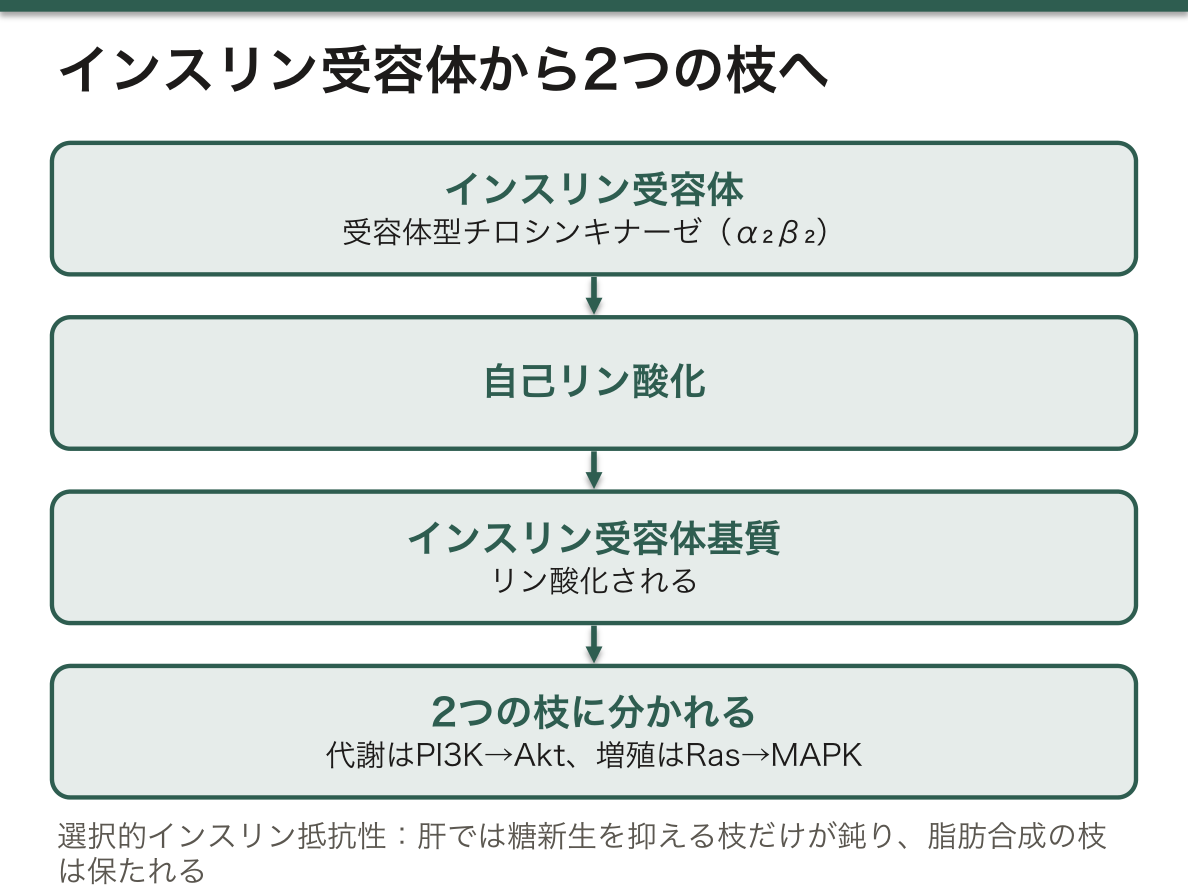
- インスリン受容体(受容体型チロシンキナーゼ、α₂β₂の四量体)に結合
- 自己リン酸化 → インスリン受容体基質をリン酸化
- ここから2つの枝に分かれる
| 枝 | 経路 | 担当 |
|---|---|---|
| 代謝の枝 | PI3K → Akt | GLUT4を膜へ移動・グリコーゲン合成・脂肪合成・糖新生の抑制 |
| 増殖の枝 | Ras → MAPK | 細胞増殖・遺伝子発現 |
| 糖輸送体 | 場所 | 特徴 |
|---|---|---|
| GLUT4 | 骨格筋・脂肪 | インスリン依存性 |
| GLUT2 | 肝・膵β細胞・小腸・腎 | 低親和性。血糖センサー |
| GLUT1 | 赤血球・脳・胎盤 | 常時発現 |
| GLUT3 | 神経 | 高親和性 |
運動がインスリン非依存的に血糖を下げるのは、筋収縮そのものがGLUT4を膜へ移動させる別経路(AMP活性化プロテインキナーゼ経由)を持つためである。だから1型糖尿病でも運動で血糖が下がるし、運動後は低血糖に注意する必要がある。「インスリンが無くても糖を取り込ませる道がある」という事実は、療養指導の根拠になる。
選択的インスリン抵抗性が、代謝症候群の中心的な逆説を説明する。肝では、糖新生を抑える枝だけが鈍り、脂肪合成を促す枝は保たれる。
- 糖新生が止まらない → 高血糖
- 脂肪合成は進む → 高中性脂肪血症・脂肪肝
「インスリンが効いていないのに、脂肪だけは作られる」——同じホルモンの下流が枝ごとに別の感受性を持つからこそ起きる。
抵抗性を生む分子的な原因も特定されつつある。遊離脂肪酸とその代謝物(ジアシルグリセロール・セラミド)が、インスリン受容体基質をセリン残基でリン酸化する。本来のチロシンリン酸化とは別の場所で、しかも信号を止める向きに働く。炎症性サイトカイン(腫瘍壊死因子α)も同じことをする——肥満が「慢性の低度炎症」と呼ばれる根拠である。
異所性脂肪という言葉もここに繋がる。皮下に収まりきらない脂肪が肝・筋・膵に沈着すると、その臓器でインスリン抵抗性が生じる。体重より、どこに付いているかが問題になる。
English version
Core
- It binds the insulin receptor (a receptor tyrosine kinase, an α₂β₂ tetramer).
- Autophosphorylation → phosphorylates insulin receptor substrate.
- From here it divides into two branches.
| Branch | Pathway | What it does |
|---|---|---|
| The metabolic branch | PI3K → Akt | Moves GLUT4 to the membrane, glycogen synthesis, lipogenesis, suppression of gluconeogenesis |
| The proliferative branch | Ras → MAPK | Cell proliferation, gene expression |
| Glucose transporter | Location | Features |
|---|---|---|
| GLUT4 | Skeletal muscle, fat | Insulin-dependent |
| GLUT2 | Liver, pancreatic β cell, small intestine, kidney | Low affinity. The glucose sensor |
| GLUT1 | Red cell, brain, placenta | Constitutive |
| GLUT3 | Neurons | High affinity |
Going further
That exercise lowers the blood glucose independently of insulin is because muscle contraction itself has another route (through AMP-activated protein kinase) that moves GLUT4 to the membrane. So the blood glucose falls with exercise even in type 1 diabetes, and one must watch for hypoglycaemia after exercise. The fact that there is a route to take up glucose without insulin is the ground of the advice given to patients.
Selective insulin resistance explains the central paradox of the metabolic syndrome. In the liver, only the branch suppressing gluconeogenesis is blunted while the branch promoting lipogenesis is preserved.
- Gluconeogenesis does not stop → hyperglycaemia.
- Lipogenesis proceeds → hypertriglyceridaemia and fatty liver.
"Insulin is not working and fat alone is being made" — it happens precisely because the branches downstream of one hormone have different sensitivities.
The molecular causes of resistance are also being identified. Free fatty acids and their metabolites (diacylglycerol, ceramide) phosphorylate insulin receptor substrate on serine residues. At a place other than the proper tyrosine phosphorylation, and in the direction of stopping the signal. Inflammatory cytokines (tumour necrosis factor α) do the same — the ground for calling obesity "chronic low-grade inflammation".
The term ectopic fat connects here. When fat that will not fit subcutaneously is deposited in liver, muscle and pancreas, insulin resistance arises in that organ. Where it sits matters more than the body weight.
インスリン分泌の仕組みと、そこに効く薬
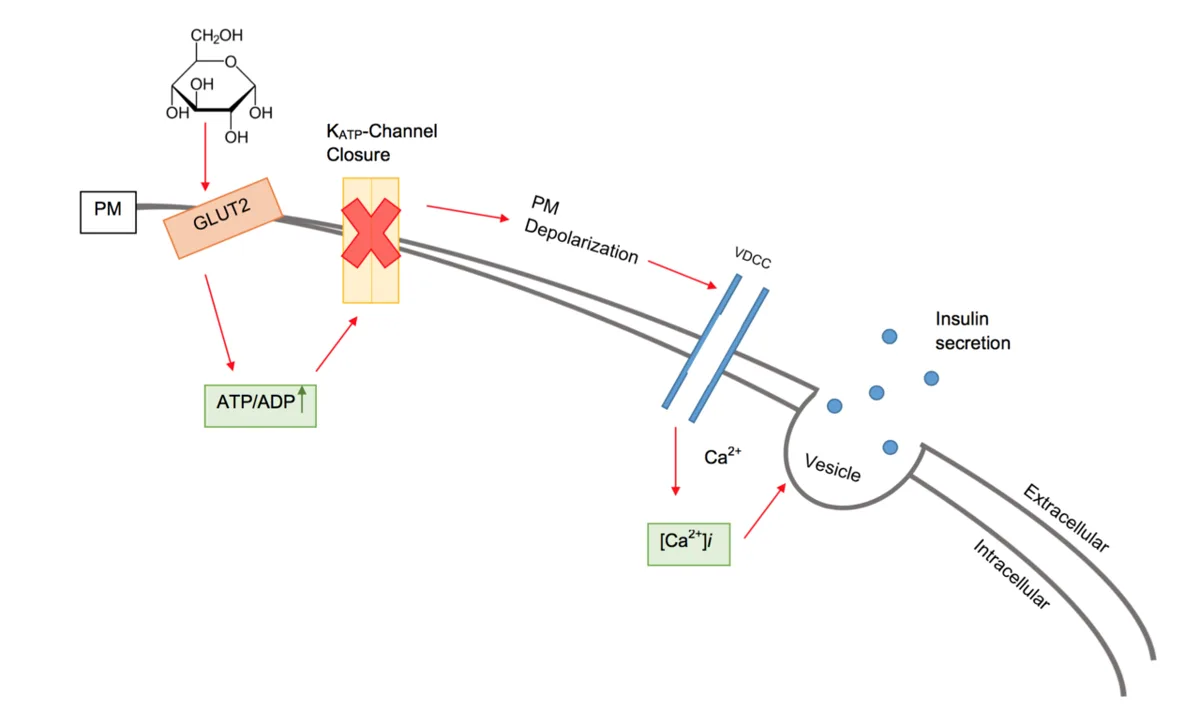
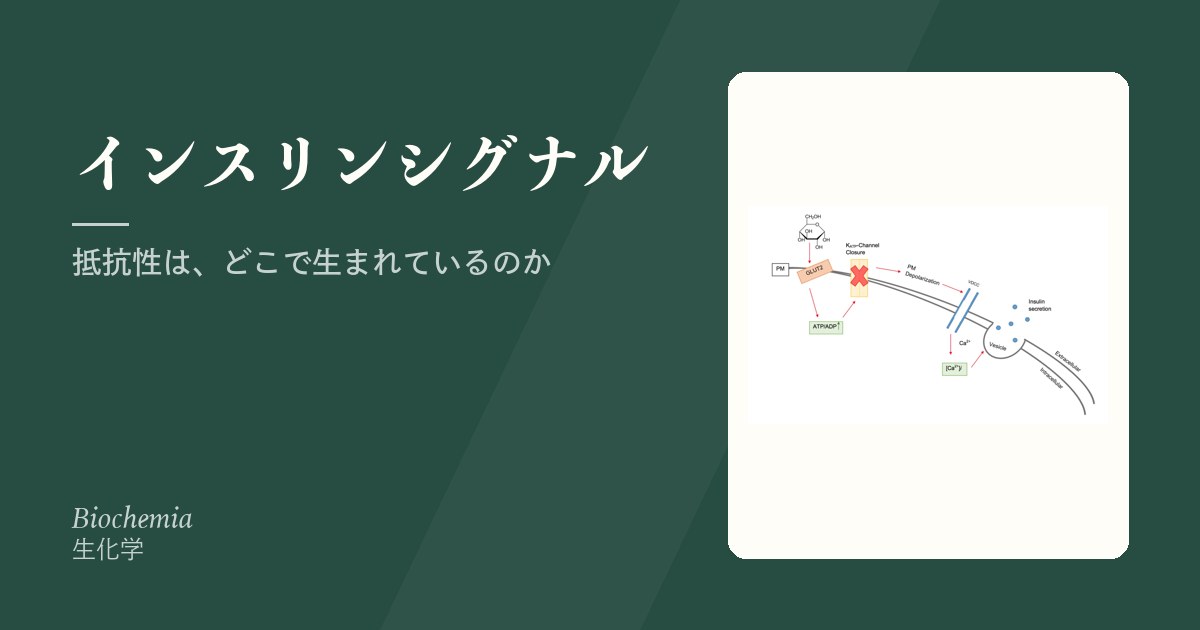
膵β細胞の分泌は、電気的な出来事である。
- グルコースがGLUT2で入る
- グルコキナーゼがリン酸化(ここが血糖センサー)
- 代謝が進みATP/ADP比が上がる
- ATP感受性K⁺チャネルが閉じる → 脱分極
- 電位依存性Ca²⁺チャネルが開く → Ca²⁺流入 → インスリン顆粒の開口分泌
| 薬 | 作用点 | 低血糖の危険 |
|---|---|---|
| スルホニル尿素薬 | ATP感受性K⁺チャネルを閉じる | あり(血糖と無関係に出させる) |
| グリニド薬 | 同じチャネル(速く短く) | あり |
| DPP-4阻害薬・GLP-1受容体作動薬 | インクレチン作用を強める | 単独では少ない(血糖依存性) |
| ジアゾキシド | チャネルを開く | —(高血糖にする) |
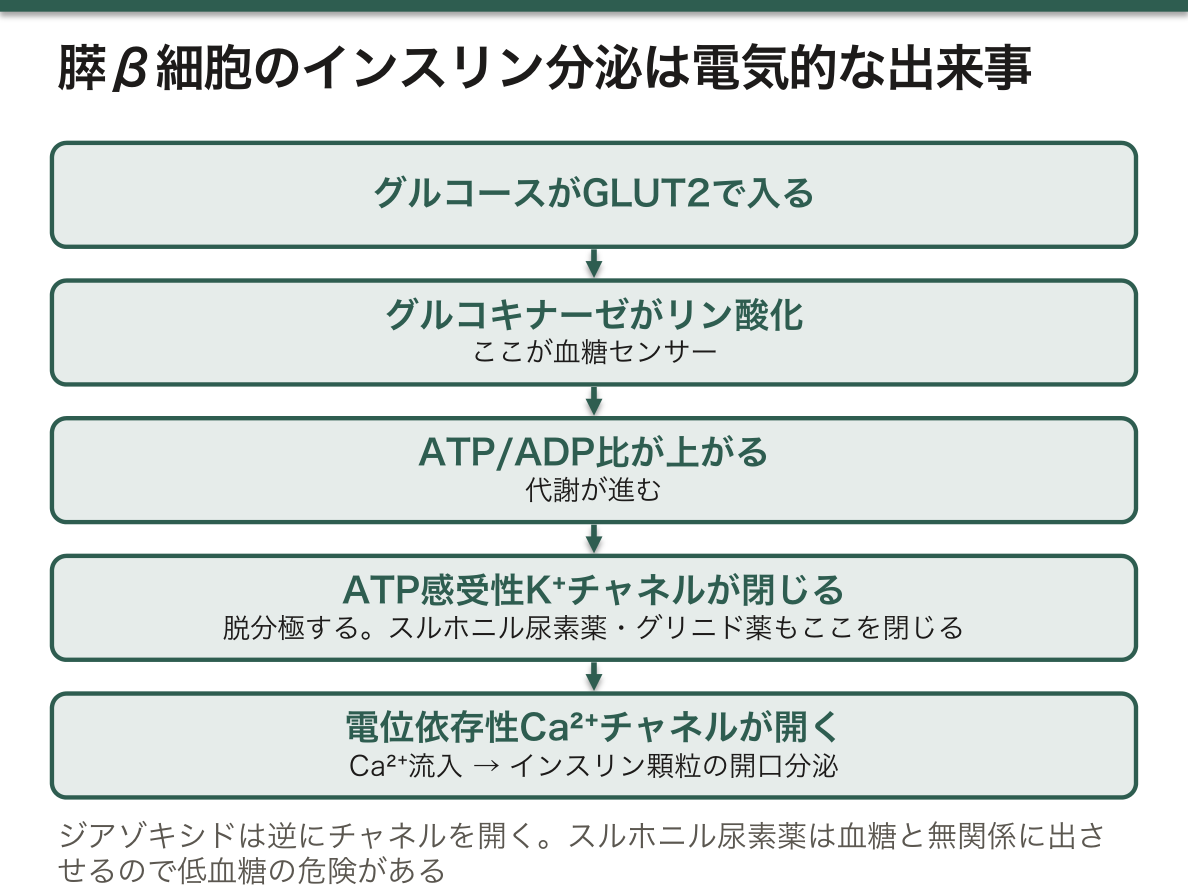
スルホニル尿素薬の低血糖が遷延するのは、血糖が低くてもチャネルを閉じ続けるからである。ブドウ糖を投与すると、かえってインスリン分泌が刺激されて低血糖が再燃する。だから治療は持続点滴と長時間の観察が必要で、意識が戻ったからといって帰宅させられない。高齢者・腎機能低下例では特に危険である。
インクレチン——GLP-1とGIP——は、同じ量のブドウ糖でも、静注より経口のほうがインスリンがよく出るという現象(インクレチン効果)の正体である。腸が「これから糖が来る」と先に知らせている。
- 血糖依存性に働くので、単独では低血糖を起こしにくい
- GLP-1はグルカゴンも抑え、胃排出を遅らせ、満腹感を与える——だから体重が減る
- DPP-4がGLP-1を数分で分解するので、阻害するか、分解されにくい類似体を使う
新生児高インスリン血症性低血糖症は、この経路の裏返しである。ATP感受性K⁺チャネル(SUR1・Kir6.2)の機能喪失変異でチャネルが閉じっぱなしになり、インスリンが出続ける。治療にジアゾキシド(チャネルを開く薬)を使う——スルホニル尿素薬とちょうど逆の作用である。
同じチャネルの機能獲得変異は、新生児糖尿病を起こす。この場合はインスリン注射ではなくスルホニル尿素薬が著効する——遺伝子診断が治療を変える実例として、繰り返し引用される。
English version
Core
Secretion by the pancreatic β cell is an electrical event.
- Glucose enters through GLUT2.
- Glucokinase phosphorylates it (this is the glucose sensor).
- Metabolism proceeds and the ATP/ADP ratio rises.
- The ATP-sensitive K⁺ channel closes → depolarisation.
- Voltage-gated Ca²⁺ channels open → Ca²⁺ enters → exocytosis of the insulin granules.
| Drug | Point of action | Risk of hypoglycaemia |
|---|---|---|
| Sulphonylureas | Close the ATP-sensitive K⁺ channel | Yes (secretion regardless of the blood glucose) |
| Glinides | The same channel (fast and short) | Yes |
| DPP-4 inhibitors, GLP-1 receptor agonists | Strengthen the incretin effect | Little when used alone (glucose-dependent) |
| Diazoxide | Opens the channel | — (it raises the blood glucose) |
Going further
Hypoglycaemia from a sulphonylurea is prolonged because it goes on closing the channel even when the blood glucose is low. Give glucose and insulin secretion is stimulated instead, and the hypoglycaemia returns. So the treatment needs a continuous infusion and long observation, and the patient cannot be sent home merely because consciousness has returned. Especially dangerous in the elderly and in reduced renal function.
The incretins — GLP-1 and GIP — are the substance of the phenomenon that the same amount of glucose releases more insulin by mouth than intravenously (the incretin effect). The gut announces in advance that sugar is coming.
- They act glucose-dependently, so alone they rarely cause hypoglycaemia.
- GLP-1 also suppresses glucagon, delays gastric emptying and gives satiety — hence weight falls.
- DPP-4 degrades GLP-1 within minutes, so one inhibits it or uses an analogue resistant to degradation.
Congenital hyperinsulinaemic hypoglycaemia is the inverse of this pathway. A loss-of-function mutation of the ATP-sensitive K⁺ channel (SUR1, Kir6.2) leaves the channel permanently closed and insulin is released continuously. Diazoxide (a drug that opens the channel) is used in treatment — exactly the reverse of a sulphonylurea.
A gain-of-function mutation of the same channel causes neonatal diabetes. There, a sulphonylurea rather than insulin works strikingly — cited again and again as an instance in which a genetic diagnosis changes the treatment.
インクレチン — 食べたことを、腸が先に知らせている
同じ量のブドウ糖でも、経口のほうが静脈内より多くインスリンが出る(インクレチン効果)。インスリン分泌の 50〜70% を占める。
| GLP-1 | GIP | |
|---|---|---|
| 出る細胞 | 回腸・大腸の L細胞 | 十二指腸・空腸の K細胞 |
| インスリン分泌 | 促す | 促す |
| グルカゴン | 抑える | 抑えない(むしろ促す) |
| 胃排出 | 遅らせる | — |
| 食欲 | 抑える | — |
どちらも DPP-4 によって数分で分解される。
作用は血糖依存性——血糖が高いときだけインスリンを出させる。
「血糖依存性である」という一点が、この系の薬の安全性を作っている。低血糖のときは働かないので、単独では低血糖を起こしにくい(糖尿病の各論の章)——「スルホニル尿素薬との最大の違いになる」。
薬は2通りの作り方になる。①分解されにくい GLP-1 受容体作動薬を入れる ②DPP-4 を止めて、自前の GLP-1 を長持ちさせる(糖尿病の薬の章)——「入れるか、壊させないかという構図が、ここでも出てくる」。
胃排出を遅らせ食欲を抑える作用が、体重減少をもたらす(脂肪組織の内分泌の項)——「肥満症の治療としても承認されるようになった」。
副作用は、この作用の延長として現れる——「悪心・嘔吐・胃排出遅延。麻酔の前に誤嚥の危険として問題になる」。
肥満手術(減量手術)の効果の一部も、インクレチンで説明される(消化器外科の章)——「食物が速く遠位腸へ届くので、L細胞が強く刺激される」。
English version
Core
The same amount of glucose releases more insulin by mouth than intravenously (the incretin effect). It accounts for 50–70 per cent of insulin secretion.
| GLP-1 | GIP | |
|---|---|---|
| Cell of origin | L cells of the ileum and colon | K cells of the duodenum and jejunum |
| Insulin secretion | Promotes | Promotes |
| Glucagon | Suppresses | Does not suppress (rather promotes) |
| Gastric emptying | Delays | — |
| Appetite | Suppresses | — |
Both are degraded within minutes by DPP-4.
The action is glucose-dependent — insulin is released only when the blood glucose is high.
Going further
- The single point of being glucose-dependent is what makes the drugs of this system safe. They do not work when the blood glucose is low, so alone they rarely cause hypoglycaemia (the chapter on the particulars of diabetes) — the greatest difference from a sulphonylurea.
- The drugs are built in two ways. ① Put in a GLP-1 receptor agonist resistant to degradation ② stop DPP-4 and make one’s own GLP-1 last (the chapter on the drugs for diabetes) — the structure of "put it in or prevent its destruction" appearing here too.
- Delaying gastric emptying and suppressing appetite brings weight loss (the section on the endocrinology of adipose tissue) — they have come to be approved as treatments for obesity too.
- The adverse effects appear as extensions of the same action — nausea, vomiting, delayed gastric emptying. It becomes a problem as a risk of aspiration before anaesthesia.
- Part of the effect of bariatric surgery is explained by the incretins (the chapter on gastrointestinal surgery) — food reaches the distal gut sooner, so the L cells are strongly stimulated.
C-ペプチド — 自分のインスリンか、外から入れたものかを分ける
インスリンは、プレプロインスリン → プロインスリン → インスリン + C-ペプチド と加工される。分泌顆粒の中で切られ、等モルで一緒に放出される。
| インスリン | C-ペプチド | |
|---|---|---|
| 肝での初回通過 | 約半分が分解される | ほとんど分解されない |
| 半減期 | 約5分 | 約30分 |
| 排泄 | 肝・腎 | 主に腎 |
| 外因性インスリンで | 上がる | 上がらない(むしろ抑制される) |
だから内因性のインスリン分泌能を見るには、C-ペプチドを測る。
尿中C-ペプチド排泄量や、空腹時血中C-ペプチド指数(CPI)が使われる。
「肝を通っても壊れない」という性質が、この分子を指標として役立たせている。末梢で測った値が、膵から出た量をよく反映する(初回通過効果の項)——「測りたいものが測れないとき、一緒に出るものを測る」。
低血糖の鑑別で、決定的な役割を果たす。
| インスリン | C-ペプチド | 読み方 |
|---|---|---|
| 高い | 高い | インスリノーマ・スルホニル尿素薬 |
| 高い | 低い | インスリンの外部投与(詐病・事故・自殺企図) |
| 低い | 低い | その他の低血糖 |
(低血糖の章)——「1組の検査が、法医学的な意味を持つことがある」。
スルホニル尿素薬と区別するには、薬物血中濃度を測る(中毒の章)——「どちらも内因性の分泌を増やすので、C-ペプチドだけでは分けられない」。
1型糖尿病では C-ペプチドが枯れていく(糖尿病の型の章)——「インスリン療法が絶対に必要かどうかの判断材料になる」。
腎不全では C-ペプチドが蓄積するので、高く出る(腎機能の章)——「分泌能を過大評価しないよう、腎機能と合わせて読む」。
English version
Core
Insulin is processed preproinsulin → proinsulin → insulin + C-peptide. It is cleaved within the secretory granule and released together, equimolar.
| Insulin | C-peptide | |
|---|---|---|
| First pass in the liver | About half is degraded | Scarcely degraded |
| Half-life | About 5 minutes | About 30 minutes |
| Excretion | Liver and kidney | Chiefly kidney |
| With exogenous insulin | Rises | Does not rise (it is suppressed) |
So to assess endogenous insulin secretion, measure C-peptide.
Urinary C-peptide excretion and the fasting C-peptide index (CPI) are used.
Going further
- The property of not being destroyed on passing through the liver is what makes this molecule useful as an index. A value measured in the periphery reflects well the amount released by the pancreas (the section on first-pass effect) — when what one wants to measure cannot be measured, measure what comes out with it.
- It plays a decisive part in the differential of hypoglycaemia.
(the chapter on hypoglycaemia) — one pair of tests sometimes carrying a forensic meaning.Insulin C-peptide Reading High High Insulinoma, sulphonylurea High Low Insulin given from outside (factitious, accidental, self-harm) Low Low Other hypoglycaemia - To distinguish a sulphonylurea, measure the drug level (the chapter on poisoning) — both increase endogenous secretion, so C-peptide alone cannot separate them.
- In type 1 diabetes the C-peptide is exhausted over time (the chapter on the types of diabetes) — material for judging whether insulin therapy is absolutely necessary.
- In renal failure C-peptide accumulates and reads high (the chapter on renal function) — read it together with renal function so as not to overestimate secretory capacity.
受容体そのものが壊れると、極端なインスリン抵抗性になる
ふつうの 2 型糖尿病のインスリン抵抗性は、受容体より下流の問題である。ところが受容体そのものが働かない病態があり、そこでは抵抗性の程度が桁違いになる。
| Donohue 症候群 | 受容体遺伝子の両アレル変異 | 子宮内発育不全・特異な顔貌・重度の高インスリン血症。予後不良 |
| A 型インスリン抵抗症 | 受容体の部分的な機能低下 | 若年女性・多毛・多嚢胞性卵巣。肥満は無いのに強い抵抗性 |
| B 型インスリン抵抗症 | 抗インスリン受容体抗体 | 自己免疫疾患に合併。高血糖と低血糖が入れ替わることがある |
| 脂肪萎縮症 | 脂肪細胞が無い/少ない | 置き場所が無く異所性脂肪になる。レプチン補充が効く |
共通する所見が黒色表皮腫である。首や腋窩の皮膚が黒くビロード状に厚くなる。高インスリン血症が、皮膚の増殖因子受容体(IGF-1 受容体)を刺激するために起こる。「インスリンが効いていない」ことが、皮膚に見えている。
選択的インスリン抵抗性という考え方が、ここで効いてくる。
インスリンの信号は途中で 2 本に分かれる。
- PI3K の経路——糖の取り込み・糖新生の抑制。抵抗性ではこちらが落ちる
- MAPK の経路——細胞の増殖。こちらは効いたまま残る
だから代償性に上がったインスリンが、増殖の側だけを強く押す。黒色表皮腫・皮膚のスキンタッグ・多嚢胞性卵巣・そして一部の癌の危険上昇が、この非対称で説明される。
⚠️ 中年以降に急速に出現した黒色表皮腫は、内臓悪性腫瘍(特に胃癌)の随伴症状でありうる。肥満に伴うものと違い、急に、広範囲に、掌にも出る。皮膚の所見が、探すべき臓器を教える例になる。
治療は原因によって変わる。B 型では免疫抑制療法、脂肪萎縮症ではレプチン、受容体異常では高用量インスリンや IGF-1 が試みられる。「インスリン抵抗性=メトホルミンと減量」ではないことを知っておく。
やせているのに強い高血糖、あるいは若年女性の多毛と月経異常では、受容体側の問題を鑑別に入れる。通常の 2 型として扱わない。
English version
Core
The insulin resistance of ordinary type 2 diabetes is a problem downstream of the receptor. There are, however, conditions in which the receptor itself does not work, and there the degree of resistance is of another order.
| Donohue syndrome | Biallelic mutation of the receptor gene | Intrauterine growth restriction, a distinctive face, severe hyperinsulinaemia. Poor prognosis |
| Type A insulin resistance | Partial loss of receptor function | A young woman, hirsutism, polycystic ovaries. Strong resistance without obesity |
| Type B insulin resistance | Anti-insulin receptor antibodies | Accompanies autoimmune disease. Hyperglycaemia and hypoglycaemia may alternate |
| Lipodystrophy | Adipocytes absent or few | With nowhere to store it, fat goes ectopic. Leptin replacement works |
The finding common to them is acanthosis nigricans. The skin of the neck and axillae thickens, dark and velvety. It arises because hyperinsulinaemia stimulates a growth factor receptor of the skin (the IGF-1 receptor). "Insulin is not working" made visible in the skin.
Going further
The idea of selective insulin resistance tells here.
The insulin signal divides in two partway along.
- The PI3K pathway — glucose uptake, suppression of gluconeogenesis. This is what falls in resistance.
- The MAPK pathway — cell proliferation. This remains working.
So the compensatorily raised insulin pushes hard only on the proliferative side. Acanthosis nigricans, skin tags, polycystic ovaries, and an increased risk of some cancers are explained by this asymmetry.
⚠️ Acanthosis nigricans appearing rapidly after middle age can be a paraneoplastic sign of a visceral malignancy (gastric cancer especially). Unlike the obesity-associated form, it is sudden, extensive, and appears on the palms too. An instance of a skin finding telling which organ to search.
Treatment differs with the cause. Immunosuppression in type B, leptin in lipodystrophy, and high-dose insulin or IGF-1 in receptor defects. Know that "insulin resistance = metformin and weight loss" is not always so.
In the clinic
In marked hyperglycaemia in a thin person, or hirsutism and menstrual disturbance in a young woman, put a problem on the receptor side in the differential. Do not handle it as ordinary type 2.
インスリン製剤は、分子の会合を操作して作られている
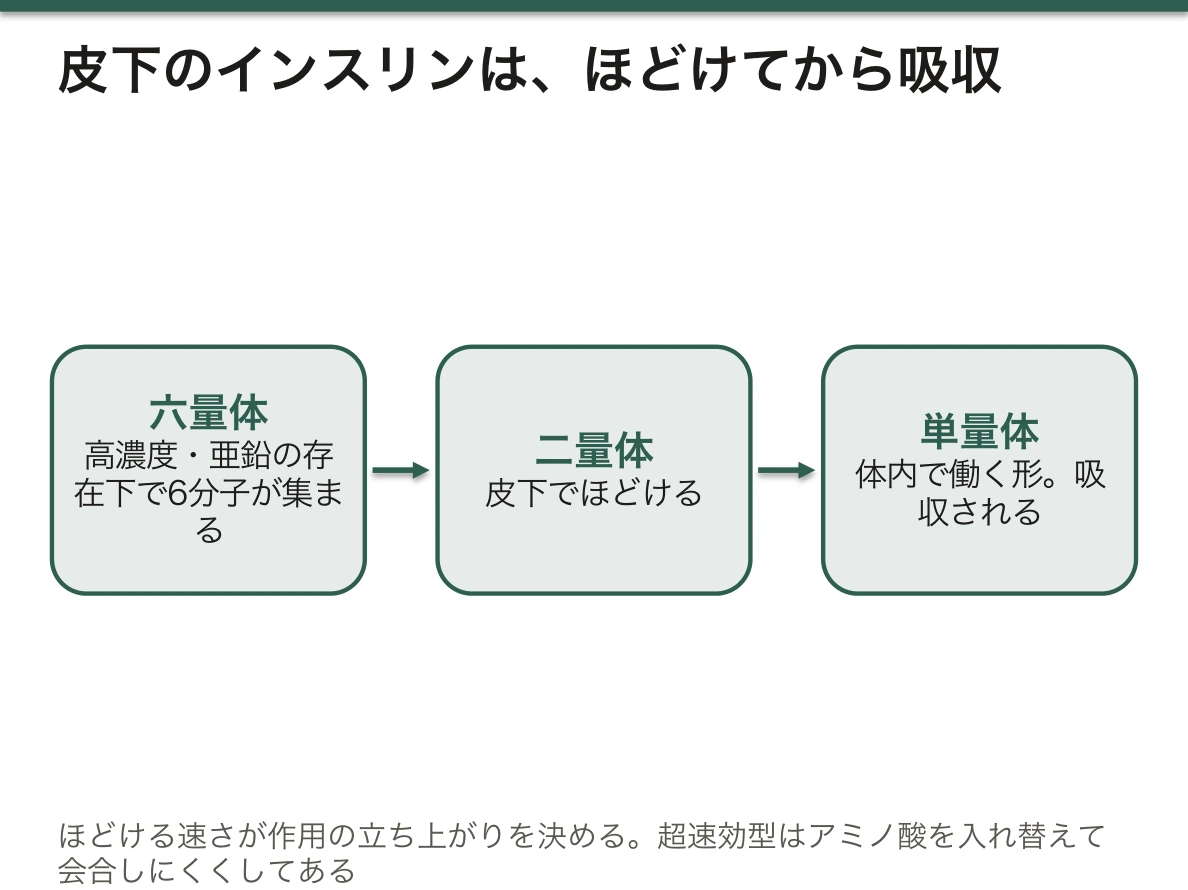
インスリンは体内では単量体として働くが、高濃度・亜鉛の存在下では 6 分子が集まって六量体になる。皮下に注射した製剤は、六量体 → 二量体 → 単量体とほどけてから吸収される。
この「ほどける速さ」が、作用の立ち上がりを決めている。だから製剤の設計は、会合をどう操作するかに集約される。
| 超速効型 | アミノ酸を入れ替えて会合しにくくする | リスプロ(B28・B29 を入れ替え)・アスパルト(B28 をアスパラギン酸に)。電荷の反発で二量体になりにくい |
| 持効型(等電点をずらす) | 中性で溶けにくくする | グラルギン。酸性の溶液で注射し、皮下の中性 pH で微細な結晶になって、ゆっくり溶け出す |
| 持効型(アルブミンに繋ぐ) | 脂肪酸を付ける | デテミル・デグルデク。アルブミンに可逆的に結合して貯留する。デグルデクは皮下で長い多量体を作る |
設計の意図は「生理的な分泌に近づける」ことにある。健常者では基礎分泌が一日中続き、食事のたびに追加分泌が鋭く立ち上がる。1 種類の製剤でこの 2 相を真似ることはできないので、持効型+超速効型を組み合わせる(basal-bolus)。
⚠️ 製剤の違いが、そのまま医療事故の原因になる。
- 名前が似ている——同じ商標に速効型と混合型があり、取り違えると低血糖か高血糖になる
- 単位を「単位」と書く——「U」を「0」と読み違えた過量投与が国内外で報告されている。略さない
- インスリン専用の注射器を使う——通常のシリンジで測ると桁を誤る
- 高濃度製剤(U-200 など)がある——同じ目盛りでも入る量が違う
吸収は注射する場所と状況でも変わる。腹壁が最も速く、大腿・臀部は遅い。入浴・運動で血流が増えると吸収が速まり、低血糖を起こす。同じ場所に打ち続けると脂肪が硬化して吸収が悪くなるので、打つ場所を毎回ずらすよう指導する——「効かなくなった」の原因がここにあることは少なくない。
血糖が不安定な患者では、注射部位を見せてもらう。硬結ができていれば、それだけで説明がつくことがある。
English version
Core
Insulin acts as a monomer in the body, but at high concentration and in the presence of zinc, six molecules gather into a hexamer. A preparation injected subcutaneously is absorbed only after unravelling hexamer → dimer → monomer.
This "speed of unravelling" sets the onset of action. So the design of the preparations comes down to how the association is manipulated.
| Ultra-rapid | Amino acids are swapped to make association less likely | Lispro (B28 and B29 swapped), aspart (B28 to aspartate). Charge repulsion makes dimers less likely |
| Long-acting (shifting the isoelectric point) | Made less soluble at neutrality | Glargine. Injected in an acid solution, it forms fine crystals at the neutral pH of the subcutis and dissolves out slowly |
| Long-acting (tethered to albumin) | A fatty acid is attached | Detemir, degludec. They bind albumin reversibly and are held in reserve. Degludec forms long multimers in the subcutis |
Going further
The intent of the design is to approach physiological secretion. In a healthy person basal secretion continues all day and additional secretion rises sharply at each meal. One preparation cannot imitate both phases, so a long-acting is combined with an ultra-rapid (basal–bolus).
⚠️ Differences between preparations are themselves a cause of clinical accidents.
- The names resemble — the same brand may have a rapid and a premixed form, and mixing them up gives hypoglycaemia or hyperglycaemia.
- Write "units" in full — overdoses from reading "U" as "0" have been reported at home and abroad. Do not abbreviate.
- Use an insulin syringe — measured in an ordinary syringe the order of magnitude goes wrong.
- There are concentrated preparations (U-200 and others) — the same graduation delivers a different amount.
Absorption also changes with the site and the circumstances. The abdominal wall is fastest; thigh and buttock are slower. A bath or exercise increases blood flow, hastens absorption and causes hypoglycaemia. Injecting repeatedly at the same site hardens the fat and worsens absorption, so advise moving the site every time — not seldom this is the cause of "it has stopped working".
In the clinic
In a patient with unstable blood glucose, ask to see the injection sites. A lipohypertrophic lump may explain it by itself.
まとめ
| 受容体から糖輸送体まで — 経路をたどる | インスリン受容体(受容体型チロシンキナーゼ、α₂β₂の四量体)に結合自己リン酸化 → インスリン受容体基質をリン酸化ここから2つの枝に分かれる枝経路担当代謝の枝PI3K → Akt… |
|---|---|
| インスリン分泌の仕組みと、そこに効く薬 | 膵β細胞の分泌は、電気的な出来事である。 |
| インクレチン — 食べたことを、腸が先に知らせている | 同じ量のブドウ糖でも、経口のほうが静脈内より多くインスリンが出る(インクレチン効果)。 |
| C-ペプチド — 自分のインスリンか、外から入れたものかを分ける | インスリンは、プレプロインスリン → プロインスリン → インスリン + C-ペプチド と加工される。 |
| 受容体そのものが壊れると、極端なインスリン抵抗性になる | ふつうの 2 型糖尿病のインスリン抵抗性は、受容体より下流の問題である。 |
| インスリン製剤は、分子の会合を操作して作られている | インスリンは体内では単量体として働くが、高濃度・亜鉛の存在下では 6 分子が集まって六量体になる。 |
このノートは医学生が授業の内容を自分の言葉でまとめたもので、診療の判断に使うものではありません。誤りに気づいたらお知らせください。