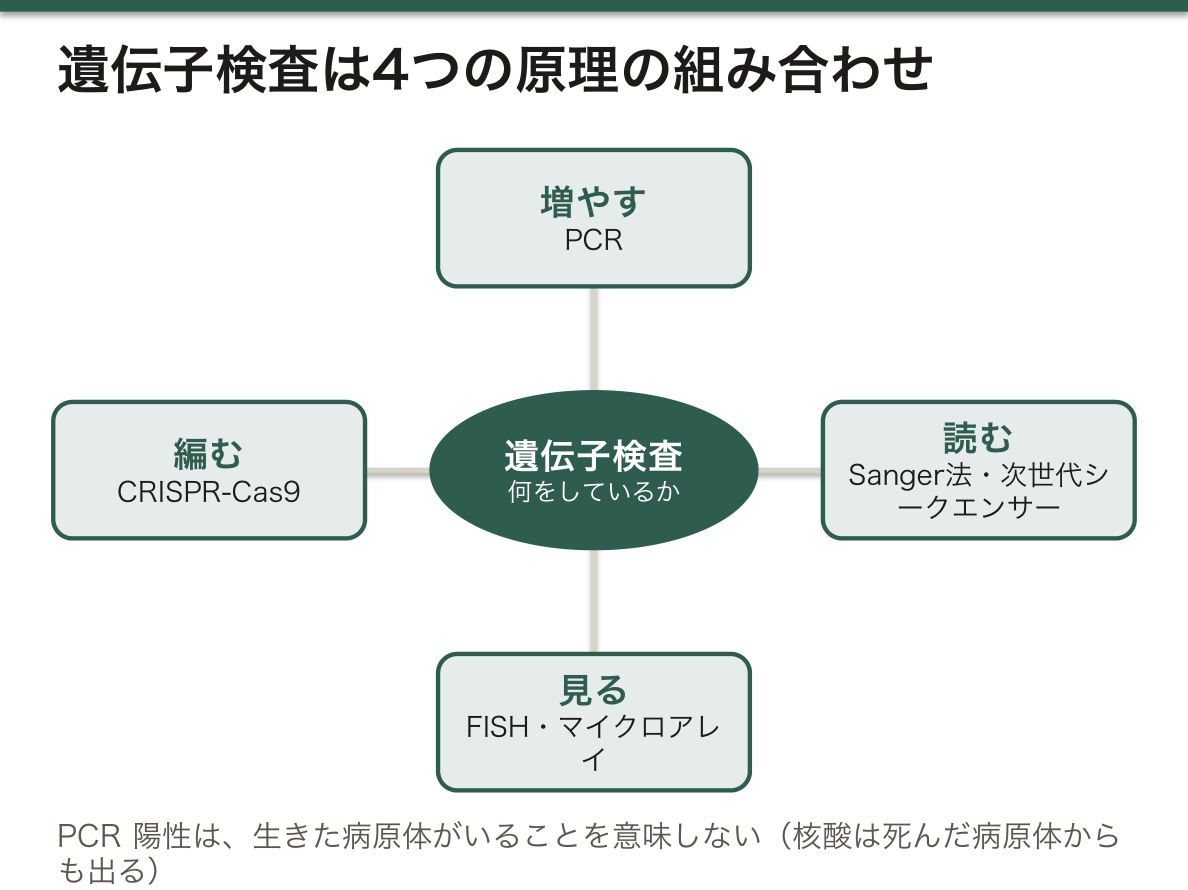
臨床で出会う遺伝子検査は、原理としては数種類しかない。「増やす」「切る」「読む」「並べる」の組み合わせになる。
- 増やす——PCR。少量のDNAを検出できる感度を作る
- 読む——Sanger法・次世代シークエンサー
- 見る——FISH(染色体上の位置)・マイクロアレイ(量の変化)
- 編む——CRISPR-Cas9
そして「何を検出しているか」で、結果の意味が変わる——「PCR 陽性は、生きた病原体がいることを意味しない」。
この一点が、感染症の解釈で最も繰り返し問題になる——核酸は死んだ病原体からも検出される。
遺伝情報の流れは複製・転写・翻訳の章、臨床遺伝は臨床遺伝の章、検査の解釈は診断学の章にある。
- PCR とその仲間 — 増やして検出する
- 読む・見る・編む — シークエンス、FISH、CRISPR
- 抗原・抗体・核酸 — 同じ「陽性」でも、意味がまるで違う
- フローサイトメトリー — 細胞を1つずつ数えて、分ける
- Ct 値は何を意味しているのか
- ウイルス量を測るということ — 「検出されない」は「消えた」ではない
PCR とその仲間 — 増やして検出する
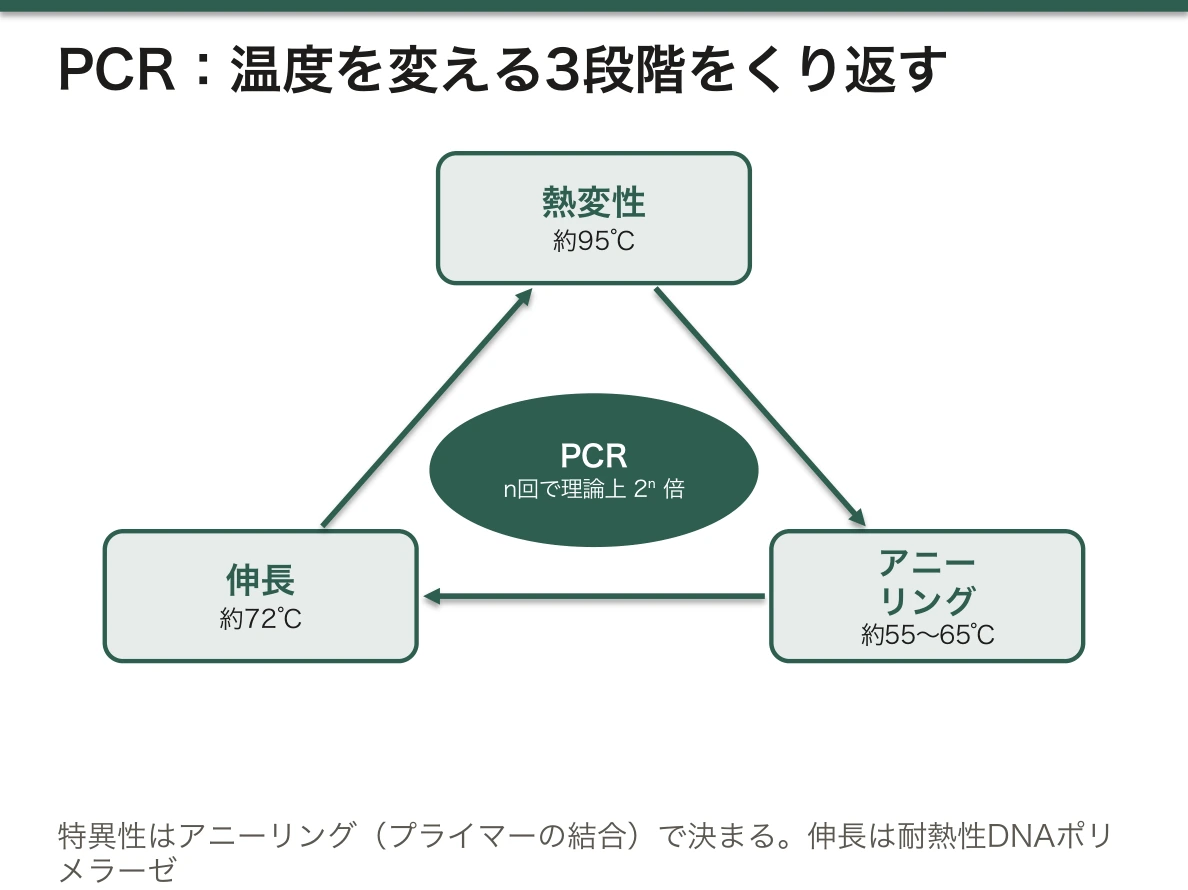
PCR の3段階を、温度を変えて繰り返す。
- 熱変性(約95℃)——二本鎖をほどく
- アニーリング(約55〜65℃)——プライマーが結合する。特異性はここで決まる
- 伸長(約72℃)——耐熱性DNAポリメラーゼが合成する
n サイクルで理論上 2ⁿ 倍になる。
派生。
- RT-PCR——逆転写でRNAをDNAにしてから増やす。RNAウイルスと遺伝子発現に使う
- リアルタイムPCR(定量PCR)——増える過程を蛍光で追い、量を測る。ウイルス量の測定
- LAMP法——一定温度で増幅する。機器が簡素で現場向き
Southern(DNA)・Northern(RNA)・Western(蛋白)——何を膜に写して調べるかの違いになる。
「PCR は核酸を見ている」という一文が、臨床解釈の分かれ目になる。感染性のある病原体がいるかどうかは、別の問題になる(検査の解釈の章)——「治った後も、数週間陽性が続くことがある」。
だから隔離解除の基準は、PCR の陰性化ではなく症状と経過日数で定められることが多い(感染対策の章)——「検査が陽性であることと、うつすことは違う」。
逆に感度が高すぎることが、コンタミネーションの問題を生む。1分子でも増幅されるので、作業空間を物理的に分ける——「偽陽性の原因が、検体ではなく検査室にある」。
リアルタイムPCR のウイルス量が、治療効果の指標になる。B型・C型肝炎・HIV(ウイルス肝炎の管理の章)——「陽性か陰性かではなく、いくつかで治療を判断する」。
そして結核では、PCR と培養の役割が違う。PCR は速いが薬剤感受性が分からず、培養は遅いが感受性が分かる(結核の診断の章)——「速さと情報量が、引き換えになっている」。
逆転写が必要かどうかは、病原体の核酸の種類で決まる(ウイルスの分類の章)——「検査の名前から、相手がRNAかDNAかを逆に読める」。
English version
Core
The three stages of PCR are repeated by changing the temperature.
- Denaturation (about 95 °C) — the double strand comes apart.
- Annealing (about 55–65 °C) — the primers bind. The specificity is decided here.
- Extension (about 72 °C) — a thermostable DNA polymerase synthesises.
After n cycles it is theoretically 2ⁿ-fold.
Derivatives.
- RT-PCR — reverse transcription turns RNA into DNA before amplification. Used for RNA viruses and for gene expression.
- Real-time (quantitative) PCR — the amplification is followed by fluorescence and the amount measured. Measurement of viral load.
- LAMP — amplification at a constant temperature. The equipment is simple and suited to the field.
Southern (DNA), Northern (RNA), Western (protein) — the difference is what is transferred to the membrane and examined.
Going further
- The single sentence "PCR is looking at nucleic acid" divides clinical interpretation. Whether an infectious pathogen is present is another question (the chapter on the interpretation of tests) — it can stay positive for weeks after recovery.
- Hence the criteria for lifting isolation are often set by symptoms and days from onset rather than by a negative PCR (the chapter on infection control) — a positive test and being infectious are different.
- Conversely, being too sensitive creates the problem of contamination. Even one molecule is amplified, so the working spaces are physically separated — the cause of a false positive lying in the laboratory rather than the specimen.
- The viral load on real-time PCR becomes the index of treatment. Hepatitis B and C, HIV (the chapter on the management of viral hepatitis) — treatment judged not on positive or negative but on how much.
- And in tuberculosis the roles of PCR and culture differ. PCR is fast and says nothing about drug sensitivity; culture is slow and gives it (the chapter on the diagnosis of tuberculosis) — speed and information traded against each other.
- Whether reverse transcription is needed is set by the kind of nucleic acid the pathogen has (the chapter on the classification of viruses) — from the name of the test one can read back whether the agent is RNA or DNA.
読む・見る・編む — シークエンス、FISH、CRISPR
Sanger 法——ジデオキシヌクレオチドで伸長を止め、長さで読む。1遺伝子を正確に読むのに今も使う。
次世代シークエンサー(NGS)——大量の断片を並列に読む。パネル検査・全エクソーム・全ゲノム。
- 臨床応用——がんゲノムプロファイリング・遺伝性疾患の網羅的検索・出生前検査(NIPT)
FISH——蛍光標識したプローブを染色体に当てる。転座と増幅を、位置ごと見られる。
- BCR-ABL1・HER2 増幅・22q11.2 欠失
マイクロアレイ(CGH)——コピー数の増減を網羅的に見る。核型で見えない微細欠失を拾う。
CRISPR-Cas9——ガイドRNAで狙った配列を切り、修復の過程で編集する。
NGS では「意義不明のバリアント(VUS)」が必ず出る——これが説明の中心になる。
網羅的に調べるほど、解釈できない結果が増える。これが遺伝子検査の最大の実務的問題になる(遺伝カウンセリングの章)——「調べる前に、何が返ってきうるかを話しておく」。
そして目的外の所見(二次的所見)が出る。癌の検査で、遺伝性の心疾患が見つかることがある(ゲノム医療の章)——「知りたくない権利を、あらかじめ確認しておく」。
NIPT は、確定診断ではなくスクリーニングになる。母体血中の胎児由来DNAを見ているが、胎盤由来の細胞のことがある(出生前検査の章)——「陽性なら羊水検査で確かめる」。
だから陽性的中率が、年齢と有病率で大きく変わる(検査の性能の章)——「同じ検査が、対象によって別の意味を持つ」。
FISH が位置を見るのに対し、PCR は配列を増やすだけになる。転座の相手を知りたければ FISH が要る(白血病の遺伝子検査の章)——「何を知りたいかで、方法が決まる」。
CRISPR は、鎌状赤血球症とβサラセミアで実際の治療になった(遺伝子治療の章)——「体外で編集して戻す方法が、まず実用化された」。
English version
Core
The Sanger method — extension is stopped with a dideoxynucleotide and read by length. Still used to read one gene accurately.
Next-generation sequencing (NGS) — a great many fragments read in parallel. Panel testing, whole exome, whole genome.
- Clinical applications — cancer genome profiling, comprehensive search in hereditary disease, prenatal testing (NIPT).
FISH — a fluorescently labelled probe is applied to the chromosome. Translocations and amplifications can be seen together with their position.
- BCR-ABL1, HER2 amplification, 22q11.2 deletion.
Microarray (CGH) — changes in copy number seen comprehensively. It picks up microdeletions invisible on a karyotype.
CRISPR-Cas9 — a guide RNA cuts the targeted sequence and editing occurs in the course of repair.
NGS always yields "variants of uncertain significance (VUS)" — and this becomes the centre of the explanation.
Going further
- The more comprehensively one tests, the more uninterpretable results appear. This is the greatest practical problem of genetic testing (the chapter on genetic counselling) — talk about what may come back before testing.
- And findings outside the purpose (secondary findings) appear. A hereditary cardiac disease may be found in a test for cancer (the chapter on genomic medicine) — confirm in advance the right not to know.
- NIPT is a screen and not a definitive diagnosis. It looks at fetal DNA in the maternal blood, which may come from placental cells (the chapter on prenatal testing) — confirm a positive with amniocentesis.
- Hence the positive predictive value varies greatly with age and prevalence (the chapter on the performance of tests) — the same test carrying a different meaning according to whom it is applied.
- FISH sees position, whereas PCR merely amplifies a sequence. To know the partner of a translocation, FISH is needed (the chapter on genetic testing in leukaemia) — what one wants to know decides the method.
- CRISPR has become an actual treatment in sickle cell disease and β-thalassaemia (the chapter on gene therapy) — the method of editing outside the body and returning the cells was the first to reach practice.
抗原・抗体・核酸 — 同じ「陽性」でも、意味がまるで違う
| 検査 | 見ているもの | 意味 | 弱点 |
|---|---|---|---|
| 抗原検査 | 病原体の蛋白 | いま体にいる(量が多い) | 感度が低い。量が少ないと陰性 |
| 核酸検査(PCR) | 病原体の遺伝子 | いる、または「いた」 | 死んだ病原体の断片でも陽性になりうる |
| 抗体検査(IgM) | 宿主の反応 | 最近の感染 | 出るまで日数がかかる・偽陽性 |
| 抗体検査(IgG) | 宿主の反応 | 過去の感染か、ワクチン後の免疫 | いつの感染かは分からない |
ペア血清で 4 倍以上の上昇があれば、最近の感染と判断する。
培養は、生きている病原体を証明し、薬剤感受性まで分かる。
「病原体を見ているのか、宿主の反応を見ているのか」という区別が、すべての出発点になる。抗体は宿主の記録なので、治ってからも残る(検体をどう採るかの章)——「治癒の判定に抗体を使わない」。
核酸検査が陽性でも、感染性があるとは限らない(感染対策の章)——「隔離を解除する判断に、PCR の陰性化を条件としない場面がある」。
窓期という考え方が、輸血の安全性を支えている(輸血の章)——「抗体が出る前でも核酸検査なら拾えるので、両方を組み合わせている」。
母子感染の診断では、移行抗体を差し引いて考える(母子感染の章)——「母体由来の IgG は胎盤を通るので、乳児の IgG 陽性は感染を意味しない。IgM なら児自身が作ったものになる」。
検査を選ぶ前に、事前確率を見積もる(検査の性能の章)——「流行期と非流行期で、同じ陽性の意味が変わる」。
English version
Core
| Test | What it sees | Meaning | Weakness |
|---|---|---|---|
| Antigen test | A protein of the pathogen | It is in the body now (in quantity) | Low sensitivity. Negative when the amount is small |
| Nucleic acid test (PCR) | The gene of the pathogen | It is there, or "was" there | Fragments of dead pathogen can make it positive |
| Antibody (IgM) | The host’s response | Recent infection | Takes days to appear; false positives |
| Antibody (IgG) | The host’s response | Past infection, or immunity after vaccination | Says nothing about when |
A fourfold rise in paired sera indicates recent infection.
Culture proves a living pathogen and gives drug sensitivity as well.
Going further
- The distinction "is it the pathogen or the host’s response that is being seen?" is the starting point of everything. An antibody is the host’s record and remains after recovery (the chapter on how to take specimens) — do not use antibody to judge cure.
- A positive nucleic acid test does not necessarily mean infectivity (the chapter on infection control) — there are settings in which a negative PCR is not a condition for lifting isolation.
- The idea of the window period underpins the safety of transfusion (the chapter on transfusion) — a nucleic acid test picks it up before antibody appears, so both are combined.
- In diagnosing vertical transmission, subtract the transferred antibody (the chapter on vertical transmission) — maternal IgG crosses the placenta, so a positive IgG in an infant does not mean infection. IgM would be the child’s own.
- Estimate the prior probability before choosing a test (the chapter on the performance of tests) — the same positive means something different in and out of an epidemic.
フローサイトメトリー — 細胞を1つずつ数えて、分ける
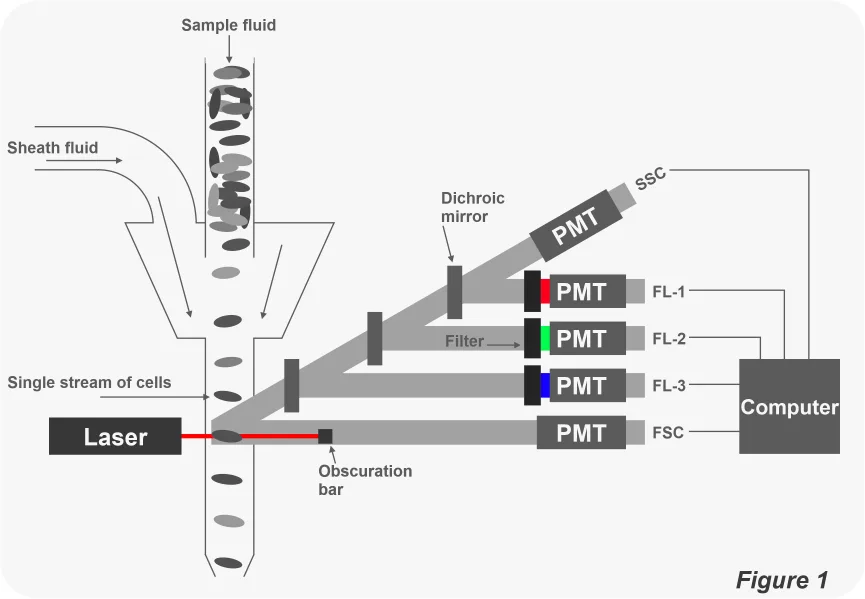
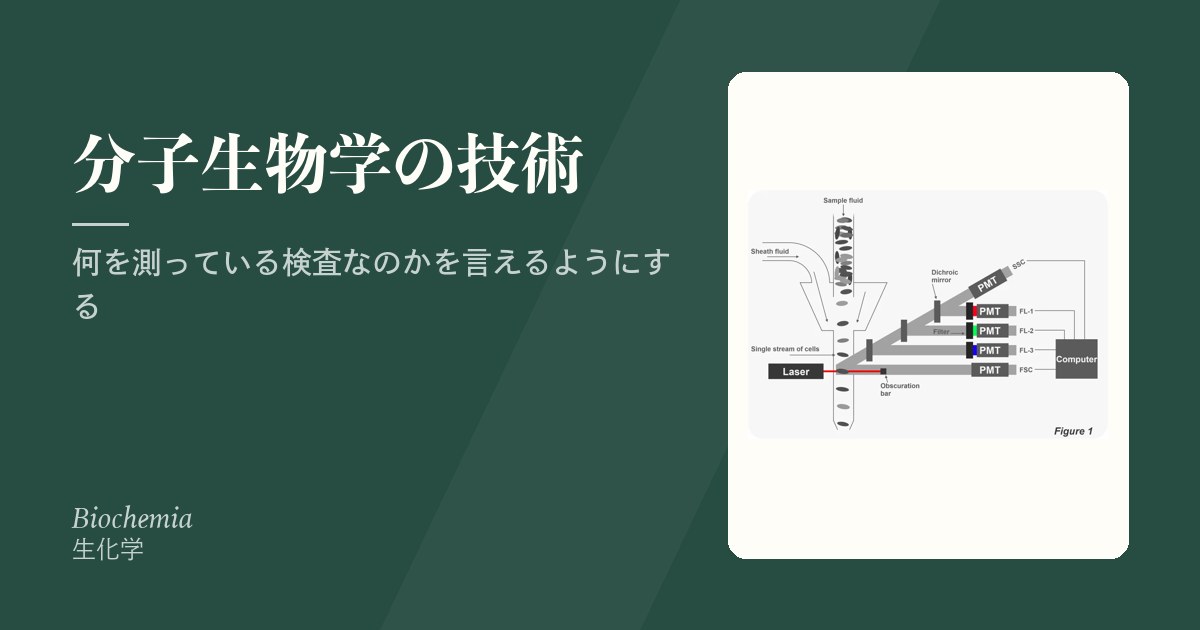
細胞を1列に流し、レーザーを当てて散乱光と蛍光を測る。
| 測るもの | 分かること |
|---|---|
| 前方散乱(FSC) | 細胞の大きさ |
| 側方散乱(SSC) | 内部の複雑さ(顆粒の多さ) |
| 蛍光 | 標識した抗体が結合した表面抗原(CD 分類) |
数千〜数万個を短時間で個別に測るので、少数の異常な集団を拾える。
使い道——白血病・リンパ腫の免疫表現型・CD4 数の測定・発作性夜間ヘモグロビン尿症・微小残存病変・造血幹細胞(CD34)の計数・DNA 量による細胞周期の解析。
「集団の平均ではなく、1つずつを見る」ことが、この技術の本質になる。だから全体に埋もれた小さな異常集団が見つかる(白血病の各論の章)——「顕微鏡で数えるのとは、桁が違う感度になる」。
微小残存病変の測定が、治療方針を変えている(分子病理の章)——「見た目の寛解と、分子レベルの寛解が別だと分かった」。
発作性夜間ヘモグロビン尿症では、あるべきものが無いことを証明する(溶血の章)——「GPI アンカーで繋がる CD55・CD59 が欠けた血球集団を検出する」。
CD4 数の測定が、HIV 感染症の管理の骨格になっている(免疫不全の章)——「日和見感染の種類が、CD4 の値ごとに並ぶ」。
造血幹細胞の採取でも、この計数がタイミングを決める(造血のニッチの項)——「CD34 陽性細胞が末梢血に十分出た時点で、アフェレーシスを行う」。
English version
Core
Cells are made to flow in single file, a laser is applied, and scattered light and fluorescence are measured.
| What is measured | What it tells |
|---|---|
| Forward scatter (FSC) | The size of the cell |
| Side scatter (SSC) | Internal complexity (granularity) |
| Fluorescence | The surface antigen bound by a labelled antibody (the CD classification) |
Thousands to tens of thousands are measured individually in a short time, so a small abnormal population can be picked up.
Uses — immunophenotyping of leukaemia and lymphoma, measurement of CD4 counts, paroxysmal nocturnal haemoglobinuria, minimal residual disease, counting haematopoietic stem cells (CD34), analysis of the cell cycle by DNA content.
Going further
- The essence of this technique is looking at cells one by one rather than at the average of a population. Hence a small abnormal population buried in the whole can be found (the chapter on the individual leukaemias) — a sensitivity of another order from counting down a microscope.
- Measurement of minimal residual disease is changing treatment policy (the chapter on molecular pathology) — it emerged that apparent remission and molecular remission are different.
- In paroxysmal nocturnal haemoglobinuria, what is proved is the absence of something that should be there (the chapter on haemolysis) — a population of cells lacking the GPI-anchored CD55 and CD59 is detected.
- Measurement of the CD4 count is the skeleton of managing HIV infection (the chapter on immunodeficiency) — the kinds of opportunistic infection line up by the CD4 value.
- In harvesting haematopoietic stem cells too, this count decides the timing (the section on the haematopoietic niche) — apheresis is done once enough CD34-positive cells have appeared in the peripheral blood.
Ct 値は何を意味しているのか
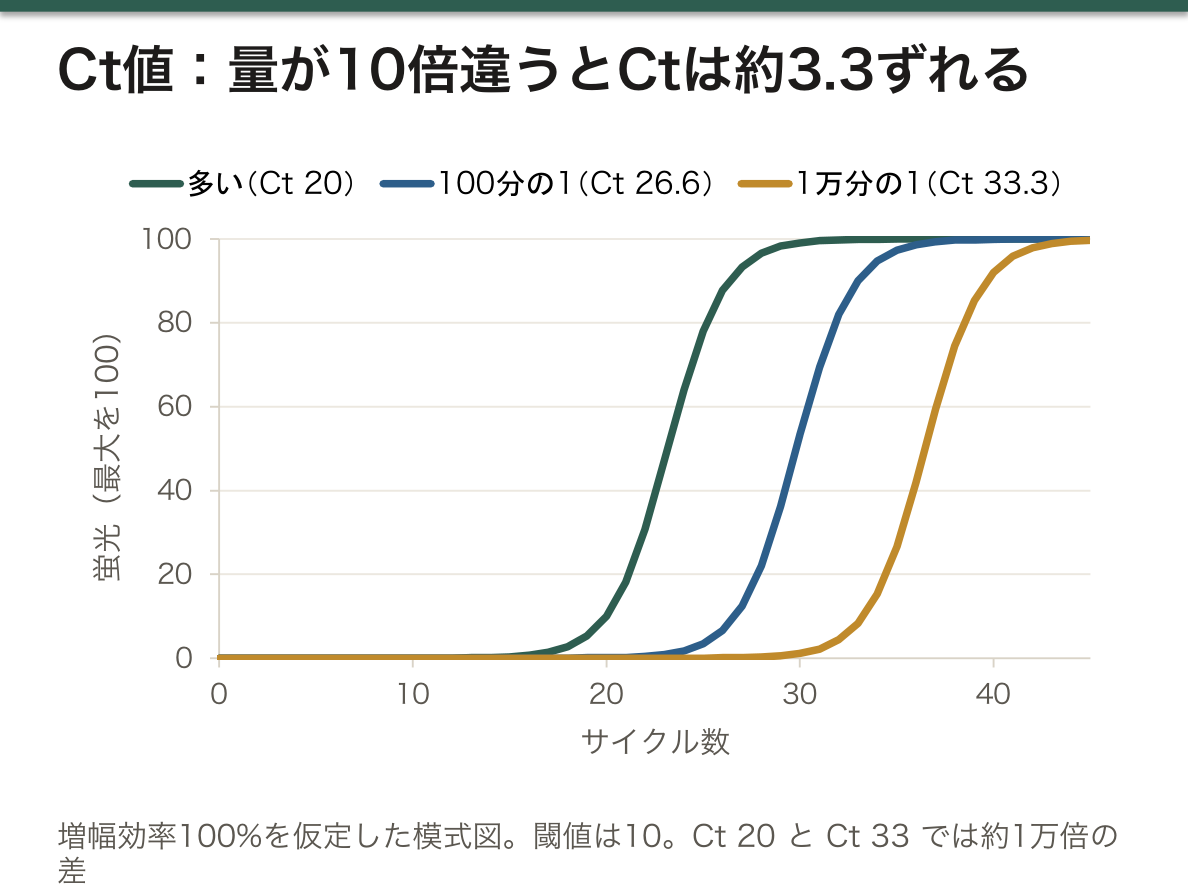
リアルタイム PCR は、増幅を1サイクルごとに蛍光で追う。検出できる量に達したサイクル数が Ct 値である。
- 元の量が多いほど、Ct は小さい——反比例ではなく対数の関係にある
- 1 サイクルで 2 倍なので、Ct が 3.3 違えば量は 10 倍違う
- Ct 20 と Ct 33 では、およそ 1 万倍の差がある
だから「陽性」の一語では情報が足りない。Ct 20 の陽性と Ct 37 の陽性は、まったく違う状態を意味しうる。
⚠️ ただし Ct を臨床判断に直結させることには限界がある。
Ct を左右する要因が、検体側にも検査側にもある。
| 採り方 | 拭い方が浅ければ量が少ない | 同じ患者でも採取者で変わる |
| 病日 | 発症前後に最多、その後は減る | 経過のどこで採ったかで大きく違う |
| 試薬・機器・標的遺伝子 | 装置ごとに Ct の意味が違う | 施設間で Ct を比較してはいけない |
そして最も重要なのは、「核酸が検出されること」と「感染性があること」は別だという点である。回復期には壊れたウイルスの核酸だけが数週間残ることがある。Ct が高い(=量が少ない)だけでは、感染性の有無を判定できない。隔離の解除が検査ではなく発症からの日数と症状で決められるようになったのは、この理解による。
偽陰性の作られ方も、原理から予測できる。
- 変異でプライマー/プローブの結合部位が変わる——特定の遺伝子だけ検出されない(複数の標的を同時に見る設計で気づける)
- 阻害物質の混入——血液・粘液。内部標準を置いて確認する
- 採取のタイミングが早すぎる——潜伏期
逆に偽陽性の最大の原因は、増幅産物によるコンタミネーションである。1 回の PCR で作られる産物は膨大で、実験室の空気中に漂えば次の検体を汚染する。前処理・増幅・検出の部屋を分けるという設計は、この一点のためにある。
PCR 陽性の報告を見たら、いつ・どこから採った検体かを確認する。同じ「陽性」でも意味が変わる。
English version
Core
Real-time PCR follows the amplification cycle by cycle with fluorescence. The number of cycles at which the detectable amount is reached is the Ct value.
- The more there was to begin with, the lower the Ct — the relation is logarithmic, not inversely proportional.
- One cycle doubles it, so a difference of 3.3 in Ct is a tenfold difference in amount.
- Between Ct 20 and Ct 33 there is roughly a ten-thousand-fold difference.
So the single word "positive" is not enough information. A positive at Ct 20 and a positive at Ct 37 can mean entirely different states.
⚠️ But there are limits to tying the Ct directly to a clinical decision.
Going further
Factors affecting the Ct lie both on the specimen side and on the laboratory side.
| How it was taken | A shallow swab collects little | It varies with the collector even in the same patient |
| Day of illness | Greatest around onset and falling thereafter | It differs greatly with where in the course it was taken |
| Reagents, instrument, target gene | The Ct means something different on each instrument | Ct values must not be compared between laboratories |
And most important is that "nucleic acid is detected" and "it is infectious" are different. In convalescence the nucleic acid of broken virus alone may remain for weeks. A high Ct (that is, a small amount) alone cannot decide whether there is infectivity. That lifting isolation came to be decided by days from onset and symptoms rather than by a test rests on this understanding.
How false negatives are made can also be predicted from the principle.
- A mutation changes the binding site of a primer or probe — one target gene alone is not detected (a design looking at several targets at once reveals it).
- Inhibitors in the sample — blood, mucus. An internal control checks for this.
- Sampling too early — the incubation period.
Conversely, the greatest cause of a false positive is contamination by amplification product. The product of one PCR is enormous, and drifting in the air of the laboratory it contaminates the next specimen. The design of separate rooms for preparation, amplification and detection exists for this single reason.
In the clinic
Seeing a report of a positive PCR, check when and from where the specimen was taken. The same "positive" means different things.
ウイルス量を測るということ — 「検出されない」は「消えた」ではない
感染症の管理で、量を測ることが治療の指標になる場面がある。定量 PCR がその中心にある。
| HIV | 治療の目標は検出限界未満 | 持続すれば性的に伝播しない(U=U)。ただしウイルスは体内に潜伏したままで、治療を止めれば再燃する |
| HBV | DNA 量で治療の適応と効果を見る | cccDNA が核内に残るので、抗ウイルス薬で抑えても排除はできない。免疫抑制で再活性化する |
| HCV | 治療終了 12 週後に検出されなければ治癒 | 持続的ウイルス学的著効(SVR)。潜伏する形を作らないので、本当に排除できる |
| CMV・EBV | 移植後・免疫抑制下で監視する | 量の上昇を見て発症前に治療を始める(先制治療) |
ウイルスによって「治る」の意味が違う。HCV は排除できるが、HIV と HBV は抑え込むだけ——違いは宿主のゲノムや核内に残る形を作るかどうかにある。
⚠️ 免疫抑制を始める前に、確認すべきことがある。
HBV の再活性化は、HBs 抗原が陰性で「治っている」と思われていた人にも起こる。HBc 抗体が陽性なら、肝内に cccDNA が残っているからである。リツキシマブ・ステロイド・化学療法で免疫が下がると再燃し、劇症肝炎に至ることがある。
- 免疫抑制療法の前に、HBs 抗原・HBs 抗体・HBc 抗体を測る
- 既往感染があれば HBV DNA を定期的に監視し、上昇したら核酸アナログを開始する
- これは「やらないと訴えられる」水準の標準的な手順として定着している
「検出限界未満」の意味も正確に押さえる。その検査で測れる下限より少ない、というだけで、ゼロを証明したわけではない。検査の下限は装置ごとに違うので、報告書には「20 IU/mL 未満」のように数値で書かれる。
同じ考え方は、白血病の微小残存病変(MRD)にも使われている。顕微鏡で見えないレベルの残存を、核酸やフローサイトメトリーで追う——「見えない」の解像度が上がったぶん、治療をいつ終わるかの判断も精密になった。
免疫抑制薬・生物学的製剤・化学療法を始める前は、B 型肝炎のスクリーニングを必ず行う。既往感染でも対象になる。
English version
Core
In managing infection there are settings in which measuring the amount is the index of treatment. Quantitative PCR is the centre of this.
| HIV | The goal of treatment is below the limit of detection | Sustained, it is not transmitted sexually (U=U). But the virus remains latent in the body and rebounds if treatment stops |
| HBV | The DNA level guides the indication and the effect | cccDNA remains in the nucleus, so antiviral drugs suppress but cannot eliminate it. It reactivates under immunosuppression |
| HCV | Undetectable 12 weeks after the end of treatment means cure | Sustained virological response (SVR). It makes no latent form, so it really can be eliminated |
| CMV, EBV | Monitored after transplantation and under immunosuppression | A rise prompts treatment before disease appears (pre-emptive therapy) |
"Cure" means different things for different viruses. HCV can be eliminated; HIV and HBV are only held down — the difference lies in whether a form persisting in the host genome or nucleus is created.
Going further
⚠️ There is something to confirm before starting immunosuppression.
- Reactivation of HBV occurs even in a person thought "cured" with a negative HBs antigen. If the HBc antibody is positive, cccDNA remains in the liver. When immunity falls with rituximab, steroids or chemotherapy it flares, and fulminant hepatitis can follow.
- Before immunosuppressive therapy, measure HBs antigen, HBs antibody and HBc antibody.
- If there is past infection, monitor the HBV DNA regularly and start a nucleoside analogue if it rises.
- This is established as a standard procedure at the level of "one is liable if it is not done".
Note also the precise meaning of "below the limit of detection". It is merely less than the lowest amount that test can measure, not a proof of zero. The lower limit differs between instruments, so the report gives it as a number, such as "below 20 IU/mL".
The same thinking is used for minimal residual disease in leukaemia. Residual disease below what the microscope can see is followed by nucleic acid tests or flow cytometry — as the resolution of "invisible" has risen, the judgement of when to end treatment has become more precise.
In the clinic
Before starting an immunosuppressant, a biological agent or chemotherapy, always carry out screening for hepatitis B. Past infection counts too.
まとめ
| PCR とその仲間 — 増やして検出する | PCR の3段階を、温度を変えて繰り返す。 |
|---|---|
| 読む・見る・編む — シークエンス、FISH、CRISPR | Sanger 法——ジデオキシヌクレオチドで伸長を止め、長さで読む。 |
| 抗原・抗体・核酸 — 同じ「陽性」でも、意味がまるで違う | 検査見ているもの意味弱点抗原検査病原体の蛋白いま体にいる(量が多い)感度が低い。 |
| フローサイトメトリー — 細胞を1つずつ数えて、分ける | 細胞を1列に流し、レーザーを当てて散乱光と蛍光を測る。 |
| Ct 値は何を意味しているのか | リアルタイム PCR は、増幅を1サイクルごとに蛍光で追う。 |
| ウイルス量を測るということ — 「検出されない」は「消えた」ではない | 感染症の管理で、量を測ることが治療の指標になる場面がある。 |
このノートは医学生が授業の内容を自分の言葉でまとめたもので、診療の判断に使うものではありません。誤りに気づいたらお知らせください。