現代の臨床検査と研究の多くは、「網羅的に測る」方向へ動いている。ゲノム・トランスクリプトーム・プロテオーム・メタボローム——いずれも個々の分子を狙うのではなく、集合として測る。
医師に必要なのは装置を操作する技術ではなく、その結果が何を意味し、どこに限界があるかを言えることである。
- 測り方の原理と、結果の限界
- 検査の性能を数字で言う — 感度・特異度と、事前確率
- ROC 曲線とカットオフ — 感度と特異度は、取引の関係にある
- 基準範囲 — 「正常」とは、健常者の95%が入る幅でしかない
- 単位が違えば、同じ数字が別の意味になる
- ベッドサイドで測るということ — POCT の利点と限界
測り方の原理と、結果の限界
| 技術 | 測るもの | 臨床での使われ方 |
|---|---|---|
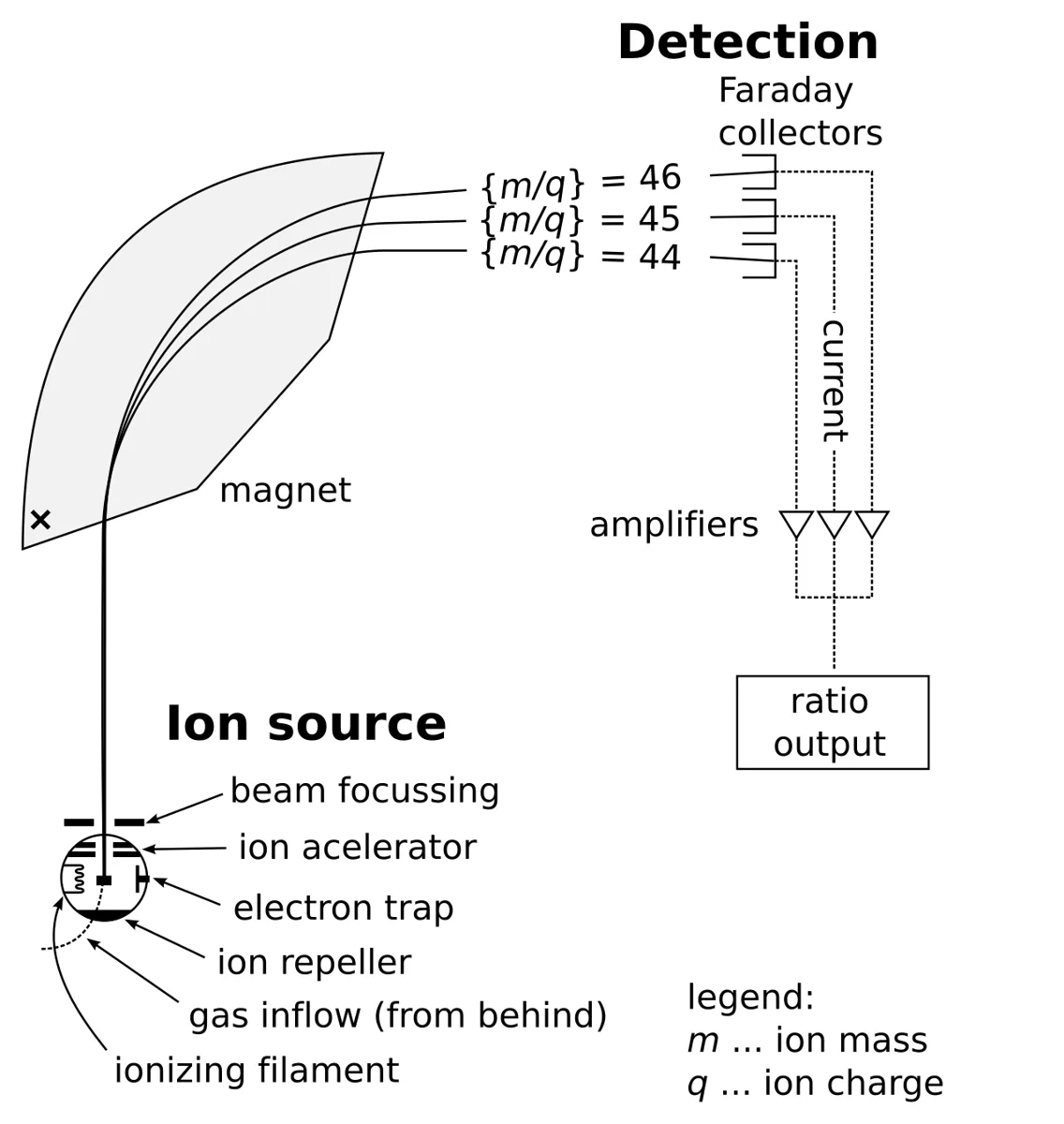
| タンデム質量分析 | 分子の質量電荷比 | 新生児マススクリーニング・薬物血中濃度・ビタミンD |
| 質量分析による微生物同定 | 菌体蛋白の型 | 培養コロニーから数分で菌種を同定 |
| 次世代シークエンサー | 塩基配列 | 遺伝性疾患・癌遺伝子パネル・微生物叢 |
| 免疫測定 | 抗原抗体反応 | ホルモン・腫瘍マーカー |
- 質量分析は「構造が違えば質量が違う」ことを利用するので、免疫測定より特異性が高い
- 免疫測定は交差反応を起こしうる
免疫測定の落とし穴を知っておくと、「検査値がおかしい」場面で立ち止まれる。
- フック効果——抗原が極端に多いと、かえって低い値が出る。絨毛癌でhCGが偽陰性になる、といった形で現れる。希釈して再検すると正しく出る
- 異好抗体・ヒト抗マウス抗体——測定系そのものに干渉して偽高値・偽低値を作る
- ビオチンの大量摂取——ビオチンを使う測定系(甲状腺機能・トロポニンなど)を狂わせる。サプリメントの服用歴が原因になる
「臨床像と検査値が合わないときは、検査を疑ってよい」——これは検査を軽んじることではなく、測定原理を知っているからこそできる判断である。
質量分析による微生物同定は、日常診療を実際に変えた技術である。従来は生化学的性状で1〜2日かかった菌種同定が、コロニーから数分で出る。抗菌薬の選択を早められるので、敗血症の予後に直結する。
癌遺伝子パネル検査の解釈には、生化学と統計の両方が要る。
- 変異が見つかっても、適応のある薬があるとは限らない(実際に治療に到達するのは1割前後)
- 意義不明の変異が多数出る
- 生殖細胞系列の変異が偶然見つかる——本人だけでなく血縁者にも関わる情報になるので、検査前の説明と同意が本質的に重要である
技術が進むほど、「測れること」と「知るべきこと」の差が広がる——ここは倫理の問題として扱う必要がある領域である。
English version
Core
| Technique | What it measures | Clinical use |
|---|---|---|
| Tandem mass spectrometry | The mass-to-charge ratio of a molecule | Newborn mass screening, drug levels, vitamin D |
| Microbial identification by mass spectrometry | The protein pattern of the organism | Identifies the species from a colony in minutes |
| Next-generation sequencing | The base sequence | Hereditary disease, cancer gene panels, the microbiome |
| Immunoassay | Antigen–antibody reaction | Hormones, tumour markers |
- Mass spectrometry exploits "a different structure means a different mass", so it is more specific than an immunoassay.
- An immunoassay can cross-react.
Going further
Knowing the pitfalls of immunoassay allows one to pause when "the laboratory value looks wrong".
- The hook effect — with an extreme excess of antigen the value reads low instead. It appears as a falsely negative hCG in choriocarcinoma and the like. Repeat on a dilution and the correct value appears.
- Heterophile and human anti-mouse antibodies — they interfere with the assay itself and create falsely high or low values.
- A large intake of biotin — it upsets assays that use biotin (thyroid function, troponin and others). A history of supplements is the cause.
"When the clinical picture and the laboratory value do not agree, one may doubt the test" — this is not to make light of testing but a judgement possible precisely because one knows the principle of measurement.
Microbial identification by mass spectrometry is a technique that has actually changed daily practice. Identification that formerly took a day or two by biochemical properties comes from a colony in minutes. The choice of antibiotic can be made sooner, so it bears directly on the outcome of sepsis.
Interpreting a cancer gene panel requires both biochemistry and statistics.
- Finding a mutation does not mean there is a drug with an indication (around 10 per cent actually reach a treatment).
- Many variants of uncertain significance appear.
- A germline mutation may be found incidentally — information that concerns blood relatives as well as the patient, so explanation and consent before testing are essential.
The further the technology advances, the wider the gap between "what can be measured" and "what should be known" — an area that must be handled as a question of ethics.
検査の性能を数字で言う — 感度・特異度と、事前確率
検査の性能は2つの層に分かれる。
| 層 | 指標 | 性質 |
|---|---|---|
| 検査そのもの | 感度・特異度・尤度比 | 有病率に左右されない |
| 目の前の患者 | 陽性的中率・陰性的中率 | 有病率に強く左右される |
- 陽性尤度比 = 感度 ÷(1 − 特異度)
- 陰性尤度比 =(1 − 感度)÷ 特異度
- 事後オッズ = 事前オッズ × 尤度比
分析的な性能も別にある——正確度(真値からのずれ)と精度(ばらつき)、検出限界。
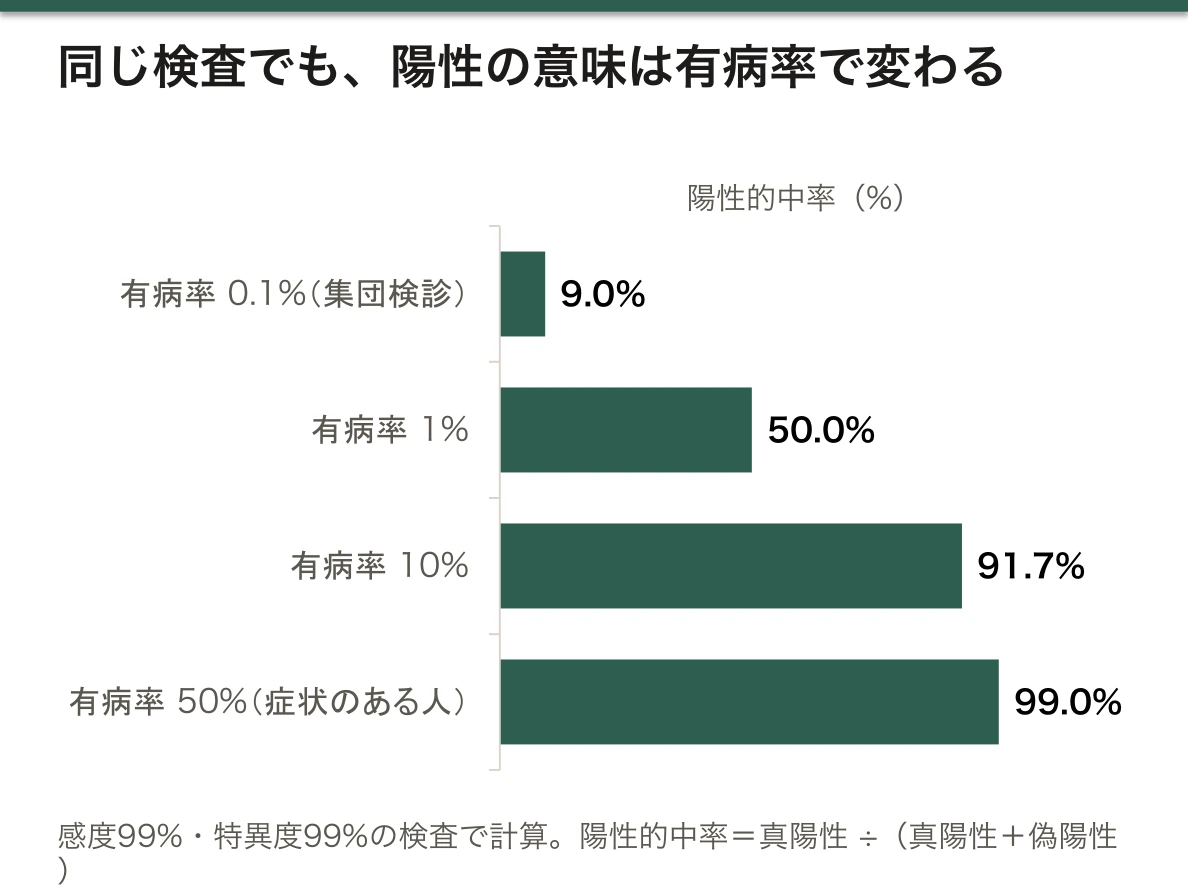
「同じ検査でも、誰に使うかで意味が変わる」——これが的中率が有病率に依存することの実務的な意味である。
例として、感度99%・特異度99%の検査を考える。
- 有病率50%の集団(症状のある人に使う)→ 陽性的中率は約99%
- 有病率0.1%の集団(無症状の集団検診)→ 陽性的中率は約9%。陽性の9割が偽陽性
検査の性能は変わっていないのに、結果の解釈がまったく違う。スクリーニングで偽陽性が問題になる理由が、この計算に尽きている。
だから臨床では、検査の前に事前確率を見積もる。
- 事前確率が非常に低ければ、陽性でも疑わしい——確認検査が要る
- 事前確率が非常に高ければ、陰性でも否定できない——肺血栓塞栓症を強く疑う症例でDダイマー陰性でも画像へ進むのはこのため
- 検査が意味を持つのは、事前確率が中間のときである
過剰診断という概念も、この延長にある。「見つけなくても生涯症状を出さなかった病変を見つけてしまう」ことで、感度を上げるほど増える。甲状腺癌の検診で明確に示された問題である。早期発見が常に善であるとは限らない——検査を勧める側に立つときに、必ず持っておくべき視点である。
English version
Core
The performance of a test divides into two layers.
| Layer | Indices | Nature |
|---|---|---|
| The test itself | Sensitivity, specificity, likelihood ratio | Not affected by prevalence |
| The patient in front of you | Positive and negative predictive value | Strongly affected by prevalence |
- Positive likelihood ratio = sensitivity ÷ (1 − specificity)
- Negative likelihood ratio = (1 − sensitivity) ÷ specificity
- Post-test odds = pre-test odds × likelihood ratio
Analytical performance is separate — accuracy (deviation from the true value), precision (scatter) and the limit of detection.
Going further
"The same test means something different according to whom it is used on" — this is the practical meaning of predictive value depending on prevalence.
As an example, take a test with 99 per cent sensitivity and 99 per cent specificity.
- In a population with 50 per cent prevalence (used on symptomatic people) → the positive predictive value is about 99 per cent.
- In a population with 0.1 per cent prevalence (screening the asymptomatic) → the positive predictive value is about 9 per cent. Nine in ten positives are false.
The performance of the test has not changed and the interpretation of the result is entirely different. The reason false positives are a problem in screening lies wholly in this calculation.
So in the clinic one estimates the prior probability before testing.
- If the prior probability is very low, even a positive is doubtful — a confirmatory test is needed.
- If the prior probability is very high, even a negative does not exclude — this is why one proceeds to imaging in a case strongly suspected of pulmonary embolism despite a negative D-dimer.
- A test has value when the prior probability is intermediate.
Overdiagnosis lies on the same extension. Finding a lesion that would never have caused symptoms in a lifetime, and it increases the more the sensitivity is raised. Shown clearly in thyroid cancer screening. Early detection is not always good — a view to hold without fail when standing on the side that recommends a test.
ROC 曲線とカットオフ — 感度と特異度は、取引の関係にある
連続値の検査は、どこで区切るかを決めなければ陽性・陰性にならない。
カットオフを下げれば感度が上がり特異度が下がる。上げれば逆になる。
ROC 曲線——縦軸に感度、横軸に「1 − 特異度」を取り、カットオフを動かして描く。曲線下面積(AUC)が 1 に近いほど、検査としての性能が高い。
| 使い方 | 優先するもの | 例 |
|---|---|---|
| 見逃したくない(除外したい) | 感度 | スクリーニング・D-ダイマー |
| 確定したい | 特異度 | 確認検査・生検 |
尤度比は、カットオフに依らず結果の強さを表す——陽性尤度比 = 感度 /(1 − 特異度)。
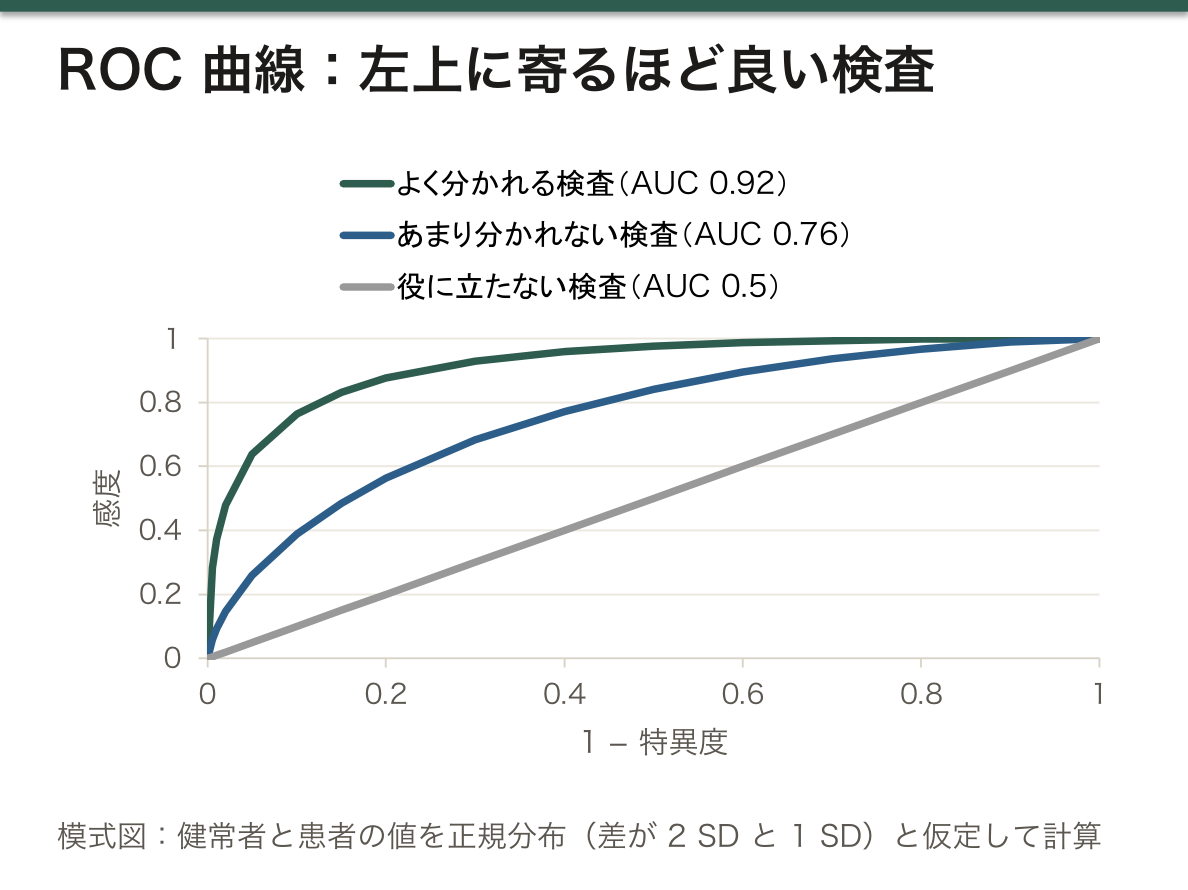
「感度と特異度は検査の性質、的中率は集団の性質」という区別が、この項の核心になる。同じ検査でも、有病率が違えば陽性の意味が変わる(この章の事前確率の項)——「検査は同じでも、答えは違う」。
だから「感度が高い検査で陰性なら除外する」という使い方が成り立つ。ただし事前確率が高すぎると、陰性でも除外できない(胸を読む章)——「D-ダイマーは、可能性が低い患者にだけ意味がある」。
尤度比を使うと、検査の前後で確率がどう動いたかを1つの数字で言える(読影という思考の章)——「陽性尤度比 10 以上、陰性尤度比 0.1 以下が、実用上の目安になる」。
カットオフの設定は、医学だけでは決まらない。見逃しの害と、偽陽性による害(不安・追加検査・侵襲)を比べて決める(スクリーニングの章)——「どちらの間違いが重いかは、病気と社会の側の問題になる」。
AUC が高くても、臨床で役立つとは限らない——「意思決定を変えない検査は、性能が良くても意味を持たない」。
English version
Core
A test giving a continuous value is neither positive nor negative until where to cut is decided.
Lower the cut-off and sensitivity rises while specificity falls. Raise it and the reverse.
The ROC curve — sensitivity on the vertical axis and "1 − specificity" on the horizontal, drawn by moving the cut-off. The nearer the area under the curve (AUC) is to 1, the better the test performs.
| Use | What is given priority | Example |
|---|---|---|
| Do not want to miss it (want to exclude) | Sensitivity | Screening, D-dimer |
| Want to confirm it | Specificity | Confirmatory test, biopsy |
The likelihood ratio expresses the strength of a result independently of the cut-off — positive likelihood ratio = sensitivity ÷ (1 − specificity).
Going further
- The core of this section is the distinction "sensitivity and specificity are properties of the test; predictive value is a property of the population". With the same test, a different prevalence changes the meaning of a positive (the section on prior probability in this chapter) — the test is the same and the answer is different.
- Hence the use "a negative on a sensitive test excludes it" holds. But if the prior probability is too high, even a negative does not exclude (the chapter on reading the chest) — D-dimer has meaning only in a patient in whom the possibility is low.
- With a likelihood ratio, how the probability moved before and after the test can be said in one number (the chapter on reporting as a form of thought) — a positive likelihood ratio of 10 or more and a negative of 0.1 or less are the practical guides.
- Setting the cut-off is not decided by medicine alone. It is decided by weighing the harm of missing against the harm of a false positive (anxiety, further tests, invasiveness) (the chapter on screening) — which error is graver is a question for the disease and for society.
- A high AUC does not mean it is useful in the clinic — a test that does not change a decision has no meaning however well it performs.
基準範囲 — 「正常」とは、健常者の95%が入る幅でしかない
基準範囲は、選ばれた健常者集団の測定値の中央 95%(平均±2標準偏差)として定める。
だから健常者でも 5% は外れる。
検査を n 個並べれば、すべてが範囲内に入る確率は 0.95ⁿ になる——20項目なら約 36%、つまり健常者の約3分の2で、どれか1つは異常値になる。
基準範囲と、病気を分ける値(臨床判断値)は別になる——「LDL コレステロール 140 mg/dL、HbA1c 6.5% は、基準範囲ではなく判断値になる」。
年齢・性・妊娠・人種・測定法で変わる。
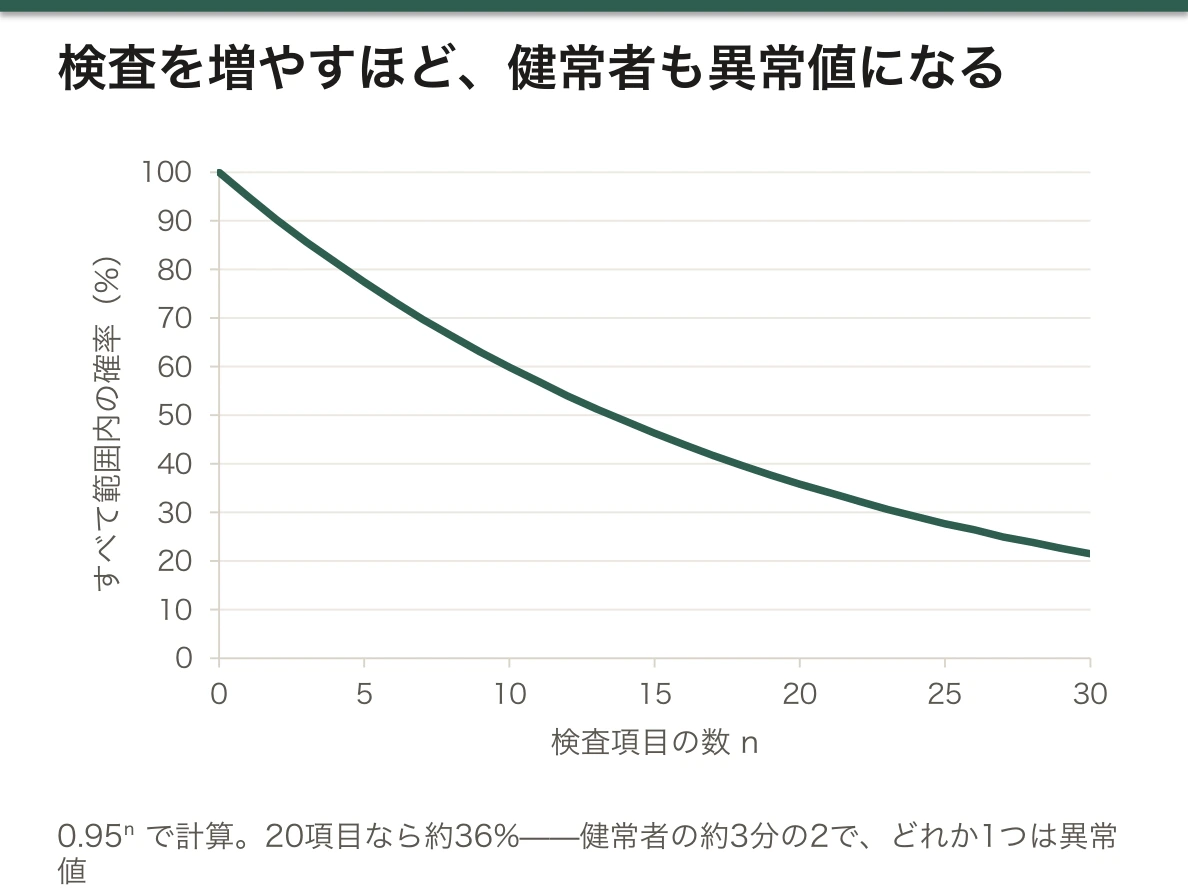
「異常値イコール病気ではない」という一点が、実務でいちばん効く。検査を増やすほど、偽陽性が確率的に増える(この章の事前確率の項)——「網羅的に測ることが、患者に不利益を与えうる」。
だから検査は仮説を持って選ぶ(病理診断の実際の章)——「何を確かめたいのか言えない検査は、出さないほうがよい」。
個人内変動と、集団間変動の違いも押さえる。ある人にとっての「いつもの値」が、基準範囲の端にあることは珍しくない——「前回値との比較が、基準範囲より情報を持つことがある」。
小児と高齢者では、そもそも基準が違う(小児の正常値の章)——「成人の基準範囲を当てはめると、正常な成長を異常と読む」。
測定法が変われば、数値そのものが変わる(酵素を測るときの落とし穴の項)——「施設をまたいで数値を比べるときは、方法を確認する」。
English version
Core
A reference range is defined as the central 95 per cent (mean ± 2 standard deviations) of the values of a selected healthy population.
So 5 per cent of healthy people fall outside it.
Line up n tests and the probability that all fall within the range is 0.95ⁿ — with 20 tests about 36 per cent, that is, in about two thirds of healthy people one value or another is abnormal.
A reference range and a value that divides disease (a clinical decision value) are different — LDL cholesterol 140 mg/dL and HbA1c 6.5 per cent are decision values, not reference ranges.
It varies with age, sex, pregnancy, ethnicity and method.
Going further
- The single point "an abnormal value is not a disease" tells most in practice. The more tests are added, the more false positives appear by probability alone (the section on prior probability in this chapter) — measuring comprehensively can do the patient harm.
- Hence choose tests with a hypothesis (the chapter on pathological diagnosis in practice) — a test for which one cannot say what is to be confirmed is better not ordered.
- Hold also the difference between within-person and between-person variation. It is not unusual for a person’s "usual value" to lie at the edge of the reference range — comparison with the previous value sometimes carries more information than the reference range.
- In children and the elderly the standards differ in the first place (the chapter on normal values in children) — apply the adult reference range and normal growth is read as abnormal.
- Change the method and the numbers themselves change (the section on the pitfalls of measuring enzymes) — when comparing values across institutions, check the method.
単位が違えば、同じ数字が別の意味になる
日本と欧米で、同じ検査項目でも使う単位が違うことがある。欧米の教科書や論文で学びながら日本で国家試験を受けるなら、両方を行き来できる必要がある。
| 血糖 | 日本 mg/dL / 欧州 mmol/L | ÷18。100 mg/dL ≒ 5.6 mmol/L |
| 総コレステロール・LDL | 同上 | ÷38.7。200 mg/dL ≒ 5.2 mmol/L |
| 中性脂肪 | 同上 | ÷88.6 |
| クレアチニン | 日本 mg/dL / 欧州 μmol/L | ×88.4。1.0 mg/dL ≒ 88 μmol/L |
| ビリルビン | 同上 | ×17.1 |
| 尿素 | 日本は BUN(窒素として)/欧州は尿素そのもの | ×2.14。測っている分子が違うので単位換算だけでは足りない |
換算係数は分子量から出るので、暗記でなく導ける。グルコースの分子量 180 → mg/dL を mmol/L にするには 18 で割る、という具合である。
同じ単位でも、測定法が違えば数値が違う。
- HbA1c——日本はかつて JDS 値を使っており、国際標準の NGSP 値より 約 0.4% 低かった。2012 年に NGSP へ移行したので、それ以前の日本の論文やカルテの数値は、そのまま比較できない
- クレアチニン——酵素法と Jaffe 法で値が違う。eGFR の推算式は、測定法と人種で係数が違う(日本人の式、欧米の式、いずれも同じ Cr から別の eGFR を出す)
- ALP——日本は 2020 年前後に JSCC 法から IFCC 法へ移行し、基準値がおよそ 3 分の 1 になった。古い値と新しい値が同じカルテに並ぶので、「急に下がった」と誤読しない
⚠️ 検査値を見るときは、3 つを確認する習慣をつける。単位・測定法・その施設の基準範囲。教科書の数値をそのまま当てはめると、判断を誤る。
薬の量にも同じ問題がある。製剤によって「塩の量」か「有効成分の量」かが違うことがあり、国際的な処方の読み替えでは注意が要る。ヨーロッパで学んだ処方を日本でそのまま書かない——商品名・剤形・単位のすべてを確認する。
海外の文献やガイドラインを読むときは、まず単位を確認する。mmol/L の数値を mg/dL のつもりで読むと、桁を誤る。
English version
Core
Japan and Europe sometimes use different units for the same test. Learning from European and American textbooks and papers while sitting the national examination in Japan, one must be able to move between the two.
| Blood glucose | Japan mg/dL / Europe mmol/L | ÷18. 100 mg/dL ≈ 5.6 mmol/L |
| Total and LDL cholesterol | The same | ÷38.7. 200 mg/dL ≈ 5.2 mmol/L |
| Triglyceride | The same | ÷88.6 |
| Creatinine | Japan mg/dL / Europe μmol/L | ×88.4. 1.0 mg/dL ≈ 88 μmol/L |
| Bilirubin | The same | ×17.1 |
| Urea | Japan uses BUN (as nitrogen) / Europe urea itself | ×2.14. The molecule measured differs, so converting units alone is not enough |
The conversion factors come from the molecular weight, so they can be derived rather than memorised. Glucose has a molecular weight of 180 → to turn mg/dL into mmol/L, divide by 18, and so on.
Going further
Even in the same units, a different method gives a different number.
- HbA1c — Japan formerly used the JDS value, about 0.4 per cent lower than the international NGSP value. It moved to NGSP in 2012, so Japanese papers and records from before then cannot be compared directly.
- Creatinine — the enzymatic and Jaffe methods give different values. The estimating equations for eGFR have different coefficients by method and by ethnicity (the Japanese equation and the Western equations give different eGFRs from the same creatinine).
- ALP — Japan moved from the JSCC to the IFCC method around 2020 and the reference range became roughly one third. Old and new values sit side by side in the same record, so do not misread it as "a sudden fall".
⚠️ Make it a habit to check three things when looking at a laboratory value. The unit, the method, and that institution’s reference range. Applying textbook figures directly leads to error.
The same problem exists with doses of drugs. Whether a preparation is stated as the amount of salt or the amount of active ingredient differs, and care is needed when reading prescriptions across countries. Do not write a prescription learned in Europe unchanged in Japan — check the brand name, the formulation and the units, all of them.
In the clinic
When reading foreign literature or guidelines, check the units first. Read a figure in mmol/L as though it were mg/dL and the order of magnitude is wrong.
ベッドサイドで測るということ — POCT の利点と限界
検査室へ送らず、その場で測る方法を POCT という。速さと引き換えに、精度と条件の許容範囲が狭くなる。
| 血糖自己測定 | 数秒 | ⚠️ 低血糖域と高血糖域で誤差が大きい。貧血・多血・脱水・末梢循環不全で狂う |
| 血液ガス | 1〜2 分 | 気泡の混入で PaO2 が上がり PaCO2 が下がる。氷冷せず速やかに測る |
| 迅速抗原検査 | 10〜15 分 | 感度が低い。陰性でも否定できない |
| トロポニン・BNP・D ダイマー | 15 分程度 | 救急の判断を速める。中央検査室の値とは一致しないことがある |
血糖測定器の干渉は、実際に事故を起こしてきた。かつて一部の測定法はマルトースやガラクトース、腹膜透析液のイコデキストリンをブドウ糖として読み、実際は低血糖なのに正常と表示された。インスリンが追加投与されて死亡例も出ている。
POCT を正しく使うための考え方は3つに整理できる。
- 結果が行動を変えるときだけ使う——「速く分かる」こと自体には価値がない。その場で治療が変わるなら意味がある
- 臨床像と合わなければ、正式な検査で確かめる——装置は疑うべき対象である。特に血糖が臨床像と合わないときは静脈血で測り直す
- 誰でも測れることが、品質管理を難しくする——検査技師以外が操作するので、定期的な精度管理と教育が仕組みとして要る
感度の低い迅速検査の扱い方も、事前確率で決まる。
| 陽性 | 特異度が高いのでほぼ確定してよい | 治療を始める |
| 陰性で、疑いが低い | 否定してよい | 経過を見る |
| 陰性で、疑いが強い | 否定できない | PCR など感度の高い検査へ進む、または臨床診断で治療する |
「陰性だったから違う」と言えるかどうかは、検査の性能だけでなく、目の前の患者の事前確率で決まる。同じ陰性でも、流行期と非流行期では意味が違う。
血糖値が症状と合わないときは、簡易測定器を信用しない。意識障害の患者では、静脈血で確認するまで判断を保留する。
English version
Core
Measuring on the spot rather than sending to the laboratory is point-of-care testing (POCT). In exchange for speed, the precision and the tolerance of conditions are narrower.
| Self-monitoring of blood glucose | Seconds | ⚠️ The error is large in the hypoglycaemic and hyperglycaemic ranges. It is disturbed by anaemia, polycythaemia, dehydration and poor peripheral perfusion |
| Blood gas | 1–2 minutes | An air bubble raises the PaO2 and lowers the PaCO2. Measure promptly without icing |
| Rapid antigen test | 10–15 minutes | Low sensitivity. A negative does not exclude |
| Troponin, BNP, D-dimer | About 15 minutes | They speed emergency decisions. They may not agree with the central laboratory’s values |
Interference with glucose meters has actually caused accidents. Some methods once read maltose, galactose and the icodextrin of peritoneal dialysis fluid as glucose, and displayed a normal value when the patient was in fact hypoglycaemic. Insulin was given in addition and deaths occurred.
Going further
The thinking needed to use POCT properly comes to three points.
- Use it only when the result changes what is done — "knowing sooner" has no value in itself. It has meaning if the treatment changes on the spot.
- If it does not fit the clinical picture, confirm with the formal test — the device is a legitimate object of doubt. Especially, when the glucose does not fit the picture, remeasure on venous blood.
- That anyone can measure makes quality control difficult — non-laboratory staff operate it, so regular quality assurance and training are needed as a system.
How to handle an insensitive rapid test is also decided by the prior probability.
| Positive | Specificity is high, so it may be taken as confirmed | Begin treatment |
| Negative with low suspicion | It may be excluded | Watch the course |
| Negative with strong suspicion | It cannot be excluded | Proceed to a sensitive test such as PCR, or treat on the clinical diagnosis |
Whether one can say "it was negative, so it is not that" is decided not only by the performance of the test but by the prior probability of the patient in front of you. The same negative means something different in and out of an epidemic.
In the clinic
When the blood glucose does not fit the symptoms, do not trust the meter. In a patient with impaired consciousness, withhold judgement until it is confirmed on venous blood.
まとめ
| 測り方の原理と、結果の限界 | 技術測るもの臨床での使われ方タンデム質量分析分子の質量電荷比新生児マススクリーニング・薬物血中濃度・ビタミンD質量分析による微生物同定菌体蛋白の型培養コロニーから数分で菌種を同定次… |
|---|---|
| 検査の性能を数字で言う — 感度・特異度と、事前確率 | 検査の性能は2つの層に分かれる。層指標性質検査そのもの感度・特異度・尤度比有病率に左右されない目の前の患者陽性的中率・陰性的中率有病率に強く左右される陽性尤度比 = 感度 ÷(1… |
| ROC 曲線とカットオフ — 感度と特異度は、取引の関係にある | 連続値の検査は、どこで区切るかを決めなければ陽性・陰性にならない。 |
| 基準範囲 — 「正常」とは、健常者の95%が入る幅でしかない | 基準範囲は、選ばれた健常者集団の測定値の中央 95%(平均±2標準偏差)として定める。 |
| 単位が違えば、同じ数字が別の意味になる | 日本と欧米で、同じ検査項目でも使う単位が違うことがある。 |
| ベッドサイドで測るということ — POCT の利点と限界 | 検査室へ送らず、その場で測る方法を POCT という。 |
このノートは医学生が授業の内容を自分の言葉でまとめたもので、診療の判断に使うものではありません。誤りに気づいたらお知らせください。