Parsons の「病人役割」は医療社会学で最も引用される概念である。4つの要素を順に言えるようにしておく。
この理論の核心は「病気は生物学的な状態であると同時に、社会的に承認された地位である」という視点である。
- Parsons の病人役割 — 2つの免除と2つの義務
- 役割の非対称はなぜ生じるか — 慢性疾患での病人役割
- Parsons の遺産と、Freidson の病い理論
Parsons の病人役割 — 2つの免除と2つの義務
Talcott Parsons(1951)は、病気を社会にとっての逸脱(deviance)と捉えた。働けない人が増えれば社会システムの機能が損なわれるので、社会は病気を一時的に承認された役割として管理する。
病人役割の4つの側面:
| 内容 | |
|---|---|
| 免除① | 通常の社会的役割(仕事・家事)から免除される |
| 免除② | 病気になったことについて責められない(自力では治せない) |
| 義務① | 回復しようと努める義務(病気であることを望んではならない) |
| 義務② | 専門家の援助を求め、協力する義務 |
医師は「病人役割への入場を許可するゲートキーパー」として位置づけられる。
役割の非対称性(asymmetry)が生じる理由を Parsons は3つ挙げた:①知識の格差(医師は専門知識を持つ)②患者の脆弱性(不安と依存)③医師の職業的権威(免許と社会的信任)。医師には affective neutrality(感情的中立)・universalism(普遍主義)・functional specificity(機能限定)・collectivity orientation(集団志向) が求められるとされた。
最大の批判は「慢性疾患に当てはまらない」ことである。糖尿病・関節リウマチ・HIV・障害では、①回復が前提にできない、②役割免除が永続すると社会が成り立たない、③自己管理が中心で「専門家に従う」だけでは足りない。だから慢性疾患では、病人役割ではなく impaired role(回復を前提としない役割)や、後の self-management の枠組みが必要になる。
「責められない」という条件も揺らいでいる。喫煙による肺癌、肥満による糖尿病、生活習慣という言葉そのものが個人の責任を含意する。「victim blaming(被害者非難)」として批判される現象は、Parsons の第2の免除が実際には取り消されていることを意味する。
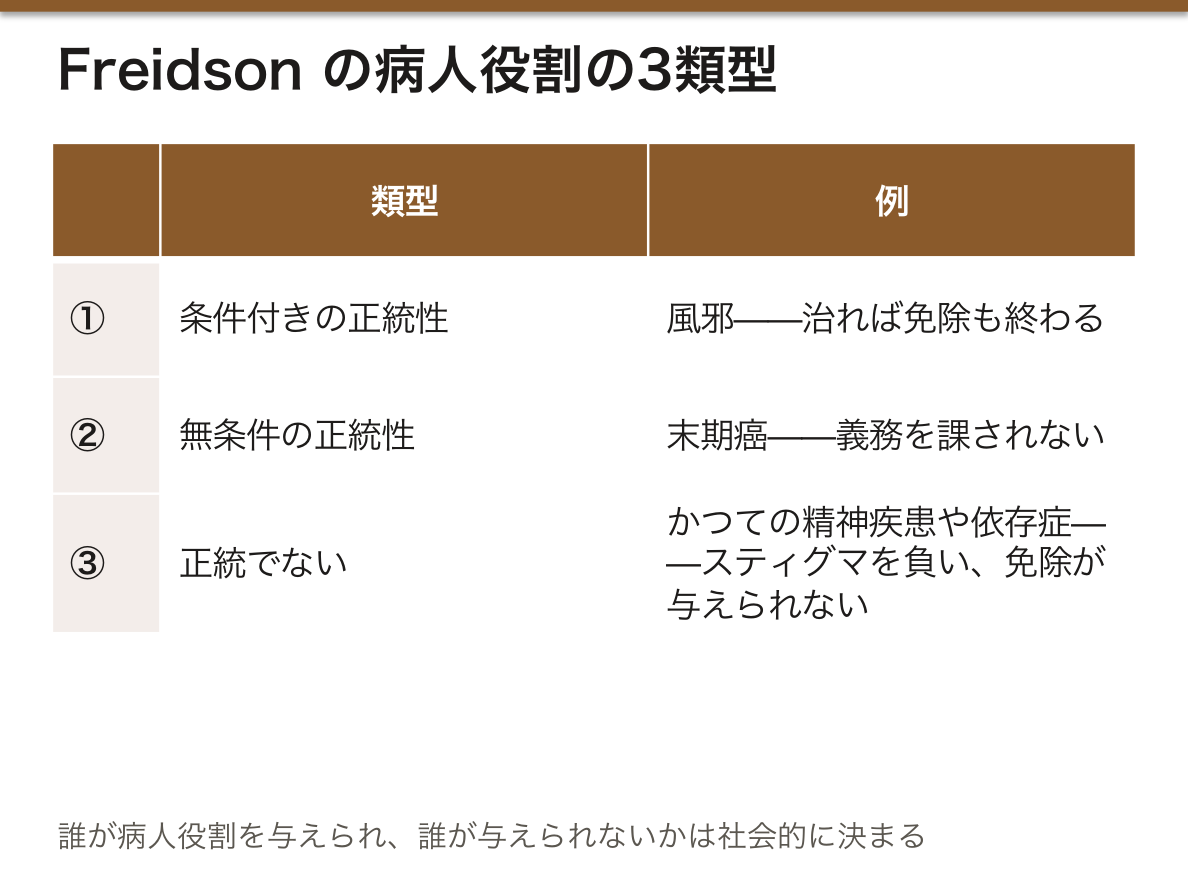
Freidson(1970)の修正:病人役割は一律ではなく、正統性(legitimacy)と重症度によって3類型に分かれる——①条件付き正統(conditional)=風邪(治れば復帰)、②無条件正統(unconditionally legitimate)=癌(義務が免除される)、③非正統(illegitimate)=スティグマを伴うもの(精神疾患・依存症・かつての HIV)。「病気になっても病人役割を与えられない人がいる」という指摘が Freidson の貢献である。
English version
Core
Talcott Parsons (1951) conceived illness as deviance from the point of view of society. If more people cannot work the social system is impaired, so society manages illness as a temporarily sanctioned role.
The four aspects of the sick role:
| Content | |
|---|---|
| Exemption ① | Exemption from ordinary social roles (work, household) |
| Exemption ② | Not held responsible for being ill (one cannot get well by oneself) |
| Obligation ① | The obligation to try to get well (one must not want to be ill) |
| Obligation ② | The obligation to seek expert help and to cooperate |
The doctor is placed as the gatekeeper who authorises entry into the sick role.
Going further
Parsons gave three reasons for the asymmetry of the roles: ① the gap in knowledge (the doctor has expertise) ② the patient’s vulnerability (anxiety and dependence) ③ the doctor’s professional authority (licence and social trust). The doctor was held to require affective neutrality, universalism, functional specificity and collectivity orientation.
The chief criticism is that it does not fit chronic disease. In diabetes, rheumatoid arthritis, HIV and disability, ① recovery cannot be presupposed, ② society cannot function if the exemption is permanent, ③ self-management is central and "obeying the expert" is not enough. So chronic disease needs the impaired role (a role not presupposing recovery), or the later framework of self-management, rather than the sick role.
The condition of "not being blamed" has also become unstable. Lung cancer from smoking, diabetes from obesity, and the very phrase "lifestyle disease" imply individual responsibility. The phenomenon criticised as "victim blaming" means that Parsons’s second exemption is in practice withdrawn.
Freidson’s (1970) revision: the sick role is not uniform but divides into three by legitimacy and severity — ① conditionally legitimate = a cold (one returns on recovery), ② unconditionally legitimate = cancer (obligations are waived), ③ illegitimate = conditions carrying stigma (mental illness, addiction, HIV in the past). "There are people who fall ill and are not granted the sick role" is Freidson’s contribution.
役割の非対称はなぜ生じるか — 慢性疾患での病人役割
Parsons は医師‐患者関係を対等ではないものとして描いた。非対称の理由は3つ。
①知識の格差——医師は専門知を持ち、患者は持たない。②患者の脆弱さ——病んでいる側は不安で判断力が落ちている。③医師の「感情中立性」と普遍主義——医師は誰に対しても同じ基準で接することが求められ、そのぶん距離が生まれる。
病人役割は慢性疾患には当てはまらない——これが最大の批判。①「回復する義務」が果たせない ②「通常の役割からの免除」が一生続くと社会が成り立たない ③糖尿病や喘息では患者自身が管理の主体で、受動的ではない。Parsons のモデルは急性疾患を前提にしていると言えれば足りる。
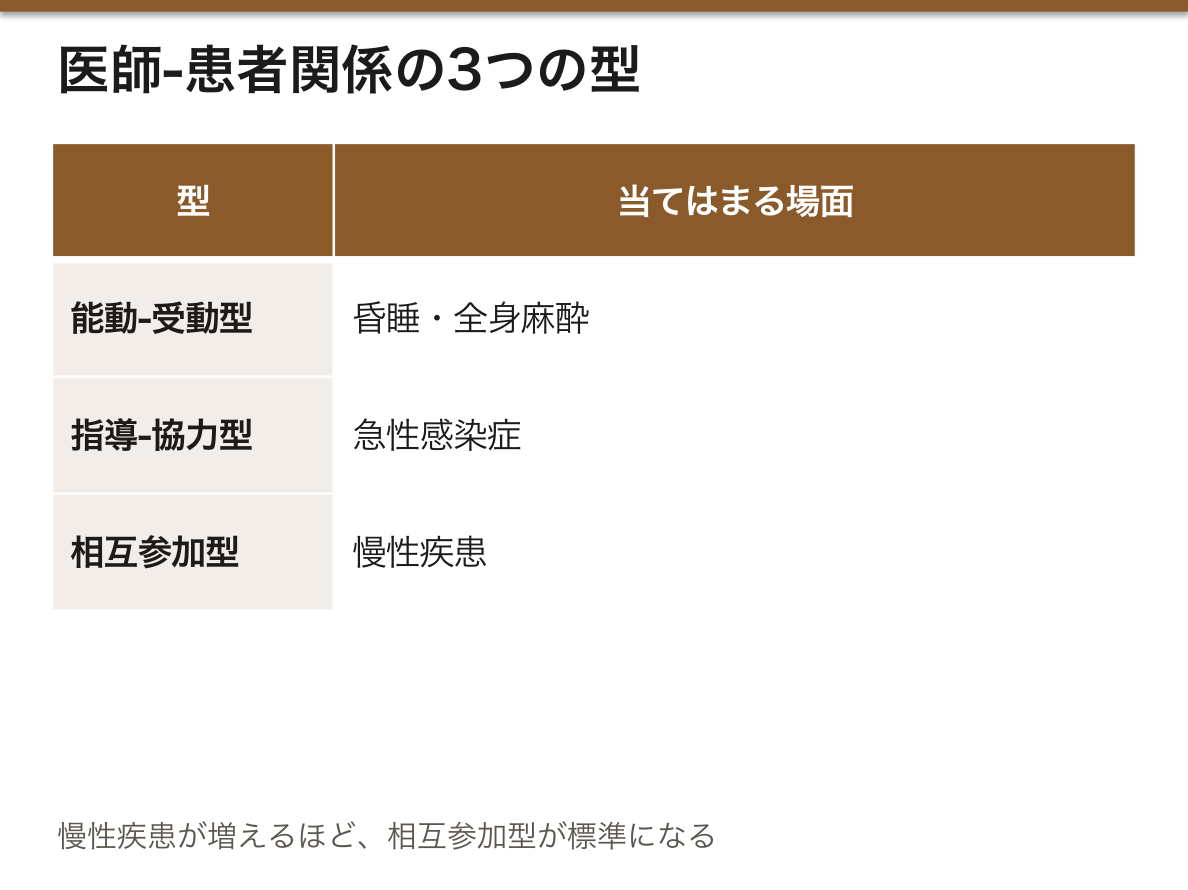
そこで Szasz と Hollender(1956)は関係を3型に分けた——能動‐受動型(昏睡・全身麻酔)、指導‐協力型(急性感染症)、相互参加型(慢性疾患)。慢性疾患が増えるほど3番目が標準になる。
English version
Core
Parsons portrayed the doctor–patient relationship as not between equals. There are three reasons for the asymmetry.
① The gap in knowledge — the doctor has expert knowledge and the patient does not. ② The patient’s frailty — the one who is ill is anxious and judges less well. ③ The doctor’s affective neutrality and universalism — the doctor is required to treat everyone by the same standard, and distance results.
The sick role does not fit chronic disease — this is the chief criticism. ① The "obligation to recover" cannot be fulfilled ② society cannot function if the "exemption from ordinary roles" lasts a lifetime ③ in diabetes and asthma the patient is the agent of management and is not passive. It suffices to be able to say that Parsons’s model presupposes acute disease.
Going further
Szasz and Hollender (1956) therefore divided the relationship into three types — activity–passivity (coma, general anaesthesia), guidance–cooperation (acute infection), mutual participation (chronic disease). The more chronic disease there is, the more the third becomes the standard.
Parsons の遺産と、Freidson の病い理論
遺産——Parsons は「病いは単なる生物学的状態ではなく、社会的に承認された役割である」ことを最初に示した。病いを逸脱 deviance として捉え、医師を社会統制の担い手(gatekeeper)と位置づけた枠組みは、いまも議論の出発点である。
Freidson(1970)の修正——彼は「病人役割は1つではない」とし、①正統性が認められるか ②深刻さの2軸で分けた。条件付きの正統性(風邪——治れば免除も終わる)、無条件の正統性(末期癌——義務を課されない)、正統でない(かつての精神疾患や依存症——スティグマを負い、免除が与えられない)。
要点は「誰が病人役割を与えられ、誰が与えられないか」が社会的に決まるということ。ここに医療専門職の権力がある。
Freidson は専門職支配 professional dominance の概念でも知られる。医師は「何が病気か」を定義する権限を独占しており、それこそが権力の源泉だと論じた。これが「医学の黄金時代」の章の医療帝国主義と医療支配の衰退につながる。
English version
Core
The legacy — Parsons was the first to show that illness is not merely a biological state but a socially sanctioned role. The framework of conceiving illness as deviance and placing the doctor as an agent of social control (a gatekeeper) is still the point of departure for debate.
Freidson’s (1970) revision — he held that there is not one sick role, and divided it on two axes, ① whether legitimacy is granted and ② severity. Conditional legitimacy (a cold — the exemption ends on recovery), unconditional legitimacy (terminal cancer — no obligations are imposed), illegitimate (mental illness and addiction in the past — stigma is borne and no exemption is granted).
The point is that who is granted the sick role and who is not is socially decided. Here lies the power of the medical profession.
Going further
Freidson is known also for the concept of professional dominance. He argued that doctors monopolise the authority to define what counts as disease, and that this is the source of their power. This leads into medical imperialism and the decline of medical dominance in the chapter on the golden age of medicine.
まとめ
| Parsons の病人役割 — 2つの免除と2つの義務 | Talcott Parsons(1951)は、病気を社会にとっての逸脱(deviance)と捉えた。 |
|---|---|
| 役割の非対称はなぜ生じるか — 慢性疾患での病人役割 | Parsons は医師‐患者関係を対等ではないものとして描いた。 |
| Parsons の遺産と、Freidson の病い理論 | 遺産——Parsons は「病いは単なる生物学的状態ではなく、社会的に承認された役割である」ことを最初に示した。 |
このノートは医学生が授業の内容を自分の言葉でまとめたもので、診療の判断に使うものではありません。誤りに気づいたらお知らせください。