医学の権威が高まり、そして揺らいだ過程を扱う章である。
CAM をどう扱うかは、将来どの科に進んでも必ず直面する。頭から否定するのでも受け入れるのでもなく、「何が起きているのか」を分析できることが目標。
- 医学の黄金時代と、医療支配の衰退
- CAM と通常医療(EBM)の比較 — 文化帝国主義の論点
- CAM の安全性と有効性 — プラセボと魔術的思考
- CAM の特徴 — 全体論・生気論・自然治癒・自己責任
- 患者中心のケアと統合医療
- 生涯発達理論(LCT)
- 批判的実在論 — 行為と構造の第三の道
- 医学の未来 — ポストトゥルース・環境・人口・ハイブリッド戦
医学の黄金時代と、医療支配の衰退
医学の黄金時代(golden age of medicine)=おおむね1945〜1970年代。特徴は3つ。
- Medical gaze(臨床のまなざし)の確立——身体を客観的に読む視線
- 治療の有効性——抗菌薬・ワクチン・外科の飛躍的進歩
- 国民保健サービスの創設——医療へのアクセスの制度化(英 NHS 1948 ほか)
その帰結としてmedical imperialism(医療帝国主義)——出産・老い・死・不幸・逸脱といった生活の領域が次々に医療の管轄に取り込まれた(医療化 medicalization)。
衰退(decline of medical dominance)の要因:慢性疾患で治せないことが露呈、医原病(Illich)、消費者運動と患者の権利、インターネットによる知識の分散、EBM が医師個人の裁量を制約、そして COVID-19 後の専門知への不信。
CAM(補完代替医療)の特徴は5つ:①ホリズム(全体を診る)②生気論(生命力という概念)③スピリチュアリティ ④自然治癒 ⑤自己責任。EBM(conventional medicine)との対比で整理すると、CAM が提供しているのは「治療」だけでなく「意味」と「時間」と「主体性」であることが見えてくる。患者が CAM に向かう理由は効果への期待だけではない——このことが Sointu の議論の核心である。
安全性と有効性:多くの CAM はプラセボ効果と自然経過で説明できる範囲を超えない。危険は2種類——直接的(生薬の肝毒性・重金属混入・相互作用)と間接的(最も重大)——有効な治療を受ける機会を失うこと。「無害だから試させてよい」とは限らない。
西洋の文化的帝国主義という論点:EBM を唯一の基準とすることが、非西洋の伝統医療を「非科学」として周縁化してきたという批判。ただしこの相対化を徹底すると、有効性の検証そのものが成り立たなくなる——講義はこの緊張を解消せずに提示する。
患者中心の統合ケア(integrative care)が実務上の答えとされる:患者が CAM を使っていることを非難せずに把握し、相互作用と機会損失を管理し、EBM の治療を確保したうえで共存させる。「使うな」ではなく「教えてください」と言えるかどうかが、実際の安全性を決める。
Life Course Theory(生涯発達理論)——健康は人生のどの時点でも同じではなく、①critical/sensitive period(胎児期・乳幼児期の曝露が生涯に影響する。Barker 仮説)②accumulation(不利が積み重なる)③pathway/chain of risk(1つの不利が次を呼ぶ)の3つの機序で軌跡が形づくられる。「いつ介入するか」を設計するための理論である。
Critical realism(批判的実在論・Bhaskar)——構造と行為は実在するが、別々の層にあり、別々に研究できるとする立場。Giddens が両者を融合させたのに対し、「繋がってはいるが同一ではない」と分析的に切り分ける。医療社会学では、生物学的実在(disease)と社会的構成(sickness)をどちらも実在と認めたうえで層を分けて扱える点が利点とされる。
English version
Core
The golden age of medicine = roughly 1945 to the 1970s. It has three features.
- The establishment of the medical gaze — the look that reads the body objectively.
- The efficacy of treatment — the leap of antibiotics, vaccines and surgery.
- The founding of national health services — institutionalised access to care (the NHS in 1948 and others).
Its consequence was medical imperialism — areas of life such as birth, ageing, death, unhappiness and deviance were taken one after another into the jurisdiction of medicine (medicalisation).
The factors in the decline of medical dominance: the exposure of an inability to cure chronic disease, iatrogenesis (Illich), the consumer movement and patients’ rights, the dispersal of knowledge through the internet, evidence-based medicine constraining individual clinical discretion, and distrust of expertise after COVID-19.
Going further
CAM (complementary and alternative medicine) has five features: ① holism (treating the whole) ② vitalism (the notion of a life force) ③ spirituality ④ natural healing ⑤ personal responsibility. Set against EBM (conventional medicine), it becomes visible that what CAM offers is not only "treatment" but meaning, time and agency. Patients turn to CAM not only in the hope of efficacy — this is the core of Sointu’s argument.
Safety and efficacy: most CAM does not exceed what the placebo effect and natural course would explain. The dangers are of two kinds — direct (hepatotoxicity of herbs, contamination with heavy metals, interactions) and indirect, and the graver — the loss of the opportunity to receive effective treatment. "It is harmless, so let them try" does not always hold.
The point about Western cultural imperialism: the criticism that making EBM the sole standard has marginalised non-Western traditional medicine as "unscientific". Yet carry that relativisation through and testing efficacy at all becomes impossible — the lecture presents this tension without resolving it.
Patient-centred integrative care is offered as the answer in practice: find out without reproach that the patient is using CAM, manage interactions and lost opportunities, and let it coexist while securing the EBM treatment. Whether one can say "tell me about it" rather than "do not use it" decides the actual safety.
Life course theory — health is not the same at every point of life, and the trajectory is shaped by three mechanisms: ① critical or sensitive periods (exposure in fetal life and infancy affecting the whole life; the Barker hypothesis) ② accumulation (disadvantages piling up) ③ pathway or chain of risk (one disadvantage calling the next). It is a theory for designing when to intervene.
Critical realism (Bhaskar) — the position that structure and agency are real, lie in different strata, and can be studied separately. Against Giddens’s fusion of the two, it separates them analytically as "connected but not identical". In medical sociology its merit is that biological reality (disease) and social construction (sickness) can both be granted reality and handled in separate strata.
CAM と通常医療(EBM)の比較 — 文化帝国主義の論点
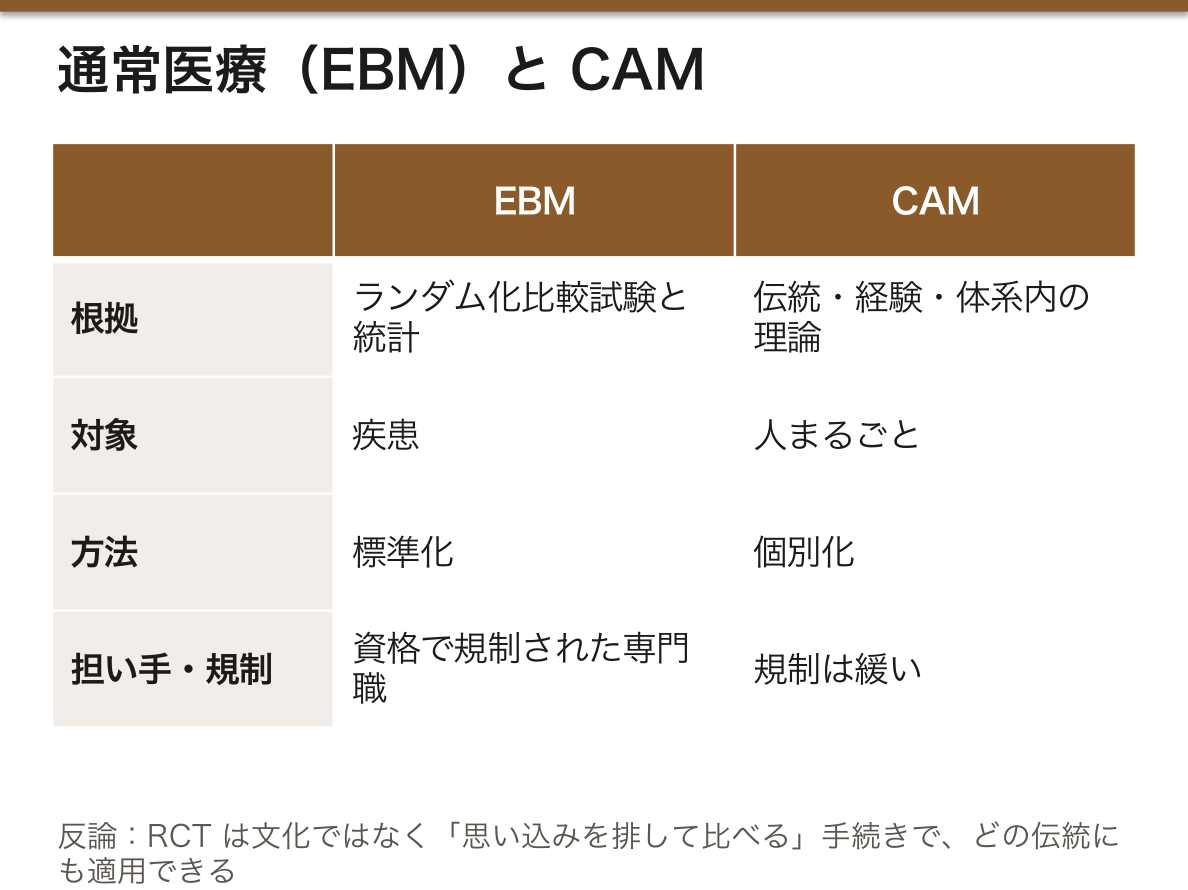
CAM(補完代替医療)と通常医療(EBM)の対比。
EBM——根拠はランダム化比較試験と統計、対象は疾患、方法は標準化、担い手は資格で規制された専門職。CAM——根拠は伝統・経験・体系内の理論、対象は人まるごと、方法は個別化、規制は緩い。
西洋の文化帝国主義という論点——「EBM の物差しで測って効果が無いと切り捨てるのは、西洋近代科学の枠組みを唯一の正統として押しつけることではないか」。実際、アーユルヴェーダや漢方は数千年の体系を持ち、その内部では整合的である。
反論——RCT は文化ではなく「思い込みを排して比べる」手続きであり、どの伝統にも等しく適用できる。この両方を並べて答えるのが正解の形。
WHO は伝統医療の統合を進める一方、安全性と質の担保を条件にしている。ここに折り合いの現実解がある。
English version
Core
The contrast of CAM and conventional medicine (EBM).
EBM — the grounds are randomised trials and statistics, the object is the disease, the method is standardisation, and the practitioners are a profession regulated by licence. CAM — the grounds are tradition, experience and theory internal to the system, the object is the whole person, the method is individualisation, and regulation is loose.
The point about Western cultural imperialism — "is measuring by the yardstick of EBM and discarding what shows no effect not imposing the framework of modern Western science as the sole legitimacy?" Indeed, Ayurveda and kampo have systems thousands of years old and are internally coherent.
The rebuttal — the RCT is not a culture but a procedure for comparing while excluding preconception, and it applies equally to any tradition. Setting out both is the form of the correct answer.
Going further
The WHO promotes the integration of traditional medicine while making the assurance of safety and quality a condition. Here lies the practical compromise.
CAM の安全性と有効性 — プラセボと魔術的思考
有効性——多くの CAM は RCT でプラセボを超えない。ただしプラセボ効果そのものは実在する(疼痛・悪心・抑うつで特に大きい)。CAM は長い診察時間・触れること・物語の共有という、プラセボ効果を最大化する条件を備えている。
安全性——「自然だから安全」は誤り。①直接の害(アリストロキア酸による腎不全、ヨヒンビン)②相互作用(セント・ジョーンズ・ワートは多くの薬の血中濃度を下げる)③最大の害は治療の遅れ——有効な治療を受けずに CAM を選ぶこと。
魔術的思考——類似の法則(似たものは似たものに効く)と感染の法則(一度触れたものは 影響を及ぼし続ける)。ホメオパシーの「希釈するほど強くなる」は後者の典型で、アボガドロ数を超えて希釈された液に原物質は1分子も残らない。
倫理的な難所——プラセボが効くと知りながら処方することは、患者を欺くことにならないか。近年はオープンラベル・プラセボ(偽薬と知らせても効く)の研究がこの問いを動かしている。
English version
Core
Efficacy — most CAM does not exceed placebo in randomised trials. But the placebo effect itself is real (largest in pain, nausea and low mood). CAM has the conditions that maximise it — a long consultation, being touched, and a shared narrative.
Safety — "natural, therefore safe" is false. ① Direct harm (renal failure from aristolochic acid, yohimbine) ② interactions (St John’s wort lowers the levels of many drugs) ③ the greatest harm is delayed treatment — choosing CAM instead of effective treatment.
Magical thinking — the law of similarity (like acts on like) and the law of contagion (what has once been in contact goes on exerting influence). Homeopathy’s "the more dilute the stronger" is the type case of the latter: diluted beyond Avogadro’s number, not one molecule of the original substance remains.
Going further
The ethical difficulty — is prescribing something knowing it works as a placebo not deceiving the patient? Recent research on open-label placebo (which works even when the patient is told it is a placebo) is shifting this question.
CAM の特徴 — 全体論・生気論・自然治癒・自己責任
①全体論 holism——身体・心・霊・環境を一体として扱う。通常医療の還元主義への対抗。
②生気論 vitalism——生命には物理化学に還元できない生命力があるとする(気、プラーナ、生命力)。病気はその流れの乱れと説明される。
③スピリチュアリティ——意味と超越の次元を治療に含める。
④自然治癒——身体には自ら治る力があり、治療者はそれを助けるだけ。
⑤個人の責任——健康は自分の生き方の結果であり、患者は受け手ではなく主体である。
⑤は両刃——主体性を与える一方で、治らないのは努力不足だという非難に転じる。「健康の社会的決定要因」の章の健康主義と同じ構造である点を指摘できると強い。
これらの特徴は「通常医療に足りないもの」を鏡像のように備えている——CAM の人気は、その欠落への需要として社会学的に説明される。
English version
Core
① Holism — body, mind, spirit and environment treated as one. Set against the reductionism of conventional medicine.
② Vitalism — the view that life has a vital force irreducible to physics and chemistry (qi, prana, the vital force). Disease is explained as a disturbance of its flow.
③ Spirituality — including the dimension of meaning and transcendence in treatment.
④ Natural healing — the body has the power to heal itself and the therapist only assists it.
⑤ Personal responsibility — health is the result of how one lives, and the patient is an agent rather than a recipient.
⑤ cuts both ways — it grants agency, and turns into the reproach that failing to get well is a failure of effort. Being able to point out that this is the same structure as the healthism of the chapter on the social determinants of health is strong.
Going further
These features possess, as a mirror image, what conventional medicine lacks — the popularity of CAM is explained sociologically as demand for that absence.
患者中心のケアと統合医療
患者中心のケア——診療の中心を疾患から患者の価値観・選好・生活へ移す。Engel の生物心理社会モデルの実践形。
統合医療 integrative medicine——根拠のある CAM を、通常医療の中に位置づけて併用すること。「代わりに使う(alternative)」のではなく「足して使う(complementary)」。
成立の条件は3つ——①根拠(少なくとも安全性は確認されていること)②透明性(患者が何を受けているか知っていること)③有効な治療を妨げないこと。
現実的な落としどころ——鍼を化学療法の悪心に、マインドフルネスを慢性疼痛に、といった限定的な適応で組み込む。「全否定でも全肯定でもない立場を述べよ」が問いの形である。
公平性の論点も外せない——統合医療は自費が多く、支払える層しか受けられない。アクセスの平等をどう担保するかが課題として挙げられる。
English version
Core
Patient-centred care — moving the centre of practice from the disease to the patient’s values, preferences and life. The practical form of Engel’s bio-psycho-social model.
Integrative medicine — placing CAM for which there is evidence within conventional medicine and using them together. Not "instead of (alternative)" but "in addition to (complementary)".
Three conditions for it to hold — ① evidence (at least that safety is established) ② transparency (that the patient knows what they are receiving) ③ that it does not impede effective treatment.
The practical settlement — building it in for limited indications, such as acupuncture for the nausea of chemotherapy and mindfulness for chronic pain. The question takes the form "state a position that is neither total rejection nor total acceptance".
Going further
The question of equity cannot be omitted — integrative medicine is often paid for privately and only those who can pay receive it. How equality of access is to be secured is raised as the problem.
生涯発達理論(LCT)
生涯発達理論は、健康を人生全体の積み重ねとして見る立場。「いま何をしているか」ではなく「これまで何を経てきたか」が現在の健康を決める。
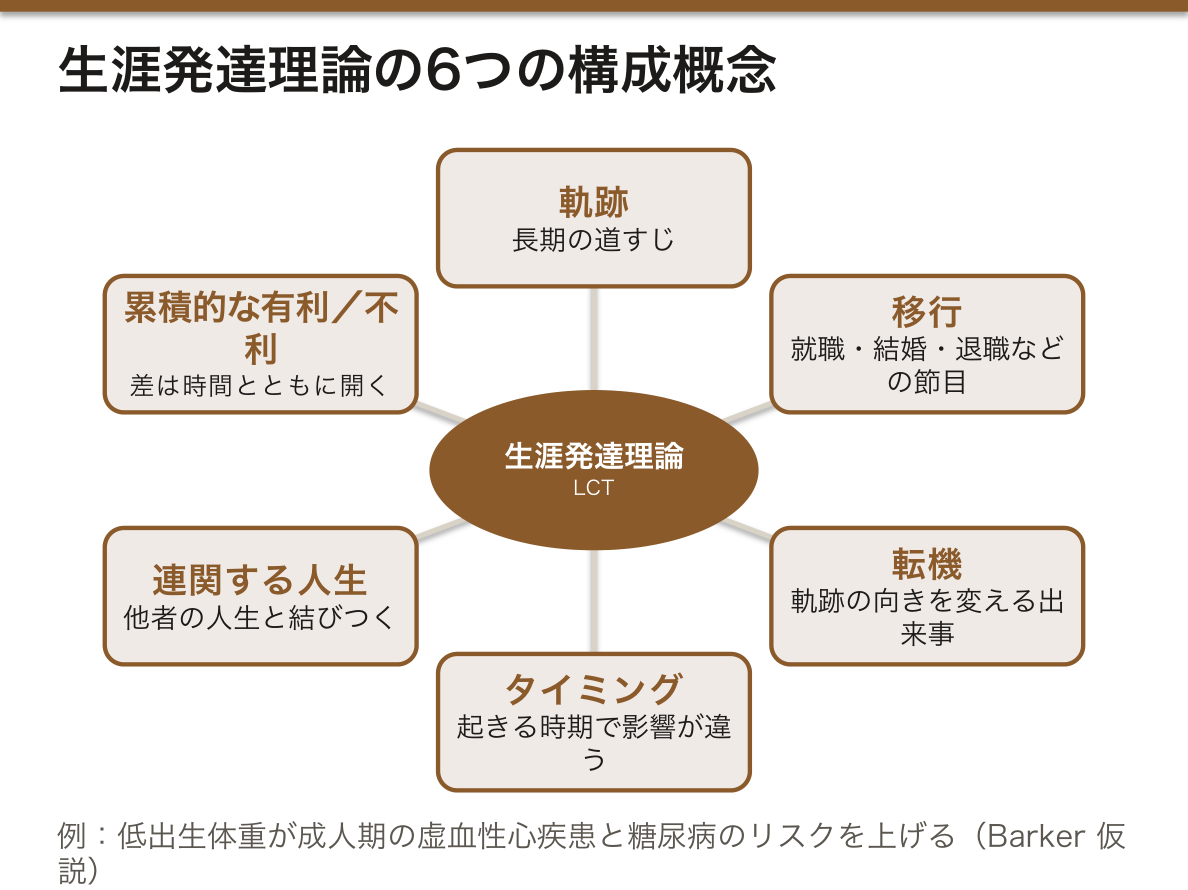
主要な構成概念——①軌跡 trajectory(長期の道すじ)②移行 transition(就職・結婚・退職などの節目)③転機 turning point(軌跡の向きを変える出来事)④タイミング(同じ出来事でも起きる時期で影響が違う)⑤連関する人生 linked lives(他者の人生と結びついている)⑥累積的な有利/不利(差は時間とともに開く)。
健康での代表例は胎生期プログラミング(Barker 仮説)——低出生体重が成人期の虚血性心疾患と糖尿病のリスクを上げる。ACE(小児期の逆境体験)も同じ枠組み。
実務への含意——介入は早いほど効く。妊娠期・乳幼児期への投資が最も費用対効果が高い。
「健康の社会的決定要因」の章の SDOH と接続する。SDOH が横(いまの社会条件)を見るのに対し、LCT は縦(時間)を見る、と対比すると整理しやすい。
English version
Core
Life course theory is the position that sees health as the accumulation of a whole life. What decides present health is not "what one is doing now" but "what one has been through".
The main concepts — ① trajectory (the long path) ② transition (junctures such as starting work, marriage, retirement) ③ turning point (an event that changes the direction of the trajectory) ④ timing (the same event has a different effect according to when it occurs) ⑤ linked lives (bound up with the lives of others) ⑥ cumulative advantage and disadvantage (differences widen with time).
The representative example in health is fetal programming (the Barker hypothesis) — low birth weight raises the risk of ischaemic heart disease and diabetes in adult life. Adverse childhood experiences (ACEs) belong in the same framework.
The implication for practice — the earlier the intervention the better it works. Investment in pregnancy and early childhood is the most cost-effective.
Going further
It connects with the SDOH of the chapter on the social determinants of health. It is easiest to arrange them as a contrast: SDOH looks across (present social conditions), life course theory along (time).
批判的実在論 — 行為と構造の第三の道
批判的実在論(Bhaskar)は、行為と構造の論争への3つ目の答え。
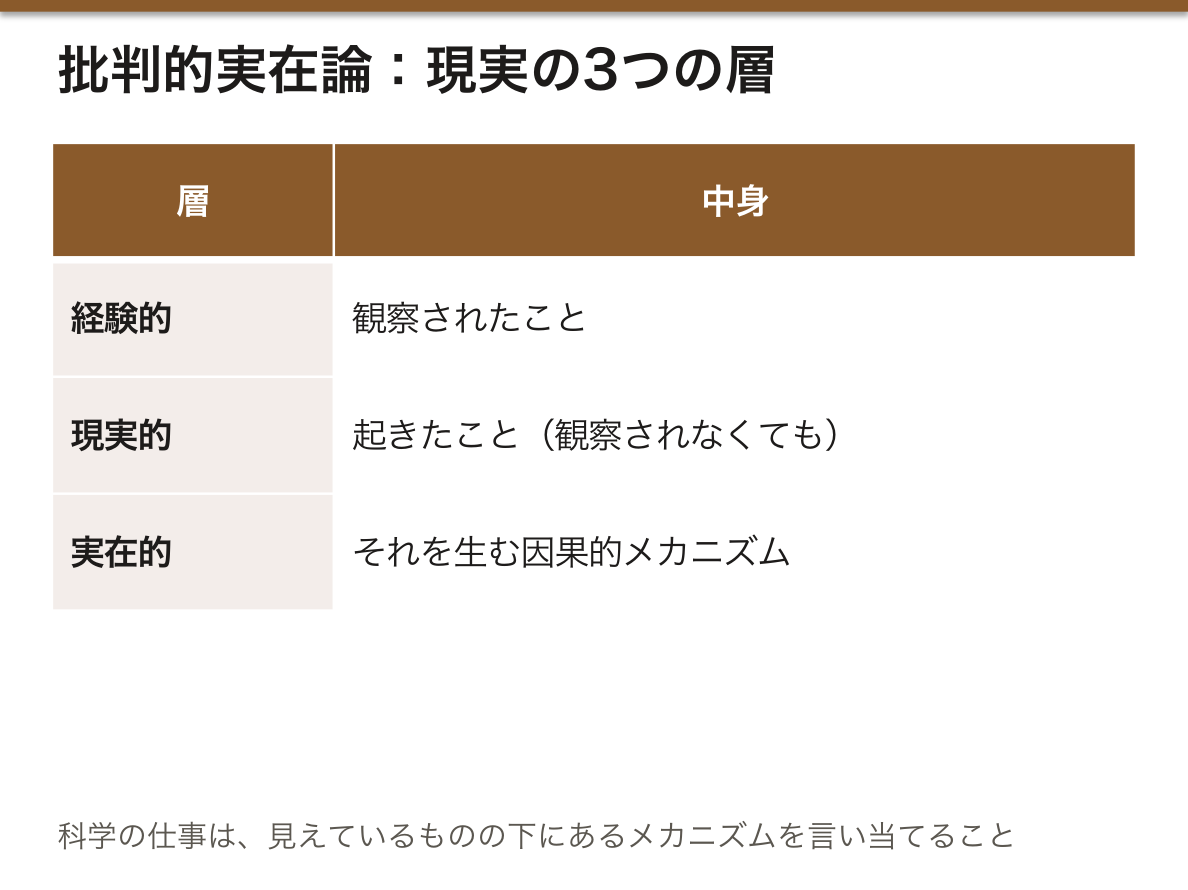
存在論的な主張——現実は3層をなす。経験的(観察されたこと)/現実的(起きたこと、観察されなくても)/実在的(それを生む因果的メカニズム)。科学の仕事は、見えているものの下にあるメカニズムを言い当てること。
行為と構造について——Giddens は両者を一体(構造は行為の中にしか存在しない)とした。批判的実在論は「両者は結びついているが、別々のものとして研究できる」とする(Archer の分析的二元論)。構造は行為に先立って存在し、行為はそれを再生産または変形する——時間差があるからこそ、両者を分けて分析できる。
この「つながっているが、分けて研究できる」が答えの核。
医療社会学での利点——社会構成主義に傾きすぎず、生物学的実在も認めたうえで社会的メカニズムを論じられる。ポストモダンの行き過ぎへの応答として位置づけられる。
English version
Core
Critical realism (Bhaskar) is the third answer to the agency–structure debate.
The ontological claim — reality has three strata. The empirical (what is observed) / the actual (what happens, observed or not) / the real (the causal mechanisms that generate it). The work of science is to name the mechanism beneath what is seen.
On agency and structure — Giddens made them one (structure exists only within action). Critical realism holds that "the two are connected and can be studied as separate things" (Archer’s analytical dualism). Structure exists prior to action, and action reproduces or transforms it — it is because there is a lag in time that the two can be analysed apart.
This "connected, and studiable separately" is the core of the answer.
Going further
Its merit in medical sociology — social mechanisms can be discussed without leaning too far into social constructionism, while granting biological reality as well. It is placed as a response to the excesses of postmodernism.
医学の未来 — ポストトゥルース・環境・人口・ハイブリッド戦
講義が挙げる4つの圧力。
①ポストトゥルース——専門知の権威が下がり、科学的合意が政治的立場として扱われる。医師は知識を伝える者から信頼を交渉する者へ。
②環境リスク——気候変動による熱波・媒介感染症の北上・大気汚染・水不足。健康の最大の決定因が環境になる。
③急激な人口変動——欧州は高齢化と労働力不足、南半球は若年人口の増加。ラトビアは人口減少と医療者の国外流出という二重の圧力を受けている。移民が医療を支える構図。
④ハイブリッド戦——軍事と非軍事の境が曖昧な攻撃。偽情報(ワクチンへの不信を煽る)、病院へのサイバー攻撃、インフラの妨害。医療機関が攻撃対象になる。
4つに共通するのは「医学だけでは解けない」こと。だから医療社会学が要る、というのが講義の締めである。
ラトビアという場所を踏まえると、③と④は抽象論ではない。
English version
Core
The four pressures the lecture names.
① Post-truth — the authority of expertise falls and scientific consensus is treated as a political position. The doctor moves from one who conveys knowledge to one who negotiates trust.
② Environmental risk — heatwaves from climate change, vector-borne disease moving north, air pollution, water shortage. The environment becomes the largest determinant of health.
③ Rapid demographic change — Europe faces ageing and a shortage of labour, the global South a growing young population. Latvia is under the double pressure of population decline and the emigration of health workers. Migrants come to sustain the health service.
④ Hybrid warfare — attacks blurring the line between military and non-military. Disinformation (stirring distrust of vaccines), cyber-attacks on hospitals, disruption of infrastructure. Health institutions become targets.
What the four have in common is that medicine alone cannot solve them. Hence the need for medical sociology — this is how the lecture closes.
Going further
Given where Latvia is, ③ and ④ are not abstractions.
まとめ
| 医学の黄金時代と、医療支配の衰退 | 医学の黄金時代(golden age of medicine)=おおむね1945〜1970年代。 |
|---|---|
| CAM と通常医療(EBM)の比較 — 文化帝国主義の論点 | CAM(補完代替医療)と通常医療(EBM)の対比。 |
| CAM の安全性と有効性 — プラセボと魔術的思考 | 有効性——多くの CAM は RCT でプラセボを超えない。 |
| CAM の特徴 — 全体論・生気論・自然治癒・自己責任 | ①全体論 holism——身体・心・霊・環境を一体として扱う。 |
| 患者中心のケアと統合医療 | 患者中心のケア——診療の中心を疾患から患者の価値観・選好・生活へ移す。 |
| 生涯発達理論(LCT) | 生涯発達理論は、健康を人生全体の積み重ねとして見る立場。 |
| 批判的実在論 — 行為と構造の第三の道 | 批判的実在論(Bhaskar)は、行為と構造の論争への3つ目の答え。 |
| 医学の未来 — ポストトゥルース・環境・人口・ハイブリッド戦 | 講義が挙げる4つの圧力。①ポストトゥルース——専門知の権威が下がり、科学的合意が政治的立場として扱われる。 |
このノートは医学生が授業の内容を自分の言葉でまとめたもので、診療の判断に使うものではありません。誤りに気づいたらお知らせください。