前の章の3理論は「行為の正しさ」を測る物差しだった。この章では、個人と社会のどちらを重く見るかをめぐる2つの立場——連帯を重んじる共同体主義と、個人の自由を重んじるリバタリアニズム——を見たうえで、臨床で最もよく使われる4原則アプローチ(自律尊重・無危害・善行・正義)に進む。
4原則は「答えを出す公式」と誤解されやすい。実際には、何を問うべきかを整理する道具であり、原則どうしがぶつかる場面でこそ考える力が試される。
- 共同体主義 — 個人の善は社会の善と切り離せない
- リバタリアニズムとミルの危害原則
- 消極的自由と積極的自由 — 「邪魔されない」と「本当に選べる」
- 4原則アプローチ — 理論の違いを越えて使える中間の原則
- 自律尊重と無危害 — 「まず害するなかれ」
- 善行・パターナリズム・正義 — 原則どうしがぶつかるとき
共同体主義 — 個人の善は社会の善と切り離せないCommunitarismus
共同体主義は、行為や決定の正しさをそれが社会全体の善に役立つかで測る。キーワードは連帯である。源流はアリストテレスの「人間はポリス的(社会的)動物である」という見方にあり、社会の中で生きることが人間の本性だと考える。ルソーはさらに、全員が参加して決める一般意志に個々人が従うべきだとした。
この見方の核心は、「自己」は社会から切り離されていないという指摘にある。私たちの選択の幅、価値観、記憶、目標は、家族・地域・学校・国・時代によって形づくられている。選ぶ自由はあるが、選べる範囲そのものは自分で選んでいない。だから、どんな共同体で暮らすかが、道徳的な行為の質を大きく左右する。
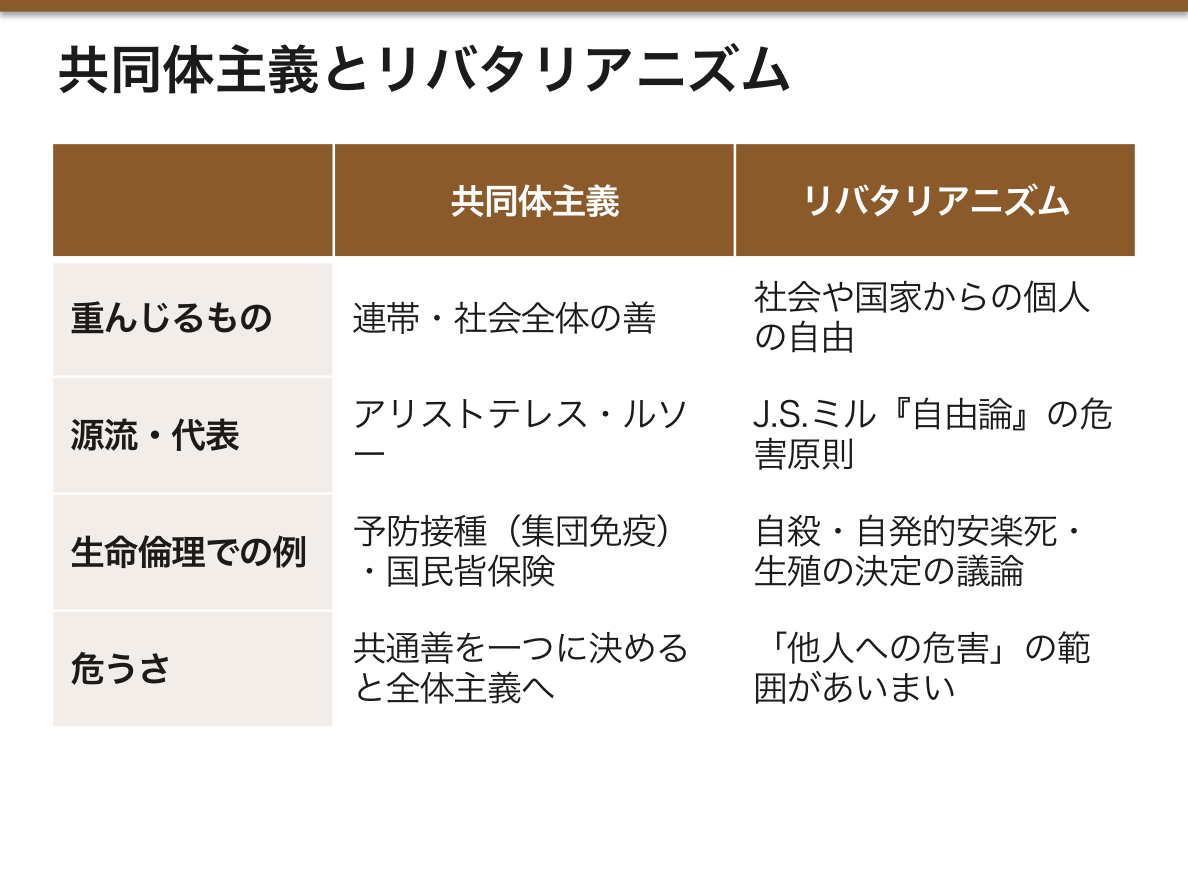
共同体主義の危うさは、共通善をただ一つの形に決めてしまうところにある。「人民の意志」を力で押しつけた20世紀の全体主義国家は、その行き着く先だった。だから現代的な読み方では、地域の問題・弱い立場の人の保護・国際的な正義など、目的の違う多様な共同体が並び立つことを求める。ポパーが「漸進的社会工学」と呼んだ、目の前の悪を一つずつ減らしていくやり方である。
共同体主義はそれ自体で完結した道徳理論ではない。けれども、倫理を個人の選択の問題だけにしないという役割を果たす。患者本人が望む延命治療の中止という決定も、それを病院が認めれば「同じ状態の他の患者にどう影響するか」という政策の問題になる。
公衆衛生は共同体主義の考え方が最も強く出る領域である。予防接種は個人の選択であると同時に、集団免疫という共有財を守る行為でもある。日本の国民皆保険も、病気の人の費用を健康な人を含む全員で支える連帯の仕組みだ。日本の臨床では家族が意思決定に深く関わることが多いが、それは本人の自律を損なう場合もあり、支える場合もある。
English version
Core
Communitarianism judges actions and decisions by whether they serve the good of society as a whole. The key word is solidarity. It goes back to Aristotle’s view that humans are political (social) animals whose nature is to live in society. Rousseau added that each person should follow the general will, decided by everyone together.
Its central point is that the self is not separate from society. Our range of choices, values, memories and goals are shaped by family, neighbourhood, school, nation and era. We are free to choose, but we did not choose the range of options we have. So the kind of community we live in strongly affects the quality of our moral action.
Going further
The danger is fixing the common good in one single form. Twentieth-century totalitarian states that forced the ‘will of the people’ on citizens were where this leads. A modern reading therefore asks for many different communities with different aims — local issues, protection of vulnerable groups, international justice. Popper called this ‘piecemeal engineering’: reducing present evils one by one.
Communitarianism is not a complete moral theory. But it stops ethics from being only about individual choice. A patient’s wish to stop life support, once a hospital accepts it, becomes a policy question: how will it affect other patients in the same condition?
In the clinic
Public health is where communitarian thinking is strongest. Vaccination is an individual choice, but it also protects a shared good, herd immunity. Japan’s universal health insurance is a solidarity system in which everyone, including healthy people, shares the costs of the sick. In Japanese clinical practice families are often deeply involved in decisions; this can either weaken or support the patient’s autonomy.
リバタリアニズムとミルの危害原則
リバタリアニズム(自由至上主義、自由主義的個人主義)は共同体主義と正反対の立場で、社会や国家からの個人の自由を最も重んじる。国家が個人の選択に踏み込める範囲を厳しく限る。
その代表的な原理が、J.S.ミルが『自由論』で示した危害原則である。文明社会の成員に対し、本人の意思に反して力を行使してよい唯一の目的は、他人への危害を防ぐことである。本人のためになるというだけでは理由にならない。自分自身、自分の身体と心に対しては、個人が主権者である。
この原則は生命倫理で、自殺・自発的安楽死・生殖に関する決定などの議論の土台になり、クローンや生殖細胞系の遺伝子改変のように「害が確実には予測できない」新技術を規制する予防原則への反論にも使われる。極端な形では、課税すら合法化された強奪とみなし、他人の福祉に責任を負わないとまで言う。
危害原則には2つの難しさがある。1つは「他人への危害」の範囲である。喫煙は受動喫煙で他人を害し、公的医療費を通じて社会全体の負担にもなる。間接的な影響まで数えれば、ほとんどの行為が他人に関わってしまう。
もう1つは、原則が前提にしているのが判断能力のある成人だという点である。ミル自身、子どもは対象外とした。また、ミルは壊れた橋を渡ろうとする人の例を挙げ、危険を知らずに渡ろうとしているなら引き止めてよいが、知ったうえで渡るなら止められないとした。本人の選択が十分な情報と自発性に基づいているかを確かめるための介入は、自由の侵害ではない——これは後で学ぶ弱いパターナリズムの考え方である。
救急で自殺を図った患者を治療するのは、危害原則に反するのか。多くの場合、自殺企図の背景にはうつ病などで判断能力や自発性が損なわれている可能性があり、まず命を救い、本人の状態を確かめることが許される。一方、判断能力のある成人が十分な説明を受けたうえで治療を断る場合、その意思は本人に不利益でも尊重される。危害原則は、この2つの場面を分ける物差しになる。
English version
Core
Libertarianism (liberal individualism) is the opposite of communitarianism. It values the freedom of the individual from society and the state above all, and strictly limits how far the state may interfere with personal choices.
Its best-known principle is the harm principle from J. S. Mill’s On Liberty: the only purpose for which power may be used over a member of a civilised society against his will is to prevent harm to others. His own good is not enough. Over himself, his own body and mind, the individual is sovereign.
In bioethics it supports arguments about suicide, voluntary euthanasia and reproductive decisions. It is also used against the precautionary principle, which would restrict new technologies (cloning, germline modification) whose harms cannot be predicted with certainty. In its extreme form, it sees even taxation as legalised robbery and denies any duty to care for others’ welfare.
Going further
The harm principle has two difficulties. The first is the scope of ‘harm to others’. Smoking harms others through second-hand smoke and burdens society through public health costs. If indirect effects count, almost every act affects others.
The second is that the principle assumes a competent adult. Mill himself excluded children. He also gave the example of a person about to cross a broken bridge: if he does not know the danger, we may stop him; if he knows and still wants to cross, we may not. Stepping in to check that a choice is informed and voluntary is not a violation of liberty — this is the idea of soft paternalism, which comes later.
In the clinic
Does treating a patient after a suicide attempt break the harm principle? Often, depression or another condition may have damaged the person’s capacity or voluntariness, so we may save the life first and then assess the person. But when a competent adult refuses treatment after full information, the refusal is respected even if it harms them. The harm principle helps separate these two situations.
消極的自由と積極的自由 — 「邪魔されない」と「本当に選べる」
哲学者バーリンは自由を2つに分けた(1958年)。
| 消極的自由 | 積極的自由 | |
|---|---|---|
| 意味 | 他者から干渉されないこと(〜からの自由) | 自分の人生の主人であり、実際に選ぶ力があること(〜への自由) |
| 守るもの | 選択への不干渉 | 選択を可能にする条件(教育・健康・情報・資源) |
| 医療での例 | 治療を拒否する権利 | 治療を受けられる保険・アクセス・十分な説明 |
| 結びつく立場 | ミルの危害原則・リバタリアニズム | 改良された自由主義・福祉国家 |
ミルの危害原則が守るのは消極的自由である。しかし干渉さえされなければ自由だと言えるだろうか。お金がなく治療を受けられない人に「誰も邪魔していないのだから自由だ」と言うのは空しい。積極的自由は、生き方を押しつけることなく、選べる選択肢そのものを広げることに目を向ける。
積極的自由を認めると、自由主義の中身が豊かになる。自律を「その時の気分で何でも選ぶこと」ではなく、自分で選び取った価値に沿って生きることと考えれば、人々の健康と福祉を高めることは自律を高める事業になる。普遍的な医療・福祉が整っていない社会で「人間の自由を守る」と言っても、個人の能力を妨げる障壁を取り除かない限り、それは空虚な言葉にすぎない。
ただしバーリン自身は積極的自由の危うさも指摘した。「あなたの本当の自己はこれを望んでいるはずだ」と権力の側が言い始めると、自由の名のもとに強制が正当化される。医療で言えば、「本当はこの治療を受けたいはずだ」と医師が患者の本心を代弁する場面に、この危険が潜んでいる。
日本でも、医療通訳の整備や、障害のある人への合理的配慮(2024年からは民間事業者にも法的義務)は、積極的自由の考え方に当たる。外国人患者が言葉の壁で説明を理解できないなら、同意書に署名しても本当に選んだとは言えない。拒否する権利(消極的自由)と、選べる条件(積極的自由)の両方がそろって初めて自律が成り立つ。
English version
Core
The philosopher Isaiah Berlin divided freedom into two kinds (1958).
| Negative freedom | Positive freedom | |
|---|---|---|
| Meaning | Not being interfered with (freedom from) | Being master of one’s own life and really able to choose (freedom to) |
| What it protects | Non-interference with choice | Conditions that make choice possible (education, health, information, resources) |
| Medical example | The right to refuse treatment | Insurance, access and clear explanation to receive treatment |
| Linked position | Mill’s harm principle, libertarianism | Revised liberalism, welfare state |
Mill’s harm principle protects negative freedom. But is a person free simply because nobody interferes? Telling someone who cannot afford treatment ‘you are free because no one stops you’ is empty. Positive freedom aims to widen the options people can actually choose from, without imposing a way of life.
Going further
Accepting positive freedom makes liberalism richer. If autonomy means not ‘choosing whatever I feel like’ but living by values I have chosen myself, then improving people’s health and welfare becomes a project to enhance autonomy. In a society without universal health and welfare services, claims to defend human freedom are empty unless the barriers to people’s capabilities are removed.
Berlin also warned of the danger of positive freedom. When those in power say ‘your true self must want this’, coercion is justified in the name of freedom. In medicine, the risk hides in moments when a doctor claims to speak for what the patient ‘really’ wants.
In the clinic
In Japan, medical interpreting and reasonable accommodation for people with disabilities (a legal duty for private businesses too since 2024) reflect positive freedom. If a foreign patient cannot understand the explanation because of language, signing a consent form is not a real choice. Autonomy needs both: the right to refuse (negative freedom) and the conditions to choose (positive freedom).
4原則アプローチ — 理論の違いを越えて使える中間の原則
ビーチャムとチルドレスが『生命医学倫理の諸原則』で示した枠組みで、生命倫理で最もよく使われる。彼らは、文化を越えて人々が共有する共通道徳があり、そこから4つの原則を取り出せると考えた。
| 原則 | 中身 | 背景にある考え |
|---|---|---|
| 自律尊重 | 判断能力のある人の自己決定を尊重し、決める力を支える | カントの人格の尊重、ミルの自由 |
| 無危害 | 害を与えない、害の危険を負わせない | 「まず害するなかれ」 |
| 善行 | 害を防ぎ・取り除き、相手の利益を積極的に増す | 医療の本来の目的、功利主義 |
| 正義 | 利益と負担を公正に分配する | 分配的正義、平等な尊重 |
大事なのは、これが答えを出す公式ではないということだ。4原則は「どんな問いを立てるべきか」を整理する道具であり、具体的な場面では原則を具体化し、ぶつかる原則どうしを比較衡量する作業が必要になる。また並び順に優先順位はない。
なぜ理論ではなく「中間レベルの原則」なのか。功利主義者とカント主義者は、なぜ嘘がいけないのかという理由では一致しないが、「患者を欺くべきでない」という原則では一致できる。理論の対立を棚上げしたまま、臨床の具体的な議論を前に進められる——これが4原則の実用上の強みである。
批判もある。原則を唱えるだけで考えた気になる使い方は、提唱者の勤め先にちなんで「ジョージタウンの呪文」と揶揄された。原則どうしがぶつかったときにどちらを取るかの手順は原則自体からは出てこない。提唱者は、原則と個別の判断を行き来して整合をとる反照的均衡(ロールズの用語)を求める。自律が他の3つより常に優先するという理解は誤解だとも明言している。
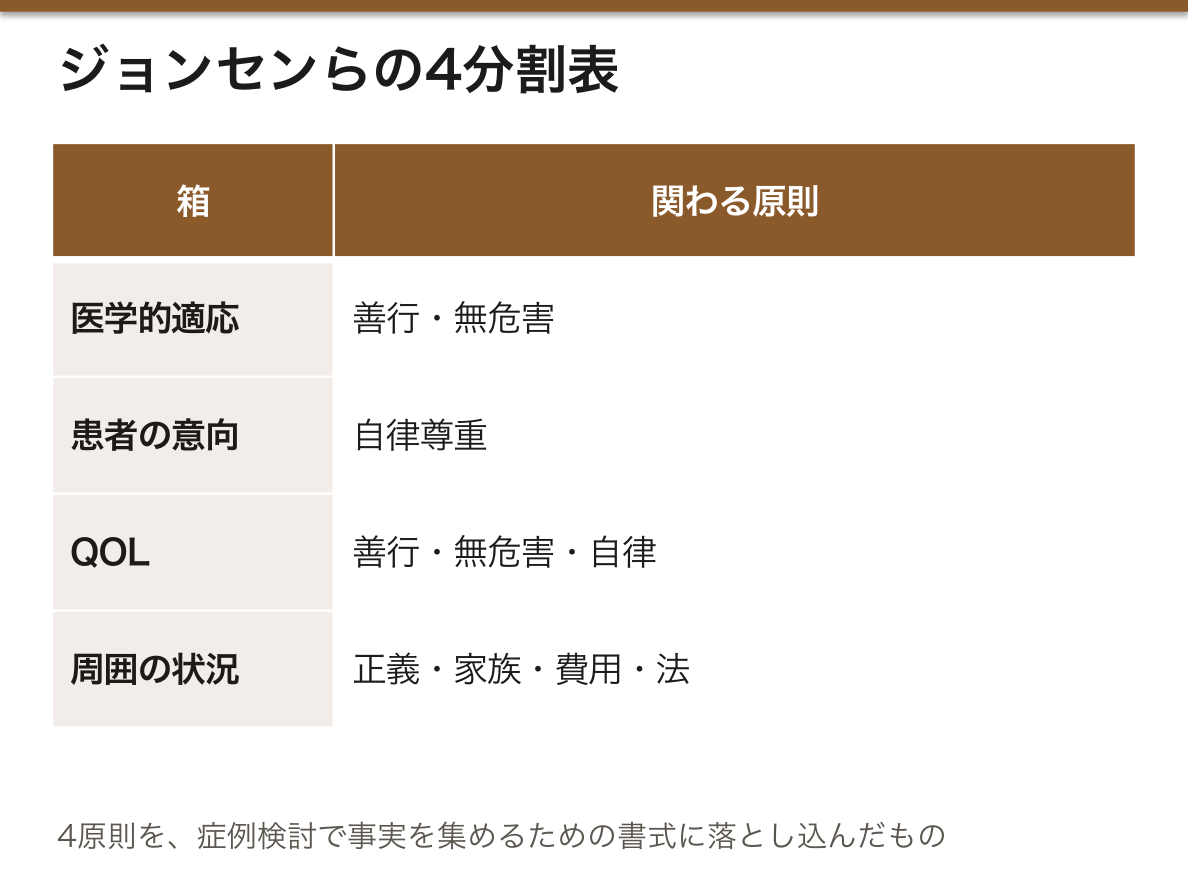
日本の臨床倫理でよく使われるのが、ジョンセンらの4分割表である。医学的適応(善行・無危害)、患者の意向(自律尊重)、QOL(善行・無危害・自律)、周囲の状況(正義・家族・費用・法)の4つの箱に事実を書き出す。4原則を、症例検討で事実を集めるための書式に落とし込んだものと考えるとよい。
English version
Core
This framework, set out by Beauchamp and Childress in Principles of Biomedical Ethics, is the most widely used in bioethics. They hold that there is a common morality shared across cultures, from which four principles can be drawn.
| Principle | Content | Background idea |
|---|---|---|
| Respect for autonomy | Respect the self-determination of competent people and support their capacity to decide | Kant’s respect for persons, Mill’s liberty |
| Non-maleficence | Do not harm; do not impose risks of harm | ‘First, do no harm’ |
| Beneficence | Prevent and remove harm; actively promote the other’s good | The basic aim of medicine; utilitarianism |
| Justice | Distribute benefits and burdens fairly | Distributive justice, equal respect |
The key point: it is not a formula that produces answers. The four principles help organise which questions to ask. In a real case we must specify them and balance those that conflict. Their order does not show priority.
Going further
Why mid-level principles rather than a theory? A utilitarian and a Kantian disagree on why lying is wrong, but they can agree on the principle ‘do not deceive patients’. We can move a clinical discussion forward while leaving theoretical disputes aside — that is the practical strength of the four principles.
There are criticisms. Reciting the principles as if that were thinking was mocked as ‘the Georgetown mantra’, after the authors’ university. The principles alone do not tell us which to choose when they conflict. The authors ask for reflective equilibrium (Rawls’s term): moving back and forth between principles and particular judgements until they fit. They also state clearly that autonomy does not always override the other three.
In the clinic
Japanese clinical ethics often uses the four-box method of Jonsen and colleagues: medical indications (beneficence, non-maleficence), patient preferences (autonomy), quality of life (beneficence, non-maleficence, autonomy) and contextual features (justice, family, costs, law). Think of it as the four principles turned into a form for collecting facts in a case discussion.
自律尊重と無危害 — 「まず害するなかれ」Primum non nocere
自律尊重は、他人の選択を大目に見る「寛容」の態度にとどまらない。ビーチャムとチルドレスは、選ぶ力そのものを守り、高める行動まで含むとした。十分な情報を伝える、考える時間をとる、理解を確かめる、といった働きかけである。普遍的な道徳法則を理性的存在が受け入れると考えたカントとは違い、他人を害さない限り各人が自分の価値観に従って行動できることを重んじる点で、ミルに近い。
無危害は、古くからの医の格言「まず害するなかれ」にさかのぼる。研究倫理と直結するのはもちろん、医師の拷問への関与の禁止、さらには環境汚染のように健康を危うくする政策まで、射程は広い。害を与えることだけでなく、不必要な害の危険を負わせることも含む。
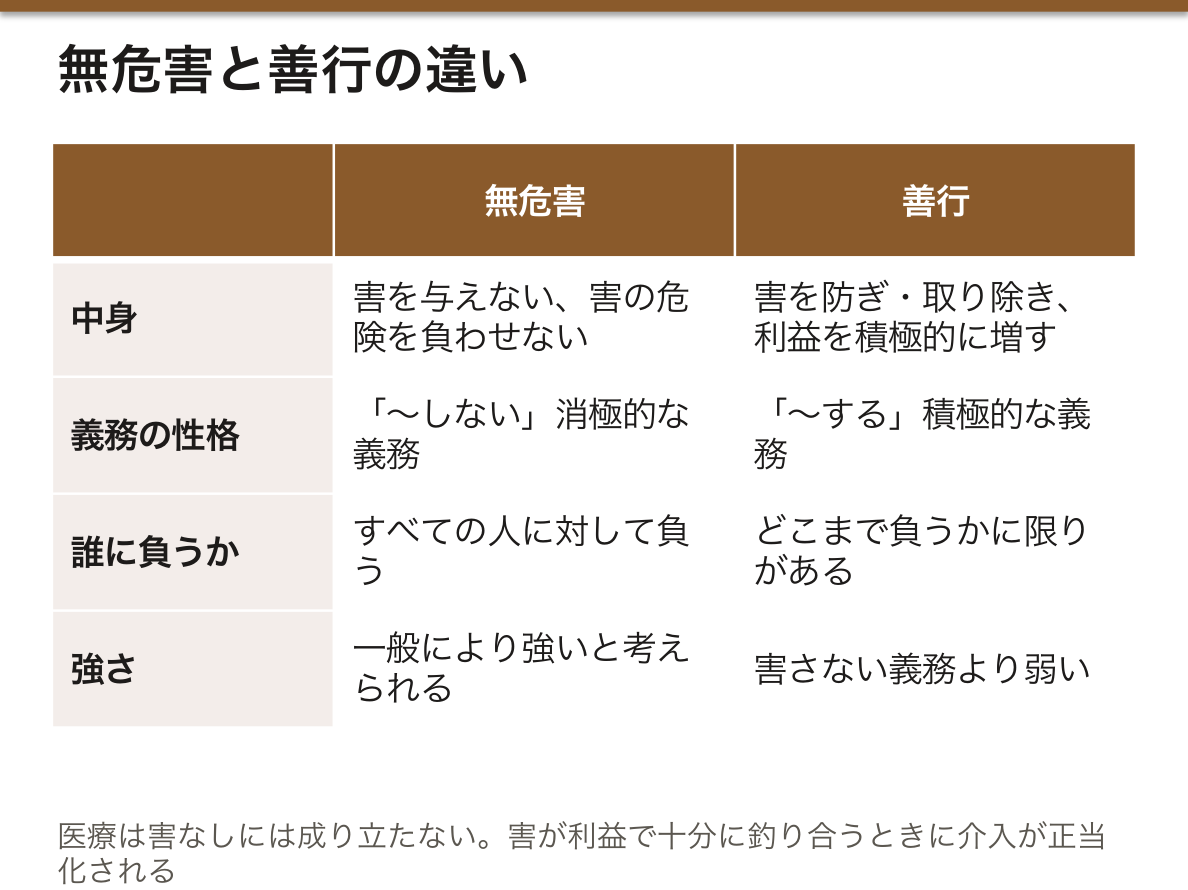
無危害と善行(次の項目)は似ているが、性格が違う。無危害は「〜しない」という消極的な義務で、すべての人に対して負い、守るのに大きな費用はかからない。善行は「〜する」という積極的な義務で、どこまで負うかに限りがある。だから一般に、害さない義務の方が、助ける義務より強いと考えられている。
ただし医療は、害をまったく与えずには成り立たない。手術は身体を傷つけ、抗癌薬には毒性がある。そこで問われるのは利益と害の比であり、害が利益で十分に釣り合うときに介入が正当化される。害が主たる目的でなく予見された副作用として生じる場合の考え方は、安楽死の章の二重結果の原則で詳しく扱う。
無危害の原則は、検査や治療の「やりすぎ」への歯止めでもある。不要な画像検査による被曝、過剰な投薬(ポリファーマシー)、偶然見つかった小さな異常を追いかける検査の連鎖は、それぞれ善意から始まって害を生む。高齢者医療で「その検査は結果によって方針が変わるか」と問う習慣は、この原則の実践である。
English version
Core
Respect for autonomy is more than tolerating other people’s choices. Beauchamp and Childress say it includes action that protects and strengthens the capacity to choose: giving enough information, allowing time, checking understanding. Unlike Kant, who thought all rational beings would accept a universal moral law, it is closer to Mill: people may act on their own values as long as they do not harm others.
Non-maleficence goes back to the old medical maxim ‘first, do no harm’. It connects directly with research ethics, but it also forbids doctors’ involvement in torture and reaches policies that endanger health, such as pollution. It covers not only causing harm but also imposing unnecessary risks of harm.
Going further
Non-maleficence and beneficence (next item) look similar but differ. Non-maleficence is a negative duty (‘do not’). We owe it to everyone, and keeping it costs little. Beneficence is a positive duty (‘do’), and its reach is limited. So it is generally held that the duty not to harm is stronger than the duty to help.
But medicine cannot work without some harm. Surgery injures the body; anticancer drugs are toxic. The question is the ratio of benefit to harm: an intervention is justified when the benefit outweighs the harm. Harm that is foreseen as a side effect, not intended, is discussed in the euthanasia chapter under the doctrine of double effect.
In the clinic
Non-maleficence also limits overtreatment. Radiation from unnecessary scans, too many drugs (polypharmacy), and chains of tests chasing small incidental findings all start from good intentions and end in harm. In care for older patients, the habit of asking ‘will this result change what we do?’ puts the principle into practice.
善行・パターナリズム・正義 — 原則どうしがぶつかるときBeneficentia
善行は、害を控えるだけでなく、害を防ぎ、害を取り除き、害を利益で埋め合わせ、相手の福祉を積極的に増すことを求める。善意をもつこと(benevolence)とは違い、実際に行動することまで含む。医療の本来の目的そのものであり、善行を怠ることは患者が医療者に寄せる信頼への裏切りになる。
善行に潜む危険がパターナリズムである。強い(硬い)パターナリズムは、本人が望まなくても「本人のため」に治療を押しつける。このとき善行は満たされても自律尊重は破られ、両方を同時に満たすことはできない。
正義はさらに衝突の種になる。すべての人をその必要に応じて平等に尊重するなら、ある個人や多数派の利益を最大にすることが、他の人を不公正に扱う結果になるなら許されない。高価な治療を一部の人に提供すれば、限られた資源の中で別の必要をもつ人の治療が削られるかもしれない。
パターナリズムは2つに分けて考えると整理しやすい。
| 弱い(柔らかい)パターナリズム | 強い(硬い)パターナリズム | |
|---|---|---|
| 介入する場面 | 本人の選択が十分に自律的でないとき(情報不足・混乱・判断能力の低下) | 本人が十分な情報をもち判断能力もあるのに、その選択を退ける |
| 例 | せん妄の患者が点滴を抜こうとするのを一時止める | 判断能力のある成人の輸血拒否を無視して輸血する |
| 評価 | 多くの場合、正当化されうる | 正当化はきわめて難しい |
功利主義的な計算は無危害と善行の背後にあるが、正義はその計算だけでは片づかない。利益と費用を公正に分けるには、個人にとっての損得を足し合わせる以上の、別の種類の推論が必要になる。これは資源配分の章で扱う。
日本の患者が口にする「先生にお任せします」は、善行と自律の関係を考える好例である。お任せを本人の自由な選択(決定の委任)として受けとめることもできるが、医師が説明を省く口実にしてはならない。治療方針を決める場面では、選択肢と見通しを伝えたうえで、それでも任せたいかを確かめるのが、自律を損なわない善行のかたちである。
English version
Core
Beneficence asks for more than not harming: prevent harm, remove harm, balance harm with benefit, and actively promote the other’s welfare. It is different from benevolence (simply wishing well); it requires action. It is the basic aim of medicine, and failing to act beneficently betrays the trust patients place in clinicians.
Its hidden danger is paternalism. Strong (hard) paternalism forces treatment on people ‘for their own good’ even when they do not want it. Beneficence is then satisfied but respect for autonomy is broken; both cannot be satisfied at once.
Justice creates even more conflict. If all people deserve equal respect according to their needs, maximising the benefit of one person, or of the majority, is not acceptable when it treats others unfairly. Providing a very expensive treatment to some may cut the care of others with different needs.
Going further
It helps to divide paternalism into two kinds.
| Soft (weak) paternalism | Hard (strong) paternalism | |
|---|---|---|
| When it intervenes | When the choice is not fully autonomous (lack of information, confusion, reduced capacity) | When the person is informed and competent, but the choice is overridden |
| Example | Briefly stopping a delirious patient from pulling out an IV line | Giving blood despite a competent adult’s refusal |
| Assessment | Often justifiable | Very hard to justify |
Utilitarian calculation lies behind non-maleficence and beneficence, but justice cannot be settled by that calculation alone. Dividing benefits and costs fairly needs a different kind of reasoning than adding up gains and losses for individuals. The resource allocation chapter deals with this.
In the clinic
The phrase Japanese patients often use, ‘I leave it to you, doctor’, is a good example of beneficence meeting autonomy. It can be respected as a free choice to delegate the decision, but it must not become an excuse for the doctor to skip the explanation. When deciding treatment, explain the options and outlook, then confirm whether the patient still wants to leave it to you — this is beneficence that does not damage autonomy.
まとめ
| 共同体主義 — 個人の善は社会の善と切り離せない | 共同体主義は、行為や決定の正しさをそれが社会全体の善に役立つかで測る。 |
|---|---|
| リバタリアニズムとミルの危害原則 | リバタリアニズム(自由至上主義、自由主義的個人主義)は共同体主義と正反対の立場で、社会や国家からの個人の自由を最も重んじる。 |
| 消極的自由と積極的自由 — 「邪魔されない」と「本当に選べる」 | 哲学者バーリンは自由を2つに分けた(1958年)。 |
| 4原則アプローチ — 理論の違いを越えて使える中間の原則 | ビーチャムとチルドレスが『生命医学倫理の諸原則』で示した枠組みで、生命倫理で最もよく使われる。 |
| 自律尊重と無危害 — 「まず害するなかれ」 | 自律尊重は、他人の選択を大目に見る「寛容」の態度にとどまらない。 |
| 善行・パターナリズム・正義 — 原則どうしがぶつかるとき | 善行は、害を控えるだけでなく、害を防ぎ、害を取り除き、害を利益で埋め合わせ、相手の福祉を積極的に増すことを求める。 |
このノートは医学生が授業の内容を自分の言葉でまとめたもので、診療の判断に使うものではありません。誤りに気づいたらお知らせください。