歯は上皮と間葉が交互に命令し合って作られる器官で、発生の順序がそのまま組織の層の順序になる。エナメル質だけが上皮由来で、だから一度失うと二度と戻らない。
- 歯と歯周組織 — 再生する組織としない組織
- 歯の発生 — 上皮と間葉が、交互に命令する
歯と歯周組織 — 再生する組織としない組織Dens
硬組織は3つ。
| 作る細胞 | 無機質 | 再生 | 神経 | |
|---|---|---|---|---|
| エナメル質 | エナメル芽細胞(上皮由来) | 約96% | しない | 無い |
| 象牙質 | 象牙芽細胞(間葉由来) | 約70% | する(第二象牙質) | 細管を介して痛む |
| セメント質 | セメント芽細胞 | 約65% | する | 無い |
歯髄——疎性結合組織・血管・神経。象牙芽細胞が外周に並ぶ。
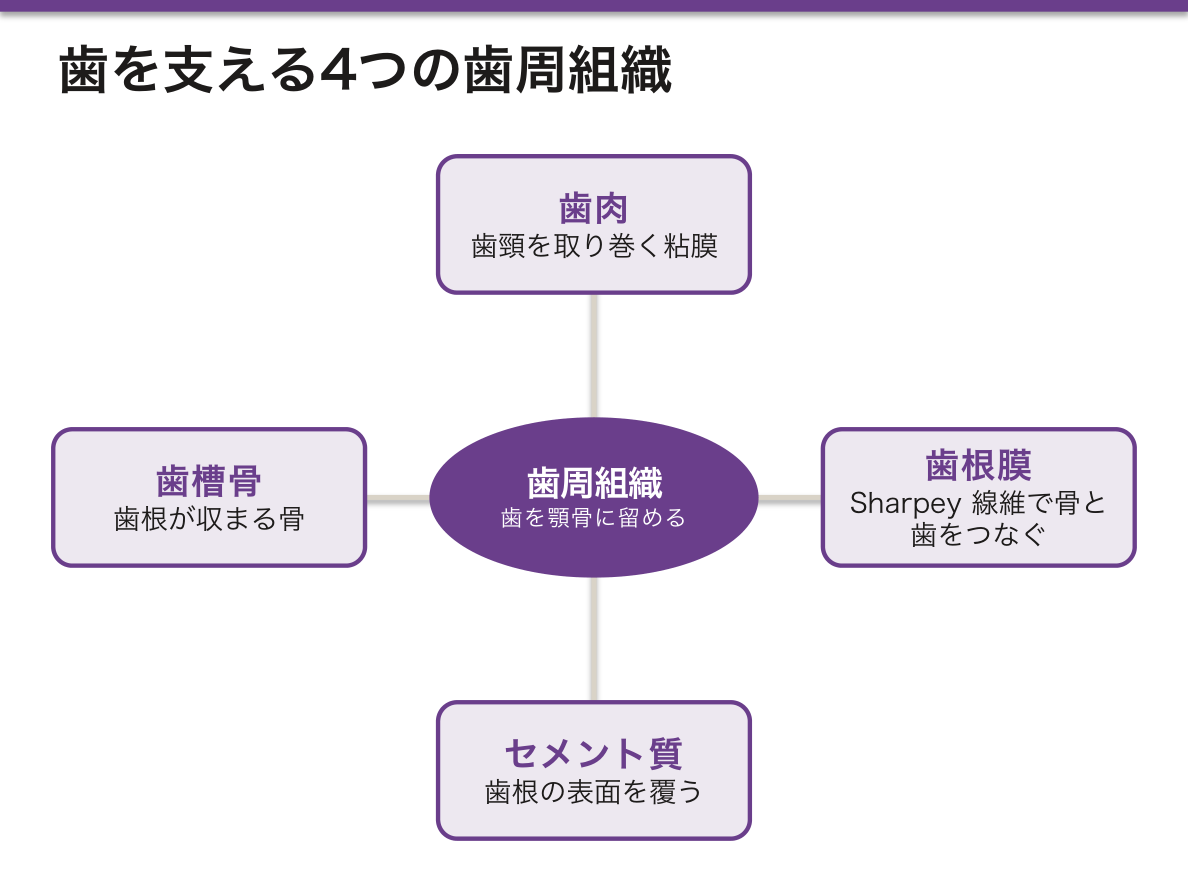
歯周組織——歯肉・歯根膜・セメント質・歯槽骨。歯根膜は骨と歯をつなぐ密性結合組織で、Sharpey 線維が両側に埋まる。
歯の発生——上皮由来(エナメル器)と間葉由来(歯乳頭)の相互作用。乳歯20本・永久歯32本。
エナメル芽細胞が萌出とともに失われることが、齲蝕が自然治癒しない理由になる——「作る細胞がもういない組織は、削れたら削れたままになる」。
逆に象牙質は反応して増える。刺激に応じて第二象牙質・修復象牙質を作り、歯髄との距離を稼ぐ——「ゆっくり進む虫歯では痛みが出にくい理由がここにある」。
象牙細管が歯髄とつながっているので、冷たいものがしみる。細管内の液体が動いて、象牙芽細胞と神経を刺激する——「歯がしみることの実体が、液体の移動になる」。
歯根膜は、噛む力を感じる感覚器でもある。ここが失われるインプラントでは、力の加減が分からなくなる——「歯は骨に埋まっているのではなく、繊維で吊られている」。
テトラサイクリン系は、発育中の歯と骨のカルシウムに結合して着色する。だから8歳未満と妊婦には原則として使わない(小児と妊婦の薬の章)——「一生残る副作用なので、代替を先に考える」。
歯周病は、全身の慢性炎症としても扱われるようになった。糖尿病と双方向に悪化させ、誤嚥性肺炎の起炎菌の供給源にもなる(口腔ケアの章)——「口腔ケアが、肺炎の予防として算定される理由になる」。
再生するかしないかで、治療がまったく違う。
エナメル質は再生しない——エナメル芽細胞は萌出とともに失われる。だから齲蝕で失った部分は詰めるしかない。フッ化物は再石灰化を助けるが、細胞が作り直すわけではない。
象牙質は再生する(第二象牙質)。刺激に応じて象牙芽細胞が新たに作るので、ゆっくり進む齲蝕では歯髄が守られる。象牙細管を介して痛むので知覚過敏が起こる。
歯髄は閉じた空間なので炎症で腫れると激痛になり、やがて壊死する。根尖病巣から歯性感染が顎骨・上顎洞・頸部・縦隔へ広がりうる。
歯周炎は歯槽骨の吸収で、糖尿病と双方向に悪影響する。感染性心内膜炎の菌血症の入口にもなる。
English version
Core
Three hard tissues.
| Made by | Mineral | Regenerates | Nerve | |
|---|---|---|---|---|
| Enamel | Ameloblast (epithelial) | ~96% | No | None |
| Dentine | Odontoblast (mesenchymal) | ~70% | Yes (secondary dentine) | Pain via the tubules |
| Cementum | Cementoblast | ~65% | Yes | None |
- Pulp — loose connective tissue, vessels and nerves, with odontoblasts lined up around the periphery.
- Periodontium — gingiva, periodontal ligament, cementum, alveolar bone. The periodontal ligament is dense connective tissue joining bone to tooth, with Sharpey’s fibres embedded on both sides.
- Development — interaction between the epithelial enamel organ and the mesenchymal dental papilla. 20 deciduous, 32 permanent teeth.
Going further
That the ameloblast is lost at eruption is why caries never heals spontaneously — a tissue whose maker is gone stays worn where it has worn.
Dentine, by contrast, responds and grows. It lays down secondary and reparative dentine according to the stimulus, buying distance from the pulp — here is why slowly advancing caries hurts so little.
Because the dentinal tubules connect with the pulp, cold is felt. Fluid moves within the tubule and stimulates the odontoblast and nerve — the physical reality of a sensitive tooth is the movement of a fluid.
The periodontal ligament is also the sense organ for the force of biting. An implant, which lacks it, leaves the patient unable to judge that force — a tooth is not set in bone but slung in fibres.
Tetracyclines bind calcium in developing teeth and bone and stain them. So they are avoided below the age of eight and in pregnancy — a side effect that lasts a lifetime, so an alternative is considered first.
Periodontal disease is now also treated as a chronic systemic inflammation. It worsens, and is worsened by, diabetes, and supplies the organisms of aspiration pneumonia — the reason oral care is reimbursed as a preventive measure against pneumonia.
In the clinic
Whether a tissue regenerates or not makes the treatment entirely different.
Enamel does not regenerate — the ameloblasts are lost at eruption. So what caries destroys can only be filled. Fluoride assists remineralisation but the cells do not rebuild it.
Dentine does regenerate (secondary dentine): the odontoblasts lay down more in response to stimulus, so the pulp is protected in slowly advancing caries. Because pain is conducted through the tubules, hypersensitivity occurs.
The pulp is a closed space, so inflammatory swelling causes severe pain and then necrosis. From a periapical lesion, odontogenic infection can spread to the jaw, maxillary sinus, neck and mediastinum.
Periodontitis is resorption of the alveolar bone and has a two-way relationship with diabetes. It is also a portal for the bacteraemia of infective endocarditis.
歯の発生 — 上皮と間葉が、交互に命令するGermen dentis
歯胚は3つの部分からできる——エナメル器(上皮由来)・歯乳頭(間葉由来)・歯小嚢(間葉由来)。
| 歯胚の部分 | 由来 | できるもの |
|---|---|---|
| エナメル器 | 口腔上皮 | エナメル質 |
| 歯乳頭 | 神経堤由来の外胚葉性間葉 | 象牙質・歯髄 |
| 歯小嚢 | 同上 | セメント質・歯根膜・歯槽骨 |
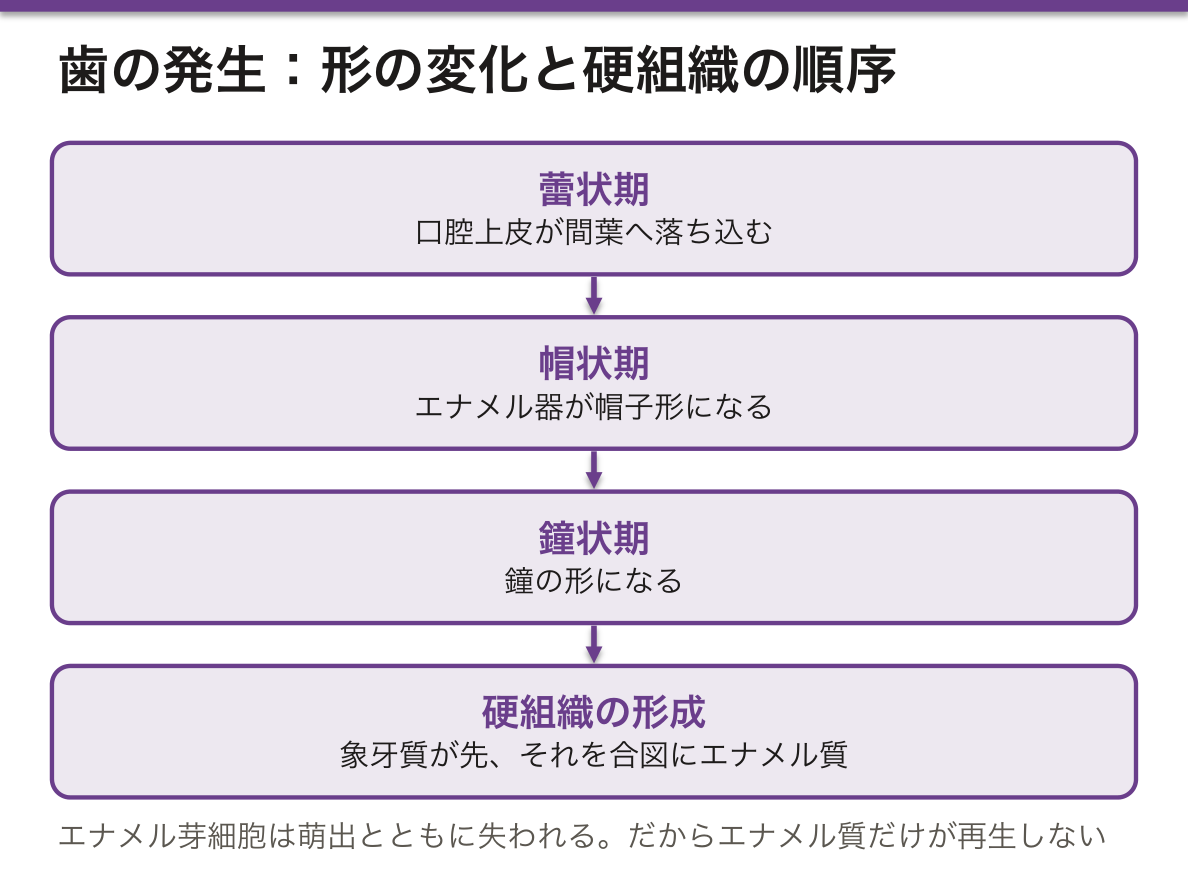
形の変化で段階を呼ぶ——蕾状期 → 帽状期 → 鐘状期。
硬組織が作られる順序が決まっている——象牙芽細胞が先に象牙質を作り、それを合図にエナメル芽細胞がエナメル質を作る。
エナメル芽細胞は萌出とともに失われる。だからエナメル質だけが再生しない。
この章の要点は「上皮と間葉が、交互に相手へ命令している」ことにある。上皮が間葉を歯乳頭に変え、歯乳頭が上皮をエナメル芽細胞に変える——「どちらが主役でもなく、往復することで形が決まる」。
だから片方だけが壊れる異常が存在する。エナメル質形成不全症は上皮側、象牙質形成不全症は間葉側の病気になる(単一遺伝子病の章)——「同じ歯なのに、遺伝形式も見た目も別になる」。
象牙質が先に作られることが、エナメル質が薄い歯を説明する。象牙質の形成が滞ると、その上に乗るエナメル質も作られない——「土台が先で、覆いが後になる」。
歯の発生は時期がきわめて正確なので、暦として使える。形成中に全身の障害があると、その時期に作られていた帯だけが低石灰化して残る(Turner 歯・エナメル質減形成)(個人識別の章)——「歯は、過去の一時期を年輪のように記録している」。
そして神経堤由来であることが、症候群の組み合わせを決める。歯・毛・爪・汗腺はどれも上皮と間葉の相互作用でできるので、外胚葉異形成症ではまとめて障害される(先天異常の章)——「歯が生えてこない子で、汗をかけるかを必ず聞く」。
乳歯は生後6〜8か月から生え始め、3歳頃に20本が揃う。永久歯は6歳臼歯から始まり、12歳頃に28本、第三大臼歯を含めて32本になる(成長と発達の章)。萌出の遅れは、甲状腺機能低下症・くる病・鎖骨頭蓋異形成症で見る。
先天梅毒の Hutchinson 歯——切縁が半月状に欠ける上顎中切歯。実質性角膜炎・内耳性難聴と合わせて Hutchinson 三徴(母子感染の章)。歯が作られていた時期に感染があったことの記録である。
English version
Core
The tooth germ has three parts — the enamel organ (epithelial), the dental papilla and the dental follicle (both mesenchymal).
| Part | Origin | Gives rise to |
|---|---|---|
| Enamel organ | Oral epithelium | Enamel |
| Dental papilla | Neural-crest-derived ectomesenchyme | Dentine, pulp |
| Dental follicle | The same | Cementum, periodontal ligament, alveolar bone |
The stages are named from the change in shape — bud → cap → bell.
The order in which the hard tissues are made is fixed: the odontoblast lays down dentine first, and that is the signal for the ameloblast to lay down enamel.
The ameloblast is lost at eruption — which is why enamel alone does not regenerate.
Going further
The point of this chapter is that epithelium and mesenchyme instruct each other in turn. The epithelium turns the mesenchyme into dental papilla, and the papilla turns the epithelium into ameloblasts — neither is the protagonist; the form is settled by the going back and forth.
So disorders exist in which only one side is broken. Amelogenesis imperfecta is a disease of the epithelial side, dentinogenesis imperfecta of the mesenchymal — the same tooth, yet different inheritance and different appearance.
That dentine is made first explains a tooth with thin enamel. If dentine formation stalls, the enamel that rides on it is not made either — the foundation first, the covering after.
The timing of tooth development is so precise that it can be used as a calendar. A systemic insult during formation leaves only the band being built at that time hypomineralised (Turner tooth, enamel hypoplasia) — a tooth records a past period like the rings of a tree.
And the neural crest origin decides which syndromes go together. Teeth, hair, nails and sweat glands are all made by epithelial–mesenchymal interaction, so all are affected together in ectodermal dysplasia — in a child whose teeth do not come through, always ask whether they can sweat.
In the clinic
The deciduous teeth begin to erupt at 6–8 months and all 20 are present by about age 3. The permanent teeth begin with the six-year molar, reaching 28 by about age 12 and 32 including the third molars.
Delayed eruption is seen in hypothyroidism, rickets and cleidocranial dysplasia.
Hutchinson’s teeth of congenital syphilis — upper central incisors notched in a crescent at the biting edge. With interstitial keratitis and sensorineural deafness they make Hutchinson’s triad. It is a record that the infection was present while the teeth were being formed.
まとめ
| 歯と歯周組織 — 再生する組織としない組織 | 硬組織は3つ。作る細胞無機質再生神経エナメル質エナメル芽細胞(上皮由来)約96%しない無い象牙質象牙芽細胞(間葉由来)約70%する(第二象牙質)細管を介して痛むセメント質セメント芽… |
|---|---|
| 歯の発生 — 上皮と間葉が、交互に命令する | 歯胚は3つの部分からできる——エナメル器(上皮由来)・歯乳頭(間葉由来)・歯小嚢(間葉由来)。 |
このノートは医学生が授業の内容を自分の言葉でまとめたもので、診療の判断に使うものではありません。誤りに気づいたらお知らせください。