解剖用語は主格と属格だけで書ける。だが臨床の言い回し——per os, in situ, post partum, sine dolore——には前置詞が入り、前置詞のあとの名詞は対格か奪格になる。
覚えることは2つしかない。①どの前置詞がどちらの格をとるか、②各変化の対格・奪格の語尾。日本の臨床でもそのまま使われる in vitro・in vivo・in situ のような句は、この2つで全部読める。
- 対格と奪格 — 4つの格の残り2つ
- 対格をとる前置詞 — ante・post・per・intra
- 奪格をとる前置詞 — cum・sine・pro・de・ex
- in と sub — 場所なら奪格、方向なら対格
- 臨床の句を読む手順 — 前置詞で区切る
対格と奪格 — 4つの格の残り2つAccusativus et ablativus
対格は動作の向かう先・対象(〜へ、〜を)、奪格は場所・手段・同伴(〜で、〜によって、〜と共に)を表す。医学のラテン語では、ほぼ前置詞のあとにしか出てこない。
| 変化 | 対格 単数 | 奪格 単数 | 対格 複数 | 奪格 複数 |
|---|---|---|---|---|
| 第1(vena) | venam | vena | venas | venis |
| 第2 男性(nervus) | nervum | nervo | nervos | nervis |
| 第2 中性(septum) | septum | septo | septa | septis |
| 第3 男・女(dolor) | dolorem | dolore | dolores | doloribus |
| 第3 中性(corpus) | corpus | corpore | corpora | corporibus |
| 第4(ductus) | ductum | ductu | ductus | ductibus |
| 第5(facies) | faciem | facie | facies | faciebus |
第3変化の母音群(basis, febris など)では対格単数が -im、奪格単数が -i になる。
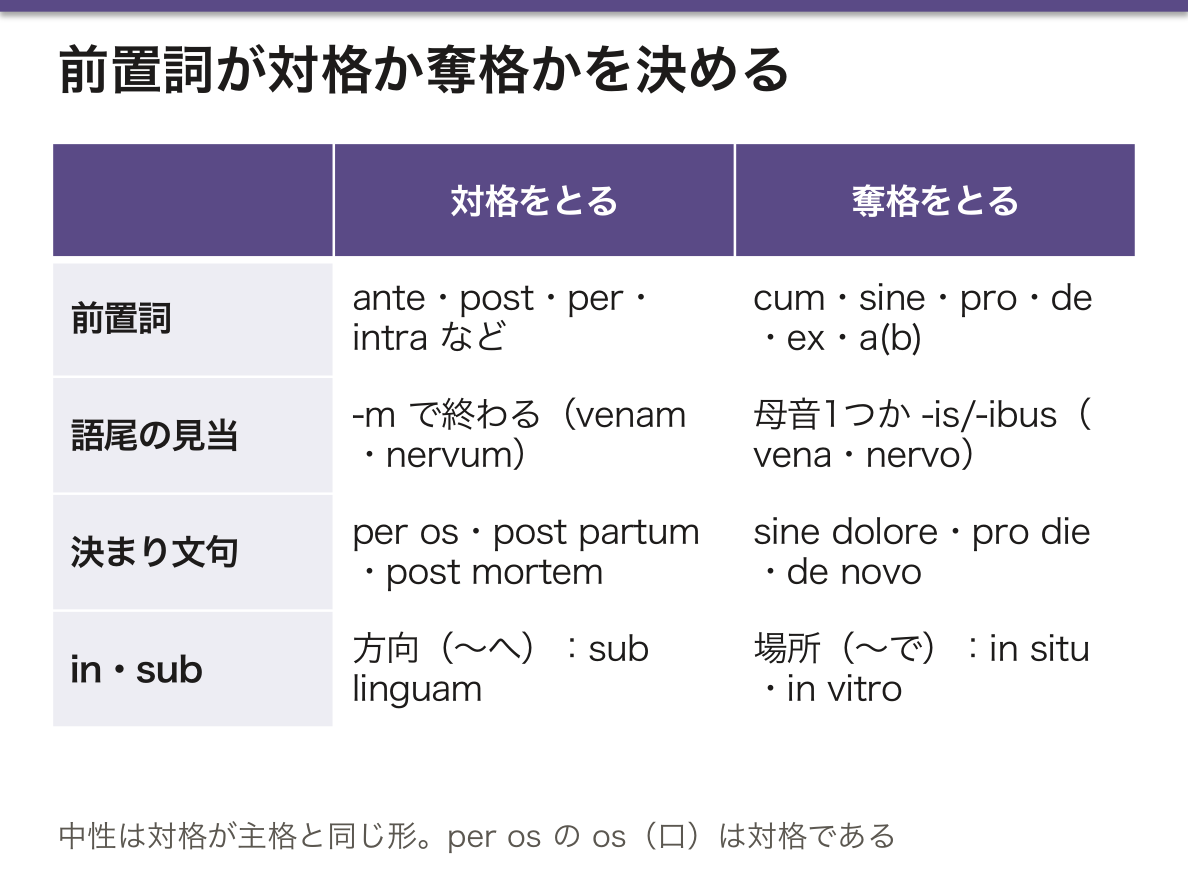
表は大きく見えるが、型は3つしかない。
①対格単数はいつも -m で終わる(-am, -um, -em, -um, -em)。ただし中性は主格と同じ形。②奪格単数は母音1つ(-a, -o, -e/-i, -u, -e)。③奪格複数は -is か -ibus(第5だけ -ebus)。
だから「-m で終われば向かう先・対象、母音1つで終われば場所・手段」と見当をつけ、前置詞と組み合わせて確かめればよい。第1変化の奪格 -a だけは主格と同じに見えるが、前置詞のあとにあれば奪格である。
English version
Core
The accusative marks where an action goes or what it acts on (to …, … as object); the ablative marks place, means or company (in, by, with). In medical Latin they appear almost only after prepositions.
| Declension | Acc. sg. | Abl. sg. | Acc. pl. | Abl. pl. |
|---|---|---|---|---|
| 1st (vena) | venam | vena | venas | venis |
| 2nd m. (nervus) | nervum | nervo | nervos | nervis |
| 2nd n. (septum) | septum | septo | septa | septis |
| 3rd m./f. (dolor) | dolorem | dolore | dolores | doloribus |
| 3rd n. (corpus) | corpus | corpore | corpora | corporibus |
| 4th (ductus) | ductum | ductu | ductus | ductibus |
| 5th (facies) | faciem | facie | facies | faciebus |
In the vowel group of the third declension (basis, febris and so on) the accusative singular is -im and the ablative singular -i.
Going further
The table looks large, but there are only three patterns.
(1) The accusative singular always ends in -m (-am, -um, -em, -um, -em), except that neuters equal their nominative. (2) The ablative singular is a single vowel (-a, -o, -e/-i, -u, -e). (3) The ablative plural is -is or -ibus (only the fifth has -ebus).
So guess “ends in -m: direction or object; ends in one vowel: place or means“, and confirm with the preposition. Only the first-declension ablative -a looks like the nominative, but after a preposition it is ablative.
対格をとる前置詞 — ante・post・per・intraPer os
次の前置詞はいつも対格をとる。
| 前置詞 | 意味 | 例 |
|---|---|---|
| ante | 〜の前に | ante partum(分娩前)、ante meridiem(午前) |
| post | 〜の後に | post operationem(術後)、post mortem(死後) |
| per | 〜を通って・〜の間 | per os(経口)、per rectum(経直腸) |
| intra | 〜の中で・〜の間に | intra partum(分娩中) |
| inter, supra, infra, contra, ad | 間・上・下・反対・〜へ | — |
per os の os は対格である。os, oris(口)は中性なので、対格は主格と同じ os になる。mors, mortis(死)は女性なので対格 mortem、operatio は operationem。
これらの前置詞は、そのまま接頭辞になっている。intercostalis(肋骨の間の)、supraspinatus・infraspinatus(棘の上・下の)、intramuscularis(筋肉内の)、contralateralis(反対側の)、postoperativus(術後の)、antebrachium(前腕:腕 brachium の前の部分)。前置詞を覚えることは、解剖用語の接頭辞を覚えることでもある。
外科の per primam intentionem(一次治癒)も対格の句で、prima → primam、intentio → intentionem と、形容詞も名詞も対格になっている。
p.o.(per os)は処方や指示で毎日見る略号である。英語の postpartum haemorrhage(分娩後出血)、antepartum、post-mortem examination(剖検)は、ラテン語の句がそのまま英語の形容詞になったもので、post partum・ante partum・post mortem と読める。
English version
Core
These prepositions always take the accusative.
| Preposition | Meaning | Example |
|---|---|---|
| ante | before | ante partum (before delivery), ante meridiem (a.m.) |
| post | after | post operationem (after the operation), post mortem (after death) |
| per | through, during | per os (by mouth), per rectum |
| intra | within, during | intra partum (during delivery) |
| inter, supra, infra, contra, ad | between, above, below, against, to | — |
The os in per os is accusative. Os, oris (mouth) is neuter, so its accusative is the same as the nominative, os. Mors, mortis (death) is feminine, so the accusative is mortem; operatio becomes operationem.
Going further
These prepositions are also prefixes. Intercostalis (between the ribs), supraspinatus and infraspinatus (above and below the spine), intramuscularis (within the muscle), contralateralis (on the opposite side), postoperativus (postoperative), antebrachium (forearm: the part before the arm, brachium). Learning the prepositions means learning the prefixes of anatomy.
The surgical per primam intentionem (healing by first intention) is an accusative phrase too: prima → primam, intentio → intentionem, with both adjective and noun in the accusative.
In the clinic
P.o. (per os) is an abbreviation seen every day in prescriptions and orders. English postpartum haemorrhage, antepartum and post-mortem examination are Latin phrases turned directly into English adjectives, and can be read as post partum, ante partum and post mortem.
奪格をとる前置詞 — cum・sine・pro・de・exCum et sine
次の前置詞はいつも奪格をとる。
| 前置詞 | 意味 | 例 |
|---|---|---|
| cum | 〜と共に | cum vitaminis(ビタミンと共に) |
| sine | 〜なしに | sine dolore(痛みなく) |
| pro | 〜のために・〜あたり | pro die(1日あたり)、aqua pro injectione(注射用水) |
| de | 〜から・〜について | de novo(新たに) |
| ex / e | 〜から外へ | ex vivo, ex tempore(用時調製) |
| a / ab | 〜から | — |
奪格の語尾は母音1つか -is/-ibus なので、dolor → dolore、dies → die、vitaminum → vitaminis(複数)、novus → novo と読む。
奪格の第3変化は -e、母音群なら -i である。dolore(dolor)、tempore(tempus)、febri(febris)。ex tempore は「その時から」=調剤の際にその場で作ることを言う。
in と sub だけは、意味によって対格と奪格を使い分ける(次の項目)。それ以外の前置詞は、どちらか一方に決まっている。
英語圏のカルテでは、c̄(上に線を引いた c)が cum=with、s̄ が sine=without の略号として使われる。de novo は「既存の病変から移行したのではなく、初めからその形で生じた」という意味で、de novo 癌・de novo の急性骨髄性白血病のように使う。
English version
Core
These prepositions always take the ablative.
| Preposition | Meaning | Example |
|---|---|---|
| cum | with | cum vitaminis (with vitamins) |
| sine | without | sine dolore (without pain) |
| pro | for, per | pro die (per day), aqua pro injectione (water for injection) |
| de | from, about | de novo (anew) |
| ex / e | out of | ex vivo, ex tempore (prepared at the time of use) |
| a / ab | from | — |
Ablative endings are a single vowel or -is/-ibus, so read dolor → dolore, dies → die, vitaminum → vitaminis (plural), novus → novo.
Going further
The third-declension ablative is -e, or -i in the vowel group: dolore (dolor), tempore (tempus), febri (febris). Ex tempore means “from the moment”: preparing a medicine on the spot when it is dispensed.
Only in and sub switch between accusative and ablative according to meaning (next item). Every other preposition is fixed to one case.
In the clinic
In English-language notes, c̄ (c with a bar) stands for cum, “with”, and s̄ for sine, “without”. De novo means “arising in that form from the start, not developing from an existing lesion”, as in de novo cancer or de novo acute myeloid leukaemia.
in と sub — 場所なら奪格、方向なら対格In situ
in と sub だけは2つの格をとる。「どこに在るか」なら奪格、「どこへ向かうか」なら対格である。
| 奪格(場所) | 対格(方向) | |
|---|---|---|
| in | in lingua(舌の上に/中に) | in linguam(舌の上へ) |
| sub | sub lingua(舌の下に) | sub linguam(舌の下へ) |
「錠剤は舌の下にある」なら Tabuletta sub lingua est、「錠剤を舌の下へ置け」なら Pone tabulettam sub linguam。医学では病変の場所を言うことが多いので、実際に出てくるのはほとんど奪格である:dolor in regione epigastrica(心窩部の痛み)。
決まり文句は、ただの奪格の形である。語尾を見れば元の名詞の変化型までわかる。
| 句 | 元の名詞 | 変化 | 意味 |
|---|---|---|---|
| in vitro | vitrum(ガラス) | 第2 | ガラスの中で=試験管内で |
| in vivo | vivum(生きているもの) | 第2 | 生体内で |
| in utero | uterus | 第2 | 子宮内で |
| in situ | situs(位置) | 第4 | 本来の位置で |
| in regione | regio | 第3 | 〜の部位で |
vitro・vivo・utero が -o なのは第2変化、situ が -u なのは第4変化だからである。
carcinoma in situ(上皮内癌)は「本来の場所にとどまっている癌」で、基底膜を越えていないので転移しない。in vitro fertilization(体外受精)、in utero(胎内で)も同じ読み方である。狭心症発作のニトログリセリン舌下投与は「舌の下へ入れる」ので、ラテン語なら方向の対格 sub linguam になる。
English version
Core
Only in and sub take two cases. For “where something is” they take the ablative; for “where something goes”, the accusative.
| Ablative (place) | Accusative (direction) | |
|---|---|---|
| in | in lingua (on / in the tongue) | in linguam (onto the tongue) |
| sub | sub lingua (under the tongue) | sub linguam (to under the tongue) |
“The tablet is under the tongue” is Tabuletta sub lingua est; “Put the tablet under the tongue” is Pone tabulettam sub linguam. Medicine mostly names the place of a lesion, so what you actually meet is nearly always the ablative: dolor in regione epigastrica (epigastric pain).
Going further
The set phrases are just ablative forms. The ending even tells you the declension of the noun.
| Phrase | Noun | Declension | Meaning |
|---|---|---|---|
| in vitro | vitrum (glass) | 2nd | in glass = in the test tube |
| in vivo | vivum (living thing) | 2nd | in the living body |
| in utero | uterus | 2nd | in the uterus |
| in situ | situs (position) | 4th | in the original place |
| in regione | regio | 3rd | in the region of |
Vitro, vivo and utero end in -o because they are second declension; situ ends in -u because it is fourth.
In the clinic
Carcinoma in situ is “cancer that stays in its original place”; it has not crossed the basement membrane and so cannot metastasise. In vitro fertilization and in utero read the same way. Sublingual nitroglycerin for angina is placed “to under the tongue”, so in Latin it would be the directional accusative sub linguam.
臨床の句を読む手順 — 前置詞で区切るPost partum
臨床の句は次の順で読む。
①前置詞を探して、そこで区切る。前置詞のあとの語は対格か奪格で、そこから新しいまとまりが始まる。②前置詞の前の部分を、解剖用語と同じように読む——主格の名詞、それに一致する形容詞、属格の名詞。③前置詞のまとまりの中も同じで、対格・奪格の名詞に形容詞と属格が付く。
| 句 | 区切り | 意味 |
|---|---|---|
| Haemorrhagia post partum | haemorrhagia | post partum | 分娩後出血 |
| Status post appendectomiam | status | post appendectomiam | 虫垂切除術後の状態 |
| Dolor in regione lumbali sinistra | dolor | in regione lumbali sinistra | 左腰部の痛み |
| Fractura colli femoris | (前置詞なし)fractura + colli + femoris | 大腿骨頸部骨折 |
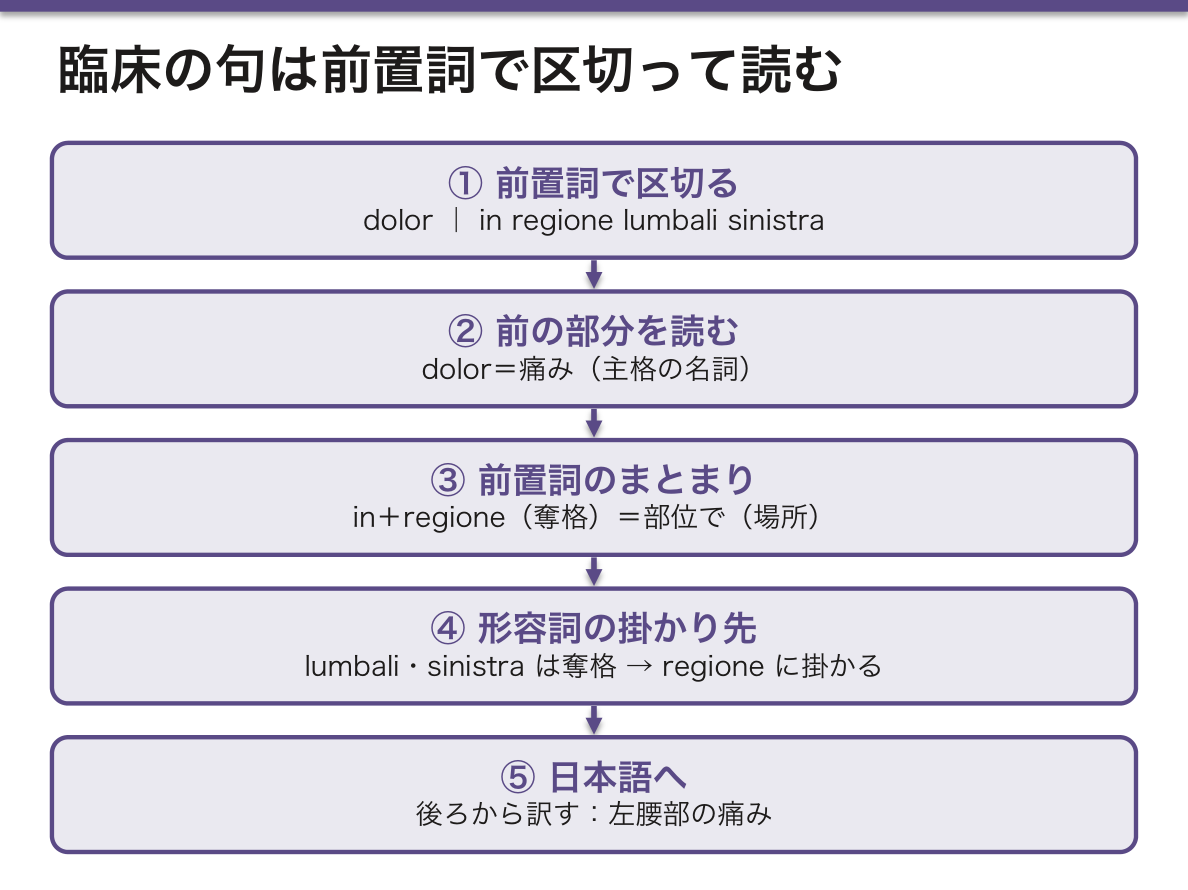
形容詞の語尾で、どの名詞に掛かるかを決める。Dolor in regione lumbali sinistra では、lumbali と sinistra が奪格(-i, -a)なので regione(奪格)に掛かり、dolor(主格)には掛からない。「左の痛み」ではなく「左の腰部」である。
日本語へは後ろから、英語へは前から訳す。英語では形容詞を名詞の前に出し、属格の前に of を置く:pain in the left lumbar region。日本語では属格と前置詞のまとまりを前に回す:左腰部の痛み。
英語のカルテの s/p は status post の略で、「s/p appendectomy」は「虫垂切除術後」を意味する。日本語のカルテでも「〜術後」の意味で s/p と書くことがある。status praesens(現症)も診察記録の見出しとして欧州でよく使われる。
English version
Core
Read a clinical phrase in this order.
(1) Find the prepositions and divide the phrase there. The word after a preposition is accusative or ablative and starts a new block. (2) Read the part before the preposition like an anatomical term: a nominative noun, adjectives agreeing with it, and nouns in the genitive. (3) Read inside the prepositional block the same way: an accusative or ablative noun with its adjectives and genitives.
| Phrase | Division | Meaning |
|---|---|---|
| Haemorrhagia post partum | haemorrhagia | post partum | postpartum haemorrhage |
| Status post appendectomiam | status | post appendectomiam | state after appendectomy |
| Dolor in regione lumbali sinistra | dolor | in regione lumbali sinistra | pain in the left lumbar region |
| Fractura colli femoris | (no preposition) fractura + colli + femoris | fracture of the femoral neck |
Going further
Use adjective endings to decide which noun they belong to. In Dolor in regione lumbali sinistra, lumbali and sinistra are ablative (-i, -a), so they belong to regione (ablative), not to dolor (nominative). It is “the left lumbar region”, not “left pain”.
Translate into Japanese from the back, into English from the front. English puts the adjective before the noun and “of” before a genitive: pain in the left lumbar region. Japanese moves the genitive and prepositional blocks to the front.
In the clinic
The s/p in English notes is status post: “s/p appendectomy” means “after appendectomy”. Japanese notes sometimes use s/p in the same sense. Status praesens (present state) is also a common heading in European examination records.
まとめ
| 対格と奪格 — 4つの格の残り2つ | 対格は動作の向かう先・対象(〜へ、〜を)、奪格は場所・手段・同伴(〜で、〜によって、〜と共に)を表す。 |
|---|---|
| 対格をとる前置詞 — ante・post・per・intra | 次の前置詞はいつも対格をとる。前置詞意味例ante〜の前にante partum(分娩前)、ante meridiem(午前)post〜の後にpost operationem(術後… |
| 奪格をとる前置詞 — cum・sine・pro・de・ex | 次の前置詞はいつも奪格をとる。前置詞意味例cum〜と共にcum vitaminis(ビタミンと共に)sine〜なしにsine dolore(痛みなく)pro〜のために・〜あたりpr… |
| in と sub — 場所なら奪格、方向なら対格 | in と sub だけは2つの格をとる。 |
| 臨床の句を読む手順 — 前置詞で区切る | 臨床の句は次の順で読む。①前置詞を探して、そこで区切る。 |
このノートは医学生が授業の内容を自分の言葉でまとめたもので、診療の判断に使うものではありません。誤りに気づいたらお知らせください。