医学ラテン語は会話のための言語ではない。必要なのは、用語を見て構造を分解し、意味を復元することだけである。そのために要る文法は「主格と属格」「単数と複数」「名詞と形容詞の一致」の3つしかない。
📍 この2章はラテン語である。解剖学・組織学の用語はこの先ずっとラテン語なので、参照用としていつでも引けるようにしておく。ラトビア語は ラトビア語の章 から始まる。
- 格 — 主格と属格だけ使う
- 形容詞 — 名詞と性・数・格を一致させる
- 名詞の5変化 — 属格の語尾で見分ける
- 名詞の性 — 語尾から見当をつける
- 複数形 — 用語の意味が変わる
格 — 主格と属格だけ使うCasus
ラテン語には6つの格があるが、解剖用語で実際に使うのは2つである。
| 格 | 役割 | 例 |
|---|---|---|
| Nominativus(主格) | その用語の主語。辞書の見出し形 | Musculus(筋) |
| Genetivus(属格) | 「〜の」。所属・部分・起始 | Corpus vertebrae(椎骨の体) |
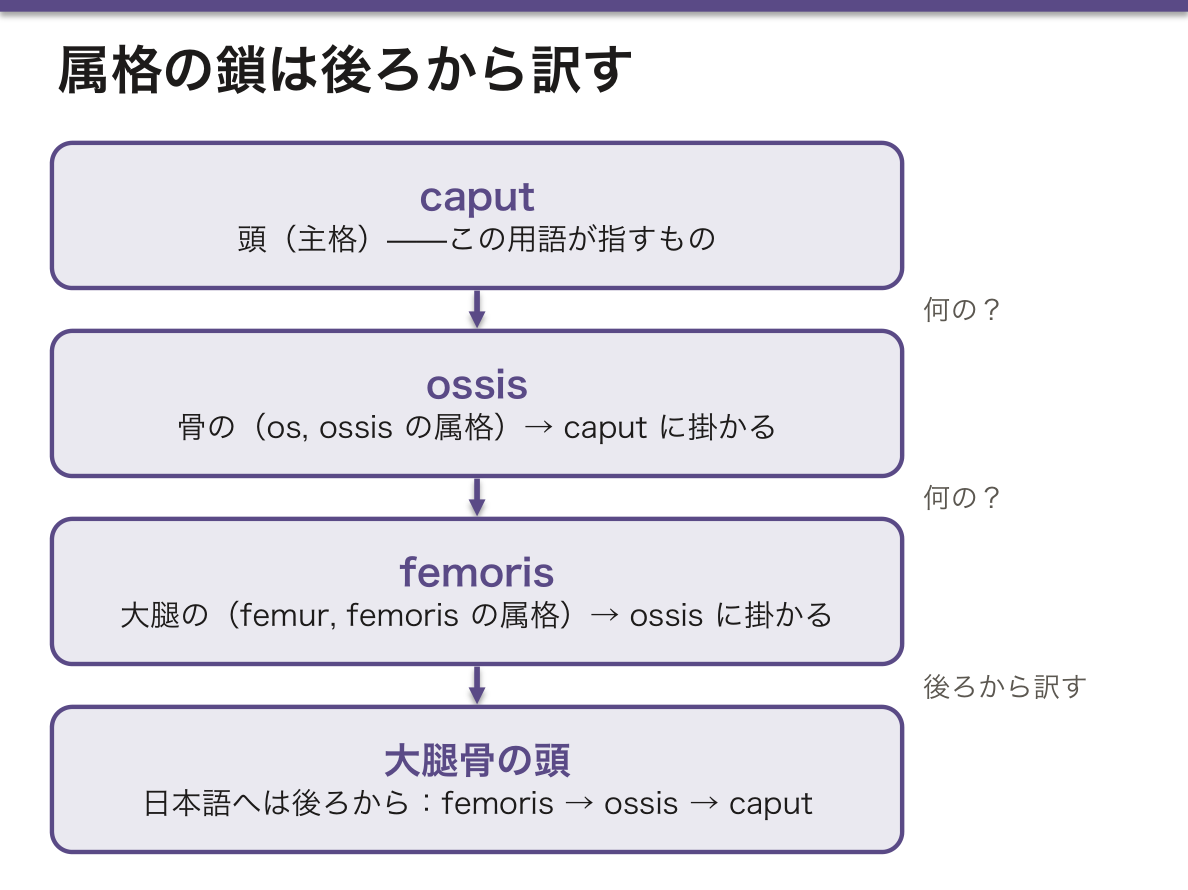
語順は「主要な語 → 修飾する語」である。日本語とは逆になるので、後ろから訳す:Caput ossis femoris =「大腿骨の頭」(femoris=大腿の、ossis=骨の、caput=頭)。
属格の語尾で名詞の変化型(declinatio)が分かる。辞書は必ず「主格, 属格」の順で載せる——属格を見ないと変化型が決まらないからである。
| 型 | 主格 → 属格 | 例 |
|---|---|---|
| 第1(女性が多い) | -a → -ae | vertebra → vertebrae |
| 第2(男性・中性) | -us / -um → -i | musculus → musculi |
| 第3(すべての性) | さまざま → -is | corpus → corporis、os → ossis |
| 第4 | -us → -us | ductus → ductus |
| 第5 | -es → -ei | facies → faciei |
第3変化がいちばん厄介で、いちばん多い。主格から属格を推測できないので、語幹が変わるものは組で覚えるしかない:os → ossis(骨)/caput → capitis(頭)/pars → partis(部)/foramen → foraminis(孔)/corpus → corporis(体)。
複数形も型で決まる。第1変化 -a → -ae(vertebra → vertebrae)、第2変化 -us → -i(musculus → musculi)、-um → -a(ligamentum → ligamenta)、第3変化 → -es(pars → partes)。Nervi・Arteriae・Ossa・Musculi はすべて複数形である。
English version
Core
Latin has six cases, and only two are actually used in anatomical terms.
| Case | Role | Example |
|---|---|---|
| Nominativus (nominative) | The subject of the term. The dictionary headword | Musculus (muscle) |
| Genetivus (genitive) | "of". Belonging, part, origin | Corpus vertebrae (the body of the vertebra) |
The word order is "the principal word → the qualifying word". It is the reverse of Japanese, so translate from the back: Caput ossis femoris = the head of the bone of the thigh (femoris = of the thigh, ossis = of the bone, caput = head).
Going further
The declension of a noun is known from the ending of the genitive. A dictionary always gives "nominative, genitive" in that order — because without the genitive the declension cannot be determined.
| Declension | Nominative → genitive | Example |
|---|---|---|
| 1st (mostly feminine) | -a → -ae | vertebra → vertebrae |
| 2nd (masculine, neuter) | -us / -um → -i | musculus → musculi |
| 3rd (all genders) | various → -is | corpus → corporis, os → ossis |
| 4th | -us → -us | ductus → ductus |
| 5th | -es → -ei | facies → faciei |
The third declension is the most troublesome and the commonest. The genitive cannot be guessed from the nominative, so those whose stem changes must simply be learned in pairs: os → ossis (bone) / caput → capitis (head) / pars → partis (part) / foramen → foraminis (opening) / corpus → corporis (body).
The plural too is set by the declension. 1st -a → -ae (vertebra → vertebrae), 2nd -us → -i (musculus → musculi), -um → -a (ligamentum → ligamenta), 3rd → -es (pars → partes). Nervi, Arteriae, Ossa and Musculi are all plurals.
形容詞 — 名詞と性・数・格を一致させるNomen adiectivum
形容詞は修飾する名詞と、性・数・格の3つを一致させる。だから語尾が名詞と揃う——これが解剖用語が「同じ音で終わる」理由である。
| 性 | 名詞 | 形容詞 | 合わせた形 |
|---|---|---|---|
| 男性 | Musculus | longus | Musculus longus |
| 女性 | Vena | longa | Vena longa |
| 中性 | Ligamentum | longum | Ligamentum longum |
複数では両方が複数になる:Vertebrae cervicales(頸椎・複数)、Arteriae coronariae(冠状動脈・複数)。
語尾が揃わない組み合わせもある。名詞と形容詞の変化型が違えば語尾は一致しない——一致するのは性・数・格であって、綴りではない。Foramen magnum(中性・第3変化の名詞+第2変化の形容詞)や Os breve がその例。「語尾が揃っていないから間違い」ではないという点が、初学者のつまずきどころである。
比較級と最上級も頻出する。-ior(男女)/ -ius(中性)=比較級、-issimus / -imus = 最上級。Vena cava superior(より上の)・Musculus gluteus maximus(最大の)・Concha nasalis inferior(より下の)。「上大静脈」の「大」は size ではなく「より上の」という位置の比較である——訳語に引きずられると意味を取り違える。
方向を表す形容詞は対で覚える:anterior/posterior(前・後)、superior/inferior(上・下)、medialis/lateralis(内側・外側)、profundus/superficialis(深・浅)、dexter/sinister(右・左)、major/minor(大・小)、internus/externus(内・外)。この14語で、解剖用語の修飾語の大半が読める。
English version
Core
An adjective agrees with the noun it qualifies in three things: gender, number and case. Hence its ending matches the noun’s — and this is why anatomical terms "end on the same sound".
| Gender | Noun | Adjective | Together |
|---|---|---|---|
| Masculine | Musculus | longus | Musculus longus |
| Feminine | Vena | longa | Vena longa |
| Neuter | Ligamentum | longum | Ligamentum longum |
In the plural both become plural: Vertebrae cervicales (cervical vertebrae), Arteriae coronariae (coronary arteries).
Going further
There are combinations in which the endings do not match. If noun and adjective are of different declensions the endings do not agree — what agrees is gender, number and case, not the spelling. Foramen magnum (a neuter third-declension noun with a second-declension adjective) and Os breve are examples. "The endings do not match, so it must be wrong" is not so — a stumbling block for the beginner.
The comparative and the superlative appear often too. -ior (masculine and feminine) / -ius (neuter) = comparative, -issimus / -imus = superlative. Vena cava superior (the upper one), Musculus gluteus maximus (the largest), Concha nasalis inferior (the lower one). The "superior" of the superior vena cava is not size but a comparison of position — being led by the translated name misses the meaning.
Learn the adjectives of direction in pairs: anterior/posterior, superior/inferior, medialis/lateralis, profundus/superficialis, dexter/sinister, major/minor, internus/externus. With these fourteen words most of the qualifiers of anatomical terms can be read.
名詞の5変化 — 属格の語尾で見分けるDeclinationes
ラテン語の名詞は5つの変化型に分かれる。どの型かは主格ではなく属格の語尾で決まるので、辞書は必ず「主格, 属格, 性」の形で載せる。
| 変化 | 属格語尾 | 主な性 | 例(主格 → 属格) |
|---|---|---|---|
| 第1 | -ae | 女性 | vertebra → vertebrae(椎骨) |
| 第2 | -i | 男性・中性 | musculus → musculi/ligamentum → ligamenti |
| 第3 | -is | 3性すべて | corpus → corporis/pars → partis |
| 第4 | -us | 男性・中性 | ductus → ductus/arcus → arcus |
| 第5 | -ei | 女性 | facies → faciei(面) |
第3変化がいちばん多く、いちばん厄介——主格から属格の形が予測できない(corpus → corporis、caput → capitis、pars → partis)。第3変化の語は主格と属格をセットで覚えるしかない。
語幹は属格から作る。属格の語尾を取ったものが語幹で、他の格はすべてそこに語尾を付ける。corporis → corpor- → corpora(複数主格)。だから属格が分からないと複数形も作れない。
複数主格の語尾——第1 -ae(vertebrae)、第2男性 -i(musculi)、第2中性 -a(ligamenta)、第3男女 -es(partes)、第3中性 -a/-ia(corpora, ossa)、第4 -us(ductus、単複同形)。
English version
Core
Latin nouns fall into five declensions. Which one is decided not by the nominative but by the ending of the genitive, so a dictionary always gives the form "nominative, genitive, gender".
| Declension | Genitive ending | Chief gender | Example (nom. → gen.) |
|---|---|---|---|
| 1st | -ae | Feminine | vertebra → vertebrae (vertebra) |
| 2nd | -i | Masculine, neuter | musculus → musculi / ligamentum → ligamenti |
| 3rd | -is | All three | corpus → corporis / pars → partis |
| 4th | -us | Masculine, neuter | ductus → ductus / arcus → arcus |
| 5th | -ei | Feminine | facies → faciei (surface) |
The third is the commonest and the most troublesome — the genitive cannot be predicted from the nominative (corpus → corporis, caput → capitis, pars → partis). Third-declension words must be learned as nominative-and-genitive pairs.
Going further
The stem is made from the genitive. Remove the genitive ending and that is the stem; every other case adds its ending to it. corporis → corpor- → corpora (nominative plural). So without the genitive the plural cannot be formed either.
The nominative plural endings — 1st -ae (vertebrae), 2nd masculine -i (musculi), 2nd neuter -a (ligamenta), 3rd masculine and feminine -es (partes), 3rd neuter -a/-ia (corpora, ossa), 4th -us (ductus, the same in singular and plural).
名詞の性 — 語尾から見当をつけるGenus nominis
形容詞を一致させるには性が要る。語尾から見当がつく。
女性——-a(costa, vena, arteria)、-tio / -sio(articulatio, incisio)、-tas(cavitas)、-tudo、-is の多く(pelvis, basis)。
男性——-us(musculus, nervus, ductus)、-or(flexor, extensor)、-er。
中性——-um(ligamentum, cerebrum)、-en(foramen, abdomen)、-us のうち第3変化のもの(corpus, crus, genus)、-ur(femur)、-ma(ギリシャ語由来。stroma, chiasma)。
ここが最頻出の引っかけ——-us で終わるのに中性の語がある(corpus, crus, genus, tempus)。これらは第3変化で、属格が -oris / -uris / -eris になる。corpus vertebrae は「椎骨の体」で corpus は中性。
ギリシャ語由来の -ma も、うっかり女性にしがちだが中性(stroma → stromatis)。
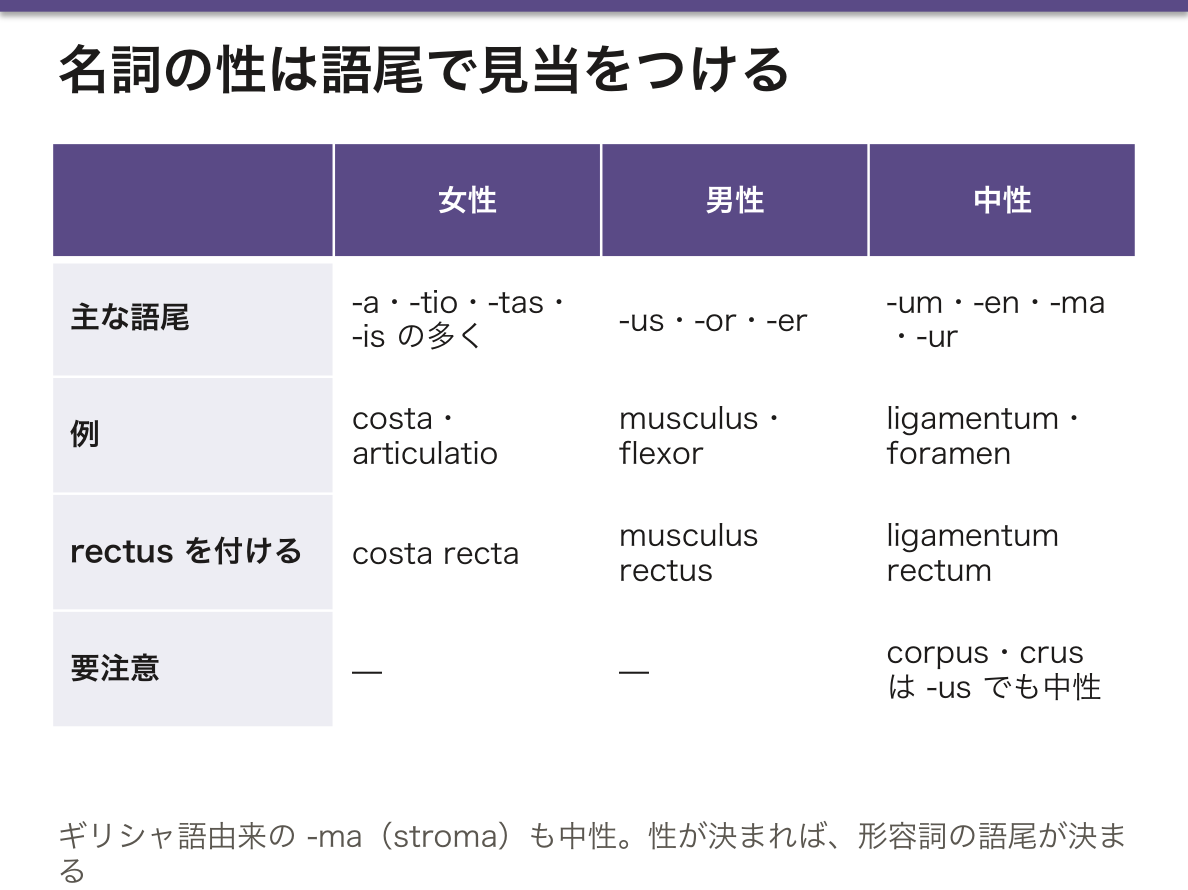
性が分かれば形容詞が決まる——musculus rectus(男)/costa recta(女)/ligamentum rectum(中)。1つの形容詞が3つの形を持つのはこのため。
English version
Core
To make an adjective agree, the gender is needed. The ending gives an indication.
Feminine — -a (costa, vena, arteria), -tio / -sio (articulatio, incisio), -tas (cavitas), -tudo, many in -is (pelvis, basis).
Masculine — -us (musculus, nervus, ductus), -or (flexor, extensor), -er.
Neuter — -um (ligamentum, cerebrum), -en (foramen, abdomen), the third-declension words in -us (corpus, crus, genus), -ur (femur), -ma (of Greek origin: stroma, chiasma).
Here is the commonest trap — there are words ending in -us that are neuter (corpus, crus, genus, tempus). These are third declension, with genitives in -oris / -uris / -eris. In corpus vertebrae, "the body of the vertebra", corpus is neuter.
The Greek -ma is readily taken for feminine but is neuter (stroma → stromatis).
Going further
Know the gender and the adjective follows — musculus rectus (m.) / costa recta (f.) / ligamentum rectum (n.). This is why one adjective has three forms.
複数形 — 用語の意味が変わるNumerus pluralis
解剖用語では単数か複数かで指すものが変わるので、複数形は避けて通れない。
os, ossis(中性)→ ossa cranii(頭蓋の諸骨)。musculus → musculi intercostales externi(外肋間筋群)。ligamentum → ligamenta flava(黄色靭帯)。vertebra → vertebrae lumbales(腰椎)。
形容詞も一緒に複数にする——ここを忘れて musculi intercostalis と書くのが典型的な誤り。
紛らわしい対——os, oris(口、中性)とos, ossis(骨、中性)は主格が同じで属格が違う。oris = 口の(cavitas oris 口腔)、ossis = 骨の。取り違えやすい組である。
ギリシャ語由来の複数——-is → -es(diagnosis → diagnoses)、-on → -a(ganglion → ganglia)、-x → -ges/-ces(phalanx → phalanges)。臨床用語で頻繁に出る。
English version
Core
In anatomical terms singular and plural refer to different things, so the plural cannot be avoided.
os, ossis (neuter) → ossa cranii (the bones of the skull). musculus → musculi intercostales externi (the external intercostal muscles). ligamentum → ligamenta flava (the ligamenta flava). vertebra → vertebrae lumbales (the lumbar vertebrae).
The adjective goes plural too — forgetting this and writing musculi intercostalis is the typical error.
A confusable pair — os, oris (mouth, neuter) and os, ossis (bone, neuter) share a nominative and differ in the genitive. oris = of the mouth (cavitas oris, the oral cavity), ossis = of the bone. The two are easily confused.
Going further
Plurals of Greek origin — -is → -es (diagnosis → diagnoses), -on → -a (ganglion → ganglia), -x → -ges/-ces (phalanx → phalanges). They appear constantly in clinical terms.
まとめ
| 格 — 主格と属格だけ使う | ラテン語には6つの格があるが、解剖用語で実際に使うのは2つである。 |
|---|---|
| 形容詞 — 名詞と性・数・格を一致させる | 形容詞は修飾する名詞と、性・数・格の3つを一致させる。 |
| 名詞の5変化 — 属格の語尾で見分ける | ラテン語の名詞は5つの変化型に分かれる。 |
| 名詞の性 — 語尾から見当をつける | 形容詞を一致させるには性が要る。語尾から見当がつく。 |
| 複数形 — 用語の意味が変わる | 解剖用語では単数か複数かで指すものが変わるので、複数形は避けて通れない。 |
このノートは医学生が授業の内容を自分の言葉でまとめたもので、診療の判断に使うものではありません。誤りに気づいたらお知らせください。