
6. NODAĻA「ES EJU UZ UNIVERSITĀTI」。この課で前置詞が本格的に出てくる。ここで「前置詞は格を支配する」というラトビア語の最重要規則が姿を見せる。
Ar ko jūs braucat uz universitāti?(どうやって大学へ来ますか)のように、この課の内容はそのまま口に出して使うことになる。
- iet と braukt — 徒歩か、乗り物か
- 前置詞 — 単数なら対格、複数なら必ず与格
- kur / uz kurieni / no kurienes — 3方向を分ける
iet と braukt — 徒歩か、乗り物かIet un braukt
ラトビア語は「行く」を移動手段で分ける。ここを間違えると、文法は正しくても意味がおかしくなる。
| iet(徒歩で行く) | braukt(乗り物で行く) | |
|---|---|---|
| es | eju | braucu |
| tu | ej | brauc |
| viņš / viņa / viņi / viņas | iet | brauc |
| mēs | ejam | braucam |
| jūs | ejat | braucat |
どちらも第1活用(不規則)である。Es eju uz universitāti.(歩いて大学へ行く)/Es braucu uz universitāti.(乗り物で大学へ行く)
iet gulēt(寝に行く=寝る)のように、iet +不定詞で日常表現になるものが多い。
手段は ar +対格で言う(乗り物は単数なので対格):
| brauc ar mašīnu 車で | brauc ar autobusu バスで | brauc ar tramvaju 市電で |
| brauc ar trolejbusu トロリーバスで | brauc ar taksometru タクシーで | brauc ar vilcienu 列車で |
| brauc ar divriteni 自転車で | brauc ar skrejriteni キックボードで | iet kājām 徒歩で |
⚠️ 「徒歩で」だけ ar を使わない。iet kājām(kāja=脚 の複数与格)という決まった形で、ar kājām とは言わない。リガの学生の答えでいちばん多いのがこの形なので、覚えておくと得をする。
過去形は 7. NODAĻA で出るが、形が大きく変わるので先に見ておく:
| iet 過去 | braukt 過去 | |
|---|---|---|
| es | gāju | braucu |
| tu | gāji | brauci |
| viņš | gāja | brauca |
| mēs | gājām | braucām |
| jūs | gājāt | braucāt |
braukt は現在の es と過去の es がどちらも braucu になる(ēst と同じ罠)。iet は語幹が ie- → gā- に化けるので、こちらは見分けが付く。
English version
Core
Latvian divides "to go" by the means of travel. Get this wrong and the grammar is right while the meaning is odd.
| iet (go on foot) | braukt (go by vehicle) | |
|---|---|---|
| es | eju | braucu |
| tu | ej | brauc |
| viņš / viņa / viņi / viņas | iet | brauc |
| mēs | ejam | braucam |
| jūs | ejat | braucat |
Both are first conjugation (irregular). Es eju uz universitāti. (I walk to the university) / Es braucu uz universitāti. (I go to the university by vehicle)
Many everyday expressions are iet plus an infinitive, such as iet gulēt (to go to sleep).
Going further
The means is said with ar plus the accusative (a vehicle being singular, hence accusative):
| brauc ar mašīnu by car | brauc ar autobusu by bus | brauc ar tramvaju by tram |
| brauc ar trolejbusu by trolleybus | brauc ar taksometru by taxi | brauc ar vilcienu by train |
| brauc ar divriteni by bicycle | brauc ar skrejriteni by scooter | iet kājām on foot |
⚠️ Only "on foot" does not use ar. iet kājām (the dative plural of kāja, leg) is the fixed form; ar kājām is not said. It is the commonest answer among students in Riga, so it is worth knowing.
The past appears in 7. NODAĻA, but the forms change greatly, so look at them in advance:
| iet past | braukt past | |
|---|---|---|
| es | gāju | braucu |
| tu | gāji | brauci |
| viņš | gāja | brauca |
| mēs | gājām | braucām |
| jūs | gājāt | braucāt |
For braukt the present es and the past es are both braucu (the same trap as ēst). iet changes its stem from ie- to gā-, so that one can be told apart.
前置詞 — 単数なら対格、複数なら必ず与格Prievārdi
6. NODAĻA で扱う前置詞は3つ。どれも単数では対格を取る。
| 前置詞 | 意味 | 例 |
|---|---|---|
| ar | 〜と/〜で(手段・材料) | Es runāju ar skolotāju.(先生と話す)/Es braucu ar autobusu.(バスで行く) |
| uz | 〜へ(行き先) | Viņi brauc uz muzeju.(博物館へ行く)/Studenti iet uz lekciju.(講義へ行く) |
| par | 〜について/〜として | Viņš domā par eksāmenu.(試験のことを考える)/Es gribētu strādāt par neirologu.(神経内科医になりたい) |
par +対格で「〜として働く」になるのは覚えておく価値がある——Par ko jūs strādājat?(ご職業は?)は問診の定番である。
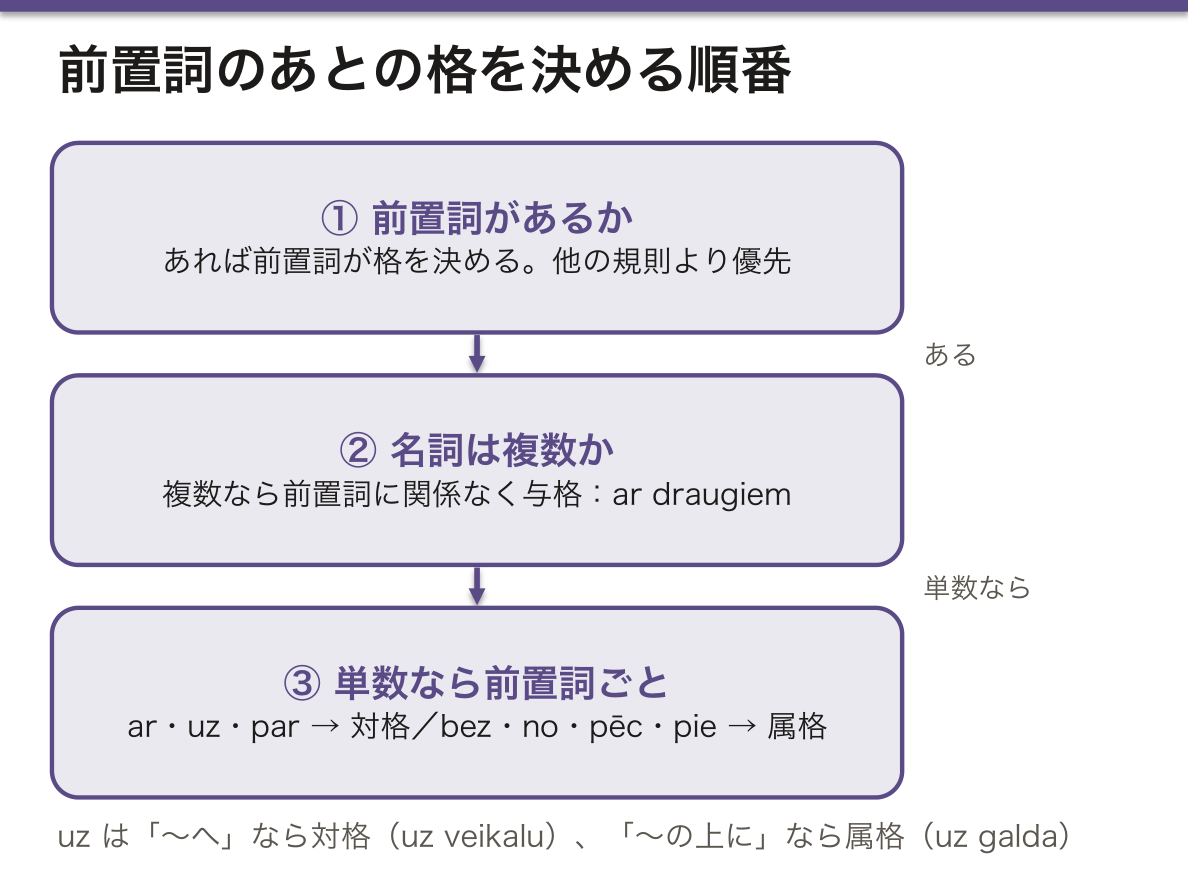
⚠️ 複数になると、全ての前置詞が与格に変わる。これはラトビア語の文法でいちばん大きな例外で、Grammar overview にも「前置詞は他の全ての規則に優先する」と明記されている。
| 単数(対格) | 複数(与格) | 訳 |
|---|---|---|
| ar draugu | ar draugiem | 友人と/友人たちと |
| uz māju | uz mājām | 家へ |
| par eksāmenu | par eksāmeniem | 試験について |
| pie ārsta(属格) | pie ārstiem | 医者のところへ |
| no Somijas(属格) | no Talsiem | フィンランドから/タルシから |
単数で属格を取る前置詞もある——bez(〜なしで)・no(〜から)・pēc(〜のあと)・pie(〜のところへ)・pirms(〜の前に)・kopš(〜以来)。tēja bez cukura(砂糖なしの紅茶)・pēc nodarbības(授業のあと)・iet pie ārsta(医者にかかる)。それでも複数になれば全部与格になるので、覚える組み合わせはそこまで多くない。
uz は2つの顔を持つ。「〜へ」なら対格、「〜の上に」なら属格である: Mēs braucam uz veikalu.(店へ行く・対格)/Grāmata ir uz galda.(本は机の上にある・属格)。
English version
Core
Three prepositions are dealt with in 6. NODAĻA. All take the accusative in the singular.
| Preposition | Meaning | Example |
|---|---|---|
| ar | with / by (means, material) | Es runāju ar skolotāju. (I speak with the teacher) / Es braucu ar autobusu. (I go by bus) |
| uz | to (destination) | Viņi brauc uz muzeju. (They go to the museum) / Studenti iet uz lekciju. (The students go to the lecture) |
| par | about / as | Viņš domā par eksāmenu. (He is thinking about the examination) / Es gribētu strādāt par neirologu. (I would like to work as a neurologist) |
par plus the accusative giving "to work as" is worth remembering — Par ko jūs strādājat? (What is your occupation?) is a standard question in history-taking.
Going further
⚠️ In the plural, every preposition switches to the dative. This is the largest exception in Latvian grammar, and the Grammar overview states plainly that the preposition overrides every other rule.
| Singular (accusative) | Plural (dative) | Meaning |
|---|---|---|
| ar draugu | ar draugiem | with a friend / with friends |
| uz māju | uz mājām | home |
| par eksāmenu | par eksāmeniem | about the examination(s) |
| pie ārsta (genitive) | pie ārstiem | to the doctor(s) |
| no Somijas (genitive) | no Talsiem | from Finland / from Talsi |
Some prepositions take the genitive in the singular — bez (without), no (from), pēc (after), pie (to, at), pirms (before), kopš (since). tēja bez cukura (tea without sugar), pēc nodarbības (after the class), iet pie ārsta (to see a doctor). Even so, in the plural they all become dative, so there are not so many combinations to learn.
uz has two faces. "To" takes the accusative; "on top of" takes the genitive: Mēs braucam uz veikalu. (We are going to the shop, accusative) / Grāmata ir uz galda. (The book is on the table, genitive)
kur / uz kurieni / no kurienes — 3方向を分けるUz kurieni
日本語の「どこ」が、ラトビア語では3つに割れる。英語も where / where to / where from と分けるので、そこは近い。
| 疑問詞 | 聞いていること | 答えの格 | 例 |
|---|---|---|---|
| Kur? | どこで(居場所) | 処格 | Kur jūs dzīvojat? — Es dzīvoju Rīgā. |
| Uz kurieni? | どこへ(行き先) | uz +対格 | Uz kurieni jūs ejat? — Uz universitāti. |
| No kurienes? | どこから(出身) | no +属格 | No kurienes jūs esat? — Es esmu no Japānas. |
No kurienes jūs esat? は自己紹介で必ず聞かれる。答えは Es esmu no Japānas.(日本から来ました)。
⚠️ 「家」は3方向とも形が違ううえ、全部不規則である。頻出するので丸ごと覚えるしかない:
| 方向 | 形 | 例 |
|---|---|---|
| どこで | mājās | Es esmu mājās.(家にいる) |
| どこへ | uz mājām | Es braucu uz mājām.(家へ帰る) |
| どこから | no mājām | Es eju no mājām.(家から出る) |
māja(家)は第4変化の単数だが、この3つでは常に複数扱いになる。だから「どこへ」も対格ではなく与格 mājām である(複数だから)。
lauki(田舎)も同じく常に複数: laukos(田舎で)/uz laukiem(田舎へ)。
地名は処格でそのまま「〜で」になる。Rīgā・Jūrmalā・Siguldā・Liepājā。ただし複数形の地名(Talsi・Cēsis・Helsinki)は複数処格 Talsos・Cēsīs・Helsinkos になる——6. NODAĻA の読解文に Mani vecāki dzīvo Helsinkos. という形で出てくる。
English version
Core
The Japanese "where" splits into three in Latvian. English divides it too, as where / where to / where from, so it is close.
| Question word | What is asked | Case of the answer | Example |
|---|---|---|---|
| Kur? | Where (location) | Locative | Kur jūs dzīvojat? — Es dzīvoju Rīgā. |
| Uz kurieni? | Where to (destination) | uz + accusative | Uz kurieni jūs ejat? — Uz universitāti. |
| No kurienes? | Where from (origin) | no + genitive | No kurienes jūs esat? — Es esmu no Japānas. |
No kurienes jūs esat? is asked without fail in an introduction. The answer is Es esmu no Japānas. (I am from Japan.)
Going further
⚠️ "Home" has a different form in all three directions, and all are irregular. It comes up constantly, so it must simply be learned whole:
| Direction | Form | Example |
|---|---|---|
| Where | mājās | Es esmu mājās. (I am at home) |
| Where to | uz mājām | Es braucu uz mājām. (I am going home) |
| Where from | no mājām | Es eju no mājām. (I am leaving home) |
māja (house) is a fourth-declension singular, but in these three it is always treated as plural. So "where to" is the dative mājām rather than the accusative (because it is plural).
lauki (the countryside) is likewise always plural: laukos (in the country) / uz laukiem (to the country).
Place names become "in —" in the locative as they stand. Rīgā, Jūrmalā, Siguldā, Liepājā. But plural place names (Talsi, Cēsis, Helsinki) take the plural locative Talsos, Cēsīs, Helsinkos — the reading passage of 6. NODAĻA has Mani vecāki dzīvo Helsinkos.
まとめ
| iet と braukt — 徒歩か、乗り物か | ラトビア語は「行く」を移動手段で分ける。 |
|---|---|
| 前置詞 — 単数なら対格、複数なら必ず与格 | 6. NODAĻA で扱う前置詞は3つ。 |
| kur / uz kurieni / no kurienes — 3方向を分ける | 日本語の「どこ」が、ラトビア語では3つに割れる。 |
このノートは医学生が授業の内容を自分の言葉でまとめたもので、診療の判断に使うものではありません。誤りに気づいたらお知らせください。