体温計・血圧計・心電計・超音波プローブ——医療機器は、体の温度・圧力・音・光といった物理量を電気信号に変えて測っている。その「変換器」がトランスデューサである。
この章では、まず電気の基本量(電流・電圧・抵抗・電力)とオームの法則を確認し、温度を電気に変える2つの代表——抵抗が変わるサーミスタと電圧を生む熱電対——の原理と使い分けを見る。最後に、取り出した弱い信号を増幅して表示する流れと、出力を入力に戻すフィードバックを扱う。フィードバックは機械だけでなく、体の恒常性の基本原理でもある。
目や耳も、光や音を神経の電気信号に変えるトランスデューサである。機械の話と生理学の話が同じ図で描ける。
- トランスデューサとセンサ — 変換するものと、感じ取るもの
- 電気の基本量とオームの法則
- サーミスタ — 温度で抵抗が大きく変わる
- 熱電対 — 温度差が電圧を生む
- 信号の増幅と表示 — 弱い信号は大きくしてから見る
- フィードバックと制御系 — 恒常性の仕組み
トランスデューサとセンサ — 変換するものと、感じ取るもの
トランスデューサ(transducer)は、エネルギー(あるいは信号)をある形から別の形に変換する装置である。医療機器では多くの場合、物理量と電気信号の間を変換する。
センサ(sensor)は、周囲の変化や出来事を検出して、その情報を他の電子機器(多くはコンピュータ)に送る装置・部品である。
ほとんどのセンサはトランスデューサだが、すべてのトランスデューサがセンサではない。マイクは音を電気に変えて音を検出するのでセンサでありトランスデューサ。スピーカーは電気を音に変えるが何も検出しないので、トランスデューサだがセンサではない。
例を入力と出力で並べると区別がはっきりする。
| 装置 | 入力 → 出力 |
|---|---|
| マイク | 音(圧力)→ 電気 |
| スピーカー | 電気 → 音 |
| 超音波プローブ | 電気 ⇄ 超音波(送信も受信も) |
| サーミスタ | 温度 → 抵抗の変化 |
| 熱電対 | 温度差 → 電圧 |
| 圧トランスデューサ | 血管内の圧 → 電気 |
サーミスタは温度に応じて抵抗が変わるだけで、それ自体はエネルギーを別の形に作り変えて出すわけではない——このためサーミスタを「センサではあるが厳密なトランスデューサではない」と説明することもある。スマートフォンの加速度計やジャイロスコープ、指紋や顔の認証もセンサの例である。
感覚受容器は生体のトランスデューサである。網膜の視細胞は光を、蝸牛の有毛細胞は音の振動を、皮膚の受容器は圧や温度を、神経の電気信号に変える。人工内耳は、マイクで拾った音を電気刺激に変えて蝸牛神経を直接刺激する、機械のトランスデューサで生体のそれを置き換える装置である。
English version
Core
A transducer is a device that converts energy (or a signal) from one form to another. In medical devices it usually converts between a physical quantity and an electrical signal.
A sensor is a device or part that detects changes or events in its surroundings and sends the information to other electronics (often a computer).
Most sensors are transducers, but not all transducers are sensors. A microphone turns sound into electricity and detects sound, so it is both. A loudspeaker turns electricity into sound but detects nothing, so it is a transducer but not a sensor.
Going further
Listing input and output makes the difference clear.
| Device | Input → output |
|---|---|
| Microphone | Sound (pressure) → electricity |
| Loudspeaker | Electricity → sound |
| Ultrasound probe | Electricity ⇄ ultrasound (sends and receives) |
| Thermistor | Temperature → change in resistance |
| Thermocouple | Temperature difference → voltage |
| Pressure transducer | Pressure in a vessel → electricity |
A thermistor only changes its resistance with temperature and does not itself turn energy into another form, so it is sometimes described as “a sensor but not strictly a transducer”. Accelerometers and gyroscopes in smartphones, and fingerprint and face recognition, are also examples of sensors.
In the clinic
Sensory receptors are the body’s transducers. Photoreceptors in the retina turn light, hair cells in the cochlea turn sound vibration, and skin receptors turn pressure and temperature into electrical nerve signals. A cochlear implant replaces the body’s transducer with a machine one: it turns sound picked up by a microphone into electrical pulses that stimulate the cochlear nerve directly.
電気の基本量とオームの法則
| 量 | 定義・式 | 単位 |
|---|---|---|
| 電流 I | 導体の断面を単位時間に通る電荷:I = q/t | A(アンペア) |
| 電圧 V | 単位電荷あたりの位置エネルギー:V = Wp/q | V(ボルト) |
| 抵抗 R | 電流の流れにくさ | Ω(オーム) |
| 電力 P | 単位時間に使うエネルギー:P = W/t = I·V | W(ワット) |
オームの法則:V = I·R(電圧と電流は比例する)。
直流(DC)は一方向に流れ、交流(AC)は向きが周期的に入れかわる。電池や電子機器の内部は直流、家庭の電源は交流。
ホースの水にたとえると覚えやすい。電圧=水を押す圧力、電流=流れる水の量、抵抗=ホースに詰まった砂。圧が同じなら砂が多いほど水は少なくなる——これがオームの法則で、血流のポアズイユの法則(流量=圧較差/抵抗)とまったく同じ形をしている。
電力とエネルギーは別物である。電力は「流れの勢い」(W)、エネルギーは「たまった量」(J または kWh)。5 kW を1時間出し続ければ 5 kWh のエネルギーになる。バケツにたとえれば、電力はホースから出る水の勢い、エネルギーはバケツにたまった水の量である。
起電力(emf)は「力」という名前だが力ではなく、電源が単位電荷に与えるエネルギー、つまり電圧で、単位はボルトである。
English version
Core
| Quantity | Definition / formula | Unit |
|---|---|---|
| Current I | Charge passing a cross-section of a conductor per unit time: I = q/t | A (ampere) |
| Voltage V | Potential energy per unit charge: V = Wp/q | V (volt) |
| Resistance R | How hard it is for current to flow | Ω (ohm) |
| Power P | Energy used per unit time: P = W/t = I·V | W (watt) |
Ohm’s law: V = I·R (voltage and current are proportional).
Direct current (DC) flows one way; alternating current (AC) changes direction periodically. Batteries and the inside of electronic devices use DC; household mains is AC.
Going further
A garden hose makes it easy to remember: voltage = the pressure pushing the water, current = the amount of water flowing, resistance = sand stuck in the hose. At the same pressure, more sand means less water — this is Ohm’s law, and it has exactly the same form as Poiseuille’s law for blood flow (flow = pressure difference/resistance).
Power and energy are different. Power is “the strength of the flow” (W); energy is “the amount collected” (J or kWh). Delivering 5 kW for one hour gives 5 kWh of energy. With a bucket: power is how hard water comes out of the hose, energy is how much water is in the bucket.
Electromotive force (emf) is called a “force” but is not one; it is the energy a source gives per unit charge — a voltage — and its unit is the volt.
サーミスタ — 温度で抵抗が大きく変わる
サーミスタ(thermistor)は、温度によって電気抵抗が大きく変わる半導体の抵抗器である。温度を抵抗の変化として読み取る(抵抗温度測定:抵抗と温度の一対一の関係にもとづく)。
| 種類 | 温度が上がると |
|---|---|
| NTC(負の温度係数、ふつうの「サーミスタ」) | 抵抗が下がる |
| PTC(正の温度係数、ポジスタ) | 抵抗が上がる |
NTC の抵抗は温度に対して指数関数的に変わる:R = R0·exp[B(1/T − 1/T0)]。
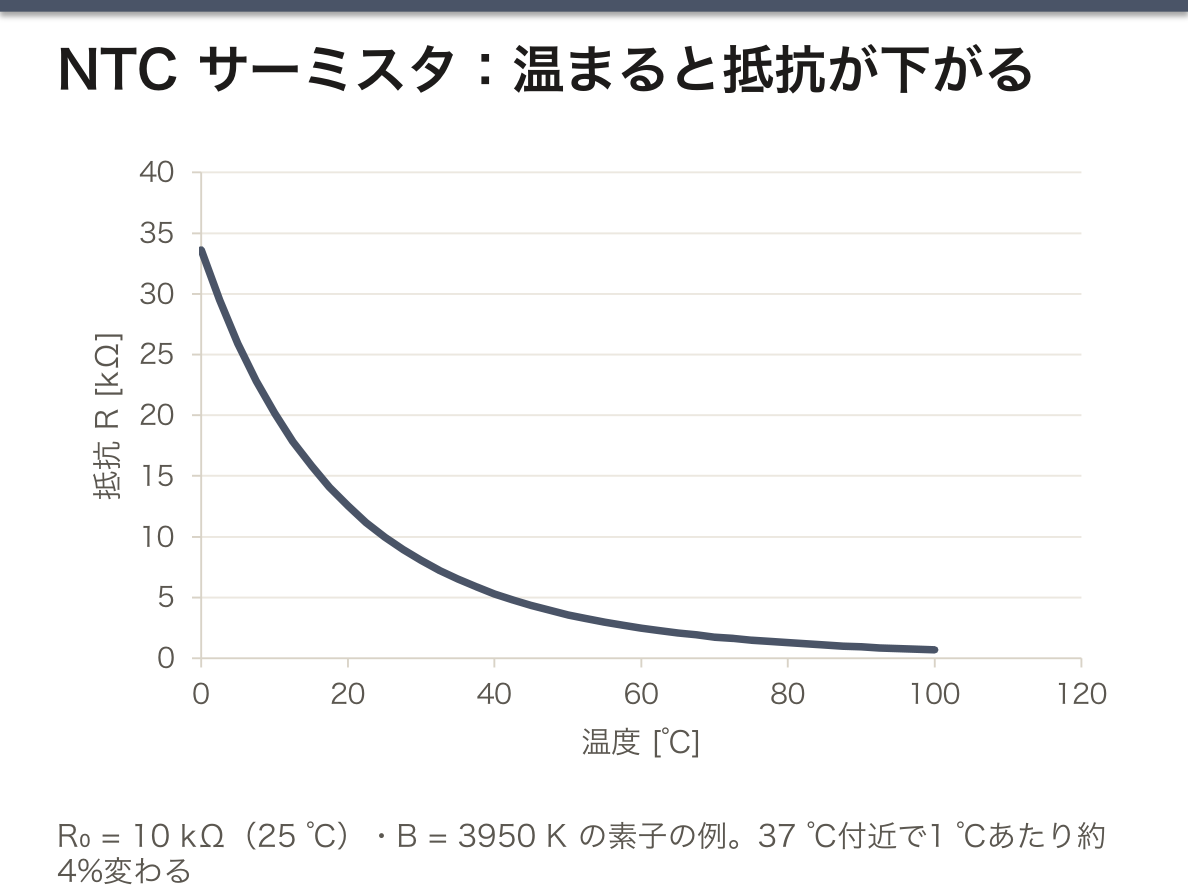
なぜ NTC は温まると抵抗が下がるのか。半導体では、温度が上がると熱エネルギーで電気を運ぶ電子(キャリア)が増える。運び手が増えるので電流が流れやすくなる。金属では逆に、温度が上がると原子の振動が増えて電子の流れを邪魔するので、抵抗はわずかに上がる。
使うには校正が要る。基準の温度計と並べて温め、温度と抵抗の対応表(校正曲線)をつくる。指数関数なので、lnR を 1/T に対してプロットすると直線になる。
長所は感度が高い(1 ℃で数%変わる)こと、短所は測れる範囲が狭く、関係が直線でないことである。
電子体温計の多くはサーミスタを使っている。肺動脈カテーテルによる熱希釈法では、冷たい液を右心房に注入し、カテーテル先端のサーミスタで肺動脈の温度変化を記録して、その変化の大きさから心拍出量を計算する。
English version
Core
A thermistor is a semiconductor resistor whose electrical resistance changes strongly with temperature. It reads temperature as a change in resistance (resistance thermometry, based on a one-to-one relation between resistance and temperature).
| Type | As temperature rises |
|---|---|
| NTC (negative temperature coefficient; the usual “thermistor”) | Resistance falls |
| PTC (positive temperature coefficient; posistor) | Resistance rises |
The resistance of an NTC changes exponentially with temperature: R = R0·exp[B(1/T − 1/T0)].
Going further
Why does an NTC’s resistance fall when warmed? In a semiconductor, rising temperature gives more electrons (carriers) enough thermal energy to carry current. More carriers make current flow more easily. In metals it is the opposite: atoms vibrate more and get in the way of the electrons, so resistance rises slightly.
To use it, calibration is needed: warm it beside a reference thermometer and make a table of temperature and resistance (a calibration curve). Because the relation is exponential, plotting lnR against 1/T gives a straight line.
Its strength is high sensitivity (several percent per °C); its weaknesses are a narrow range and a non-linear relation.
In the clinic
Most electronic clinical thermometers use thermistors. In thermodilution with a pulmonary artery catheter, cold fluid is injected into the right atrium, a thermistor at the catheter tip records the temperature change in the pulmonary artery, and cardiac output is calculated from the size of that change.
熱電対 — 温度差が電圧を生む
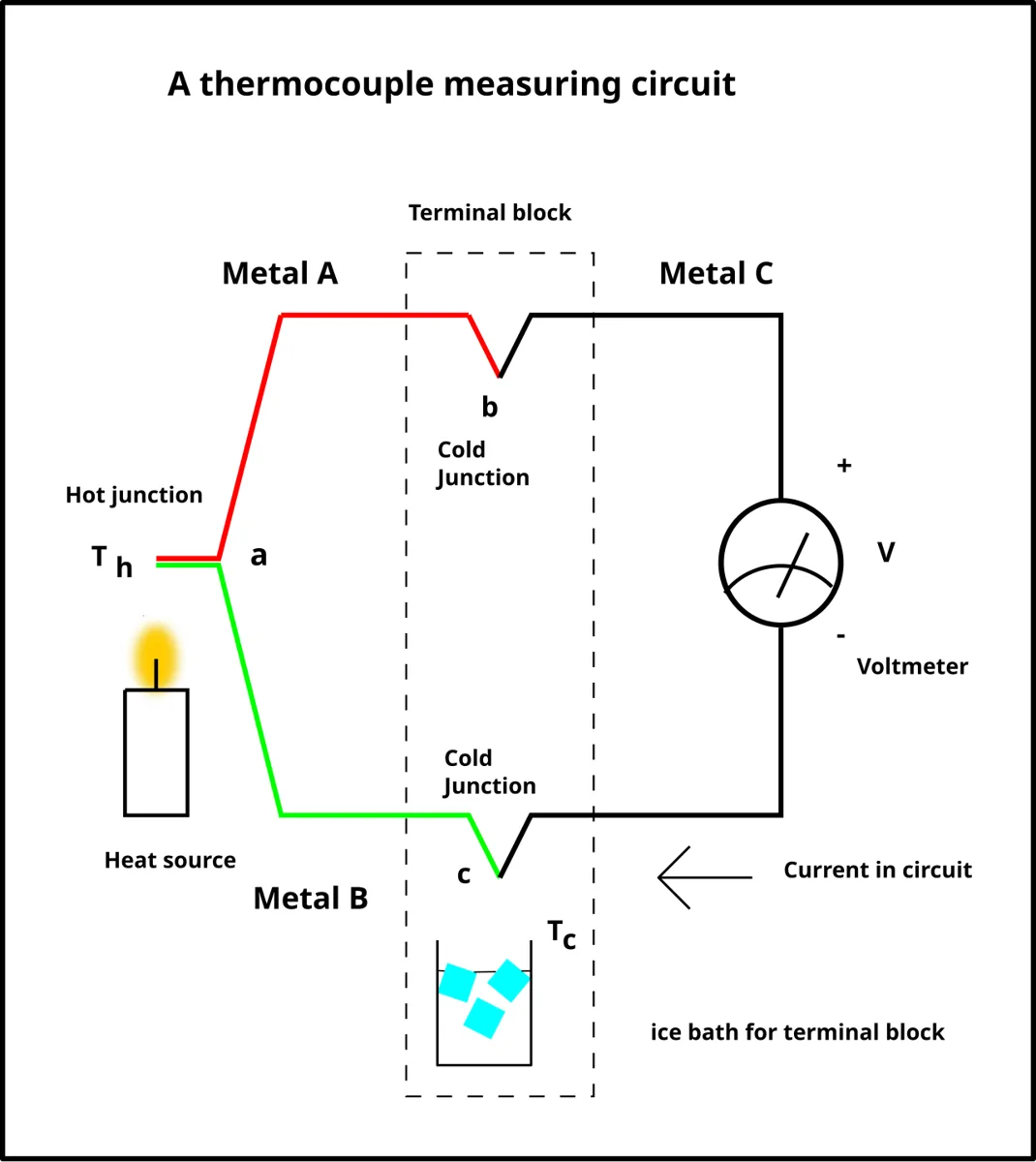
熱電対(thermocouple)は、種類の違う2本の金属線(例:銅とコンスタンタン)の両端を接合したもの。一方の接点を測りたい場所(測温接点)に、他方を基準温度(基準接点)に置くと、2つの接点の温度差に比例した電圧(起電力)が生じる。
E = α·ΔT(α:ゼーベック係数。銅–コンスタンタンで約 0.04 mV/K)
この現象をゼーベック効果という。生じるのは直流の電圧で、関係は測定範囲でほぼ直線である。
なぜ電圧が生じるのか。導線の一端を温めると、熱い側の電子は激しく動いて冷たい側へ広がり、熱い側は電子が不足、冷たい側は過剰になる。こうして導線の長さ方向の温度勾配に沿って電圧ができる。電圧は接点そのものではなく、温度差のかかった導線の中で生じる。
ではなぜ2種類の金属が要るのか。同じ金属で輪をつくると、行きと帰りで同じ大きさの逆向きの電圧ができて打ち消し合う(銅–銅では起電力ゼロ)。金属ごとに電圧のでき方が違うので、異なる2本を組み合わせると差が残り、測れる電圧になる。
関連する熱電効果:ペルチェ効果(電流を流すと一方の接点で熱を吸収し、他方で放出する。電子冷却に使う)、トムソン効果(温度勾配のある1本の導体に電流を流すと熱を吸収・放出する)。3つは互いに関係しあう可逆な現象である。
サーミスタとの使い分け:熱電対は測れる温度範囲が広く、小さく、反応が速いが、電圧が非常に小さく(1 K で数十 μV)、基準接点の温度管理と増幅が要る。サーミスタは感度が高いが範囲が狭い。体温付近を精密に測るならサーミスタ、高温や広い範囲なら熱電対が向く。熱電対を多数直列にしたもの(サーモパイル)は、耳式の赤外線体温計の検出部に使われる。
English version
Core
A thermocouple is made of two wires of different metals (for example, copper and constantan) joined at both ends. With one junction at the place to measure (the measuring junction) and the other at a reference temperature (the reference junction), a voltage (emf) proportional to the temperature difference between the junctions appears.
E = α·ΔT (α: the Seebeck coefficient, about 0.04 mV/K for copper–constantan)
This is the Seebeck effect. The voltage is DC, and the relation is nearly linear over the measuring range.
Going further
Why does a voltage appear? When one end of a wire is heated, electrons on the hot side move more and spread toward the cold side; the hot side runs short of electrons and the cold side has extra. So a voltage builds along the temperature gradient in the length of the wire. It arises in the wire under the temperature difference, not at the junction itself.
Why two kinds of metal? A loop of a single metal makes equal and opposite voltages going and returning, which cancel (copper–copper gives zero emf). Each metal builds voltage differently, so combining two different wires leaves a difference that can be measured.
Related thermoelectric effects: the Peltier effect (a current absorbs heat at one junction and releases it at the other; used for electronic cooling) and the Thomson effect (current in a single conductor with a temperature gradient absorbs or releases heat). The three are related, reversible phenomena.
In the clinic
Choosing between them: thermocouples cover a wide temperature range, are small and respond fast, but their voltage is very small (tens of μV per K) and needs reference-junction control and amplification. Thermistors are more sensitive but cover a narrow range. For precise measurement near body temperature, a thermistor fits; for high temperatures or wide ranges, a thermocouple. Many thermocouples in series (a thermopile) are used as the detector in infrared ear thermometers.
信号の増幅と表示 — 弱い信号は大きくしてから見る
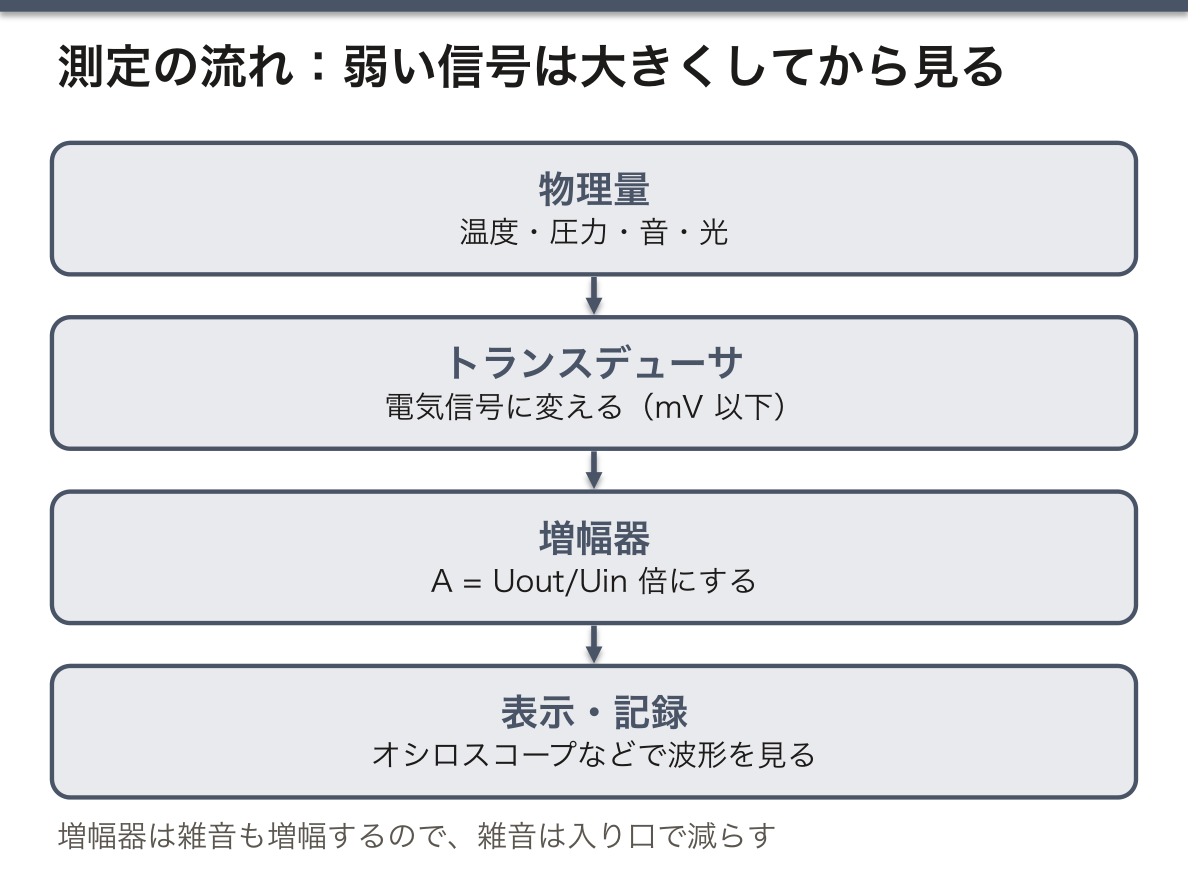
トランスデューサから出る電気信号は、多くの場合弱すぎてそのままでは表示も記録もできない(マイクや熱電対の出力は mV やそれ以下)。そこで増幅器(アンプ)で振幅(と電力)を大きくしてから表示装置に送る。
測定の流れ:物理量 → トランスデューサ → 増幅器 → 表示・記録装置。
増幅の度合いを増幅率(利得) A という:A = Uout/Uin。デシベルで表すと、電圧比では 20·log10(Uout/Uin) dB。
オシロスコープは、電圧の時間変化を画面に波形として描く装置で、信号の形・周期・振幅を目で見られる。
なぜ電圧のデシベルは20倍なのか。電力は電圧の2乗に比例する(P = V2/R)。電力比の dB は 10·log なので、電圧比で書くと 10·log(V2) = 20·logV になる。電圧を10倍にする増幅器は 20 dB、100倍なら 40 dB。
増幅器は信号だけでなく雑音も増幅する。体の信号は μV〜mV と小さいので、雑音を入り口で減らすこと(シールド、差動増幅で共通の雑音を打ち消す)が測定の質を決める。
心電図の電位は約1 mV、脳波は数十 μV しかなく、どちらも数千〜数万倍に増幅して記録する。電源の交流(50/60 Hz)が混ざると基線に細かい規則的な波が乗るので、電極の接触や周囲の電気機器を確かめる。
English version
Core
The electrical signal from a transducer is often too weak to display or record as it is (microphone and thermocouple outputs are millivolts or less). So an amplifier increases its amplitude (and power) before it goes to a display.
The measurement chain: physical quantity → transducer → amplifier → display or recorder.
The degree of amplification is the gain A: A = Uout/Uin. In decibels, for a voltage ratio it is 20·log10(Uout/Uin) dB.
An oscilloscope draws the change of voltage over time as a waveform on a screen, so you can see the shape, period and amplitude of a signal.
Going further
Why 20 for voltage decibels? Power is proportional to the square of voltage (P = V2/R). Power ratios in dB use 10·log, so with a voltage ratio it becomes 10·log(V2) = 20·logV. An amplifier that multiplies voltage by 10 gives 20 dB; by 100, 40 dB.
An amplifier boosts noise as well as signal. Body signals are small, microvolts to millivolts, so reducing noise at the input (shielding, differential amplifiers that cancel common noise) decides the quality of the measurement.
In the clinic
The ECG is only about 1 mV and the EEG tens of μV; both are amplified thousands to tens of thousands of times before recording. Mains AC (50/60 Hz) adds fine, regular waves on the baseline, so check the electrode contacts and nearby electrical equipment.
フィードバックと制御系 — 恒常性の仕組み
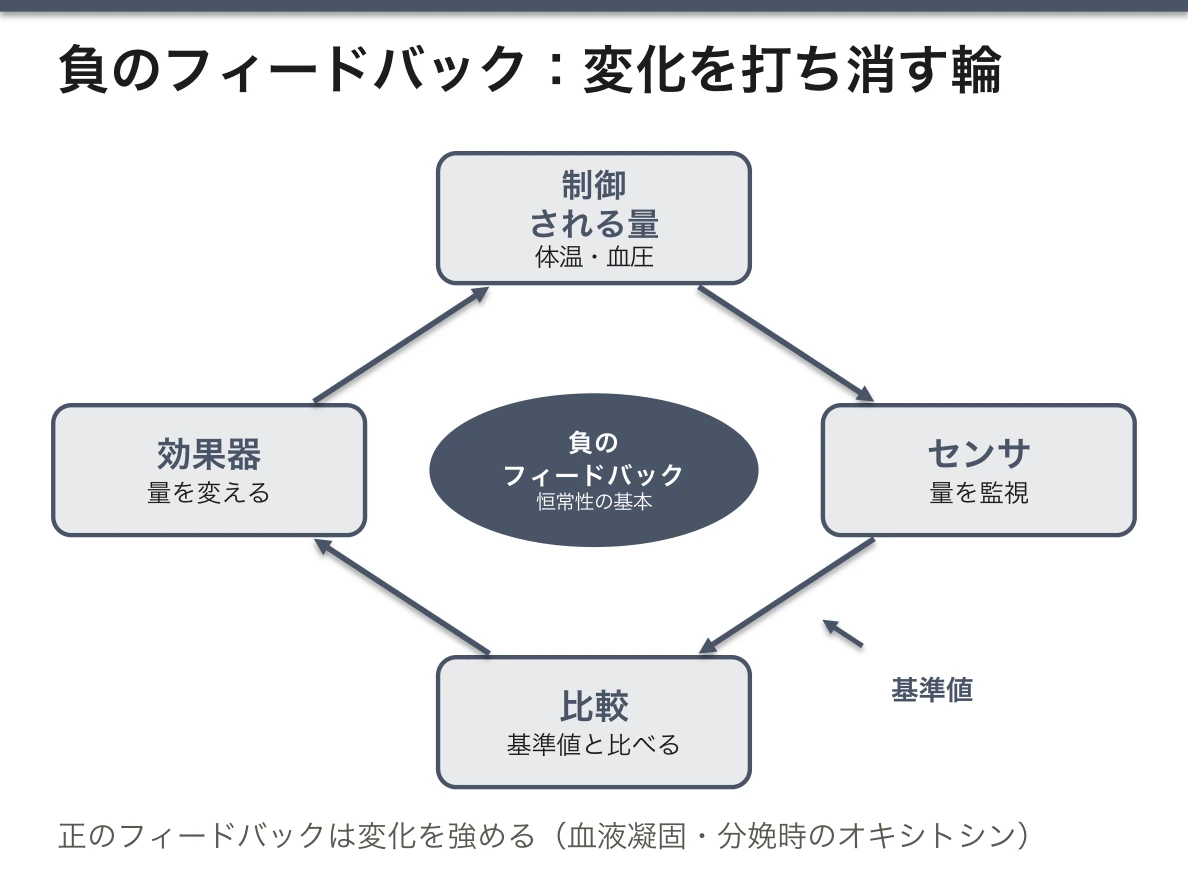
フィードバックとは、出力の一部を入力に戻して、系の働きを調節することである。
制御の過程は次の要素からなる:①制御される量(体温、血圧、瞳孔の大きさなど)、②その量を監視して情報を伝える手段(センサ)、③基準値(設定値)、④量と基準値を比べる仕組み、⑤比べた結果を、量を変える行動に変える仕組み(効果器)。体の中で指令は神経とホルモンで伝えられる。
負のフィードバック:変化を打ち消す向きにはたらき、系を安定させる。正のフィードバック:変化を強める向きにはたらき、変化を一気に進める。
増幅器に帰還をかけたときの増幅率は、元の増幅率を A、出力を入力へ戻す割合を β として
Af = A/(1 − βA)
βA が負(負帰還)なら分母は1より大きく、増幅率は下がるが安定する。βA が正(正帰還)なら分母が1より小さく、増幅率は元より大きくなり、βA が1に近づくと発振する(マイクとスピーカーのハウリング)。
体の調節の多くが負のフィードバックなのは、外乱があっても基準値に戻すことが恒常性そのものだからである。正のフィードバックは、いったん始めたら最後まで完了させたい過程に限って使われる。
負のフィードバックの例:瞳孔の対光反射(光が強くなると瞳孔が縮み、網膜に入る光を減らす)、体温調節、圧受容器反射による血圧の調節、ホルモン分泌(甲状腺ホルモンが TSH を抑える)。正のフィードバックの例:血液凝固(血小板が集まると、さらに血小板を呼ぶ物質を出す)、分娩時のオキシトシン、排卵前の LH サージ。正のフィードバックが止まらなくなると、敗血症での播種性血管内凝固のように病的な連鎖になる。
English version
Core
Feedback means returning part of the output to the input to regulate how a system works.
A control process has these parts: (1) the controlled quantity (body temperature, blood pressure, pupil size, etc.), (2) a way to monitor it and send information (a sensor), (3) a reference value (set point), (4) a way to compare the quantity with the reference, and (5) a way to turn the result of the comparison into action that changes the quantity (an effector). In the body, instructions are carried by nerves and hormones.
Negative feedback works to cancel a change and stabilizes the system. Positive feedback works to strengthen a change and drives it forward quickly.
Going further
When feedback is applied to an amplifier with gain A, and β is the fraction of output returned to the input, the gain becomes
Af = A/(1 − βA)
If βA is negative (negative feedback), the denominator is larger than 1, so the gain falls but becomes stable. If βA is positive (positive feedback), the denominator is smaller than 1 and the gain grows; as βA approaches 1 the system oscillates (the howling between a microphone and a loudspeaker).
Most body regulation is negative feedback because returning to the set point despite disturbances is what homeostasis is. Positive feedback is used only for processes that, once started, should be carried through to the end.
In the clinic
Examples of negative feedback: the pupillary light reflex (bright light narrows the pupil and reduces light reaching the retina), temperature control, blood pressure control by the baroreceptor reflex, and hormone secretion (thyroid hormone suppresses TSH). Examples of positive feedback: blood clotting (gathering platelets release substances that call more platelets), oxytocin during labor, and the LH surge before ovulation. When positive feedback cannot stop, it becomes a harmful chain, as in disseminated intravascular coagulation in sepsis.
まとめ
| トランスデューサとセンサ — 変換するものと、感じ取るもの | トランスデューサ(transducer)は、エネルギー(あるいは信号)をある形から別の形に変換する装置である。 |
|---|---|
| 電気の基本量とオームの法則 | 量定義・式単位電流 I導体の断面を単位時間に通る電荷:I = q/tA(アンペア)電圧 V単位電荷あたりの位置エネルギー:V = Wp/qV(ボルト)抵抗 R電流の流れにくさΩ(オ… |
| サーミスタ — 温度で抵抗が大きく変わる | サーミスタ(thermistor)は、温度によって電気抵抗が大きく変わる半導体の抵抗器である。 |
| 熱電対 — 温度差が電圧を生む | 熱電対(thermocouple)は、種類の違う2本の金属線(例:銅とコンスタンタン)の両端を接合したもの。 |
| 信号の増幅と表示 — 弱い信号は大きくしてから見る | トランスデューサから出る電気信号は、多くの場合弱すぎてそのままでは表示も記録もできない(マイクや熱電対の出力は mV やそれ以下)。 |
| フィードバックと制御系 — 恒常性の仕組み | フィードバックとは、出力の一部を入力に戻して、系の働きを調節することである。 |
このノートは医学生が授業の内容を自分の言葉でまとめたもので、診療の判断に使うものではありません。誤りに気づいたらお知らせください。