新しい薬や手術は、人に使う前に動物で確かめられる。医療はこの段階の上に成り立っている。では、動物に苦痛を与える実験はどこまで許されるのか。
この章では、人間と動物の間に「道徳的に意味のある違い」があるかという問いから始め、動物の痛みを科学の対象外とみなしてきた「科学のイデオロギー」、動物モデルの研究が抱える心理学者のジレンマ、そして現在の国際的な標準である3Rを見る。
- 人間と動物の「道徳的に意味のある違い」
- 「科学のイデオロギー」 — 動物の痛みは科学の対象外か
- 心理学者のジレンマ — 似ているなら非道徳、似ていないなら無意味
- 3R — 置き換え・削減・苦痛の軽減
人間と動物の「道徳的に意味のある違い」
道徳的に意味のある違いとは、2つの存在を道徳的に違って扱うことを正当化できる性質のことである。成績が同じ2人の学生に、目の色が違うという理由で別の評価をつけることはできない。目の色は成績にとって意味のある違いではないからだ。
では人間と動物の間に、痛みを与える実験を一方には許し、他方には禁じるだけの違いがあるか。伝統的に挙げられてきたのは、魂をもつ・理性がある・言語を使う・神に与えられた地位・力の強さなどである。動物倫理の論者は、少なくとも痛みを感じることが問題になる場面では、これらはどれも意味のある違いではないと論じた。ベンサムの言葉で言えば、問うべきは「理性があるか、話せるか」ではなく「苦しむことができるか」である。力の強さを持ち出せば「力は正義なり」を認めることになり、それこそ道徳が退けるべき考えだ。
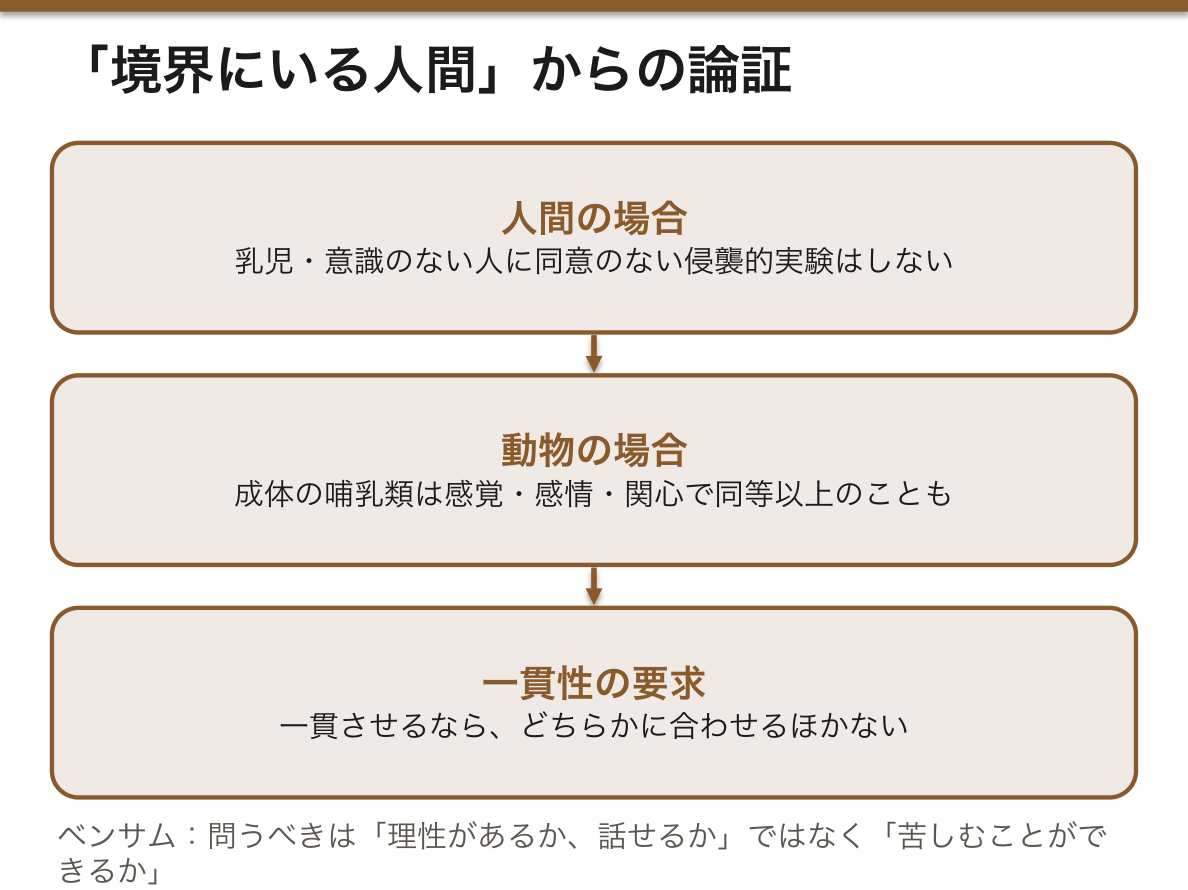
この議論を鋭くするのが「境界にいる人間」からの論証である。私たちは、乳児・意識のない人・重い知的障害や認知症のある人に、社会に大きな利益があるとしても、同意のない侵襲的な実験を決して行わない。ところが、ふつうの成体の哺乳類は、感覚・感情・関心の幅でこうした人々と同等か、それ以上のこともある。道徳的な一貫性を求めるなら、どちらかに合わせるほかない。
シンガーは、種の違いだけを理由に動物の利益を軽く扱うことを種差別(speciesism)と呼び、人種差別や性差別になぞらえた。功利主義は動物の苦しみを幸福の計算にそのまま入れる。これに対し、理性的な道徳的行為者であることを道徳の基礎に置くカント的な立場や、人間の開花を目標とする徳倫理では、動物は人間と同じ道徳的地位をもたないが、それでも苦痛はできるだけ小さくすべきだとされる。どの理論に立っても「動物の苦痛はどうでもよい」という結論は出てこない。
ヘルシンキ宣言も、人を対象とする研究は適切な動物実験に基づくべきだとしつつ、研究に使われる動物の福祉を尊重しなければならないと明記している。新薬は動物での安全性の確認を経て初めて人に投与される。医療はこの段階を前提に成り立っているので、医師は動物実験の倫理に無関係ではいられない。
English version
Core
A morally relevant difference is a feature that justifies treating two beings differently in a morally significant way. We cannot give two students with identical work different grades because of their eye colour; eye colour is not relevant to grades.
Is there a difference between humans and animals that allows painful experiments on one but forbids them on the other? Traditional answers include having a soul, reason, language, a God-given status, or greater power. Animal ethicists argue that none of these is relevant, at least where the capacity to feel pain is at issue. In Bentham’s words, the question is not ‘can they reason? can they talk?’ but ‘can they suffer?‘ Appealing to power means accepting ‘might makes right’ — exactly what morality exists to reject.
Going further
The argument is sharpened by ‘marginal humans’. We never do non-consensual invasive experiments on infants, unconscious people, or people with severe intellectual disability or dementia, even for great social benefit. Yet a normal adult mammal may equal or exceed them in sensation, emotion and interests. Moral consistency forces us to treat the two alike one way or the other.
Singer called discounting animals’ interests only because of species speciesism, comparing it to racism and sexism. Utilitarianism puts animal suffering straight into the calculation. In contrast, views based on rational moral agency (Kant) or human flourishing (virtue ethics) do not give animals equal moral status, but still hold that their suffering should be kept to a minimum. No theory concludes that animal pain does not matter.
In the clinic
The Declaration of Helsinki says research on humans should be based on adequate animal experiments, and also that the welfare of animals used for research must be respected. New drugs are given to humans only after safety testing in animals. Medicine depends on this step, so doctors cannot be indifferent to the ethics of animal research.
「科学のイデオロギー」 — 動物の痛みは科学の対象外か
1980年代半ばまで、科学界は動物実験への倫理的な問いを「これは科学上の必要であって道徳の問題ではない」と退けることが多かった。ロリンはその背景を科学のイデオロギー(科学の常識)と呼んだ。科学教育の中で、事実として疑われないまま教え込まれる前提の束である。中心は2つある。
| 前提 | 中身 | 帰結 |
|---|---|---|
| 科学は価値から自由である | 検証できる主張だけが意味をもつ(論理実証主義)。倫理的な主張は主観的な感情の表出にすぎない | 倫理は科学者が考える問題ではない |
| 主観的な心の状態は科学的に実在しない | 外から観察できないものは扱わない(行動主義) | 動物の「感じられた痛み」は科学的には存在しないことになる |
この見方に立つと、実験動物の鳴き声やもがきは、苦痛の表れではなく機械的な反応として片づけられてしまう。
このイデオロギーには内部の矛盾がある。鎮痛薬の効果を動物で調べているのに、動物の痛みを科学的に実在しないとみなすのは一貫しない。進化の連続性、神経解剖学・神経化学の共通性から見ても、ヒトにだけ意識が突然現れたと考える方が不自然である。
ロリンは、動物に意識はないとする新デカルト主義や、道徳を理性的な者どうしの契約とみなす契約説、人間への利益を挙げる議論などを検討し、どれも動物の苦痛を無視する根拠にならないと論じた。そのうえで、1980年代以降の「常識の取り戻し」を描いた。動物の感覚と苦痛は経験的・道徳的な現実であり、科学は倫理の真空の中にはない。法律による審査と鎮痛の義務づけが進み、文献上もほとんど論じられていなかった実験動物の鎮痛が研究されるようになった。痛みは実験結果をゆがめるストレス要因でもあり、苦痛を減らすことは良い科学の条件でもある。
English version
Core
Until the mid-1980s, the scientific community often dismissed ethical questions about animal research by saying ‘this is a scientific necessity, not a moral issue’. Rollin called the background scientific ideology (the common sense of science): a set of assumptions taught during scientific training as unquestioned fact. Two are central.
| Assumption | Content | Result |
|---|---|---|
| Science is value-free | Only verifiable statements have meaning (logical positivism); ethical claims are just subjective feelings | Ethics is not a scientist’s concern |
| Subjective mental states are not scientifically real | What cannot be observed from outside is ignored (behaviourism) | An animal’s felt pain does not ‘exist’ scientifically |
From this view, a lab animal’s cries and struggles are dismissed as mechanical responses rather than signs of suffering.
Going further
The ideology contradicts itself. Testing painkillers on animals while treating animal pain as unreal is inconsistent. Evolutionary continuity and shared neuroanatomy and neurochemistry also make it implausible that consciousness suddenly appeared only in humans.
Rollin examined neo-Cartesian denials of animal consciousness, contract theories that limit morality to rational agents, and arguments from human benefit, and argued that none justifies ignoring animal suffering. He described a ‘reappropriation of common sense’ from the 1980s: animal feeling and suffering are empirical and moral realities, and science does not stand in an ethical vacuum. Legal review and required pain relief spread, and analgesia for lab animals, almost absent from the literature before, began to be studied. Pain is also a stressor that distorts results, so reducing suffering is also a condition of good science.
心理学者のジレンマ — 似ているなら非道徳、似ていないなら無意味
心理学者のジレンマは、動物を人間の心の状態のモデルとして使う研究に向けられた批判である。痛み・うつ・不安・依存・攻撃性などを動物に引き起こして調べる実験は、次の二者択一を避けられない。
| 動物の状態が人間の状態に | 帰結 | |
|---|---|---|
| 第一の角 | 似ている(類比的である) | 人間に与えれば許されない苦しみを、人間に近い存在に与えていることになり、道徳的に正当化しにくい |
| 第二の角 | 似ていない | 人間について何も分からないので、科学的に無意味であり、苦痛を与える理由がない |
つまり、研究を科学的に正当化する根拠(人間との類似)が、そのまま研究を道徳的に問題のあるものにする。
このジレンマが鋭いのは、研究者自身の論理を使っているからだ。サルにうつ状態を引き起こしてヒトの治療を探す研究は、「サルのうつはヒトのうつと同じように苦しい」という前提に立って初めて意味をもつ。その前提を認めれば、苦痛の重さも認めなければならない。
ジレンマから逃れる道は、2つの角の間にあるかもしれない。似ている程度が部分的で、知りたい仕組み(たとえば特定の神経回路)だけが共通し、苦痛は最小限にできる、という場合である。だがそれを主張するなら、研究者はどの点で似ていて、どの点で違うのかを具体的に示す責任を負う。これは科学的妥当性と無危害の原則がぶつかる典型的な場面である。
精神科の薬の多くは、動物の行動モデルで効果が確かめられてきた。一方で、動物モデルで有望だった候補薬がヒトでは効かない例も多い。心理学者のジレンマは、倫理の問題であると同時に、そのモデルが本当にヒトの病気を映しているかという科学の問題でもある。
English version
Core
The psychologist’s dilemma is a criticism of research that uses animals as models of human mental states. Experiments that induce pain, depression, anxiety, addiction or aggression in animals cannot avoid this choice.
| The animal state is | Result | |
|---|---|---|
| First horn | analogous to the human state | We inflict suffering that would be unacceptable in humans on a being like us — hard to justify morally |
| Second horn | not analogous | We learn nothing about humans, so the research is scientifically pointless and the suffering has no reason |
The very ground that justifies the research scientifically (similarity to humans) is what makes it morally problematic.
Going further
The dilemma is sharp because it uses the researchers’ own logic. Inducing depression in monkeys to find human treatments only makes sense if monkey depression is like human depression — including how much it hurts. Accept the premise, and you must accept the weight of the suffering.
A way out may lie between the horns: the similarity is partial, only the mechanism of interest (say, a particular neural circuit) is shared, and suffering can be minimised. But then researchers must show concretely in what ways the model is similar and in what ways it differs. This is a typical clash between scientific validity and non-maleficence.
In the clinic
Many psychiatric drugs were tested in animal behavioural models, yet many candidates that looked promising in animals fail in humans. The psychologist’s dilemma is an ethical question and also a scientific one: does the model really reflect the human disease?
3R — 置き換え・削減・苦痛の軽減
3Rは、1959年にラッセルとバーチが提唱した、動物実験の倫理の国際的な標準である。
| R | 中身 | 例 |
|---|---|---|
| Replacement(置き換え) | 動物を使わない方法、または苦痛を感じにくい生物に置き換える | 細胞・組織培養、オルガノイド、コンピュータ・シミュレーション、疫学研究 |
| Reduction(削減) | 同じ情報を得るのに使う動物の数を減らす | 統計的に適切なサンプル数の設計、実験の重複を避ける |
| Refinement(苦痛の軽減) | 手順を改善し、痛みと苦しみを最小限にする | 適切な麻酔・鎮痛、人道的エンドポイント、飼育環境の改善 |
動物の苦痛と使用数を最小限にしようとするこの立場を福祉主義(welfarist)アプローチと呼ぶ。多くの国の法規制はこの考え方に基づき、専門の委員会が実験計画を3Rの観点から審査している。
3Rは「動物を使うこと自体は認めたうえで、害を減らす」立場である。これに対し動物解放論の側は、どれも不十分だと批判する。動物はヒトの薬の安全性や効果を予測するモデルとして当てにならず、たとえ当てになるとしても、動物を生命と自由への権利をもたない存在として扱うべきではない、という主張である(一貫させれば、食用・娯楽・運搬への利用にも反対することになる)。
3RにRespect(尊重)を加えて「4R」とする整理もある。実験のあらゆる段階で動物の福祉を念頭に置け、というものだ。また、ロリンは見落とされがちな点を指摘している。実験動物が受ける苦しみの多くは、実験の処置そのものより、その種の本性(テロス)に合わない飼育環境——穴を掘る齧歯類を狭い箱に入れる、群れで暮らす動物を孤立させる——から来るかもしれない。さらに、ヒトの遺伝病を再現した遺伝子改変動物は、治療法のない慢性の苦痛を長く抱えることがあり、新しい倫理的課題になっている。
日本では動物愛護管理法に3Rの考え方が盛り込まれ、大学や研究機関は動物実験委員会を置いて計画を審査している。医学教育でも、生きた動物を使う実習の多くはシミュレーターや献体による学習に置き換えられてきた。これは置き換えの実践例である。
English version
Core
The 3Rs, proposed by Russell and Burch in 1959, are the international standard for the ethics of animal research.
| R | Content | Examples |
|---|---|---|
| Replacement | Use methods without animals, or organisms less able to feel pain | Cell and tissue culture, organoids, computer simulation, epidemiology |
| Reduction | Use fewer animals for the same information | Proper statistical sample sizes, avoiding repeated experiments |
| Refinement | Improve procedures to minimise pain and distress | Proper anaesthesia and analgesia, humane endpoints, better housing |
This approach, which tries to minimise both suffering and numbers, is called the welfarist approach. Most national laws are based on it, and specialist committees review experimental plans in terms of the 3Rs.
Going further
The 3Rs accept the use of animals but try to reduce harm. Animal liberationists say this is not enough: animals are poor models for predicting the safety and efficacy of human drugs, and even if they were good models, we should not treat animals as having no rights to life and freedom (to be consistent, this view must also oppose using animals for food, entertainment and transport).
Some add Respect to make ‘4Rs’: keep animal welfare in mind at every stage. Rollin also points out something often missed: much of what lab animals suffer may come not from the procedures but from housing that does not fit their species nature (telos) — burrowing rodents kept in small boxes, social animals kept alone. And genetically engineered animals that model human genetic diseases may live long with chronic pain that cannot be treated, a new ethical problem.
In the clinic
In Japan, the Act on Welfare and Management of Animals includes the 3Rs, and universities and research institutes have animal experiment committees that review plans. In medical education, many classes that once used live animals have been replaced by simulators and learning with donated bodies — a working example of replacement.
まとめ
| 人間と動物の「道徳的に意味のある違い」 | 道徳的に意味のある違いとは、2つの存在を道徳的に違って扱うことを正当化できる性質のことである。 |
|---|---|
| 「科学のイデオロギー」 — 動物の痛みは科学の対象外か | 1980年代半ばまで、科学界は動物実験への倫理的な問いを「これは科学上の必要であって道徳の問題ではない」と退けることが多かった。 |
| 心理学者のジレンマ — 似ているなら非道徳、似ていないなら無意味 | 心理学者のジレンマは、動物を人間の心の状態のモデルとして使う研究に向けられた批判である。 |
| 3R — 置き換え・削減・苦痛の軽減 | 3Rは、1959年にラッセルとバーチが提唱した、動物実験の倫理の国際的な標準である。 |
このノートは医学生が授業の内容を自分の言葉でまとめたもので、診療の判断に使うものではありません。誤りに気づいたらお知らせください。