遺伝子を「読む」技術(出生前・着床前の検査)と「書き換える」技術(遺伝子治療・ゲノム編集)は、病気を原因から治す希望と同時に、人を選び、作り変える力をもたらした。
この章では、体細胞と生殖細胞系の遺伝子治療の違いから始め、救世主きょうだい、受精卵のゲノム編集、デザイナー・ベビーとエンハンスメント、そしてそれらの議論の背後に常に影を落とす優生学の歴史(日本の優生保護法を含む)を見る。
一貫して問われるのは2つ。治療と増強の境界はどこか、そして誰が決めるのか(本人か、親か、国家か)。
- 遺伝子治療 — 体細胞か、生殖細胞系か
- 救世主きょうだい — 兄や姉を救うために生まれる子
- ゲノム編集と生殖細胞系の改変 — 越えてはならない線か
- デザイナー・ベビーとエンハンスメント — 治療を越えて
- 優生学 — 過去の過ちと「新しい優生学」
遺伝子治療 — 体細胞か、生殖細胞系か
遺伝子治療とは、遺伝物質を加えたり発現させたりして、欠けている、あるいは異常な遺伝子の働きを補い、病気を治療・予防することである。症状を抑えるのではなく病気の原因に働きかける点に新しさがある。遺伝子を細胞に届けるには、多くの場合ウイルスを改変したベクター(運び屋)を使う。
| 体細胞遺伝子治療 | 生殖細胞系遺伝子治療 | |
|---|---|---|
| 対象 | 患者本人の体の細胞(血液・肝臓・網膜など) | 精子・卵子・受精卵(胚) |
| 変化が及ぶ範囲 | その患者一代限り | 子孫に受け継がれる |
| 倫理的評価 | 通常の新しい治療と同じ枠組み(危険と利益、同意)で評価できる | 将来の世代の同意が得られず、取り返しがつかない。多くの国で禁止 |
体細胞遺伝子治療は、倫理的には他の新しい治療と本質的に変わらないと考えられている。問題の中心は、まだ未知の部分が多い技術の危険と、研究としての同意の質である。1999年、米国で18歳の若者が遺伝性の代謝疾患の遺伝子治療の臨床試験に参加し、ウイルスベクターへの激しい免疫反応で亡くなった。動物での重い副作用の情報が十分に伝えられていなかったことや、研究者の利益相反が問題になり、遺伝子治療研究の規制が見直された。
生殖細胞系の改変が特別視されるのは、①まだ存在しない将来の人々に、本人の同意なく変化を負わせる、②誤りが子孫に広がり取り消せない、③治療と増強の境界があいまいになり、優生学への扉を開く、という3つの理由からである(次の項目以下)。
体細胞遺伝子治療は実用の段階に入った。脊髄性筋萎縮症(SMA)に対し、正常な遺伝子をウイルスベクターで1回投与する治療が日本でも承認され、その薬価は1億円を超える。患者のT細胞を遺伝子改変してがんを攻撃させる CAR-T 細胞療法も血液がんで使われている。技術の倫理は、安全性の問題から高額な治療を誰がどう負担するかという正義の問題へと重心を移しつつある。
English version
Core
Gene therapy treats or prevents disease by adding or expressing genetic material that corrects missing or abnormal gene functions. Its novelty is that it acts on the cause of disease rather than controlling symptoms. Genes are usually delivered to cells with a vector, often a modified virus.
| Somatic gene therapy | Germline gene therapy | |
|---|---|---|
| Target | The patient’s body cells (blood, liver, retina, etc.) | Sperm, eggs, fertilised eggs (embryos) |
| Reach of the change | Only the patient | Passed on to descendants |
| Ethical assessment | Can be judged like any new treatment (risks and benefits, consent) | Future generations cannot consent; cannot be undone; banned in many countries |
Going further
Somatic gene therapy is thought to be ethically no different in kind from other new treatments. The main issues are the risks of a technology with many unknowns and the quality of research consent. In 1999 an 18-year-old in the US joined a gene therapy trial for an inherited metabolic disease and died from a severe immune reaction to the viral vector. Poor disclosure of serious side effects in animals and the researchers’ conflicts of interest led to tighter regulation.
Germline modification is treated as special for three reasons: (1) it imposes changes on future people who do not yet exist without their consent; (2) mistakes spread to descendants and cannot be undone; (3) it blurs the line between therapy and enhancement and opens the door to eugenics (following items).
In the clinic
Somatic gene therapy is now in use. For spinal muscular atrophy (SMA), a one-time treatment that delivers a normal gene by viral vector has been approved in Japan; its price is over 100 million yen. CAR-T cell therapy, which genetically modifies a patient’s T cells to attack cancer, is used for blood cancers. The ethical focus is shifting from safety to justice: who pays for very expensive treatments, and how.
救世主きょうだい — 兄や姉を救うために生まれる子
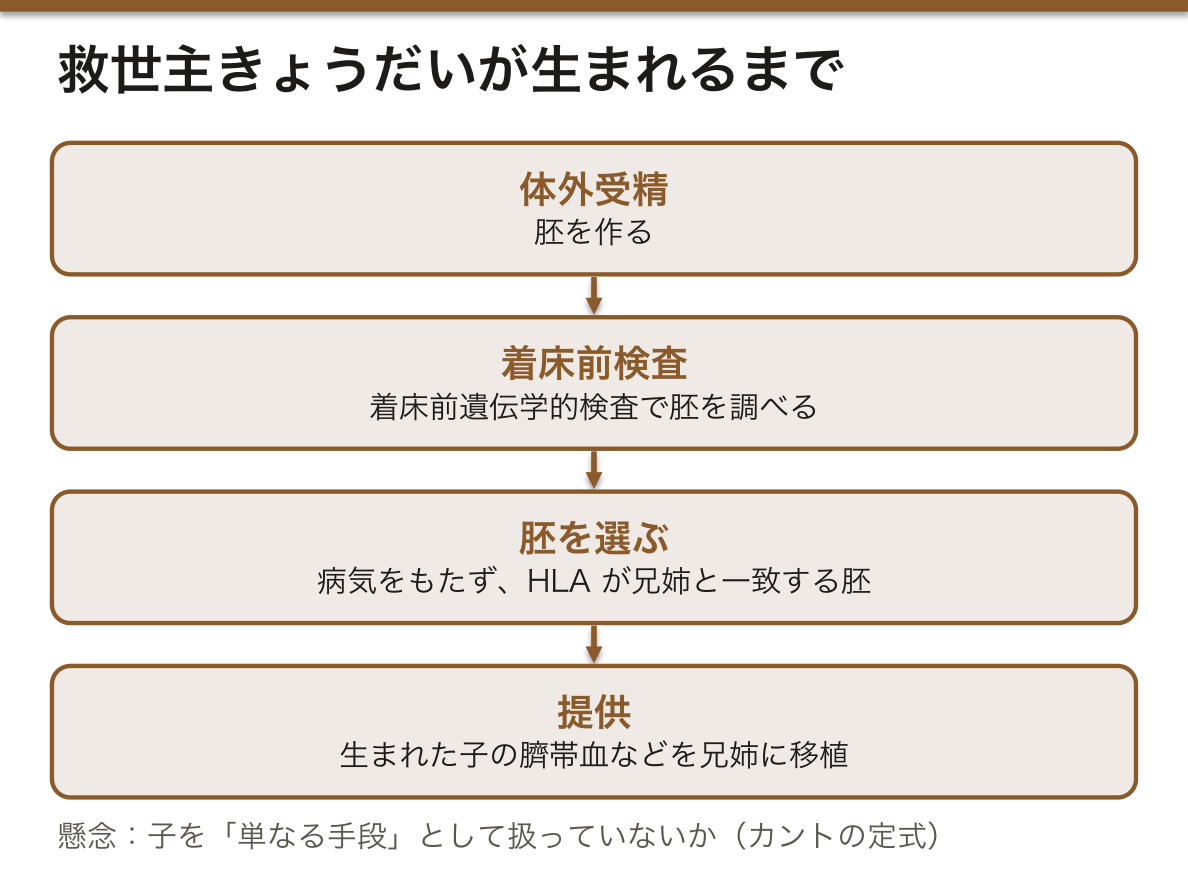
救世主きょうだいとは、重い病気の兄や姉に、骨髄や臍帯血などを提供できる適合ドナーとなることを目的にもうけられた子である。体外受精でできた胚に着床前遺伝学的検査を行い、病気をもたず、かつ組織の型(HLA)が兄姉と一致する胚を選んで移植する。2000年に米国で、遺伝性の骨髄不全の姉のために生まれた男の子の臍帯血が移植されたのが、よく知られた最初の例である。
主な倫理的懸念は、カントの定式に沿ったもので、子を「単なる手段」として扱っているのではないか、という点である。子は自分自身の価値のためではなく、他人の治療のための道具として選ばれたことになる。
反論も強い。第一に、カントが禁じたのは「単なる手段として」扱うことであり、子が兄姉を救う役割を負いながら、同時にそれ自体として愛され育てられるなら、手段としてだけ扱ったことにはならない。そもそも人は、家業の跡継ぎ、きょうだいの遊び相手、夫婦関係のためなど、さまざまな「理由」で子をもうけてきた。第二に、臍帯血の採取は生まれた子に危険をほとんど与えない。
問題が深刻になるのは、その先である。臍帯血で足りず、のちに骨髄の採取や、さらには腎臓の提供まで求められたらどうか。子が幼いうちは自分で同意できず、親は兄姉の命がかかった状況で中立な代理人になりにくい。また、適合しない胚は病気がなくても選ばれない。だから多くの国は、救世主きょうだいを認める場合でも、重い病気に限り、他に治療法がない場合に、審査を経て個別に許可する形をとっている。
この問題は、遺伝カウンセリングや小児の移植医療で現実に出会う。日本では着床前遺伝学的検査は、日本産科婦人科学会の審査のもとで重い遺伝性疾患などに限って認められている。親の願いが切実であるほど、生まれてくる子自身の利益を誰が代弁するのかという問いを、医療者が意識して持ち込む必要がある。
English version
Core
A saviour sibling is a child conceived to be a matched donor — of bone marrow or cord blood — for a seriously ill older sibling. Embryos made by IVF undergo preimplantation genetic testing, and one that is free of the disease and matches the sibling’s tissue type (HLA) is transferred. A well-known first case was in the US in 2000: cord blood from a newborn boy was transplanted to his sister with an inherited bone marrow failure.
The main concern follows Kant: is the child being treated merely as a means? The child is chosen not for its own sake but as a tool for someone else’s treatment.
Going further
The replies are strong. First, Kant forbade treating people merely as means. If the child saves the sibling and is also loved and raised for its own sake, it is not treated only as a means. People have always had children for many ‘reasons’: an heir, a playmate for a sibling, the marriage. Second, collecting cord blood carries almost no risk to the newborn.
The problem becomes serious afterwards. What if cord blood is not enough and the child is later asked for bone marrow, or even a kidney? A young child cannot consent, and parents whose other child’s life is at stake are hardly neutral surrogates. Embryos that do not match are not chosen, even if healthy. So most countries that allow saviour siblings do so only for serious disease when no other treatment exists, with case-by-case approval.
In the clinic
Clinicians meet this in genetic counselling and paediatric transplantation. In Japan, preimplantation genetic testing is allowed only for serious inherited diseases and similar conditions, under review by the Japan Society of Obstetrics and Gynecology. The more desperate the parents’ wish, the more clinicians need to raise the question: who speaks for the interests of the child to be born?
ゲノム編集と生殖細胞系の改変 — 越えてはならない線か
2010年代に登場した CRISPR-Cas9 などのゲノム編集技術は、狙った遺伝子の配列を以前よりはるかに簡単・正確に書き換えられるようにした。体細胞への応用(血液疾患の治療など)は臨床で使われ始めている。一方、受精卵を編集して子を誕生させることは、ほぼ世界的に越えてはならない線とされてきた。
2018年、中国の研究者が、HIV に感染しにくくするために受精卵の遺伝子を編集した双子が誕生したと発表し、世界中から強い非難を浴びた。研究者は有罪判決を受けた。
非難の理由は、ここまでの章の原則で整理できる。
| 原則 | 何が破られたか |
|---|---|
| 無危害 | 狙っていない部位の改変(オフターゲット)や、細胞ごとに編集の結果が違うモザイクの危険が評価されていなかった |
| 善行・必要性 | HIV 感染を防ぐ他の確立した方法があり、編集する医学的な必要がなかった |
| 自律・同意 | 親への説明は不十分で、子とその子孫は同意できない |
| 研究倫理 | 独立した審査と透明性を欠き、成果は論文ではなく発表で先に示された |
もっと根本的な論点もある。生殖細胞系の改変を将来、十分に安全にできるようになったら許されるのか。重い遺伝病を受精卵の段階で防げるなら善行だという主張がある一方、多くの場合は着床前検査で病気をもたない胚を選ぶという代替手段があり、編集でなければならない場面は限られる、という反論がある。
日本では、ゲノム編集した受精卵を人や動物の子宮に移植することは指針で禁止されており、法律による規制も議論されている。基礎研究としての受精卵のゲノム編集は、目的を限り、厳しい審査のもとでのみ認められる。医学生にとっては、技術的にできることとしてよいことの間に社会的な合意づくりが必要だ、ということを示す代表例である。
English version
Core
Genome editing tools such as CRISPR-Cas9, which appeared in the 2010s, made it far easier and more precise to rewrite a target DNA sequence. Somatic uses (such as treating blood disorders) are entering the clinic. But editing embryos to produce children has been treated almost worldwide as a line not to cross.
In 2018 a Chinese researcher announced the birth of twins whose embryos he had edited to make them resistant to HIV infection. He was condemned around the world and later convicted.
Going further
The reasons can be organised with the principles from earlier chapters.
| Principle | What was broken |
|---|---|
| Non-maleficence | Risks of unintended edits (off-target effects) and mosaicism (different results in different cells) were not assessed |
| Beneficence / necessity | Established ways to prevent HIV infection existed; there was no medical need to edit |
| Autonomy / consent | The parents’ information was inadequate; the children and their descendants cannot consent |
| Research ethics | No independent review or transparency; results were announced before any paper |
A deeper issue remains. If germline editing became safe enough, would it be acceptable? Some argue that preventing serious genetic disease at the embryo stage is beneficence. Others reply that in most cases choosing an unaffected embryo by preimplantation testing is an alternative, so situations that truly require editing are few.
In the clinic
In Japan, transferring genome-edited embryos into a human or animal uterus is banned by guidelines, and regulation by law is being discussed. Editing embryos in basic research is allowed only for limited purposes under strict review. For medical students it is a key example: between what technology can do and what we may do, society must build agreement.
デザイナー・ベビーとエンハンスメント — 治療を越えて
エンハンスメント(増強)とは、病気の治療以外の目的で、医療技術や遺伝的な介入を使って人の性質や能力を高めることである。焦点は「治す」ことではなく「より良くする」ことにある。その領域は大きく5つに分けられる。
| 領域 | 例 |
|---|---|
| 身体 | 美容外科、筋力・持久力を高める薬(スポーツのドーピング) |
| 寿命の延長 | 老化を遅らせる薬 |
| 認知 | 注意・記憶を高める薬(試験勉強に使われる中枢刺激薬) |
| 気分 | 悲しみや内気さを薬で取り除く |
| 道徳 | 薬や遺伝子操作で人をより利他的に、攻撃的でなくする |
デザイナー・ベビーは、着床前の選別やゲノム編集で、病気の予防を越えて望む性質(目の色、身長、知能、運動能力)を選んだ、あるいは作り変えた子を指す言葉である。治療としての遺伝的介入から、性質の選択へと滑り坂を下ることへの懸念を表している。
エンハンスメントへの批判は4つに整理できる。①効果の根拠が乏しい——認知の増強は、期待されるほど記憶や推論を高めないことが多い。②本物らしさ——薬で作った満足や利他性は、本人が選び取った態度ではなく一種の化学的な強制ではないか。③「より良い」とは何か——強く、賢く、長生きであることが本当に人生をよくするのかは、問われていない価値の前提に依存する。④正義——高額な増強は豊かな少数者だけが使え、遺伝的にも社会的にも格差を固定する。
デザイナー・ベビーについては、ハーバーマスが、他人の設計の産物として生まれることが、自分は自分の人生の作者だという自己理解を根本から変えてしまう、と論じた。親の選択が子の「開かれた未来」を狭めるという議論(生殖の章)と重なる。一方、リバタリアンの立場からは、危害が証明されない限り親の選択に国家が介入すべきでない、という反論がある。治療と増強の境界自体もあいまいで、身長の低い子への成長ホルモンは、病気のある子には治療、そうでない子には増強になりうる。
臨床で身近なのは、成長ホルモン、中枢刺激薬、美容医療である。「病気でない人の希望に応じる医療は医療か」という問いは、保険の適用範囲(誰が負担するか)の問題とも結びつく。限られた研究資源を、豊かな国の少数者の増強に向けるのか、多くの人がまだ受けられない基本的な医療に向けるのかという研究の優先順位の問題でもある。
English version
Core
Enhancement is the use of medical or genetic interventions to improve human traits or capacities for purposes other than treating disease. The focus is not ‘curing’ but ‘making better’. There are five broad areas.
| Area | Examples |
|---|---|
| Physical | Cosmetic surgery; drugs for strength and endurance (doping in sport) |
| Lifespan extension | Drugs that slow ageing |
| Cognitive | Drugs for attention and memory (stimulants used for exam study) |
| Mood | Removing sadness or shyness with drugs |
| Moral | Making people more altruistic and less aggressive with drugs or genes |
A designer baby is a child whose genes were selected or altered, by embryo selection or genome editing, to include desired traits (eye colour, height, intelligence, athletic ability) beyond disease prevention. The term expresses fear of a slippery slope from therapeutic genetic intervention to choosing traits.
Going further
Criticisms fall into four groups. (1) Weak evidence: cognitive enhancement often raises memory and reasoning much less than people believe. (2) Authenticity: contentment or altruism produced by a drug may be a kind of chemical coercion rather than the person’s own commitment. (3) What is ‘better’? Whether being stronger, smarter or longer-lived really makes life better depends on unexamined value assumptions. (4) Justice: costly enhancement is available only to a rich minority and fixes inequality genetically and socially.
On designer babies, Habermas argued that being born as the product of someone else’s design fundamentally changes a person’s self-understanding as the author of their own life. This overlaps with the ‘open future’ argument (reproduction chapter). Libertarians reply that the state should not interfere with parents’ choices unless harm is proven. The line between therapy and enhancement is itself blurred: growth hormone for a short child may be therapy for one child and enhancement for another.
In the clinic
In clinical practice, growth hormone, stimulants and cosmetic medicine are the familiar cases. The question ‘is medicine that serves the wishes of healthy people still medicine?’ links to insurance coverage — who pays. It is also a question of research priorities: should limited research resources go to enhancing a rich minority, or to basic care many people still cannot get?
優生学 — 過去の過ちと「新しい優生学」Eugenica
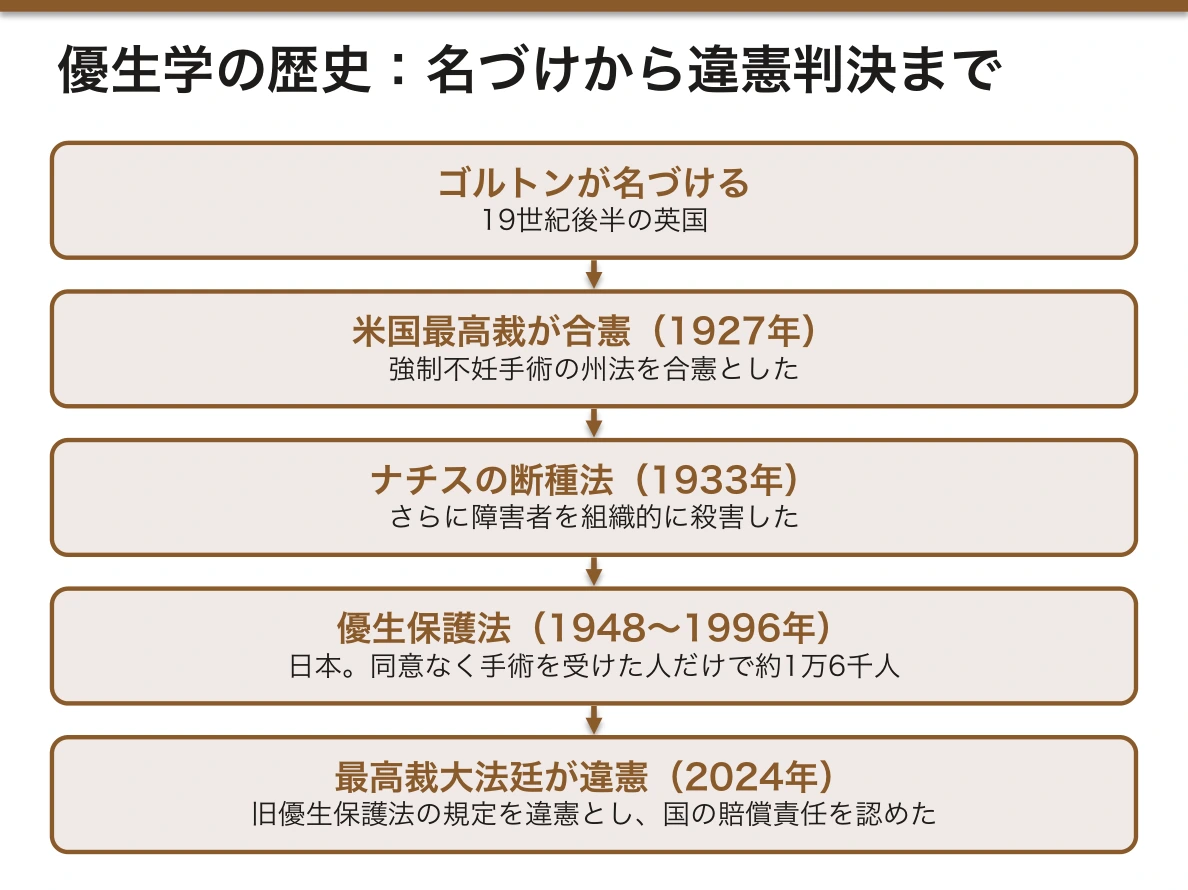
優生学とは、誰が子をもつかに影響を与えることで、人間集団の遺伝的な質を改良しようとする考えと実践である。19世紀後半に英国のゴルトンが名づけた。2つの形がある。
| 積極的優生学 | 消極的優生学 | |
|---|---|---|
| 中身 | 「望ましい」性質をもつとされた人の生殖を奨励する | 「望ましくない」性質をもつとされた人の生殖を妨げる |
| 歴史上の例 | 特定の層への出産奨励 | 強制不妊手術、結婚の制限、障害者の殺害 |
20世紀前半には、米国の多くの州が強制不妊手術の法律をつくり、米国の最高裁はそれを合憲とした(1927年)。ナチス・ドイツは1933年に断種法を定め、さらに障害者を組織的に殺害した。優生学は「科学」の名のもとに、国家が人の生殖と生命の価値を決めた歴史である。
現代の論点は、国家が強制しない優生学はありうるか、である。出生前検査や着床前検査で障害をもつ胎児・胚を避ける選択は、一人ひとりは自由な選択であっても、社会全体で積み重なれば特定の人々を減らす結果になる。これを「裏口からの優生学」と呼ぶ批判がある。障害者の権利の立場からは、こうした選択が「障害のある人生は生きる価値がない」というメッセージを社会に送る(表出主義的批判)とされる。
これに対し、親が健康な子を望むのは子が健やかに育ってほしいからで、今生きている障害者を軽んじる意図はない、という反論がある。また、障害による苦しみのすべてが社会の偏見から来るわけではなく、治療できない身体的な苦痛を伴う病気もある。両者を分けるのは、誰が決めるか(国家か、十分な情報と支援を受けた本人か)と、社会が障害のある人を支える体制をもっているかである。選択を本人に委ねながら、障害とともに生きる人生を支える社会をつくることが、優生学の過ちを繰り返さない条件になる。
日本にも深刻な歴史がある。1948年から1996年まで続いた優生保護法のもとで、遺伝性とされた病気や障害のある人々に不妊手術が行われ、本人の同意なく手術を受けた人だけで約1万6千人にのぼる。2024年、最高裁大法廷は旧優生保護法の規定を憲法違反と判断し、国の賠償責任を認めた。医師はその手術を担った側であったことを、医療者は忘れてはならない。
English version
Core
Eugenics is the idea and practice of improving the genetic quality of a human population by influencing who has children. The term was coined by Galton in Britain in the late nineteenth century. It has two forms.
| Positive eugenics | Negative eugenics | |
|---|---|---|
| Content | Encouraging people with ‘desirable’ traits to reproduce | Preventing people with ‘undesirable’ traits from reproducing |
| Historical examples | Encouraging births in certain groups | Forced sterilisation, marriage restrictions, killing disabled people |
In the early twentieth century, many US states passed forced sterilisation laws, and the US Supreme Court upheld them (1927). Nazi Germany passed a sterilisation law in 1933 and later systematically killed disabled people. Eugenics is a history of states, in the name of ‘science’, deciding about people’s reproduction and the value of their lives.
Going further
The modern question is whether there can be eugenics without state coercion. Choosing, through prenatal or preimplantation testing, to avoid a fetus or embryo with a disability is a free individual choice, but added up across society it reduces certain groups of people. Critics call this ‘back-door eugenics’. From a disability rights view, such choices send society the message that life with a disability is not worth living (the expressivist objection).
The reply: parents want a healthy child because they want the child to flourish, not because they disrespect disabled people. And not all suffering from disability comes from social prejudice; some conditions bring physical pain that cannot be treated. What separates the two is who decides (the state, or the informed and supported person) and whether society supports disabled people. Leaving choices to individuals while building a society that supports lives with disability is the condition for not repeating eugenics.
In the clinic
Japan has a serious history too. Under the Eugenic Protection Law (1948–1996), people with illnesses or disabilities considered hereditary were sterilised; about 16,000 had the operation without their consent. In 2024 the Supreme Court Grand Bench held the law’s provisions unconstitutional and found the state liable for damages. Clinicians must remember that doctors were the ones who performed those operations.
まとめ
| 遺伝子治療 — 体細胞か、生殖細胞系か | 遺伝子治療とは、遺伝物質を加えたり発現させたりして、欠けている、あるいは異常な遺伝子の働きを補い、病気を治療・予防することである。 |
|---|---|
| 救世主きょうだい — 兄や姉を救うために生まれる子 | 救世主きょうだいとは、重い病気の兄や姉に、骨髄や臍帯血などを提供できる適合ドナーとなることを目的にもうけられた子である。 |
| ゲノム編集と生殖細胞系の改変 — 越えてはならない線か | 2010年代に登場した CRISPR-Cas9 などのゲノム編集技術は、狙った遺伝子の配列を以前よりはるかに簡単・正確に書き換えられるようにした。 |
| デザイナー・ベビーとエンハンスメント — 治療を越えて | エンハンスメント(増強)とは、病気の治療以外の目的で、医療技術や遺伝的な介入を使って人の性質や能力を高めることである。 |
| 優生学 — 過去の過ちと「新しい優生学」 | 優生学とは、誰が子をもつかに影響を与えることで、人間集団の遺伝的な質を改良しようとする考えと実践である。 |
このノートは医学生が授業の内容を自分の言葉でまとめたもので、診療の判断に使うものではありません。誤りに気づいたらお知らせください。