移植医療は、臓器が足りないという事実と、死の定義という問いの2つの上に立っている。人工呼吸器が登場して、脳の機能が失われても身体が生き続けるようになったとき、「人はいつ死ぬのか」が改めて問われた。
この章では、提供の種類と同意の仕組み(オプトイン・オプトアウト)、家族の反対や臓器売買をめぐる問い、心肺死から脳死への変化とそれへの異論、遷延性意識障害と高次脳死の考え方、そして日本の臓器移植法と法的脳死判定を順に見る。
日本の制度の要点は一つ。脳死は、臓器提供をする場合に限って人の死として扱われる。
- 臓器移植と提供の種類 — 足りないという根本問題
- 同意の仕組み — オプトイン・オプトアウト・ソフトオプトアウト
- 家族の反対・臓器の売買・条件付き提供・登録者の優先
- 心肺死から脳死へ — 何が死の定義を変えたのか
- 脳死への異論 — 「全体としての統合」は本当に失われるのか
- 遷延性意識障害(植物状態)と高次脳死
- 日本の臓器移植法と法的脳死判定
臓器移植と提供の種類 — 足りないという根本問題Transplantatio
臓器移植の倫理の出発点は、提供される臓器の数が、必要とする人の数より少ないという事実である。移植は末期の心臓・肺・肝臓の不全では唯一の根本的な治療であり、腎不全でも透析より生存と生活の質を改善し、長期的には費用も抑える。それでも欧州だけで数万人が待機し、毎日のように待機中に亡くなる人がいる。
| 提供の種類 | 下位分類 | 主な臓器 |
|---|---|---|
| 生体提供 | (a) 血縁者からの提供 (b) 非血縁者からの提供(配偶者、利他的な第三者) | 腎臓、肝臓の一部 |
| 死体提供 | (a) 脳死後の提供(DBD) (b) 心停止後(循環死後)の提供(DCD) | 心臓・肺・肝臓・腎臓・膵臓・小腸など |
生体提供は、健康な人に、本人のためではない手術を受けさせるという点で、医療の原則からすると例外的である。提供者には長期的に高血圧や腎機能低下のわずかな危険が残るので、生涯の経過観察と、提供によって経済的に損をしない仕組みが求められる。家族の中で「断れない」圧力がかかりやすく、自発性の確認が倫理上の要になる(倫理理論の章の生体腎ドナーの例)。
死体提供の2つの型は、死の判定の違いに対応する。脳死後提供では、人工呼吸器で循環が保たれたまま臓器が摘出されるので、臓器の状態が良い。心停止後提供は、生命維持治療の中止後に心停止を確認してから行うもので、以前は成績が劣るとされたが、臓器を灌流・保存する技術の進歩で脳死後提供と同等の長期成績が報告されるようになった。ただし、治療中止の判断と提供の話が近づくほど、「臓器のために治療をやめたのではないか」という疑いを生まない手続きが必要になる。
日本では死体からの提供が少ないため、腎移植の大部分が生体腎移植であり、肝移植でも生体部分肝移植が中心になってきた。世界的には珍しい構造で、生体ドナーの保護がとりわけ重い意味をもつ。国試でも、生体ドナーの自発性の確認や、移植の待機と臓器のあっせんを担う組織(日本臓器移植ネットワーク)は基本事項である。
English version
Core
The starting point of transplant ethics is the fact that fewer organs are available than people who need them. Transplantation is the only definitive treatment for end-stage heart, lung and liver failure, and for kidney failure it improves survival and quality of life over dialysis and saves money in the long run. Yet tens of thousands wait in Europe alone, and people die on waiting lists almost every day.
| Type | Subtypes | Main organs |
|---|---|---|
| Living donation | (a) living related (b) living unrelated (spouse, altruistic stranger) | Kidney, part of the liver |
| Deceased donation | (a) after brain death (DBD) (b) after circulatory death (DCD) | Heart, lungs, liver, kidneys, pancreas, small bowel |
Going further
Living donation is an exception to medical principles: a healthy person undergoes surgery that is not for their own benefit. Donors keep a small long-term risk of hypertension and reduced kidney function, so lifelong follow-up and arrangements so that donors are not financially worse off are needed. Pressure within families makes refusal hard, so confirming voluntariness is the ethical key (see the kidney donor example in the ethical theories chapter).
The two types of deceased donation match two ways of determining death. In DBD, organs are removed while circulation is kept going by the ventilator, so their condition is good. DCD takes place after life-sustaining treatment is withdrawn and cardiac arrest is confirmed. It was once thought to give worse results, but with better perfusion and preservation, long-term results similar to DBD are now reported. However, the closer the decision to withdraw treatment is to talk of donation, the more we need procedures that avoid the suspicion that ‘treatment was stopped to get organs’.
In the clinic
Because deceased donation is rare in Japan, most kidney transplants are from living donors, and living-donor partial liver transplantation has been central. This is unusual worldwide, and it makes the protection of living donors especially important. Confirming the voluntariness of living donors and the organisation that coordinates waiting lists and organ allocation (the Japan Organ Transplant Network) are basic topics for the national examination.
同意の仕組み — オプトイン・オプトアウト・ソフトオプトアウト
死後の臓器提供に、本人の同意をどう扱うか。2つの基本的な仕組みがある。
| 仕組み | 定義 | 主な国 |
|---|---|---|
| オプトイン(明示的同意) | 生前に提供者として登録するという積極的な意思決定をした人(または遺族が承諾した場合)から提供する | ドイツ、デンマーク、スイス、日本など |
| オプトアウト(推定同意) | 生前に提供者の登録から外れるという積極的な意思決定をしなかった人は、提供に同意したとみなす | スペイン、フランス、ベルギー、オランダなど |
| ソフト・オプトアウト | 推定同意を基本としつつ、家族の意向を確認し、反対があれば提供しない | 英国(ウェールズが2015年に先行)など、実際のオプトアウトの多く |
オプトアウトを支持する論拠は3つある。①世論の支持:多くの人は提供に賛成と答えるが、実際に登録する人は少ない。初期設定を「提供する」にすれば、その意思とのずれが埋まる。②提供率が高い:国際比較では、推定同意の国の提供率が高い傾向がある。③遺族の精神的負担が減る:悲しみの中で「提供するかどうか」を一から決めさせずに済む。
反対の論拠もある。①さまざまな理由で(制度を知らない、手続きが分からない)生前に拒否の意思表示をしなかった人がいる。黙っていたことを同意とみなしてよいのか。②オプトアウトという制度そのものが提供率を上げるという明確な証拠はない。多くの国を比べた研究では、他の要因を調整すると差が消え、むしろ生体提供が少ないという結果もある。提供率世界一のスペインの成功は、法律よりも、全病院に置かれた移植コーディネーター、ICU での提供者の把握、監査の体制によると考えられている。③国家が身体を「既定で使える」とすることへの反発が、かえって信頼を損なう。④家族の拒否を認めるソフト・オプトアウトは、実際の運用がオプトインとほとんど変わらないかもしれない。
日本は本人の意思表示を基本とするオプトインに近い制度だが、2010年の改正で、本人の意思が不明な場合も家族の書面による承諾で提供できるようになった。一方、本人が提供の意思を示していても、家族が拒めば提供は行われない。運転免許証・健康保険証などの意思表示欄は、本人の意思を家族に伝える手段でもある。
English version
Core
How should the person’s consent be handled for donation after death? There are two basic systems.
| System | Definition | Main countries |
|---|---|---|
| Opt-in (explicit consent) | Donation from people who made an active decision during life to join the donor register (or whose families agree) | Germany, Denmark, Switzerland, Japan, etc. |
| Opt-out (presumed consent) | People who did not make an active decision during life to be excluded from the register are presumed to consent | Spain, France, Belgium, Netherlands, etc. |
| Soft opt-out | Presumed consent, but the family is consulted, and donation does not go ahead if they object | The UK (Wales first, 2015) and most opt-out systems in practice |
Going further
There are three arguments for opt-out. (1) Public support: many people say they support donation, but few register. Making ‘donate’ the default closes this gap. (2) Higher donation rates: international comparisons tend to show higher rates in presumed-consent countries. (3) Less emotional burden for relatives: grieving families need not decide from scratch.
There are arguments against. (1) Some people did not opt out during life for various reasons (not knowing the system, not knowing how). Can silence count as consent? (2) There is no clear evidence that opt-out by itself raises donation rates. Studies of many countries find the difference disappears after adjusting for other factors, and opt-out has even been linked to less living donation. Spain’s world-leading success is attributed less to its law than to transplant coordinators in every hospital, identification of donors in ICUs and audits. (3) Backlash against the state treating bodies as usable ‘by default’ may damage trust. (4) A soft opt-out that lets families refuse may work almost the same as opt-in.
In the clinic
Japan’s system is close to opt-in, based on the person’s expressed wishes, but since the 2010 revision donation is possible with the family’s written consent when the person’s wishes are unknown. On the other hand, even if the person wished to donate, donation does not go ahead if the family refuses. The donor declaration section on driving licences and health insurance cards is also a way to tell the family one’s wishes.
家族の反対・臓器の売買・条件付き提供・登録者の優先
臓器不足をめぐって、さらにいくつかの倫理的な問いがある。
| 問い | 認める側の論拠 | 慎重・反対の側の論拠 |
|---|---|---|
| 家族が反対したら?(本人は提供カードを持っていた) | 本人の生前の意思を尊重すべき。なぜ遺族が、財産以上に身体について発言権をもつのか | 利益と害の比:悲嘆の中の家族に強行すれば、社会の信頼が損なわれ将来の提供が減る。身体への権利も財産権と同じく絶対ではない |
| 臓器の売買を認めるか? | 自分の身体について、たとえ自分に害があっても決める権利がある。提供される臓器が増える | 貧しく弱い立場の人々が売る側に回り、搾取される。金で順番を買えることは不公正 |
| 条件付き提供を認めるか?(「この民族の人にだけ」) | 提供は贈与であり、提供者の意思を尊重すべき。断れば臓器そのものが失われる | 社会の差別や偏見を移植医療に持ち込む。人の命と差別の解消のどちらがより重いか |
| 登録者を優先するか? | 互恵性:提供する意思をもつ人が受け取る側でも優先される。登録が増える | ①登録者だけが受け取れる、では医療の必要に基づく配分を壊す。②優先するだけなら許容されうるが、登録できない事情のある人に不利 |
典型的な事例で考える。高齢の女性がくも膜下出血で昏睡に陥り、手術をしても予後はきわめて悪い。本人の望みどおり治療を中止することになった。財布には臓器提供の意思表示カードが入っていたが、家族は提供に同意しない。提供は行われるべきか。
法律上は本人の意思で提供できる国でも、実際には家族の強い反対を押し切って提供が行われることはまれである。理由は倫理理論の言葉で整理できる。本人の自律(義務論)は提供を支持するが、遺族の悲嘆や、病院が強行したことが報道されて提供への信頼が崩れる帰結(功利主義)は逆を指す。多くの専門家が勧めるのは、どちらかを切り捨てることではなく、本人の意思を家族と共有し、家族がそれを受け入れられるよう支えることである。そのために、元気なうちに自分の意思を家族に話しておくことが最も効果的だとされる。
臓器売買は、国際的な宣言でも日本の臓器移植法でも禁止されている(合法的な有償の腎臓提供制度をもつ国はイランなどごく少数)。海外で金銭を払って移植を受ける「移植ツーリズム」も、2008年のイスタンブール宣言で強く批判された。日本は2010年から、本人が書面で示していれば親族への優先提供を認めている。条件付き提供の一種だが、家族への思いを形にするという理由で例外的に認められたものである。
English version
Core
The organ shortage raises further ethical questions.
| Question | Arguments for allowing | Arguments for caution / against |
|---|---|---|
| What if the family objects? (the person had a donor card) | The person’s wishes should be respected. Why should relatives have more say over our body than over our property? | Benefit and harm: forcing donation on grieving families may damage public trust and reduce future donation. Rights to our bodies, like property rights, are not absolute |
| Should organ markets be allowed? | People have the right to decide about their bodies, even if it harms them. More organs would be available | Poor and vulnerable people become sellers and are exploited. Buying a place in the queue is unfair |
| Should conditional donation be allowed? (‘only to people of this ethnic group’) | Donation is a gift; the donor’s wishes should be respected; refusing loses the organ altogether | It brings social discrimination and prejudice into medicine. Which matters more: a human life, or reducing discrimination? |
| Should registered donors get priority? | Reciprocity: those willing to give are favoured when they need to receive; registration rises | (1) ‘Only registered donors can receive’ breaks allocation by need. (2) Mere priority may be acceptable, but it disadvantages people who cannot register |
Going further
Consider a typical case. An older woman falls into a coma after a subarachnoid haemorrhage; even with surgery, her outlook is very poor. As she wished, treatment is to be withdrawn. Her purse holds a donor card, but her family does not agree to donation. Should donation go ahead?
Even where the law allows donation on the person’s wishes alone, donation over strong family objection is rare in practice. The reasons can be put in theory terms. The person’s autonomy (deontology) supports donation, but the consequences — the family’s grief, and loss of public trust if a hospital is reported to have forced it (utilitarianism) — point the other way. Most experts advise not sacrificing one side but sharing the person’s wishes with the family and supporting them to accept those wishes. The most effective step is telling one’s family one’s wishes while still well.
In the clinic
Organ trading is banned by international declarations and by Japan’s Organ Transplant Act (only a very few countries, such as Iran, have a legal paid kidney donation system). Transplant tourism — paying for a transplant abroad — was strongly condemned in the Declaration of Istanbul (2008). Since 2010 Japan has allowed priority donation to relatives if the person stated this in writing — a form of conditional donation allowed as an exception because it gives form to the donor’s feelings for family.
心肺死から脳死へ — 何が死の定義を変えたのかMors cerebralis
長い間、死は心肺死——呼吸と心拍の不可逆的な停止——で判定されてきた。それを変えたのは2つの技術である。
| 変化 | 何が起きたか |
|---|---|
| 現代的な人工呼吸器(と蘇生の普及) | 脳の機能が失われても、呼吸と循環を機械で維持し続けられるようになった。蘇生されたが意識の戻らない患者が ICU にとどまり続けるという問題が生まれた |
| 移植医療の発達 | 心停止を待たず、循環の保たれた状態で臓器を摘出できれば移植の成績がよくなる。臓器の調達という要請が生まれた |
こうして1960年代後半から、脳死——脳全体の機能の不可逆的な停止——を人の死とする考えが医学と法律に急速に広まった。現在、死は心肺の基準と脳の基準のどちらでも判定しうる、とする国が多い。
では、なぜ脳死の基準は「死」の基準になるのか。標準的な説明は、脳死の基準は本質的には伝統的な基準と違わないというものだ。生きているとは、有機体が一つの全体として機能することであり、脳はその統合機能を担っている。心肺の停止が死であるのは、それによって全体の統合が失われるからで、脳死は同じ統合の喪失をより直接に示している、という論理である。
脳死には定義の違いがある。全脳死は大脳と脳幹を含む脳全体の機能停止で、米国や日本が採る。脳幹死は脳幹の機能停止を基準とし、英国などが採る(脳幹が止まれば意識も呼吸も戻らないと考える)。さらに、意識の能力をつかさどる大脳の機能が失われた時点を死とする高次脳死という考えもあるが、これを採用した国はない(後の項目)。
脳死の判定で最も重要なのは前提条件と除外例の確認である。深い昏睡の原因が、薬物中毒・低体温・代謝や内分泌の異常など回復しうるものでないことを確かめなければならない。臨床で脳死とされる状態の診断と、臓器提供のための法的な判定は、日本では区別される(最後の項目)。
English version
Core
For a long time death was determined by cardio-respiratory death: the irreversible stop of breathing and heartbeat. Two technologies changed this.
| Change | What happened |
|---|---|
| Modern ventilation (and more resuscitation) | Breathing and circulation could be kept going by machine after brain function was lost; resuscitated patients who never woke stayed in ICUs |
| Development of transplantation | Removing organs while circulation continues, without waiting for cardiac arrest, gives better results — a demand for organ procurement arose |
From the late 1960s, the idea that brain death — the irreversible end of the functioning of the whole brain — is human death spread rapidly in medicine and law. Today many countries say death can be determined by either cardio-respiratory or brain criteria.
Going further
Why are brain criteria criteria of death? The standard answer is that they do not differ in essence from the traditional criteria. To be alive means for the organism to function as a whole, and the brain performs this integrative function. Cardiac arrest is death because it ends integration; brain death shows the same loss of integration more directly.
Definitions differ. Whole-brain death is the end of function of the entire brain, including the brainstem; the US and Japan use it. Brainstem death uses the brainstem as the criterion; the UK uses it (once the brainstem stops, consciousness and breathing cannot return). Higher-brain death places death at the loss of the cerebral functions that support consciousness, but no country has adopted it (later item).
In the clinic
The most important step in determining brain death is checking the preconditions and exclusions: the deep coma must not be due to something reversible such as drug intoxication, hypothermia, or metabolic or endocrine disturbance. In Japan, clinical diagnosis of a brain-dead state is distinguished from the legal determination for organ donation (last item).
脳死への異論 — 「全体としての統合」は本当に失われるのか
脳死を人の死とすることには、根強い異論がある。
| 異論 | 中身 |
|---|---|
| どの脳機能が決定的なのか | どの脳機能が不可逆的に止まれば、それが同時に人の死になるのか。視床下部のホルモン分泌など、一部の機能が残ることもある |
| 統合機能の多くは脳死後も続く | 体温の維持、傷の治癒、感染への反応、成長が続く。脳死とされた子どもが、人工呼吸器のもとで十数年にわたり身体の機能を保った例が報告されている |
| 遺体が子を宿せる | 脳死となった妊婦の身体を数か月維持し、健康な子が生まれた例がある |
| 家族の受けとめ | 温かく、胸が上下し、心臓が動いている人を、家族は死者と受けとめにくい |
こうした異論を踏まえると、脳死の患者について3つの選択肢がある。①患者は死んでいるので、臓器摘出は許される(現在の多くの国の立場)。②患者は死んでいないが、臓器摘出は許される。③患者は死んでいないので、臓器摘出は許されない。
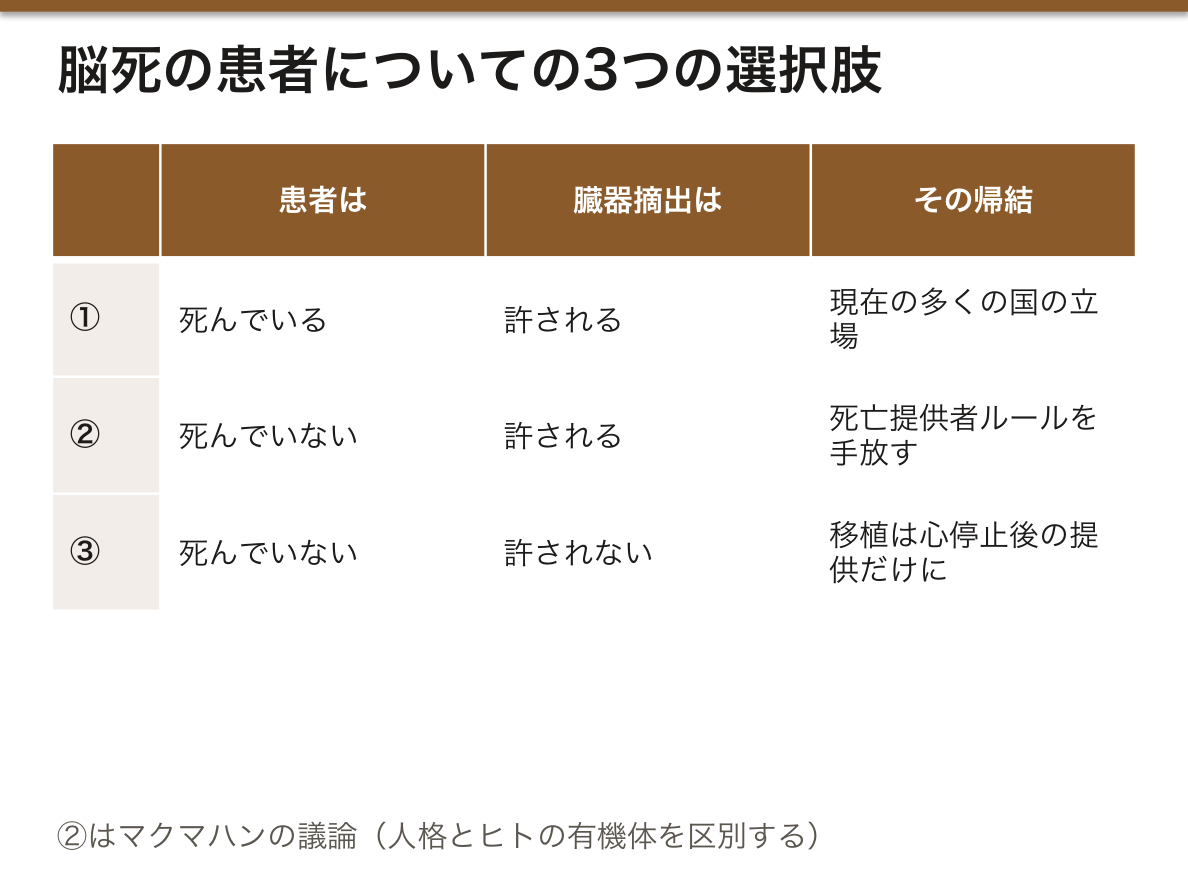
②は過激に聞こえるが、真剣に論じられている。マクマハンは、人格(person)とヒトの有機体を区別すべきだと論じた。有機体としての死は、身体の統合された機能の不可逆的な停止であり、それは脳がなくても、化学的・内分泌的な連絡で分散的に保たれうる。脳死の身体は、生物学的には生きている有機体でありうる。一方、私たちは本質的に意識をもつ心(身体化された心)であり、意識の能力が不可逆的に失われたとき、人格としての私はもう存在しない。だとすれば、脳死の患者に残るのは、人格を失った生きた有機体であり、本人の事前の同意があれば、臓器を摘出しても人格を殺すことにはならない。
この考えは、臓器摘出の前提として「提供者は死んでいなければならない」という死亡提供者ルール(dead donor rule)を手放すことを意味し、社会の信頼を損なう恐れが強い。だから多くの国は①にとどまっている。③を採ると移植医療は心停止後の提供だけに限られる。どの選択肢にも代償がある。異論を知ることは、脳死を否定するためではなく、家族の受けとめがなぜ難しいのかを理解し、誠実に説明するためにある。
家族に脳死を説明するとき、「まだ温かいのに」「心臓が動いているのに」という声は、医学的な無知ではなく、死をどう受けとめるかの問題である。「機械が動かしているだけです」と退けるのではなく、脳の機能が回復しないことと、身体の変化が今後どう進むかを、時間をかけて伝える姿勢が求められる。
English version
Core
There are persistent objections to treating brain death as death.
| Objection | Content |
|---|---|
| Which brain functions are decisive? | Which functions, once irreversibly lost, are at the same time the death of a person? Some functions, such as hypothalamic hormone release, may remain |
| Many integrative functions continue after brain death | Temperature control, wound healing, response to infection and growth continue. A child declared brain dead kept body functions on a ventilator for over a decade |
| Corpses can gestate children | Bodies of brain-dead pregnant women have been maintained for months and healthy babies born |
| The attitude of relatives | Families find it hard to see a warm person whose chest rises and heart beats as dead |
Given these objections, there are three options for brain-dead patients: (1) they are dead, so organ procurement is permissible (the view of most countries today); (2) they are not dead, but organ procurement is permissible; (3) they are not dead, and organ procurement is not permissible.
Going further
Option (2) sounds extreme but is seriously argued. McMahan distinguishes the person from the human organism. The organism dies when integrated bodily functioning irreversibly stops, and that integration can be kept up in a decentralised way by chemical and endocrine signals, even without the brain. A brain-dead body may be a biologically living organism. But we are essentially conscious, embodied minds; when the capacity for consciousness is irreversibly lost, the person no longer exists. Then what remains in brain death is a living organism without a person, and removing organs with the person’s prior consent does not kill a person.
This means giving up the dead donor rule — that donors must be dead before vital organs are removed — and risks badly damaging public trust. So most countries stay with (1). Choosing (3) would limit transplantation to donation after cardiac death. Every option has a cost. Knowing the objections is not about denying brain death, but about understanding why families struggle and explaining honestly.
In the clinic
When explaining brain death, words like ‘but he’s still warm’ or ‘his heart is beating’ are not medical ignorance but a question of how to accept death. Instead of dismissing them with ‘it’s only the machine’, take time to explain that brain function will not return and how the body will change from here.
遷延性意識障害(植物状態)と高次脳死Status vegetativus persistens
遷延性意識障害(持続的植物状態、PVS)は、大脳皮質の広い損傷で意識と認知の能力が失われる一方、脳幹の機能は保たれている状態である。自分で呼吸し、睡眠と覚醒のリズムがあり、目を開けることもあるが、自分や周囲を認識している徴候がない。人工呼吸器を必要としないことが多く、栄養と水分の補給で長く生き続けうる。脳死とは別物である。
| 脳死 | 遷延性意識障害(植物状態) | 閉じ込め症候群 | |
|---|---|---|---|
| 損傷の主な部位 | 脳全体(脳幹を含む) | 大脳皮質(脳幹は保たれる) | 脳幹の腹側(橋) |
| 意識 | なし | なし(覚醒はある) | 保たれる |
| 自発呼吸 | なし | あることが多い | ある |
| 死か | 多くの国で死とされる | 生きている | 生きている(意識清明) |
心臓が数分以上止まると、低酸素に弱い大脳は損なわれやすく、脳幹は比較的保たれやすい。そのため、蘇生後に植物状態になる人が生まれる。高次脳死の立場は、意識の能力が不可逆的に失われた時点を人の死とする。人格の本質が意識にあるなら、植物状態の患者は、生物学的には生きていても、人格としてはすでに存在しないことになる。
しかし高次脳死は広く受け入れられていない。自分で呼吸し代謝している人を「死んでいる」と呼ぶことは、生物学的に受け入れがたいからである。さらに大きな問題は診断の不確かさだ。脳の機能画像を使った研究で、臨床的に植物状態と診断された患者の一部に、指示に反応する脳活動が見つかった。ベッドサイドの診察では、植物状態と、わずかな意識の徴候がある最小意識状態や閉じ込め症候群を見分けにくい。外から意識がないように見えても、内側に意識が残っている可能性を消せないのである。
日本では1972年に日本脳神経外科学会が植物状態の定義を示した。自力で移動できない、自力で摂食できない、糞尿失禁がある、意味のある発語がない、簡単な命令に応じる以上の意思疎通ができない、追視はあっても認識しない、という6項目が、治療にもかかわらず3か月以上続く状態である。植物状態の患者の人工栄養を続けるかどうかは、英国や米国で大きな裁判になったが、日本では人生の最終段階のガイドラインに沿い、本人の推定意思をもとに話し合うことになる。
English version
Core
A persistent vegetative state (PVS) is a condition in which widespread damage to the cerebral cortex destroys consciousness and cognition while brainstem function is preserved. The patient breathes, has sleep–wake cycles and may open the eyes, but shows no awareness of self or surroundings. A ventilator is often not needed, and with nutrition and hydration the patient may live for a long time. It is not brain death.
| Brain death | PVS | Locked-in syndrome | |
|---|---|---|---|
| Main site of damage | Whole brain (including brainstem) | Cerebral cortex (brainstem preserved) | Ventral brainstem (pons) |
| Consciousness | None | None (wakefulness present) | Preserved |
| Spontaneous breathing | None | Often present | Present |
| Dead? | Regarded as dead in many countries | Alive | Alive (fully aware) |
Going further
If the heart stops for more than a few minutes, the cerebrum, which is sensitive to lack of oxygen, is easily damaged, while the brainstem is more likely to survive. That is how people come to be in a vegetative state after resuscitation. The higher-brain death view places death at the irreversible loss of the capacity for consciousness. If the essence of a person is consciousness, a PVS patient is biologically alive but no longer exists as a person.
But higher-brain death is not widely accepted, because calling someone who breathes and metabolises ‘dead’ is biologically hard to accept. A bigger problem is diagnostic uncertainty. Functional brain imaging found brain activity responding to commands in some patients clinically diagnosed as vegetative. At the bedside it is hard to tell PVS from the minimally conscious state, which shows slight signs of awareness, or from locked-in syndrome. Even if a person looks unconscious from outside, we cannot rule out that consciousness remains inside.
In the clinic
In 1972 the Japan Neurosurgical Society defined the vegetative state: unable to move by oneself, unable to eat by oneself, incontinent, no meaningful speech, no communication beyond following simple commands, and eye tracking without recognition — persisting three months or more despite treatment. Whether to continue artificial nutrition in PVS led to major court cases in the UK and US; in Japan it is discussed on the basis of the patient’s presumed wishes, following the end-of-life guidelines.
日本の臓器移植法と法的脳死判定
日本では1997年に臓器移植法が施行され、脳死下での臓器提供が法律上可能になった。当初は本人の書面による意思表示と家族の承諾の両方が必要で、意思表示が有効なのは15歳以上だったため、提供はきわめて少なく、小児の心臓移植は国内でほぼ不可能だった。2010年の改正法で、次のように変わった。
| 1997年の法律 | 2010年の改正後 | |
|---|---|---|
| 本人の意思が不明な場合 | 提供できない | 家族の書面による承諾で提供できる |
| 15歳未満 | 提供できない | 家族の承諾で提供できる(虐待を受けた子からは提供しない) |
| 親族への優先提供 | なし | 本人の書面による意思表示があれば可能 |
法的脳死判定は、臓器提供を前提とする場合に限って行われる。前提条件(原因の明らかな器質的な脳障害で深昏睡にあり、回復の見込みがない)を確かめ、除外例を除いたうえで、次の5項目を確認する。
| 項目 | 中身 |
|---|---|
| ①深昏睡 | 痛み刺激にも反応しない |
| ②瞳孔の固定 | 瞳孔径が左右とも4mm以上 |
| ③脳幹反射の消失 | 対光反射・角膜反射・毛様脊髄反射・眼球頭反射・前庭反射・咽頭反射・咳反射の7つ |
| ④平坦脳波 | 脳波が平坦である |
| ⑤自発呼吸の消失 | 無呼吸テストで確認する(最後に行う) |
判定は2回行い、1回目から6時間以上(6歳未満は24時間以上)あけて2回目を行う。2回目の判定終了時刻が死亡時刻となる。
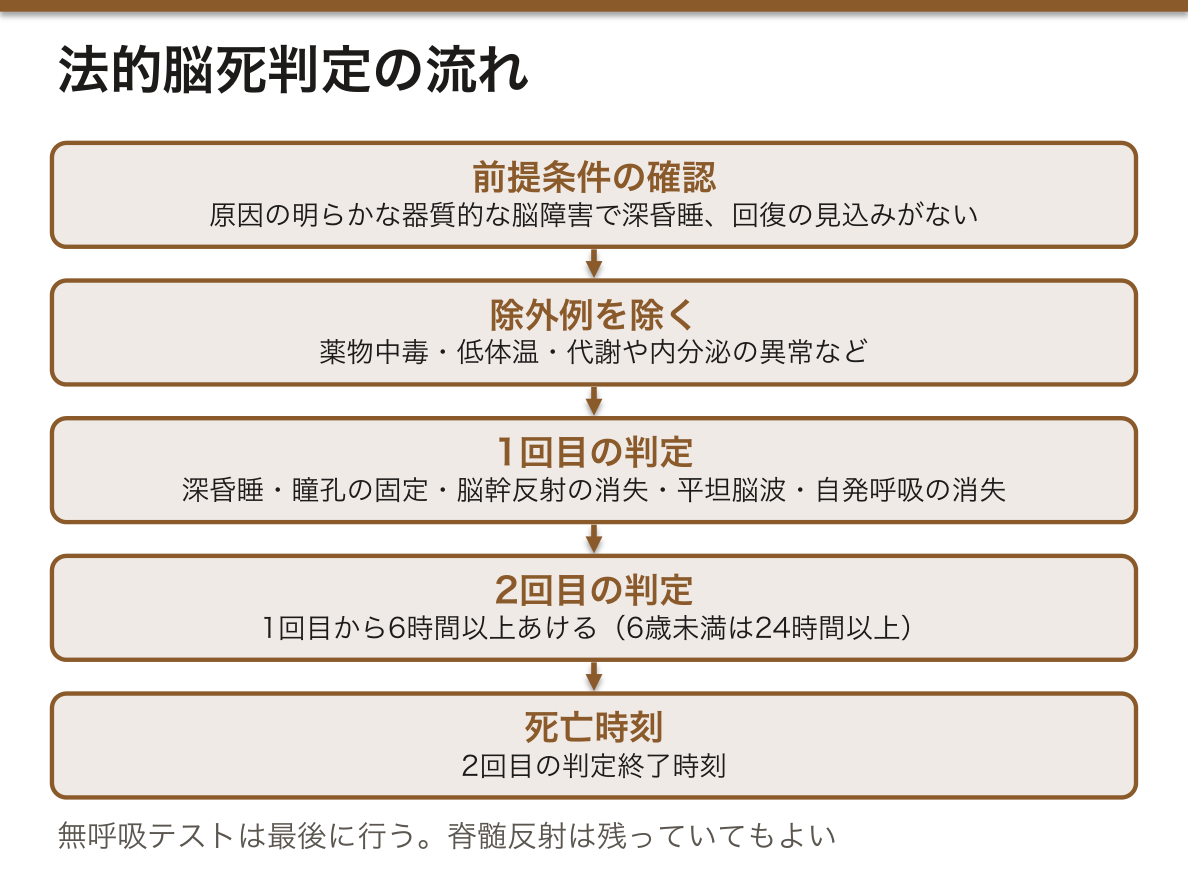
日本の制度の特徴は、脳死を「臓器提供をする場合に限って」人の死として扱う点にある。臓器提供をしない場合には法的脳死判定は行われず、死は従来どおり心停止で判定される。つまり同じ状態の患者でも、提供するかどうかで死の時刻が変わりうる。これは前の項目の3つの選択肢のどれとも完全には一致しない、日本独特の妥協であり、脳死を人の死と考えるかどうかについて社会の合意が分かれていることの表れでもある。
判定基準は全脳死の考え方に立ち、脳幹死を採る英国より厳格な面がある。それでも、人口あたりの臓器提供数は欧米諸国に比べて一桁以上少ない。理由としては、死生観や家族の受けとめに加え、提供の機会がある病院での提供者の把握や、移植コーディネーターの体制など、スペインの例で見た仕組みの差が挙げられる。
国試で問われるのは、法的脳死判定の5項目、6時間(6歳未満は24時間)の間隔、無呼吸テストを最後に行うこと、そして脊髄反射は残っていてもよいことである。脳死の患者で手足が動く(ラザロ徴候など)のは脊髄の反射であり、脳の機能が残っている証拠ではない。家族がそれを見て驚くことがあるので、前もって説明しておくことが大切である。
English version
Core
Japan’s Organ Transplant Act came into force in 1997 and made donation after brain death legal. At first both the person’s written wishes and the family’s consent were required, and only people aged 15 or older could validly state their wishes. Donations were very few, and child heart transplants were almost impossible in Japan. The 2010 revision changed this.
| 1997 law | After the 2010 revision | |
|---|---|---|
| Person’s wishes unknown | No donation | Donation possible with the family’s written consent |
| Under 15 | No donation | Possible with family consent (not from abused children) |
| Priority donation to relatives | None | Possible if stated in writing |
Legal brain death determination is done only when organ donation is planned. After confirming the preconditions (deep coma from an organic brain injury of known cause, with no hope of recovery) and excluding other causes, five items are checked.
| Item | Content |
|---|---|
| (1) Deep coma | No response even to painful stimuli |
| (2) Fixed pupils | Both pupils 4 mm or more |
| (3) Loss of brainstem reflexes | Seven: light, corneal, ciliospinal, oculocephalic, vestibular, pharyngeal and cough reflexes |
| (4) Flat EEG | Electrical silence on EEG |
| (5) Loss of spontaneous breathing | Confirmed by the apnoea test (done last) |
The determination is done twice, with the second at least 6 hours after the first (24 hours for children under 6). The time the second determination ends is the time of death.
Going further
A distinctive feature of Japan’s system is that brain death is treated as death only when organs are to be donated. Without donation, no legal brain death determination is done, and death is determined by cardiac arrest as before. So for patients in the same condition, the time of death may depend on whether they donate. This Japanese compromise does not match any of the three options in the previous item exactly, and it shows that society remains divided on whether brain death is death.
The criteria follow the whole-brain idea and are in some ways stricter than the UK’s brainstem criteria. Even so, the number of donations per population is more than ten times lower than in Western countries. Reasons include views of death and families’ responses, and also differences in systems seen in the Spanish example — identifying donors in hospitals and the organisation of transplant coordinators.
In the clinic
For the national examination: the five items of legal brain death determination, the interval of 6 hours (24 hours under age 6), the apnoea test done last, and that spinal reflexes may remain. Limb movements in brain-dead patients (such as the Lazarus sign) are spinal reflexes, not evidence of brain function. Families can be shocked to see them, so explain in advance.
まとめ
| 臓器移植と提供の種類 — 足りないという根本問題 | 臓器移植の倫理の出発点は、提供される臓器の数が、必要とする人の数より少ないという事実である。 |
|---|---|
| 同意の仕組み — オプトイン・オプトアウト・ソフトオプトアウト | 死後の臓器提供に、本人の同意をどう扱うか。 |
| 家族の反対・臓器の売買・条件付き提供・登録者の優先 | 臓器不足をめぐって、さらにいくつかの倫理的な問いがある。 |
| 心肺死から脳死へ — 何が死の定義を変えたのか | 長い間、死は心肺死——呼吸と心拍の不可逆的な停止——で判定されてきた。 |
| 脳死への異論 — 「全体としての統合」は本当に失われるのか | 脳死を人の死とすることには、根強い異論がある。 |
| 遷延性意識障害(植物状態)と高次脳死 | 遷延性意識障害(持続的植物状態、PVS)は、大脳皮質の広い損傷で意識と認知の能力が失われる一方、脳幹の機能は保たれている状態である。 |
| 日本の臓器移植法と法的脳死判定 | 日本では1997年に臓器移植法が施行され、脳死下での臓器提供が法律上可能になった。 |
このノートは医学生が授業の内容を自分の言葉でまとめたもので、診療の判断に使うものではありません。誤りに気づいたらお知らせください。