同じ臓器に、ラテン語の名詞とギリシャ語の語根の2つの名前がある。腎臓は解剖では ren(arteria renalis)、病名では nephr-(nephritis)。この二本立てが医学用語でいちばん混乱を生むところである。
理由ははっきりしている。ギリシャ語は語根をつなげて1語の合成語を作るのが得意で、ラテン語はそれが苦手だからである。腎臓の切除はラテン語なら excisio renis(腎の切除)と句になるが、ギリシャ語なら nephrectomia の1語で済む。だから新しい病名や術式はギリシャ語の部品で作られてきた。
接頭辞と、-itis・-osis・-oma・-ectomia などの基本の接尾辞は臨床用語の組み立ての章にある。この章は組み立ての規則・ラテン語とギリシャ語の対応表・残りの接尾辞・臨床用語の文法を扱う。
- 組み立ての規則 — 連結母音 -o- を入れるか落とすか
- 頭頸部と神経の対 — 解剖はラテン語、病名はギリシャ語
- 胸腹部の臓器の対
- 組織・運動器・一般概念の対 — 似た形に注意
- rrh の4兄弟 — 出血・流出・縫合・破裂
- 形と状態の変化を表す接尾辞 — 反対の組で覚える
- 臨床用語の文法 — 語尾で変化型と性が決まる
組み立ての規則 — 連結母音 -o- を入れるか落とすかLaryngopharyngitis
語根は辞書や表で nephr(o)- のように、連結母音 o を括弧に入れて示される。入れるかどうかは次で決まる。
| 場合 | o | 例 |
|---|---|---|
| 接尾辞が子音で始まる | 入れる | nephr-o-logia, gastr-o-scopia, spondyl-o-tomia |
| 接尾辞が母音で始まる | 落とす | nephr-itis, gastr-ectomia, neur-algia, hydr-aemia |
| 語根と語根の間 | 必ず入れる | laryng-o-pharyng-itis, pyel-o-nephr-itis, oste-o-myel-itis |
意味は後ろから取る。接尾辞が「何が起きているか」、その前の語根が「どこで」である。gastroenteritis は「胃と腸(gastr-o-enter)の炎症(-itis)」、pyelonephritis は「腎盂と腎(pyel-o-nephr)の炎症」。
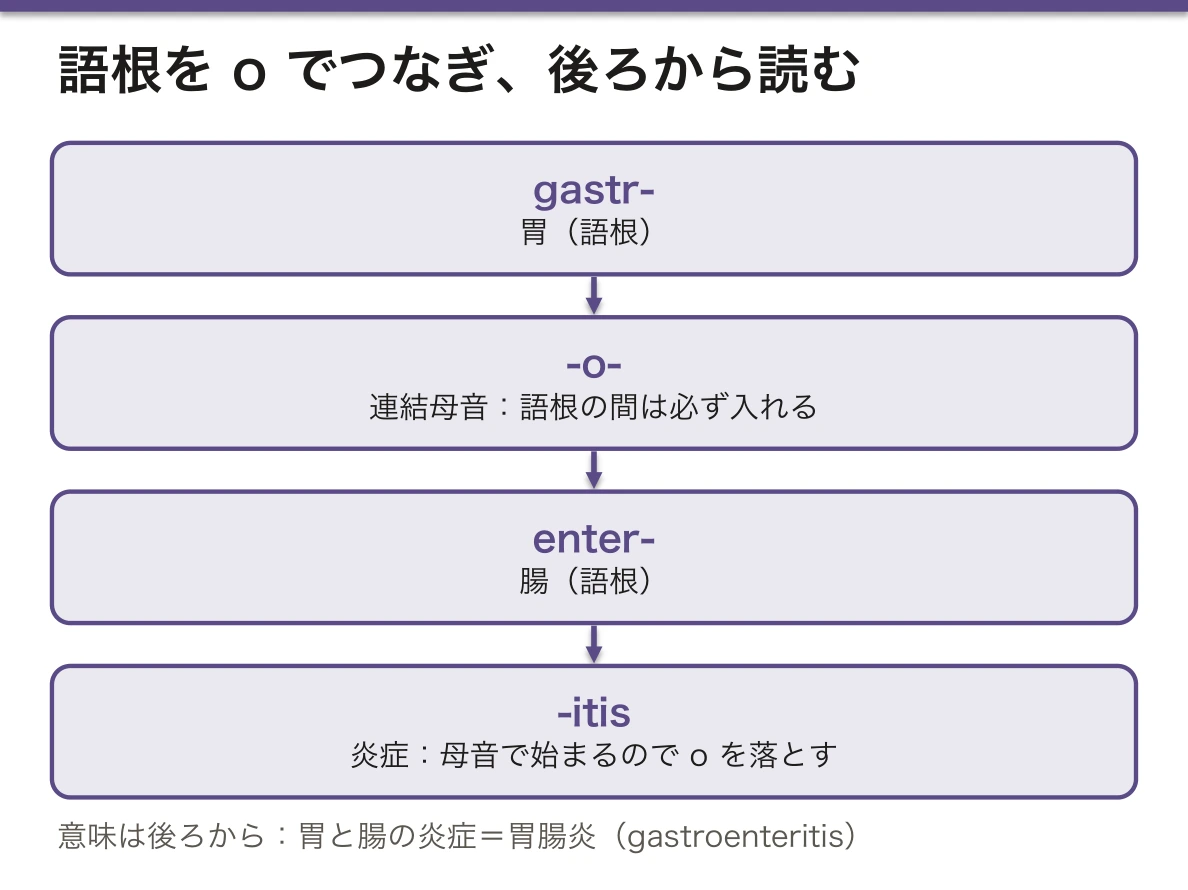
o が入る理由は、子音の衝突を避けるためである。nephr+logia は発音できないので o をはさむが、nephr+itis はそのまま続けて読める。だから同じ語根でも、後ろの接尾辞しだいで o が出たり消えたりする——gastroscopia と gastrectomia、arthrographia と arthritis。
ラテン語とギリシャ語を混ぜた語(混成語)も多い。appendicitis(ラテン語 appendix+ギリシャ語 -itis)、tonsillitis、mammographia(ラテン語 mamma+ギリシャ語 -graphia)。本来の方式ではないが、定着していればそれが正しい用語である。純粋なギリシャ語形の mastographia と並んで使われる。
English version
Core
Roots are listed as nephr(o)-, with the linking vowel o in brackets. Whether you use it depends on the following.
| Case | o | Examples |
|---|---|---|
| Suffix starts with a consonant | insert | nephr-o-logia, gastr-o-scopia, spondyl-o-tomia |
| Suffix starts with a vowel | drop | nephr-itis, gastr-ectomia, neur-algia, hydr-aemia |
| Between two roots | always insert | laryng-o-pharyng-itis, pyel-o-nephr-itis, oste-o-myel-itis |
Take the meaning from the end. The suffix says what is happening; the root before it says where. Gastroenteritis is “inflammation (-itis) of stomach and intestine (gastr-o-enter)”; pyelonephritis is “inflammation of the renal pelvis and kidney (pyel-o-nephr)”.
Going further
The o is there to stop consonants colliding. Nephr + logia cannot be pronounced, so o goes between; nephr + itis flows as it is. So the same root shows or loses its o depending on the suffix: gastroscopia and gastrectomia, arthrographia and arthritis.
Words mixing Latin and Greek (hybrids) are common too: appendicitis (Latin appendix + Greek -itis), tonsillitis, mammographia (Latin mamma + Greek -graphia). This is not the original pattern, but an established term is the correct term. The purely Greek mastographia is used alongside it.
頭頸部と神経の対 — 解剖はラテン語、病名はギリシャ語Ophthalmologia
| ラテン語の名詞 | ギリシャ語の語根 | 意味 | 臨床用語の例 |
|---|---|---|---|
| caput, capitis | cephal- | 頭 | cephalalgia(頭痛) |
| cerebrum | encephal- | 脳 | encephalitis(脳炎) |
| mater(dura mater など) | mening- | 髄膜 | meningitis(髄膜炎) |
| medulla | myel- | 髄(脊髄・骨髄) | myelitis, myelopathia |
| nervus | neur- | 神経 | neuralgia(神経痛) |
| oculus | ophthalm- | 眼 | ophthalmoscopia(検眼鏡検査) |
| palpebra | blephar- | 眼瞼 | blepharoptosis(眼瞼下垂) |
| lacrima | dacry- | 涙 | dacryocystitis(涙嚢炎) |
| auris | ot- | 耳 | otitis media(中耳炎) |
| nasus | rhin- | 鼻 | rhinitis(鼻炎) |
| os, oris | stomat- | 口 | stomatitis(口内炎) |
| lingua | gloss- | 舌 | glossitis(舌炎) |
| labium | cheil- | 唇 | cheilitis(口唇炎) |
| dens, dentis | odont- | 歯 | odontologia(歯科学) |
同じ部位でも、解剖の形容詞はラテン語から、病名はギリシャ語から作る。regio oralis(口部:os, oris から)と stomatitis、arteria lingualis と glossitis、palpebra superior と blepharoptosis。左の列は解剖用語の中で、右の列は病名・検査名・診療科名の中で出てくる。
myel- は2つの「髄」を指す。脊髄(medulla spinalis)と骨髄(medulla ossium)である。myelitis・myelopathia は脊髄、osteomyelitis(骨髄炎)・myeloma(骨髄腫)は骨髄。poliomyelitis は「灰白(polio-)の脊髄炎」で、脊髄灰白質の前角が侵される。前後の語根で判断する。
診療科の名前はギリシャ語で作られている:ophthalmologia(眼科学)・otorhinolaryngologia(耳鼻咽喉科学:ot-o-rhin-o-laryng-o-logia)・neurologia(神経内科学)。otorhinolaryngologia は語根を3つ連ねた長い語だが、規則どおり o でつないでいるだけである。
English version
Core
| Latin noun | Greek root | Meaning | Clinical example |
|---|---|---|---|
| caput, capitis | cephal- | head | cephalalgia (headache) |
| cerebrum | encephal- | brain | encephalitis |
| mater (dura mater etc.) | mening- | meninges | meningitis |
| medulla | myel- | marrow (spinal cord, bone marrow) | myelitis, myelopathia |
| nervus | neur- | nerve | neuralgia |
| oculus | ophthalm- | eye | ophthalmoscopia |
| palpebra | blephar- | eyelid | blepharoptosis (ptosis of the eyelid) |
| lacrima | dacry- | tear | dacryocystitis |
| auris | ot- | ear | otitis media |
| nasus | rhin- | nose | rhinitis |
| os, oris | stomat- | mouth | stomatitis |
| lingua | gloss- | tongue | glossitis |
| labium | cheil- | lip | cheilitis |
| dens, dentis | odont- | tooth | odontologia (dentistry) |
Going further
For the same part, anatomical adjectives come from Latin and disease names from Greek. Regio oralis (from os, oris) and stomatitis; arteria lingualis and glossitis; palpebra superior and blepharoptosis. The left column appears inside anatomical terms; the right column inside the names of diseases, tests and specialties.
Myel- refers to two kinds of marrow: the spinal cord (medulla spinalis) and the bone marrow (medulla ossium). Myelitis and myelopathia concern the spinal cord; osteomyelitis and myeloma concern the bone marrow. Poliomyelitis is “inflammation of the grey (polio-) spinal cord”, attacking the anterior horn of the grey matter. Decide from the roots around it.
In the clinic
The names of specialties are Greek: ophthalmologia, otorhinolaryngologia (ot-o-rhin-o-laryng-o-logia), neurologia. Otorhinolaryngologia strings three roots together, but it only joins them with o, exactly by the rule.
胸腹部の臓器の対Nephrectomia
| ラテン語の名詞 | ギリシャ語の語根 | 意味 | 臨床用語の例 |
|---|---|---|---|
| cor, cordis | cardi- | 心臓 | cardiomegalia, pericarditis |
| pulmo | pneum(on)- | 肺 | pneumonia, pneumonectomia |
| vas | angi- | 血管 | angiographia |
| vena | phleb- | 静脈 | phlebitis(静脈炎) |
| sanguis | haem(at)- | 血液 | haematuria(血尿) |
| ventriculus / gaster | gastr- | 胃 | gastritis |
| intestinum | enter- | 腸(主に小腸) | enteritis |
| colon | col- | 結腸 | colitis |
| ren | nephr- | 腎 | nephritis, nephrectomia |
| pelvis renalis | pyel- | 腎盂 | pyelonephritis |
| vesica (urinaria) | cyst- | 膀胱 | cystitis(膀胱炎) |
| vesica fellea | cholecyst- | 胆嚢 | cholecystitis |
| fel | chol(e)- | 胆汁 | cholelithiasis(胆石症) |
| hepar | hepat- | 肝 | hepatitis |
| lien | splen- | 脾 | splenomegalia |
| abdomen | lapar- | 腹(腹壁) | laparotomia, laparoscopia |
| uterus | hyster- / metr- | 子宮 | hysterectomia, endometriosis |
| mamma | mast- | 乳房 | mastectomia, mastitis |
見た目の似た語根に注意する。
cyst- だけなら膀胱(cystitis=膀胱炎)だが、cholecyst-(胆汁の袋)は胆嚢、ラテン語の cysta は嚢胞である。pyel-(腎盂)と py-(膿)も紛らわしい——pyelonephritis は腎盂腎炎、pyuria は膿尿。pneum- には「肺(pneumon)」と「空気(pneuma)」の2つがあり、pneumonia は肺炎、pneumothorax は胸腔に空気がある状態(気胸)である。
子宮には2つの語根があり、手術名は hyster-(hysterectomia 子宮摘出術)、内膜や出血は metr-(endometrium, endometriosis, metrorrhagia)で作ることが多い。
English version
Core
| Latin noun | Greek root | Meaning | Clinical example |
|---|---|---|---|
| cor, cordis | cardi- | heart | cardiomegalia, pericarditis |
| pulmo | pneum(on)- | lung | pneumonia, pneumonectomia |
| vas | angi- | vessel | angiographia |
| vena | phleb- | vein | phlebitis |
| sanguis | haem(at)- | blood | haematuria |
| ventriculus / gaster | gastr- | stomach | gastritis |
| intestinum | enter- | intestine (mainly small) | enteritis |
| colon | col- | colon | colitis |
| ren | nephr- | kidney | nephritis, nephrectomia |
| pelvis renalis | pyel- | renal pelvis | pyelonephritis |
| vesica (urinaria) | cyst- | urinary bladder | cystitis |
| vesica fellea | cholecyst- | gallbladder | cholecystitis |
| fel | chol(e)- | bile | cholelithiasis (gallstones) |
| hepar | hepat- | liver | hepatitis |
| lien | splen- | spleen | splenomegalia |
| abdomen | lapar- | abdomen (abdominal wall) | laparotomia, laparoscopia |
| uterus | hyster- / metr- | uterus | hysterectomia, endometriosis |
| mamma | mast- | breast | mastectomia, mastitis |
Going further
Watch for roots that look alike.
Cyst- on its own means the urinary bladder (cystitis), but cholecyst- (“bile bag”) is the gallbladder, and the Latin cysta is a cyst. Pyel- (renal pelvis) and py- (pus) are confusing too: pyelonephritis is inflammation of the renal pelvis and kidney, pyuria is pus in the urine. Pneum- has two sources, “lung” (pneumon) and “air” (pneuma): pneumonia is inflammation of the lung; pneumothorax is air in the pleural cavity.
The uterus has two roots. Operation names usually use hyster- (hysterectomia), while words for the lining and bleeding often use metr- (endometrium, endometriosis, metrorrhagia).
組織・運動器・一般概念の対 — 似た形に注意Osteomyelitis
| ラテン語 | 語根 | 意味 | 例 |
|---|---|---|---|
| os, ossis | oste- | 骨 | osteoporosis, osteomalacia |
| cartilago | chondr- | 軟骨 | chondroma |
| articulatio | arthr- | 関節 | arthroscopia |
| musculus | my- | 筋 | myositis, myalgia |
| vertebra | spondyl- | 椎骨 | spondylitis, spondylosis |
| digitus | dactyl- | 指 | syndactylia(合指症) |
| pes, pedis | pod- | 足 | podalgia |
| cutis | derm(at)- | 皮膚 | dermatitis |
| adeps | lip- | 脂肪 | lipoma |
| unguis | onych- | 爪 | onychomycosis(爪白癬) |
| tela | hist- | 組織 | histologia |
| cellula | cyt- | 細胞 | cytologia |
| ラテン語 | 語根 | 意味 | 例 |
|---|---|---|---|
| aqua | hydr- | 水 | hydrocephalus |
| sudor | hidr- | 汗 | hyperhidrosis(多汗症) |
| lapis | lith- | 石 | nephrolithiasis |
| pus | py- | 膿 | pyuria |
| tumor | onc- | 腫瘍 | oncologia |
| cadaver | necr- | 死体・壊死 | necrosis |
| calor | therm- | 熱 | hypothermia |
| tempus | chron- | 時間 | chronicus |
| nox, noctis | nyct- | 夜 | nycturia(夜間頻尿) |
| mensis | men- | 月 | amenorrhoea(無月経) |
| morbus | nos- | 病気 | nosocomialis(院内の) |
| mens, mentis | phren- | 心 | schizophrenia |
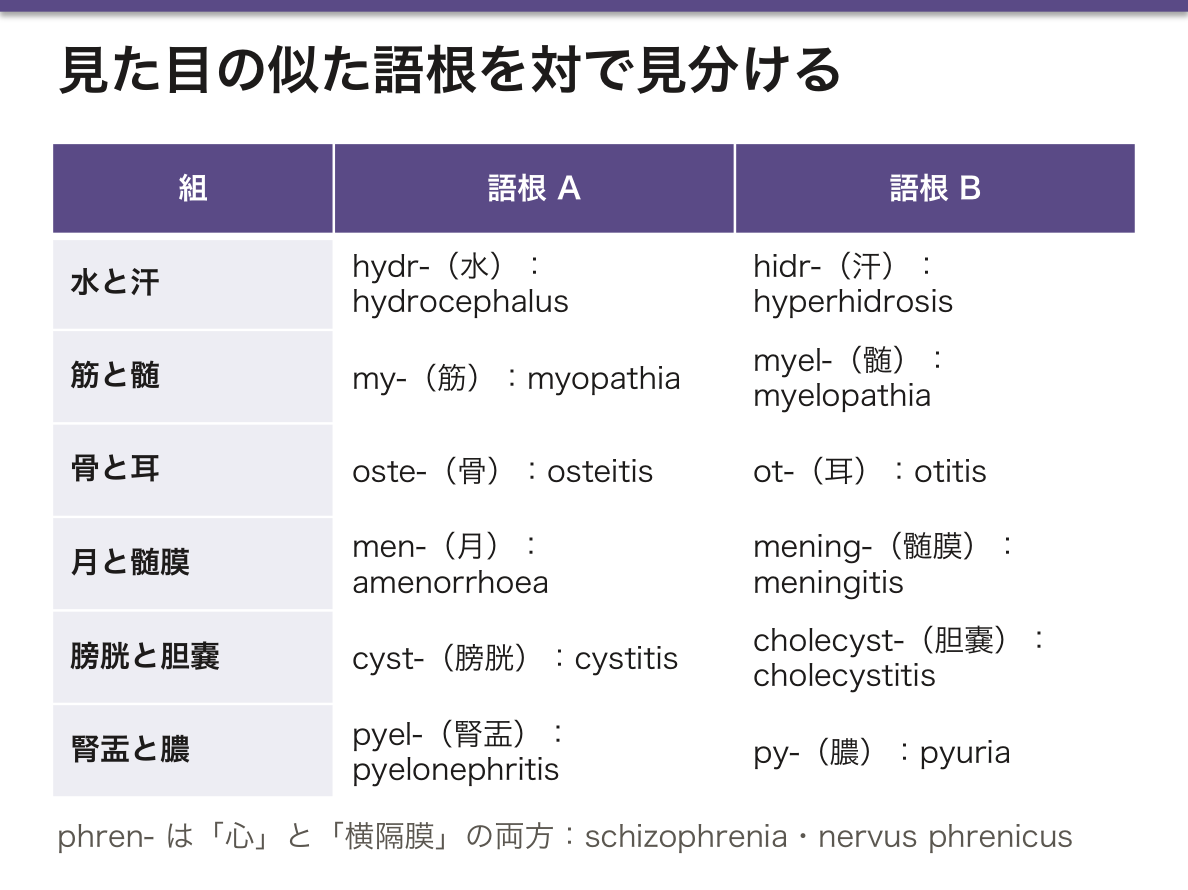
1文字違いの語根がいちばん危ない。
hydr-(水)と hidr-(汗):hydrocephalus(水頭症)と hyperhidrosis(多汗症)。my-(筋)と myel-(髄):myopathia(筋疾患)と myelopathia(脊髄症)。oste-(骨)・ot-(耳)・stomat-(口):osteitis・otitis・stomatitis。men-(月)・mening-(髄膜)・phren-(心、また横隔膜)。
phren- には2つの意味がある。ギリシャ人は心が横隔膜のあたりにあると考えたので、schizophrenia(心)と nervus phrenicus(横隔神経)が同じ語根になっている。
脊椎の病名は spondyl- と接尾辞の組み合わせで読み分けられる。spondylitis(脊椎炎:炎症)、spondylosis(脊椎症:変性)、spondylolysis(脊椎分離症:椎弓の一部が離れる。-lysis=ほどける)、spondylolisthesis(脊椎すべり症:椎体が前へすべる。-listhesis=すべり)。osteomalacia(骨軟化症:骨の石灰化の障害)と osteoporosis(骨粗鬆症:骨量の減少)も、接尾辞が病態の違いをそのまま言っている。
English version
Core
| Latin | Root | Meaning | Example |
|---|---|---|---|
| os, ossis | oste- | bone | osteoporosis, osteomalacia |
| cartilago | chondr- | cartilage | chondroma |
| articulatio | arthr- | joint | arthroscopia |
| musculus | my- | muscle | myositis, myalgia |
| vertebra | spondyl- | vertebra | spondylitis, spondylosis |
| digitus | dactyl- | finger, toe | syndactylia |
| pes, pedis | pod- | foot | podalgia |
| cutis | derm(at)- | skin | dermatitis |
| adeps | lip- | fat | lipoma |
| unguis | onych- | nail | onychomycosis |
| tela | hist- | tissue | histologia |
| cellula | cyt- | cell | cytologia |
| Latin | Root | Meaning | Example |
|---|---|---|---|
| aqua | hydr- | water | hydrocephalus |
| sudor | hidr- | sweat | hyperhidrosis |
| lapis | lith- | stone | nephrolithiasis |
| pus | py- | pus | pyuria |
| tumor | onc- | tumour | oncologia |
| cadaver | necr- | corpse, death | necrosis |
| calor | therm- | heat | hypothermia |
| tempus | chron- | time | chronicus |
| nox, noctis | nyct- | night | nycturia |
| mensis | men- | month | amenorrhoea |
| morbus | nos- | disease | nosocomialis (hospital-acquired) |
| mens, mentis | phren- | mind | schizophrenia |
Going further
Roots that differ by one letter are the most dangerous.
Hydr- (water) and hidr- (sweat): hydrocephalus and hyperhidrosis. My- (muscle) and myel- (marrow): myopathia (muscle disease) and myelopathia (disease of the spinal cord). Oste- (bone), ot- (ear), stomat- (mouth): osteitis, otitis, stomatitis. Men- (month), mening- (meninges), phren- (mind; also diaphragm).
Phren- has two meanings. The Greeks placed the mind near the diaphragm, so schizophrenia (mind) and nervus phrenicus (the nerve to the diaphragm) share a root.
In the clinic
Spinal disease names can be told apart by spondyl- plus a suffix: spondylitis (inflammation), spondylosis (degeneration), spondylolysis (part of the vertebral arch separates; -lysis = loosening), spondylolisthesis (the vertebral body slips forward; -listhesis = slipping). Osteomalacia (defective mineralisation of bone) and osteoporosis (loss of bone mass) likewise state the difference in their suffixes.
rrh の4兄弟 — 出血・流出・縫合・破裂Rhinorrhagia
rrh で始まる接尾辞は4つあり、意味がまったく違う。見分けるのは rrh のあとの部分である。
| 接尾辞 | 意味 | 例 |
|---|---|---|
| -rrhagia | 出血 | rhinorrhagia(鼻出血)、haemorrhagia、metrorrhagia(不正子宮出血) |
| -rrhoea | 流れ出ること(分泌・排出) | rhinorrhoea(鼻漏)、diarrhoea、otorrhoea(耳漏)、galactorrhoea(乳汁漏出) |
| -rrhaphia | 縫合 | herniorrhaphia(ヘルニア縫合術)、neurorrhaphia(神経縫合) |
| -rrhexis | 破裂 | angiorrhexis(血管破裂)、cardiorrhexis(心破裂) |
rhinorrhagia と rhinorrhoea は1語違うだけで、「鼻血」と「鼻水」である。
それぞれの元の語を知ると混同しなくなる。
-rrhoea は「流れる」(rheumatismus の rheu- も同じ語根で、体液が流れて関節に溜まると考えた名残)。-rrhaphia は「縫い目」で、解剖の raphe(縫線:raphe palati, raphe scroti)と同じ語である——縫い合わせたような線が raphe、縫い合わせる手術が -rrhaphia。-rrhexis は「裂けること」、-rrhagia は「ほとばしり出ること」。
rr と重なるのは、語頭の rh が母音のあとに付いたときの規則による(文字と発音の章)。
病理学では出血を機序で2つに分ける。血管壁が破れて起こる破綻性出血(haemorrhagia per rhexin)と、壁は保たれたまま赤血球がにじみ出る漏出性出血(per diapedesin)である。per rhexin の rhexin は rhexis(破裂)の対格で、-rrhexis と同じ語である。
English version
Core
There are four suffixes beginning with rrh, with entirely different meanings. Tell them apart by what follows rrh.
| Suffix | Meaning | Examples |
|---|---|---|
| -rrhagia | bleeding | rhinorrhagia (nosebleed), haemorrhagia, metrorrhagia (irregular uterine bleeding) |
| -rrhoea | flow, discharge | rhinorrhoea (runny nose), diarrhoea, otorrhoea, galactorrhoea |
| -rrhaphia | suture | herniorrhaphia (hernia repair), neurorrhaphia (nerve suture) |
| -rrhexis | rupture | angiorrhexis (rupture of a vessel), cardiorrhexis (rupture of the heart) |
Rhinorrhagia and rhinorrhoea differ by one part: “nosebleed” and “runny nose”.
Going further
Knowing the original words stops the confusion.
-rrhoea means “flow” (the rheu- of rheumatismus is the same root, a relic of the idea that body fluids flowed into the joints). -rrhaphia means “seam”, the same word as anatomical raphe (raphe palati, raphe scroti): a line that looks sewn together is a raphe, and an operation that sews is -rrhaphia. -rrhexis means “tearing”, and -rrhagia “bursting forth”.
The rr comes from the rule that an initial rh doubles after a vowel (chapter on letters and sounds).
In the clinic
Pathology divides bleeding by mechanism. Haemorrhage per rhexin occurs when the vessel wall breaks; haemorrhage per diapedesin occurs when red cells seep through an intact wall. The rhexin of per rhexin is the accusative of rhexis (rupture), the same word as -rrhexis.
形と状態の変化を表す接尾辞 — 反対の組で覚えるGastroptosis
臨床用語の組み立ての章に無い接尾辞を、反対の意味の組にまとめる。
| 接尾辞 | 意味 | 反対の組 | 例 |
|---|---|---|---|
| -ptosis | 下垂 | -pexia(固定) | nephroptosis(腎下垂)↔ nephropexia(腎固定術) |
| -stenosis | 狭窄 | -ectasia(拡張) | stenosis aortae ↔ bronchiectasia(気管支拡張症) |
| -malacia | 軟化 | -sclerosis(硬化) | osteomalacia ↔ arteriosclerosis |
| -genesis | 形成 | -lysis(溶解・分離) | osteogenesis ↔ haemolysis |
| 接尾辞 | 意味 | 例 |
|---|---|---|
| -algia / -odynia | 痛み | neuralgia, glossodynia |
| -aemia | 血液の状態 | anaemia, uraemia |
| -uria | 尿の状態 | haematuria, proteinuria, polyuria |
| -lithiasis | 結石症 | cholelithiasis, nephrolithiasis |
| -plegia | 麻痺 | hemiplegia, paraplegia, tetraplegia |
| -necrosis | 壊死 | osteonecrosis |
| -phobia | 病的な恐怖 | hydrophobia |
反対の組で覚えるのは、病態と治療が組になっているからである。臓器が落ちる(-ptosis)なら留める(-pexia)、狭くなる(-stenosis)病気と広がる(-ectasia)病気がある。病名を見たら、反対の語尾を持つ治療や病態を思い浮かべると、知識が2倍につながる。
-plegia は完全麻痺、-paresis は不全麻痺である。範囲を表す接頭辞と組んで:hemi-(片側)・para-(両下肢)・tetra- / quadri-(四肢)・mono-(一肢)。hemiparesis は「片側の不全麻痺」になる。
osteomalacia と osteoporosisはどちらも骨がもろくなるが、別の病気である。osteomalacia は骨基質の石灰化の障害(ビタミン D 欠乏など)で、骨は柔らかくなる。osteoporosis は骨量そのものの減少で、石灰化は保たれている。osteogenesis imperfecta(骨形成不全症)は「不完全な骨形成」で、I 型コラーゲンの異常による。
English version
Core
Suffixes not in the chapter on building clinical terms, grouped into pairs of opposites.
| Suffix | Meaning | Opposite | Examples |
|---|---|---|---|
| -ptosis | falling, prolapse | -pexia (fixation) | nephroptosis ↔ nephropexia |
| -stenosis | narrowing | -ectasia (widening) | stenosis aortae ↔ bronchiectasia |
| -malacia | softening | -sclerosis (hardening) | osteomalacia ↔ arteriosclerosis |
| -genesis | formation | -lysis (dissolution, loosening) | osteogenesis ↔ haemolysis |
| Suffix | Meaning | Examples |
|---|---|---|
| -algia / -odynia | pain | neuralgia, glossodynia |
| -aemia | state of the blood | anaemia, uraemia |
| -uria | state of the urine | haematuria, proteinuria, polyuria |
| -lithiasis | stone disease | cholelithiasis, nephrolithiasis |
| -plegia | paralysis | hemiplegia, paraplegia, tetraplegia |
| -necrosis | necrosis | osteonecrosis |
| -phobia | morbid fear | hydrophobia |
Going further
Pairs of opposites work because disease and treatment come in pairs. If an organ drops (-ptosis), you fix it (-pexia); there are diseases of narrowing (-stenosis) and of widening (-ectasia). When you see a disease name, think of the treatment or condition with the opposite suffix, and each fact links to a second one.
-plegia is complete paralysis; -paresis is partial weakness. With prefixes of extent: hemi- (one side), para- (both legs), tetra- / quadri- (all four limbs), mono- (one limb). Hemiparesis is “partial weakness of one side”.
In the clinic
Osteomalacia and osteoporosis both make bone fragile, but they are different diseases. Osteomalacia is defective mineralisation of the bone matrix (vitamin D deficiency and others), and the bone becomes soft. Osteoporosis is loss of bone mass itself, with mineralisation preserved. Osteogenesis imperfecta is “imperfect bone formation”, caused by abnormal type I collagen.
臨床用語の文法 — 語尾で変化型と性が決まるHepatitis, hepatitidis
ギリシャ語で作った臨床用語も、ラテン語の文の中ではふつうの名詞として変化する。変化型と性は接尾辞で決まる。
| 接尾辞 | 変化・性 | 属格 | 複数 | 形容詞の例 |
|---|---|---|---|---|
| -ia(-ectomia, -algia, -aemia…) | 第1・女性 | -iae | -iae | gastrectomia totalis, anaemia perniciosa |
| -itis | 第3・女性 | -itidis | -itides | hepatitis viralis, colitis ulcerosa |
| -sis(-osis, -lysis…) | 第3母音群・女性 | -sis | -ses | tuberculosis miliaris, diagnosis differentialis |
| -oma | 第3・中性 | -omatis | -omata | lymphoma malignum |
| -gramma | 第3・中性 | -grammatis | -grammata | electrocardiogramma |
-itis の属格 -itidis は見慣れないが、文の中ではよく出る:therapia hepatitidis chronicae(慢性肝炎の治療)では、hepatitidis(属格)に chronicae(女性・属格)が一致している。対格は -itidem で、「中耳炎のあとに」は post otitidem mediam になる。
-sis は主格と属格が同じ形なので、prognosis tuberculosis(結核の予後)の tuberculosis は属格である。複数は -ses:diagnoses, metastases, anastomoses。
英語の論文でも複数形はこのまま使われる。metastases(転移巣)、anastomoses、arthritides(いろいろな関節炎)、carcinomata(古い用法)。英語の単語だと思って -s を付けると、metastasises のような誤りになる。
English version
Core
Clinical terms built from Greek decline as ordinary nouns inside a Latin phrase. The suffix decides their declension and gender.
| Suffix | Declension, gender | Gen. | Plural | With an adjective |
|---|---|---|---|---|
| -ia (-ectomia, -algia, -aemia…) | 1st, fem. | -iae | -iae | gastrectomia totalis, anaemia perniciosa |
| -itis | 3rd, fem. | -itidis | -itides | hepatitis viralis, colitis ulcerosa |
| -sis (-osis, -lysis…) | 3rd vowel group, fem. | -sis | -ses | tuberculosis miliaris, diagnosis differentialis |
| -oma | 3rd, neut. | -omatis | -omata | lymphoma malignum |
| -gramma | 3rd, neut. | -grammatis | -grammata | electrocardiogramma |
Going further
The genitive of -itis, -itidis, looks strange but appears often in phrases: in therapia hepatitidis chronicae (treatment of chronic hepatitis), hepatitidis (genitive) agrees with chronicae (feminine genitive). The accusative is -itidem, so “after otitis media” is post otitidem mediam.
In -sis the nominative and genitive are the same, so in prognosis tuberculosis (the prognosis of tuberculosis) tuberculosis is genitive. The plural is -ses: diagnoses, metastases, anastomoses.
English papers use these plurals as they are: metastases, anastomoses, arthritides (various arthritides), carcinomata (older use). Treating them as English words and adding -s gives errors such as “metastasises”.
まとめ
| 組み立ての規則 — 連結母音 -o- を入れるか落とすか | 語根は辞書や表で nephr(o)- のように、連結母音 o を括弧に入れて示される。 |
|---|---|
| 頭頸部と神経の対 — 解剖はラテン語、病名はギリシャ語 | ラテン語の名詞ギリシャ語の語根意味臨床用語の例caput, capitiscephal-頭cephalalgia(頭痛)cerebrumencephal-脳encephalitis… |
| 胸腹部の臓器の対 | ラテン語の名詞ギリシャ語の語根意味臨床用語の例cor, cordiscardi-心臓cardiomegalia, pericarditispulmopneum(on)-肺pneum… |
| 組織・運動器・一般概念の対 — 似た形に注意 | ラテン語語根意味例os, ossisoste-骨osteoporosis, osteomalaciacartilagochondr-軟骨chondromaarticulatioar… |
| rrh の4兄弟 — 出血・流出・縫合・破裂 | rrh で始まる接尾辞は4つあり、意味がまったく違う。 |
| 形と状態の変化を表す接尾辞 — 反対の組で覚える | 臨床用語の組み立ての章に無い接尾辞を、反対の意味の組にまとめる。 |
| 臨床用語の文法 — 語尾で変化型と性が決まる | ギリシャ語で作った臨床用語も、ラテン語の文の中ではふつうの名詞として変化する。 |
このノートは医学生が授業の内容を自分の言葉でまとめたもので、診療の判断に使うものではありません。誤りに気づいたらお知らせください。