患者との最初のやりとりで要るものを集める:相手の呼び方(tu か jūs か)、丁寧なお願いの形 -iet、体の部位の名前、1〜10の数。どれも文法としては小さいが、診察室では最初の1分で必ず使う。
- tu と jūs — 患者には必ず jūs
- -iet の命令形 — 丁寧なお願いは1つの語尾で
- 体の部位 — 性と変化型ごとに束ねる
- 1〜10の数 — 名詞の性に合わせて形が変わる
tu と jūs — 患者には必ず jūsTu un jūs
tu は親しい相手1人、jūs は複数の相手と、丁寧に話す相手1人に使う。患者・医療スタッフ・教員には jūs である。
| くだけた(tu) | 丁寧(jūs) | |
|---|---|---|
| あいさつ | Čau! / Sveiks!(男)/ Sveika!(女) | Labdien! / Sveiki! |
| 調子は? | Kā tev iet? | Kā jums iet? |
| 名前は? | Kā tevi sauc? | Kā jūs sauc? |
| すみません | Atvaino! / Piedod! | Atvainojiet! / Piedodiet! |
答え方:Mani sauc …(私の名前は…)、Priecājos iepazīties.(はじめまして)、Ļoti patīkami.(よろしく)。
格によって形が変わる。「〜に」(与格)は tev / jums、「〜を」(対格)は tevi / jūs になる。Kā tev iet? は「君にとってどう進んでいるか」、Kā tevi sauc? は「人は君をどう呼ぶか」という構造で、tevi は対格である。jūs は対格でも主格と同じ形なので Kā jūs sauc? になる。
jūs を主語にすると、動詞は2人称複数の形になる:jūs esat(である)、jūs dzīvojat、jūs studējat。1人の患者に話すときも、この複数の形を使う。
診察の始まりの型:Labdien! Es esmu medicīnas students(studente). Kā jūs sauc? Kā jums iet? ——医学生だと名乗り、名前を聞き、具合を聞く。ここまでを jūs でそろえれば、最初の1分は失礼にならない。
English version
Core
Tu is for one person you know well; jūs is for several people and for one person you speak to politely. Patients, healthcare staff and teachers get jūs.
| Informal (tu) | Polite (jūs) | |
|---|---|---|
| Greeting | Čau! / Sveiks! (m.) / Sveika! (f.) | Labdien! / Sveiki! |
| How are you? | Kā tev iet? | Kā jums iet? |
| What is your name? | Kā tevi sauc? | Kā jūs sauc? |
| Sorry / excuse me | Atvaino! / Piedod! | Atvainojiet! / Piedodiet! |
Answers: Mani sauc … (My name is …), Priecājos iepazīties. (Pleased to meet you), Ļoti patīkami. (Nice to meet you).
Going further
The form changes with the case. “To you” (dative) is tev / jums; “you” as object (accusative) is tevi / jūs. Kā tev iet? is built as “how is it going for you”, and Kā tevi sauc? as “how do people call you”, so tevi is accusative. Jūs has the same form in the accusative and nominative, hence Kā jūs sauc?
With jūs as subject, the verb takes the second-person plural form: jūs esat (are), jūs dzīvojat, jūs studējat. Use this plural form even when speaking to a single patient.
In the clinic
A pattern for opening a consultation: Labdien! Es esmu medicīnas students (studente). Kā jūs sauc? Kā jums iet? — say you are a medical student, ask the name, ask how they are. Keep all of it in jūs and the first minute will be polite.
-iet の命令形 — 丁寧なお願いは1つの語尾でParādiet, kur jums sāp!
-iet で終わる動詞は、丁寧な命令(お願い)の形である。「〜してください」の「ください」は書かれていないが、語尾に含まれている。lūdzu(どうぞ)を添えるとさらに丁寧になる。
| ラトビア語 | 意味 |
|---|---|
| Parādiet, kur jums sāp! | 痛いところを見せてください |
| Sēdieties! | お掛けください |
| Pagaidiet! | お待ちください |
| Nāciet iekšā! | お入りください |
| Atvainojiet! | すみません(お手数をかけて) |
| Piedodiet! | ごめんなさい(自分がしたことについて) |
| Lūdzu, palīdziet man! | 手伝っていただけますか |
Atvainojiet と Piedodiet は使う場面が違う。Atvainojiet は「お手数ですが」——人を呼び止める、道を聞くときの「すみません」。Piedodiet は「許してください」——自分の失敗を謝るときの「ごめんなさい」。患者に話しかけるときは Atvainojietである。
Sēdieties の -ieties は再帰動詞(「自分を〜させる」)の命令形で、「自分を座らせてください」=お掛けください。くだけた相手には -iet を付けない短い形(Atvaino!, Piedod!)を使う。
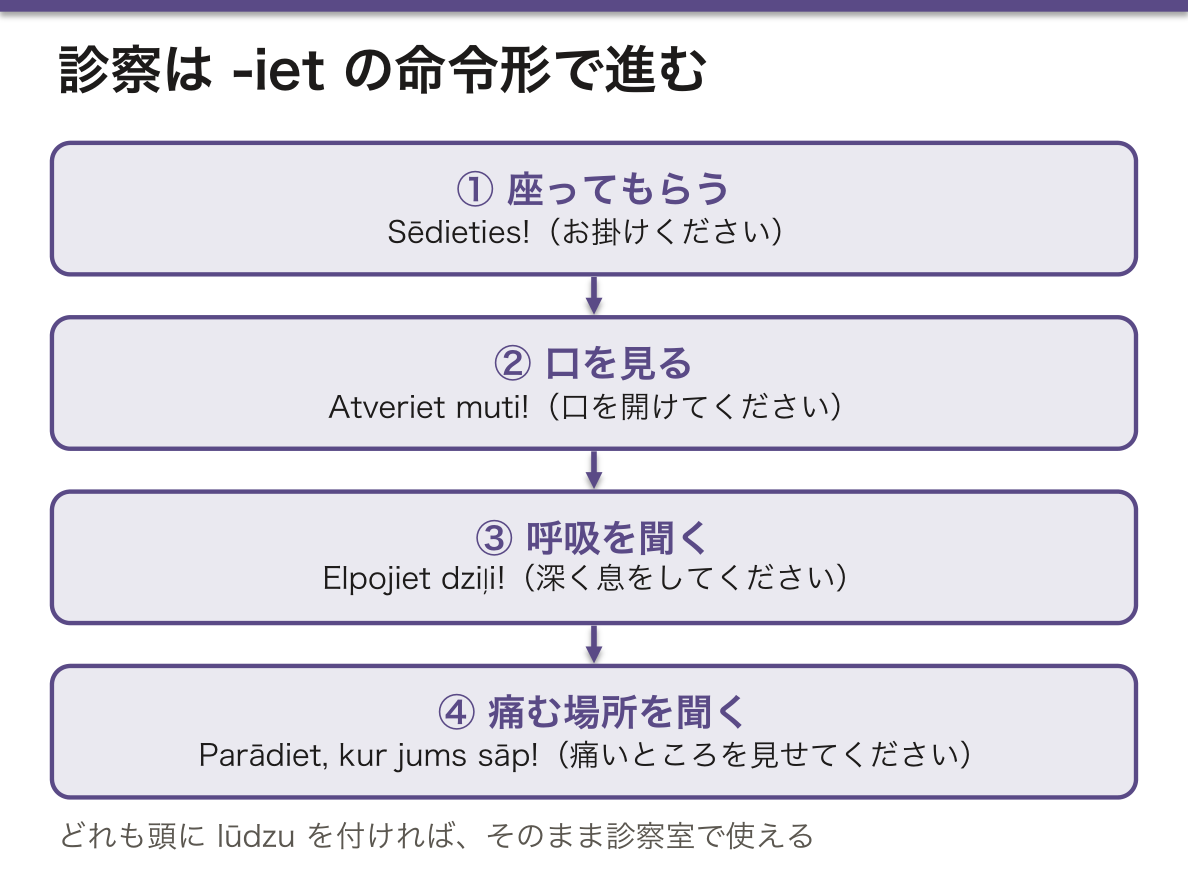
身体診察では命令形が続く:Sēdieties(座って)→ Atveriet muti(口を開けて)→ Elpojiet dziļi(深く息をして)→ Parādiet, kur jums sāp(痛いところを見せて)。どれも頭に lūdzu を付ければ、そのまま診察室で使える。
English version
Core
A verb ending in -iet is a polite command (a request). The “please” is not written, but it is contained in the ending. Adding lūdzu (please) makes it more polite still.
| Latvian | Meaning |
|---|---|
| Parādiet, kur jums sāp! | Please show me where it hurts |
| Sēdieties! | Please take a seat |
| Pagaidiet! | Please wait |
| Nāciet iekšā! | Please come in |
| Atvainojiet! | Excuse me (for troubling you) |
| Piedodiet! | I’m sorry (for what I did) |
| Lūdzu, palīdziet man! | Could you help me, please? |
Going further
Atvainojiet and Piedodiet are used in different situations. Atvainojiet is “sorry to trouble you” — stopping someone, asking the way. Piedodiet is “forgive me” — apologising for your own mistake. When you address a patient, use Atvainojiet.
The -ieties of Sēdieties is the command form of a reflexive verb (“make yourself …”): “seat yourself, please”. With people you know well, use the short forms without -iet (Atvaino!, Piedod!).
In the clinic
A physical examination is a chain of requests: Sēdieties (sit down) → Atveriet muti (open your mouth) → Elpojiet dziļi (breathe deeply) → Parādiet, kur jums sāp (show me where it hurts). Put lūdzu in front of each and they are ready for the consulting room.
体の部位 — 性と変化型ごとに束ねるGalva, kāja, roka
体の部位の名前を変化型ごとにまとめる。性がわかれば、形容詞(liels deguns, sāpīga kāja など)も正しく付けられる。
| 変化(性) | 語 |
|---|---|
| 第1(男性) | deguns(鼻)、kakls(首・のど)、plecs(肩)、vēders(腹) |
| 第2(男性) | celis(膝)、elkonis(肘)、ķermenis(体)、muskulis(筋肉) |
| 第4(女性) | galva(頭)、kāja(脚・足)、roka(腕・手)、mugura(背中)、pēda(足先) |
| 第5(女性) | mute(口)、piere(額) |
| 第6(女性) | acs(眼)、auss(耳)、sirds(心臓)、krūtis(胸)、asinis(血) |
| 複数のみ | mati(髪) |
roka は腕と手、kāja は脚と足を1語で指す。足首から先だけを言うなら pēda である。
複数形も変化型どおり:ceļi(膝:第2変化なので l → ļ)、elkoņi(肘:n → ņ)、acis・ausis(第6変化 -is)、kājas・rokas(第4変化 -as)。Man sāp ceļi.(両膝が痛い)、Man sāp acis.(目が痛い)。
痛む場所を名詞の sāpes で言うときは処格:sāpes ceļos(膝の痛み)、sāpes mugurā(背中の痛み)、sāpes krūtīs(胸の痛み)。
ラテン語の解剖用語と並べて覚えると、2つの言語が互いの手がかりになる:caput / galva、genu / celis、cubitus / elkonis、oculus / acs、auris / auss、cor / sirds、dorsum / mugura。ラテン語 cor が中性、ラトビア語 sirds が女性のように、性は言語ごとに別なので混ぜないこと。
English version
Core
Body parts grouped by declension. Once you know the gender, you can add adjectives correctly (liels deguns, sāpīga kāja and so on).
| Declension (gender) | Words |
|---|---|
| 1st (masc.) | deguns (nose), kakls (neck, throat), plecs (shoulder), vēders (abdomen) |
| 2nd (masc.) | celis (knee), elkonis (elbow), ķermenis (body), muskulis (muscle) |
| 4th (fem.) | galva (head), kāja (leg, foot), roka (arm, hand), mugura (back), pēda (foot) |
| 5th (fem.) | mute (mouth), piere (forehead) |
| 6th (fem.) | acs (eye), auss (ear), sirds (heart), krūtis (chest), asinis (blood) |
| plural only | mati (hair) |
Roka covers arm and hand, and kāja covers leg and foot, each in one word. For the foot below the ankle only, say pēda.
Going further
Plurals follow the declension: ceļi (knees; second declension, so l → ļ), elkoņi (elbows; n → ņ), acis, ausis (sixth declension -is), kājas, rokas (fourth declension -as). Man sāp ceļi. (My knees hurt.) Man sāp acis. (My eyes hurt.)
To name the place of pain with the noun sāpes, use the locative: sāpes ceļos (pain in the knees), sāpes mugurā (back pain), sāpes krūtīs (chest pain).
In the clinic
Learn them side by side with the Latin anatomical terms, and each language becomes a clue to the other: caput / galva, genu / celis, cubitus / elkonis, oculus / acs, auris / auss, cor / sirds, dorsum / mugura. Gender belongs to each language separately — Latin cor is neuter, Latvian sirds is feminine — so do not mix them.
1〜10の数 — 名詞の性に合わせて形が変わるViens, viena
ラトビア語の数詞は形容詞のように名詞の性に合わせる。
| 男性 | 女性 | |
|---|---|---|
| 1 | viens | viena |
| 2 | divi | divas |
| 3 | trīs | trīs |
| 4 | četri | četras |
| 5 | pieci | piecas |
| 6 | seši | sešas |
| 7 | septiņi | septiņas |
| 8 | astoņi | astoņas |
| 9 | deviņi | deviņas |
| 10 | desmit | desmit |
男性は -i、女性は -as(1 だけ単数で viens / viena)。trīs と desmit は変わらない。viens students, viena studente/divi brāļi, divas māsas/pieci gadi, piecas dienas。
1 は単数、2 以上は複数の名詞をとる。年齢では、1 で終わる数(11 を除く)は単数になる:Man ir 21 gads、Viņam ir 31 gads、しかし Man ir 19 gadi・22 gadi。英語の I am 21 years old と違い、「21 年」が単数になるのが要点である。
11〜19(vienpadsmit, divpadsmit …)は性で変わらない。だから迷うのは 1〜9 の部分だけである。
服薬の説明に必ず出る:divas tabletes trīs reizes dienā(1回2錠を1日3回)。tablete(錠剤)と reize(回)はどちらも女性名詞なので divas、trīs は性で変わらない。dienā は diena(日)の処格で「1日のうちに」。
English version
Core
Latvian numbers agree with the noun’s gender, like adjectives.
| Masculine | Feminine | |
|---|---|---|
| 1 | viens | viena |
| 2 | divi | divas |
| 3 | trīs | trīs |
| 4 | četri | četras |
| 5 | pieci | piecas |
| 6 | seši | sešas |
| 7 | septiņi | septiņas |
| 8 | astoņi | astoņas |
| 9 | deviņi | deviņas |
| 10 | desmit | desmit |
Masculine -i, feminine -as (only 1 is singular: viens / viena). Trīs and desmit do not change. Viens students, viena studente / divi brāļi, divas māsas / pieci gadi, piecas dienas.
Going further
One takes a singular noun; two and above take a plural. For age, numbers ending in 1 (except 11) take the singular: Man ir 21 gads, Viņam ir 31 gads, but Man ir 19 gadi, 22 gadi. Unlike English “21 years old”, “21 year” is singular here.
Eleven to nineteen (vienpadsmit, divpadsmit …) do not change for gender, so only the 1–9 part needs thought.
In the clinic
It always comes up when explaining medication: divas tabletes trīs reizes dienā (two tablets three times a day). Tablete (tablet) and reize (time) are both feminine, so divas; trīs does not change. Dienā is the locative of diena (day), “in a day”.
まとめ
| tu と jūs — 患者には必ず jūs | tu は親しい相手1人、jūs は複数の相手と、丁寧に話す相手1人に使う。 |
|---|---|
| -iet の命令形 — 丁寧なお願いは1つの語尾で | -iet で終わる動詞は、丁寧な命令(お願い)の形である。 |
| 体の部位 — 性と変化型ごとに束ねる | 体の部位の名前を変化型ごとにまとめる。性がわかれば、形容詞(liels deguns, sāpīga kāja など)も正しく付けられる。 |
| 1〜10の数 — 名詞の性に合わせて形が変わる | ラトビア語の数詞は形容詞のように名詞の性に合わせる。 |
このノートは医学生が授業の内容を自分の言葉でまとめたもので、診療の判断に使うものではありません。誤りに気づいたらお知らせください。