脂質は3つの顔を持つ——①貯える(中性脂肪)②囲む(リン脂質・コレステロール)③伝える(ステロイド・エイコサノイド)。
この章の中心は3つ目になる。膜のリン脂質から切り出されたアラキドン酸が、炎症・発熱・疼痛・血栓のすべての出発点になる——「NSAIDs とステロイドがなぜ効くかは、この1本の図で説明できる」。
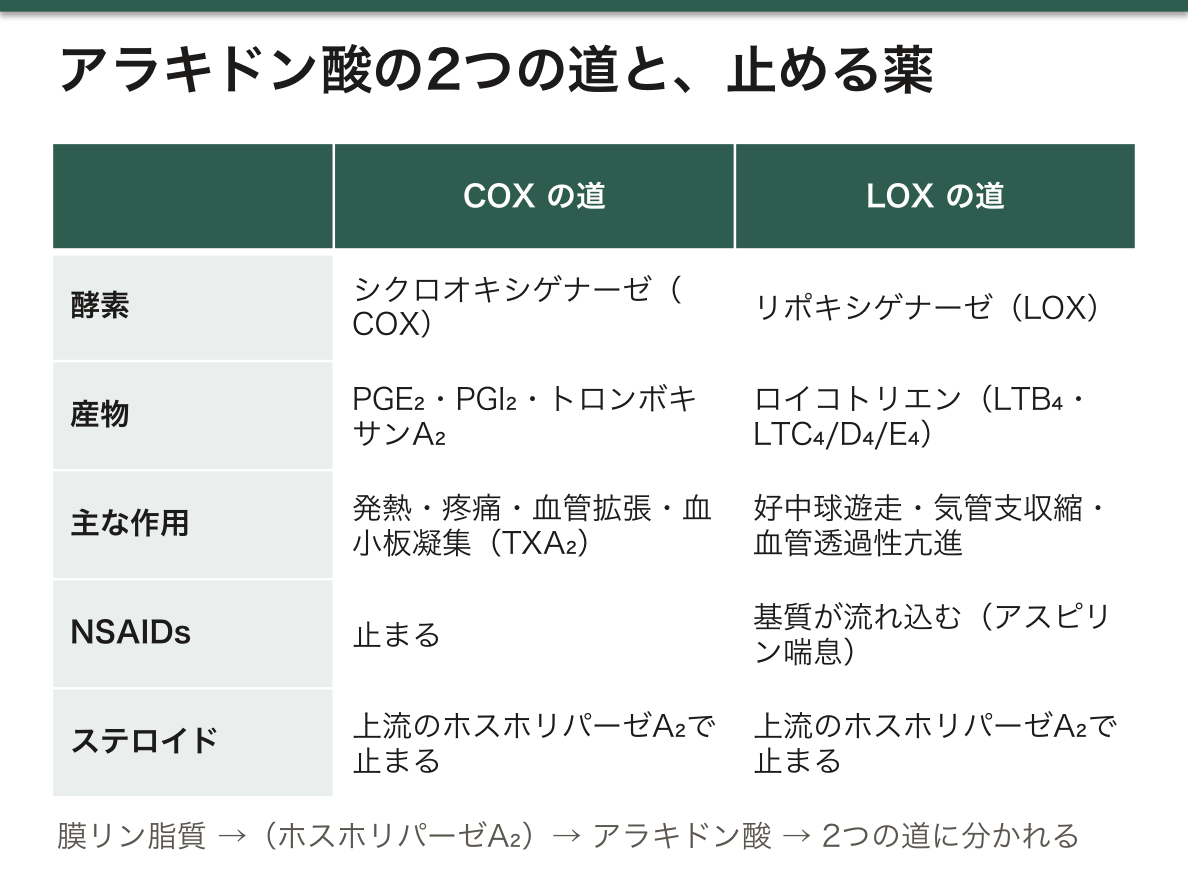
- ステロイド——ホスホリパーゼA₂ を止める。だから上流で全部止まる
- NSAIDs——シクロオキシゲナーゼを止める。ロイコトリエン側は残る
だから NSAIDs でアラキドン酸がロイコトリエン側へ回り、喘息が悪化しうる——「片方を塞ぐと、もう片方へ流れる」。
- 脂質の分類 — 単純・複合・誘導
- エステル結合で組み立てる脂質と、融点の違い — 飽和・シス・トランス
- アラキドン酸カスケード — 1枚の図が薬理を支える
- NSAIDs は痛む前に飲むほうが効く — 「作らせない薬」と「消す薬」の違い
- 膜脂質の非対称 — 内側にあるはずの脂質が、外に出ると合図になる
- 必須脂肪酸 — 材料が変われば、作られる産物が変わる
- 炎症は、自然に消えるのではなく、能動的に止められている
- エイコサノイドは、薬としても使われている
脂質の分類 — 単純・複合・誘導
脂肪酸——炭素数と二重結合で分類する。
- 飽和——パルミチン酸・ステアリン酸
- 一価不飽和——オレイン酸(n-9)
- 多価不飽和——リノール酸(n-6)・α-リノレン酸(n-3)は必須脂肪酸。ヒトは n-3 と n-6 の位置に二重結合を作れない
- アラキドン酸(n-6)・EPA と DHA(n-3)
単純脂質——中性脂肪(トリアシルグリセロール)・ロウ・コレステロールエステル。
複合脂質。
- グリセロリン脂質——ホスファチジルコリン(レシチン)・ホスファチジルセリン・ホスファチジルイノシトール
- スフィンゴ脂質——スフィンゴミエリン(髄鞘)・セレブロシド・ガングリオシド
誘導脂質——ステロイド・脂溶性ビタミン・エイコサノイド。
スフィンゴ脂質が髄鞘に多いことが、その分解酵素の欠損で神経症状が出る理由になる。Tay-Sachs 病(ガングリオシド)・Niemann-Pick 病(スフィンゴミエリン)・異染性白質ジストロフィー(スルファチド)(蓄積症の章)——「溜まる物質の分布が、症状の分布になる」。
ホスファチジルイノシトールが、シグナル伝達の材料になる。切られて IP₃ と DAG になり、Ca²⁺ を動かす(Gタンパク質共役型受容体の章)——「膜そのものが、情報の貯蔵庫になっている」。
ホスファチジルコリンは、肺サーファクタントの主成分になる。ジパルミトイルホスファチジルコリンが表面張力を下げる(肺胞の章)——「早産児の呼吸窮迫症候群が、1つの脂質の不足で起きる」。
だから羊水のレシチン/スフィンゴミエリン比が、肺成熟の指標になる(呼吸窮迫症候群の章)——「2種類の脂質の比が、生まれてよい時期を教える」。
n-3 系脂肪酸は、n-6 と同じ酵素を奪い合う。EPA から作られるエイコサノイドは炎症惹起性が弱い(脂質異常症の章)——「食事の脂肪酸の比が、炎症の質を変える」。
トランス脂肪酸は、飽和脂肪酸に似た立体構造を持つ。LDL を上げ HDL を下げる(栄養の章)——「二重結合があるのに、形が飽和に近いので振る舞いも近い」。
English version
Core
Fatty acids are classified by carbon number and double bonds.
- Saturated — palmitic, stearic.
- Monounsaturated — oleic (n-9).
- Polyunsaturated — linoleic (n-6) and α-linolenic (n-3) are the essential fatty acids. Humans cannot make a double bond at the n-3 or n-6 position.
- Arachidonic acid (n-6), EPA and DHA (n-3).
Simple lipids — triglyceride (triacylglycerol), wax, cholesteryl ester.
Complex lipids.
- Glycerophospholipids — phosphatidylcholine (lecithin), phosphatidylserine, phosphatidylinositol.
- Sphingolipids — sphingomyelin (myelin), cerebroside, ganglioside.
Derived lipids — steroids, fat-soluble vitamins, eicosanoids.
Going further
- That sphingolipids are abundant in myelin is why a deficiency of the enzymes degrading them gives neurological symptoms. Tay–Sachs disease (ganglioside), Niemann–Pick disease (sphingomyelin), metachromatic leukodystrophy (sulfatide) (the chapter on storage diseases) — the distribution of the substance that accumulates becoming the distribution of the symptoms.
- Phosphatidylinositol is the material of signal transduction. Cut, it becomes IP₃ and DAG and moves Ca²⁺ (the chapter on G protein-coupled receptors) — the membrane itself being a store of information.
- Phosphatidylcholine is the principal component of pulmonary surfactant. Dipalmitoylphosphatidylcholine lowers the surface tension (the chapter on the alveolus) — the respiratory distress syndrome of the premature infant arising from a shortage of one lipid.
- Hence the lecithin/sphingomyelin ratio of the amniotic fluid is an index of lung maturity (the chapter on respiratory distress syndrome) — the ratio of two lipids telling when it is safe to be born.
- The n-3 fatty acids compete with n-6 for the same enzymes. The eicosanoids made from EPA are weakly pro-inflammatory (the chapter on dyslipidaemia) — the ratio of fatty acids in the diet changing the quality of inflammation.
- Trans fatty acids have a shape resembling that of saturated fatty acids. They raise LDL and lower HDL (the chapter on nutrition) — a double bond present, but the shape close to saturated, so the behaviour is close too.
エステル結合で組み立てる脂質と、融点の違い — 飽和・シス・トランス
脂質の多くは、脂肪酸の –COOH とアルコールの –OH の脱水縮合(エステル化)で組み立てられている。どの官能基が反応するかを押さえると、構造式と加水分解の産物が書ける。
| 脂質 | アルコール部分 | エステル結合の数 | 加水分解の産物 |
|---|---|---|---|
| トリアシルグリセロール(TAG) | グリセロールの –OH 3つ | 3(カルボン酸エステル) | グリセロール+脂肪酸3 |
| グリセロリン脂質(ホスファチジルコリンなど) | グリセロールの –OH 3つ | 脂肪酸とのエステル2+リン酸エステル(頭部とはリン酸ジエステル) | グリセロール+脂肪酸2+リン酸+頭部(コリンなど) |
| コレステロールエステル | コレステロールの 3-OH | 1 | コレステロール+脂肪酸 |
| ガラクト脂質(植物の膜) | グリセロール(3位はガラクトースとグリコシド結合) | 2 | グリセロール+脂肪酸2+ガラクトース |
TAG の生成:グリセロール+3 R–COOH → TAG+3 H₂O。逆に加水分解では水3分子が要る。NaOH で加水分解すると脂肪酸のナトリウム塩(石けん)ができ、これをけん化という。
融点は、脂肪酸の鎖がどれだけ密に詰まれるかで決まる。
| 脂肪酸 | 炭素数:二重結合 | 融点(約) |
|---|---|---|
| パルミチン酸(飽和) | 16:0 | 63 ℃ |
| ステアリン酸(飽和) | 18:0 | 70 ℃ |
| エライジン酸(トランス) | 18:1 | 45 ℃ |
| オレイン酸(シス) | 18:1 | 13 ℃ |
| リノール酸(シス) | 18:2 | −5 ℃ |
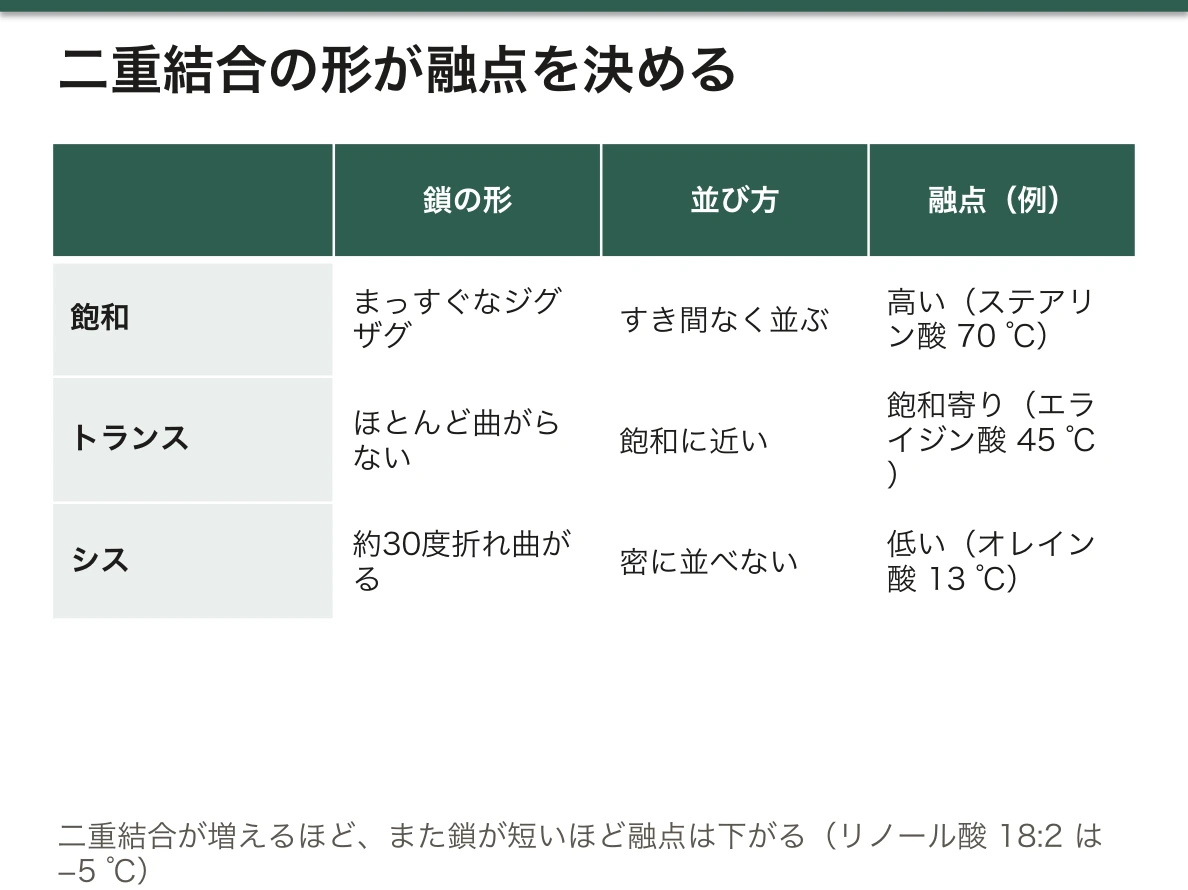
なぜシスの二重結合で融点が下がるのか。飽和脂肪酸はまっすぐなジグザグで、隣の鎖とすき間なく並び、ファンデルワールス力で強く引き合う。シスの二重結合は鎖を約30度折り曲げるので、隣と密に並べず、少ない熱で離れられる。トランスの二重結合は鎖をほとんど曲げないので、飽和に近い詰まり方をし、融点も飽和寄りになる。二重結合が増えるほど、また鎖が短いほど、融点は下がる。
だから動物の脂(飽和が多い)は室温で固体、植物油と魚油(不飽和が多い)は液体である。生体膜は体温で適度な流動性を保つ必要があり、リン脂質の2位に不飽和脂肪酸を置き、コレステロールで硬さを調節している。
English version
Core
Most lipids are built by condensation of a fatty acid –COOH with an alcohol –OH (esterification). Knowing which groups react lets you draw the structure and the hydrolysis products.
| Lipid | Alcohol part | Number of ester bonds | Hydrolysis products |
|---|---|---|---|
| Triacylglycerol (TAG) | Three –OH of glycerol | 3 (carboxylic esters) | Glycerol + 3 fatty acids |
| Glycerophospholipid (e.g. phosphatidylcholine) | Three –OH of glycerol | 2 fatty acid esters + phosphate ester (phosphodiester with the head group) | Glycerol + 2 fatty acids + phosphate + head group (e.g. choline) |
| Cholesteryl ester | 3-OH of cholesterol | 1 | Cholesterol + fatty acid |
| Galactolipid (plant membranes) | Glycerol (position 3 glycosidically bound to galactose) | 2 | Glycerol + 2 fatty acids + galactose |
Making TAG: glycerol + 3 R–COOH → TAG + 3 H₂O; hydrolysis needs 3 water molecules. Hydrolysis with NaOH gives the sodium salts of fatty acids (soap): saponification.
Melting point depends on how tightly fatty acid chains can pack.
| Fatty acid | Carbons:double bonds | Melting point (approx.) |
|---|---|---|
| Palmitic (saturated) | 16:0 | 63 °C |
| Stearic (saturated) | 18:0 | 70 °C |
| Elaidic (trans) | 18:1 | 45 °C |
| Oleic (cis) | 18:1 | 13 °C |
| Linoleic (cis) | 18:2 | −5 °C |
Going further
Why does a cis double bond lower the melting point? Saturated chains are straight zigzags that line up closely and attract each other strongly by van der Waals forces. A cis double bond bends the chain by about 30°, so neighbours cannot pack closely and less heat separates them. A trans double bond hardly bends the chain, so it packs almost like a saturated one and melts at a higher temperature. More double bonds and shorter chains mean lower melting points.
So animal fat (mostly saturated) is solid at room temperature, while plant and fish oils (mostly unsaturated) are liquid. Membranes need suitable fluidity at body temperature: phospholipids carry an unsaturated fatty acid at position 2, and cholesterol adjusts stiffness.
アラキドン酸カスケード — 1枚の図が薬理を支える
膜リン脂質 →(ホスホリパーゼA₂)→ アラキドン酸 → 2つの道。
①シクロオキシゲナーゼ(COX)の道。
- プロスタグランジン——PGE₂(発熱・疼痛・血管拡張・胃粘膜保護)・PGI₂(プロスタサイクリン、血小板凝集抑制・血管拡張)
- トロンボキサンA₂(TXA₂)——血小板凝集・血管収縮
②リポキシゲナーゼ(LOX)の道——ロイコトリエン。LTB₄(好中球遊走)・LTC₄/D₄/E₄(気管支収縮・血管透過性亢進)。
COX-1——常に働く。胃粘膜・腎血流・血小板。COX-2——炎症で誘導される。
低用量アスピリン——血小板の COX-1 を不可逆に阻害する。血小板は核が無く再合成できないので、効果が寿命(約7〜10日)続く。
低用量アスピリンが抗血小板薬として働く理屈は、細胞に核があるかどうかの差になる。血小板は作り直せず、血管内皮は作り直せる(血小板の章)——「同じ酵素を止めているのに、片方だけ効果が残る」。
だから手術前の休薬期間が7〜10日になる(周術期管理の章)——「薬の半減期ではなく、細胞の寿命で決まる」。
NSAIDs の副作用が、そのまま COX-1 の生理作用の裏返しになる。胃潰瘍(PGE₂ の粘膜保護の消失)・腎障害(輸入細動脈の拡張の消失)・出血傾向(NSAIDsの章)——「副作用の一覧を覚えるのではなく、止めた作用から導く」。
腎血流の依存が強い状況で、NSAIDs が急性腎障害を起こす。脱水・心不全・肝硬変・高齢・利尿薬併用(急性腎障害の章)——「普段は要らない代償が、要る状況で薬に潰される」。
アスピリン喘息は、COX が塞がれてロイコトリエン側へ流れることで説明される(気管支喘息の章)——「アレルギーではないので、他の NSAIDs でも同じことが起きる」。
だからロイコトリエン受容体拮抗薬が、この型の喘息に効く(喘息の薬の章)——「流れ込む先を塞ぐという発想になる」。
English version
Core
Membrane phospholipid → (phospholipase A₂) → arachidonic acid → two roads.
① The cyclo-oxygenase (COX) road.
- Prostaglandins — PGE₂ (fever, pain, vasodilatation, protection of the gastric mucosa), PGI₂ (prostacyclin; inhibits platelet aggregation, vasodilates).
- Thromboxane A₂ (TXA₂) — platelet aggregation, vasoconstriction.
② The lipoxygenase (LOX) road — leukotrienes. LTB₄ (neutrophil chemotaxis), LTC₄/D₄/E₄ (bronchoconstriction, increased vascular permeability).
COX-1 — always active. Gastric mucosa, renal blood flow, platelets. COX-2 — induced by inflammation.
Low-dose aspirin — irreversibly inhibits platelet COX-1. The platelet has no nucleus and cannot resynthesise it, so the effect lasts its lifespan (about 7–10 days).
Going further
- The reasoning by which low-dose aspirin acts as an antiplatelet drug is the difference of whether the cell has a nucleus. The platelet cannot remake it, the endothelium can (the chapter on platelets) — the same enzyme stopped, and the effect remaining on one side only.
- Hence the interval of withdrawal before surgery is 7–10 days (the chapter on perioperative management) — set not by the half-life of the drug but by the lifespan of the cell.
- The adverse effects of NSAIDs are, directly, the physiological actions of COX-1 turned inside out. Gastric ulcer (loss of PGE₂ mucosal protection), renal injury (loss of dilatation of the afferent arteriole), bleeding tendency (the chapter on NSAIDs) — rather than memorising the list of adverse effects, derive them from the action stopped.
- NSAIDs cause acute kidney injury where the dependence on renal blood flow is strong. Dehydration, heart failure, cirrhosis, old age, a diuretic taken with them (the chapter on acute kidney injury) — a compensation not usually needed being crushed by the drug in the situation where it is.
- Aspirin-induced asthma is explained by COX being blocked and the flow going to the lipoxygenase side (the chapter on bronchial asthma) — it is not an allergy, so the same happens with other NSAIDs.
- Hence leukotriene receptor antagonists work in this type of asthma (the chapter on the drugs for asthma) — the idea of blocking where it flows to.
NSAIDs は痛む前に飲むほうが効く — 「作らせない薬」と「消す薬」の違い
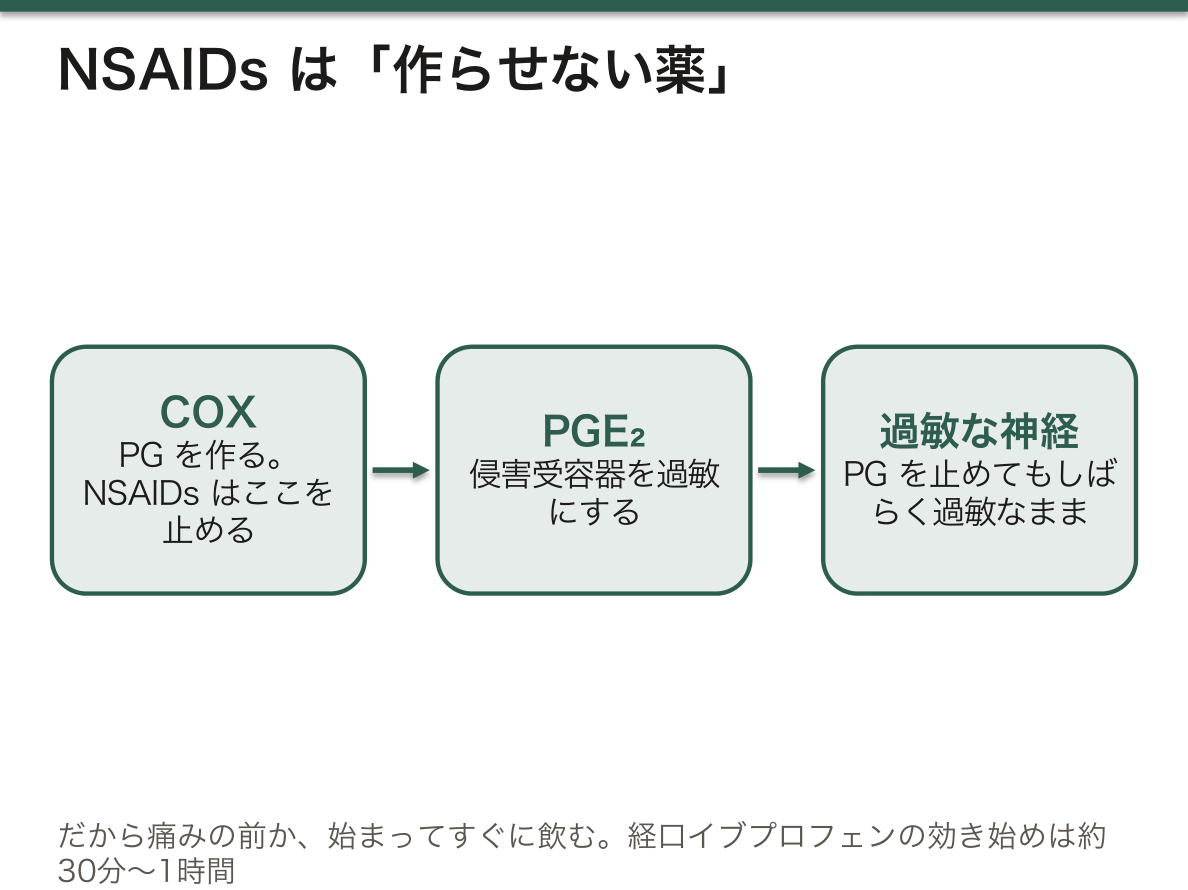
イブプロフェンなどの NSAIDs は、COX を阻害してこれから作られるプロスタグランジンを止める薬である。すでに作られて組織に出たプロスタグランジンを壊したり、受容体から外したりはしない。
プロスタグランジン E₂ は、それ自体が強い痛みを起こすというより、侵害受容器(痛みの神経終末)を過敏にする(ブラジキニンなどへの反応を強める)。いったん過敏になった神経は、PG の産生を止めてもしばらく過敏なままである。だから痛みが始まる前、または始まってすぐに飲むほうが効く。
効き始めまでに時間がかかるのは、飲んだ薬が胃腸で吸収され、血中濃度が上がって組織の COX に届くまでの時間が要るからである。経口のイブプロフェンでは、効き始めがおよそ30分〜1時間、血中濃度の山が1〜2時間後になる。
この性質は、月経痛(月経が始まる前後から子宮内膜でプロスタグランジンが急に増える)や、歯科処置・手術の後の痛みで使われる「先回りの投与」の根拠になっている。月経困難症では、痛みが強くなってからより、始まりの兆しで飲むほうが効きやすい。
NSAIDs は特定の酵素(COX)だけに効く特異的な阻害で、イブプロフェンは基質のアラキドン酸と活性部位を奪い合う可逆的な競合阻害、アスピリンは COX のセリンをアセチル化する不可逆な阻害である。可逆なイブプロフェンは血中から消えれば効果も切れるので、痛みが続くなら一定の間隔で飲み続ける必要がある。
English version
Core
NSAIDs such as ibuprofen inhibit COX and stop prostaglandins that are about to be made. They do not destroy prostaglandins already released or remove them from receptors.
Prostaglandin E₂ does not so much cause pain itself as sensitise nociceptors (pain nerve endings), strengthening their response to bradykinin and other mediators. Once sensitised, nerves stay sensitive for a while even if PG production stops. So the drug works better before the pain starts or as soon as it begins.
It takes time to act because the drug must be absorbed, reach the blood and get to COX in the tissue. Oral ibuprofen starts working in about 30 minutes to 1 hour, with peak blood levels at 1–2 hours.
Going further
This is the basis of ‘pre-emptive’ dosing for period pain (prostaglandins rise sharply in the endometrium around the start of menstruation) and pain after dental or surgical procedures. In dysmenorrhoea, taking the drug at the first sign works better than waiting until the pain is strong.
NSAIDs are specific inhibitors (they act on COX only). Ibuprofen is a reversible competitive inhibitor, competing with arachidonic acid for the active site; aspirin is an irreversible inhibitor that acetylates a serine of COX. Reversible ibuprofen stops working once it leaves the blood, so ongoing pain needs regular doses.
膜脂質の非対称 — 内側にあるはずの脂質が、外に出ると合図になる
細胞膜の脂質二重層は、内外で組成が違う。
| 層 | 主な脂質 |
|---|---|
| 外層 | ホスファチジルコリン・スフィンゴミエリン・糖脂質 |
| 内層 | ホスファチジルセリン・ホスファチジルエタノールアミン・ホスファチジルイノシトール |
維持しているのは3つの酵素——フリッパーゼ(内へ運ぶ、ATP を使う)・フロッパーゼ(外へ)・スクランブラーゼ(両方向、カルシウムで活性化)。
ホスファチジルセリンが外に出ることが、2つの合図になる。
- アポトーシスの目印——マクロファージが「食べてよい」と認識する
- 凝固の足場——活性化した血小板の表面で、凝固因子が集まる負電荷の面になる
「内側にあるべき脂質が外に出た」という一事が、死と止血の両方の合図になっている。細胞は、膜の裏表を保つことに ATP を払い続けている(膜輸送の章)——「エネルギーが尽きると、非対称が崩れる」。
だからアポトーシスの検出に、アネキシンV が使われる(アポトーシスの章)——「外に出たホスファチジルセリンに結合する蛋白を、標識して見ている」。
凝固の足場になることは、抗リン脂質抗体症候群の理解につながる(膠原病の章)——「検査では凝固時間が延びるのに、体では血栓ができるという矛盾が生じる」。
Scott 症候群は、スクランブラーゼの異常で出血傾向を示す(出血の型の章)——「血小板の数も凝固因子も正常なのに、足場が作れないので固まらない」。
赤血球で非対称が崩れると、脾で除去され、血栓も起こしやすくなる(赤血球膜の項)——「鎌状赤血球症やサラセミアで血栓が多い理由の1つになる」。
English version
Core
The lipid bilayer of the cell membrane differs in composition between inside and outside.
| Leaflet | Chief lipids |
|---|---|
| Outer | Phosphatidylcholine, sphingomyelin, glycolipid |
| Inner | Phosphatidylserine, phosphatidylethanolamine, phosphatidylinositol |
Three enzymes maintain it — flippase (carries inward, using ATP), floppase (outward), scramblase (both ways, activated by calcium).
Phosphatidylserine appearing on the outside is two signals.
- The mark of apoptosis — the macrophage recognises it as "fit to eat".
- The platform of coagulation — on the surface of an activated platelet it is the negatively charged face on which the clotting factors gather.
Going further
- The single fact that a lipid that should be inside has come outside serves as the signal both of death and of haemostasis. The cell goes on paying ATP to keep the two faces of the membrane apart (the chapter on membrane transport) — when the energy runs out, the asymmetry collapses.
- Hence annexin V is used to detect apoptosis (the chapter on apoptosis) — labelling a protein that binds the phosphatidylserine that has come out.
- Its being the platform of coagulation leads to the understanding of the antiphospholipid syndrome (the chapter on connective tissue disease) — the contradiction that the clotting time is prolonged in the test while thrombi form in the body.
- Scott syndrome shows a bleeding tendency from an abnormal scramblase (the chapter on the patterns of bleeding) — platelet count and clotting factors normal, and yet no clot because the platform cannot be made.
- When the asymmetry collapses in the red cell it is removed in the spleen and thrombosis becomes more likely (the section on the red cell membrane) — one reason thrombosis is common in sickle cell disease and thalassaemia.
必須脂肪酸 — 材料が変われば、作られる産物が変わる
ヒトは炭素9番より先に二重結合を入れられない。だから n-6 系と n-3 系は食事から摂るしかない。
| 系列 | 出発点 | 主な誘導体 | エイコサノイド |
|---|---|---|---|
| n-6 | リノール酸 | アラキドン酸 | プロスタグランジンE₂・トロンボキサンA₂・ロイコトリエンB₄(2系・4系) |
| n-3 | α-リノレン酸 | EPA・DHA | プロスタグランジンE₃・トロンボキサンA₃・ロイコトリエンB₅(3系・5系) |
n-3 由来のエイコサノイドは、n-6 由来より作用が弱い——だから n-3 を増やすと、炎症と血小板凝集が抑えられる方向へ傾く。
両者は同じ酵素(Δ6-不飽和化酵素・伸長酵素)を取り合う——比が意味を持つ理由になる。
欠乏症——皮膚炎・脱毛・創傷治癒の遅れ・成長障害。
「同じ酵素を取り合う」という一点が、n-6/n-3 比という考え方の根拠になっている。絶対量ではなく、どちらが優先して代謝されるかで産物が決まる(アラキドン酸カスケードの項)——「片方を増やすことが、もう片方を減らすことになる」。
DHA は網膜と脳に濃縮されている(網膜の章)——「視細胞の外節膜に多く、乳児の発達に必要とされる理由になる」。
EPA 製剤は、高中性脂肪血症の治療に使われる(脂質異常症の章)——「出血傾向が副作用として問題になるのは、トロンボキサンの作用が弱まるから」。
必須脂肪酸欠乏は、長期の脂肪を含まない静脈栄養で起こる(栄養をどう入れるかの章)——「エネルギーは足りているのに、皮膚が荒れて治らないという形で現れる」。
トランス脂肪酸は、二重結合の向きだけが違う(食の政策の章)——「LDL を上げ HDL を下げるので、各国で表示や含有量の規制が進んだ」。
English version
Core
Humans cannot put a double bond beyond carbon 9. So the n-6 and n-3 series can only come from the diet.
| Series | Starting point | Chief derivatives | Eicosanoids |
|---|---|---|---|
| n-6 | Linoleic acid | Arachidonic acid | PGE₂, TXA₂, LTB₄ (the 2- and 4-series) |
| n-3 | α-Linolenic acid | EPA, DHA | PGE₃, TXA₃, LTB₅ (the 3- and 5-series) |
The n-3-derived eicosanoids act more weakly than the n-6-derived — so increasing n-3 tilts things towards suppressing inflammation and platelet aggregation.
The two compete for the same enzymes (Δ6-desaturase, the elongases) — the reason the ratio matters.
Deficiency — dermatitis, hair loss, delayed wound healing, growth failure.
Going further
- The single point that they compete for the same enzyme is the ground of the idea of the n-6/n-3 ratio. The products are set not by the absolute amount but by which is metabolised preferentially (the section on the arachidonic acid cascade) — increasing one is decreasing the other.
- DHA is concentrated in retina and brain (the chapter on the retina) — abundant in the outer segment membrane of the photoreceptor, hence the claim that it is needed for infant development.
- EPA preparations are used to treat hypertriglyceridaemia (the chapter on dyslipidaemia) — a bleeding tendency is a problem as an adverse effect because the action of thromboxane is weakened.
- Essential fatty acid deficiency occurs with long-term fat-free parenteral nutrition (the chapter on how to give nutrition) — appearing as skin that is rough and will not heal while the energy is adequate.
- Trans fatty acids differ only in the orientation of the double bond (the chapter on food policy) — they raise LDL and lower HDL, so labelling and content limits have advanced in many countries.
炎症は、自然に消えるのではなく、能動的に止められている
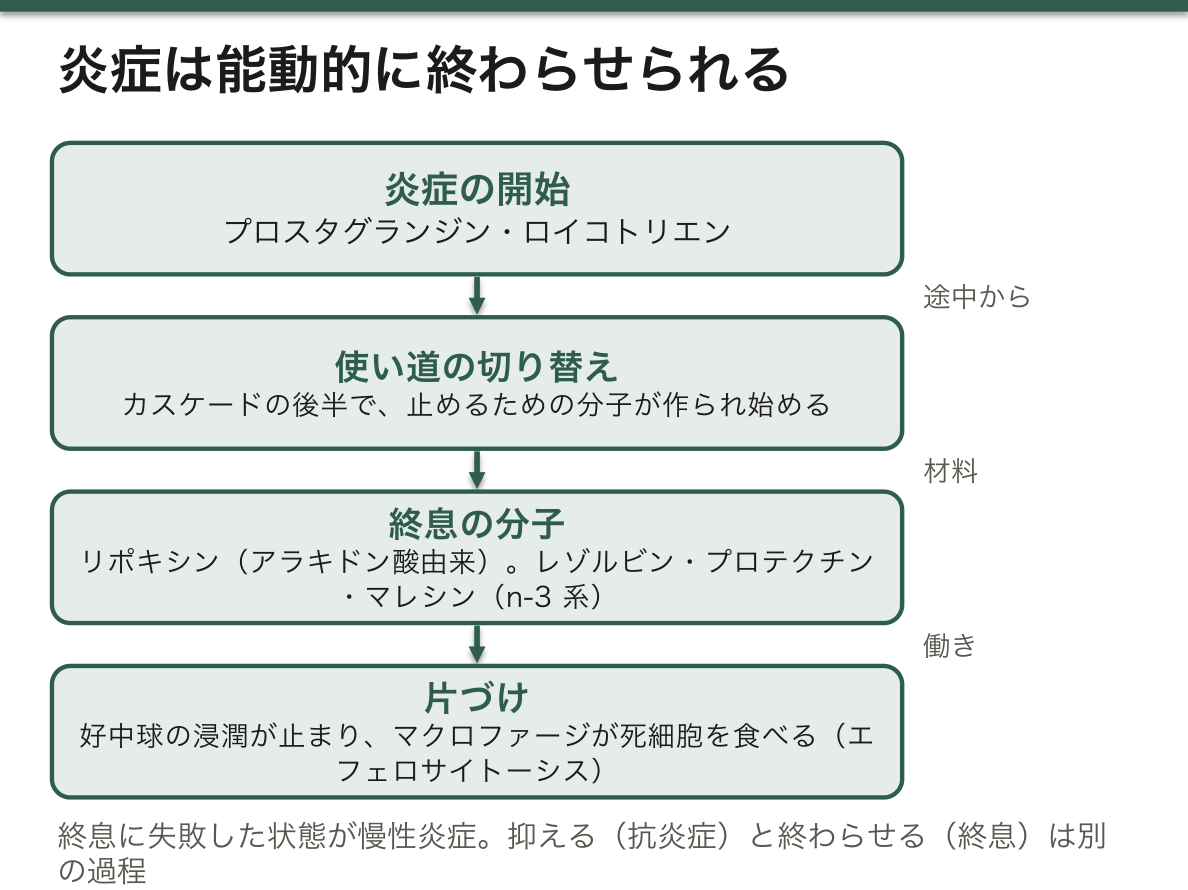
炎症が治まる過程は、刺激が無くなって受動的に鎮まるのではない。止めるための分子が、途中から作られ始める。
アラキドン酸カスケードの後半で、材料の使い道が切り替わる。
- リポキシン——アラキドン酸から作られる。好中球の浸潤を止め、マクロファージによる死細胞の片づけを促す
- レゾルビン・プロテクチン・マレシン——n-3 系脂肪酸(EPA・DHA)から作られる
これらは炎症を抑えるのではなく終わらせる——免疫を弱めずに、片づけを進める方向に働く。「抗炎症」と「炎症の終息」は別の過程であるという理解が近年広がった。
この枠組みが、いくつかの現象を説明する。
アスピリンは、止める側の分子も作らせる。アセチル化された COX-2 はプロスタグランジンを作れなくなるが、そのかわりアスピリン誘導型リポキシンを作り出す。低用量アスピリンの効果が、血小板の抑制だけでは説明しきれないとされる根拠の1つになっている。
終息の失敗が、慢性炎症である。動脈硬化・慢性歯周炎・炎症性腸疾患・線維化では、炎症が始まりすぎているのではなく、終わらないことが問題になっている。だから治療の方向として「終息を助ける」という発想が出てくる。
| n-3 系脂肪酸 | 終息分子の材料になる | 高純度 EPA 製剤が心血管イベントを減らした試験がある一方、試験ごとに結果が割れており、結論は確定していない |
| 強い抗炎症 | 片づけの過程も止めうる | ステロイドや高用量 NSAID が組織の修復を遅らせる場面がある |
アポトーシスした細胞を食べること(エフェロサイトーシス)が終息の中心にある。食べたマクロファージは抗炎症性に転換する。死細胞が片づかない状態が続くと、自己抗原が露出して自己免疫の引き金になる——全身性エリテマトーデスの病態として議論されている。
炎症を「消す」ことだけを目標にしない。治りきらない炎症には、抑える薬を足す以外の考え方がある。
English version
Core
The process by which inflammation settles is not a passive quietening as the stimulus goes. Molecules for stopping it begin to be made partway through.
In the latter half of the arachidonic acid cascade the use of the material switches.
- Lipoxins — made from arachidonic acid. They stop neutrophil infiltration and promote the clearing of dead cells by macrophages.
- Resolvins, protectins, maresins — made from the n-3 fatty acids (EPA, DHA).
These do not suppress inflammation but end it — acting in the direction of advancing the clearance without weakening immunity. The understanding has spread in recent years that "anti-inflammation" and "the resolution of inflammation" are different processes.
Going further
This framework explains several phenomena.
Aspirin also makes the molecules of the stopping side. The acetylated COX-2 can no longer make prostaglandins, but instead it produces aspirin-triggered lipoxins. One of the grounds for holding that the effect of low-dose aspirin cannot be explained wholly by suppression of platelets.
Chronic inflammation is a failure of resolution. In atherosclerosis, chronic periodontitis, inflammatory bowel disease and fibrosis, the problem is not that inflammation begins too much but that it does not end. Hence the idea of "assisting resolution" as a direction of treatment.
| n-3 fatty acids | Are the material of the resolving molecules | A trial of a high-purity EPA preparation reduced cardiovascular events, while the results differ between trials and the conclusion is not settled |
| Strong anti-inflammation | Can stop the clearing process too | There are settings in which steroids or high-dose NSAIDs delay the repair of tissue |
At the centre of resolution is the eating of apoptotic cells (efferocytosis). The macrophage that has eaten converts to an anti-inflammatory state. When dead cells go on unclear, self antigens are exposed and autoimmunity can be triggered — discussed as a mechanism of systemic lupus erythematosus.
In the clinic
Do not make "extinguishing" the inflammation the only goal. For inflammation that will not resolve there are ways of thinking other than adding another suppressive drug.
エイコサノイドは、薬としても使われている
アラキドン酸カスケードは止める側(阻害薬)ばかりが有名だが、産物そのものを薬として投与する使い方も多い。作用は生理的な働きの延長として理解できる。
| PGE1(アルプロスタジル) | 血管を広げる | 閉塞性動脈硬化症。新生児では動脈管を開いたままにする——動脈管依存性心疾患で命綱になる |
| PGE1 誘導体(ミソプロストール) | 胃粘膜を守る/子宮を収縮させる | NSAID 潰瘍の予防。⚠️ 妊婦には禁忌(流産を起こす) |
| PGI2(エポプロステノール) | 強力な血管拡張と血小板抑制 | 肺動脈性肺高血圧症。半減期が数分なので持続静注する |
| PGF2α 誘導体(ラタノプロスト) | 房水の流出を増やす | 緑内障の第一選択。副作用に虹彩の色素沈着・睫毛の伸長 |
| PGE2(ジノプロストン) | 子宮頸管を熟化させる | 分娩誘発 |
受容体を遮る側の薬も、同じ図の上に並ぶ。
- ロイコトリエン受容体拮抗薬(モンテルカスト)——気管支喘息とアレルギー性鼻炎。ロイコトリエンは「遅く出て長く効く気管支収縮物質」なので、発作を止める薬ではなく、起こさせない薬になる
- トロンボキサン合成酵素阻害薬・受容体拮抗薬——喘息・脳血管障害
- 5-リポキシゲナーゼ阻害薬——欧米で喘息に使われる
⚠️ アスピリン喘息(NSAID 過敏喘息)が、この図で最もよく説明できる。COX を止めるとアラキドン酸が余り、リポキシゲナーゼ側へ流れてロイコトリエンが増える。だからアスピリンに限らず、COX-1 を抑える NSAID すべてで起きる——「アスピリンを避ければよい」という理解は危険である。アセトアミノフェン(少量)や選択的 COX-2 阻害薬は比較的安全とされる。
この患者群は鼻茸と慢性副鼻腔炎を合併しやすく、三徴として知られている。ロイコトリエン受容体拮抗薬がよく効くのも、機序から予想がつく。
喘息の患者に鎮痛薬を出すときは、NSAID で発作が出たことがあるかを必ず聞く。市販の風邪薬でも起こりうる。
English version
Core
The arachidonic acid cascade is famous chiefly for the stopping side (the inhibitors), but giving the products themselves as drugs is also common. The actions can be understood as extensions of the physiological ones.
| PGE1 (alprostadil) | Dilates vessels | Peripheral arterial disease. In the newborn it holds the ductus arteriosus open — a lifeline in duct-dependent heart disease |
| A PGE1 analogue (misoprostol) | Protects the gastric mucosa / contracts the uterus | Prevention of NSAID ulcer. ⚠️ Contraindicated in pregnancy (it causes abortion) |
| PGI2 (epoprostenol) | Powerful vasodilatation and platelet inhibition | Pulmonary arterial hypertension. The half-life being minutes, it is given by continuous infusion |
| A PGF2α analogue (latanoprost) | Increases the outflow of aqueous | First choice in glaucoma. Adverse effects: pigmentation of the iris, lengthening of the lashes |
| PGE2 (dinoprostone) | Ripens the cervix | Induction of labour |
Going further
The drugs that block the receptors line up on the same diagram.
- Leukotriene receptor antagonists (montelukast) — bronchial asthma and allergic rhinitis. Leukotrienes are "a bronchoconstrictor released late and acting long", so it is a drug not for stopping an attack but for preventing one.
- Thromboxane synthase inhibitors and receptor antagonists — asthma, cerebrovascular disease.
- 5-Lipoxygenase inhibitors — used for asthma in Europe and America.
⚠️ Aspirin-exacerbated respiratory disease (NSAID-hypersensitive asthma) is best explained on this diagram. Stop COX and the arachidonic acid is left over, flowing to the lipoxygenase side and increasing the leukotrienes. So it happens with every NSAID that suppresses COX-1, not aspirin alone — the understanding that "it is enough to avoid aspirin" is dangerous. Paracetamol (in small doses) and the selective COX-2 inhibitors are held to be relatively safe.
This group of patients often has nasal polyps and chronic sinusitis, known as the triad. That leukotriene receptor antagonists work well can be predicted from the mechanism.
In the clinic
When prescribing an analgesic to an asthmatic patient, always ask whether an NSAID has ever brought on an attack. It can happen with an over-the-counter cold remedy too.
まとめ
| 脂質の分類 — 単純・複合・誘導 | 脂肪酸——炭素数と二重結合で分類する。飽和——パルミチン酸・ステアリン酸一価不飽和——オレイン酸(n-9)多価不飽和——リノール酸(n-6)・α-リノレン酸(n-3)は必須脂肪酸。 |
|---|---|
| エステル結合で組み立てる脂質と、融点の違い — 飽和・シス・トランス | 脂質の多くは、脂肪酸の –COOH とアルコールの –OH の脱水縮合(エステル化)で組み立てられている。 |
| アラキドン酸カスケード — 1枚の図が薬理を支える | 膜リン脂質 →(ホスホリパーゼA₂)→ アラキドン酸 → 2つの道。 |
| NSAIDs は痛む前に飲むほうが効く — 「作らせない薬」と「消す薬」の違い | イブプロフェンなどの NSAIDs は、COX を阻害してこれから作られるプロスタグランジンを止める薬である。 |
| 膜脂質の非対称 — 内側にあるはずの脂質が、外に出ると合図になる | 細胞膜の脂質二重層は、内外で組成が違う。 |
| 必須脂肪酸 — 材料が変われば、作られる産物が変わる | ヒトは炭素9番より先に二重結合を入れられない。 |
| 炎症は、自然に消えるのではなく、能動的に止められている | 炎症が治まる過程は、刺激が無くなって受動的に鎮まるのではない。 |
| エイコサノイドは、薬としても使われている | アラキドン酸カスケードは止める側(阻害薬)ばかりが有名だが、産物そのものを薬として投与する使い方も多い。 |
このノートは医学生が授業の内容を自分の言葉でまとめたもので、診療の判断に使うものではありません。誤りに気づいたらお知らせください。