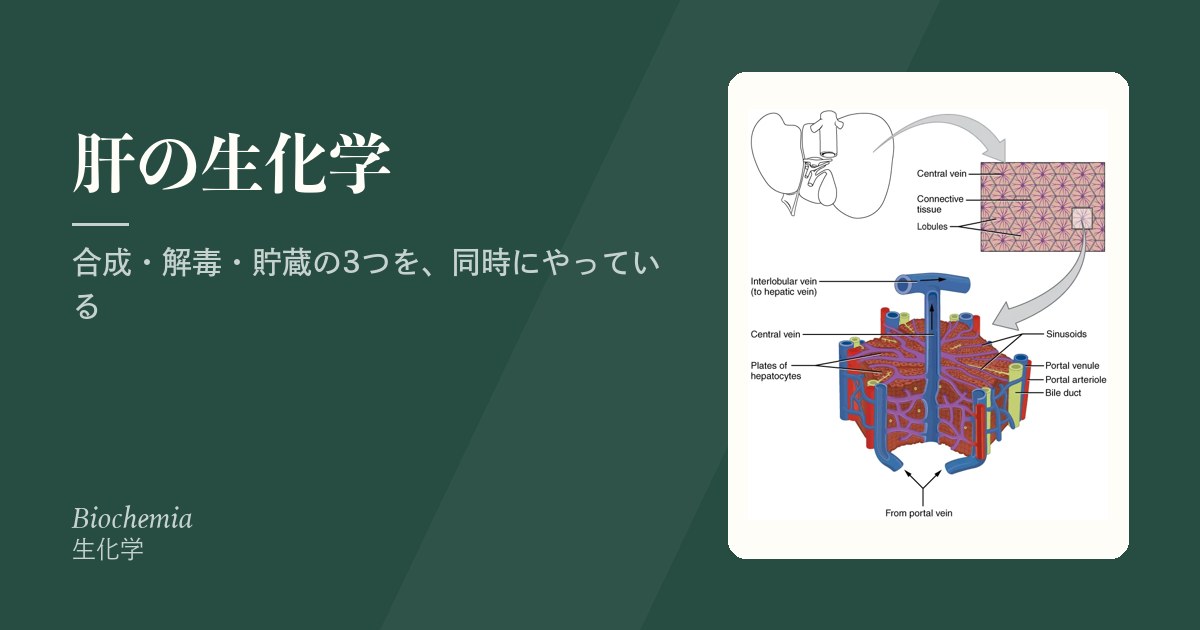
肝は代謝の中央処理装置である。門脈から入る栄養をまず受け取り、全身へ配る形に整える。肝機能検査が多岐にわたるのは、担っている仕事が3系統あるからである。
- 合成——アルブミン・凝固因子・コリンエステラーゼ
- 解毒——アンモニア・ビリルビン・薬物
- 貯蔵と供給——グリコーゲン・脂溶性ビタミン・鉄・銅
- ビリルビン代謝 — 黄疸を3か所で切る
- 肝の貯蔵と、溜まりすぎる金属
- 肝の合成能を測る — アルブミンと凝固因子は、時間の物差しが違う
- 解毒という言葉の中身 — 肝がやっている3つの別々の仕事
- 肝細胞は、小葉のどこにいるかで仕事が違う
- Hy の法則 — 2 つの検査値の組合せが、肝障害の予後を分ける
ビリルビン代謝 — 黄疸を3か所で切る
- 産生:ヘム →(ヘムオキシゲナーゼ)→ ビリベルジン → 間接ビリルビン(脂溶性、アルブミンに結合して運ばれる)
- 抱合:肝でUDPグルクロン酸転移酵素により直接ビリルビン(水溶性)へ
- 排泄:胆汁へ。腸内細菌がウロビリノゲンに変える
| 型 | 優位 | 尿中ビリルビン | 代表 |
|---|---|---|---|
| 肝前性(溶血) | 間接 | 陰性(間接型は尿へ出ない) | 溶血性貧血 |
| 肝性 | 両方 | 陽性 | 肝炎・肝硬変 |
| 肝後性(閉塞) | 直接 | 陽性・灰白色便 | 胆管結石・膵頭部癌 |
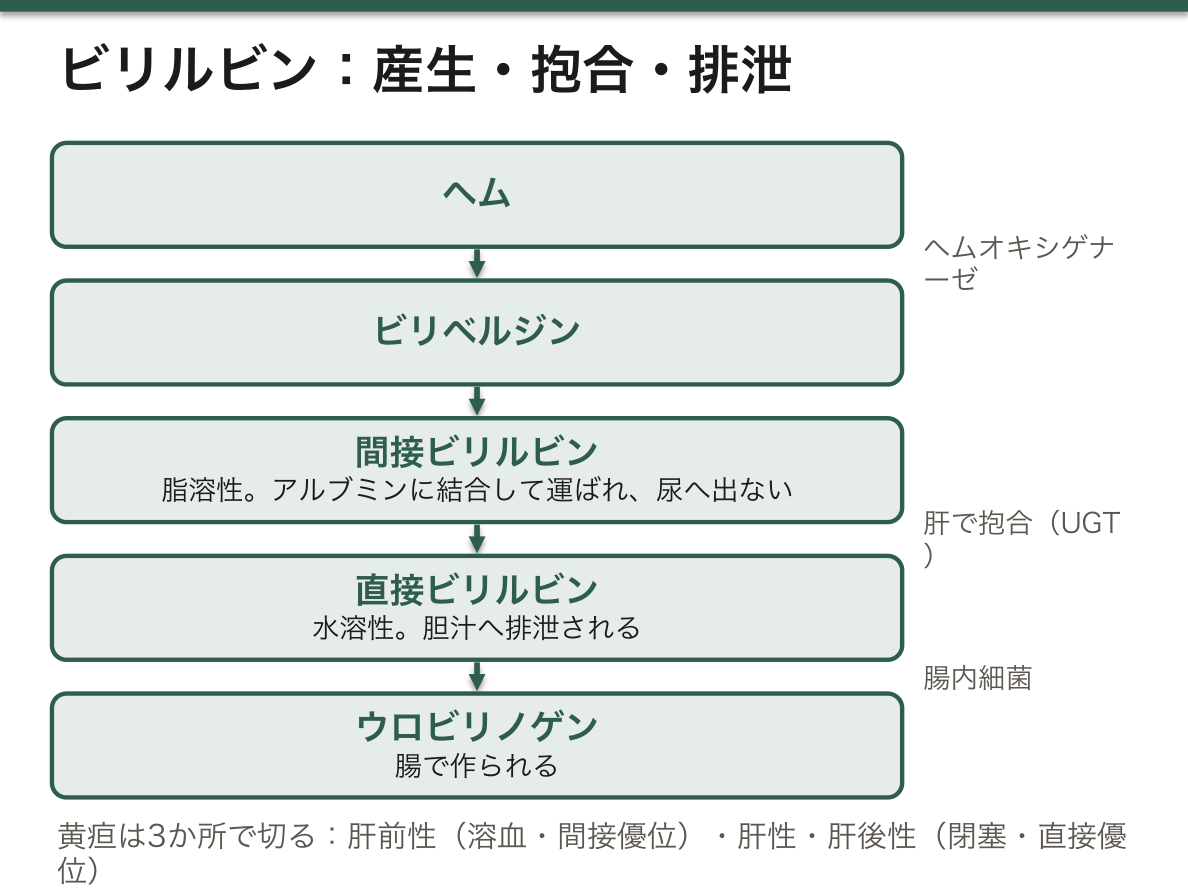
間接ビリルビンが尿に出ない理由を言えるようにしておく。アルブミンと強く結合しているため、糸球体で濾過されない。だから「尿が濃いのに黄疸」なら直接型優位であると、検査の前に見当がつく。
体質性黄疸は4つで、抱合の前か後かで2つずつに分かれる。
| 疾患 | 異常 | 型 | 要点 |
|---|---|---|---|
| Gilbert症候群 | UDPグルクロン酸転移酵素の軽度低下 | 間接 | 人口の数%。絶食・ストレス・感染で悪化。無害 |
| Crigler-Najjar症候群I型 | 同酵素の完全欠損 | 間接 | 核黄疸。フェノバルビタールが効かない |
| II型 | 部分欠損 | 間接 | フェノバルビタールで酵素が誘導され改善する |
| Dubin-Johnson症候群 | 排泄側の輸送体(MRP2) | 直接 | 肝が黒い |
| Rotor症候群 | 取り込み側 | 直接 | 肝は黒くない |
Gilbert症候群は「見つかっても何もしなくてよい」が、知らないと不要な精査を招く。絶食で悪化するという特徴は、術前や検査前の絶食後に黄疸が目立つという形で現れる。
薬物代謝との関わりも重要である。UDPグルクロン酸転移酵素(UGT1A1)はイリノテカンの活性代謝物も抱合する。UGT1A1の多型があると重篤な骨髄抑制と下痢が起きるので、投与前の遺伝子型検査が保険適用になっている。体質性黄疸の遺伝子が、抗癌薬の投与量を決めている。
English version
Core
Production: haem → (haem oxygenase) → biliverdin → indirect bilirubin (lipid-soluble, carried bound to albumin).
Conjugation: in the liver, by UDP-glucuronosyltransferase, to direct bilirubin (water-soluble).
Excretion: into the bile; the gut flora convert it to urobilinogen.
| Type | Predominant | Urinary bilirubin | Typical cause |
|---|---|---|---|
| Prehepatic (haemolysis) | Indirect | Negative (the indirect form does not enter the urine) | Haemolytic anaemia |
| Hepatic | Both | Positive | Hepatitis, cirrhosis |
| Posthepatic (obstruction) | Direct | Positive, with pale stools | Duct stone, carcinoma of the head of the pancreas |
Going further
Be able to say why indirect bilirubin does not appear in the urine: bound tightly to albumin, it is not filtered at the glomerulus. So "dark urine with jaundice" already indicates a direct-predominant picture before the test is done.
The constitutional jaundices are four, two on either side of conjugation.
| Disease | Defect | Type | Point |
|---|---|---|---|
| Gilbert’s syndrome | Mildly reduced transferase | Indirect | A few per cent of the population. Worse with fasting, stress, infection. Harmless |
| Crigler–Najjar type I | Complete absence | Indirect | Kernicterus. Phenobarbital does not work |
| Type II | Partial | Indirect | Improves with phenobarbital, which induces the enzyme |
| Dubin–Johnson | The excretory transporter (MRP2) | Direct | A black liver |
| Rotor | Uptake | Direct | The liver is not black |
Gilbert’s syndrome requires nothing to be done, but not knowing it invites needless investigation. That it worsens with fasting shows itself as jaundice becoming conspicuous after preoperative or pre-test starvation.
Its bearing on drug metabolism matters too. UDP-glucuronosyltransferase (UGT1A1) also conjugates the active metabolite of irinotecan. With a UGT1A1 polymorphism, severe marrow suppression and diarrhoea occur, so genotyping before treatment is reimbursed. The gene of a constitutional jaundice decides the dose of a cytotoxic drug.
肝の貯蔵と、溜まりすぎる金属
肝は鉄と銅の中央倉庫でもある。どちらも必要だが、遊離すると活性酸素を生むため、必ず蛋白に結合させて扱う。
| ヘモクロマトーシス | Wilson病 | |
|---|---|---|
| 金属 | 鉄 | 銅 |
| 遺伝子 | HFE(ヘプシジンが低下) | ATP7B(胆汁への排泄不全) |
| 検査 | トランスフェリン飽和度↑・フェリチン↑ | セルロプラスミン↓・尿中銅↑ |
| 肝以外 | 糖尿病・皮膚色素沈着・心筋症・関節症 | Kayser-Fleischer輪・錐体外路症状・精神症状 |
| 治療 | 瀉血 | D-ペニシラミン・トリエンチン・亜鉛 |
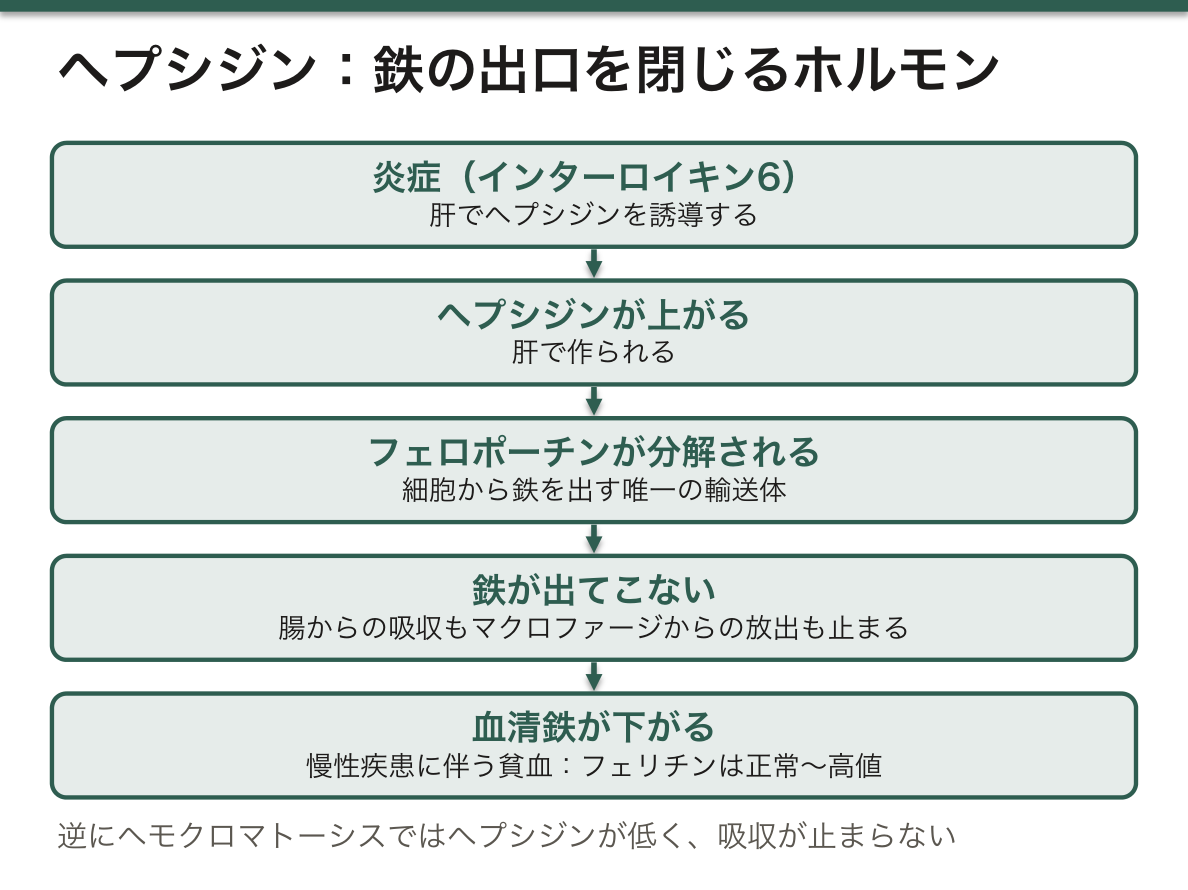
ヘプシジンが鉄代謝の中心であることを押さえると、複数の貧血が1つの図で説明できる。ヘプシジンは肝で作られ、フェロポーチン(細胞から鉄を出す唯一の輸送体)を分解する。
- ヘプシジンが上がる → 腸からの吸収もマクロファージからの放出も止まる → 血清鉄が下がる
- 炎症でインターロイキン6がヘプシジンを誘導する → 慢性疾患に伴う貧血。貯蔵鉄はあるのに使えないので、フェリチンは正常〜高値、血清鉄は低い
- ヘモクロマトーシスではヘプシジンが低い → 吸収が止まらない
- 無効造血ではエリスロフェロンがヘプシジンを抑える → サラセミアの鉄過剰
鉄欠乏性貧血と慢性疾患に伴う貧血の鑑別は、フェリチンが低いか(欠乏)、正常以上か(炎症)で分ける。フェリチンは急性期蛋白でもあるので、炎症があると欠乏を覆い隠す——両者が併存するときが最も難しい。
Wilson病は若年で治療可能な神経疾患であり、見逃してはならない群に入る。
- 40歳未満の原因不明の肝障害、若年の振戦・構音障害・書字障害、説明のつかない精神症状で疑う
- 溶血を伴う急性肝不全——遊離銅が赤血球膜を壊す。アルカリホスファターゼが低いことが手がかりになる
- Kayser-Fleischer輪は細隙灯で見る——肉眼では分からないことが多い
治療は生涯続ける必要があり、中断すると急速に悪化する。「治せる遺伝病」だからこそ、診断の遅れが取り返しのつかない結果になる。
English version
Core
The liver is also the central store of iron and copper. Both are needed, but free they generate reactive oxygen, so they are always handled bound to protein.
| Haemochromatosis | Wilson’s disease | |
|---|---|---|
| Metal | Iron | Copper |
| Gene | HFE (hepcidin falls) | ATP7B (defective biliary excretion) |
| Tests | Transferrin saturation ↑, ferritin ↑ | Caeruloplasmin ↓, urinary copper ↑ |
| Outside the liver | Diabetes, pigmentation, cardiomyopathy, arthropathy | Kayser–Fleischer rings, extrapyramidal and psychiatric symptoms |
| Treatment | Venesection | D-penicillamine, trientine, zinc |
Going further
Fix hepcidin as the centre of iron metabolism and several anaemias can be explained on one diagram. Hepcidin is made in the liver and degrades ferroportin (the only transporter that moves iron out of a cell).
- Hepcidin rises → absorption from the gut and release from macrophages both stop → the serum iron falls.
- Inflammation induces hepcidin through IL-6 → the anaemia of chronic disease. The stored iron is there but unusable, so the ferritin is normal or high while the serum iron is low.
- In haemochromatosis hepcidin is low → absorption does not stop.
- In ineffective erythropoiesis, erythroferrone suppresses hepcidin → the iron overload of thalassaemia.
Iron deficiency and the anaemia of chronic disease are separated by whether the ferritin is low (deficiency) or normal and above (inflammation). Ferritin is also an acute-phase protein, so inflammation masks a deficiency — and the two coexisting is the hardest situation of all.
Wilson’s disease is a treatable neurological disease of the young and belongs to the group that must not be missed.
- Unexplained liver disease under the age of 40; tremor, dysarthria or micrographia in a young person; unexplained psychiatric symptoms.
- Acute liver failure with haemolysis — free copper destroys the red cell membrane. A low alkaline phosphatase is a clue.
- Kayser–Fleischer rings are seen on slit lamp — often not visible to the naked eye.
Treatment must continue for life, and interruption causes rapid deterioration. Precisely because it is a curable genetic disease, delay in diagnosis has irrecoverable consequences.
肝の合成能を測る — アルブミンと凝固因子は、時間の物差しが違う
肝は血漿蛋白のほとんどを作っている(免疫グロブリンを除く)。
| 指標 | 半減期 | 見ているもの |
|---|---|---|
| アルブミン | 約 20 日 | 数週間の経過(慢性) |
| トランスフェリン | 約 7 日 | 中期 |
| プレアルブミン(トランスサイレチン) | 約 2 日 | 短期の栄養状態 |
| 凝固因子(PT) | 数時間〜数日 | 今この時点の合成能(急性) |
だから急性肝不全では PT が先に、慢性肝疾患ではアルブミンが低くなる。
アルブミンは膠質浸透圧の約 8 割を担い、ビリルビン・脂肪酸・カルシウム・薬物を運ぶ。
「半減期が短い蛋白ほど、直近を映す」という一本の原則で全部整理できる。アルブミンは古い記録、PT は今日の記録になる——「同じ肝機能でも、測っている時間の幅が違う」。
だから急性肝不全の定義に PT が入っている。PT-INR 1.5 以上と肝性脳症が、劇症化の判断になる(肝臓が急に止まるときの章)——「アルブミンを待っていては間に合わない」。
低アルブミン血症は、肝以外でも起こる。①作れない(肝・低栄養) ②失う(ネフローゼ・蛋白漏出性胃腸症・熱傷) ③薄まる/炎症で減る(負の急性期蛋白)(糸球体疾患の章)——「低い理由を3つに分けてから、肝の話にする」。
そして薬物動態にも直接効く。フェニトインやワルファリンは蛋白結合率が高いので、アルブミンが低いと遊離型が増えて効きすぎる(血中濃度を測る章)——「総濃度が同じでも、効き方が違う」。
カルシウムの補正も同じ理屈になる(カルシウムの章)——「測っているのは総量なので、運び屋が減れば見かけ上下がる」。
English version
Core
The liver makes almost all the plasma proteins (immunoglobulins excepted).
| Index | Half-life | What it shows |
|---|---|---|
| Albumin | About 20 days | The course of weeks (chronic) |
| Transferrin | About 7 days | Intermediate |
| Prealbumin (transthyretin) | About 2 days | Short-term nutrition |
| Clotting factors (PT) | Hours to days | Synthetic capacity at this moment (acute) |
So in acute liver failure the PT falls first, and in chronic liver disease the albumin.
Albumin provides about 80 per cent of the colloid osmotic pressure and carries bilirubin, fatty acids, calcium and drugs.
Going further
One principle organises it all: the shorter the half-life, the more recent the period it reflects. Albumin is an old record and the PT today’s — the same "liver function" measured over a different span of time.
So the PT enters the definition of acute liver failure. A PT-INR of 1.5 or more with encephalopathy is the criterion of fulminant disease — waiting on the albumin would be too late.
Hypoalbuminaemia occurs outside the liver too. ① cannot be made (liver, malnutrition) ② is lost (nephrotic syndrome, protein-losing enteropathy, burns) ③ is diluted or falls with inflammation (a negative acute-phase protein) — divide the reason into three before turning to the liver.
It also tells directly in pharmacokinetics. Phenytoin and warfarin are highly protein-bound, so with a low albumin the free fraction rises and they act too strongly — the same total concentration acting differently.
The correction of calcium follows the same reasoning — what is measured is the total, so when the carrier falls the value appears to fall.
解毒という言葉の中身 — 肝がやっている3つの別々の仕事
「解毒」は1つの働きではない。少なくとも3つを分けて考える。
| 仕事 | 相手 | やり方 |
|---|---|---|
| ①窒素の処理 | アンモニア | 尿素回路で尿素へ。門脈血から取り除く |
| ②異物の代謝 | 薬・毒物・アルコール | 第I相(酸化)→ 第II相(抱合)で水に溶かす |
| ③内因性物質の処理 | ビリルビン・ホルモン・胆汁酸 | 抱合して胆汁へ捨てる |
3つとも「水に溶けない分子を、溶ける形にして捨てる」という一点で共通する。
門脈血が肝を必ず通ることが、この仕組みの前提になる(初回通過効果)。
だから門脈の血が肝を通らなくなると、3つとも同時に破綻する。門脈大循環シャントでは、腸から来たアンモニアが処理されずに全身へ回る(アンモニアの運搬の章)——「肝細胞が働いていても、素通りされれば意味がない」。
肝性脳症の誘因が「消化管出血」であることも、ここから導ける。血液が腸内で蛋白として分解され、アンモニアの負荷になる(羽ばたき振戦の章)——「出血が、そのまま窒素の食事になっている」。
治療も、この経路のどこを止めるかで整理できる。ラクツロースは大腸を酸性にしてアンモニアをイオン型にし、吸収させずに排出する。リファキシミンは産生する菌そのものを減らす(消化器の薬の章)——「作らせない・吸わせないの2手になる」。
初回通過効果が失われることは、薬の効き方も変える。肝硬変では経口薬の血中濃度が上がり、同じ量でも効きすぎる(薬物動態の章)——「肝が悪い患者では、量ではなく通り道を考える」。
ホルモンの処理が滞ることが、身体所見として現れる。エストロゲンが分解されず、女性化乳房・クモ状血管腫・手掌紅斑が出る——「見た目の所見が、代謝が止まった証拠になっている」。
English version
Core
"Detoxification" is not one function. Distinguish at least three.
| Work | On what | How |
|---|---|---|
| ① Disposal of nitrogen | Ammonia | To urea in the urea cycle. Removed from the portal blood |
| ② Metabolism of xenobiotics | Drugs, poisons, alcohol | Phase I (oxidation) → phase II (conjugation), to make them water-soluble |
| ③ Disposal of endogenous substances | Bilirubin, hormones, bile acids | Conjugated and discarded in the bile |
All three share one point — take a molecule that will not dissolve in water and put it into a form that will, then discard it. That the portal blood must pass through the liver is the premise (the first-pass effect).
Going further
So when the portal blood no longer passes through the liver, all three fail together. In a portosystemic shunt the ammonia from the gut is unprocessed and reaches the systemic circulation — the hepatocytes may be working, but it means nothing if the blood passes them by.
That gastrointestinal bleeding precipitates hepatic encephalopathy follows from this. The blood is broken down as protein in the gut and becomes an ammonia load — a haemorrhage acting as a meal of nitrogen.
The treatment too is organised by where on this route it is blocked. Lactulose acidifies the colon and holds the ammonia in its ionised form so that it is not absorbed and is passed; rifaximin reduces the organisms that make it — two moves: do not make it, do not absorb it.
Losing the first-pass effect also changes how drugs act. In cirrhosis the blood levels of oral drugs rise and the same dose acts too strongly — in a patient with liver disease, think about the route rather than the dose.
Failure to dispose of hormones shows itself as physical signs. Oestrogen is not degraded, giving gynaecomastia, spider naevi and palmar erythema — the appearance itself being evidence that a metabolism has stopped.
肝細胞は、小葉のどこにいるかで仕事が違う
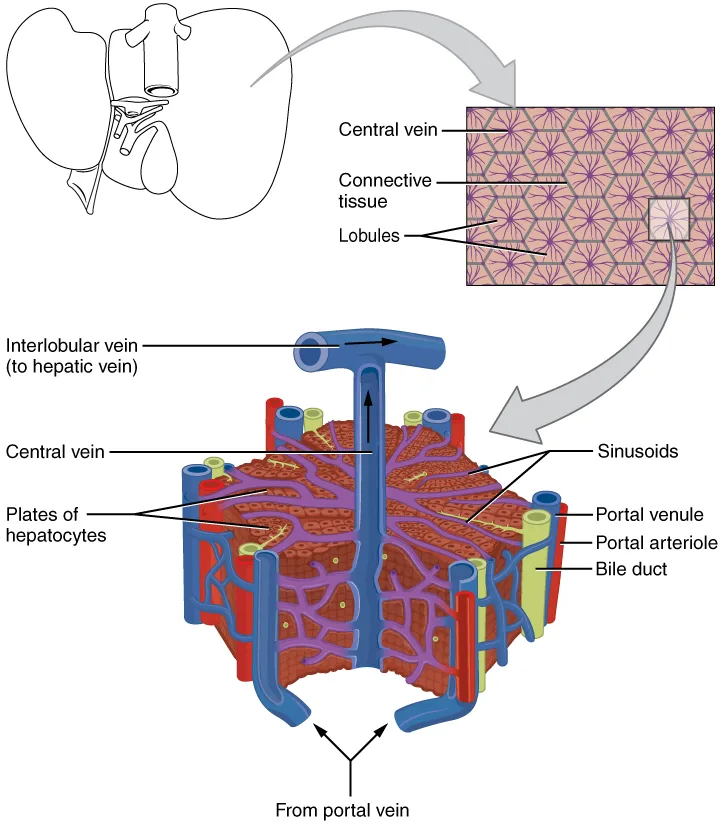
肝細胞は均一ではない。門脈域から中心静脈までの位置によって、持っている酵素が違う。
| 帯 1(門脈域側) | 帯 3(中心静脈側) | |
| 酸素 | 豊富 | 乏しい |
| 主な仕事 | 糖新生・尿素合成・β酸化・胆汁酸の合成 | 解糖・脂肪酸合成・薬物代謝(P450)・グルタミン合成 |
| 性格 | 酸素を使う仕事を割り当てられている | 酸素が要らない仕事と、酸素を使う解毒 |
アンモニアの処理も分業している——帯 1 の尿素回路が大部分を処理し、取りこぼしを帯 3 のグルタミン合成酵素が拾う。低親和性で大量に処理する系の後ろに、高親和性の系を置くという設計である。
この配置が、肝障害のパターンをそのまま決めている。
| 虚血・うっ血 | 帯 3 が壊死する | 最も酸素が届きにくい。ショック肝・うっ血肝(肉ずく肝) |
| アセトアミノフェン中毒 | 帯 3 が壊死する | P450 が帯 3 に多いので、毒性代謝物がそこで作られる |
| アルコール性肝障害 | 帯 3 から始まる | 同じ理由。中心静脈周囲の線維化が初期像になる |
| 黄リン・鉄などの直接毒 | 帯 1 が壊死する | 門脈から入ってすぐ、濃度が最も高い場所 |
「なぜいつも中心静脈のまわりが壊れるのか」に、2 つの独立した理由があるという点が要である——酸素が最も少ないことと、毒を作る酵素が最も多いこと。虚血でも薬物でも同じ場所が壊れるので、組織像だけでは原因を決められない。
肝硬変で門脈大循環シャントができると、血液が肝細胞に触れずに素通りする。帯 1 の尿素回路を通らないのでアンモニアが処理されないし、帯 3 の P450 を通らないので初回通過効果が消えて薬の血中濃度が跳ね上がる。肝性脳症と薬物過量が同時に起きやすいのはこのためである。
肝硬変の患者では、肝で代謝される薬を通常量で出さない。特に鎮静薬・オピオイドは効きすぎて肝性脳症の引き金になる。
English version
Core
Hepatocytes are not uniform. The enzymes they carry differ with their position between portal tract and central vein.
| Zone 1 (portal) | Zone 3 (perivenular) | |
|---|---|---|
| Oxygen | Plentiful | Scarce |
| Chief work | Gluconeogenesis, urea synthesis, β-oxidation, bile acid synthesis | Glycolysis, lipogenesis, drug metabolism (P450), glutamine synthesis |
| Character | Assigned the work that uses oxygen | Work that needs no oxygen, and detoxification that uses it |
The handling of ammonia is divided too — the urea cycle of zone 1 deals with most of it and glutamine synthetase of zone 3 picks up what escapes. A high-capacity, low-affinity system with a high-affinity system placed behind it.
Going further
This arrangement decides the pattern of liver injury directly.
| Cause | Where it necroses | Why |
|---|---|---|
| Ischaemia, congestion | Zone 3 | Oxygen reaches it least. Shock liver, congestive (nutmeg) liver |
| Paracetamol | Zone 3 | P450 is concentrated there, so the toxic metabolite is made there |
| Alcoholic injury | Begins in zone 3 | The same reason. Perivenular fibrosis is the early picture |
| Direct poisons (yellow phosphorus, iron) | Zone 1 | Just after entry from the portal vein, where the concentration is highest |
The point is that "why is it always around the central vein?" has two independent answers — that is where the oxygen is least and where the enzymes that make the poison are most. Ischaemia and drugs destroy the same place, so the histology alone cannot settle the cause.
When a portosystemic shunt forms in cirrhosis, the blood passes without touching the hepatocytes. Not passing the urea cycle of zone 1, the ammonia is unprocessed; not passing the P450 of zone 3, the first-pass effect disappears and drug levels leap. Hence hepatic encephalopathy and drug overdose readily occur together.
In the clinic
In a patient with cirrhosis, do not prescribe at usual doses a drug metabolised by the liver. Sedatives and opioids in particular act too strongly and trigger encephalopathy.
Hy の法則 — 2 つの検査値の組合せが、肝障害の予後を分ける
薬で肝の数値が上がることは珍しくない。大半は薬を止めれば戻る。問題は、そのうちどれが致死的になるかを見分けることである。
その物差しが Hy の法則で、次の3つが揃ったときに危険と判定する。
- ALT(または AST)が基準上限の 3 倍を超える——肝細胞が壊れている
- 総ビリルビンが基準上限の 2 倍を超える——処理する能力が追いつかなくなっている
- ALP の上昇が目立たない——胆道の閉塞では説明できない
この組合せが出た薬では、およそ 10% が死亡または肝移植に至ると経験的に知られている。医薬品の承認審査でも使われる基準である。
なぜビリルビンの上昇が決定的なのか。肝には大きな予備能があり、ビリルビンを処理する能力が尽きるのは、かなりの割合の肝細胞が失われた後である。酵素の上昇は「壊れた細胞の数」を映すが、ビリルビンは「残った肝の働き」を映す。逸脱酵素と機能検査は、まったく別のことを言っている。
| 逸脱酵素 | AST・ALT・LDH | 細胞が壊れた量。高いほど重症とは限らない |
| 機能(合成) | PT-INR・アルブミン | 残った肝の働き。予後を決めるのはこちら |
| 機能(排泄) | ビリルビン | 同上 |
⚠️ 劇症化の最中は、ALT がむしろ下がる。壊れる肝細胞が残っていないためで、「数値が改善した」と読み違えてはならない。同時に PT-INR が延び、ビリルビンが上がっていれば、事態は悪化している。
障害の型は R 値で分ける(ALT の上昇倍率 ÷ ALP の上昇倍率)。5 以上なら肝細胞型・2 以下なら胆汁うっ滞型・あいだは混合型。型によって被疑薬の候補も、経過の長さも変わる(胆汁うっ滞型は治るまで数か月かかる)。
薬物性肝障害には2つの型があり、時間の予測できるかどうかが違う。
- 用量依存性——量が多ければ誰でも起きる。予測できる(アセトアミノフェン)
- 特異体質性——用量と関係なく、まれに、遅れて起きる。予測できない。HLA の型が関与することが分かってきている
肝障害の重症度を尋ねられたら、AST・ALT ではなく PT-INR とビリルビンと意識状態を答える。移植の適応もこの3つで判断されている。
English version
Core
It is not unusual for a drug to raise the liver enzymes, and most resolve when the drug is stopped. The problem is telling which of them will be fatal. The measure is Hy’s law, judging it dangerous when three things are present together.
- ALT (or AST) above three times the upper limit — hepatocytes are being destroyed.
- Total bilirubin above twice the upper limit — the capacity to process is not keeping up.
- No conspicuous rise in ALP — it cannot be explained by biliary obstruction.
Empirically, about 10 per cent of cases in which a drug produces this combination die or come to transplantation. It is a criterion used in the licensing of medicines.
Going further
Why is the rise in bilirubin decisive? The liver has a large reserve, and the capacity to handle bilirubin is exhausted only after a considerable proportion of hepatocytes has been lost. A rise in enzymes reflects the number of cells destroyed; the bilirubin reflects the work the remaining liver can do. Leakage enzymes and function tests say quite different things.
| Tests | What they mean | |
|---|---|---|
| Leakage enzymes | AST, ALT, LDH | How many cells have been destroyed. High does not always mean severe |
| Function (synthesis) | PT-INR, albumin | What the remaining liver can do. These decide the prognosis |
| Function (excretion) | Bilirubin | The same |
⚠️ During fulminant deterioration the ALT actually falls, there being no hepatocytes left to be destroyed. Do not misread it as improvement. If the PT-INR is lengthening and the bilirubin rising at the same time, the situation is worsening.
The pattern is classified by the R value (fold rise in ALT ÷ fold rise in ALP): 5 or more = hepatocellular, 2 or less = cholestatic, between = mixed. The pattern changes both the list of suspect drugs and the length of the course (the cholestatic type takes months to resolve).
Drug-induced liver injury has two forms, differing in whether they can be predicted.
- Dose-dependent — enough of it does it to anybody. Predictable (paracetamol).
- Idiosyncratic — unrelated to dose, rare and delayed. Unpredictable. HLA type is now known to be involved.
In the clinic
Asked about the severity of a liver injury, answer with the PT-INR, the bilirubin and the state of consciousness, not the AST and ALT. The indication for transplantation is judged on those three.
まとめ
| ビリルビン代謝 — 黄疸を3か所で切る | 産生:ヘム →(ヘムオキシゲナーゼ)→ ビリベルジン → 間接ビリルビン(脂溶性、アルブミンに結合して運ばれる)抱合:肝でUDPグルクロン酸転移酵素により直接ビリルビン(水溶性)へ… |
|---|---|
| 肝の貯蔵と、溜まりすぎる金属 | 肝は鉄と銅の中央倉庫でもある。どちらも必要だが、遊離すると活性酸素を生むため、必ず蛋白に結合させて扱う。 |
| 肝の合成能を測る — アルブミンと凝固因子は、時間の物差しが違う | 肝は血漿蛋白のほとんどを作っている(免疫グロブリンを除く)。 |
| 解毒という言葉の中身 — 肝がやっている3つの別々の仕事 | 「解毒」は1つの働きではない。少なくとも3つを分けて考える。 |
| 肝細胞は、小葉のどこにいるかで仕事が違う | 肝細胞は均一ではない。門脈域から中心静脈までの位置によって、持っている酵素が違う。 |
| Hy の法則 — 2 つの検査値の組合せが、肝障害の予後を分ける | 薬で肝の数値が上がることは珍しくない。大半は薬を止めれば戻る。 |
このノートは医学生が授業の内容を自分の言葉でまとめたもので、診療の判断に使うものではありません。誤りに気づいたらお知らせください。